
Differences in DNA 1 Heterochromatin vs Euchromatin Heterochromatin
- Slides: 19
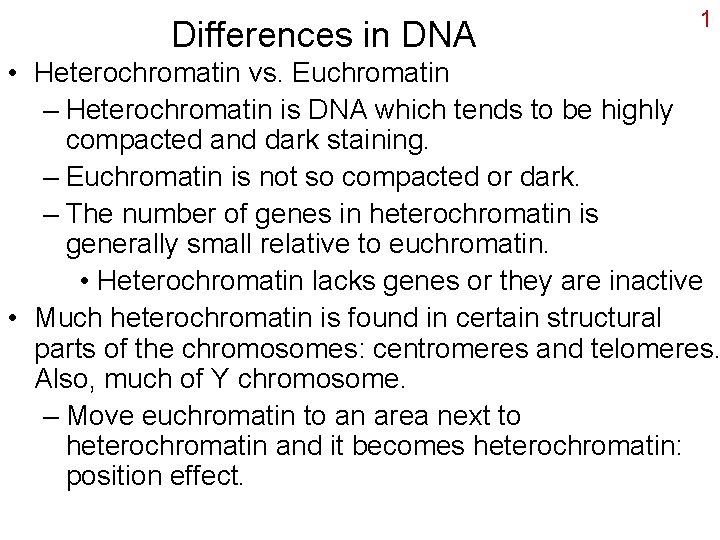
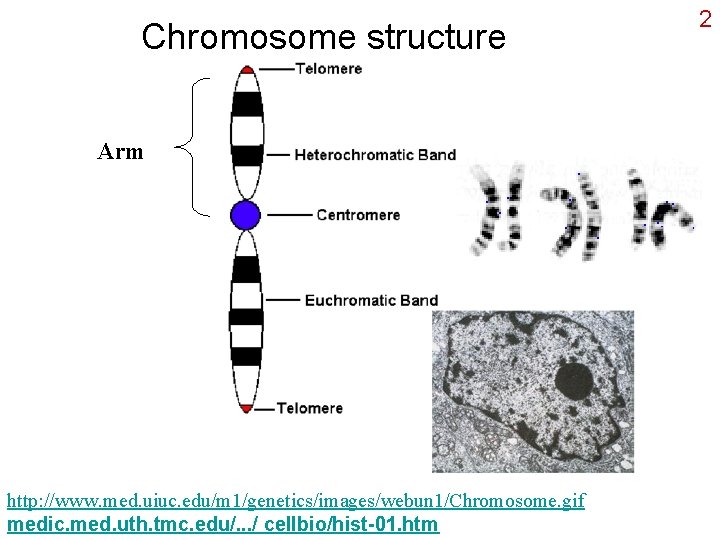
Differences in DNA 1 • Heterochromatin vs. Euchromatin – Heterochromatin is DNA which tends to be highly compacted and dark staining. – Euchromatin is not so compacted or dark. – The number of genes in heterochromatin is generally small relative to euchromatin. • Heterochromatin lacks genes or they are inactive • Much heterochromatin is found in certain structural parts of the chromosomes: centromeres and telomeres. Also, much of Y chromosome. – Move euchromatin to an area next to heterochromatin and it becomes heterochromatin: position effect.
Chromosome structure Arm http: //www. med. uiuc. edu/m 1/genetics/images/webun 1/Chromosome. gif medic. med. uth. tmc. edu/. . . / cellbio/hist-01. htm 2
More on Differences in DNA 3 • Base sequences are obviously different from one organism to another, but overall DNA composition can differ as well. • In most eukaryotic organisms, DNA composition is not uniform across all the DNA in the cell: patches within the same cell where DNA composition is distinct from other regions.
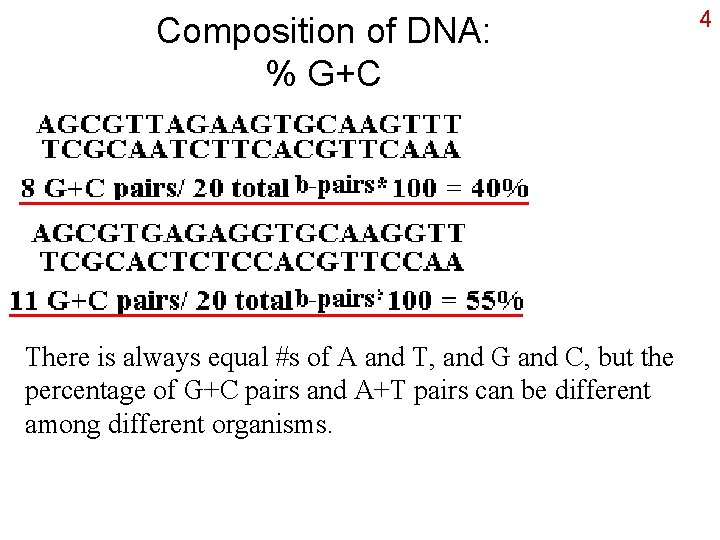
Composition of DNA: % G+C There is always equal #s of A and T, and G and C, but the percentage of G+C pairs and A+T pairs can be different among different organisms. 4
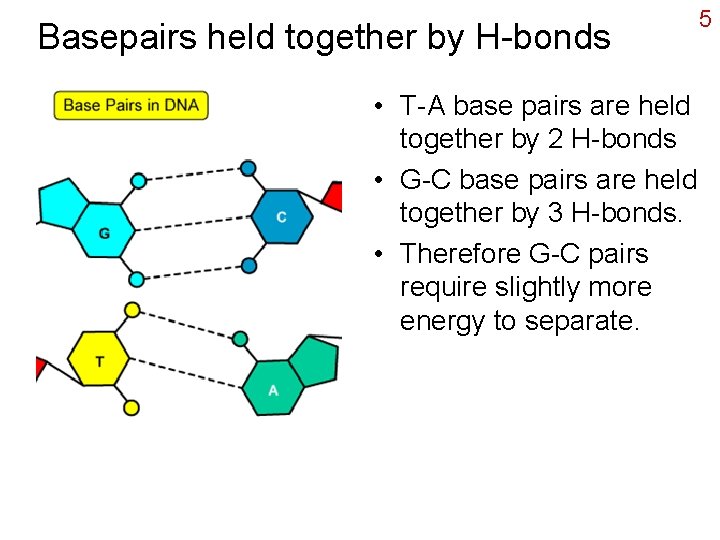
Basepairs held together by H-bonds • T-A base pairs are held together by 2 H-bonds • G-C base pairs are held together by 3 H-bonds. • Therefore G-C pairs require slightly more energy to separate. 5
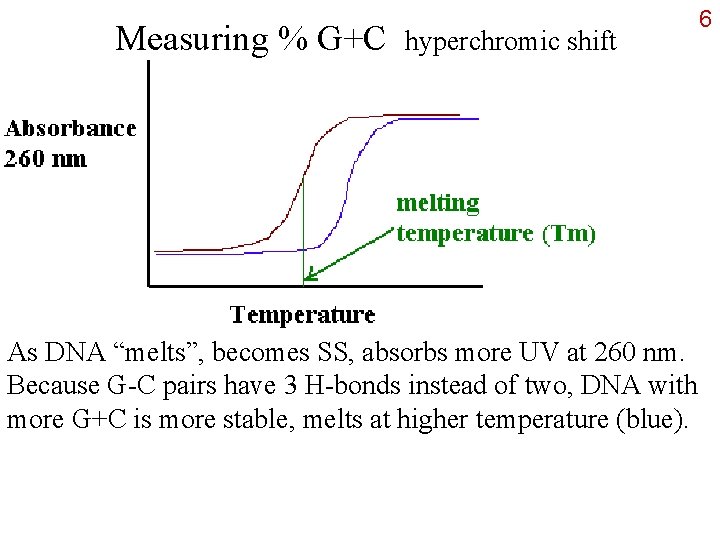
Measuring % G+C hyperchromic shift As DNA “melts”, becomes SS, absorbs more UV at 260 nm. Because G-C pairs have 3 H-bonds instead of two, DNA with more G+C is more stable, melts at higher temperature (blue). 6
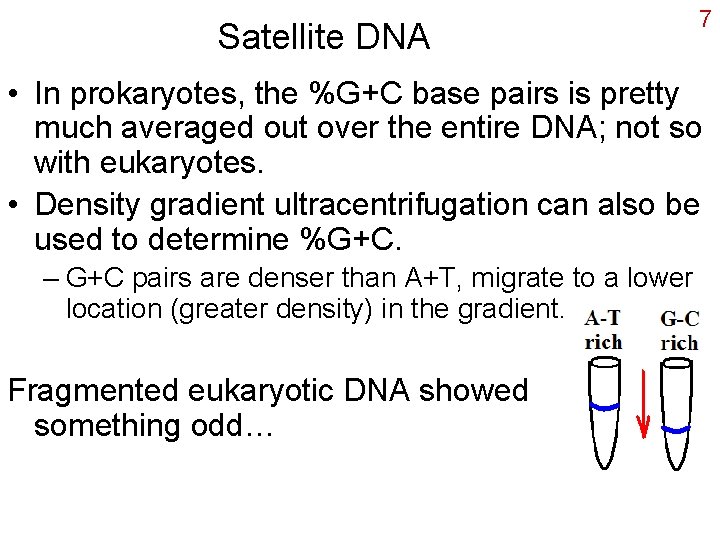
Satellite DNA 7 • In prokaryotes, the %G+C base pairs is pretty much averaged out over the entire DNA; not so with eukaryotes. • Density gradient ultracentrifugation can also be used to determine %G+C. – G+C pairs are denser than A+T, migrate to a lower location (greater density) in the gradient. Fragmented eukaryotic DNA showed something odd…
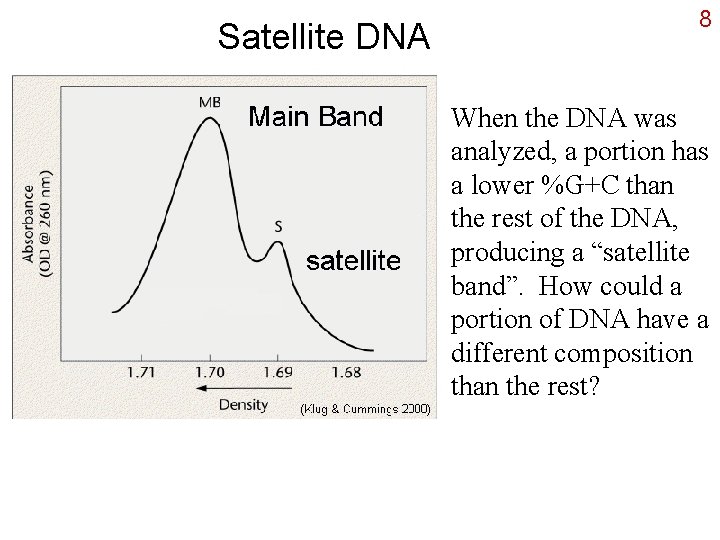
Satellite DNA 8 When the DNA was analyzed, a portion has a lower %G+C than the rest of the DNA, producing a “satellite band”. How could a portion of DNA have a different composition than the rest?
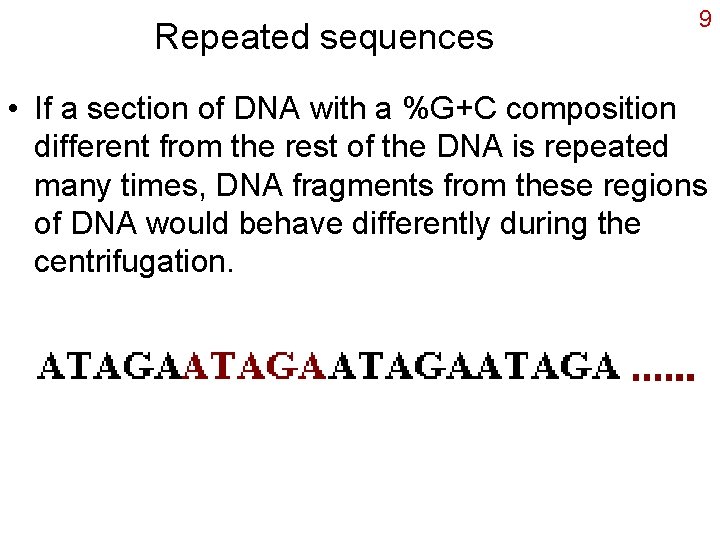
Repeated sequences 9 • If a section of DNA with a %G+C composition different from the rest of the DNA is repeated many times, DNA fragments from these regions of DNA would behave differently during the centrifugation.
Study of the Composition of DNA using DNA renaturation kinetics 10 • Break DNA into random fragments. • Denature with heat (melt). • Cool, allow strands to find their complements and go from ss to ds again (anneal/renature). • Follow entire process using UV light absorption at 260 nm – as DNA goes from ss to ds, Abs decreases.
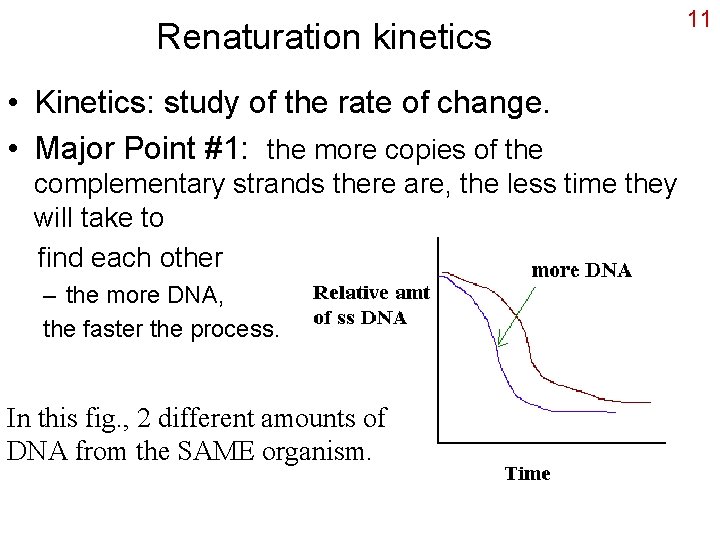
Renaturation kinetics • Kinetics: study of the rate of change. • Major Point #1: the more copies of the complementary strands there are, the less time they will take to find each other – the more DNA, the faster the process. In this fig. , 2 different amounts of DNA from the SAME organism. 11
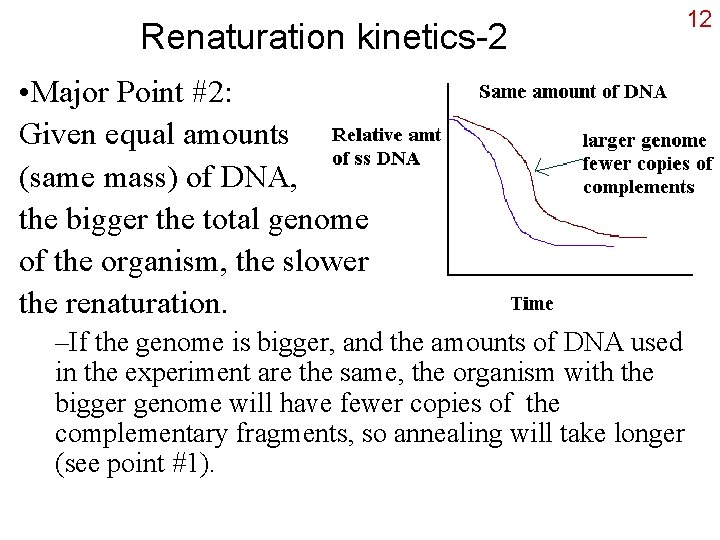
Renaturation kinetics-2 • Major Point #2: Given equal amounts (same mass) of DNA, the bigger the total genome of the organism, the slower the renaturation. –If the genome is bigger, and the amounts of DNA used in the experiment are the same, the organism with the bigger genome will have fewer copies of the complementary fragments, so annealing will take longer (see point #1). 12
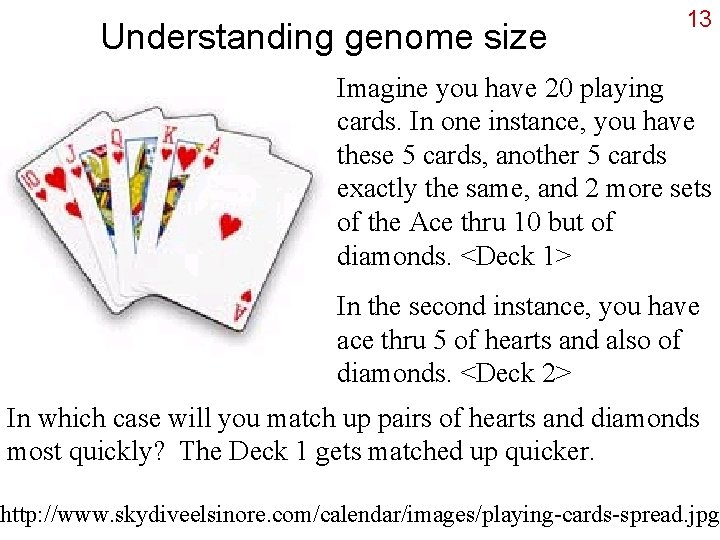
Understanding genome size 13 Imagine you have 20 playing cards. In one instance, you have these 5 cards, another 5 cards exactly the same, and 2 more sets of the Ace thru 10 but of diamonds. <Deck 1> In the second instance, you have ace thru 5 of hearts and also of diamonds. <Deck 2> In which case will you match up pairs of hearts and diamonds most quickly? The Deck 1 gets matched up quicker. http: //www. skydiveelsinore. com/calendar/images/playing-cards-spread. jpg
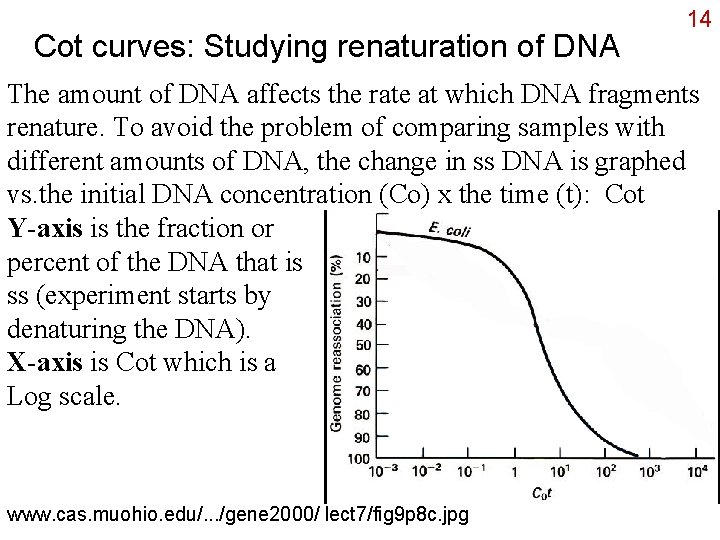
Cot curves: Studying renaturation of DNA 14 The amount of DNA affects the rate at which DNA fragments renature. To avoid the problem of comparing samples with different amounts of DNA, the change in ss DNA is graphed vs. the initial DNA concentration (Co) x the time (t): Cot Y-axis is the fraction or percent of the DNA that is ss (experiment starts by denaturing the DNA). X-axis is Cot which is a Log scale. www. cas. muohio. edu/. . . /gene 2000/ lect 7/fig 9 p 8 c. jpg
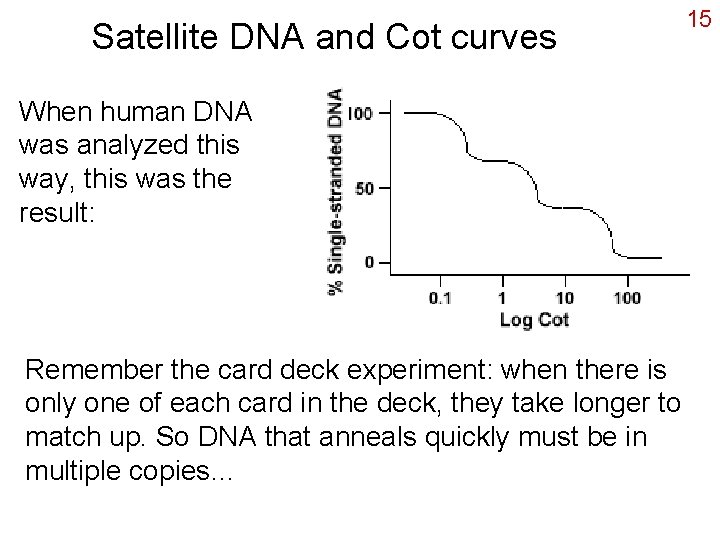
Satellite DNA and Cot curves When human DNA was analyzed this way, this was the result: Remember the card deck experiment: when there is only one of each card in the deck, they take longer to match up. So DNA that anneals quickly must be in multiple copies… 15
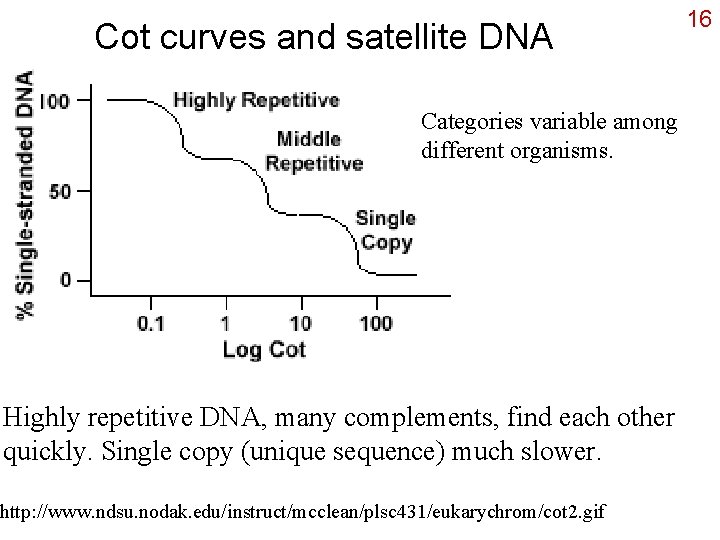
Cot curves and satellite DNA Categories variable among different organisms. Highly repetitive DNA, many complements, find each other quickly. Single copy (unique sequence) much slower. http: //www. ndsu. nodak. edu/instruct/mcclean/plsc 431/eukarychrom/cot 2. gif 16
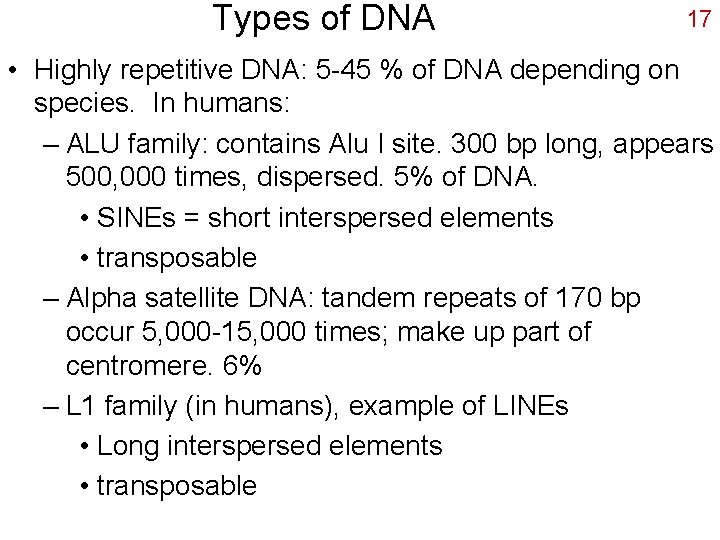
Types of DNA 17 • Highly repetitive DNA: 5 -45 % of DNA depending on species. In humans: – ALU family: contains Alu I site. 300 bp long, appears 500, 000 times, dispersed. 5% of DNA. • SINEs = short interspersed elements • transposable – Alpha satellite DNA: tandem repeats of 170 bp occur 5, 000 -15, 000 times; make up part of centromere. 6% – L 1 family (in humans), example of LINEs • Long interspersed elements • transposable
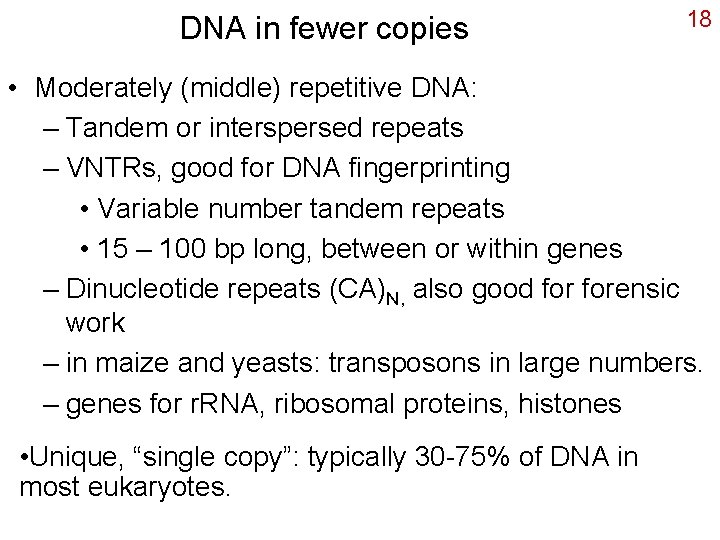
DNA in fewer copies 18 • Moderately (middle) repetitive DNA: – Tandem or interspersed repeats – VNTRs, good for DNA fingerprinting • Variable number tandem repeats • 15 – 100 bp long, between or within genes – Dinucleotide repeats (CA)N, also good forensic work – in maize and yeasts: transposons in large numbers. – genes for r. RNA, ribosomal proteins, histones • Unique, “single copy”: typically 30 -75% of DNA in most eukaryotes.
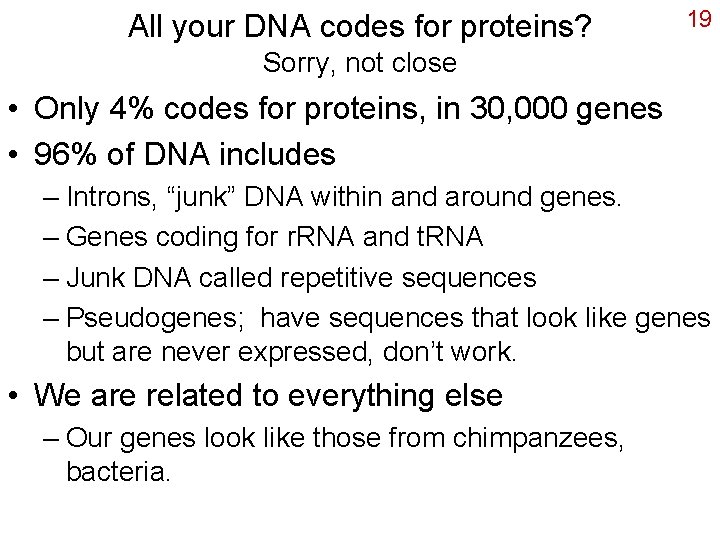
All your DNA codes for proteins? 19 Sorry, not close • Only 4% codes for proteins, in 30, 000 genes • 96% of DNA includes – Introns, “junk” DNA within and around genes. – Genes coding for r. RNA and t. RNA – Junk DNA called repetitive sequences – Pseudogenes; have sequences that look like genes but are never expressed, don’t work. • We are related to everything else – Our genes look like those from chimpanzees, bacteria.