
Differences Between European and African Honey Bees African

Differences Between European and African Honey Bees African honey bees and European honey bees are the same species (Apis mellifera), but the two are classified as different sub-species. European honey bees were first introduced to the Americas in the 1500 s by European explorers. For centuries, European honey bees have been selected by beekeepers for their robust honey production and storage behavior, their reduced regular swarming (colony splitting) tendencies, and their gentleness. The African honey bee (Apis mellifera scutellata) was brought to Brazil in the 1950 s in an effort to increase honey production. However, 16 queens were accidentally released and thrived in Brazil's native environment. Since then, African bees have spread throughout South America, Central America, and into the United States. The African honey bee is considerably more defensive than its European cousin. Consequently, it is important to understand key differences between the aggressive African bee and the docile European honey bee. Please note, the term "Africanized" is generally applied to any progeny resulting from matings between European and African bees. Figure 1. European honey bees only send out 10 -20 guard bees when disturbed. Credit: Ian Mc. Guire Hive Defense and Stinging Unlike wasps and hornets, honey bees can only sting once, and will die shortly afterward. Stinging is often a last resort in hive defense. The venom of the African honey bee is no more potent than that of the European honey bee. For a fatality to occur from venom toxicity, it normally would take about 10 stings per pound of body weight, from either a African or European honey bee. The main difference between the European and African honey bee is its defense response; an African honey bee colony, if disturbed, will send more guard bees to sting, and will pursue for a longer distance and stay agitated for a longer period of time, than a European honey bee. Swarming and Absconding Swarming is a natural occurrence when the colony gets too large and resources are abundant. The colony rears a new queen and the hive splits. Absconding occurs when resources are scarce or there is a threat to the hive. The entire colony will abandon the hive for a new location. Figure 2. An Africanized bee colony will send out hundreds of guard bees when disturbed. Credit: Ian Mc. Guire Figure 3. A swarm of African honey bees. Credit: W. H. Kern, Jr. , UF/IFAS Selection of Nesting Site Because Africanized honey bees swarm more often, fewer individuals are involved in each swarm, meaning they do not require a large cavity to build a nest. Africanized bees are often discovered in water meter boxes (Figure 4) and other man-made cavities, whereas European honey bees need a larger volume nesting site, and tend to nest in hollowed tree cavities (Figure 5). If You Are Attacked Run away or get indoors as fast as possible if you are attacked. Never stand in one spot and swat because this only aggravates bees further and increases the number of stings you may receive. Be aware that bees may follow you for hundreds of yards. Do not stop running to hide yourself under water or in leaves, brush or a crevice because bees are likely to find you and inflict numerous stings. The single most important thing is to get away from the colony! Information reproduced from “Differences Between European and African Honey Bees” by M. K. O'Malley, Extension assistant, J. D. Ellis, associate professor, and C. M. Zettel Nalen, Extension assistant, Entomology and Nematology Department, UF/IFAS Extension, Gainesville, FL 32611. Figure 4. A water meter box where a previous African honey bee colony had been nesting. Credit: UF/IFAS Honey Bee Research and Extension Laboratory Figure 5. A large hollow tree cavity suitable for a European honey bee nest. Credit: UF/IFAS Honey Bee Research and Extension Laboratory Figure 6. Exposed two month old African honey bee colony on tree branches. Credit: W. H. Kern, Jr. , UF/IFAS)
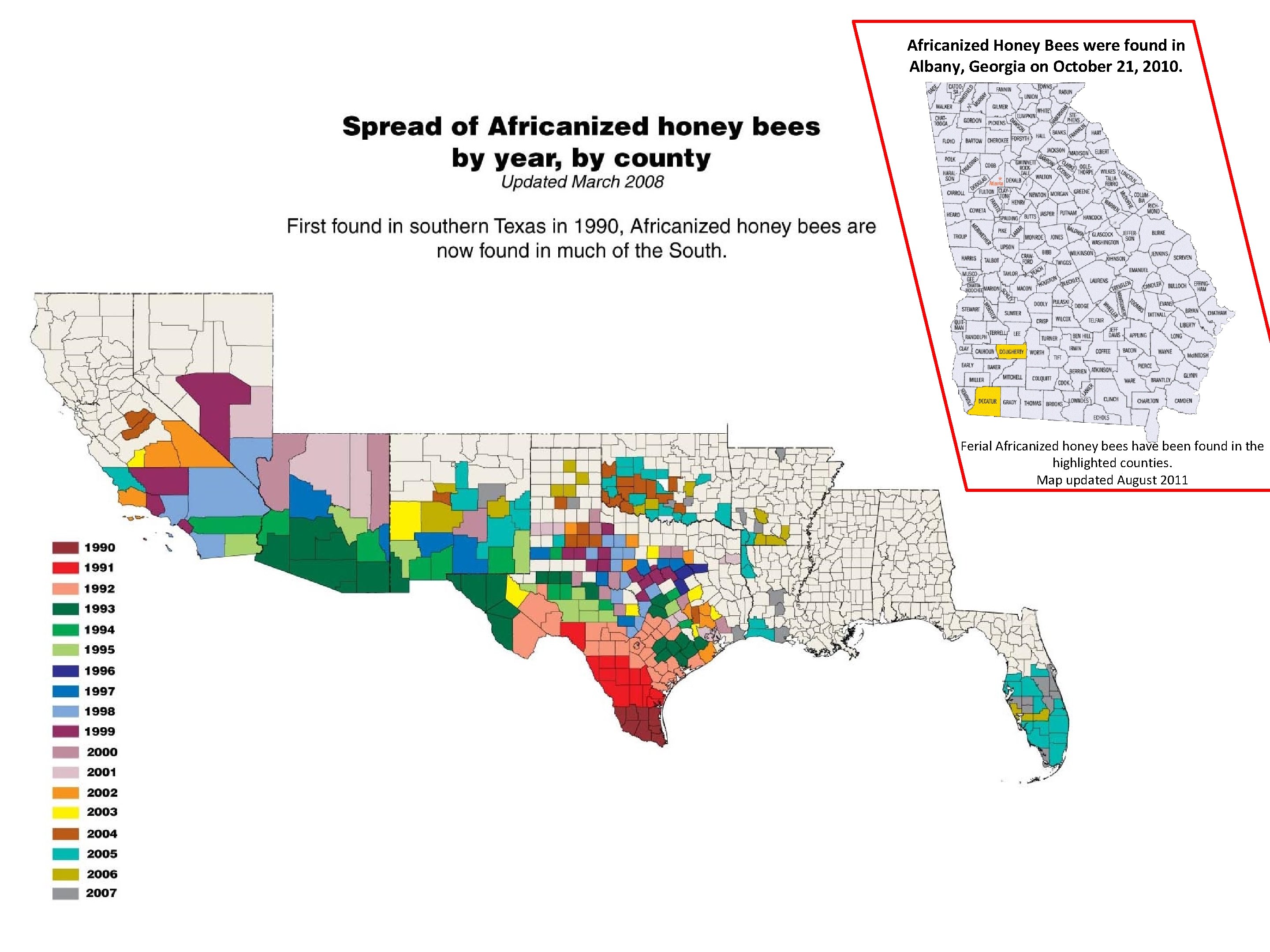
Africanized Honey Bees were found in Albany, Georgia on October 21, 2010. Ferial Africanized honey bees have been found in the highlighted counties. Map updated August 2011
- Slides: 2