
Difference Language and Resistance Audre Lorde and bell
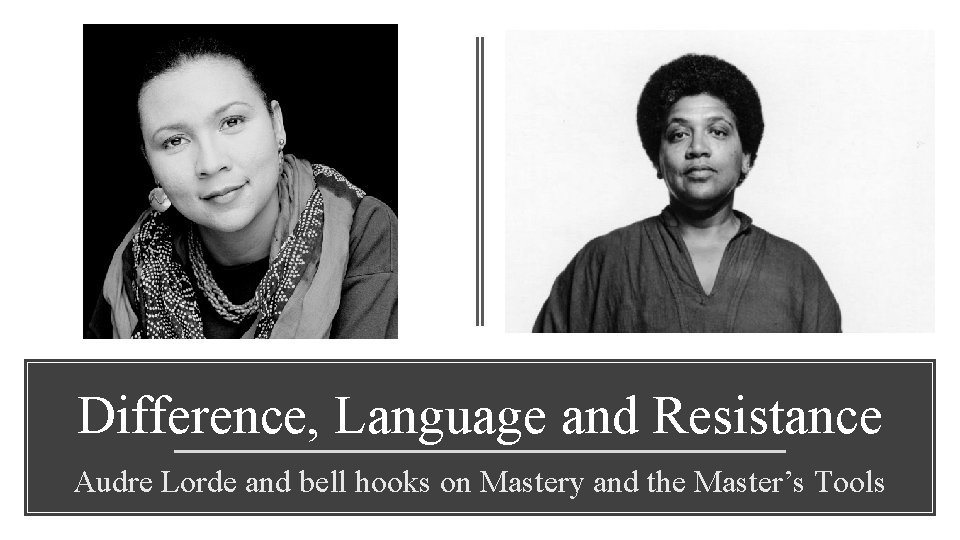
Difference, Language and Resistance Audre Lorde and bell hooks on Mastery and the Master’s Tools
Audre Lorde, “The Master’s Tools will Never Dismantle the Master’s House” “Advocating the mere tolerance of difference between women is the grossest reformism. It is a total denial of the creative function of difference in our lives. Difference must be not merely tolerated, but seen as a fund of necessary polarities between which our creativity can spark like a dialectic. Only then does the necessity for interdependence become unthreatening. Only within that interdependency of different strengths, acknowledged and equal, can the power to seek new ways of being in the world generate, as well as the courage and sustenance to act where there are not charters” (147).
Audre Lorde’s Epistemology of Interdependence in Difference “For women, the need and desire to nurture each other is not pathological but redemptive, and it is within that knowledge that our real power I rediscovered. It is this real connection which is so feared by a patriarchal world. Only within a patriarchal structure is maternity the only power open to women. Interdependency between women is the way to a freedom which allows the I to be, not in order to be used, but in order to be creative. This is a difference between the passive be and the active being” (147).
Women and Difference In Lorde’s text ‘women’ are a minority group that is internally divided and thus less powerful in claiming rights from a dominant majority group: “As women, we have been taught either to ignore our differences, or to view them as causes for separation and suspicion rather than as forces for change. Without community there is no liberation, only the most vulnerable and temporary armistice between an individual and her oppression. But community must not mean a shedding of our differences, nor the pathetic pretense that these differences do not exist” (148).
Black Women and White Feminism Audre Lorde is speaking to a group of feminists who have not oriented themselves properly toward difference. To clarify the problem Lorde makes the analogy between White Feminism and patriarchy below: “Women of today are still being called upon to stretch across the gap of male ignorance and to educate men as to our existence and our needs. This is an old and primary tool of all oppressors to keep the oppressed occupied with the master’s concerns. Now we hear it is the task of women of Color to educate white women – in the face of tremendous resistance – as to our existence, our differences, our relative roles in our joint survival. This is a diversion of energies and a tragic repetition of racist patriarchal thought” (148).
bell hooks, “Language Teaching: New Worlds/New Words” “Like desire, language disrupts, refuses to be contained within boundaries. (. . . ) Words impose themselves, take root in our memory against our will. ” “This is the oppressors language yet I need it to talk to you. ” “Reflecting on Adrienne Rich’s words, I know that it is not the English language that hurts me, but what the oppressors do with it, how they shape it to become a territory that limits and defines, how they make it a weapon that can shame, humiliate, colonize” (143).
“We know that in the past, university faculty also tended to remain tightly wedged in “ethnic enclaves” that favored one “standard” of writing, one type of English. In the 1870’s and 1880’s, U. S. private colleges, according to W. Bruce Leslie in Gentlemen and Scholars: College and Community in the “Age of the University, ” 1865 -1917, were comprised almost exclusively of Protestants of northeastern European ancestry; “other groups remained outside the pale” (241). In fact, in “Mechanical Correctness as a Focus in Composition Instruction, ” Robert J. Connors argues that the emphasis in English classes on proper usage and grammatical correctness arose from the Eastern U. S. reaction against the “roughness” of frontier America (63). In other words, then, as now, response to linguistic diversity led to a shoring up of “academic” language. ” from “Stocking the Bodega: Towards a New Writing Center Paradigm” by Nancy Effinger Wilson
“To recognize that we touch one another in language seems particularly difficult in a society that would have us believe that there is no dignity in the experience of passion, that to feel deeply is to be inferior, for within the dualism of Western metaphysical thought, ideas are always more important than language. To heal the splitting of mind and body, we marginalized and oppressed people attempt to recover ourselves and our experience in language. We seek to make a place for intimacy. (. . . ) we make English do what we want it to do. We take the oppressor’s language and turn it against itself. We make our words a counter-hegemonic speech, liberating ourselves in language” (146).
- Slides: 8