
Diff Serv Standards Problem Statement draftpolktsvwgdiffservstdsproblemstatement00 1 August
Diff. Serv Standards Problem Statement draft-polk-tsvwg-diffserv-stds-problem-statement-00 1 August 2012 James Polk
Purpose of Draft Create discussion to resolve various issues wrt perception of Diff. Serv usage and guidance. Scope of this effort is wide, so some things to remember: 1. The IETF is only for SPs (not true). 2. The only considerations to be contemplated at IETF are expressed live, and about ‘their’ network (again, not true). 3. New things that require interoperability and “do no harm” (true). 2

Why This and Why Now • Migrate towards consistency on many common traffic types over time. – Certainly not for all traffic types – Certainly not against internal policies for internal traffic • Applications becoming more and more involved in Qo. S/Co. S, and there are more and more of them behave slightly differently. – More vendors building applications and/or endpoints *without* this in mind. • While flexibility from RFC 2474/5 is great, reality is difficult to manage. 3
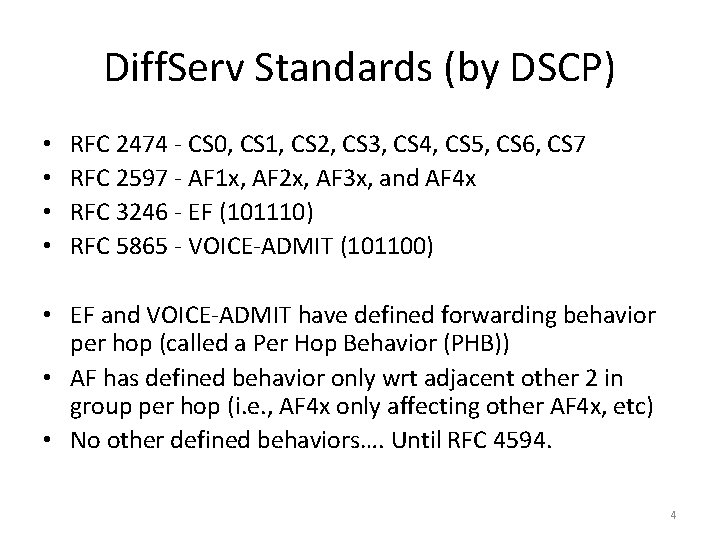
Diff. Serv Standards (by DSCP) • • RFC 2474 - CS 0, CS 1, CS 2, CS 3, CS 4, CS 5, CS 6, CS 7 RFC 2597 - AF 1 x, AF 2 x, AF 3 x, and AF 4 x RFC 3246 - EF (101110) RFC 5865 - VOICE-ADMIT (101100) • EF and VOICE-ADMIT have defined forwarding behavior per hop (called a Per Hop Behavior (PHB)) • AF has defined behavior only wrt adjacent other 2 in group per hop (i. e. , AF 4 x only affecting other AF 4 x, etc) • No other defined behaviors…. Until RFC 4594. 4
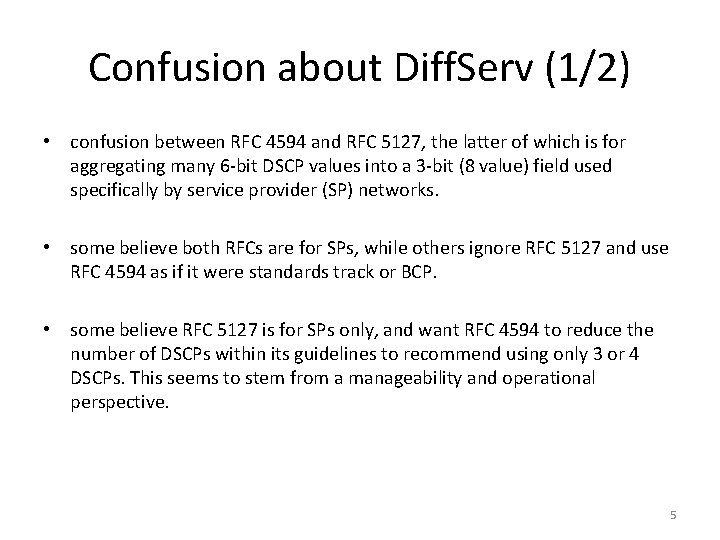
Confusion about Diff. Serv (1/2) • confusion between RFC 4594 and RFC 5127, the latter of which is for aggregating many 6 -bit DSCP values into a 3 -bit (8 value) field used specifically by service provider (SP) networks. • some believe both RFCs are for SPs, while others ignore RFC 5127 and use RFC 4594 as if it were standards track or BCP. • some believe RFC 5127 is for SPs only, and want RFC 4594 to reduce the number of DSCPs within its guidelines to recommend using only 3 or 4 DSCPs. This seems to stem from a manageability and operational perspective. 5
Confusion about Diff. Serv (2/2) • some know RFC 4594 is informational and do not follow its guidelines specifically because it is informational. • some use DSCP values that are not defined within RFC 4594, making mapping between different networks using similar or identical application flows difficult. • some believe enterprise networks should not use either RFC except at the edge of their networks, where they directly connect to SP networks. • some argue that the services class guidance per class is too broad and are therefore not sure in which service class a particular application is to reside. 6
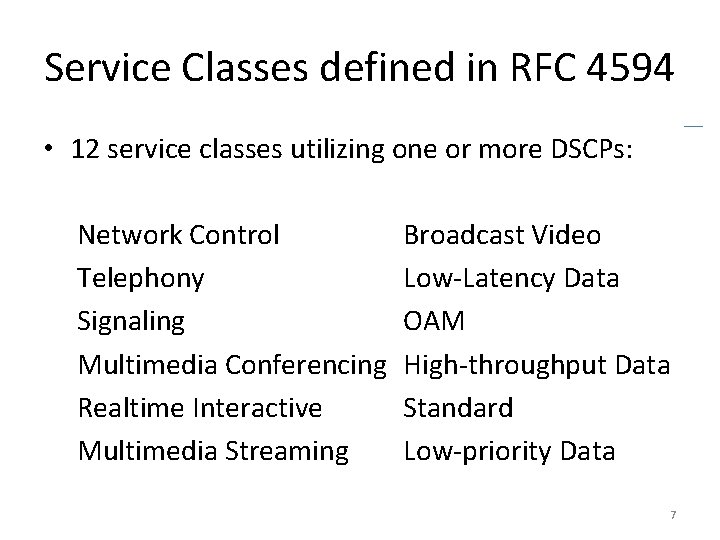
Service Classes defined in RFC 4594 • 12 service classes utilizing one or more DSCPs: Network Control Telephony Signaling Multimedia Conferencing Realtime Interactive Multimedia Streaming Broadcast Video Low-Latency Data OAM High-throughput Data Standard Low-priority Data 7
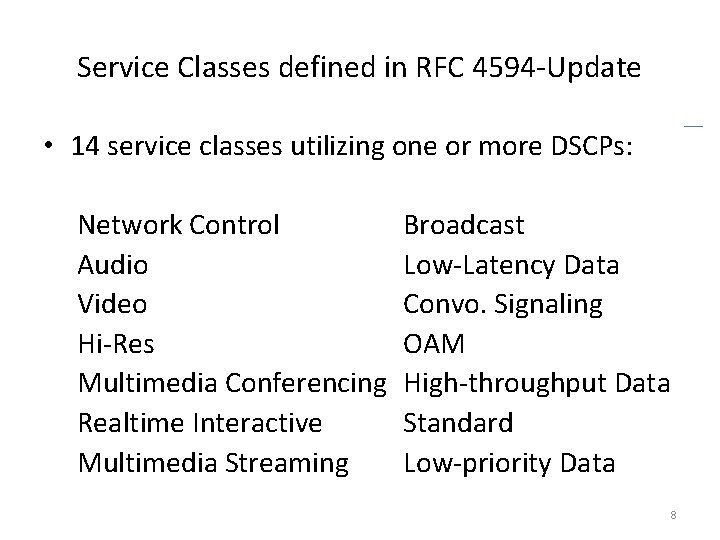
Service Classes defined in RFC 4594 -Update • 14 service classes utilizing one or more DSCPs: Network Control Audio Video Hi-Res Multimedia Conferencing Realtime Interactive Multimedia Streaming Broadcast Low-Latency Data Convo. Signaling OAM High-throughput Data Standard Low-priority Data 8
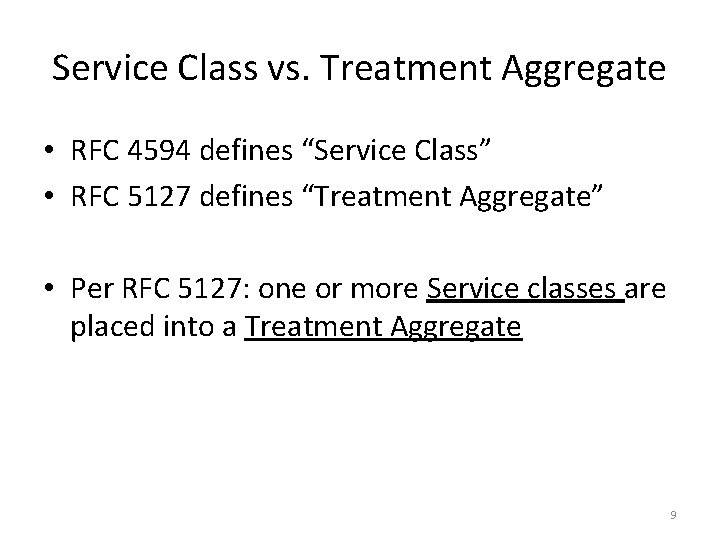
Service Class vs. Treatment Aggregate • RFC 4594 defines “Service Class” • RFC 5127 defines “Treatment Aggregate” • Per RFC 5127: one or more Service classes are placed into a Treatment Aggregate 9
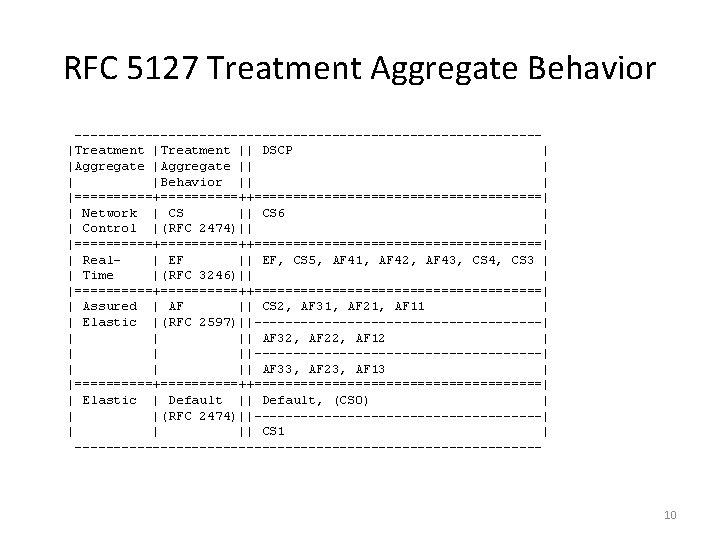
RFC 5127 Treatment Aggregate Behavior ------------------------------|Treatment || DSCP | |Aggregate || | | |Behavior || | |==========++===================| | Network | CS || CS 6 | | Control |(RFC 2474)|| | |==========++===================| | Real| EF || EF, CS 5, AF 41, AF 42, AF 43, CS 4, CS 3 | | Time |(RFC 3246)|| | |==========++===================| | Assured | AF || CS 2, AF 31, AF 21, AF 11 | | Elastic |(RFC 2597)||-------------------| | | || AF 32, AF 22, AF 12 | ||-------------------| | | || AF 33, AF 23, AF 13 | |==========++===================| | Elastic | Default || Default, (CS 0) | | |(RFC 2474)||-------------------| | | || CS 1 | ------------------------------ 10
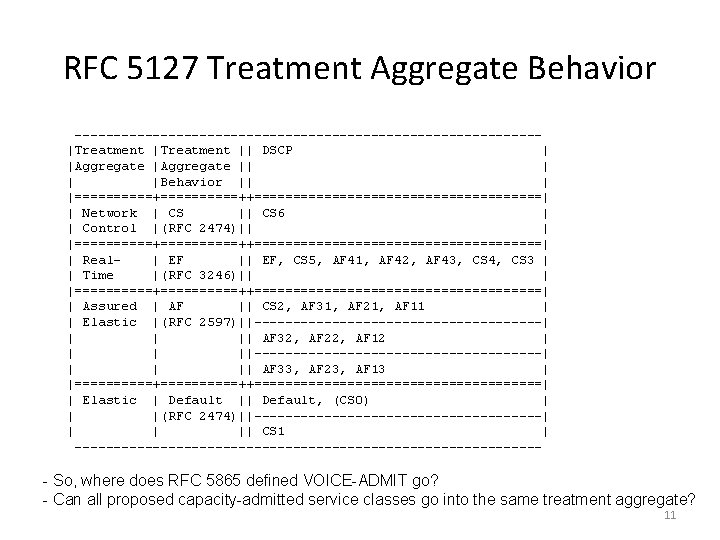
RFC 5127 Treatment Aggregate Behavior ------------------------------|Treatment || DSCP | |Aggregate || | | |Behavior || | |==========++===================| | Network | CS || CS 6 | | Control |(RFC 2474)|| | |==========++===================| | Real| EF || EF, CS 5, AF 41, AF 42, AF 43, CS 4, CS 3 | | Time |(RFC 3246)|| | |==========++===================| | Assured | AF || CS 2, AF 31, AF 21, AF 11 | | Elastic |(RFC 2597)||-------------------| | | || AF 32, AF 22, AF 12 | ||-------------------| | | || AF 33, AF 23, AF 13 | |==========++===================| | Elastic | Default || Default, (CS 0) | | |(RFC 2474)||-------------------| | | || CS 1 | ------------------------------ - So, where does RFC 5865 defined VOICE-ADMIT go? - Can all proposed capacity-admitted service classes go into the same treatment aggregate? 11
Next Steps • If RFC 4594 update is an acceptable effort (at least the direction of it), need to update RFC 5127 to make both consistent. 12
Open Issues • React to comments and questions about the update draft… 13
- Slides: 13