
Dietary carbohydrate breakdown by the human microbiota Petra
Dietary carbohydrate breakdown by the human microbiota Petra Louis
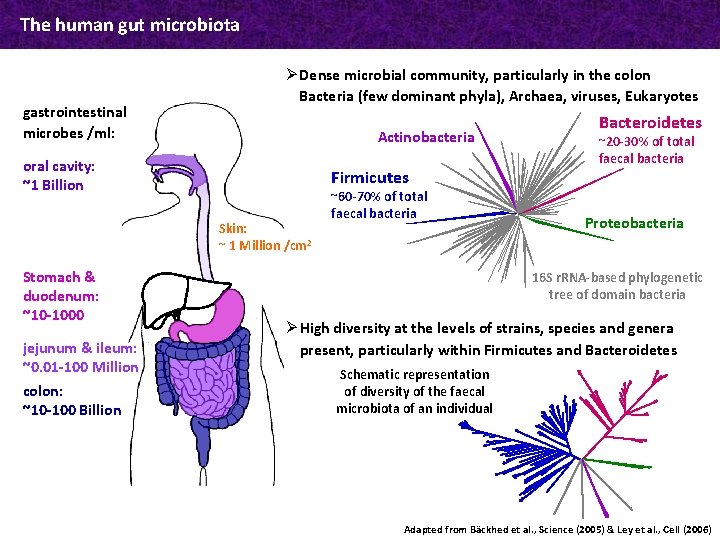
The human gut microbiota gastrointestinal microbes /ml: Ø Dense microbial community, particularly in the colon Bacteria (few dominant phyla), Archaea, viruses, Eukaryotes Actinobacteria oral cavity: ~1 Billion Firmicutes Skin: ~ 1 Million /cm 2 Stomach & duodenum: ~10 -1000 jejunum & ileum: ~0. 01 -100 Million colon: ~10 -100 Billion ~60 -70% of total faecal bacteria Bacteroidetes ~20 -30% of total faecal bacteria Proteobacteria 16 S r. RNA-based phylogenetic tree of domain bacteria Ø High diversity at the levels of strains, species and genera present, particularly within Firmicutes and Bacteroidetes Schematic representation of diversity of the faecal microbiota of an individual Adapted from Bäckhed et al. , Science (2005) & Ley et al. , Cell (2006)
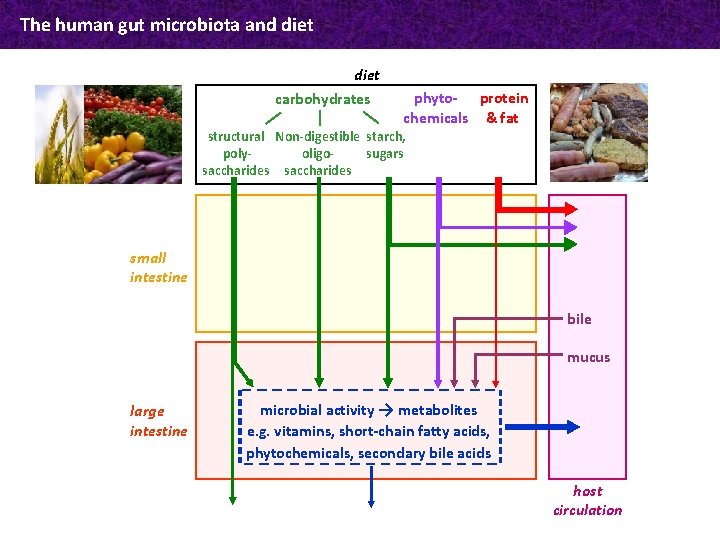
The human gut microbiota and diet carbohydrates phyto- protein chemicals & fat structural Non-digestible starch, polyoligosugars saccharides small intestine bile mucus large intestine microbial activity → metabolites e. g. vitamins, short-chain fatty acids, phytochemicals, secondary bile acids host circulation
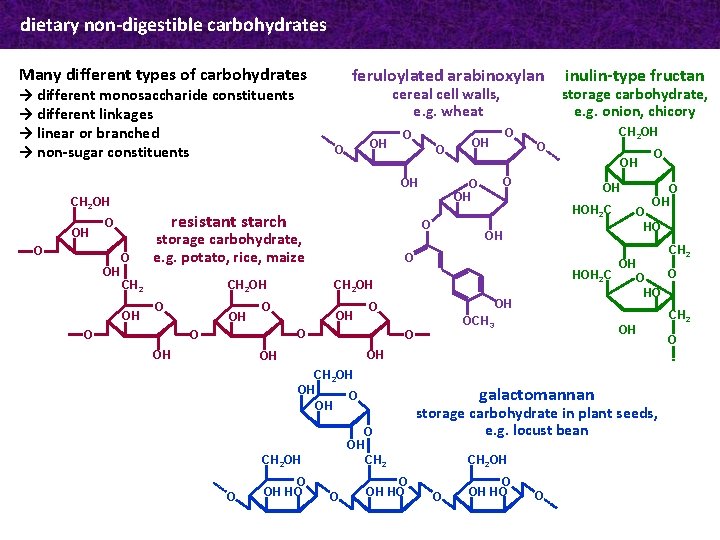
dietary non-digestible carbohydrates Many different types of carbohydrates → different monosaccharide constituents → different linkages → linear or branched → non-sugar constituents feruloylated arabinoxylan cereal cell walls, e. g. wheat OH O OH CH 2 OH OH O resistant starch O O OH CH 2 OH storage carbohydrate, e. g. potato, rice, maize O O OH OH OH O OH HOH 2 C OH O O OH O HO CH 2 HOH 2 C OH O OCH 3 O OH O O HO OH OH OH CH 2 OH OH O OH HO galactomannan O OH CH 2 OH O O O CH 2 OH storage carbohydrate, e. g. onion, chicory O OH O inulin-type fructan O O OH HO storage carbohydrate in plant seeds, e. g. locust bean CH 2 OH O O OH HO O CH 2 O
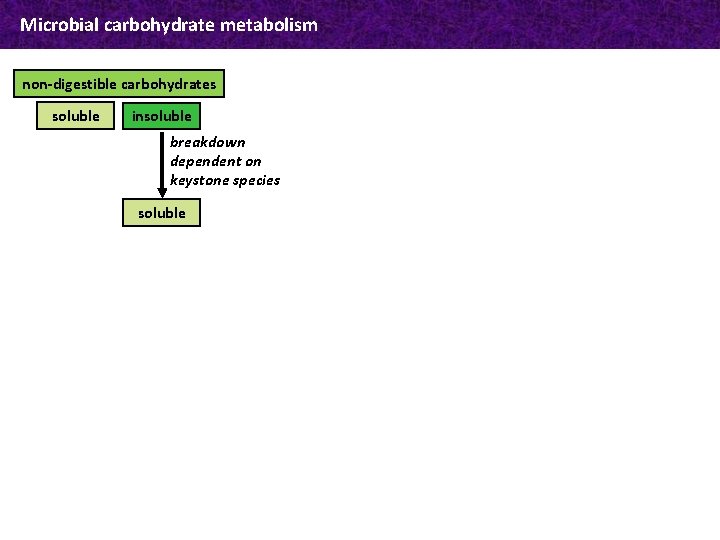
Microbial carbohydrate metabolism non-digestible carbohydrates soluble insoluble breakdown dependent on keystone species soluble
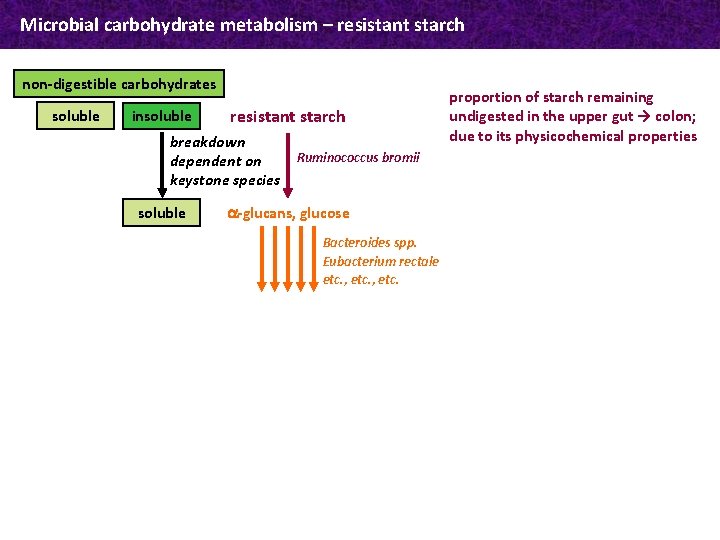
Microbial carbohydrate metabolism – resistant starch non-digestible carbohydrates soluble insoluble resistant starch breakdown dependent on keystone species soluble Ruminococcus bromii a-glucans, glucose Bacteroides spp. Eubacterium rectale etc. , etc. proportion of starch remaining undigested in the upper gut → colon; due to its physicochemical properties
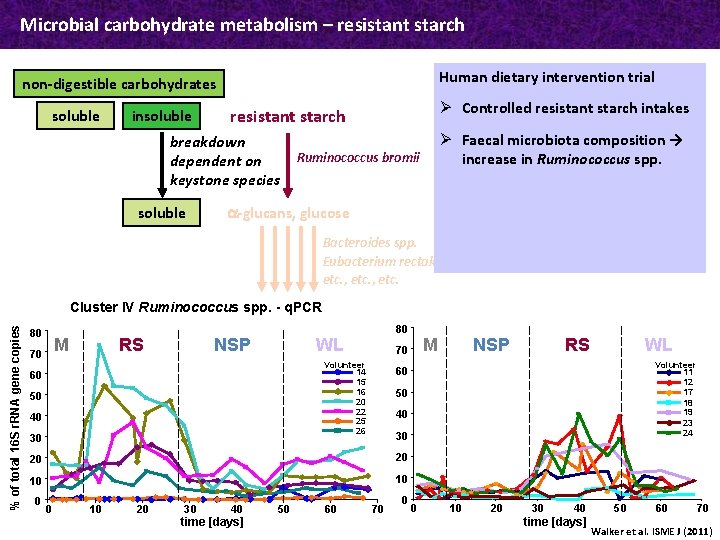
Microbial carbohydrate metabolism – resistant starch Human dietary intervention trial non-digestible carbohydrates soluble insoluble breakdown dependent on keystone species soluble Ø Controlled resistant starch intakes resistant starch Ø Faecal microbiota composition → increase in Ruminococcus spp. Ruminococcus bromii a-glucans, glucose Bacteroides spp. Eubacterium rectale etc. , etc. % of total 16 S r. RNA gene copies Cluster IV Ruminococcus spp. - q. PCR 80 M 70 RS NSP 80 WL Volunteer 14 15 16 20 22 25 26 60 50 40 30 30 40 time [days] 50 60 Volunteer 11 12 17 18 19 23 24 30 10 20 WL 40 10 10 RS 50 20 0 NSP 60 20 0 M 70 70 0 0 10 20 30 40 time [days] 50 60 70 Walker et al. ISME J (2011)
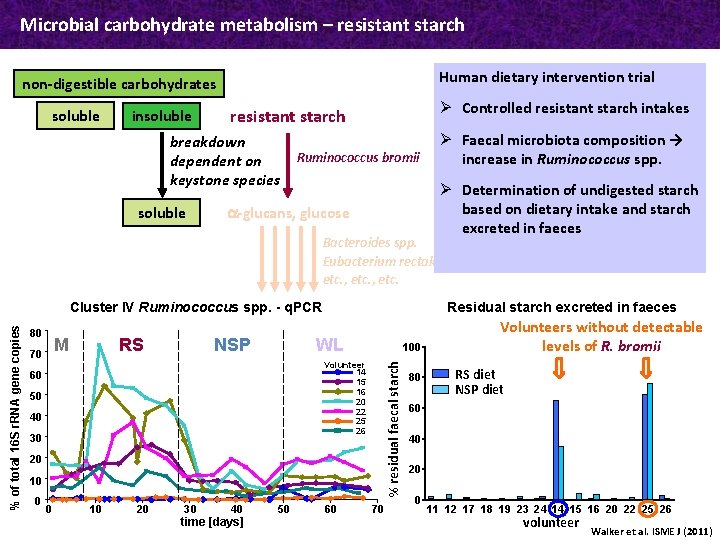
Microbial carbohydrate metabolism – resistant starch Human dietary intervention trial non-digestible carbohydrates soluble insoluble breakdown dependent on keystone species soluble Ø Controlled resistant starch intakes resistant starch Ø Faecal microbiota composition → increase in Ruminococcus spp. Ruminococcus bromii a-glucans, glucose Bacteroides spp. Eubacterium rectale etc. , etc. 80 M 70 RS NSP Residual starch excreted in faeces WL 100 Volunteer 14 15 16 20 22 25 26 60 50 40 30 % residual faecal starch % of total 16 S r. RNA gene copies Cluster IV Ruminococcus spp. - q. PCR 20 10 0 0 10 20 30 40 time [days] 50 Ø Determination of undigested starch based on dietary intake and starch excreted in faeces 60 70 80 Volunteers without detectable levels of R. bromii RS diet NSP diet 60 40 20 0 11 12 17 18 19 23 24 14 15 16 20 22 25 26 volunteer Walker et al. ISME J (2011)
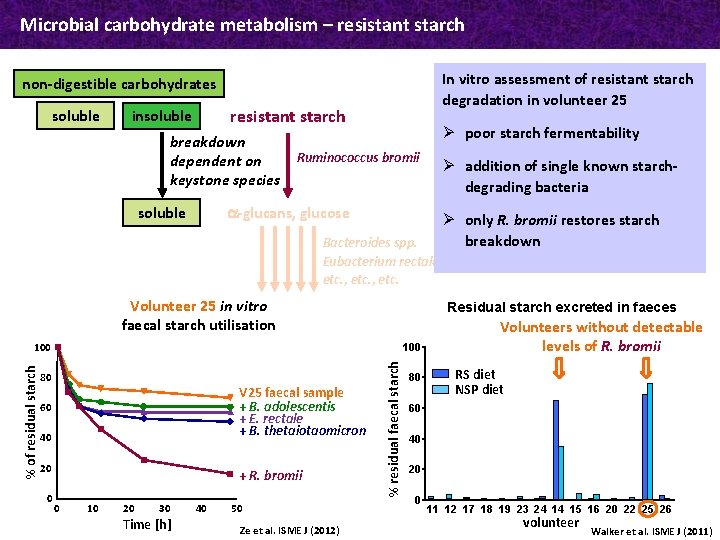
Microbial carbohydrate metabolism – resistant starch In vitro assessment of resistant starch degradation in volunteer 25 non-digestible carbohydrates soluble resistant starch insoluble breakdown dependent on keystone species Ø poor starch fermentability Ruminococcus bromii Ø addition of single known starchdegrading bacteria a-glucans, glucose soluble Bacteroides spp. Eubacterium rectale etc. , etc. Volunteer 25 in vitro faecal starch utilisation Residual starch excreted in faeces 100 V 25 faecal sample + B. adolescentis + E. rectale + B. thetaiotaomicron 60 40 20 0 + R. bromii 0 10 20 30 Time [h] 40 50 Ze et al. ISME J (2012) % residual faecal starch % of residual starch 100 80 Ø only R. bromii restores starch breakdown 80 Volunteers without detectable levels of R. bromii RS diet NSP diet 60 40 20 0 11 12 17 18 19 23 24 14 15 16 20 22 25 26 volunteer Walker et al. ISME J (2011)
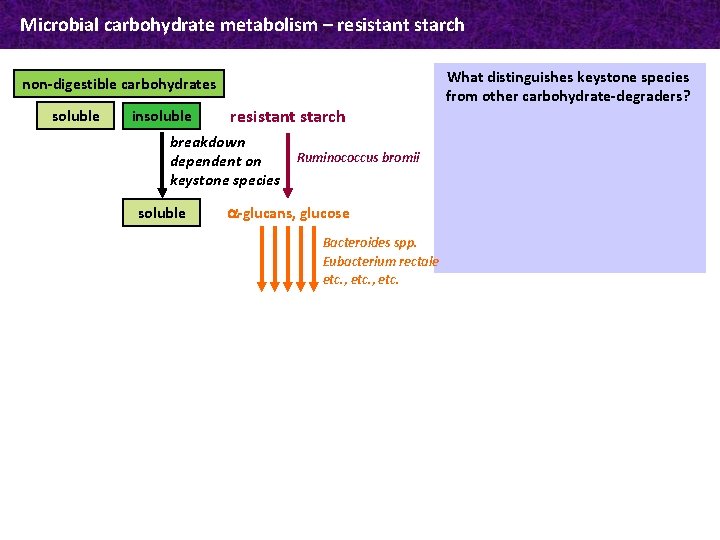
Microbial carbohydrate metabolism – resistant starch non-digestible carbohydrates soluble insoluble resistant starch breakdown dependent on keystone species soluble Ruminococcus bromii a-glucans, glucose Bacteroides spp. Eubacterium rectale etc. , etc. What distinguishes keystone species from other carbohydrate-degraders?
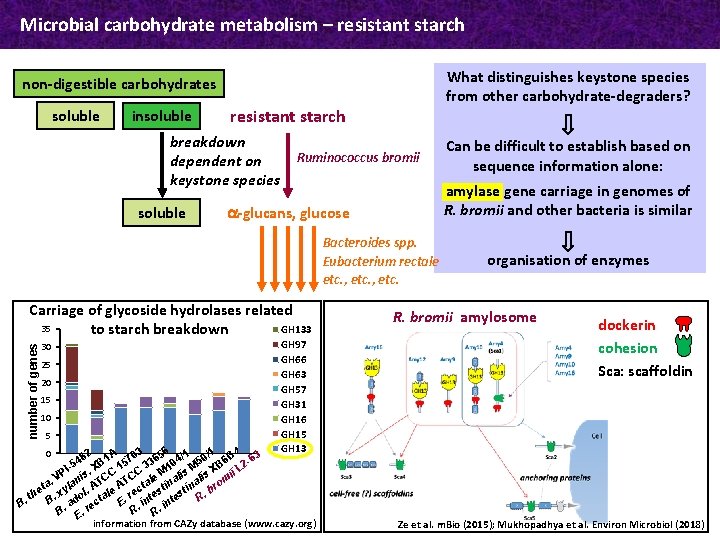
Microbial carbohydrate metabolism – resistant starch What distinguishes keystone species from other carbohydrate-degraders? non-digestible carbohydrates soluble insoluble resistant starch breakdown dependent on keystone species soluble Ruminococcus bromii amylase gene carriage in genomes of R. bromii and other bacteria is similar a-glucans, glucose Bacteroides spp. Eubacterium rectale etc. , etc. number of genes Carriage of glycoside hydrolases related 35 GH 133 to starch breakdown 30 25 20 15 10 5 GH 97 GH 66 GH 63 GH 57 GH 31 GH 16 GH 15 GH 13 6 82 1 A 703 365 4/1 50/1 6 B 4 -63 4 5 B I-5. X C 1 C 3 M 10 is M XB ii L 2 P l is C C V e lis a. ylan AT AT ctal tina rom t. e b th B. x dol tale. re ntes R. . c i E n a B i e R. R. B. E. r information from CAZy database (www. cazy. org) 0 Can be difficult to establish based on sequence information alone: organisation of enzymes R. bromii amylosome dockerin cohesion Sca: scaffoldin Ze et al. m. Bio (2015); Mukhopadhya et al. Environ Microbiol (2018)
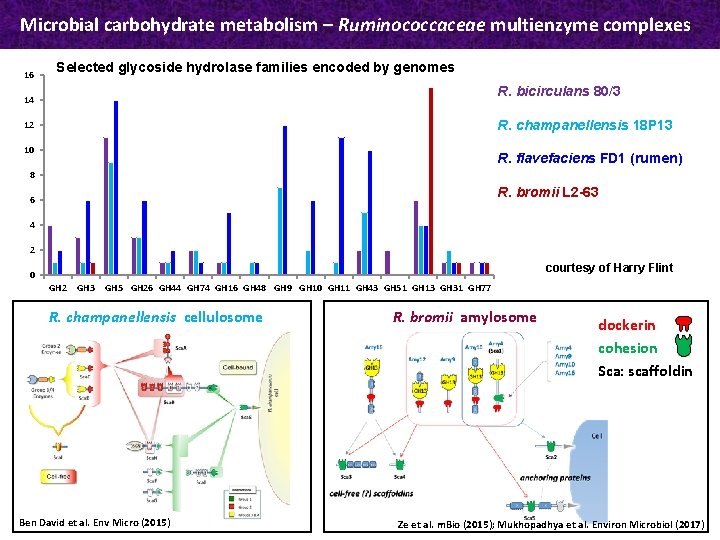
Microbial carbohydrate metabolism – Ruminococcaceae multienzyme complexes 16 Selected glycoside hydrolase families encoded by genomes R. bicirculans 80/3 14 R. champanellensis 18 P 13 12 10 R. flavefaciens FD 1 (rumen) 8 R. bromii L 2 -63 6 4 2 courtesy of Harry Flint 0 GH 2 GH 3 GH 5 GH 26 GH 44 GH 74 GH 16 GH 48 GH 9 GH 10 GH 11 GH 43 GH 51 GH 13 GH 31 GH 77 R. champanellensis cellulosome Ben David et al. Env Micro (2015) R. bromii amylosome dockerin cohesion Sca: scaffoldin Ze et al. m. Bio (2015); Mukhopadhya et al. Environ Microbiol (2017)
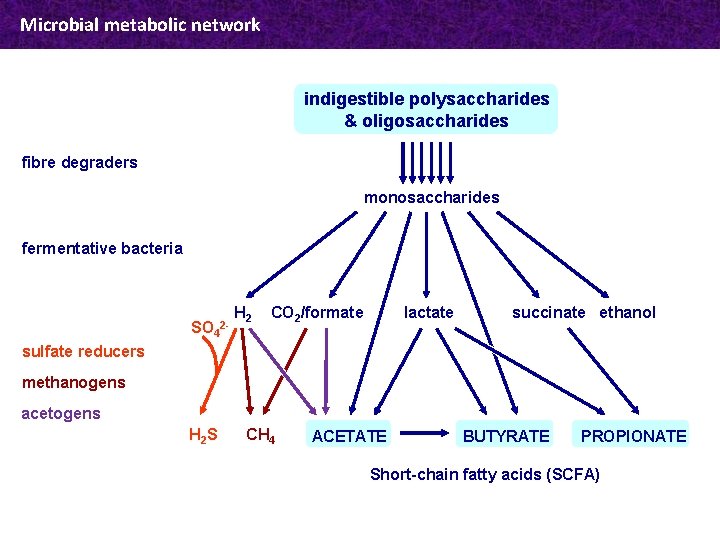
Microbial metabolic network indigestible polysaccharides & oligosaccharides fibre degraders monosaccharides fermentative bacteria SO 4 2 - H 2 CO 2/formate lactate succinate ethanol sulfate reducers methanogens acetogens H 2 S CH 4 ACETATE BUTYRATE PROPIONATE Short-chain fatty acids (SCFA)
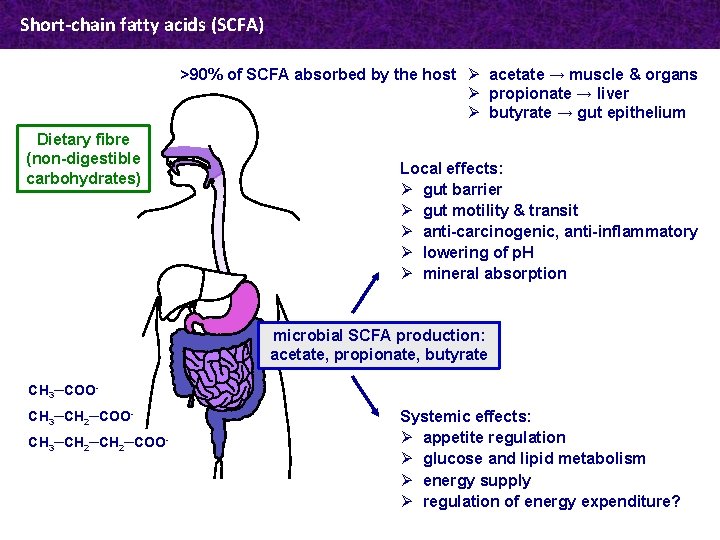
Short-chain fatty acids (SCFA) >90% of SCFA absorbed by the host Ø acetate → muscle & organs Ø propionate → liver Ø butyrate → gut epithelium Dietary fibre (non-digestible carbohydrates) Local effects: Ø gut barrier Ø gut motility & transit Ø anti-carcinogenic, anti-inflammatory Ø lowering of p. H Ø mineral absorption microbial SCFA production: acetate, propionate, butyrate CH 3─COOCH 3─CH 2─CH 2─COO- Systemic effects: Ø appetite regulation Ø glucose and lipid metabolism Ø energy supply Ø regulation of energy expenditure?
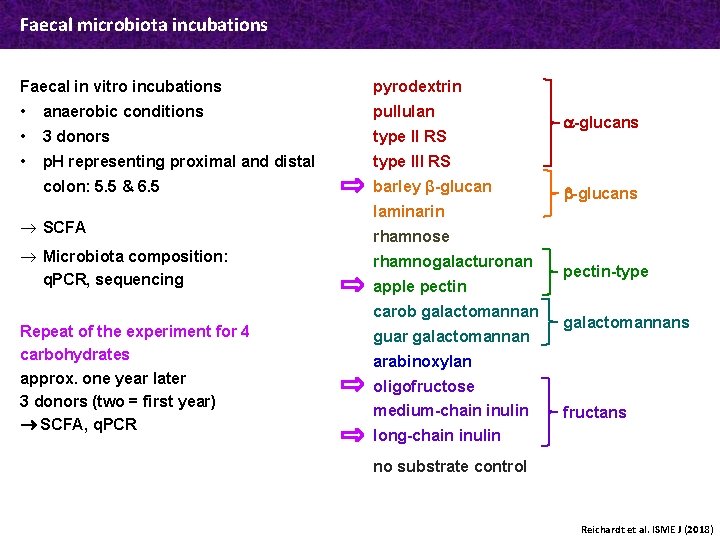
Faecal microbiota incubations Faecal in vitro incubations pyrodextrin • anaerobic conditions pullulan • 3 donors type II RS • p. H representing proximal and distal type III RS colon: 5. 5 & 6. 5 barley β-glucan ® SCFA ® Microbiota composition: q. PCR, sequencing laminarin b-glucans rhamnose rhamnogalacturonan apple pectin carob galactomannan Repeat of the experiment for 4 carbohydrates approx. one year later 3 donors (two = first year) SCFA, q. PCR a-glucans guar galactomannan pectin-type galactomannans arabinoxylan oligofructose medium-chain inulin fructans long-chain inulin no substrate control Reichardt et al. ISME J (2018)
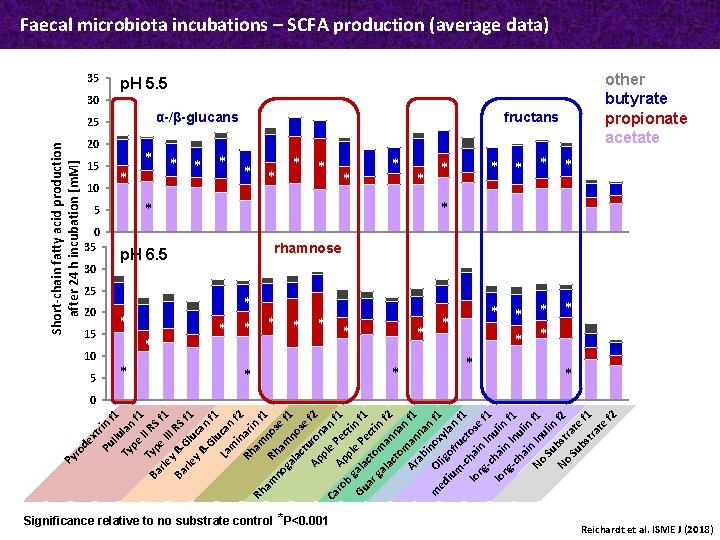
xt Pu rin f llu 1 Ty lan pe f II 1 T R Ba yp S rle e I f 1 I I y Ba ß- RS G f 1 rle l y ß uca -G n f lu 1 La can m in f 2 Rh ari am n f Rh 1 am R no no ha se ga mn f 1 la ct ose Ap uro f 2 pl nan e Ca ro Ap Pec f 1 b pl ti Gu gala e P n f 1 ar cto ect ga m in la an f 2 ct om nan Ar an f 1 ab na i n m f O no ed lig xyl 1 iu of an m ru -c c f 1 lo hai tose ng n -c In f 1 lo hai ulin ng n -c Inu f 1 ha in lin No In f 1 Su ulin No bst f 2 Su rate bs tra f 1 te f 2 ro de Py Short-chain fatty acid production after 24 h incubation [m. M] Faecal microbiota incubations – SCFA production (average data) 35 30 20 15 10 0 35 30 20 15 10 5 Ap. H 5. 5 25 α-/β-glucans 5 25 * * * fructans * * * * * Bp. H 6. 5 * Acetate Propionate Significance relative to no substrate control *P<0. 001 * * * Butyrate * * * other butyrate propionate acetate * * * rhamnose * * * * 0 Reichardt et al. ISME J (2018)
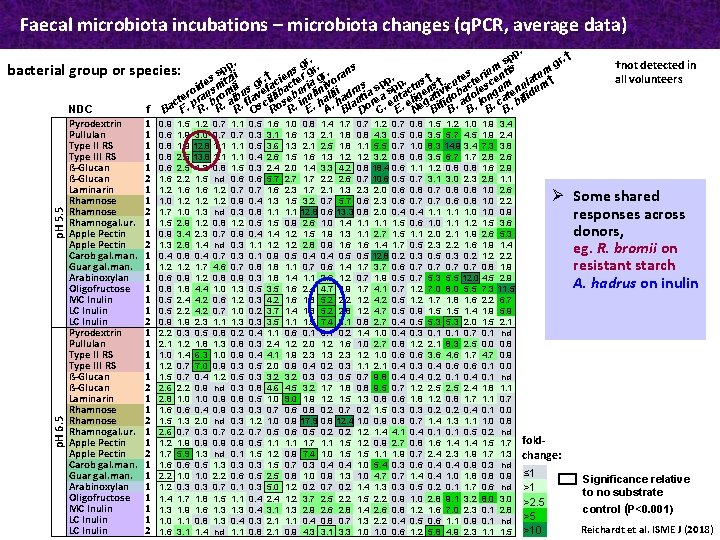
Faecal microbiota incubations – microbiota changes (q. PCR, average data) p. H 6. 5 p. H 5. 5 bacterial . pp. r. † r s. g g †not detected in p. s m group or species: sp ii s riumntis ns r gr gr. ran u † t e. e †. s i z t e all volunteers e e r a † p. s † o t t t ide sni mii us g efacbac uria iniv ii rus sp spp ctu ens vicubac lesc umenul um o r u o b v li b ul ll d tia a ta g ti o o ng t fid cte. pra. br. al. fla scil ose. in. ha lau ore. eu. eli ega ifid. ad. lo. ca. bi a f B F R R R O R R E A B D C E N B B B NDC Pyrodextrin 1 0. 9 1. 5 1. 2 0. 7 1. 1 0. 5 1. 6 1. 0 0. 8 1. 4 1. 7 0. 7 1. 2 0. 7 0. 8 1. 5 1. 2 1. 0 1. 9 3. 4 Pullulan 1 0. 6 1. 9 3. 0 0. 7 0. 3 3. 1 1. 6 1. 3 2. 1 1. 8 0. 8 4. 3 0. 5 0. 9 3. 5 5. 7 4. 5 1. 9 2. 4 Type II RS 1 0. 8 1. 9 12. 8 1. 1 0. 5 3. 6 1. 3 2. 1 2. 5 1. 8 1. 1 5. 5 0. 7 1. 0 8. 3 14. 9 3. 4 7. 3 3. 8 Type III RS 1 0. 8 2. 5 13. 8 1. 1 0. 4 2. 6 1. 5 1. 6 1. 3 1. 2 3. 2 0. 8 3. 5 6. 7 1. 7 2. 8 2. 6 ß-Glucan 1 0. 6 2. 5 1. 2 0. 8 1. 5 0. 3 2. 4 2. 0 1. 4 3. 3 4. 2 0. 8 18. 4 0. 6 1. 1 1. 2 0. 8 1. 6 2. 9 ß-Glucan 2 1. 6 2. 2 1. 5 nd 0. 6 5. 7 2. 7 1. 7 2. 2 2. 6 0. 7 10. 6 0. 5 0. 7 3. 1 3. 0 2. 3 2. 8 1. 1 Laminarin 1 1. 2 1. 6 1. 2 0. 7 1. 6 2. 3 1. 7 2. 1 1. 3 2. 0 0. 6 0. 8 0. 7 0. 8 1. 0 2. 6 Ø Some shared Rhamnose 1 1. 0 1. 2 0. 9 0. 4 1. 3 1. 5 3. 2 0. 7 5. 7 0. 6 2. 3 0. 6 0. 7 0. 6 0. 8 1. 0 2. 2 Rhamnose 2 1. 7 1. 0 1. 3 nd 0. 3 0. 8 1. 1 12. 8 0. 6 13. 3 0. 8 2. 0 0. 4 1. 1 1. 0 0. 9 responses across Rhamnogal. ur. 1 1. 5 2. 9 1. 2 0. 8 1. 2 0. 5 1. 5 0. 9 2. 6 1. 0 1. 4 1. 1 1. 5 0. 6 1. 0 1. 1 1. 2 1. 5 3. 6 donors, Apple Pectin 1 0. 9 3. 4 2. 3 0. 7 0. 9 0. 4 1. 2 1. 5 1. 9 1. 3 1. 1 2. 7 1. 5 1. 1 2. 0 2. 1 1. 9 2. 6 5. 3 Apple Pectin 2 1. 3 2. 8 1. 4 nd 0. 3 1. 1 1. 2 2. 8 0. 9 1. 6 1. 4 1. 7 0. 5 2. 3 2. 2 1. 6 1. 9 1. 4 eg. R. bromii on Carob gal. man. 1 0. 4 0. 8 0. 4 0. 7 0. 3 0. 1 0. 9 0. 5 0. 4 0. 5 12. 8 0. 2 0. 3 0. 5 0. 3 0. 2 1. 2 2. 2 Guar gal. man. 1 1. 2 1. 7 4. 6 0. 7 0. 8 1. 1 0. 7 0. 6 1. 4 1. 7 3. 7 0. 6 0. 7 0. 8 1. 9 resistant starch Arabinoxylan 1 0. 6 0. 9 1. 2 0. 8 0. 9 0. 3 1. 8 1. 4 1. 1 2. 6 1. 2 0. 7 1. 9 0. 5 0. 7 5. 3 5. 5 12. 0 4. 5 2. 9 A. hadrus on inulin Oligofructose 1 0. 8 1. 8 4. 4 1. 0 1. 3 0. 5 3. 5 1. 6 2. 4 4. 7 1. 9 1. 7 4. 1 0. 7 1. 2 7. 0 8. 0 5. 5 7. 3 11. 5 MC Inulin 1 0. 5 2. 4 4. 2 0. 6 1. 2 0. 3 4. 2 1. 6 1. 8 5. 2 2. 2 1. 2 4. 2 0. 5 1. 2 1. 7 1. 8 1. 6 2. 2 6. 7 LC Inulin 1 0. 5 2. 2 4. 2 0. 7 1. 0 0. 2 3. 7 1. 4 1. 8 5. 2 2. 8 1. 2 4. 7 0. 5 0. 9 1. 5 1. 4 1. 9 5. 9 LC Inulin 2 0. 9 1. 9 2. 3 1. 1 1. 3 0. 3 3. 5 1. 1 1. 5 7. 4 3. 1 0. 8 2. 7 0. 4 0. 5 5. 3 2. 0 1. 5 2. 1 Pyrodextrin 1 2. 2 0. 3 0. 5 0. 8 0. 2 0. 4 1. 1 0. 6 0. 1 0. 2 1. 4 1. 0 0. 4 0. 3 0. 1 0. 7 0. 1 nd Pullulan 1 2. 1 1. 2 1. 8 1. 3 0. 8 0. 3 2. 4 1. 2 2. 0 1. 2 1. 6 1. 0 2. 7 0. 8 1. 2 2. 1 8. 3 2. 5 0. 0 0. 8 Type II RS 1 1. 0 1. 4 6. 3 1. 0 0. 9 0. 4 4. 1 1. 9 2. 3 1. 3 2. 3 1. 2 1. 0 0. 6 3. 6 4. 6 1. 7 4. 7 0. 9 Type III RS 1 1. 2 0. 7 7. 0 0. 9 0. 3 0. 5 2. 0 0. 9 0. 4 0. 2 0. 3 1. 1 2. 1 0. 4 0. 3 0. 4 0. 6 0. 1 0. 0 ß-Glucan 1 1. 5 0. 7 0. 4 1. 2 0. 5 0. 3 3. 2 0. 3 0. 5 0. 7 9. 8 0. 4 0. 2 0. 1 0. 4 0. 1 nd ß-Glucan 2 2. 6 2. 2 0. 9 nd 0. 3 0. 8 4. 6 4. 5 3. 2 1. 7 1. 8 0. 8 9. 5 0. 7 1. 2 2. 5 2. 4 1. 8 1. 1 Laminarin 1 2. 8 1. 0 0. 9 0. 8 0. 5 1. 0 9. 0 1. 9 1. 2 1. 5 1. 3 0. 8 0. 6 1. 8 1. 2 0. 8 1. 7 1. 1 0. 7 Rhamnose 1 1. 6 0. 4 0. 9 0. 3 0. 7 0. 6 0. 8 0. 2 0. 7 0. 2 1. 5 0. 3 0. 2 0. 4 0. 1 0. 0 Rhamnose 2 1. 5 1. 3 2. 0 nd 0. 3 1. 2 1. 0 0. 9 17. 9 0. 8 12. 4 1. 0 0. 9 0. 8 0. 7 1. 4 1. 3 1. 1 1. 0 0. 8 Rhamnogal. ur. 1 2. 6 0. 7 0. 3 0. 7 0. 2 0. 7 0. 5 0. 6 0. 5 0. 2 1. 4 4. 1 0. 4 0. 1 0. 5 0. 2 nd Apple Pectin 1 1. 2 1. 9 0. 5 1. 1 1. 7 1. 1 1. 5 1. 2 0. 9 2. 7 0. 8 1. 6 1. 4 1. 5 1. 7 fold. Apple Pectin 2 1. 7 5. 9 1. 3 nd 0. 1 1. 5 1. 2 0. 9 7. 4 1. 0 1. 5 1. 1 1. 9 0. 7 2. 4 2. 3 1. 9 1. 7 1. 3 change: Carob gal. man. 1 1. 6 0. 5 1. 3 0. 3 1. 5 0. 7 0. 3 0. 4 1. 0 5. 4 0. 3 0. 6 0. 4 0. 9 0. 3 nd Guar gal. man. 1 2. 2 1. 0 2. 2 0. 6 0. 5 2. 5 0. 8 1. 0 0. 9 1. 3 1. 0 4. 7 0. 7 1. 4 0. 4 1. 0 1. 8 0. 9 ≤ 1 Significance relative Arabinoxylan 1 1. 2 0. 3 0. 7 0. 1 0. 3 5. 0 1. 2 0. 7 0. 2 1. 4 1. 3 0. 5 0. 2 0. 1 1. 7 0. 6 nd >1 to no substrate Oligofructose 1 1. 4 1. 7 1. 8 1. 5 1. 1 0. 4 2. 4 1. 2 3. 7 2. 5 2. 2 1. 5 2. 2 0. 9 1. 0 2. 8 9. 1 3. 2 8. 0 3. 0 >2. 5 MC Inulin 1 1. 3 1. 9 1. 6 1. 3 0. 4 3. 1 1. 3 2. 9 2. 6 2. 8 1. 4 2. 6 0. 8 1. 2 1. 6 7. 0 2. 3 0. 1 2. 8 control (P<0. 001) LC Inulin 1 1. 0 1. 1 0. 8 1. 3 0. 4 0. 3 2. 1 1. 1 0. 4 0. 8 0. 7 1. 3 2. 2 0. 4 0. 5 0. 6 1. 1 0. 9 0. 1 nd >5 Reichardt et al. ISME J (2018) LC Inulin 2 1. 6 3. 1 1. 4 nd 1. 1 0. 8 2. 1 0. 9 4. 3 3. 1 3. 3 1. 0 0. 6 1. 2 5. 8 4. 9 2. 3 1. 1 1. 5 >10
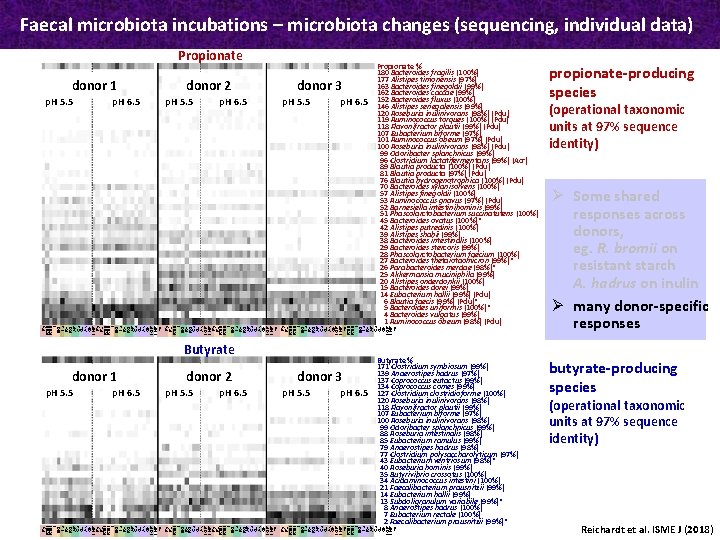
Faecal microbiota incubations – microbiota changes (sequencing, individual data) Propionate donor 1 p. H 6. 5 p. H 5. 5 p. H 6. 5 donor 3 p. H 5. 5 p. H 6. 5 propionate-producing species Butyrate % 171 Clostridium symbiosum (99%) 139 Anaerostipes hadrus (97%) 137 Coprococcus eutactus (99%) 134 Coprococcus comes (99%) 127 Clostridium clostridioforme (100%) 120 Roseburia inulinivorans (98%) 118 Flavonifractor plautii (99%) 107 Eubacterium biforme (97%) 100 Roseburia inulinivorans (98%) 99 Odoribacter splanchnicus (99%) 88 Roseburia intestinalis (98%) 85 Eubacterium ramulus (99%) 79 Anaerostipes hadrus (98%) 77 Clostridium polysaccharolyticum (97%) 43 Eubacterium ventriosum (98%)* 40 Roseburia hominis (99%) 35 Butyrivibrio crossotus (100%) 34 Acidaminococcus intestini (100%) 21 Faecalibacterium prausnitzii (99%) 14 Eubacterium hallii (99%) 13 Subdoligranulum variabile (99%)* 8 Anaerostipes hadrus (100%) 7 Eubacterium rectale (100%) 2 Faecalibacterium prausnitzii (99%)* butyrate-producing species Py RSII I BG La Rh RG AP Ca Gu AX OF I-HP Py Pu RSII I BG La Rh RG AP Ca Gu AX OF I-GP I-HP no i Py Pu RSII I BG Rh RG Ca Gu AX I-GP I-HP Py Pu RSII I BG La Rh RG AP Ca Gu AX OF I-GP I-HP no i Py Pu RSII I BG La Rh RG AP Ca Gu AX OF I-GP I-HP no RSII I BG La Rh AP Ca Gu OF I-GP I-HP no i p. H 5. 5 donor 2 Propionate % 180 Bacteroides fragilis (100%) 177 Alistipes timonensis (97%) 163 Bacteroides finegoldii (99%) 162 Bacteroides caccae (99%) 152 Bacteroides fluxus (100%) 146 Alistipes senegalensis (99%) 120 Roseburia inulinivorans (98%) (Pdu) 119 Ruminococcus torques (100%) (Pdu) 118 Flavonifractor plautii (99%) (Pdu) 107 Eubacterium biforme (97%) 101 Ruminococcus obeum (97%) (Pdu) 100 Roseburia inulinivorans (98%) (Pdu) 99 Odoribacter splanchnicus (99%) 96 Clostridium lactatifermentans (99%) (Acr) 89 Blautia producta (100%) (Pdu) 81 Blautia producta (97%) (Pdu) 76 Blautia hydrogenotrophica (100%) (Pdu) 70 Bacteroides xylanisolvens (100%) 57 Alistipes finegoldii (100%) 53 Ruminococcus gnavus (97%) (Pdu) 52 Barnesiella intestinihominis (99%) 51 Phascolarctobacterium succinatutens (100%) 45 Bacteroides ovatus (100%)* 42 Alistipes putredinis (100%) 39 Alistipes shahii (99%) 38 Bacteroides intestinalis (100%) 29 Bacteroides stercoris (99%) 28 Phascolarctobacterium faecium (100%) 27 Bacteroides thetaiotaomicron (99%)* 26 Parabacteroides merdae (98%)* 25 Akkermansia muciniphila (99%) 20 Alistipes onderdonkii (100%) 15 Bacteroides dorei (99%) 14 Eubacterium hallii (99%) (Pdu) 6 Blautia faecis (99%) (Pdu)* 5 Bacteroides uniformis (100%)* 4 Bacteroides vulgatus (99%) 1 Ruminococcus obeum (98%) (Pdu) Butyrate donor 1 p. H 6. 5 p. H 5. 5 p. H 6. 5 donor 3 p. H 5. 5 p. H 6. 5 Py RSII I BG La Rh RG AP Ca Gu AX OF I-HP Py Pu RSII I BG La Rh RG AP Ca Gu AX OF I-GP I-HP no i Py Pu RSII I BG Rh RG Ca Gu AX I-GP I-HP Py Pu RSII I BG La Rh RG AP Ca Gu AX OF I-GP I-HP no i Py Pu RSII I BG La Rh RG AP Ca Gu AX OF I-GP I-HP no RSII I BG La Rh AP Ca Gu OF I-GP I-HP no i p. H 5. 5 donor 2 (operational taxonomic units at 97% sequence identity) Ø Some shared responses across donors, eg. R. bromii on resistant starch A. hadrus on inulin Ø many donor-specific responses (operational taxonomic units at 97% sequence identity) Reichardt et al. ISME J (2018)
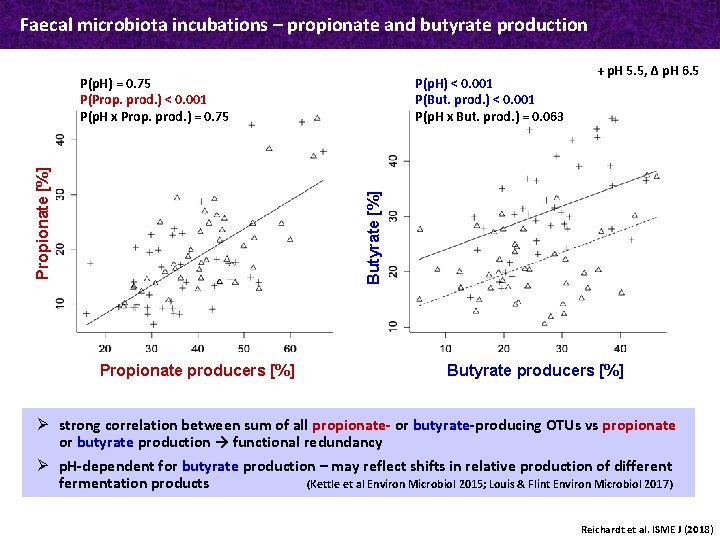
Faecal microbiota incubations – propionate and butyrate production P(p. H) < 0. 001 P(But. prod. ) < 0. 001 P(p. H x But. prod. ) = 0. 063 + p. H 5. 5, Δ p. H 6. 5 Butyrate [%] Propionate [%] P(p. H) = 0. 75 P(Prop. prod. ) < 0. 001 P(p. H x Prop. prod. ) = 0. 75 Propionate producers [%] Butyrate producers [%] Ø strong correlation between sum of all propionate- or butyrate-producing OTUs vs propionate or butyrate production → functional redundancy Ø p. H-dependent for butyrate production – may reflect shifts in relative production of different fermentation products (Kettle et al Environ Microbiol 2015; Louis & Flint Environ Microbiol 2017) Reichardt et al. ISME J (2018)
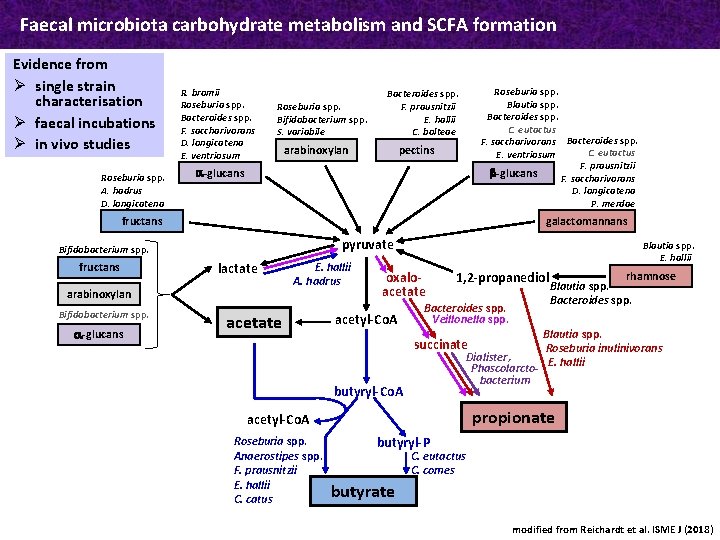
Faecal microbiota carbohydrate metabolism and SCFA formation Evidence from Ø single strain characterisation Ø faecal incubations Ø in vivo studies Roseburia spp. A. hadrus D. longicatena R. bromii Roseburia spp. Bacteroides spp. F. saccharivorans D. longicatena E. ventriosum Roseburia spp. Bifidobacterium spp. S. variabile Roseburia spp. Blautia spp. Bacteroides spp. C. eutactus F. saccharivorans Bacteroides spp. C. eutactus E. ventriosum F. prausnitzii b-glucans F. saccharivorans D. longicatena P. merdae Bacteroides spp. F. prausnitzii E. hallii C. bolteae arabinoxylan pectins a-glucans fructans galactomannans pyruvate Bifidobacterium spp. fructans lactate arabinoxylan Bifidobacterium spp. a-glucans E. hallii A. hadrus acetate Blautia spp. E. hallii oxaloacetate acetyl-Co. A 1, 2 -propanediol Bacteroides spp. Veillonella spp. succinate Dialister, Phascolarctobacterium butyryl-Co. A Blautia spp. Roseburia inulinivorans E. hallii propionate acetyl-Co. A Roseburia spp. Anaerostipes spp. F. prausnitzii E. hallii C. catus rhamnose Blautia spp. Bacteroides spp. butyryl-P C. eutactus C. comes butyrate modified from Reichardt et al. ISME J (2018)
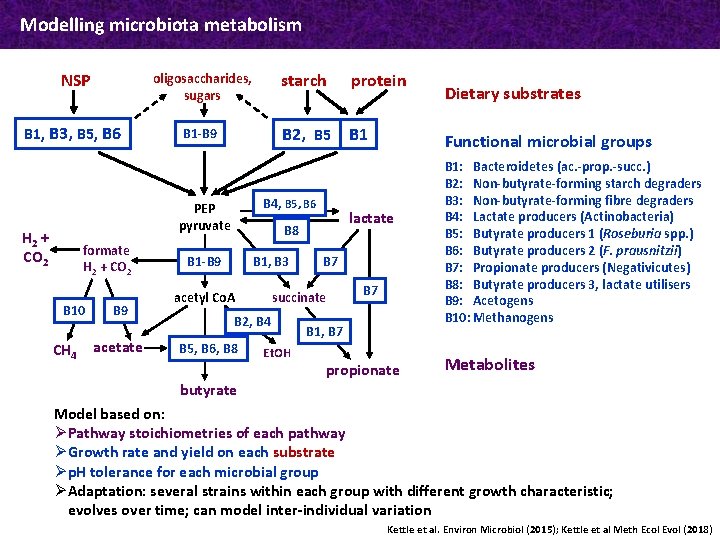
Modelling microbiota metabolism NSP oligosaccharides, sugars B 1, B 3, B 5, B 6 B 1 -B 9 formate H 2 + CO 2 B 10 CH 4 B 9 acetate protein B 2, B 5 B 1 B 4, B 5, B 6 PEP pyruvate H 2 + CO 2 starch B 1 -B 9 B 1, B 3 B 2, B 4 B 5, B 6, B 8 B 7 succinate acetyl Co. A Et. OH Functional microbial groups lactate B 8 Dietary substrates B 7 B 1, B 7 propionate B 1: Bacteroidetes (ac. -prop. -succ. ) B 2: Non-butyrate-forming starch degraders B 3: Non-butyrate-forming fibre degraders B 4: Lactate producers (Actinobacteria) B 5: Butyrate producers 1 (Roseburia spp. ) B 6: Butyrate producers 2 (F. prausnitzii) B 7: Propionate producers (Negativicutes) B 8: Butyrate producers 3, lactate utilisers B 9: Acetogens B 10: Methanogens Metabolites butyrate Model based on: Ø Pathway stoichiometries of each pathway Ø Growth rate and yield on each substrate Ø p. H tolerance for each microbial group Ø Adaptation: several strains within each group with different growth characteristic; evolves over time; can model inter-individual variation Kettle et al. Environ Microbiol (2015); Kettle et al Meth Ecol Evol (2018)
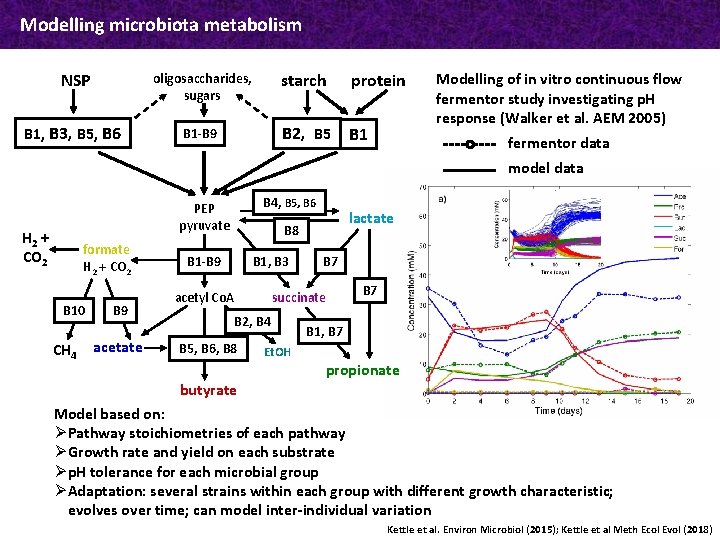
Modelling microbiota metabolism NSP oligosaccharides, sugars B 1, B 3, B 5, B 6 B 1 -B 9 starch protein B 2, B 5 B 1 Modelling of in vitro continuous flow fermentor study investigating p. H response (Walker et al. AEM 2005) fermentor data model data B 4, B 5, B 6 PEP pyruvate H 2 + CO 2 formate H 2 + CO 2 B 10 CH 4 B 9 acetate lactate B 8 B 1 -B 9 B 1, B 3 succinate acetyl Co. A B 2, B 4 B 5, B 6, B 8 B 7 B 1, B 7 Et. OH propionate butyrate Model based on: Ø Pathway stoichiometries of each pathway Ø Growth rate and yield on each substrate Ø p. H tolerance for each microbial group Ø Adaptation: several strains within each group with different growth characteristic; evolves over time; can model inter-individual variation Kettle et al. Environ Microbiol (2015); Kettle et al Meth Ecol Evol (2018)
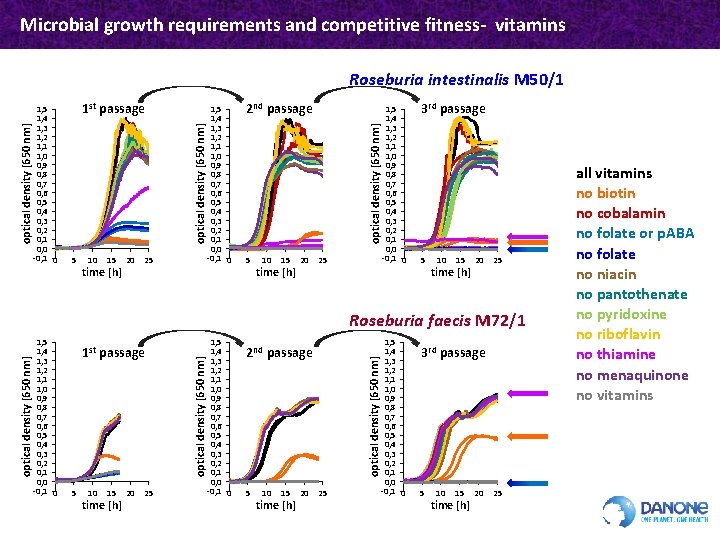
Microbial growth requirements and competitive fitness- vitamins 1 st passage 5 10 15 time [h] 20 25 1, 4 1, 3 1, 2 1, 1 1, 0 0, 9 0, 8 0, 7 0, 6 0, 5 0, 4 0, 3 0, 2 0, 1 0, 0 -0, 1 0 2 nd passage optical density [650 nm] 1, 5 1, 4 1, 3 1, 2 1, 1 1, 0 0, 9 0, 8 0, 7 0, 6 0, 5 0, 4 0, 3 0, 2 0, 1 0, 0 -0, 1 0 optical density [650 nm] Roseburia intestinalis M 50/1 5 10 15 time [h] 20 25 1, 4 1, 3 1, 2 1, 1 1, 0 0, 9 0, 8 0, 7 0, 6 0, 5 0, 4 0, 3 0, 2 0, 1 0, 0 -0, 1 0 3 rd passage 5 10 15 time [h] 20 25 1 st passage 5 10 15 time [h] 20 25 1, 4 1, 3 1, 2 1, 1 1, 0 0, 9 0, 8 0, 7 0, 6 0, 5 0, 4 0, 3 0, 2 0, 1 0, 0 -0, 1 0 2 nd passage 5 10 15 time [h] 20 optical density [650 nm] 1, 5 1, 4 1, 3 1, 2 1, 1 1, 0 0, 9 0, 8 0, 7 0, 6 0, 5 0, 4 0, 3 0, 2 0, 1 0, 0 -0, 1 0 optical density [650 nm] Roseburia faecis M 72/1 25 1, 4 1, 3 1, 2 1, 1 1, 0 0, 9 0, 8 0, 7 0, 6 0, 5 0, 4 0, 3 0, 2 0, 1 0, 0 -0, 1 0 3 rd passage 5 10 15 time [h] 20 25 all vitamins no biotin no cobalamin no folate or p. ABA no folate no niacin no pantothenate no pyridoxine no riboflavin no thiamine no menaquinone no vitamins
![Microbial growth requirements and competitive fitness [Thi. S]-COPH [Thi. S]-CO-AMP [Isc. S]-SSH Thi. I](http://slidetodoc.com/presentation_image_h2/e119217e3ba2c0a081383fc0878827d3/image-24.jpg "Microbial growth requirements and competitive fitness [Thi. S]-COPH [Thi. S]-CO-AMP [Isc. S]-SSH Thi. I")
Microbial growth requirements and competitive fitness [Thi. S]-COPH [Thi. S]-CO-AMP [Isc. S]-SSH Thi. I [Thi. S]-COSH glyceraldehyde-3 P pyruvate L-tyrosine L-glycine dxs Thi. H 1 -deoxy-D-xylulose-5 phosphate Thi. O optical density [650 nm] L-cysteine Thi. F L-glycine imine Thi. G 2 -(2 -carboxy-4 -methyl-thiazol-5 -yl)ethyl phosphate Thi. E 4 -amino-5 -hydroxzymethyl-2 methylpyrimidine diphosphate Thi. D 4 -amino-5 -hydroxzymethyl-2 methylpyrimidine phosphate Thi. C 1 -(phospho-ribosyl)-5 -aminoimidazole 1, 5 1, 4 1, 3 1, 2 1, 1 1, 0 0, 9 0, 8 0, 7 0, 6 0, 5 0, 4 0, 3 0, 2 0, 1 0, 0 -0, 1 0 3 rd passage 5 10 15 time [h] 20 25 Importance of confirming genome sequence-based data Ø annotation errors Ø genes missing in draft genomes Roseburia faecis M 72/1 1, 5 Ø genes not functional thiamine-P 1, 4 3 rd passage 1, 3 or not expressed 1, 2 optical density [650 nm] [Isc. S]-SH Roseburia intestinalis M 50/1 1, 0 0, 9 0, 8 0, 7 0, 6 0, 5 0, 4 0, 3 0, 2 0, 1 0, 0 -0, 1 0 5 10 15 time [h] 20 25
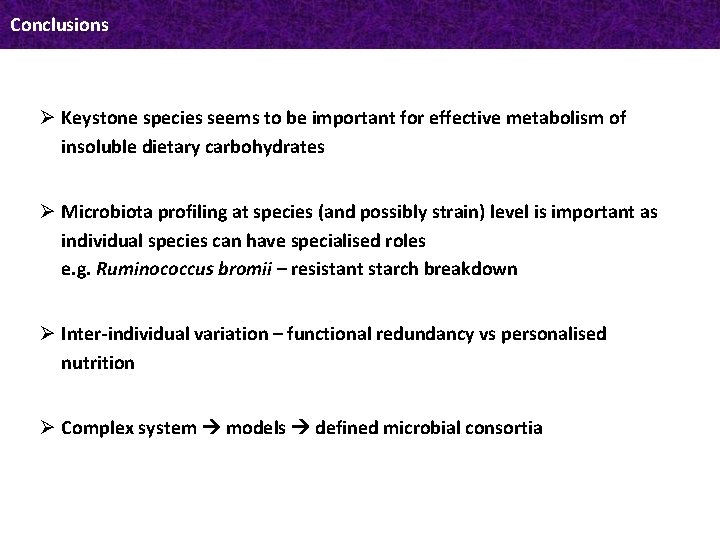
Conclusions Ø Keystone species seems to be important for effective metabolism of insoluble dietary carbohydrates Ø Microbiota profiling at species (and possibly strain) level is important as individual species can have specialised roles e. g. Ruminococcus bromii – resistant starch breakdown Ø Inter-individual variation – functional redundancy vs personalised nutrition Ø Complex system models defined microbial consortia

Acknowledgements Funding Harry Flint Sylvia Duncan Alan Walker Aurore Bergerat Freda Farquharson Jennifer Ince Jenny Laverde Nicole Reichardt Paul Sheridan Eva Soto-Martin Maren Vollmer Lucy Webster Xiaolei Ze David Brown Grietje Holtrop Janice Drew Helen Kettle Alex Johnstone Gerald Lobley Lynda Williams Human Studies Unit Scottish Government Collaborators: Julian Parkhill et al. (Wellcome Trust Sanger Inst. Cambridge) Ed Bayer et al. (Weizmann Inst. Israel) Bernard Henrissat (Aix-Marseille University) Nathalie Juge et al. (Institute of Food Research, Norwich) Nicole Koropatkin (University of Michigan) Mirko Bunzel et al. (Karlsruhe Institute of Technology) Douglas Morrison et al. (University of Glasgow) Muriel Derrien, Jean-Michel Faurie (Danone)
- Slides: 26