
DIENCEPHALON Subthalamus Hypothalamus Dr Zeenat Zaidi SUBTHALAMUS SUBTHALAMUS

DIENCEPHALON Subthalamus & Hypothalamus Dr Zeenat Zaidi

SUBTHALAMUS
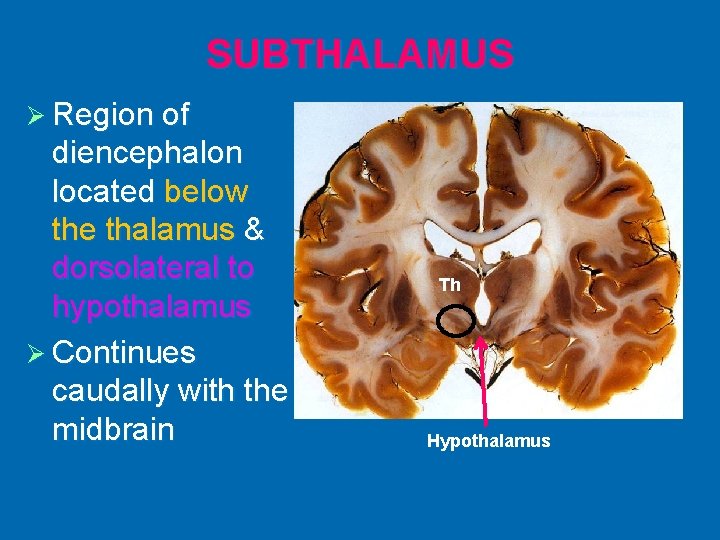
SUBTHALAMUS Ø Region of diencephalon located below the thalamus & dorsolateral to hypothalamus Ø Continues caudally with the midbrain Th Hypothalamus
Contents Rostral extension of: l Red nucleus l Substantia nigra l Brainstem reticular formation as Zona incerta Ø Long tracts passing through brain stem and heading toward thalamus l Spinothalamic & Trigeminothalamic tracts l Medial lemniscus l Dentatothalamic fibers Ø Pallidothalamic fibers (fasciculus lenticularis, Ansa lenticularis & thalamic fascicle) Ø Subthalamic nucleus Ø
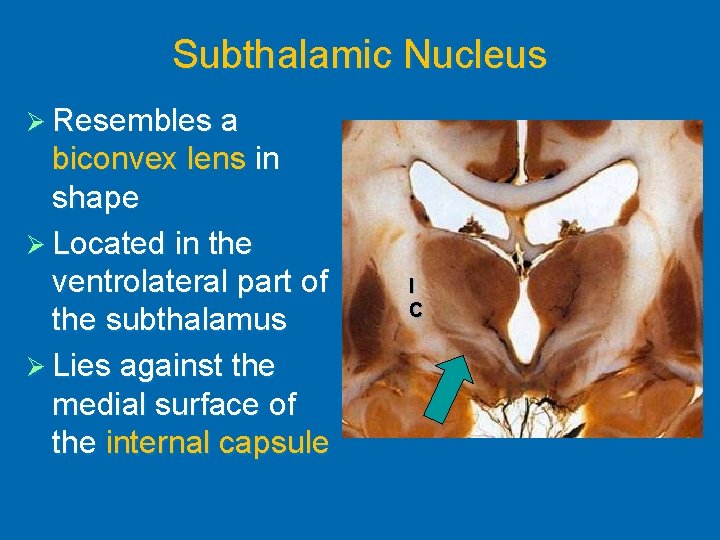
Subthalamic Nucleus Ø Resembles a biconvex lens in shape Ø Located in the ventrolateral part of the subthalamus Ø Lies against the medial surface of the internal capsule I C
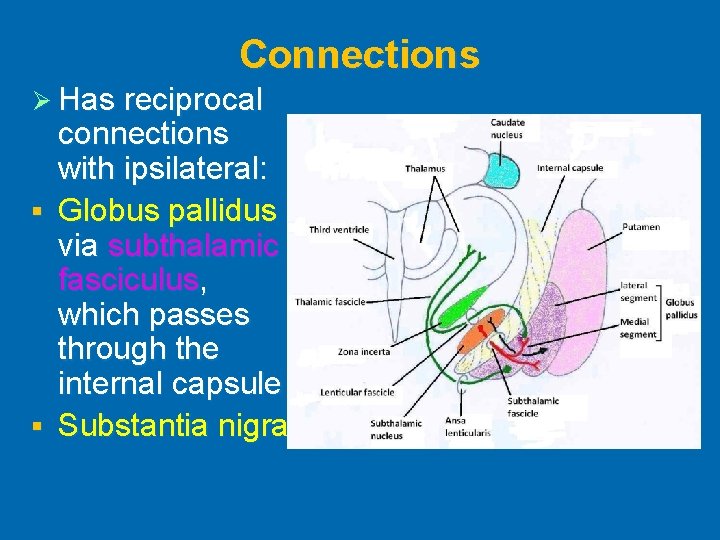
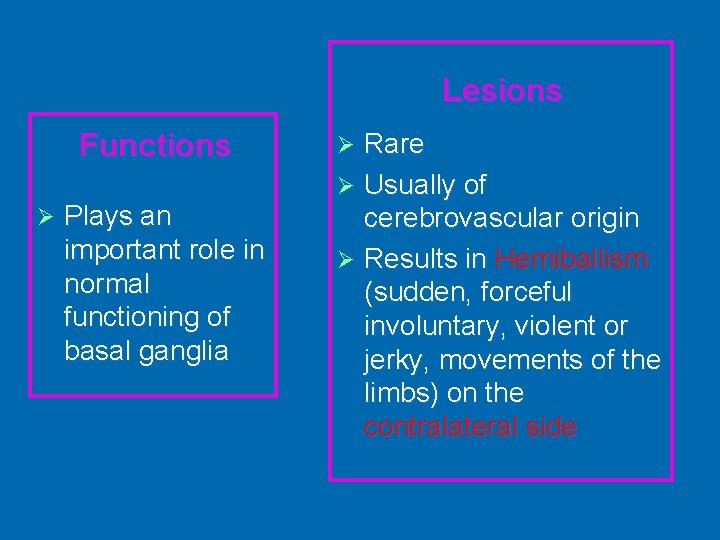
Connections Ø Has reciprocal connections with ipsilateral: § Globus pallidus via subthalamic fasciculus, which passes through the internal capsule § Substantia nigra
Lesions Functions Ø Plays an important role in normal functioning of basal ganglia Rare Ø Usually of cerebrovascular origin Ø Results in Hemiballism (sudden, forceful involuntary, violent or jerky, movements of the limbs) on the contralateral side Ø
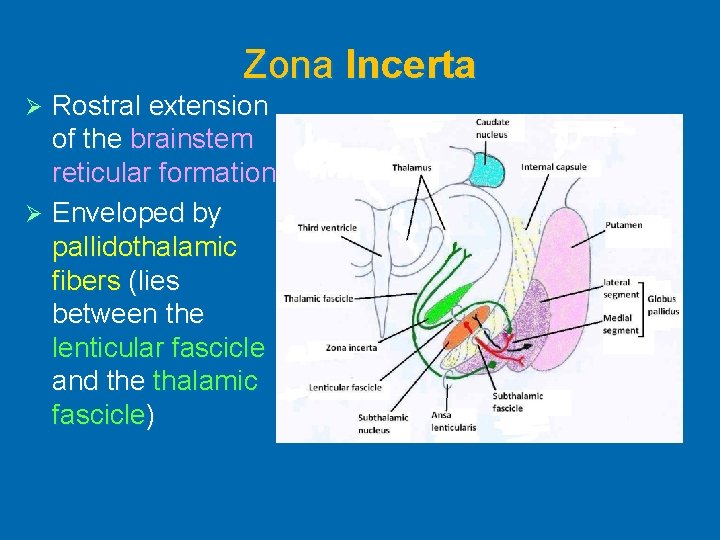
Zona Incerta Rostral extension of the brainstem reticular formation Ø Enveloped by pallidothalamic fibers (lies between the lenticular fascicle and the thalamic fascicle) Ø

HYPOTHALAMUS
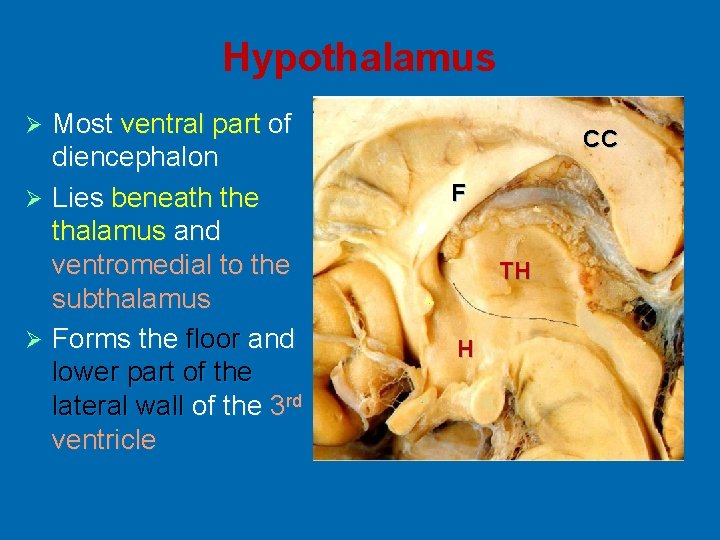
Hypothalamus Most ventral part of diencephalon Ø Lies beneath the thalamus and ventromedial to the subthalamus Ø Forms the floor and lower part of the lateral wall of the 3 rd ventricle Ø CC F TH H
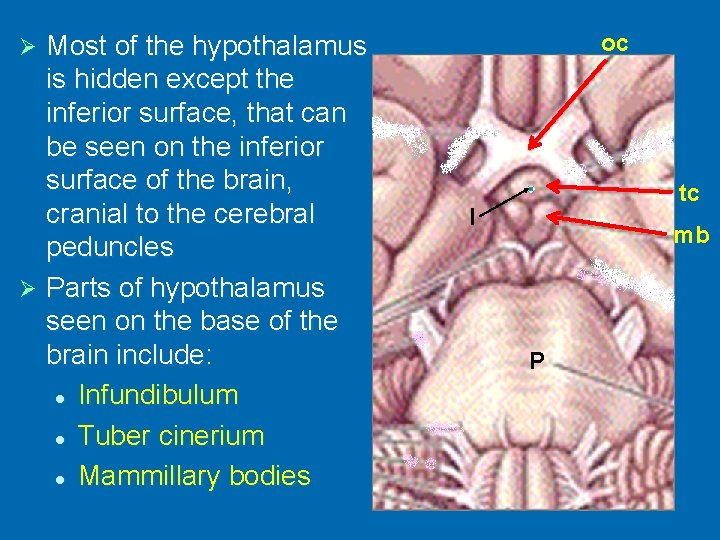
Most of the hypothalamus is hidden except the inferior surface, that can be seen on the inferior surface of the brain, cranial to the cerebral peduncles Ø Parts of hypothalamus seen on the base of the brain include: l Infundibulum l Tuber cinerium l Mammillary bodies oc Ø tc I mb P

The anterior column of the fornix passes vertically through the substance of hypothalamus (to terminate in the mamillary body) and divides it into medial and lateral zones F mb
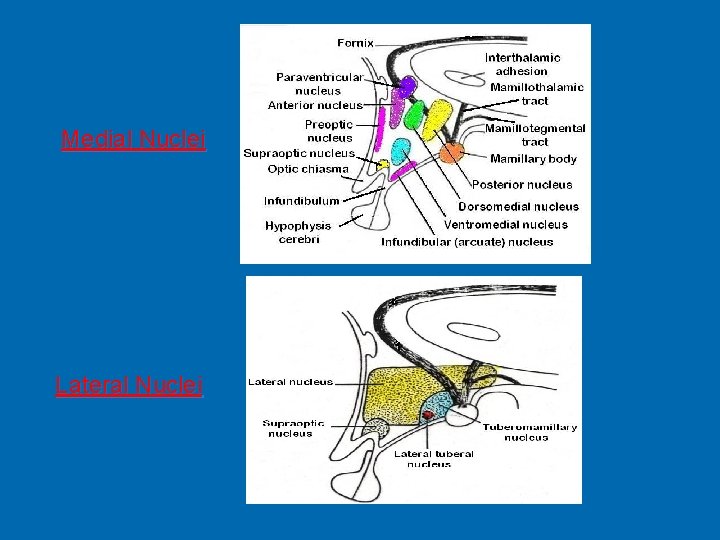
Medial Nuclei Lateral Nuclei
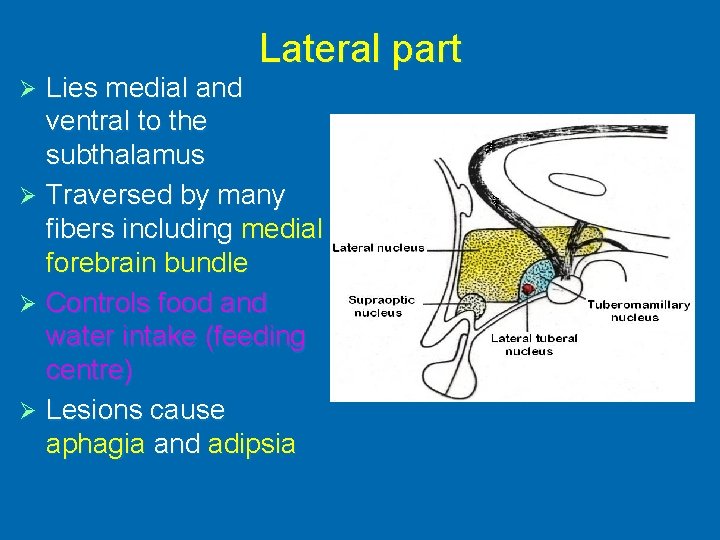
Lateral part Lies medial and ventral to the subthalamus Ø Traversed by many fibers including medial forebrain bundle Ø Controls food and water intake (feeding centre) Ø Lesions cause aphagia and adipsia Ø
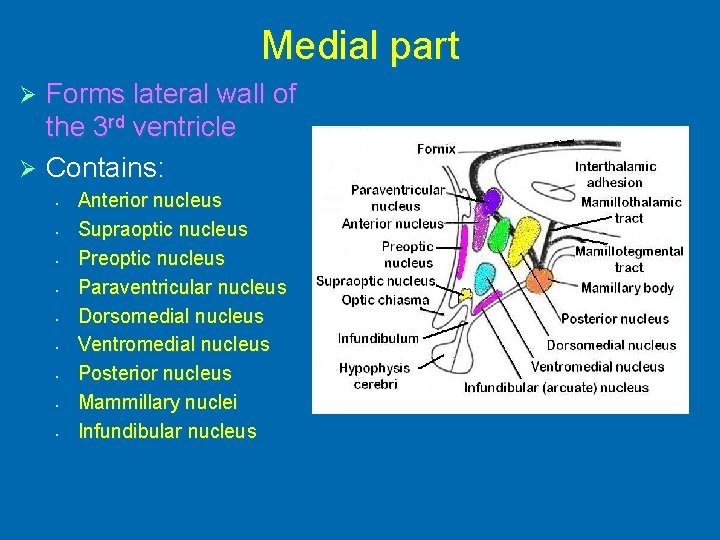
Medial part Forms lateral wall of the 3 rd ventricle Ø Contains: Ø • • • Anterior nucleus Supraoptic nucleus Preoptic nucleus Paraventricular nucleus Dorsomedial nucleus Ventromedial nucleus Posterior nucleus Mammillary nuclei Infundibular nucleus
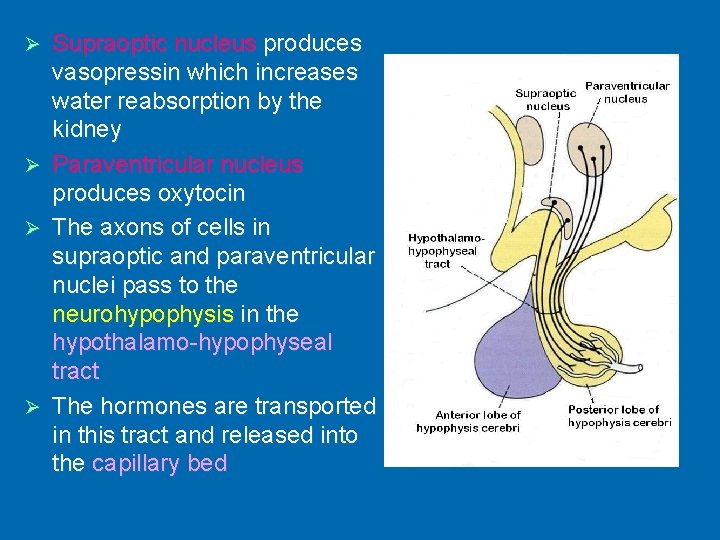
Ø Ø Supraoptic nucleus produces vasopressin which increases water reabsorption by the kidney Paraventricular nucleus produces oxytocin The axons of cells in supraoptic and paraventricular nuclei pass to the neurohypophysis in the hypothalamo-hypophyseal tract The hormones are transported in this tract and released into the capillary bed
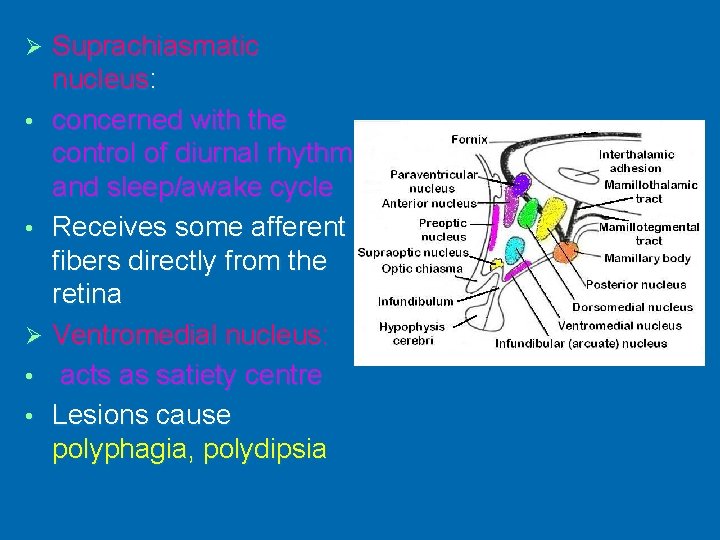
Suprachiasmatic nucleus: • concerned with the control of diurnal rhythm and sleep/awake cycle • Receives some afferent fibers directly from the retina Ø Ventromedial nucleus: • acts as satiety centre • Lesions cause polyphagia, polydipsia Ø
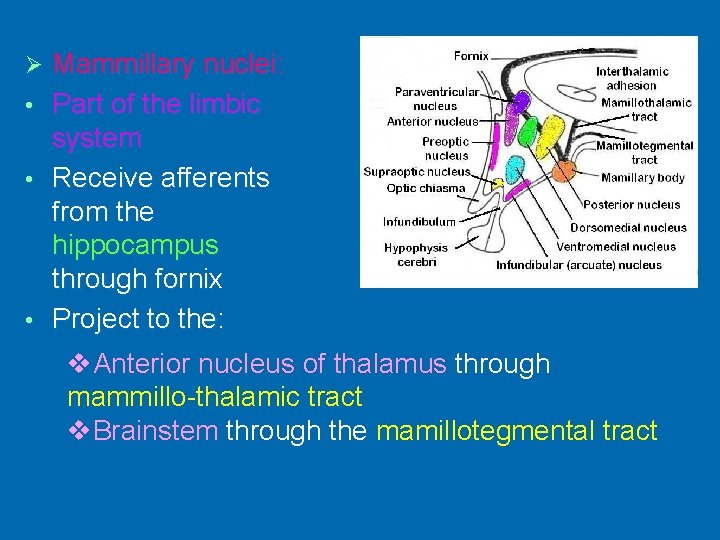
Mammillary nuclei: • Part of the limbic system • Receive afferents from the hippocampus through fornix • Project to the: Ø v. Anterior nucleus of thalamus through mammillo-thalamic tract v. Brainstem through the mamillotegmental tract
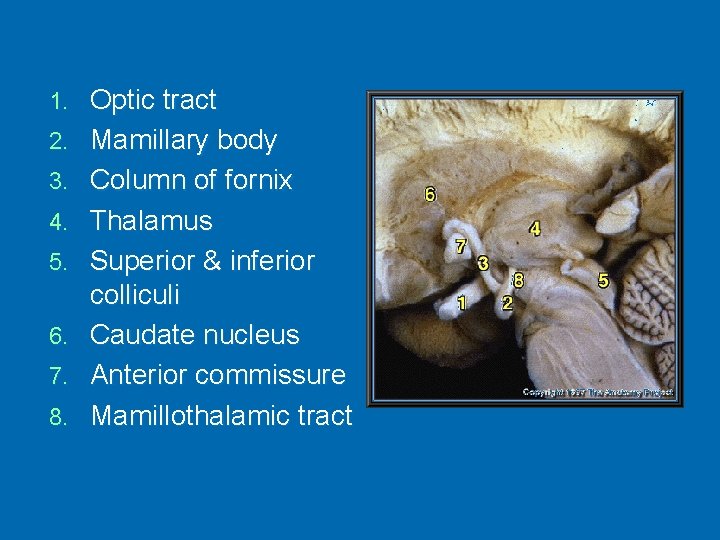
1. 2. 3. 4. 5. 6. 7. 8. Optic tract Mamillary body Column of fornix Thalamus Superior & inferior colliculi Caudate nucleus Anterior commissure Mamillothalamic tract
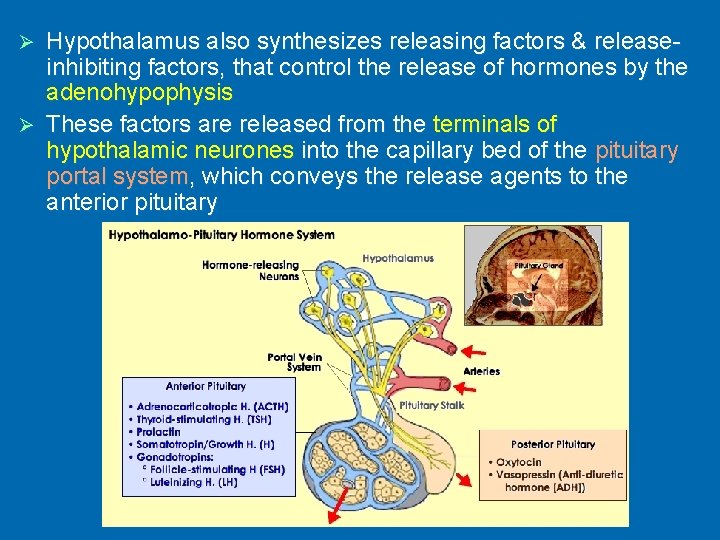
Hypothalamus also synthesizes releasing factors & releaseinhibiting factors, that control the release of hormones by the adenohypophysis Ø These factors are released from the terminals of hypothalamic neurones into the capillary bed of the pituitary portal system, which conveys the release agents to the anterior pituitary Ø
Functions 1. 2. 3. 4. 5. 6. 7. 8. 9. Co-ordination of homeostatic mechanism Controls the release of hormones from the pituitary gland. Center for regulation of autonomic activity --- controls medulla oblongata nuclei for cardiovascular, respiration q Activation of posterior region associated with sympathetic responses q Activation of anterior region associated with parasympathetic responses The mammillary nuclei are associated with the emotional behaviour and memory The suprachiasmatic nucleus is concerned with diurnal rhythm & sleep/waking cycle The lateral hypothalamus & the ventromedial nucleus regulate feeding and drinking Center for Feeding reflexes—licking, swallowing, etc. Controls subconscious skeletal muscle movements—facial expressions, sexual movements Coordinates autonomic response to conscious input—thought of fear produces accelerated heart rate, etc.
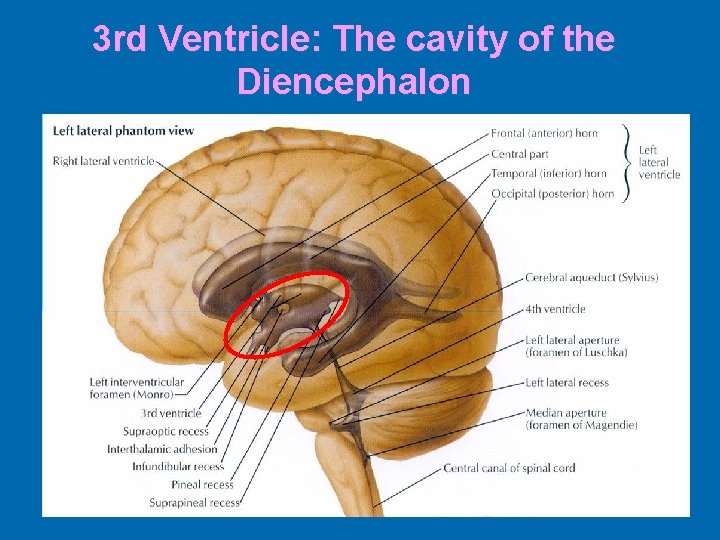
3 rd Ventricle: The cavity of the Diencephalon
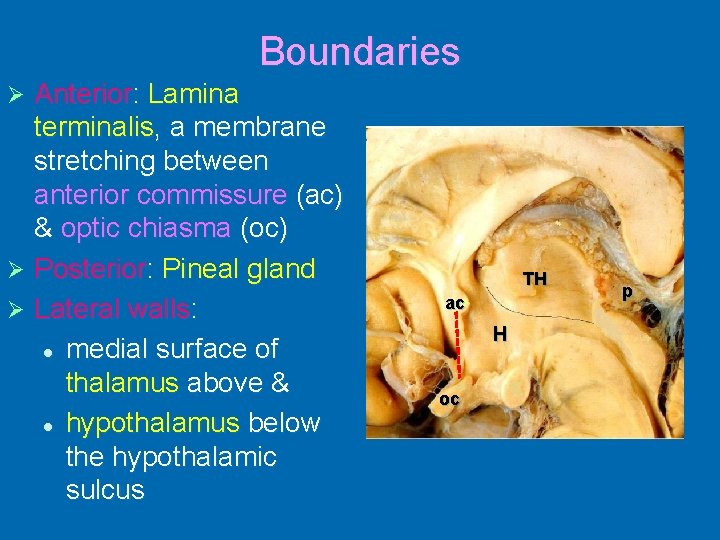
Boundaries Anterior: Lamina terminalis, a membrane stretching between anterior commissure (ac) & optic chiasma (oc) Ø Posterior: Pineal gland Ø Lateral walls: l medial surface of thalamus above & l hypothalamus below the hypothalamic sulcus Ø TH ac H oc p
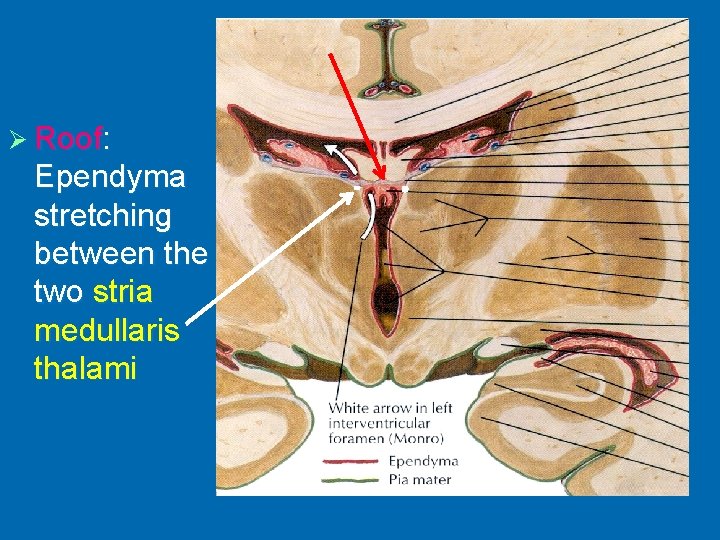
Ø Roof: Ependyma stretching between the two stria medullaris thalami
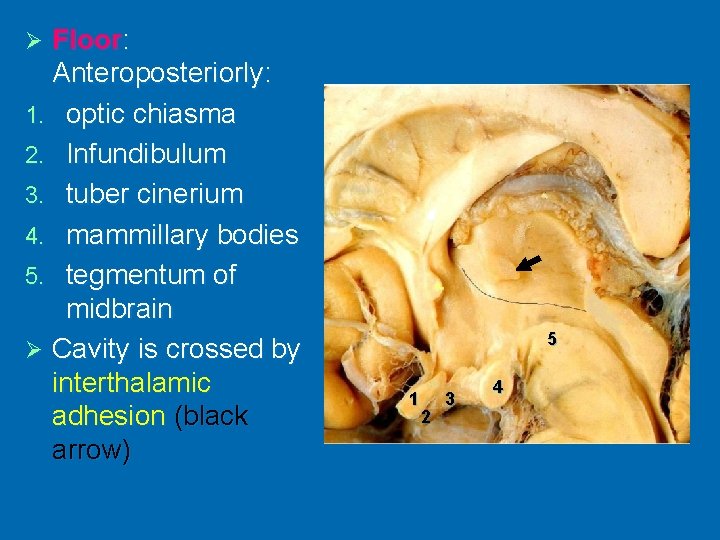
Floor: Anteroposteriorly: 1. optic chiasma 2. Infundibulum 3. tuber cinerium 4. mammillary bodies 5. tegmentum of midbrain Ø Cavity is crossed by interthalamic adhesion (black arrow) Ø 5 1 2 3 4
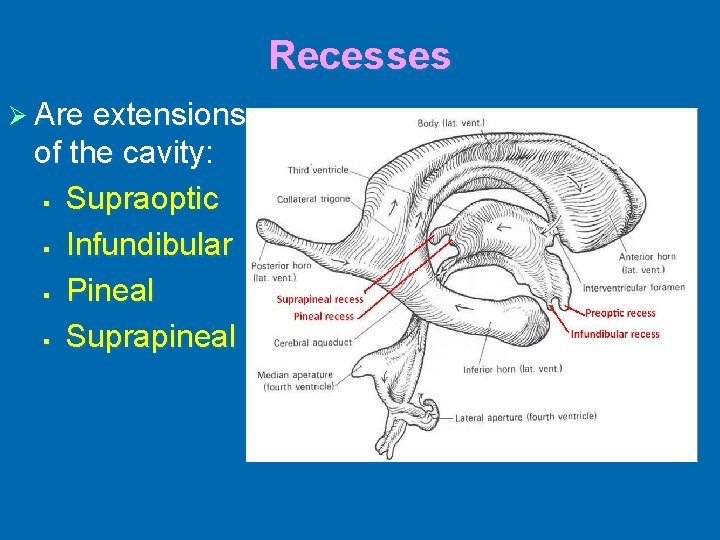
Recesses Ø Are extensions of the cavity: § Supraoptic § Infundibular § Pineal § Suprapineal
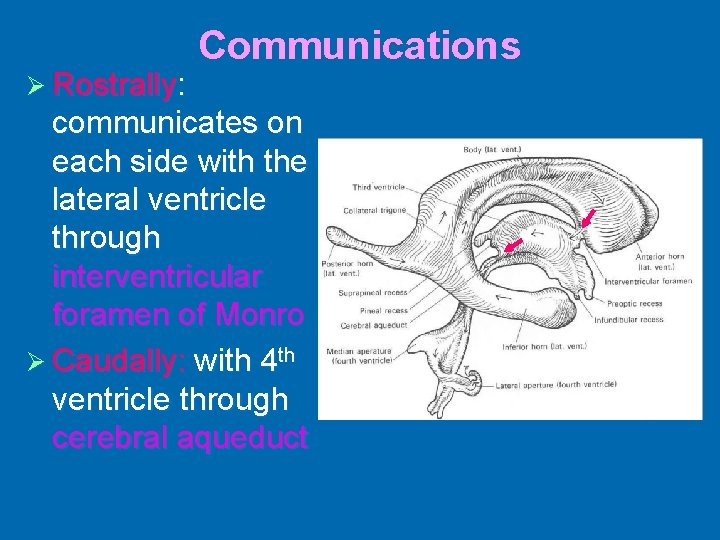
Ø Rostrally: Communications communicates on each side with the lateral ventricle through interventricular foramen of Monro Ø Caudally: with 4 th ventricle through cerebral aqueduct
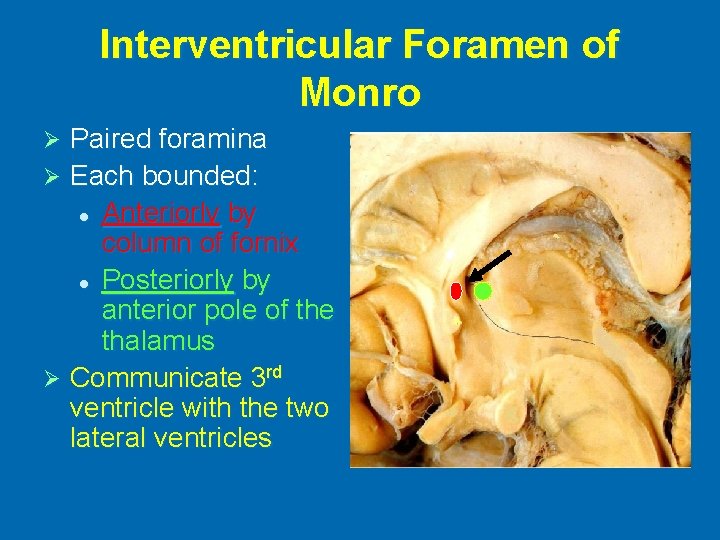
Interventricular Foramen of Monro Paired foramina Ø Each bounded: l Anteriorly by column of fornix l Posteriorly by anterior pole of the thalamus Ø Communicate 3 rd ventricle with the two lateral ventricles Ø
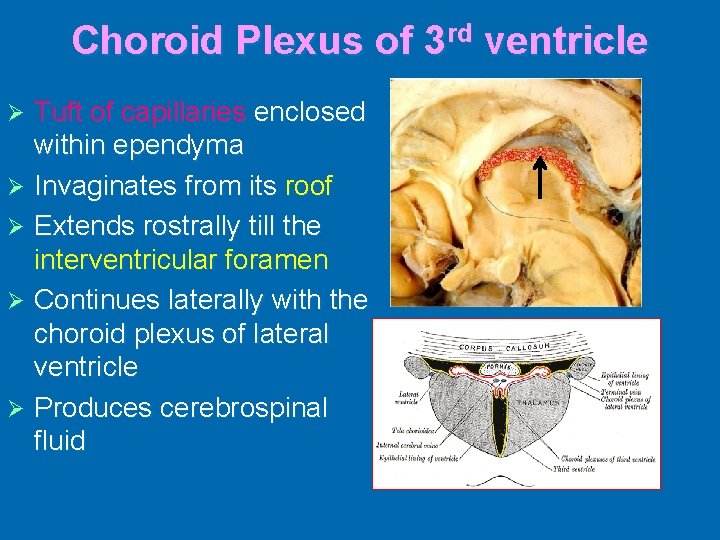
Choroid Plexus of 3 rd ventricle Tuft of capillaries enclosed within ependyma Ø Invaginates from its roof Ø Extends rostrally till the interventricular foramen Ø Continues laterally with the choroid plexus of lateral ventricle Ø Produces cerebrospinal fluid Ø
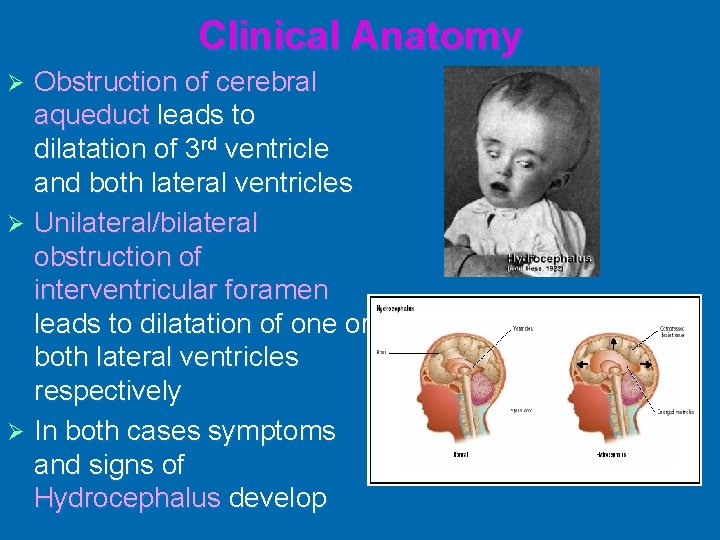
Clinical Anatomy Obstruction of cerebral aqueduct leads to dilatation of 3 rd ventricle and both lateral ventricles Ø Unilateral/bilateral obstruction of interventricular foramen leads to dilatation of one or both lateral ventricles respectively Ø In both cases symptoms and signs of Hydrocephalus develop Ø

Thank You & Good Luck
- Slides: 32