
Diencephalon Sits on top of the brain stem
Diencephalon · Sits on top of the brain stem · Enclosed by the cerebral heispheres · Made of three parts · Thalamus · Hypothalamus · Epithalamus Copyright © 2003 Pearson Education, Inc. publishing as Benjamin Cummings Slide
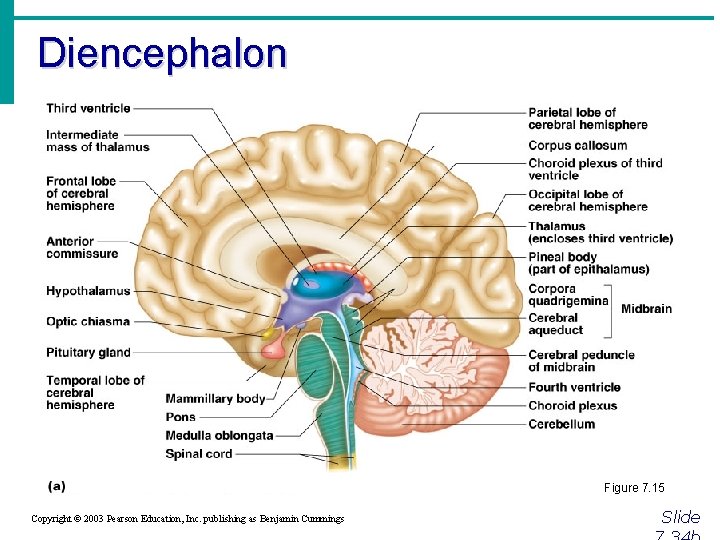
Diencephalon Figure 7. 15 Copyright © 2003 Pearson Education, Inc. publishing as Benjamin Cummings Slide
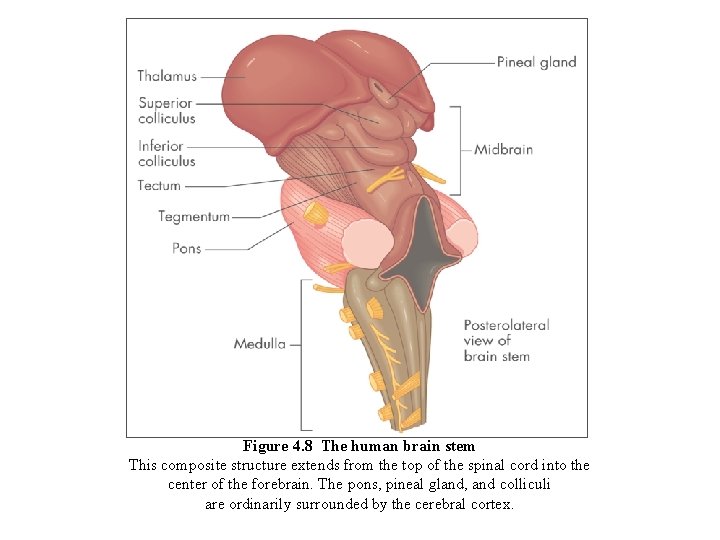
Figure 4. 8 The human brain stem This composite structure extends from the top of the spinal cord into the center of the forebrain. The pons, pineal gland, and colliculi are ordinarily surrounded by the cerebral cortex.
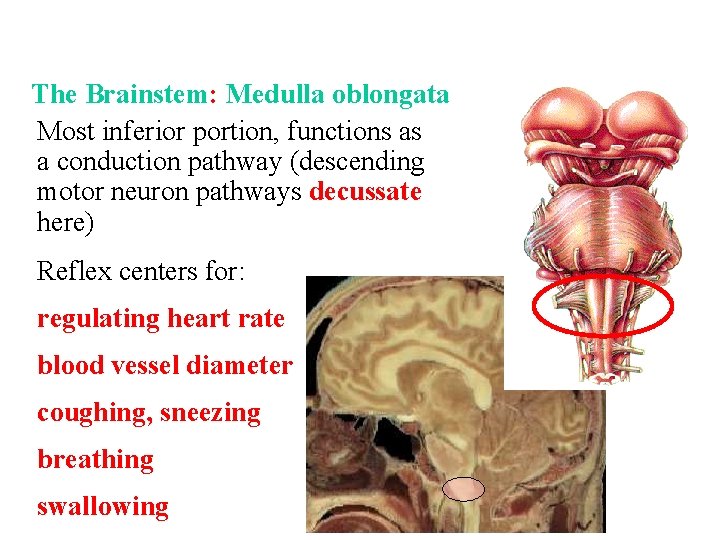
The Brainstem: Medulla oblongata Most inferior portion, functions as a conduction pathway (descending motor neuron pathways decussate here) Reflex centers for: regulating heart rate blood vessel diameter coughing, sneezing breathing swallowing

The Brainstem: Pons Superior to Medulla oblongata. Contains more ascending and descending pathways. Relays information from cerebrum to cerebellum. Also includes sleep and respiratory centers.

The Brainstem: Midbrain Small section superior to the pons. Part of the auditory pathways and visual reflexes Also involved in regulating muscle tone/activity and coordination
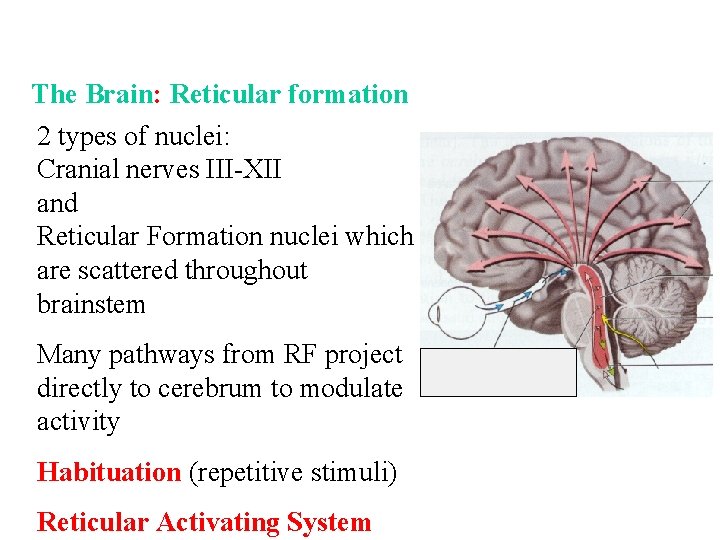
The Brain: Reticular formation 2 types of nuclei: Cranial nerves III-XII and Reticular Formation nuclei which are scattered throughout brainstem Many pathways from RF project directly to cerebrum to modulate activity Habituation (repetitive stimuli) Reticular Activating System
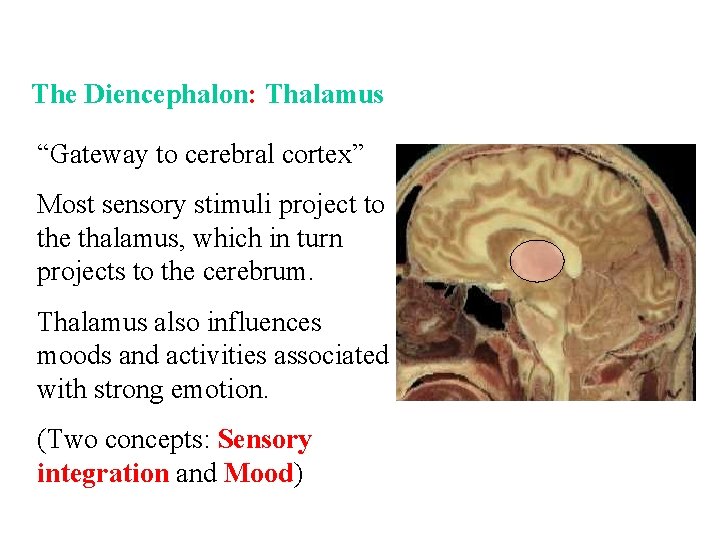
The Diencephalon: Thalamus “Gateway to cerebral cortex” Most sensory stimuli project to the thalamus, which in turn projects to the cerebrum. Thalamus also influences moods and activities associated with strong emotion. (Two concepts: Sensory integration and Mood)
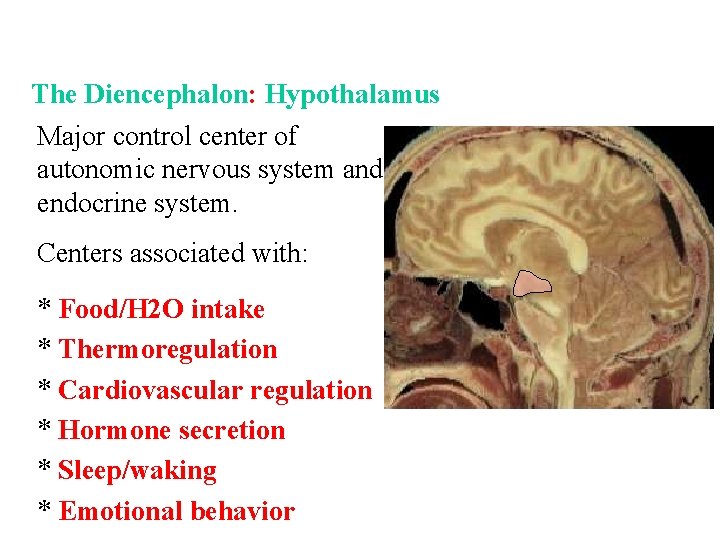
The Diencephalon: Hypothalamus Major control center of autonomic nervous system and endocrine system. Centers associated with: * Food/H 2 O intake * Thermoregulation * Cardiovascular regulation * Hormone secretion * Sleep/waking * Emotional behavior
Thalamus · Surrounds the third ventricle · The relay station for sensory impulses · Transfers impulses to the correct part of the cortex for localization and interpretation Copyright © 2003 Pearson Education, Inc. publishing as Benjamin Cummings Slide 7. 35
Hypothalamus · Under the thalamus · Important autonomic nervous system center · Helps regulate body temperature · Controls water balance · Regulates metabolism Copyright © 2003 Pearson Education, Inc. publishing as Benjamin Cummings Slide
Hypothalamus · An important part of the limbic system (emotions) · The pituitary gland is attached to the hypothalamus Copyright © 2003 Pearson Education, Inc. publishing as Benjamin Cummings Slide
Epithalamus · Forms the roof of the third ventricle · Houses the pineal body (an endocrine gland) · Includes the choroid plexus – forms cerebrospinal fluid Copyright © 2003 Pearson Education, Inc. publishing as Benjamin Cummings Slide 7. 37
Brain Stem · Attaches to the spinal cord · Parts of the brain stem · Midbrain · Pons · Medulla oblongata Copyright © 2003 Pearson Education, Inc. publishing as Benjamin Cummings Slide
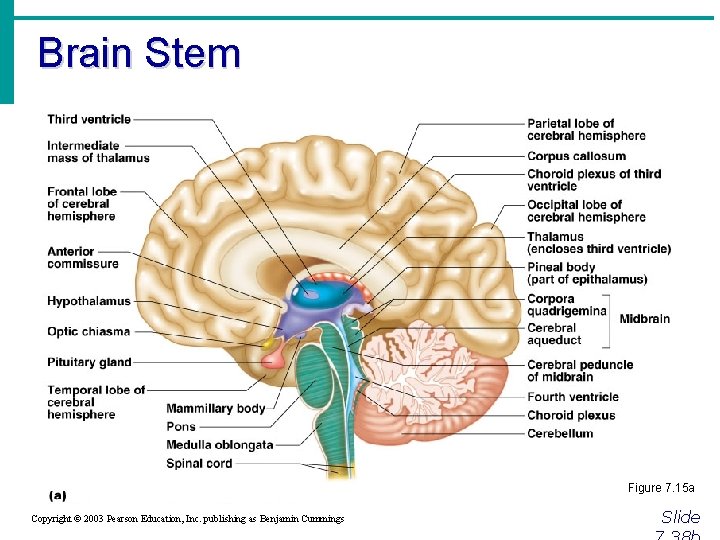
Brain Stem Figure 7. 15 a Copyright © 2003 Pearson Education, Inc. publishing as Benjamin Cummings Slide
Midbrain · Mostly composed of tracts of nerve fibers · Reflex centers for vision and hearing · Cerebral aquaduct – 3 rd-4 th ventricles Copyright © 2003 Pearson Education, Inc. publishing as Benjamin Cummings Slide 7. 39
Pons · The bulging center part of the brain stem · Mostly composed of fiber tracts · Includes nuclei involved in the control of breathing Copyright © 2003 Pearson Education, Inc. publishing as Benjamin Cummings Slide 7. 40
Medulla Oblongata · · The lowest part of the brain stem Merges into the spinal cord Includes important fiber tracts Contains important control centers · Heart rate control · Blood pressure regulation · Breathing · Swallowing · Vomiting Copyright © 2003 Pearson Education, Inc. publishing as Benjamin Cummings Slide 7. 41

- Slides: 19