
Dielectrics in superconducting structures Substrates Amorphous surface oxides
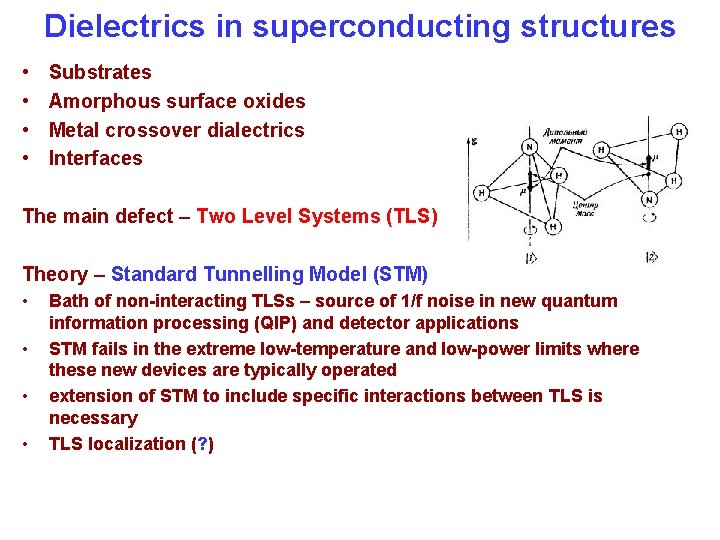
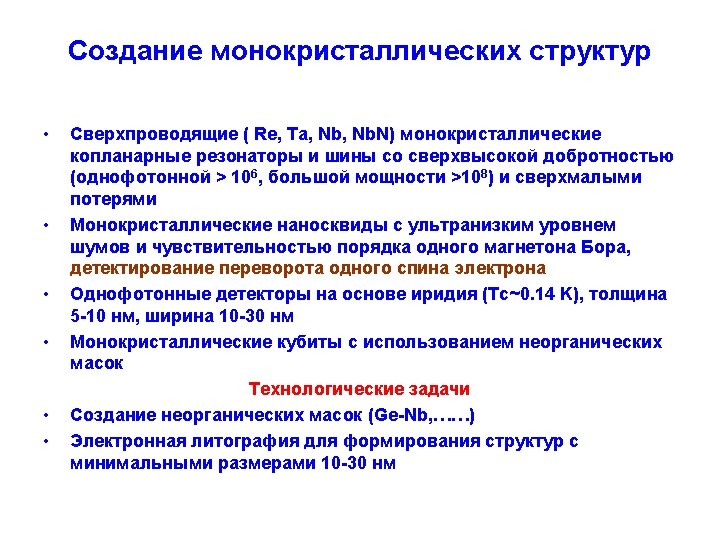
Dielectrics in superconducting structures • • Substrates Amorphous surface oxides Metal crossover dialectrics Interfaces The main defect – Two Level Systems (TLS) Theory – Standard Tunnelling Model (STM) • • Bath of non-interacting TLSs – source of 1/f noise in new quantum information processing (QIP) and detector applications STM fails in the extreme low-temperature and low-power limits where these new devices are typically operated extension of STM to include specific interactions between TLS is necessary TLS localization (? )
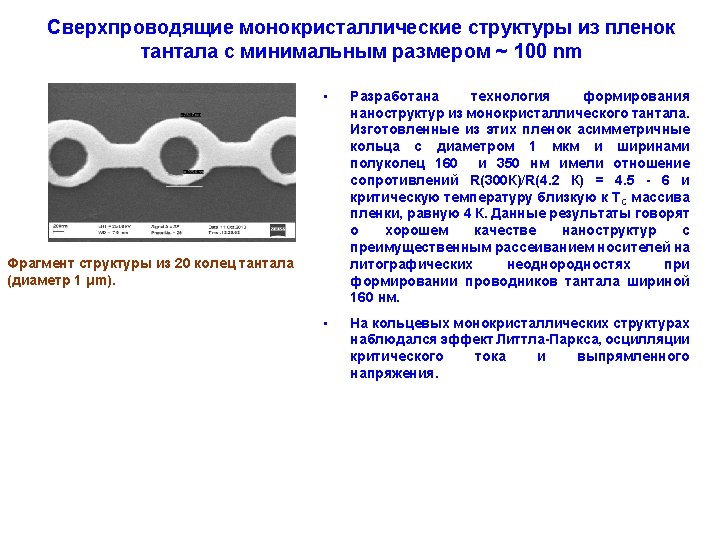

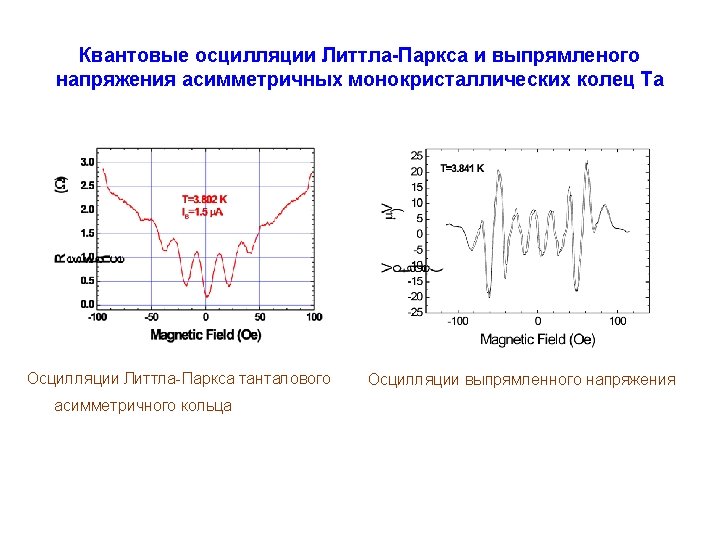
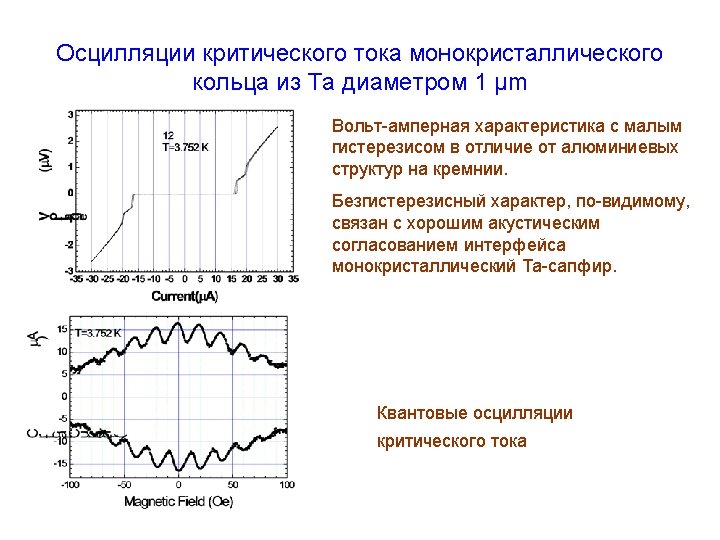
Persistent current in superconducting rings All periodical phenomena in supeconducting ring structures result from Bohr quantization The specrtum of permited velosity states is quantized => n=0, ± 1, … r –radius of a ring This results in persistent current Weak Screening IPL≈10µA× 7 p. H≈0. 03Φ 0<< Φ 0
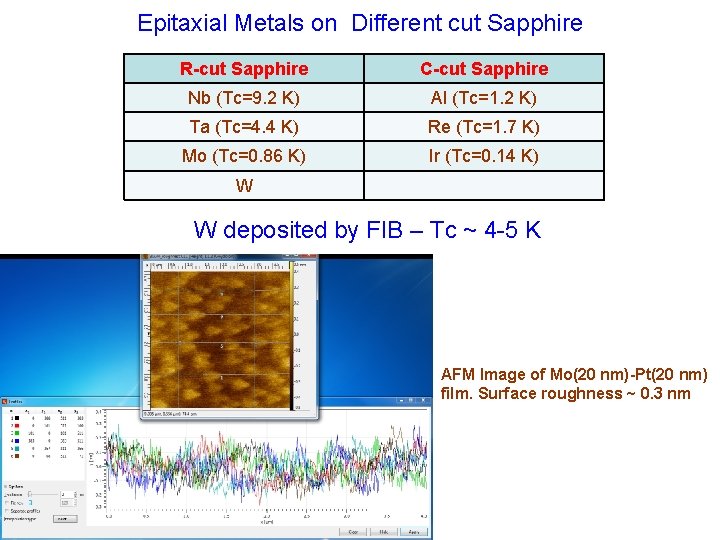
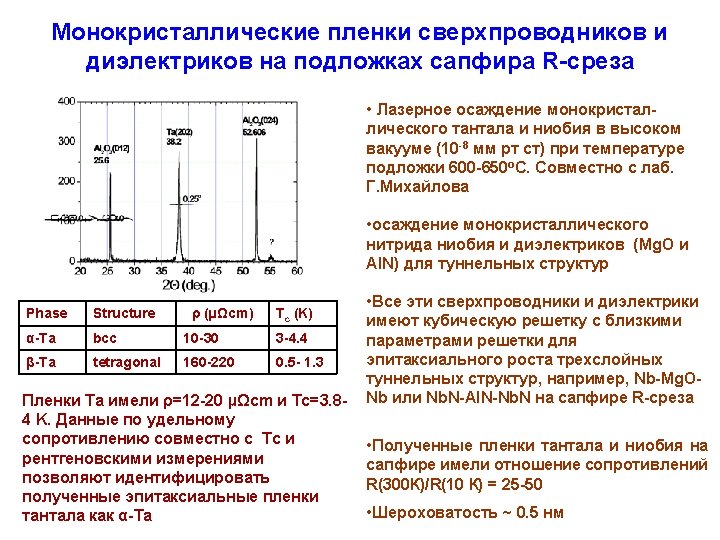
Epitaxial Metals on Different cut Sapphire R-cut Sapphire C-cut Sapphire Nb (Tc=9. 2 K) Al (Tc=1. 2 K) Ta (Tc=4. 4 K) Re (Tc=1. 7 K) Mo (Tc=0. 86 K) Ir (Tc=0. 14 K) W W deposited by FIB – Tc ~ 4 -5 K AFM Image of Mo(20 nm)-Pt(20 nm) film. Surface roughness ~ 0. 3 nm
Evidence for interacting two-level systems from the 1/f noise of a superconducting resonator J. Burnett 1, 2, L. Faoro 3, 4, I. Wisby 1, 2, V. L. Gurtovoi 5, A. V. Chernykh 5, G. M. Mikhailov 5, V. A. Tulin 5, R. Shaikhaidarov 2, V. N. Antonov 2, P. J. Meeson 2, A. Ya. Tzalenchuk 1, and T. Lindström 1 1 National Physical Laboratory, Hampton Road, Teddington, TW 11 0 LW, UK 2 Physics Department, Royal Holloway University of London, Egham, Surrey TW 20 0 EX, UK 3 Laboratoire de Physique Theorique et Hautes Energies, CNRS UMR 7589, Universites Paris 6 et 7, 4 place Jussieu, 75252 Paris, Cedex 05, France 4 Department of Physics and Astronomy, Rutgers The State University of New Jersey, 136 Frelinghuysen Road, Piscataway, 08854 New Jersey, USA 5 Institute of Microelectronics Technology, Russian Academy of Sciences, 142432 Chernogolovka, Moscow District, Russia Nature Communications 5 (4119), 1 -6 (2014)
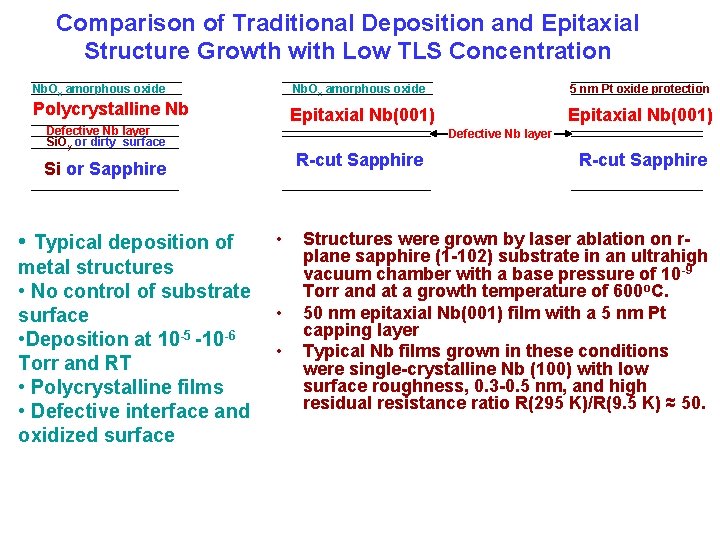
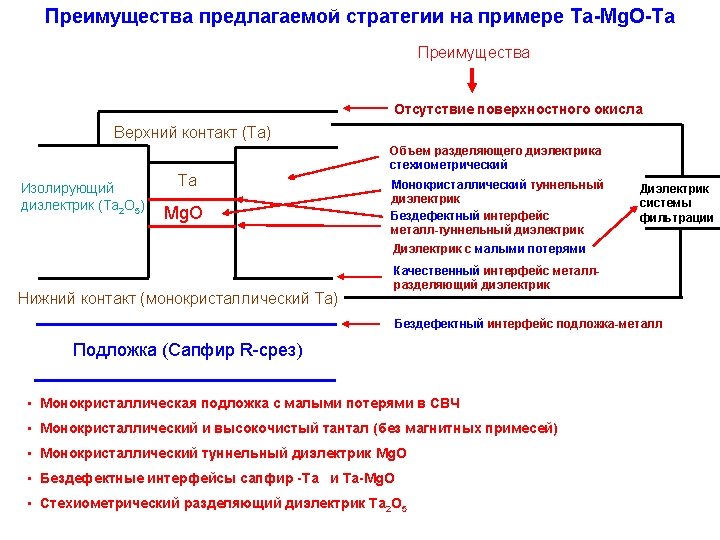
Comparison of Traditional Deposition and Epitaxial Structure Growth with Low TLS Concentration Nb. Ox amorphous oxide 5 nm Pt oxide protection Polycrystalline Nb Epitaxial Nb(001) Defective Nb layer Si. Oy or dirty surface Defective Nb layer R-cut Sapphire Si or Sapphire • Typical deposition of metal structures • No control of substrate surface • Deposition at 10 -5 -10 -6 Torr and RT • Polycrystalline films • Defective interface and oxidized surface • • • R-cut Sapphire Structures were grown by laser ablation on rplane sapphire (1 -102) substrate in an ultrahigh vacuum chamber with a base pressure of 10 -9 Torr and at a growth temperature of 600 o. C. 50 nm epitaxial Nb(001) film with a 5 nm Pt capping layer Typical Nb films grown in these conditions were single-crystalline Nb (100) with low surface roughness, 0. 3 -0. 5 nm, and high residual resistance ratio R(295 K)/R(9. 5 K) ≈ 50.
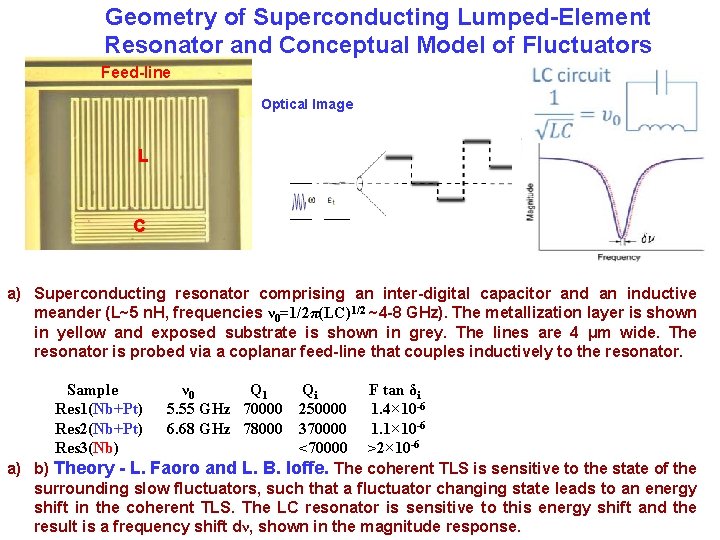
Geometry of Superconducting Lumped-Element Resonator and Conceptual Model of Fluctuators Feed-line Optical Image L C a) Superconducting resonator comprising an inter-digital capacitor and an inductive meander (L~5 n. H, frequencies ν 0=1/2π(LC)1/2 ~4 -8 GHz). The metallization layer is shown in yellow and exposed substrate is shown in grey. The lines are 4 μm wide. The JJ resonator is probed via a coplanar feed-line that couples inductively to the resonator. ll dimensions in μm. Sample ν 0 Ql Qi F tan δi Res 1(Nb+Pt) 5. 55 GHz 70000 250000 1. 4× 10 -6 Res 2(Nb+Pt) 6. 68 GHz 78000 370000 1. 1× 10 -6 Res 3(Nb) <70000 >2× 10 -6 a) b) Theory - L. Faoro and L. B. Ioffe. The coherent TLS is sensitive to the state of the surrounding slow fluctuators, such that a fluctuator changing state leads to an energy shift in the coherent TLS. The LC resonator is sensitive to this energy shift and the result is a frequency shift dν, shown in the magnitude response.
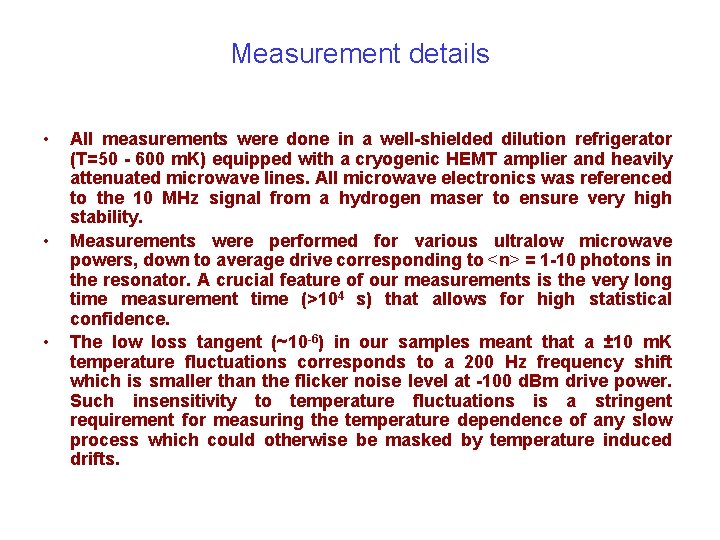
Measurement details • • • All measurements were done in a well-shielded dilution refrigerator (T=50 - 600 m. K) equipped with a cryogenic HEMT amplier and heavily attenuated microwave lines. All microwave electronics was referenced to the 10 MHz signal from a hydrogen maser to ensure very high stability. Measurements were performed for various ultralow microwave powers, down to average drive corresponding to <n> = 1 -10 photons in the resonator. A crucial feature of our measurements is the very long time measurement time (>104 s) that allows for high statistical confidence. The low loss tangent (~10 -6) in our samples meant that a ± 10 m. K temperature fluctuations corresponds to a 200 Hz frequency shift which is smaller than the flicker noise level at -100 d. Bm drive power. Such insensitivity to temperature fluctuations is a stringent requirement for measuring the temperature dependence of any slow process which could otherwise be masked by temperature induced drifts.
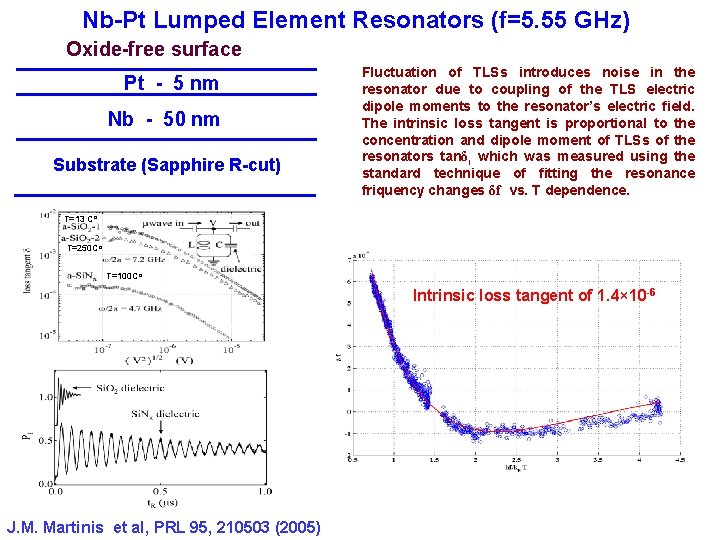
Nb-Pt Lumped Element Resonators (f=5. 55 GHz) Oxide-free surface Pt - 5 nm Nb - 50 nm Substrate (Sapphire R-cut) Fluctuation of TLSs introduces noise in the resonator due to coupling of the TLS electric dipole moments to the resonator’s electric field. The intrinsic loss tangent is proportional to the concentration and dipole moment of TLSs of the resonators tanδi which was measured using the standard technique of fitting the resonance friquency changes δf vs. T dependence. T=13 Co T=250 Co T=100 Co Intrinsic loss tangent of 1. 4× 10 -6 J. M. Martinis et al, PRL 95, 210503 (2005)
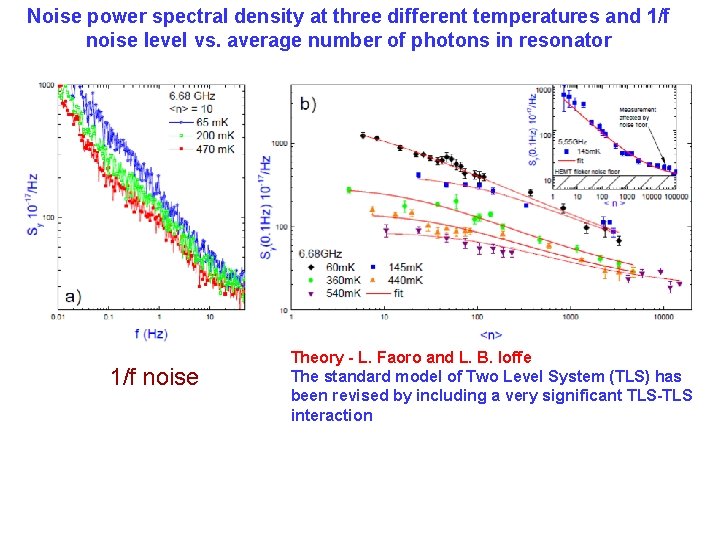
Noise power spectral density at three different temperatures and 1/f noise level vs. average number of photons in resonator 1/f noise Theory - L. Faoro and L. B. Ioffe The standard model of Two Level System (TLS) has been revised by including a very significant TLS-TLS interaction
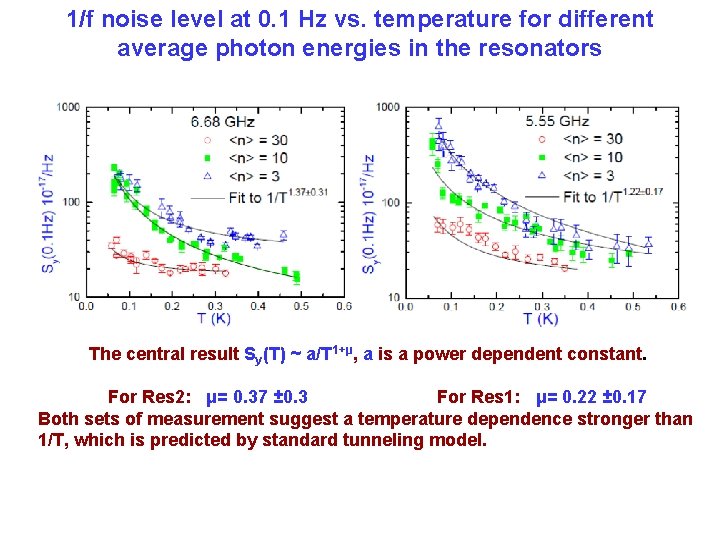
1/f noise level at 0. 1 Hz vs. temperature for different average photon energies in the resonators The central result Sy(T) ~ a/T 1+μ, a is a power dependent constant. For Res 2: μ= 0. 37 ± 0. 3 For Res 1: μ= 0. 22 ± 0. 17 Both sets of measurement suggest a temperature dependence stronger than 1/T, which is predicted by standard tunneling model.
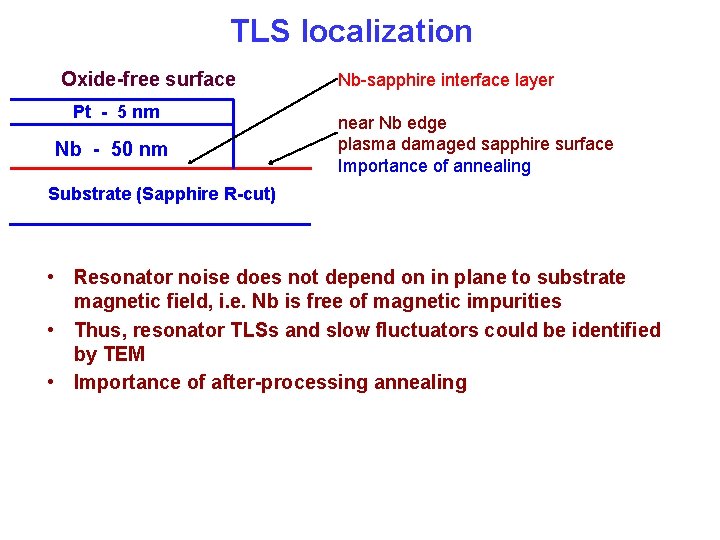
TLS localization Oxide-free surface Pt - 5 nm Nb - 50 nm Nb-sapphire interface layer near Nb edge plasma damaged sapphire surface Importance of annealing Substrate (Sapphire R-cut) • Resonator noise does not depend on in plane to substrate magnetic field, i. e. Nb is free of magnetic impurities • Thus, resonator TLSs and slow fluctuators could be identified by TEM • Importance of after-processing annealing
Нет субмикронных Джозефсоновских переходов из трехслойных структур для Flux-кубитов 1. Aluminum hard mask technique for the fabrication of high quality submicron Nb/Al–Al. Ox/Nb Josephson junctions (0. 8 μм) Ch. Kaiser, J. M. Meckbach, K. S. Ilin, J. Lisenfeld, R. Sch¨afer, A. V. Ustinov and M. Siegel, Supercond. Sci. Technol. 24, 035005 (2011) 2. Lifetime and Coherence of Two-Level Defects in a Josephson Junction Yoni Shalibo, Ya’ara Rofe, David Shwa, Felix Zeides, Matthew Neeley, John M. Martinis, and Nadav Katz (1 μм) PRL 105, 177001 (2010) 3. Phase qubits fabricated with trilayer junctions M. Weides, R. C. Bialczak, M. Lenander, E. Lucero, Matteo Mariantoni, M. Neeley, A. D. O’Connell, D. Sank, H. Wang, J. Wenner, T. Yamamoto, Y. Yin, A. N. Cleland, and J. Martinis Supercond. Sci. Technol. 24, 055005 (2011)
- Slides: 29