
Die Brder Grimm Whitney Inge Schoellerman Dorothea Grimm
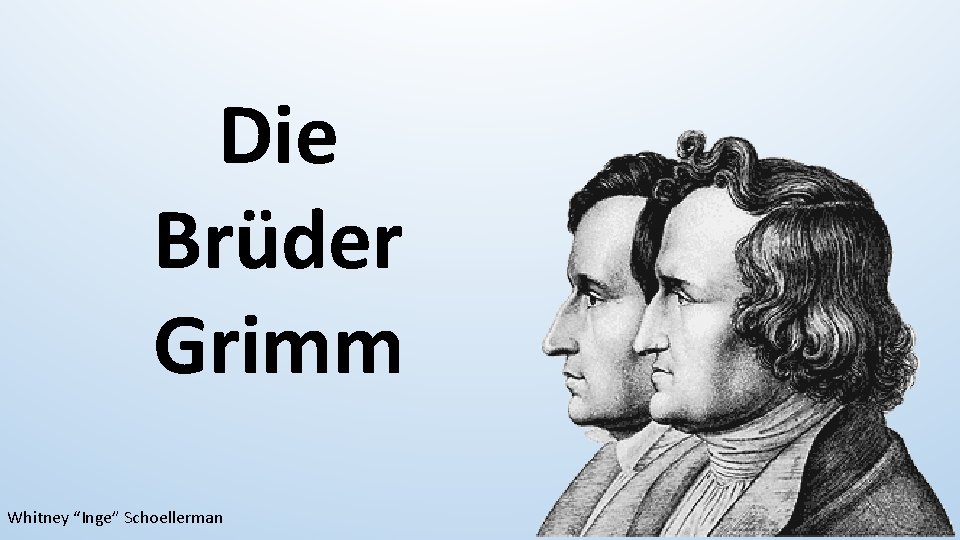
Die Brüder Grimm Whitney “Inge” Schoellerman
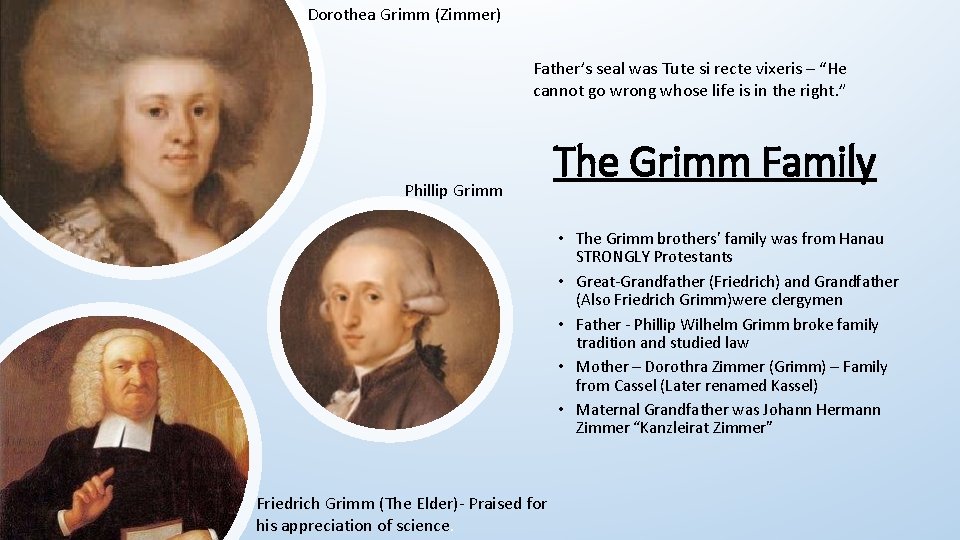
Dorothea Grimm (Zimmer) Father’s seal was Tute si recte vixeris – “He cannot go wrong whose life is in the right. ” Phillip Grimm The Grimm Family • The Grimm brothers’ family was from Hanau STRONGLY Protestants • Great-Grandfather (Friedrich) and Grandfather (Also Friedrich Grimm)were clergymen • Father - Phillip Wilhelm Grimm broke family tradition and studied law • Mother – Dorothra Zimmer (Grimm) – Family from Cassel (Later renamed Kassel) • Maternal Grandfather was Johann Hermann Zimmer “Kanzleirat Zimmer” Friedrich Grimm (The Elder)- Praised for his appreciation of science.
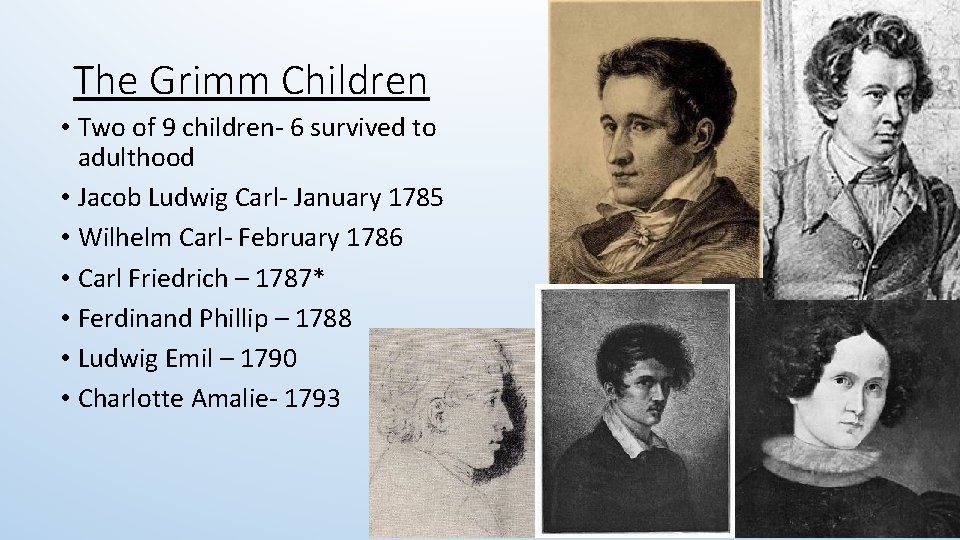
The Grimm Children • Two of 9 children- 6 survived to adulthood • Jacob Ludwig Carl- January 1785 • Wilhelm Carl- February 1786 • Carl Friedrich – 1787* • Ferdinand Phillip – 1788 • Ludwig Emil – 1790 • Charlotte Amalie- 1793
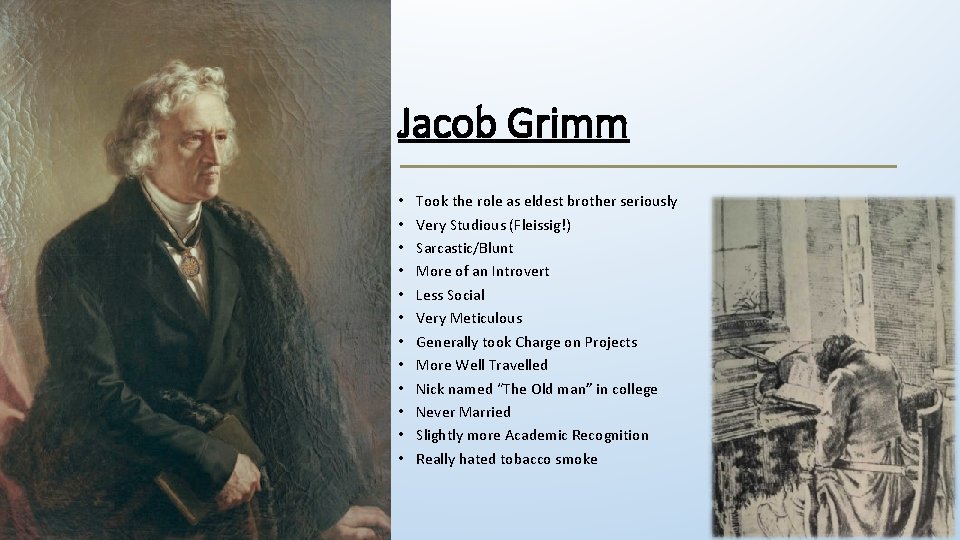
Jacob Grimm • • • Took the role as eldest brother seriously Very Studious (Fleissig!) Sarcastic/Blunt More of an Introvert Less Social Very Meticulous Generally took Charge on Projects More Well Travelled Nick named “The Old man” in college Never Married Slightly more Academic Recognition Really hated tobacco smoke
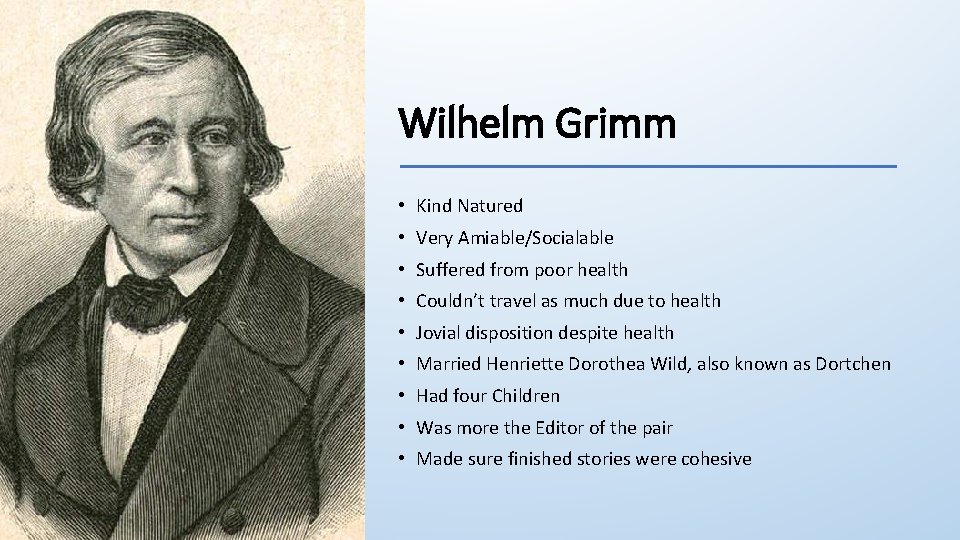
Wilhelm Grimm • Kind Natured • Very Amiable/Socialable • Suffered from poor health • Couldn’t travel as much due to health • Jovial disposition despite health • Married Henriette Dorothea Wild, also known as Dortchen • Had four Children • Was more the Editor of the pair • Made sure finished stories were cohesive
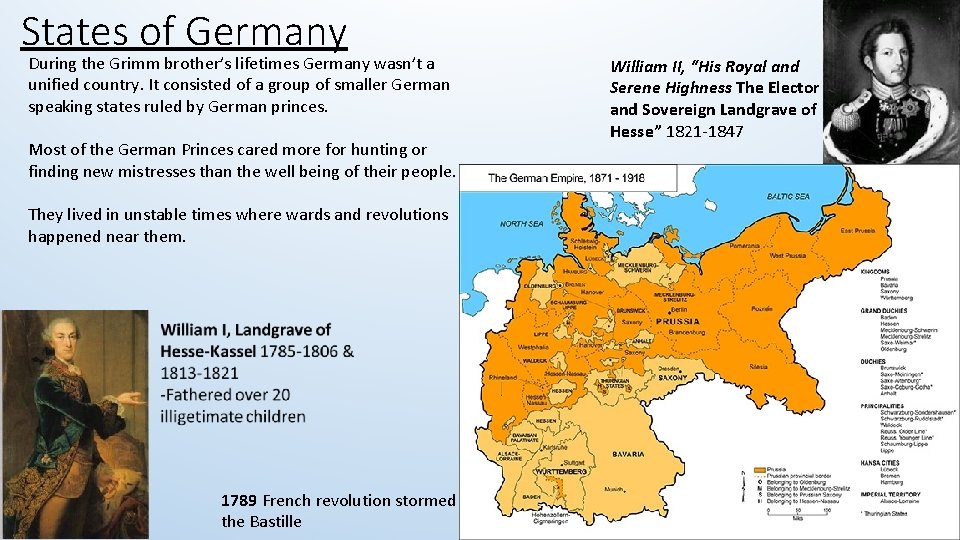
States of Germany During the Grimm brother’s lifetimes Germany wasn’t a unified country. It consisted of a group of smaller German speaking states ruled by German princes. Most of the German Princes cared more for hunting or finding new mistresses than the well being of their people. They lived in unstable times where wards and revolutions happened near them. 1789 French revolution stormed the Bastille William II, “His Royal and Serene Highness The Elector and Sovereign Landgrave of Hesse” 1821 -1847
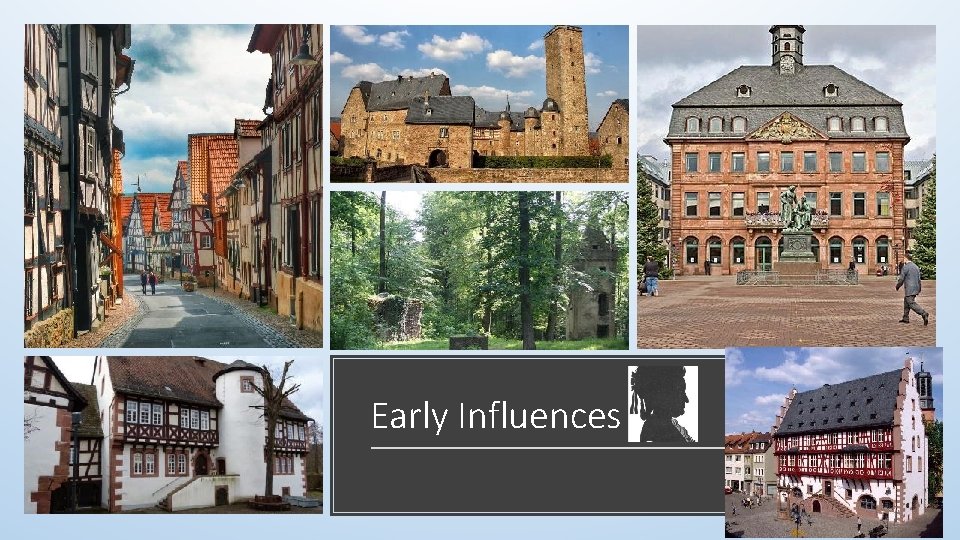
Early Influences
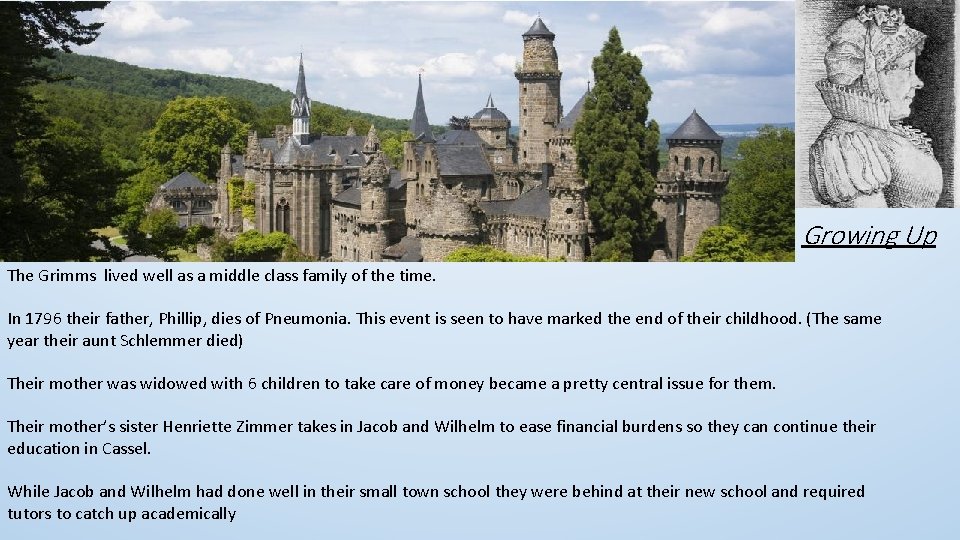
Growing Up The Grimms lived well as a middle class family of the time. In 1796 their father, Phillip, dies of Pneumonia. This event is seen to have marked the end of their childhood. (The same year their aunt Schlemmer died) Their mother was widowed with 6 children to take care of money became a pretty central issue for them. Their mother’s sister Henriette Zimmer takes in Jacob and Wilhelm to ease financial burdens so they can continue their education in Cassel. While Jacob and Wilhelm had done well in their small town school they were behind at their new school and required tutors to catch up academically
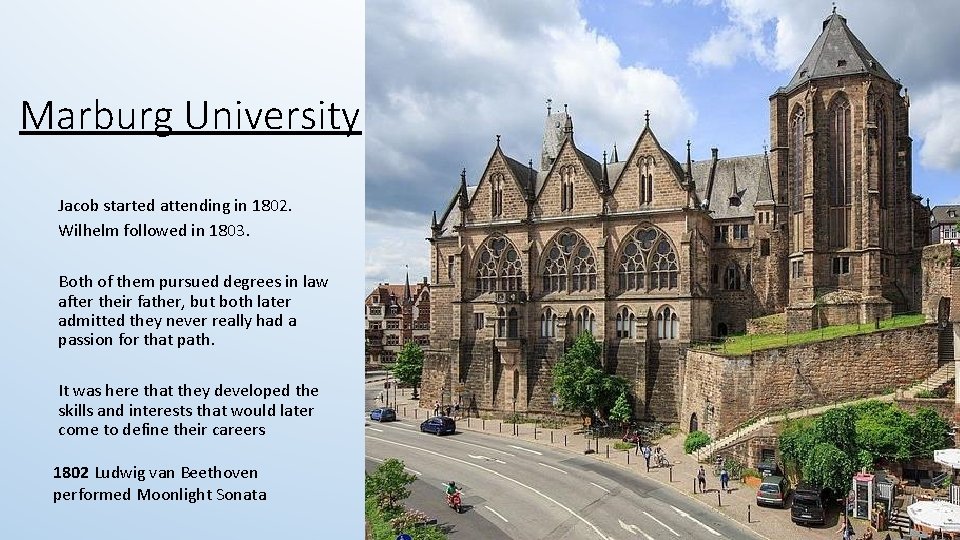
Marburg University Jacob started attending in 1802. Wilhelm followed in 1803. Both of them pursued degrees in law after their father, but both later admitted they never really had a passion for that path. It was here that they developed the skills and interests that would later come to define their careers 1802 Ludwig van Beethoven performed Moonlight Sonata
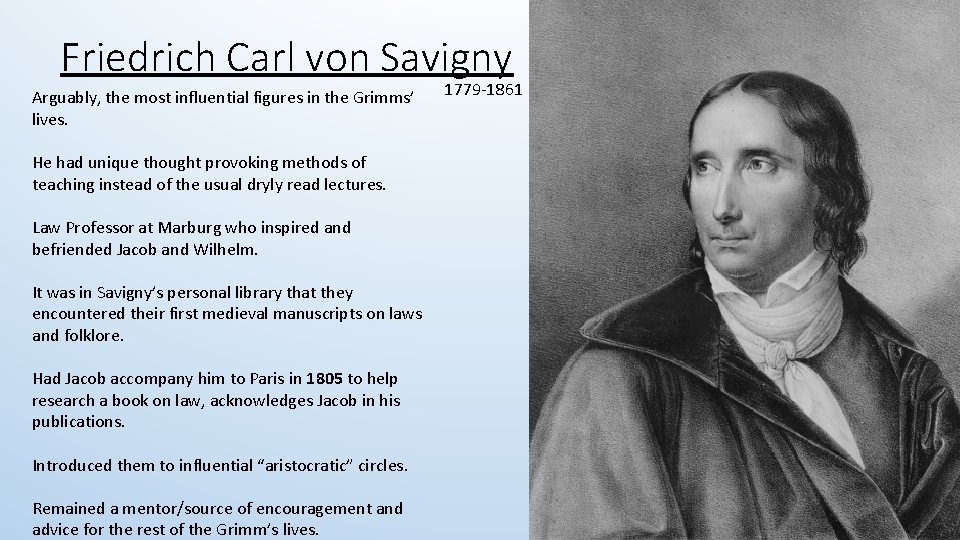
Friedrich Carl von Savigny Arguably, the most influential figures in the Grimms’ lives. He had unique thought provoking methods of teaching instead of the usual dryly read lectures. Law Professor at Marburg who inspired and befriended Jacob and Wilhelm. It was in Savigny’s personal library that they encountered their first medieval manuscripts on laws and folklore. Had Jacob accompany him to Paris in 1805 to help research a book on law, acknowledges Jacob in his publications. Introduced them to influential “aristocratic” circles. Remained a mentor/source of encouragement and advice for the rest of the Grimm’s lives. 1779 -1861
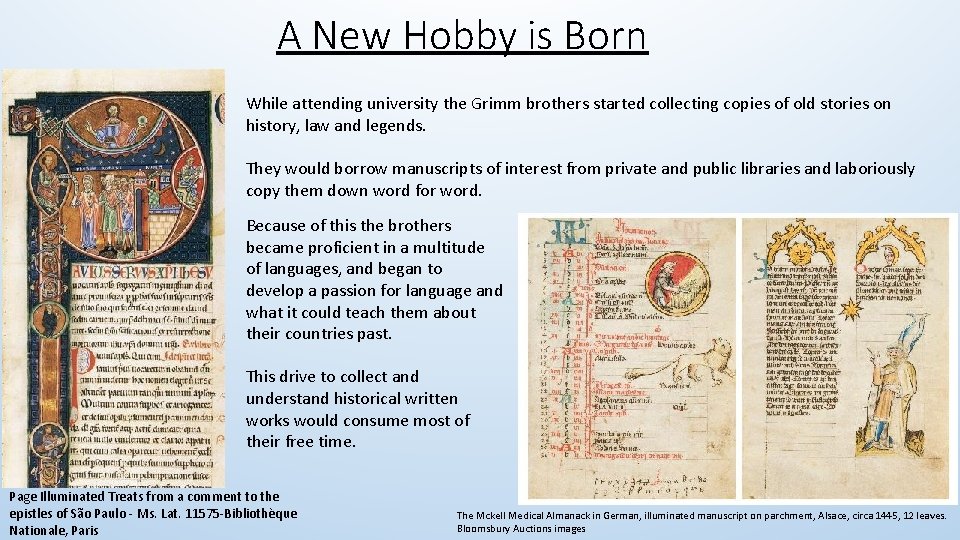
A New Hobby is Born While attending university the Grimm brothers started collecting copies of old stories on history, law and legends. They would borrow manuscripts of interest from private and public libraries and laboriously copy them down word for word. Because of this the brothers became proficient in a multitude of languages, and began to develop a passion for language and what it could teach them about their countries past. This drive to collect and understand historical written works would consume most of their free time. Page Illuminated Treats from a comment to the epistles of São Paulo - Ms. Lat. 11575 -Bibliothèque Nationale, Paris The Mckell Medical Almanack in German, illuminated manuscript on parchment, Alsace, circa 1445, 12 leaves. Bloomsbury Auctions images
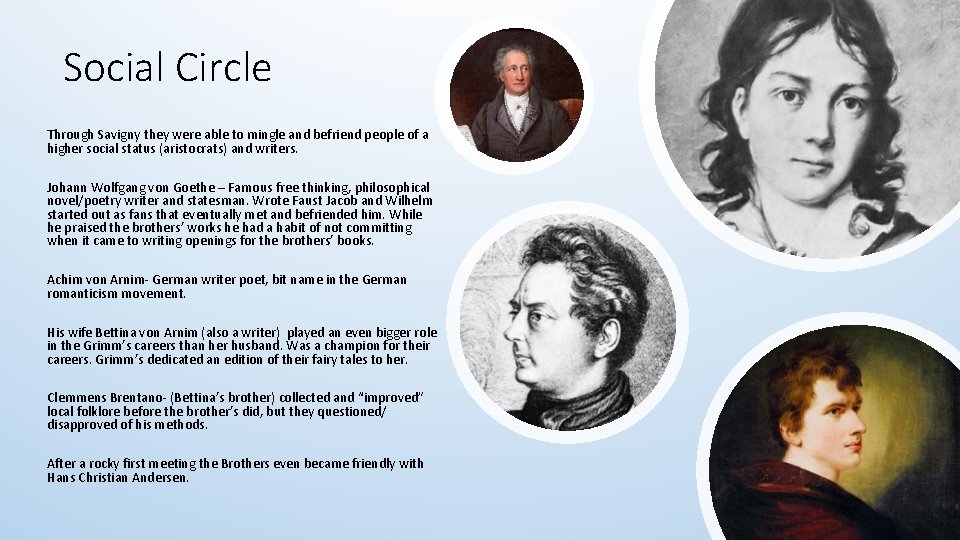
Social Circle Through Savigny they were able to mingle and befriend people of a higher social status (aristocrats) and writers. Johann Wolfgang von Goethe – Famous free thinking, philosophical novel/poetry writer and statesman. Wrote Faust Jacob and Wilhelm started out as fans that eventually met and befriended him. While he praised the brothers’ works he had a habit of not committing when it came to writing openings for the brothers’ books. Achim von Arnim- German writer poet, bit name in the German romanticism movement. His wife Bettina von Arnim (also a writer) played an even bigger role in the Grimm’s careers than her husband. Was a champion for their careers. Grimm’s dedicated an edition of their fairy tales to her. Clemmens Brentano- (Bettina’s brother) collected and “improved” local folklore before the brother’s did, but they questioned/ disapproved of his methods. After a rocky first meeting the Brothers even became friendly with Hans Christian Andersen.
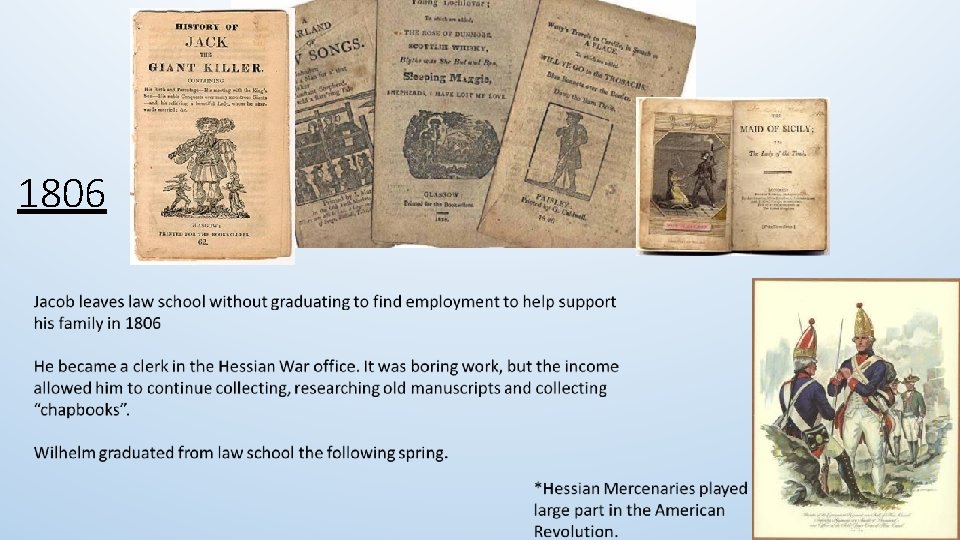
1806
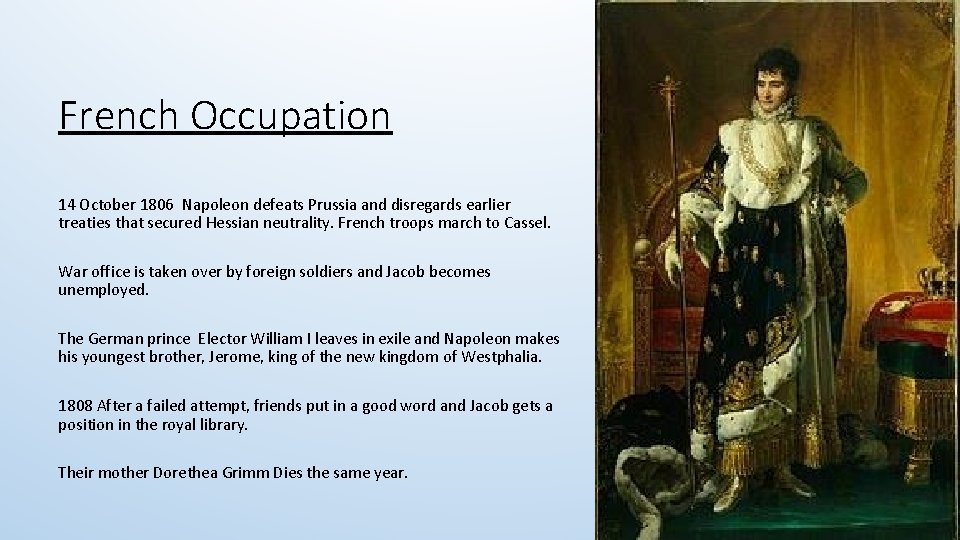
French Occupation 14 October 1806 Napoleon defeats Prussia and disregards earlier treaties that secured Hessian neutrality. French troops march to Cassel. War office is taken over by foreign soldiers and Jacob becomes unemployed. The German prince Elector William I leaves in exile and Napoleon makes his youngest brother, Jerome, king of the new kingdom of Westphalia. 1808 After a failed attempt, friends put in a good word and Jacob gets a position in the royal library. Their mother Dorethea Grimm Dies the same year.
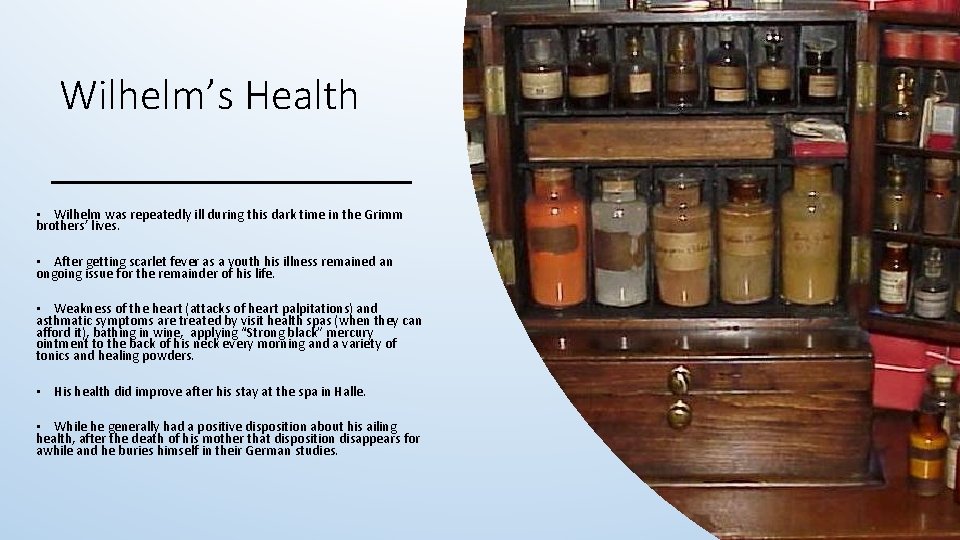
Wilhelm’s Health • Wilhelm was repeatedly ill during this dark time in the Grimm brothers’ lives. • After getting scarlet fever as a youth his illness remained an ongoing issue for the remainder of his life. • Weakness of the heart (attacks of heart palpitations) and asthmatic symptoms are treated by visit health spas (when they can afford it), bathing in wine, applying “Strong black” mercury ointment to the back of his neck every morning and a variety of tonics and healing powders. • His health did improve after his stay at the spa in Halle. • While he generally had a positive disposition about his ailing health, after the death of his mother that disposition disappears for awhile and he buries himself in their German studies.
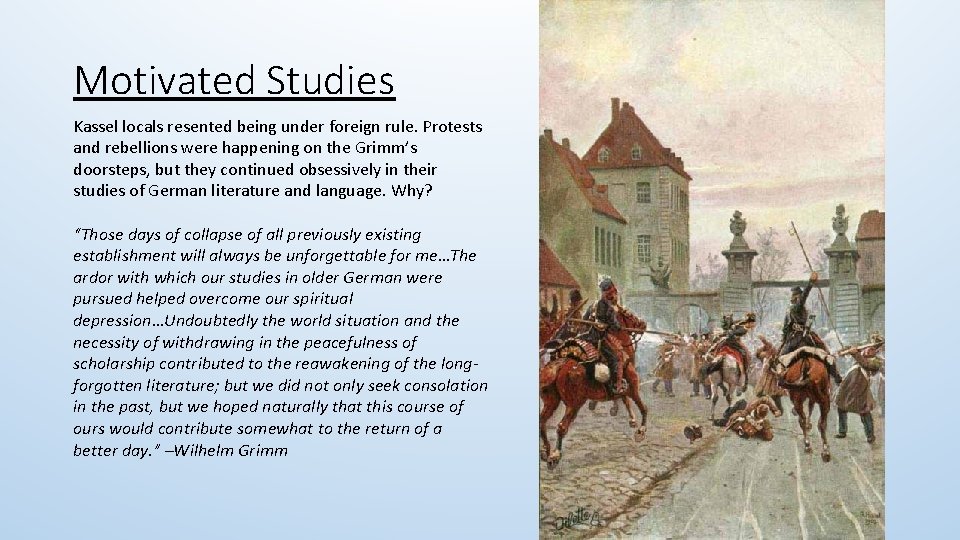
Motivated Studies Kassel locals resented being under foreign rule. Protests and rebellions were happening on the Grimm’s doorsteps, but they continued obsessively in their studies of German literature and language. Why? “Those days of collapse of all previously existing establishment will always be unforgettable for me…The ardor with which our studies in older German were pursued helped overcome our spiritual depression…Undoubtedly the world situation and the necessity of withdrawing in the peacefulness of scholarship contributed to the reawakening of the longforgotten literature; but we did not only seek consolation in the past, but we hoped naturally that this course of ours would contribute somewhat to the return of a better day. ” –Wilhelm Grimm
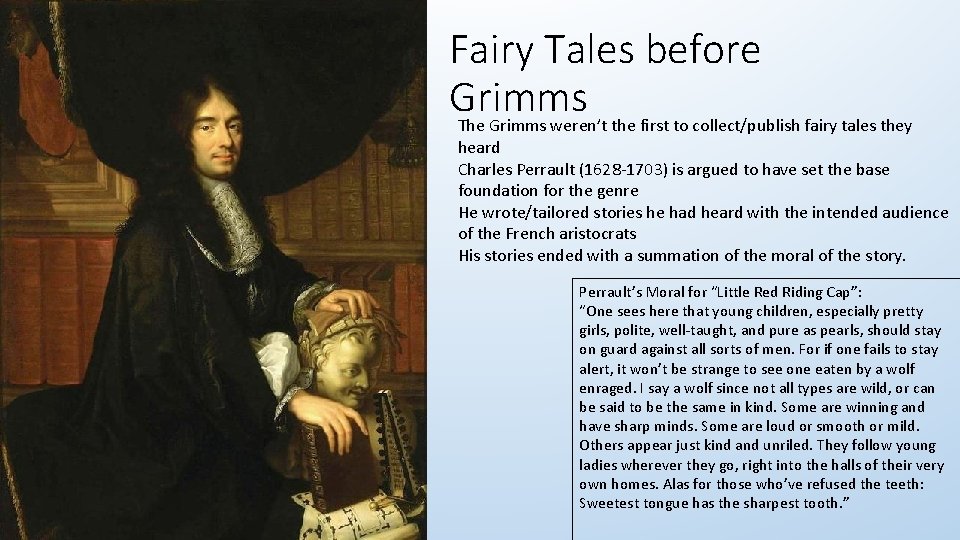
Fairy Tales before Grimms The Grimms weren’t the first to collect/publish fairy tales they heard Charles Perrault (1628 -1703) is argued to have set the base foundation for the genre He wrote/tailored stories he had heard with the intended audience of the French aristocrats His stories ended with a summation of the moral of the story. Perrault’s Moral for “Little Red Riding Cap”: “One sees here that young children, especially pretty girls, polite, well-taught, and pure as pearls, should stay on guard against all sorts of men. For if one fails to stay alert, it won’t be strange to see one eaten by a wolf enraged. I say a wolf since not all types are wild, or can be said to be the same in kind. Some are winning and have sharp minds. Some are loud or smooth or mild. Others appear just kind and unriled. They follow young ladies wherever they go, right into the halls of their very own homes. Alas for those who’ve refused the teeth: Sweetest tongue has the sharpest tooth. ”
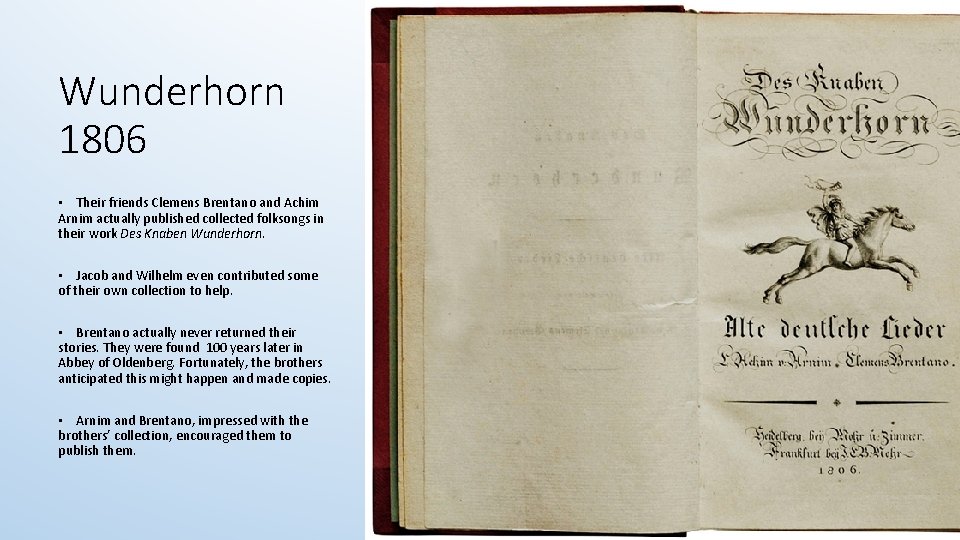
Wunderhorn 1806 • Their friends Clemens Brentano and Achim Arnim actually published collected folksongs in their work Des Knaben Wunderhorn. • Jacob and Wilhelm even contributed some of their own collection to help. • Brentano actually never returned their stories. They were found 100 years later in Abbey of Oldenberg. Fortunately, the brothers anticipated this might happen and made copies. • Arnim and Brentano, impressed with the brothers’ collection, encouraged them to publish them.
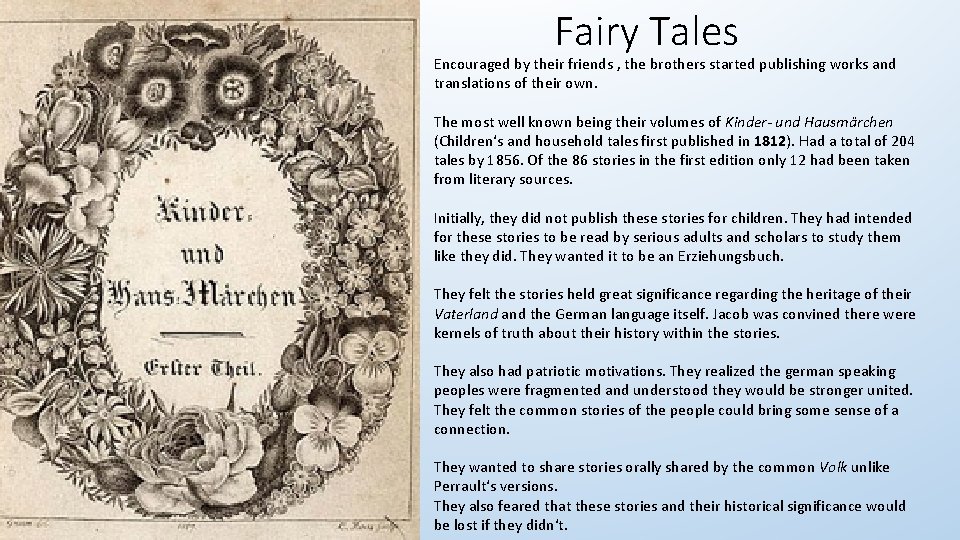
Fairy Tales Encouraged by their friends , the brothers started publishing works and translations of their own. The most well known being their volumes of Kinder- und Hausmärchen (Children‘s and household tales first published in 1812). Had a total of 204 tales by 1856. Of the 86 stories in the first edition only 12 had been taken from literary sources. Initially, they did not publish these stories for children. They had intended for these stories to be read by serious adults and scholars to study them like they did. They wanted it to be an Erziehungsbuch. They felt the stories held great significance regarding the heritage of their Vaterland the German language itself. Jacob was convined there were kernels of truth about their history within the stories. They also had patriotic motivations. They realized the german speaking peoples were fragmented and understood they would be stronger united. They felt the common stories of the people could bring some sense of a connection. They wanted to share stories orally shared by the common Volk unlike Perrault‘s versions. They also feared that these stories and their historical significance would be lost if they didn‘t.
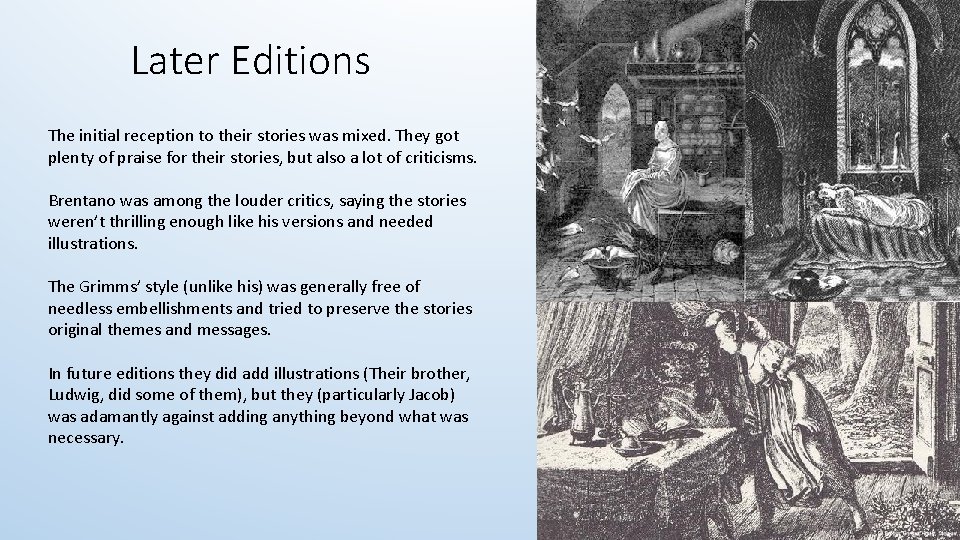
Later Editions The initial reception to their stories was mixed. They got plenty of praise for their stories, but also a lot of criticisms. Brentano was among the louder critics, saying the stories weren’t thrilling enough like his versions and needed illustrations. The Grimms’ style (unlike his) was generally free of needless embellishments and tried to preserve the stories original themes and messages. In future editions they did add illustrations (Their brother, Ludwig, did some of them), but they (particularly Jacob) was adamantly against adding anything beyond what was necessary.
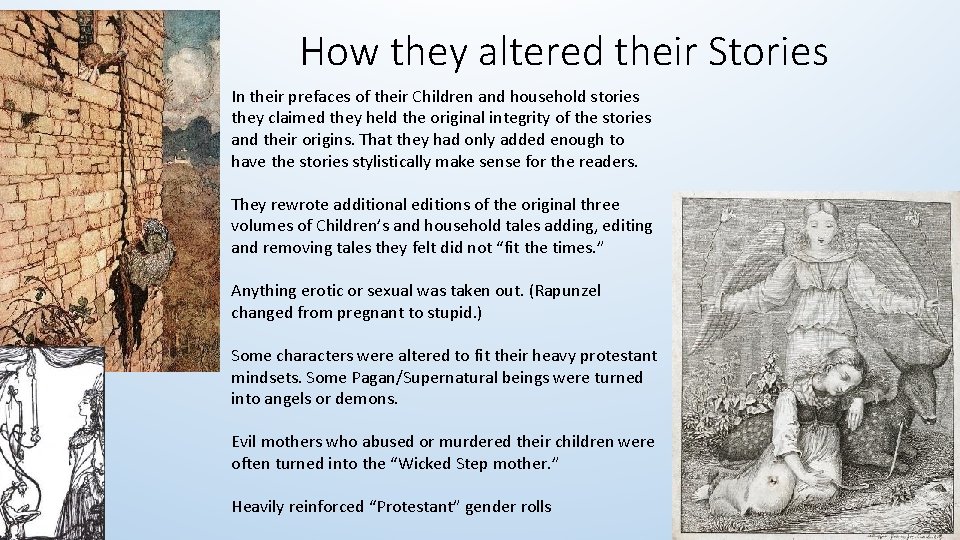
How they altered their Stories In their prefaces of their Children and household stories they claimed they held the original integrity of the stories and their origins. That they had only added enough to have the stories stylistically make sense for the readers. They rewrote additional editions of the original three volumes of Children’s and household tales adding, editing and removing tales they felt did not “fit the times. ” Anything erotic or sexual was taken out. (Rapunzel changed from pregnant to stupid. ) Some characters were altered to fit their heavy protestant mindsets. Some Pagan/Supernatural beings were turned into angels or demons. Evil mothers who abused or murdered their children were often turned into the “Wicked Step mother. ” Heavily reinforced “Protestant” gender rolls
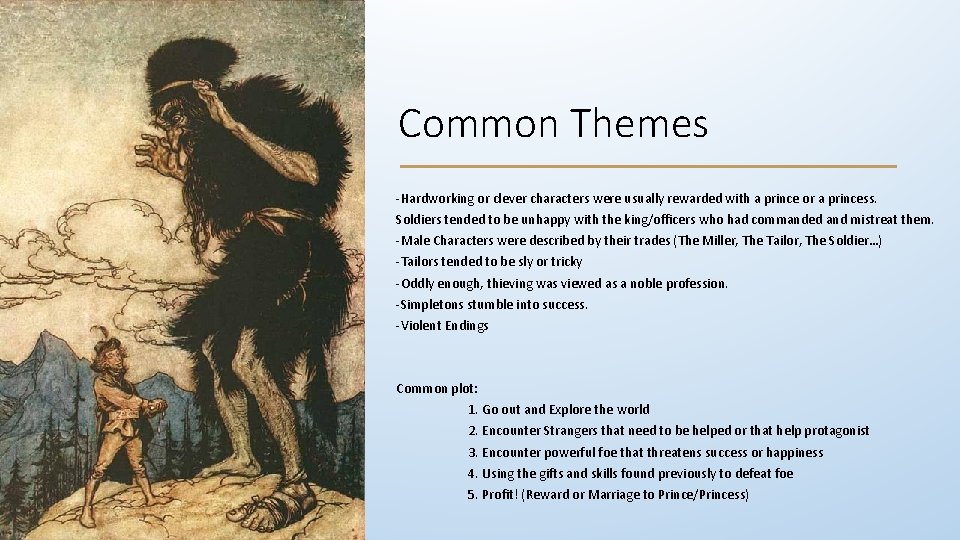
Common Themes -Hardworking or clever characters were usually rewarded with a prince or a princess. Soldiers tended to be unhappy with the king/officers who had commanded and mistreat them. -Male Characters were described by their trades (The Miller, The Tailor, The Soldier…) -Tailors tended to be sly or tricky -Oddly enough, thieving was viewed as a noble profession. -Simpletons stumble into success. -Violent Endings Common plot: 1. Go out and Explore the world 2. Encounter Strangers that need to be helped or that help protagonist 3. Encounter powerful foe that threatens success or happiness 4. Using the gifts and skills found previously to defeat foe 5. Profit! (Reward or Marriage to Prince/Princess)
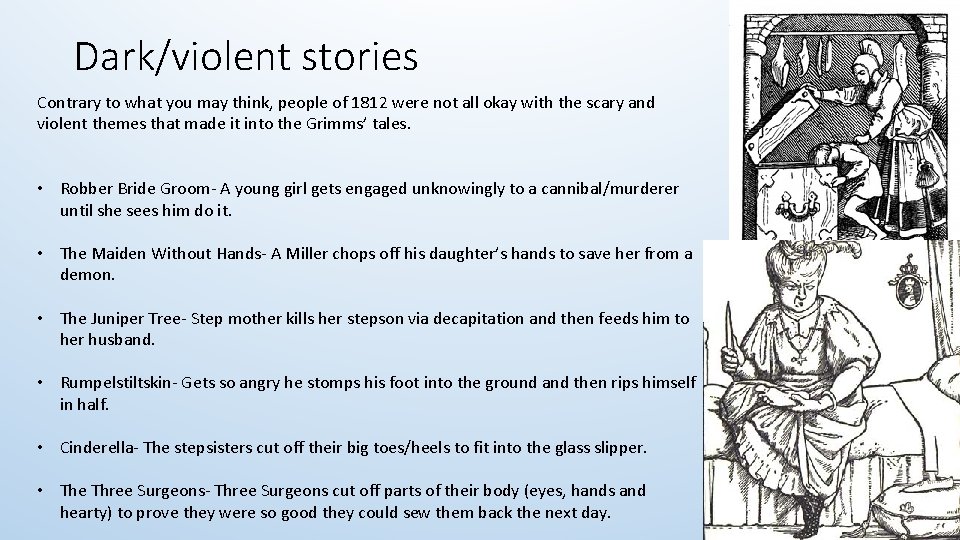
Dark/violent stories Contrary to what you may think, people of 1812 were not all okay with the scary and violent themes that made it into the Grimms’ tales. • Robber Bride Groom- A young girl gets engaged unknowingly to a cannibal/murderer until she sees him do it. • The Maiden Without Hands- A Miller chops off his daughter’s hands to save her from a demon. • The Juniper Tree- Step mother kills her stepson via decapitation and then feeds him to her husband. • Rumpelstiltskin- Gets so angry he stomps his foot into the ground and then rips himself in half. • Cinderella- The stepsisters cut off their big toes/heels to fit into the glass slipper. • The Three Surgeons- Three Surgeons cut off parts of their body (eyes, hands and hearty) to prove they were so good they could sew them back the next day.
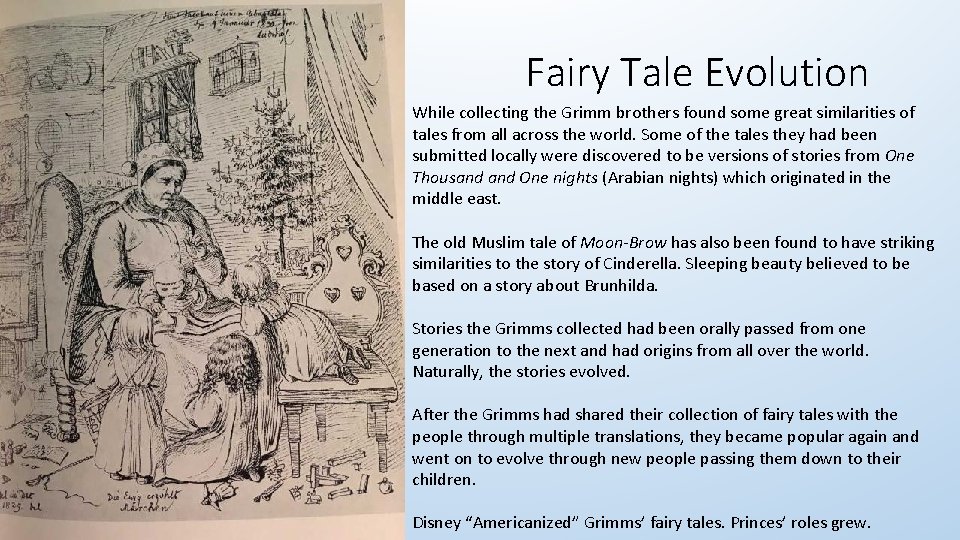
Fairy Tale Evolution While collecting the Grimm brothers found some great similarities of tales from all across the world. Some of the tales they had been submitted locally were discovered to be versions of stories from One Thousand One nights (Arabian nights) which originated in the middle east. The old Muslim tale of Moon-Brow has also been found to have striking similarities to the story of Cinderella. Sleeping beauty believed to be based on a story about Brunhilda. Stories the Grimms collected had been orally passed from one generation to the next and had origins from all over the world. Naturally, the stories evolved. After the Grimms had shared their collection of fairy tales with the people through multiple translations, they became popular again and went on to evolve through new people passing them down to their children. Disney “Americanized” Grimms’ fairy tales. Princes’ roles grew.
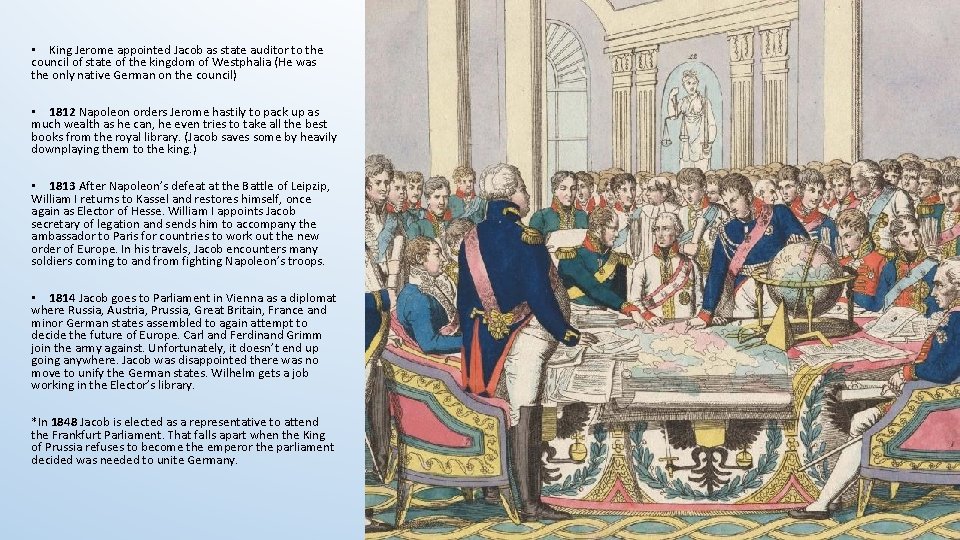
• King Jerome appointed Jacob as state auditor to the council of state of the kingdom of Westphalia (He was the only native German on the council) • 1812 Napoleon orders Jerome hastily to pack up as much wealth as he can, he even tries to take all the best books from the royal library. (Jacob saves some by heavily downplaying them to the king. ) • 1813 After Napoleon’s defeat at the Battle of Leipzip, William I returns to Kassel and restores himself, once again as Elector of Hesse. William I appoints Jacob secretary of legation and sends him to accompany the ambassador to Paris for countries to work out the new order of Europe. In his travels, Jacob encounters many soldiers coming to and from fighting Napoleon’s troops. • 1814 Jacob goes to Parliament in Vienna as a diplomat where Russia, Austria, Prussia, Great Britain, France and minor German states assembled to again attempt to decide the future of Europe. Carl and Ferdinand Grimm join the army against. Unfortunately, it doesn’t end up going anywhere. Jacob was disappointed there was no move to unify the German states. Wilhelm gets a job working in the Elector’s library. *In 1848 Jacob is elected as a representative to attend the Frankfurt Parliament. That falls apart when the King of Prussia refuses to become the emperor the parliament decided was needed to unite Germany.
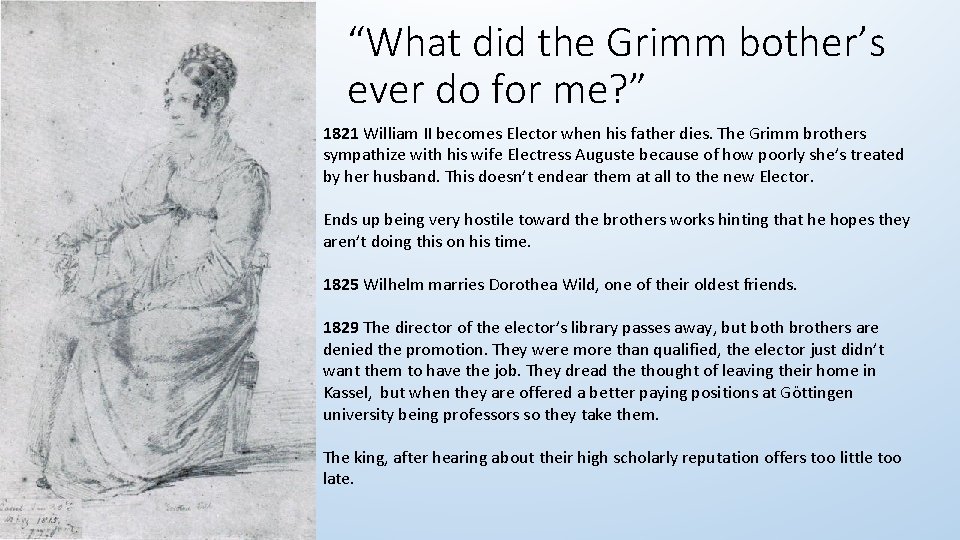
“What did the Grimm bother’s ever do for me? ” 1821 William II becomes Elector when his father dies. The Grimm brothers sympathize with his wife Electress Auguste because of how poorly she’s treated by her husband. This doesn’t endear them at all to the new Elector. Ends up being very hostile toward the brothers works hinting that he hopes they aren’t doing this on his time. 1825 Wilhelm marries Dorothea Wild, one of their oldest friends. 1829 The director of the elector’s library passes away, but both brothers are denied the promotion. They were more than qualified, the elector just didn’t want them to have the job. They dread the thought of leaving their home in Kassel, but when they are offered a better paying positions at Göttingen university being professors so they take them. The king, after hearing about their high scholarly reputation offers too little too late.
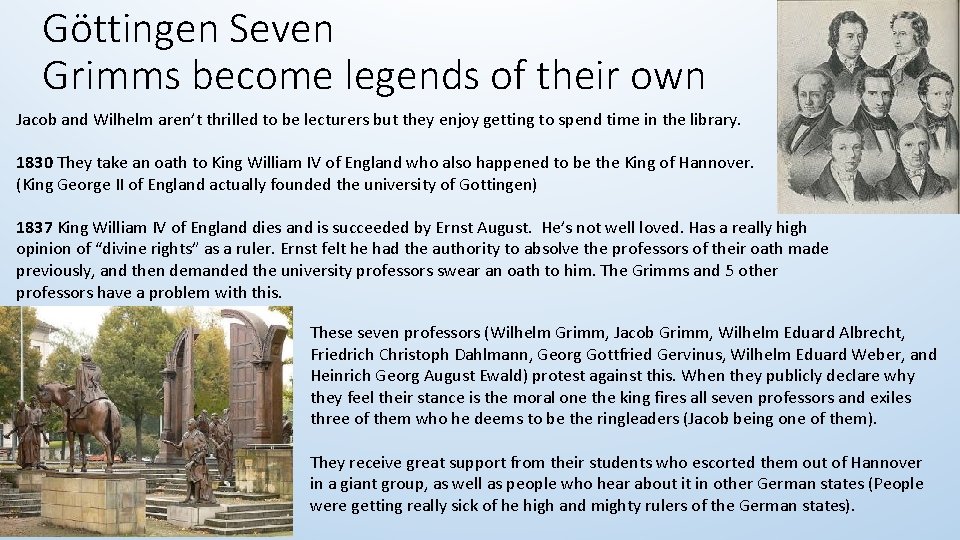
Göttingen Seven Grimms become legends of their own Jacob and Wilhelm aren’t thrilled to be lecturers but they enjoy getting to spend time in the library. 1830 They take an oath to King William IV of England who also happened to be the King of Hannover. (King George II of England actually founded the university of Gottingen) 1837 King William IV of England dies and is succeeded by Ernst August. He’s not well loved. Has a really high opinion of “divine rights” as a ruler. Ernst felt he had the authority to absolve the professors of their oath made previously, and then demanded the university professors swear an oath to him. The Grimms and 5 other professors have a problem with this. These seven professors (Wilhelm Grimm, Jacob Grimm, Wilhelm Eduard Albrecht, Friedrich Christoph Dahlmann, Georg Gottfried Gervinus, Wilhelm Eduard Weber, and Heinrich Georg August Ewald) protest against this. When they publicly declare why they feel their stance is the moral one the king fires all seven professors and exiles three of them who he deems to be the ringleaders (Jacob being one of them). They receive great support from their students who escorted them out of Hannover in a giant group, as well as people who hear about it in other German states (People were getting really sick of he high and mighty rulers of the German states).
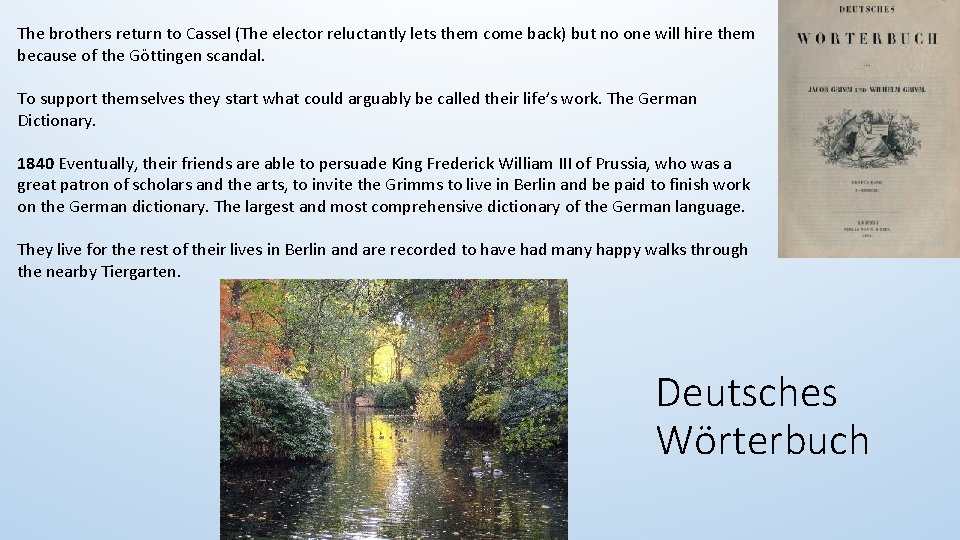
The brothers return to Cassel (The elector reluctantly lets them come back) but no one will hire them because of the Göttingen scandal. To support themselves they start what could arguably be called their life’s work. The German Dictionary. 1840 Eventually, their friends are able to persuade King Frederick William III of Prussia, who was a great patron of scholars and the arts, to invite the Grimms to live in Berlin and be paid to finish work on the German dictionary. The largest and most comprehensive dictionary of the German language. They live for the rest of their lives in Berlin and are recorded to have had many happy walks through the nearby Tiergarten. Deutsches Wörterbuch

Grimm’s Law Jacob Grimm worked out a system of “sound shifting” later called Grimm’s law. His research revealed that the German language came from a common Indo-European language with Russian, Greek, Celtic and Old Norse. Prior to this German, as a language, was considered Barbaric and inferior to the classical languages like French and Italian. Grimm’s law is still relevant in the study of languages and how they are connected (philology)
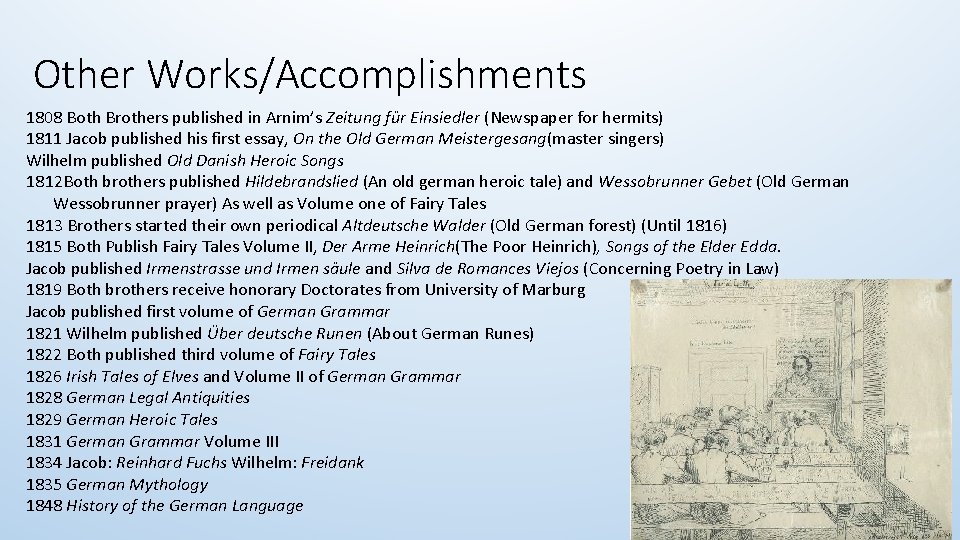
Other Works/Accomplishments 1808 Both Brothers published in Arnim’s Zeitung für Einsiedler (Newspaper for hermits) 1811 Jacob published his first essay, On the Old German Meistergesang(master singers) Wilhelm published Old Danish Heroic Songs 1812 Both brothers published Hildebrandslied (An old german heroic tale) and Wessobrunner Gebet (Old German Wessobrunner prayer) As well as Volume one of Fairy Tales 1813 Brothers started their own periodical Altdeutsche Walder (Old German forest) (Until 1816) 1815 Both Publish Fairy Tales Volume II, Der Arme Heinrich(The Poor Heinrich), Songs of the Elder Edda. Jacob published Irmenstrasse und Irmen säule and Silva de Romances Viejos (Concerning Poetry in Law) 1819 Both brothers receive honorary Doctorates from University of Marburg Jacob published first volume of German Grammar 1821 Wilhelm published Über deutsche Runen (About German Runes) 1822 Both published third volume of Fairy Tales 1826 Irish Tales of Elves and Volume II of German Grammar 1828 German Legal Antiquities 1829 German Heroic Tales 1831 German Grammar Volume III 1834 Jacob: Reinhard Fuchs Wilhelm: Freidank 1835 German Mythology 1848 History of the German Language
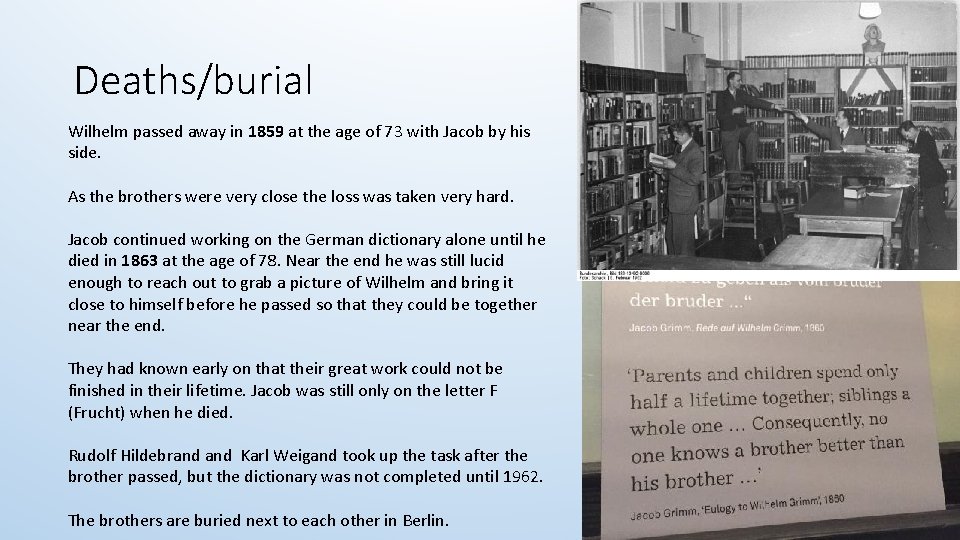
Deaths/burial Wilhelm passed away in 1859 at the age of 73 with Jacob by his side. As the brothers were very close the loss was taken very hard. Jacob continued working on the German dictionary alone until he died in 1863 at the age of 78. Near the end he was still lucid enough to reach out to grab a picture of Wilhelm and bring it close to himself before he passed so that they could be together near the end. They had known early on that their great work could not be finished in their lifetime. Jacob was still only on the letter F (Frucht) when he died. Rudolf Hildebrand Karl Weigand took up the task after the brother passed, but the dictionary was not completed until 1962. The brothers are buried next to each other in Berlin.
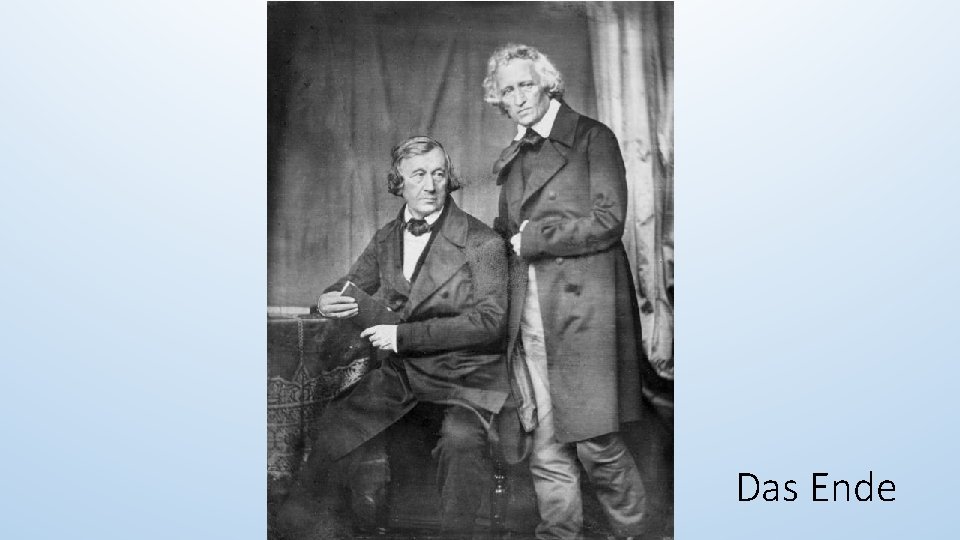
Das Ende
Sources Michaelis-Jena, Ruth. The Brothers Grimm. Praeger, 1970. Peppard, Murray B. Paths Through the Forest: A Bibliography of the Brothers Grimm. Holt, Rhinehart and Winston, 1971. Zipes, Jack. The Brothers Grimm: From Enchanted Forests to the Modern World. Routledge, 1988. Zipes, Jack. Paul, Lissa. And Vallone, Lynne. The Norton Anthology of Children’s Literature. W. W. Norton and Company, 2005. Dollerup, Cay. “Translation as a Creative Force in Literature: The Birth of the European Bourgeois Fairy-Tale. ” Modern Language Review, vol. 90, no. 1, Jan. 1995, pp. 94– 102. EBSCOhost, search. ebscohost. com/login. aspx? direct=true&db=a 9 h&AN=9505311013&site=eh ost-live. Grimm, Jacob, Wilhelm Grimm, Clarissa Pinkola Estes. Tales of the Brothers Grimm: Edited, Selected, and Introduced by Clarissa Pinkola. Book-of-the-month club, 1999. Print.
Picture Sources: Double Portrait of Brothers done by Ludwig Emil Grimm Oil painting of Phillip Wilhelm Grimm by K. G. Urlaub, Straatsarchiv, Marburg/Lahn Oil painting of Dorothea Grimm by K. G. Urlaub, Straatsarchiv, Marburg/Lahn Oil painting of Freidrich Grimm Sr Pencil Sketches of the Grimm Children by Ludwig Emil Grimm Portrait of Jacob Grimm by Begas Drawing of Jacob at his desk by Ludwig Emil Grimm Sketch of Wilhelm Grimm by Ludwig Grimm Painting of William I, Elector of Hesse (1743 -1821) wearing the danish Order of the Elephant by Carl Gustaf Pilo William II, Elector of Hesse (1777 -1847) Conrad Bodenstein Map of German Empire © German Historical Institute, Washington, DC / James Retallack, 2007. Steinau Street by Charley Robinson Originally built as a city hall in the 1530's, this building now houses the Gesellschaft für Goldschmiedkunst (Society for Goldsmith Art). Picture from http: //www. goldschmiedehaus. com/ Picture of Hanau’s Town hall with the Brother’s Grimm Monument in front of it Ruins of Monastery of St Wolfgang in Hanau - Haselburg-müller - Eigenes Werk Grimm house in Steinau from Travel and Tipples blog - http: //travelsandtipplescom. ipage. com/the-brothers-grimm -childhood-home-steinau-an-der-strase/ Steinau Palace - Werner Funk Henriette Zimmer, Etching by Ludwig Grimm Löwenburg Castle -Außenansicht der Löwenburg, Foto: MHK, Arno Hensmanns
Pictures Sources Cont. Marburg University - https: //www. uni-assist. de/en/tools/uni-assist-universities/detail/hochschule/93/ Portrait of Savigny - lithograph by Franz Xaver Winterhalter Manuscripts sited on slide Portrait of Goete by Joseph Karl Stieler Portrait of Ludwig Achin von Arnim by Peter Edward Stroehling Portrait of Bettina von Arnim- unknown Etching of Clemens Brentano by Ludwig Grimm Chapbook of Jack the Giant Killer Hessian grenadiers - https: //militaryhistorynow. com/2018/10/25/the-legend-of-sleepy-hollow-and-thehessians-of-the-american-revolution/ Jerome Bonaparte portrait by Portrait by François Gérard Portrait of Charles Perralt by Philippe Lallemand - Palace of Versailles Title-page of Des Knaben Wunderhorn: Alte deutsche Lieder, Volume 1, published in 1806 Metro. Postcard depicting Napoleanic war with Prussia - http: //www. metropostcard. com/war 3 e. html 1800 s Apothecary Kit - http: //www. medicalantiques. com/medical/Apothecary_and_Drug_Kits. htm Title page of first volume of Grimms' Kinder- und Hausmärchen (1819) 2 nd Ed. Erster Theil Cinderella, Little Red Riding Hood & Sleeping Illustrations by Ludwig Grimm. Rapunzel Illustration by Arthur Rackham Evil Queen from Snow White by Arthur Rackham, Illustrations to the 1909 "The Valiant Tailor" from Grimm Fairy Tales Jacob Grimm Lecturing by Ludwig Grimm 1830 Photograph of the Grimm Brothers later in life
Picture Sources Cont. Juniper Tree drawing by Moritz von Schwind (1804 - 1871) Stepsister cutting off toe Jacobs, Joseph, ed. European Folk and Fairy Tales. John D. Batten, illustrator. New York: G. P Putnam's Sons, 1916. The nanny at Hassenpflug’s telling fairytales Christmas 1829. Pen and ink drawing by Ludwig Emil Grimm. The Congress of Vienna, watercolor etching by August Friedrich Andreas Campe, in the collection of the State Borodino War and History Museum, Moscow. Dorethea Wild. Pencil Drawing by Ludwig Emil Grimm. The Göttingen Seven. Top row: Wilhelm Grimm, Jacob Grimm. Middle Row: Wilhelm Eduard Albrecht, Friedrich Christoph Dahlmann, Georg Gottfried Gervinus. Bottom Row: Wilhelm Eduard Weber, Heinrich Georg August Ewald The bronze statues of the Göttingen Seven seen near to the federal state parliament in Hanover. The original title page of the Deutsches Wörterbuch, 1854 Tiergarten Park in Berlin in Autum https: //en. wikipedia. org/wiki/Tiergarten_(park)#/media/File: Berlin_Tiergarten 4. jpg The Berlin Academy of Sciences staff working to complete the Grimm dictionary, 1952
- Slides: 36