
Did the Filipino Middle Income Class Grow Substantially
Did the Filipino Middle Income Class Grow Substantially after the Robust Economic Growth of the B. Aquino Administration? Presented by Mechelle M. Viernes Statistical Specialist II, PSA Romulo A. Virola Jessamyn O. Encarnacion, Bernadette B. Balamban, Mildred Addawe, Anna Jean Casanas and Mechelle M. Viernes 13 th National Convention on Statistics October 3 -4, 2016, EDSA Shangri-La Hotel, Mandaluyong City
OUTLINE I. Introduction II. Methodology III. Highlights of Results IV. Concluding Remarks and Way Forward 13 th National Convention on Statistics October 3 -4, 2016, EDSA Shangri-La Hotel, Mandaluyong City
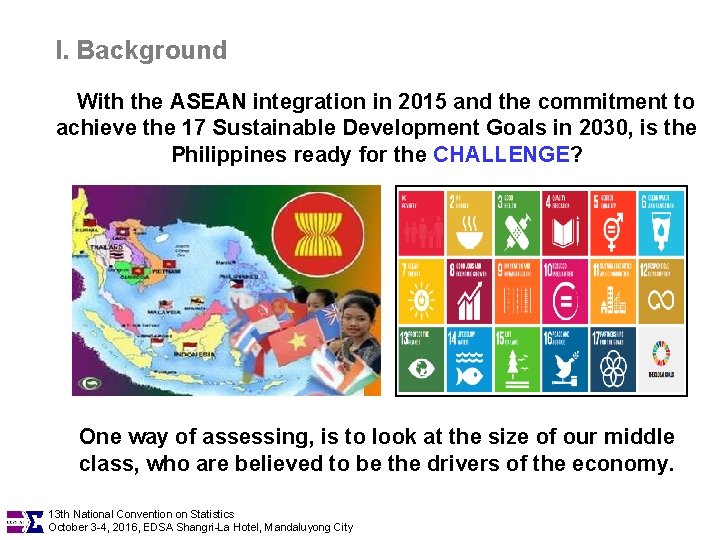
I. Background With the ASEAN integration in 2015 and the commitment to achieve the 17 Sustainable Development Goals in 2030, is the Philippines ready for the CHALLENGE? One way of assessing, is to look at the size of our middle class, who are believed to be the drivers of the economy. 13 th National Convention on Statistics October 3 -4, 2016, EDSA Shangri-La Hotel, Mandaluyong City

I. Background • During the 10 th , 11 th and 12 th National Conventions on Statistics (NCS), the proportion of Filipino middle income class was estimated using the results of the 2000, 2003, 2006, and 2009 FIES, which indicated that the middle income class had not grown much, with a share of at most 25% of the distribution of families. • Recently, there were increasing clamor for more updated statistics on middle income class. 13 th National Convention on Statistics October 3 -4, 2016, EDSA Shangri-La Hotel, Mandaluyong City

I. Background In addition, there is clamor for information on socio-economic classification, given the following: • Need for a definition of low income individuals for RA 10693 – An Act Strengthening NGOs Engaged in Microfinance Operations for the Poor, where a duly registered Microfinance NGO shall pay 2% tax based on its gross receipts from microfinance operations in lieu of all national taxes, provided, that the microfinance operations cater to the poor and low-income individuals. • Specific programs can be designed to help particular socioeconomic groups. • Needed by many market research organizations in designing strategies for their target groups. 13 th National Convention on Statistics October 3 -4, 2016, EDSA Shangri-La Hotel, Mandaluyong City
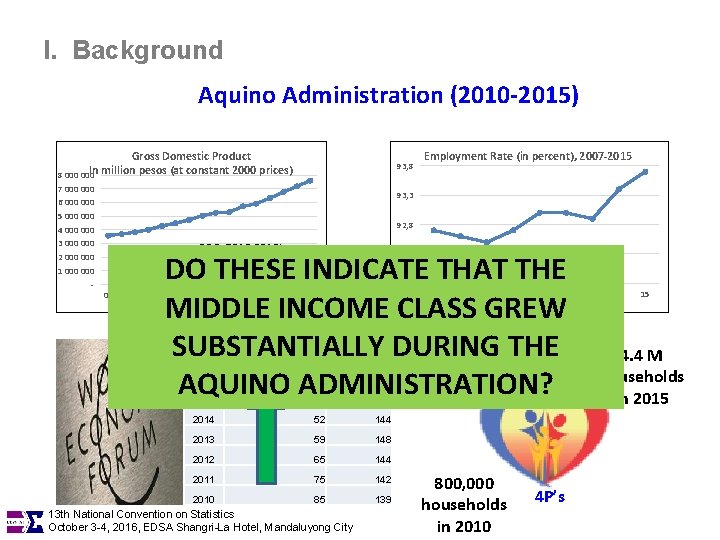
I. Background Aquino Administration (2010 -2015) Gross Domestic Product In million pesos (at constant 2000 prices) 8 000 93, 8 7 000 93, 3 6 000 5 000 92, 8 4 000 3 000 2 000 1 000 - Employment Rate (in percent), 2007 -2015 GDP (2010 -2015) Current – 6. 7% Constant – 4. 9% 92, 3 DO THESE INDICATE THAT THE MIDDLE INCOME CLASS GREW SUBSTANTIALLY DURING THE AQUINO ADMINISTRATION? 91, 8 00 01 02 03 04 05 06 07 08 09 10 11 12 13 14 15 Year Rank in the Global Competitiveness Report Number of Countries 2015 47 140 2014 52 144 2013 59 148 2012 65 144 2011 75 142 2010 85 139 13 th National Convention on Statistics October 3 -4, 2016, EDSA Shangri-La Hotel, Mandaluyong City 800, 000 households in 2010 4 P’s 4. 4 M households in 2015
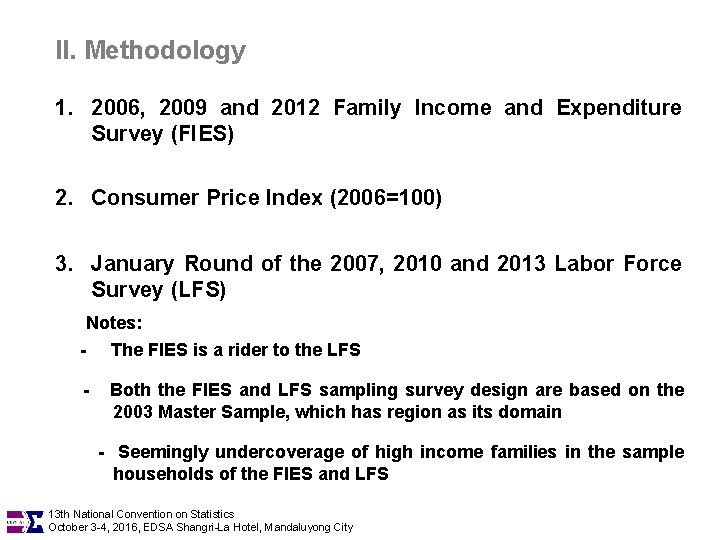
II. Methodology 1. 2006, 2009 and 2012 Family Income and Expenditure Survey (FIES) 2. Consumer Price Index (2006=100) 3. January Round of the 2007, 2010 and 2013 Labor Force Survey (LFS) Notes: - The FIES is a rider to the LFS - Both the FIES and LFS sampling survey design are based on the 2003 Master Sample, which has region as its domain - Seemingly undercoverage of high income families in the sample households of the FIES and LFS 13 th National Convention on Statistics October 3 -4, 2016, EDSA Shangri-La Hotel, Mandaluyong City

II. Methodology 1. Cluster Analysis is a multivariate analysis technique that classifies objects or individuals into a small number of mutually exclusive groups. This was performed on the 2006 FIES to determine the a priori grouping of families (low, middle, or the high-income clusters) based on income 13 th National Convention on Statistics October 3 -4, 2016, EDSA Shangri-La Hotel, Mandaluyong City
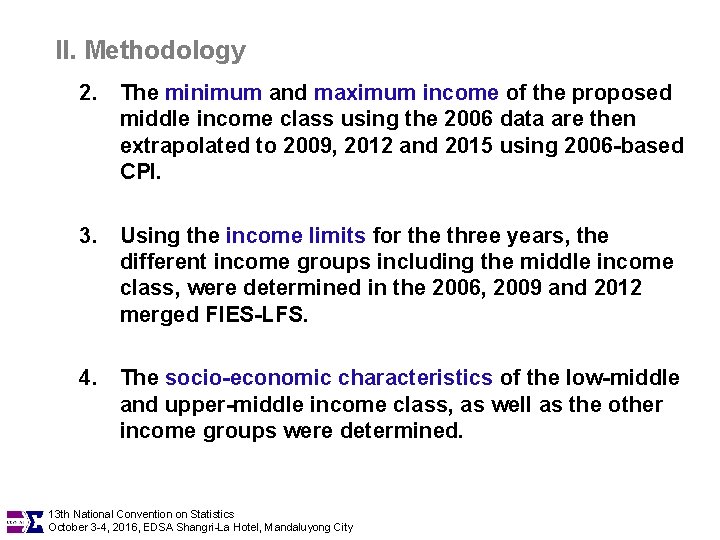
II. Methodology 2. The minimum and maximum income of the proposed middle income class using the 2006 data are then extrapolated to 2009, 2012 and 2015 using 2006 -based CPI. 3. Using the income limits for the three years, the different income groups including the middle income class, were determined in the 2006, 2009 and 2012 merged FIES-LFS. 4. The socio-economic characteristics of the low-middle and upper-middle income class, as well as the other income groups were determined. 13 th National Convention on Statistics October 3 -4, 2016, EDSA Shangri-La Hotel, Mandaluyong City

II. Methodology • Difference in the methodology between 2013 and 2016 NCS papers a. Definition by income 2013 NCS 2016 NCS 2003 2006 Per capita income 3. CPI reference year 2006 4. Level of disaggregation National 2003, 2006, 2009, 2012 1. Base year for clustering 2. Clustering variable 5. Coverage 13 th National Convention on Statistics October 3 -4, 2016, EDSA Shangri-La Hotel, Mandaluyong City
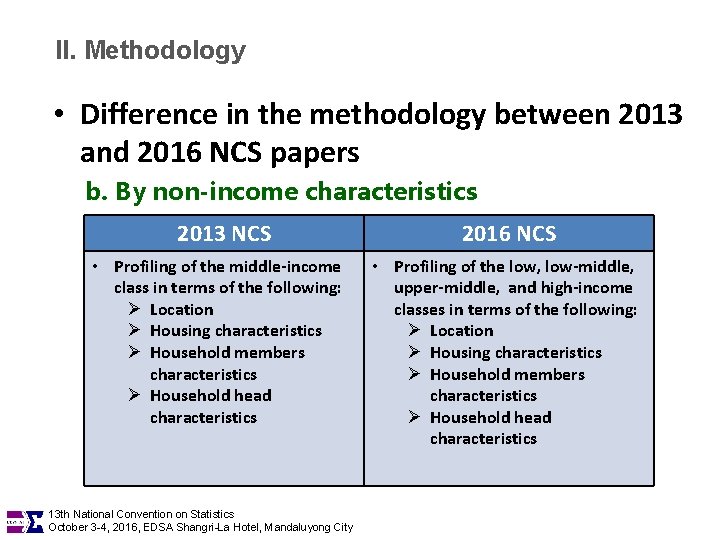
II. Methodology • Difference in the methodology between 2013 and 2016 NCS papers b. By non-income characteristics 2013 NCS • Profiling of the middle-income class in terms of the following: Ø Location Ø Housing characteristics Ø Household members characteristics Ø Household head characteristics 13 th National Convention on Statistics October 3 -4, 2016, EDSA Shangri-La Hotel, Mandaluyong City 2016 NCS • Profiling of the low, low-middle, upper-middle, and high-income classes in terms of the following: Ø Location Ø Housing characteristics Ø Household members characteristics Ø Household head characteristics

III. Highlights of Results Annual Per Capita Income of the Five Clusters from the 5 -Cluster Analysis of the 2006 FIES data 2006 PER CAPITA INCOME Cluster Percent Income Minimum Maximum families Class Mean Median 1 19, 396 17, 165 1, 719 43, 652 74. 0 2 66, 743 61, 962 43, 659 114, 884 20. 6 3 160, 139 148, 080 114, 959 273, 615 4. 6 4 376, 060 337, 726 274, 516 738, 000 0. 8 776, 400 2, 495, 499 0. 1 5 1, 227, 308 1, 088, 915 13 th National Convention on Statistics October 3 -4, 2016, EDSA Shangri-La Hotel, Mandaluyong City Low. Middle Upper. Middle High
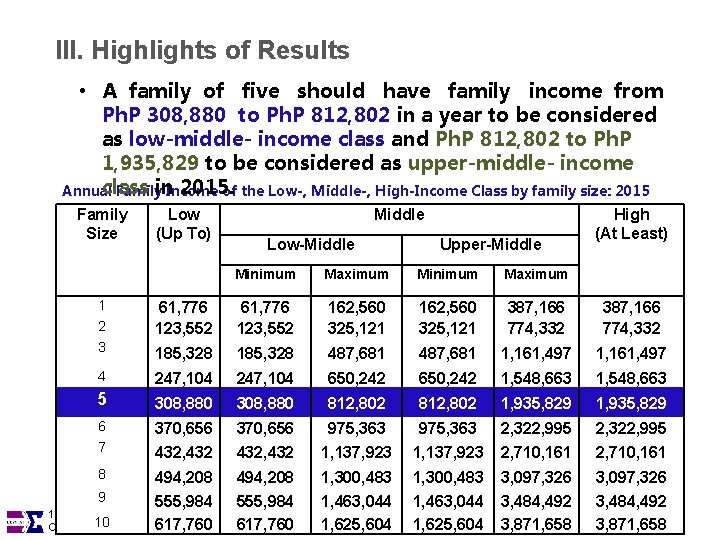
III. Highlights of Results • A family of five should have family income from Ph. P 308, 880 to Ph. P 812, 802 in a year to be considered as low-middle- income class and Ph. P 812, 802 to Ph. P 1, 935, 829 to be considered as upper-middle- income class 2015. Annual Familyin Income of the Low-, Middle-, High-Income Class by family size: 2015 Family Size Low (Up To) Middle Low-Middle Upper-Middle Minimum Maximum High (At Least) 1 2 3 61, 776 123, 552 162, 560 325, 121 387, 166 774, 332 185, 328 487, 681 1, 161, 497 4 247, 104 650, 242 1, 548, 663 5 308, 880 812, 802 1, 935, 829 6 7 370, 656 975, 363 2, 322, 995 432, 432 1, 137, 923 2, 710, 161 494, 208 1, 300, 483 9 555, 984 1, 463, 044 13 th National Convention on Statistics 10 2016, EDSA 617, 760 1, 625, 604 October 3 -4, Shangri-La Hotel, Mandaluyong City 1, 300, 483 1, 463, 044 1, 625, 604 3, 097, 326 3, 484, 492 3, 871, 658 8
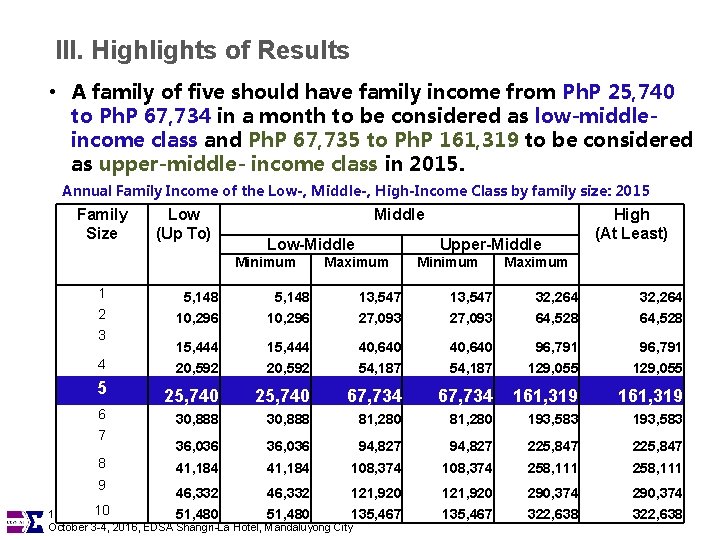
III. Highlights of Results • A family of five should have family income from Ph. P 25, 740 to Ph. P 67, 734 in a month to be considered as low-middleincome class and Ph. P 67, 735 to Ph. P 161, 319 to be considered as upper-middle- income class in 2015. Annual Family Income of the Low-, Middle-, High-Income Class by family size: 2015 Family Size Low (Up To) Middle Low-Middle Minimum 1 2 3 Upper-Middle Maximum Minimum High (At Least) Maximum 5, 148 10, 296 13, 547 27, 093 32, 264 64, 528 15, 444 20, 592 40, 640 54, 187 96, 791 129, 055 25, 740 67, 734 161, 319 6 7 30, 888 81, 280 193, 583 36, 036 94, 827 225, 847 8 41, 184 108, 374 258, 111 46, 332 51, 480 121, 920 135, 467 290, 374 322, 638 4 5 9 46, 332 10 Convention on 13 th National Statistics 51, 480 October 3 -4, 2016, EDSA Shangri-La Hotel, Mandaluyong City
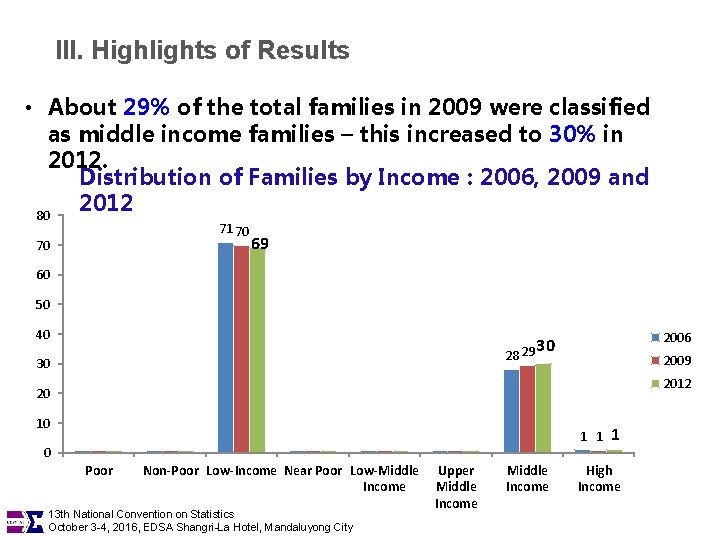
III. Highlights of Results • About 29% of the total families in 2009 were classified as middle income families – this increased to 30% in 2012. Distribution of Families by Income : 2006, 2009 and 2012 80 71 70 70 60 50 49 50 69 49 40 30 20 23 24 21 20 20 10 4 4 24 4 Non-Poor Low-Income Near Poor Low-Middle Income 13 th National Convention on Statistics October 3 -4, 2016, EDSA Shangri-La Hotel, Mandaluyong City 2009 2012 5 5 6 1 1 0 Poor 2006 30 28 29 Upper Middle Income 1 High Income
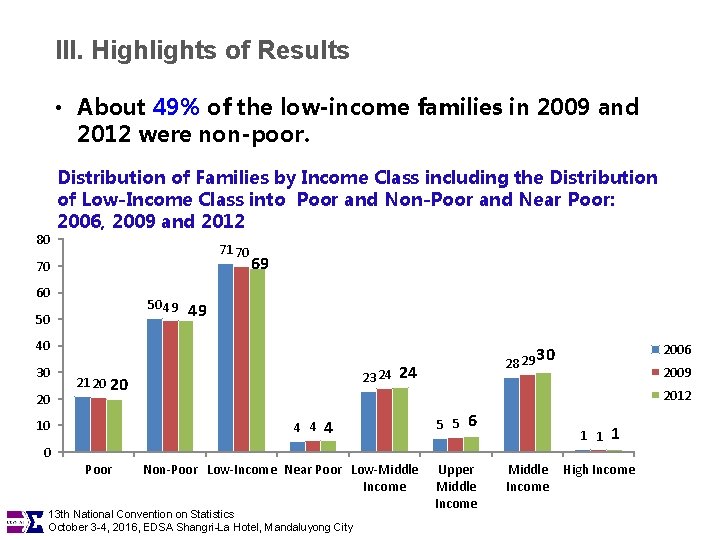
III. Highlights of Results • About 49% of the low-income families in 2009 and 2012 were non-poor. 80 Distribution of Families by Income Class including the Distribution of Low-Income Class into Poor and Non-Poor and Near Poor: 2006, 2009 and 2012 71 70 70 60 50 49 50 69 49 40 30 20 23 24 21 20 20 10 24 2009 2012 4 4 4 5 5 6 1 1 0 Poor 2006 30 28 29 Non-Poor Low-Income Near Poor Low-Middle Income 13 th National Convention on Statistics October 3 -4, 2016, EDSA Shangri-La Hotel, Mandaluyong City Upper Middle Income 1 High Income
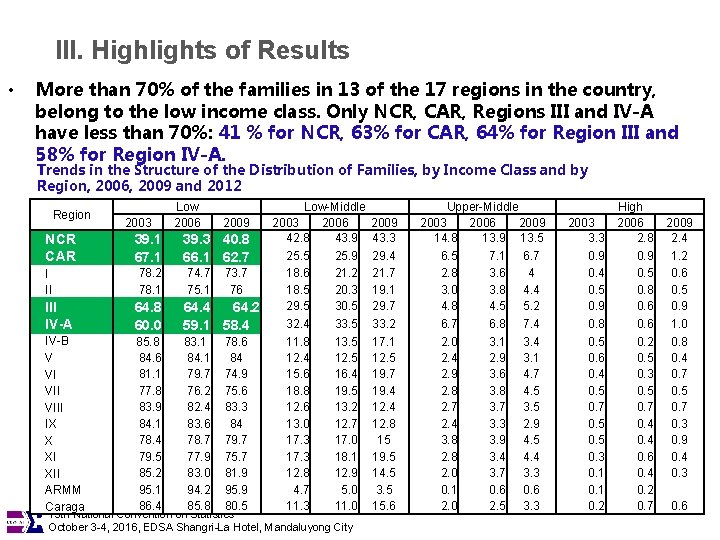
III. Highlights of Results • More than 70% of the families in 13 of the 17 regions in the country, belong to the low income class. Only NCR, CAR, Regions III and IV-A have less than 70%: 41 % for NCR, 63% for CAR, 64% for Region III and 58% for Region IV-A. Trends in the Structure of the Distribution of Families, by Income Class and by Region, 2006, 2009 and 2012 Region NCR CAR I II 2003 39. 1 67. 1 78. 2 78. 1 Low 2006 2009 39. 3 40. 8 66. 1 62. 7 74. 7 75. 1 73. 7 76 III IV-A 64. 8 60. 0 64. 4 64. 2 59. 1 58. 4 IV-B V VI VIII IX X XI XII ARMM Caraga 85. 8 84. 6 81. 1 77. 8 83. 9 84. 1 78. 4 79. 5 85. 2 95. 1 86. 4 83. 1 84. 1 79. 7 76. 2 82. 4 83. 6 78. 7 77. 9 83. 0 94. 2 85. 8 78. 6 84 74. 9 75. 6 83. 3 84 79. 7 75. 7 81. 9 95. 9 80. 5 Low-Middle 2003 2006 42. 8 43. 9 25. 5 25. 9 18. 6 21. 2 18. 5 20. 3 29. 5 30. 5 32. 4 33. 5 11. 8 13. 5 12. 4 12. 5 15. 6 16. 4 18. 8 19. 5 12. 6 13. 2 13. 0 12. 7 17. 3 17. 0 17. 3 18. 1 12. 8 12. 9 4. 7 5. 0 11. 3 11. 0 13 th National Convention on Statistics October 3 -4, 2016, EDSA Shangri-La Hotel, Mandaluyong City 2009 43. 3 29. 4 21. 7 19. 1 29. 7 33. 2 17. 1 12. 5 19. 7 19. 4 12. 8 15 19. 5 14. 5 3. 5 15. 6 Upper-Middle 2003 2006 2009 14. 8 13. 9 13. 5 6. 5 7. 1 6. 7 2. 8 3. 6 4 3. 0 3. 8 4. 4 4. 8 4. 5 5. 2 6. 7 6. 8 7. 4 2. 0 3. 1 3. 4 2. 9 3. 1 2. 9 3. 6 4. 7 2. 8 3. 8 4. 5 2. 7 3. 5 2. 4 3. 3 2. 9 3. 8 3. 9 4. 5 2. 8 3. 4 4. 4 2. 0 3. 7 3. 3 0. 1 0. 6 2. 0 2. 5 3. 3 2003 3. 3 0. 9 0. 4 0. 5 0. 9 0. 8 0. 5 0. 6 0. 4 0. 5 0. 7 0. 5 0. 3 0. 1 0. 2 High 2006 2. 8 0. 9 0. 5 0. 8 0. 6 0. 2 0. 5 0. 3 0. 5 0. 7 0. 4 0. 6 0. 4 0. 2 0. 7 2009 2. 4 1. 2 0. 6 0. 5 0. 9 1. 0 0. 8 0. 4 0. 7 0. 5 0. 7 0. 3 0. 9 0. 4 0. 3 0. 6
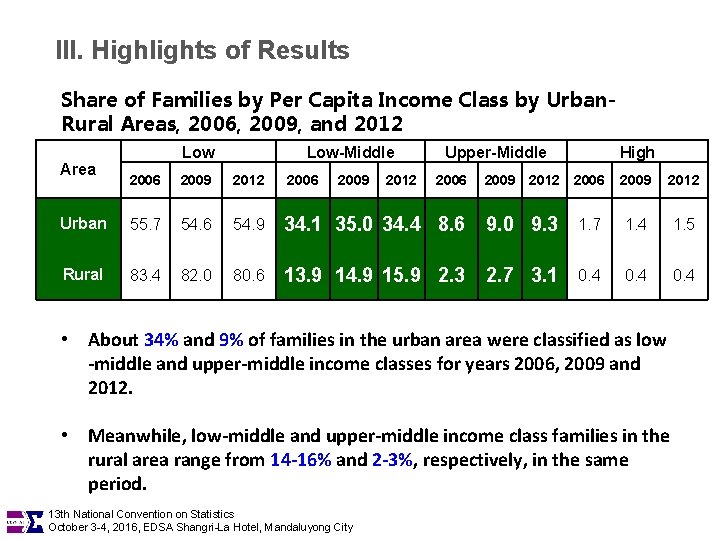
III. Highlights of Results Share of Families by Per Capita Income Class by Urban. Rural Areas, 2006, 2009, and 2012 Area Low-Middle 2009 2012 Upper-Middle 2006 2009 2012 2006 Urban 55. 7 54. 6 54. 9 34. 1 35. 0 34. 4 8. 6 9. 0 9. 3 Rural 83. 4 82. 0 80. 6 13. 9 14. 9 15. 9 2. 3 2. 7 3. 1 High 2009 2012 2006 2009 2012 1. 7 1. 4 1. 5 0. 4 • About 34% and 9% of families in the urban area were classified as low -middle and upper-middle income classes for years 2006, 2009 and 2012. • Meanwhile, low-middle and upper-middle income class families in the rural area range from 14 -16% and 2 -3%, respectively, in the same period. 13 th National Convention on Statistics October 3 -4, 2016, EDSA Shangri-La Hotel, Mandaluyong City
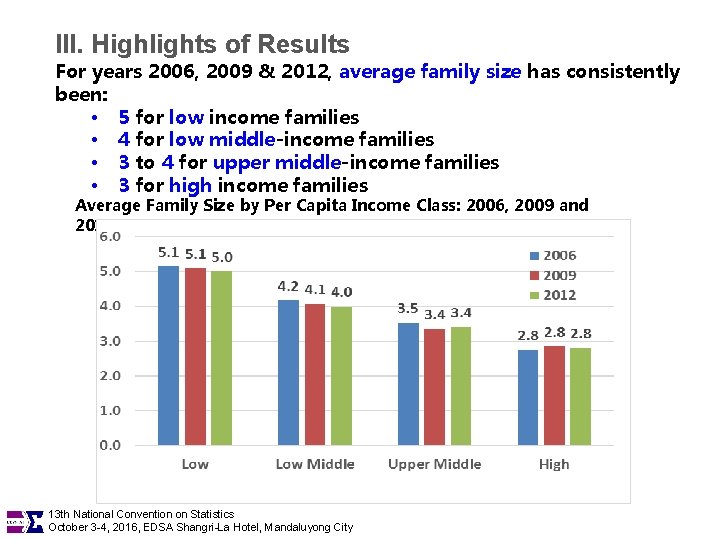
III. Highlights of Results For years 2006, 2009 & 2012, average family size has consistently been: • 5 for low income families • 4 for low middle-income families • 3 to 4 for upper middle-income families • 3 for high income families Average Family Size by Per Capita Income Class: 2006, 2009 and 2012 13 th National Convention on Statistics October 3 -4, 2016, EDSA Shangri-La Hotel, Mandaluyong City
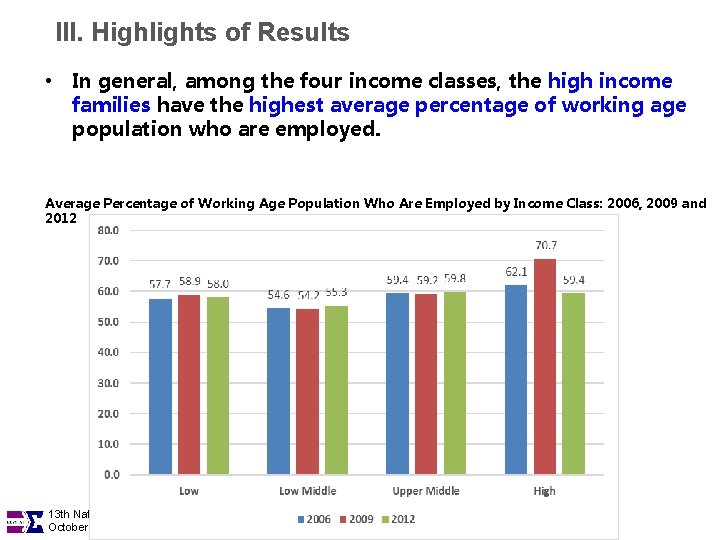
III. Highlights of Results • In general, among the four income classes, the high income families have the highest average percentage of working age population who are employed. Average Percentage of Working Age Population Who Are Employed by Income Class: 2006, 2009 and 2012 13 th National Convention on Statistics October 3 -4, 2016, EDSA Shangri-La Hotel, Mandaluyong City
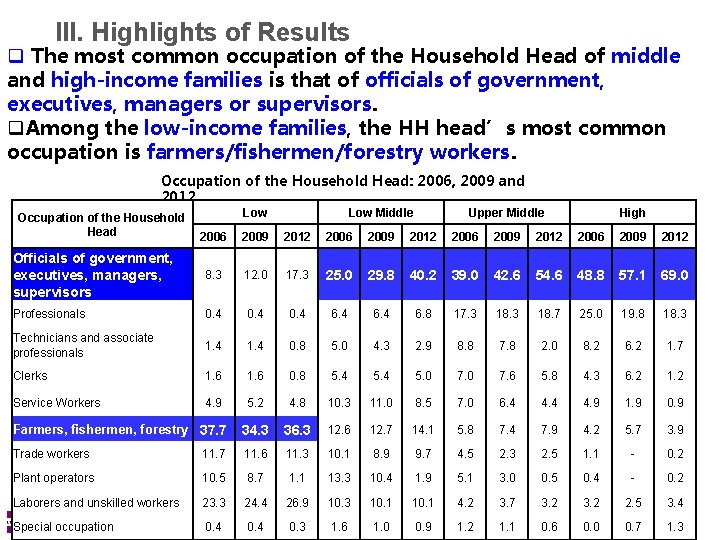
III. Highlights of Results q The most common occupation of the Household Head of middle and high-income families is that of officials of government, executives, managers or supervisors. q. Among the low-income families, the HH head’s most common occupation is farmers/fishermen/forestry workers. Occupation of the Household Head: 2006, 2009 and 2012 Occupation of the Household Head Low Middle Upper Middle High 2006 2009 2012 Officials of government, executives, managers, supervisors 8. 3 12. 0 17. 3 25. 0 29. 8 40. 2 39. 0 42. 6 54. 6 48. 8 57. 1 69. 0 Professionals 0. 4 6. 8 17. 3 18. 7 25. 0 19. 8 18. 3 Technicians and associate professionals 1. 4 0. 8 5. 0 4. 3 2. 9 8. 8 7. 8 2. 0 8. 2 6. 2 1. 7 Clerks 1. 6 0. 8 5. 4 5. 0 7. 6 5. 8 4. 3 6. 2 1. 2 Service Workers 4. 9 5. 2 4. 8 10. 3 11. 0 8. 5 7. 0 6. 4 4. 9 1. 9 0. 9 Farmers, fishermen, forestry 37. 7 34. 3 36. 3 12. 6 12. 7 14. 1 5. 8 7. 4 7. 9 4. 2 5. 7 3. 9 Trade workers 11. 7 11. 6 11. 3 10. 1 8. 9 9. 7 4. 5 2. 3 2. 5 1. 1 - 0. 2 Plant operators 10. 5 8. 7 1. 1 13. 3 10. 4 1. 9 5. 1 3. 0 0. 5 0. 4 - 0. 2 Laborers and unskilled workers 23. 3 24. 4 26. 9 10. 3 10. 1 4. 2 3. 7 3. 2 2. 5 3. 4 1. 0 0. 9 1. 2 1. 1 0. 6 0. 0 0. 7 1. 3 13 th National Convention on Statistics Special. October occupation 0. 4 Hotel, 0. 4 Mandaluyong 0. 3 1. 6 3 -4, 2016, EDSA Shangri-La City
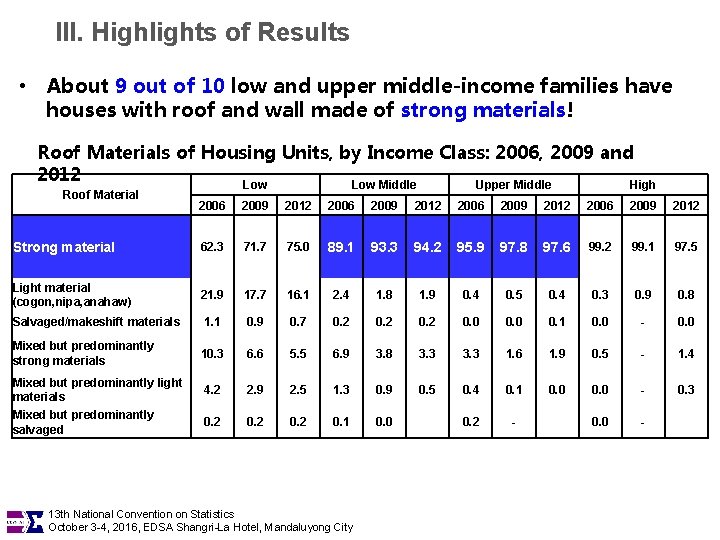
III. Highlights of Results • About 9 out of 10 low and upper middle-income families have houses with roof and wall made of strong materials! Roof Materials of Housing Units, by Income Class: 2006, 2009 and 2012 Low Middle Upper Middle High Roof Material 2006 2009 2012 Strong material 62. 3 71. 7 75. 0 89. 1 93. 3 94. 2 95. 9 97. 8 97. 6 99. 2 99. 1 97. 5 Light material (cogon, nipa, anahaw) 21. 9 17. 7 16. 1 2. 4 1. 8 1. 9 0. 4 0. 5 0. 4 0. 3 0. 9 0. 8 Salvaged/makeshift materials 1. 1 0. 9 0. 7 0. 2 0. 0 0. 1 0. 0 - 0. 0 Mixed but predominantly strong materials 10. 3 6. 6 5. 5 6. 9 3. 8 3. 3 1. 6 1. 9 0. 5 - 1. 4 Mixed but predominantly light materials 4. 2 2. 9 2. 5 1. 3 0. 9 0. 5 0. 4 0. 1 0. 0 - 0. 3 Mixed but predominantly salvaged 0. 2 0. 1 0. 0 0. 2 - 0. 0 - 13 th National Convention on Statistics October 3 -4, 2016, EDSA Shangri-La Hotel, Mandaluyong City
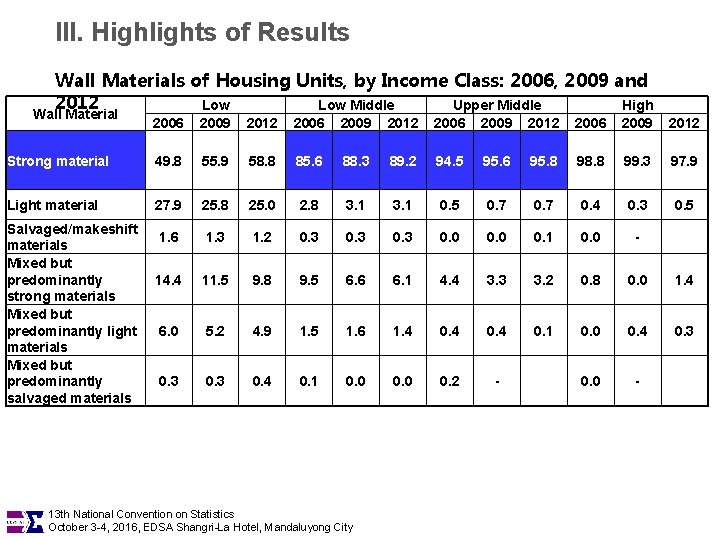
III. Highlights of Results Wall Materials of Housing Units, by Income Class: 2006, 2009 and 2012 Low Middle Upper Middle High Wall Material 2006 2009 2012 Strong material 49. 8 55. 9 58. 8 85. 6 88. 3 89. 2 94. 5 95. 6 95. 8 98. 8 99. 3 97. 9 Light material 27. 9 25. 8 25. 0 2. 8 3. 1 0. 5 0. 7 0. 4 0. 3 0. 5 1. 6 1. 3 1. 2 0. 3 0. 0 0. 1 0. 0 - 14. 4 11. 5 9. 8 9. 5 6. 6 6. 1 4. 4 3. 3 3. 2 0. 8 0. 0 1. 4 6. 0 5. 2 4. 9 1. 5 1. 6 1. 4 0. 1 0. 0 0. 4 0. 3 0. 4 0. 1 0. 0 0. 2 - 0. 0 - Salvaged/makeshift materials Mixed but predominantly strong materials Mixed but predominantly light materials Mixed but predominantly salvaged materials 13 th National Convention on Statistics October 3 -4, 2016, EDSA Shangri-La Hotel, Mandaluyong City

III. Highlights of Results q Across all the income classes, most of the households have single house. Type of Building/House of Housing Units, by Income Class: 2006, 2009 and 2012 Type of Building/House Single house Duplex Apartment/ accessoria/ condo/townhouse Low 2006 2009 Low Middle 2012 2006 2009 2012 Upper Middle 2006 2009 2012 High 2006 2009 2012 95. 1 95. 2 87. 3 88. 0 88. 9 82. 0 86. 9 90. 0 83. 6 89. 4 90. 0 2. 4 3. 7 3. 5 3. 8 4. 1 2. 6 3. 5 4. 2 2. 8 3. 5 2. 3 2. 4 8. 3 8. 1 7. 2 12. 2 10. 2 6. 0 8. 9 7. 0 6. 0 Commercial/ industrial/agricultural building/house 0. 2 0. 1 0. 6 0. 3 0. 1 1. 6 0. 3 0. 4 3. 4 0. 8 0. 4 Other building unit (e. g. cave, boat) 0. 1 0. 0 0. 1 - 0. 1 0. 0 - 0. 1 13 th National Convention on Statistics October 3 -4, 2016, EDSA Shangri-La Hotel, Mandaluyong City
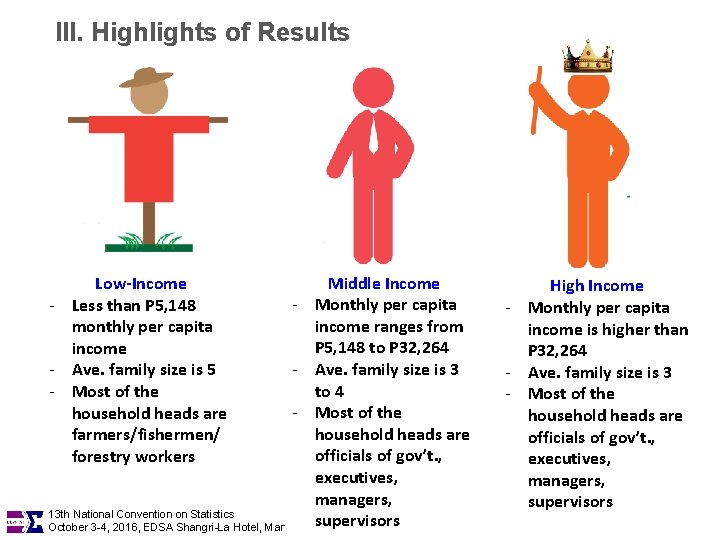
III. Highlights of Results Middle Income - Monthly per capita income ranges from P 5, 148 to P 32, 264 - Ave. family size is 3 to 4 - Most of the household heads are officials of gov’t. , executives, managers, 13 th National Convention on Statistics supervisors October 3 -4, 2016, EDSA Shangri-La Hotel, Mandaluyong City Low-Income - Less than P 5, 148 monthly per capita income - Ave. family size is 5 - Most of the household heads are farmers/fishermen/ forestry workers High Income - Monthly per capita income is higher than P 32, 264 - Ave. family size is 3 - Most of the household heads are officials of gov’t. , executives, managers, supervisors
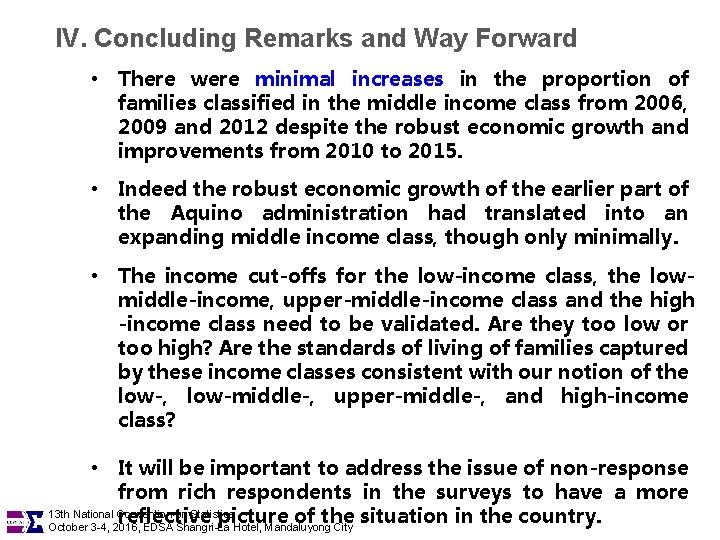
IV. Concluding Remarks and Way Forward • There were minimal increases in the proportion of families classified in the middle income class from 2006, 2009 and 2012 despite the robust economic growth and improvements from 2010 to 2015. • Indeed the robust economic growth of the earlier part of the Aquino administration had translated into an expanding middle income class, though only minimally. • The income cut-offs for the low-income class, the lowmiddle-income, upper-middle-income class and the high -income class need to be validated. Are they too low or too high? Are the standards of living of families captured by these income classes consistent with our notion of the low-, low-middle-, upper-middle-, and high-income class? • It will be important to address the issue of non-response from rich respondents in the surveys to have a more 13 th National Convention on Statistics reflective picture of the situation in the country. October 3 -4, 2016, EDSA Shangri-La Hotel, Mandaluyong City
Maraming Salamat po. Happy National Statistics Month! URL: http: //www. psa. gov. ph 13 th National Convention on Statistics October 3 -4, 2016, EDSA Shangri-La Hotel, Mandaluyong City
- Slides: 27