
Dictionaries Collection of unordered pairs key element Pairs
![Reminder: Binary Search • public static int index. Of(int[] a, int key) { •](https://slidetodoc.com/presentation_image/7a9919f153f15603d005a87c1031d0b8/image-8.jpg "Reminder: Binary Search • public static int index. Of(int[] a, int key) { •")
![Ideal Hashing • Uses a 1 D array (or table) table[0: b-1]. § Each](https://slidetodoc.com/presentation_image/7a9919f153f15603d005a87c1031d0b8/image-16.jpg "Ideal Hashing • Uses a 1 D array (or table) table[0: b-1]. § Each")
![What Can Go Wrong? (3, d) [0] (22, a) (33, c) [1] [2] [3]](https://slidetodoc.com/presentation_image/7a9919f153f15603d005a87c1031d0b8/image-18.jpg "What Can Go Wrong? (3, d) [0] (22, a) (33, c) [1] [2] [3]")
![2. Map Into A Home Bucket (3, d) [0] (22, a) (33, c) [1]](https://slidetodoc.com/presentation_image/7a9919f153f15603d005a87c1031d0b8/image-26.jpg "2. Map Into A Home Bucket (3, d) [0] (22, a) (33, c) [1]")
![Uniform Hash Function (3, d) [0] (22, a) (33, c) [1] [2] [3] (73,](https://slidetodoc.com/presentation_image/7a9919f153f15603d005a87c1031d0b8/image-27.jpg "Uniform Hash Function (3, d) [0] (22, a) (33, c) [1] [2] [3] (73,")
![Uniform Hash Function (3, d) [0] (22, a) (33, c) [1] [2] [3] (73,](https://slidetodoc.com/presentation_image/7a9919f153f15603d005a87c1031d0b8/image-28.jpg "Uniform Hash Function (3, d) [0] (22, a) (33, c) [1] [2] [3] (73,")
- Slides: 33
Dictionaries • Collection of unordered pairs. § (key, element) § Pairs have different keys. § Stores ‘mapping’ from key to element • Operations. § find(the. Key) § erase(the. Key) § insert(the. Key, the. Element)
Application • Collection of student records in this class. § (key, element) = (student name, linear list of assignment and exam scores) § All keys are distinct. • Get the element whose key is John Adams. • Update the element whose key is Diana Ross. § insert() implemented as update when there is already a pair with the given key. § erase() followed by insert().
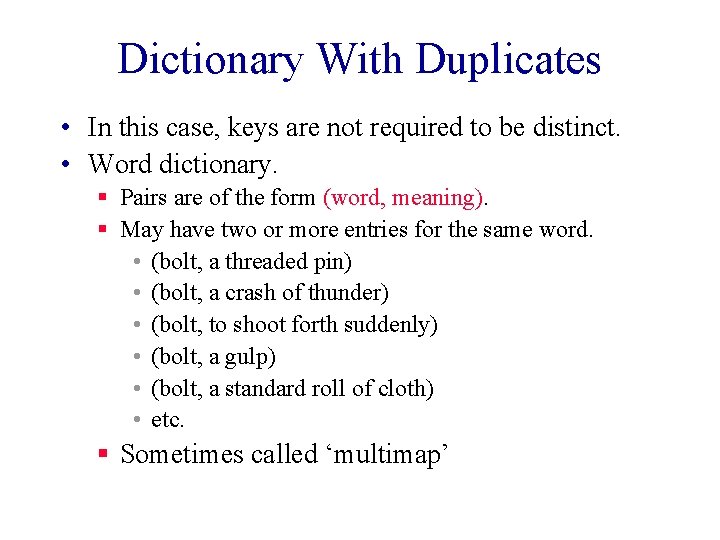
Dictionary With Duplicates • In this case, keys are not required to be distinct. • Word dictionary. § Pairs are of the form (word, meaning). § May have two or more entries for the same word. • (bolt, a threaded pin) • (bolt, a crash of thunder) • (bolt, to shoot forth suddenly) • (bolt, a gulp) • (bolt, a standard roll of cloth) • etc. § Sometimes called ‘multimap’
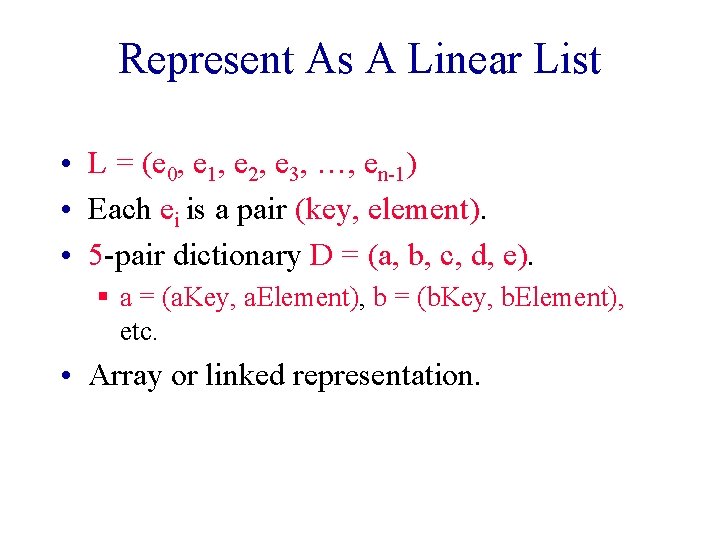
Represent As A Linear List • L = (e 0, e 1, e 2, e 3, …, en-1) • Each ei is a pair (key, element). • 5 -pair dictionary D = (a, b, c, d, e). § a = (a. Key, a. Element), b = (b. Key, b. Element), etc. • Array or linked representation.
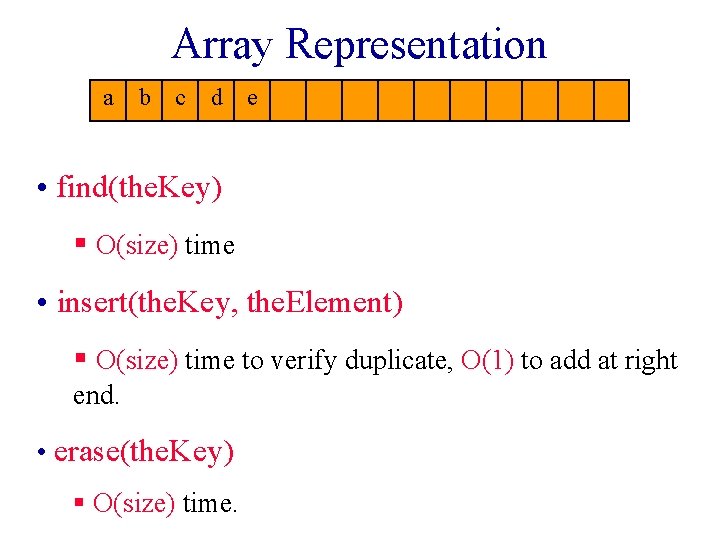
Array Representation a b c d e • find(the. Key) § O(size) time • insert(the. Key, the. Element) § O(size) time to verify duplicate, O(1) to add at right end. • erase(the. Key) § O(size) time.
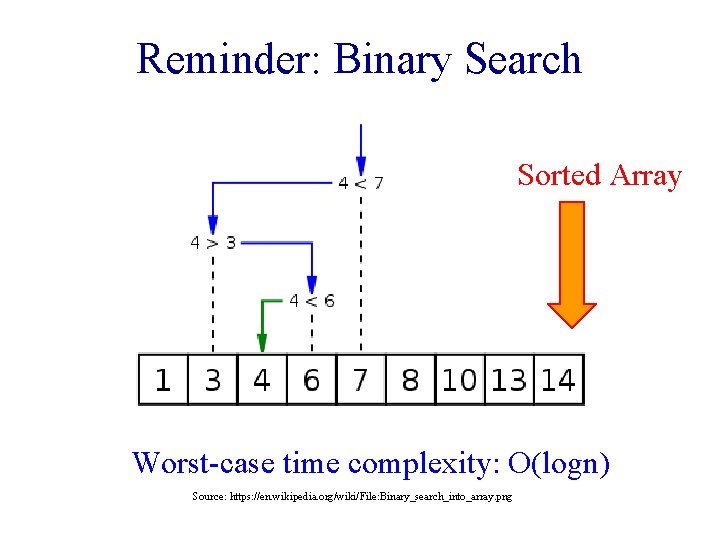
Reminder: Binary Search Sorted Array Worst-case time complexity: O(logn) Source: https: //en. wikipedia. org/wiki/File: Binary_search_into_array. png
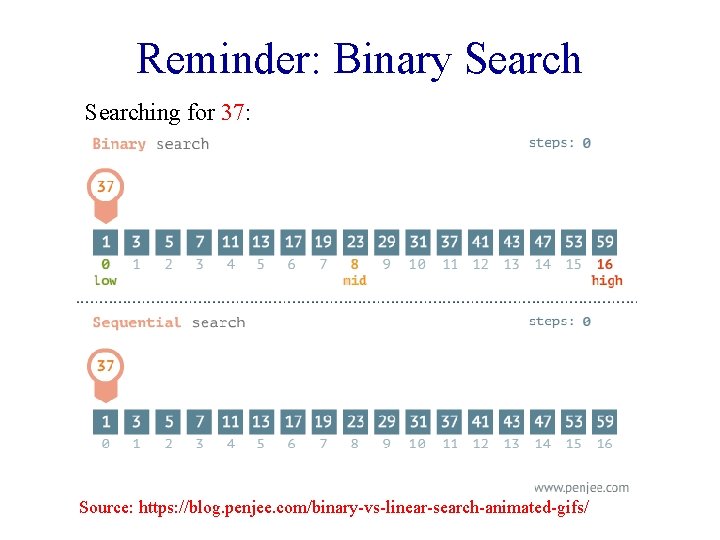
Reminder: Binary Searching for 37: Source: https: //blog. penjee. com/binary-vs-linear-search-animated-gifs/
Reminder: Binary Search • public static int index. Of(int[] a, int key) { • int lo = 0; • int hi = a. length - 1; • while (lo <= hi) { • // Key is in a[lo. . hi] or not present. • int mid = lo + (hi - lo) / 2; • if (key < a[mid]) hi = mid - 1; • else if (key > a[mid]) lo = mid + 1; • else return mid; • } • return -1; • } source: http: //algs 4. cs. princeton. edu/11 model/Binary. Search. java. html
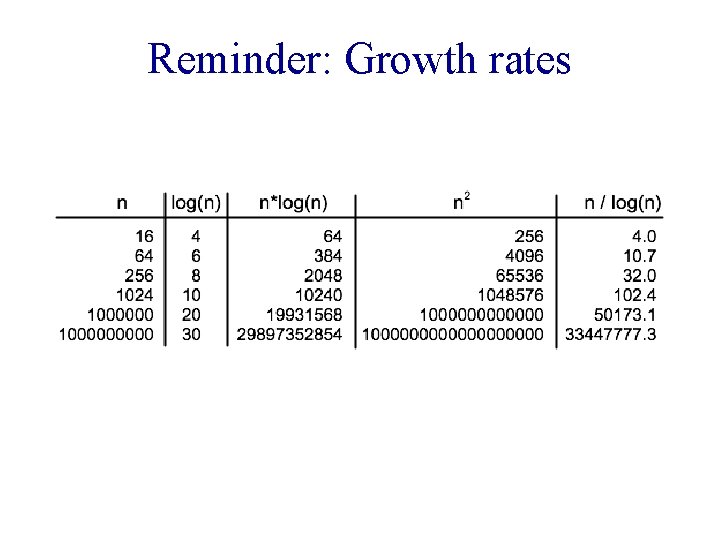
Reminder: Growth rates
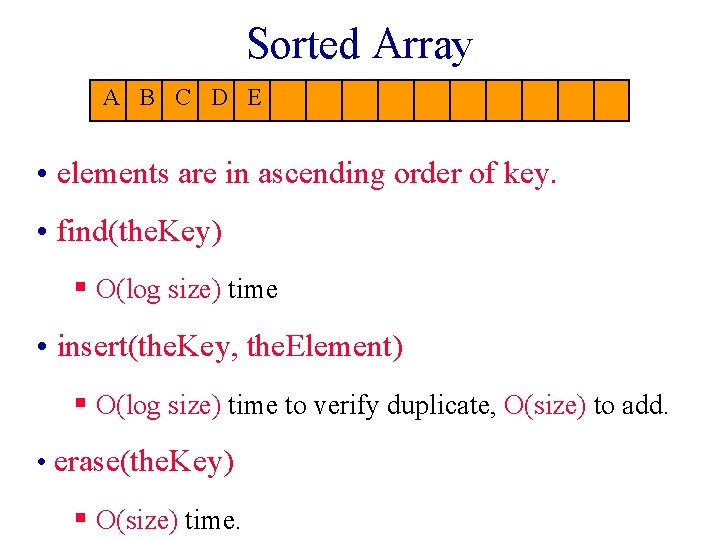
Sorted Array A B C D E • elements are in ascending order of key. • find(the. Key) § O(log size) time • insert(the. Key, the. Element) § O(log size) time to verify duplicate, O(size) to add. • erase(the. Key) § O(size) time.
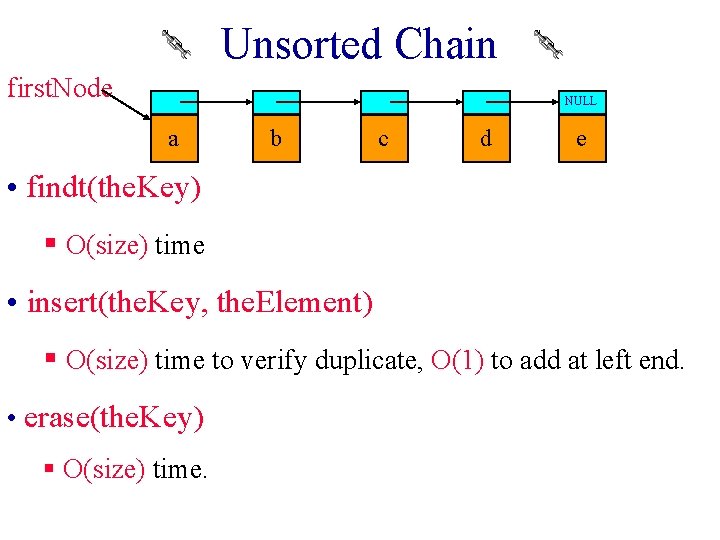
Unsorted Chain first. Node NULL a b c d e • findt(the. Key) § O(size) time • insert(the. Key, the. Element) § O(size) time to verify duplicate, O(1) to add at left end. • erase(the. Key) § O(size) time.
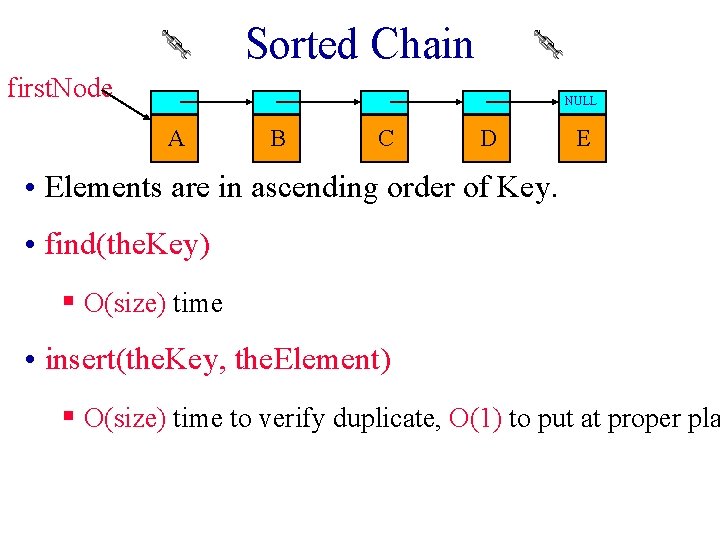
Sorted Chain first. Node NULL A B C D E • Elements are in ascending order of Key. • find(the. Key) § O(size) time • insert(the. Key, the. Element) § O(size) time to verify duplicate, O(1) to put at proper pla
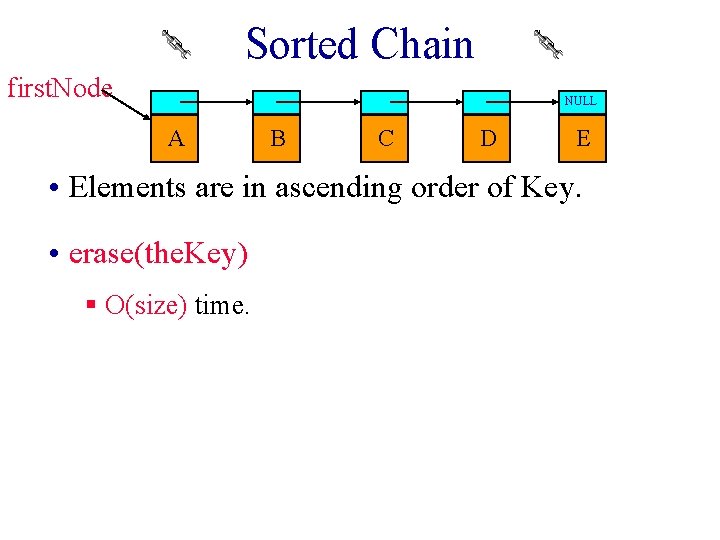
Sorted Chain first. Node NULL A B C D E • Elements are in ascending order of Key. • erase(the. Key) § O(size) time.
Skip Lists • Worst-case time for find, insert, and erase is O(size). • Expected time is O(log size). • We’ll skip lists.
Hash Tables • Worst-case time for find, insert, and erase is O(size). • Expected time is O(1).
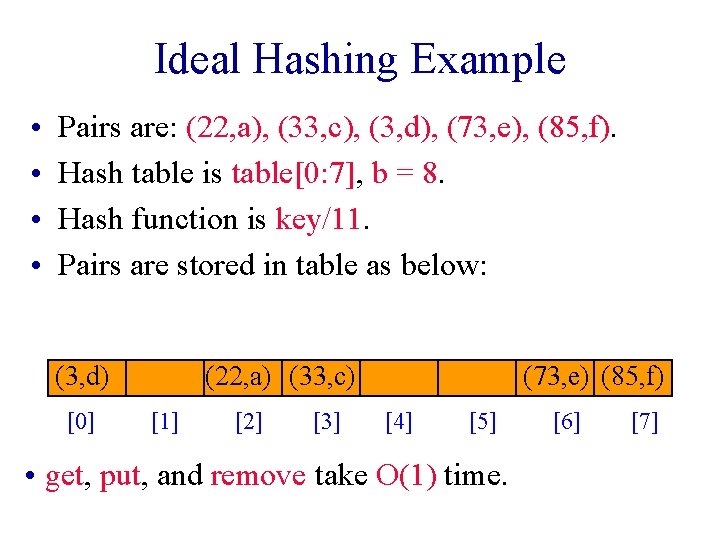
Ideal Hashing • Uses a 1 D array (or table) table[0: b-1]. § Each position of this array is a bucket. § A bucket can normally hold only one dictionary pair. • Uses a hash function f that converts each key k into an index in the range [0, b-1]. § f(k) is the home bucket for key k. • Every dictionary pair (key, element) is stored in its home bucket table[f[key]].
Ideal Hashing Example • • Pairs are: (22, a), (33, c), (3, d), (73, e), (85, f). Hash table is table[0: 7], b = 8. Hash function is key/11. Pairs are stored in table as below: (3, d) [0] (22, a) (33, c) [1] [2] [3] (73, e) (85, f) [4] [5] • get, put, and remove take O(1) time. [6] [7]
What Can Go Wrong? (3, d) [0] (22, a) (33, c) [1] [2] [3] (73, e) (85, f) [4] [5] [6] [7] • Where does (26, g) go? • Keys that have the same home bucket are synonyms. § 22 and 26 are synonyms with respect to the hash function that is in use. • The home bucket for (26, g) is already occupied. § Handle Collision and overflow • Where does (100, h) go? § Not mapped to a valid bucket Choose a better hash function
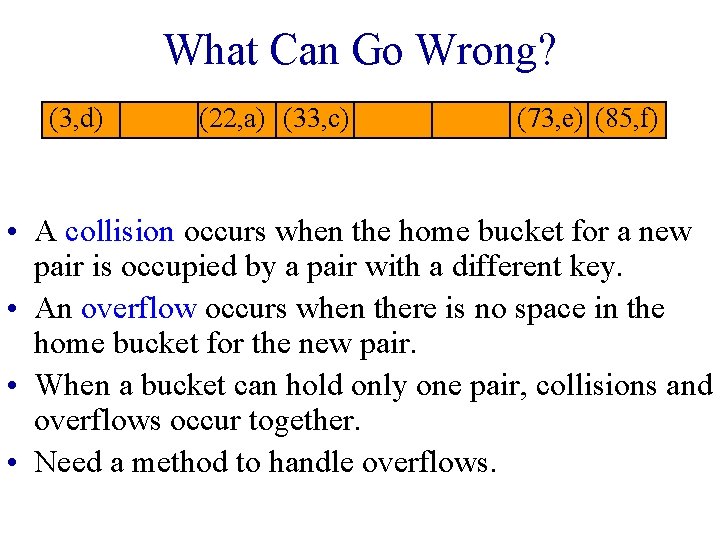
What Can Go Wrong? (3, d) (22, a) (33, c) (73, e) (85, f) • A collision occurs when the home bucket for a new pair is occupied by a pair with a different key. • An overflow occurs when there is no space in the home bucket for the new pair. • When a bucket can hold only one pair, collisions and overflows occur together. • Need a method to handle overflows.
Hash Table Issues • Choice of hash function. • Overflow handling method. • Size (number of buckets) of hash table.
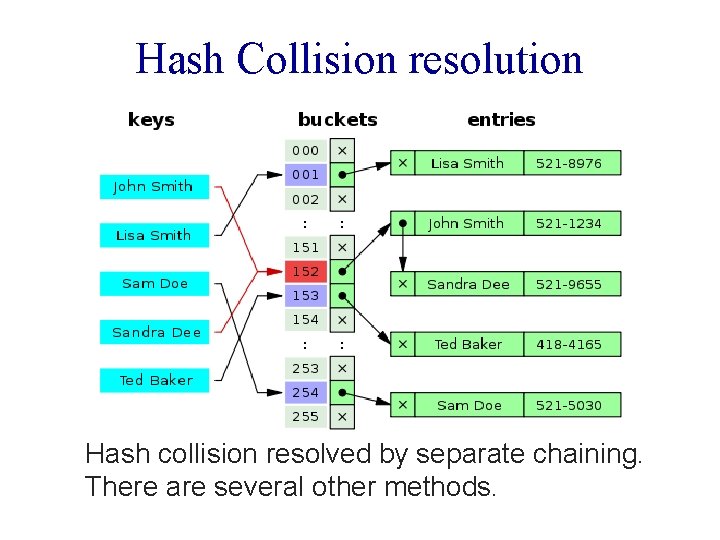
Hash Collision resolution Hash collision resolved by separate chaining. There are several other methods.
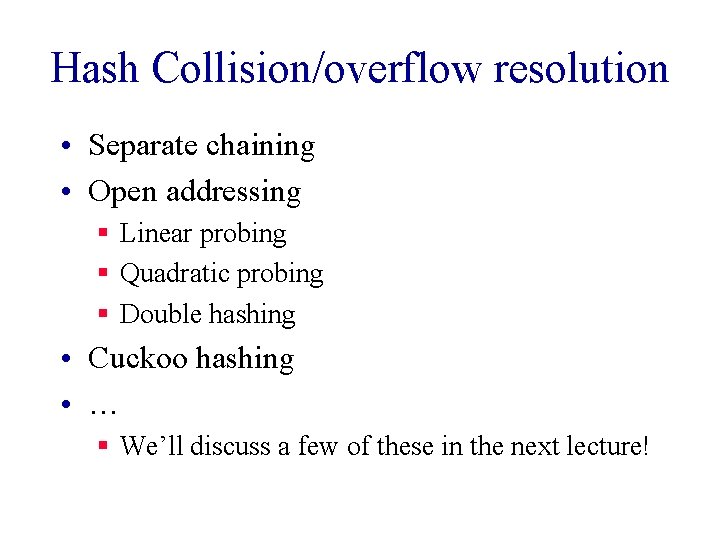
Hash Collision/overflow resolution • Separate chaining • Open addressing § Linear probing § Quadratic probing § Double hashing • Cuckoo hashing • … § We’ll discuss a few of these in the next lecture!
Hash Functions • Two parts: § 1. Convert key into a nonnegative integer in case the key is not an integer. • Done by the function hash(). • 2. Map an integer into a home bucket. § f(k) is an integer in the range [0, b-1], where b is the number of buckets in the table.
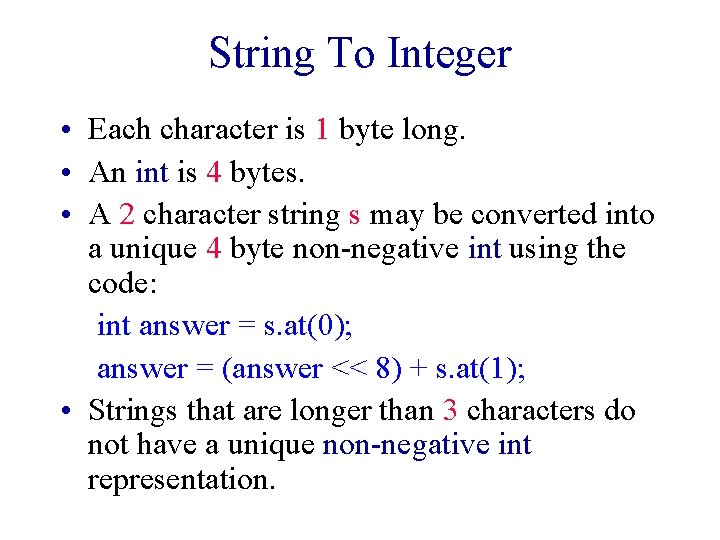
String To Integer • Each character is 1 byte long. • An int is 4 bytes. • A 2 character string s may be converted into a unique 4 byte non-negative int using the code: int answer = s. at(0); answer = (answer << 8) + s. at(1); • Strings that are longer than 3 characters do not have a unique non-negative int representation.
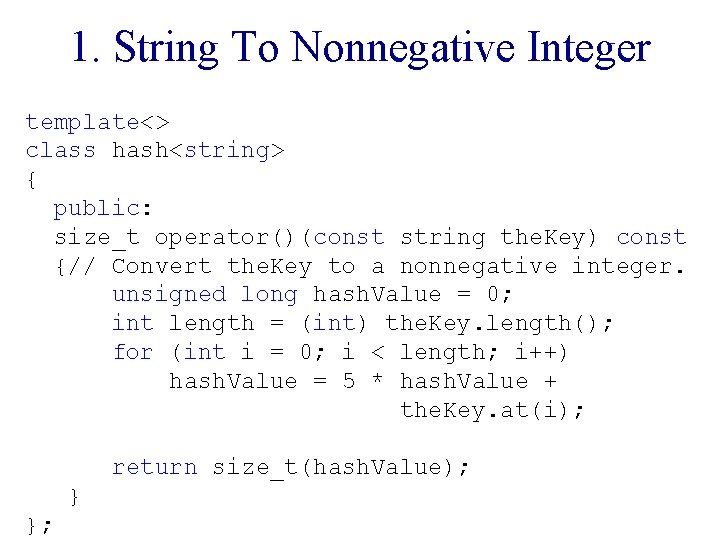
1. String To Nonnegative Integer template<> class hash<string> { public: size_t operator()(const string the. Key) const {// Convert the. Key to a nonnegative integer. unsigned long hash. Value = 0; int length = (int) the. Key. length(); for (int i = 0; i < length; i++) hash. Value = 5 * hash. Value + the. Key. at(i); return size_t(hash. Value); } };
2. Map Into A Home Bucket (3, d) [0] (22, a) (33, c) [1] [2] [3] (73, e) (85, f) [4] [5] [6] [7] • Most common method is by division. home. Bucket = hash(the. Key) % divisor; • divisor equals number of buckets b. • 0 <= home. Bucket < divisor = b § Dynamic resizing reduces chance of ‘%’ collision. § Resizing is accompanied by a full or incremental table rehash whereby existing items are mapped to new bucket locations. *
Uniform Hash Function (3, d) [0] (22, a) (33, c) [1] [2] [3] (73, e) (85, f) [4] [5] [6] [7] • Let key. Space be the set of all possible keys. • A uniform hash function maps the keys in key. Space into buckets such that approximately the same number of keys get mapped into each bucket.
Uniform Hash Function (3, d) [0] (22, a) (33, c) [1] [2] [3] (73, e) (85, f) [4] [5] [6] [7] • Equivalently, the probability that a randomly selected key has bucket i as its home bucket is 1/b, 0 <= i < b. • A uniform hash function minimizes the likelihood of an overflow when keys are selected at random.
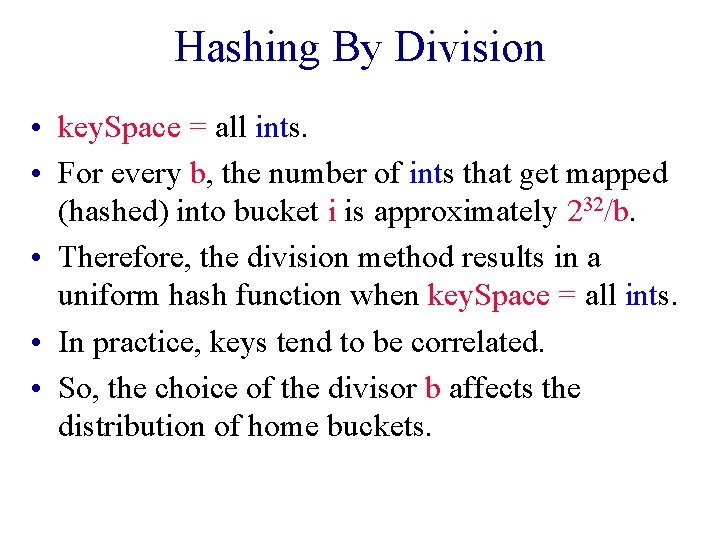
Hashing By Division • key. Space = all ints. • For every b, the number of ints that get mapped (hashed) into bucket i is approximately 232/b. • Therefore, the division method results in a uniform hash function when key. Space = all ints. • In practice, keys tend to be correlated. • So, the choice of the divisor b affects the distribution of home buckets.
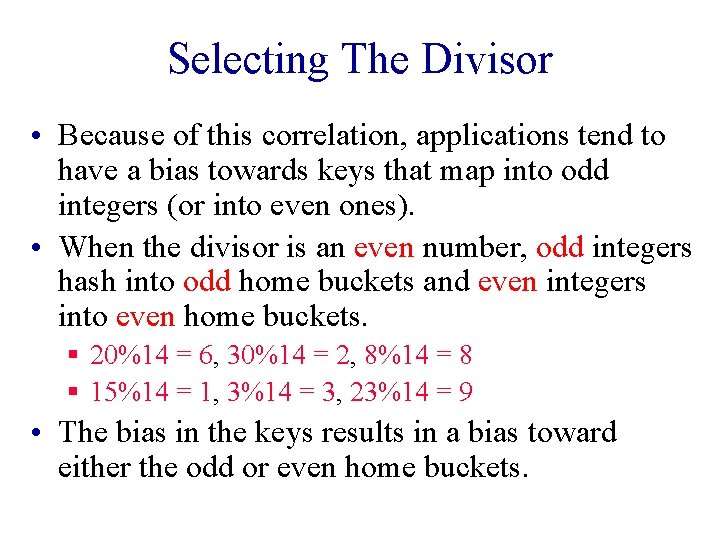
Selecting The Divisor • Because of this correlation, applications tend to have a bias towards keys that map into odd integers (or into even ones). • When the divisor is an even number, odd integers hash into odd home buckets and even integers into even home buckets. § 20%14 = 6, 30%14 = 2, 8%14 = 8 § 15%14 = 1, 3%14 = 3, 23%14 = 9 • The bias in the keys results in a bias toward either the odd or even home buckets.
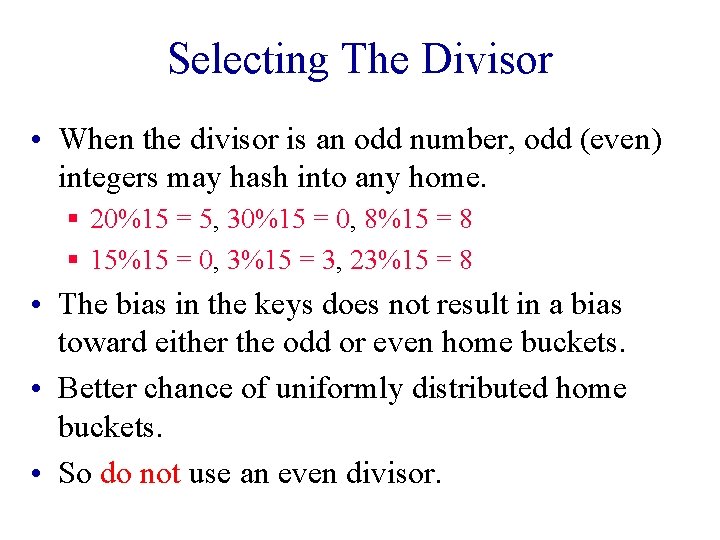
Selecting The Divisor • When the divisor is an odd number, odd (even) integers may hash into any home. § 20%15 = 5, 30%15 = 0, 8%15 = 8 § 15%15 = 0, 3%15 = 3, 23%15 = 8 • The bias in the keys does not result in a bias toward either the odd or even home buckets. • Better chance of uniformly distributed home buckets. • So do not use an even divisor.
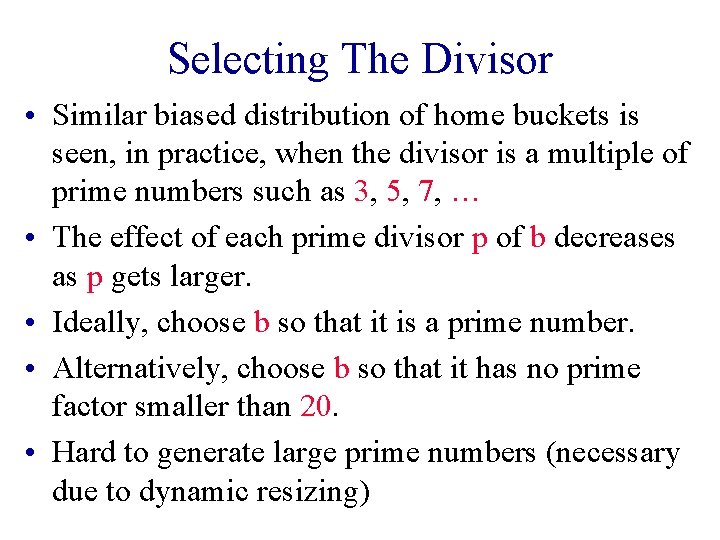
Selecting The Divisor • Similar biased distribution of home buckets is seen, in practice, when the divisor is a multiple of prime numbers such as 3, 5, 7, … • The effect of each prime divisor p of b decreases as p gets larger. • Ideally, choose b so that it is a prime number. • Alternatively, choose b so that it has no prime factor smaller than 20. • Hard to generate large prime numbers (necessary due to dynamic resizing)
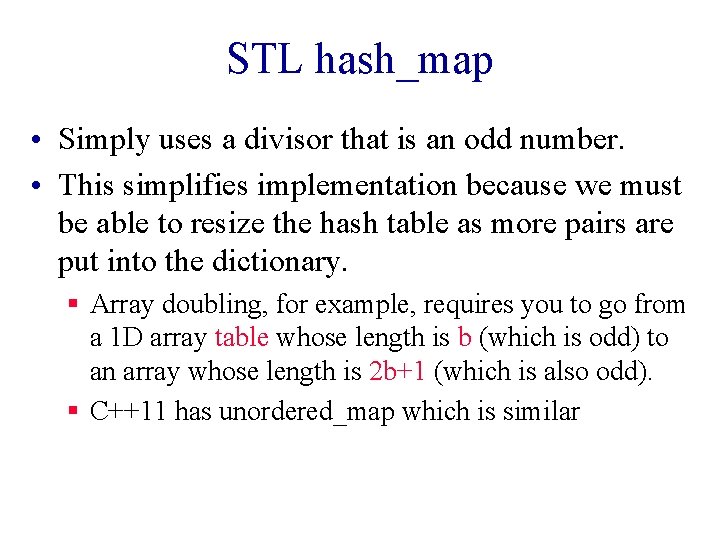
STL hash_map • Simply uses a divisor that is an odd number. • This simplifies implementation because we must be able to resize the hash table as more pairs are put into the dictionary. § Array doubling, for example, requires you to go from a 1 D array table whose length is b (which is odd) to an array whose length is 2 b+1 (which is also odd). § C++11 has unordered_map which is similar