
Diction Word Choice is EVERYTHING How many of
- Slides: 17
Diction: Word Choice is EVERYTHING!
How many of you have received a text message and not understood the emotion behind the text?
OR sent a text and it was highly misunderstood?
This happens because all the reader, or person who has received the text message, has to interpret are WORDS. There is no tone of voice, no facial expressions, eye contact, or body language that comes with a text. This shows you just how powerful plain ol' simple words can be.
Words carry emotions with them.
A coat isn’t torn, it is tattered.
The Army does not want revenge; it is thirsty for revenge.
What is the difference between the words WARRIOR and SOLDIER?
What is the difference between the words APPAREL and CLOTHES?
Diction or word choice is the foundation of an author’s voice. Word choice is the most powerful element; it affects the author’s meaning and tone. Words can have strong connotations which can elicit certain responses.
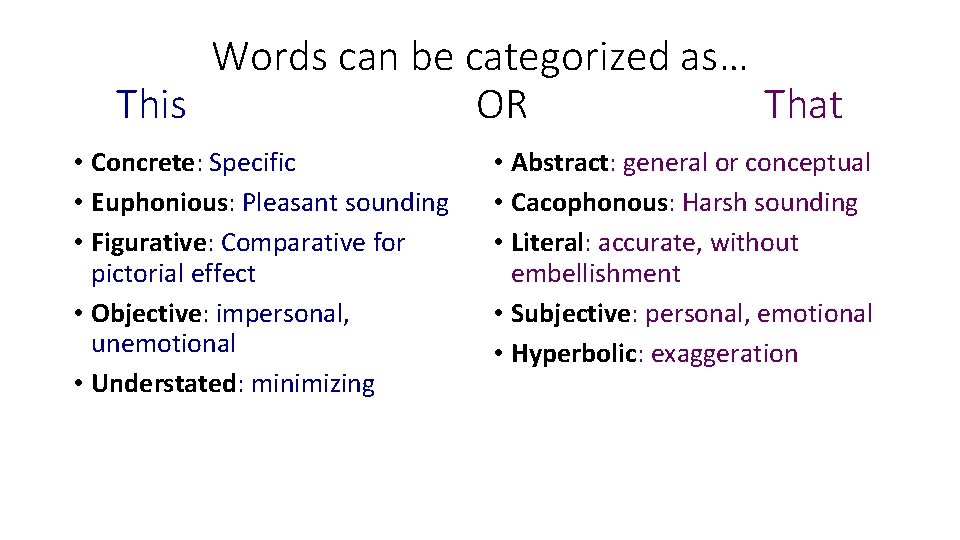
Words can be categorized as… This OR That • Concrete: Specific • Euphonious: Pleasant sounding • Figurative: Comparative for pictorial effect • Objective: impersonal, unemotional • Understated: minimizing • Abstract: general or conceptual • Cacophonous: Harsh sounding • Literal: accurate, without embellishment • Subjective: personal, emotional • Hyperbolic: exaggeration
Denotation: • The word’s literal meaning from a dictionary. • Example: The words “plump” and “obese” both literally describe a person who is overweight.
Connotation: • The word’s implied or suggested meaning that has been culturally created, the emotional “tag” that goes along with the word. Connotation is important because it shows the difference between synonyms. Example: • The word “plump” have the connotation of being pleasantly fat, or cutely overweight. It is also a word that is used more often to describe women. • The word “obese” is often used by medical personnel and is more scientific.
Tone Interpretation: • This is where you describe the feeling behind the words in a specific quote from the text. You must express your reaction or emotional response to the text. • This does not mean that you paraphrase the text.
“Only Gatsby, the man who gives his name to this book, was exempt from my reaction. ” - The Great Gatsby by F. Scott Fitzgerald
Each Diction Assignment: 1. Quote from the text. Who said the quote and at what point in the plot is the quote said? 2. Word to be analyzed. 3. Determine DENOTATION. 4. Determine ETYMOLOGY (origin of the word). 5. Determine CONNOTATION. (Explain emotions that come with the word and label the word according to the 10 labels I had you write down. ) 6. Discuss the TONE and author’s purpose of using the word. What emotion is conveyed?
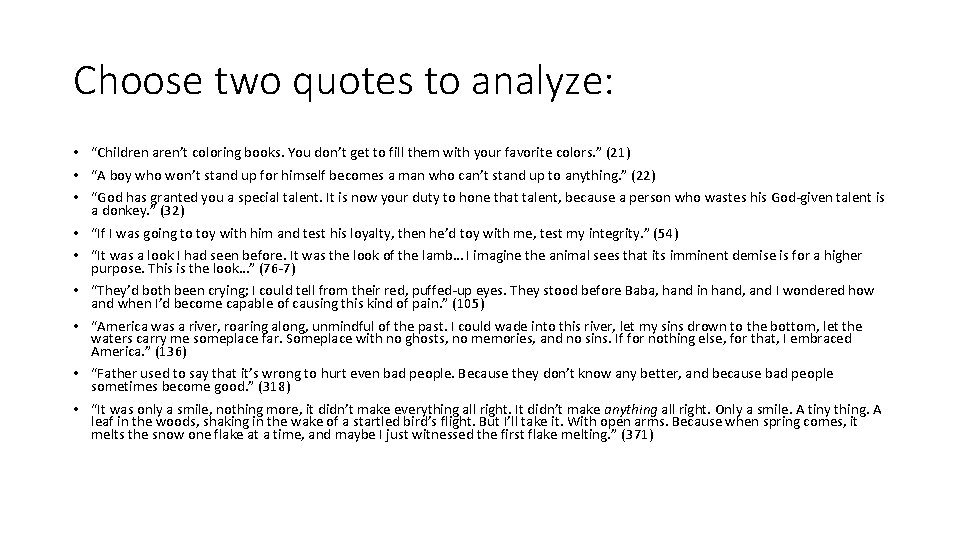
Choose two quotes to analyze: • “Children aren’t coloring books. You don’t get to fill them with your favorite colors. ” (21) • “A boy who won’t stand up for himself becomes a man who can’t stand up to anything. ” (22) • “God has granted you a special talent. It is now your duty to hone that talent, because a person who wastes his God-given talent is a donkey. ” (32) • “If I was going to toy with him and test his loyalty, then he’d toy with me, test my integrity. ” (54) • “It was a look I had seen before. It was the look of the lamb… I imagine the animal sees that its imminent demise is for a higher purpose. This is the look…” (76 -7) • “They’d both been crying; I could tell from their red, puffed-up eyes. They stood before Baba, hand in hand, and I wondered how and when I’d become capable of causing this kind of pain. ” (105) • “America was a river, roaring along, unmindful of the past. I could wade into this river, let my sins drown to the bottom, let the waters carry me someplace far. Someplace with no ghosts, no memories, and no sins. If for nothing else, for that, I embraced America. ” (136) • “Father used to say that it’s wrong to hurt even bad people. Because they don’t know any better, and because bad people sometimes become good. ” (318) • “It was only a smile, nothing more, it didn’t make everything all right. It didn’t make anything all right. Only a smile. A tiny thing. A leaf in the woods, shaking in the wake of a startled bird’s flight. But I’ll take it. With open arms. Because when spring comes, it melts the snow one flake at a time, and maybe I just witnessed the first flake melting. ” (371)