
Diction PreAP English 9 Diction The choice of
- Slides: 17
Diction Pre-AP English 9
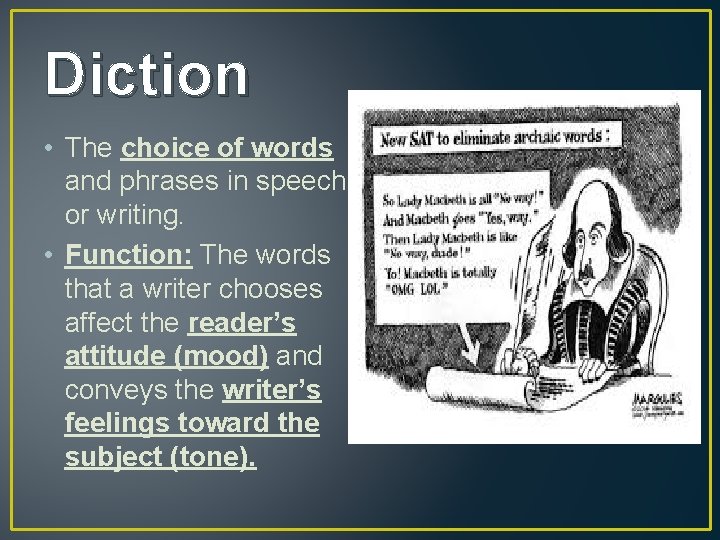
Diction • The choice of words and phrases in speech or writing. • Function: The words that a writer chooses affect the reader’s attitude (mood) and conveys the writer’s feelings toward the subject (tone).
Diction • Diction refers to the author's choice of words. • Diction functions as the writer's basic tools: – they create the color and texture of the written work; – they both reflect and determine the level of formality; – they shape the reader's perceptions.
Why Diction Matters • Choosing words that are clear, concrete, and exact shape a writer’s voice. • Good writers do not use words such as pretty, nice, bad, stuff, things, etc… Instead, they employ words that will have as specific effect on the reader. • A coat isn’t torn; it’s tattered. • The United States Marines don’t want revenge; they are thirsting for revenge. • A door does not shut; it thuds.
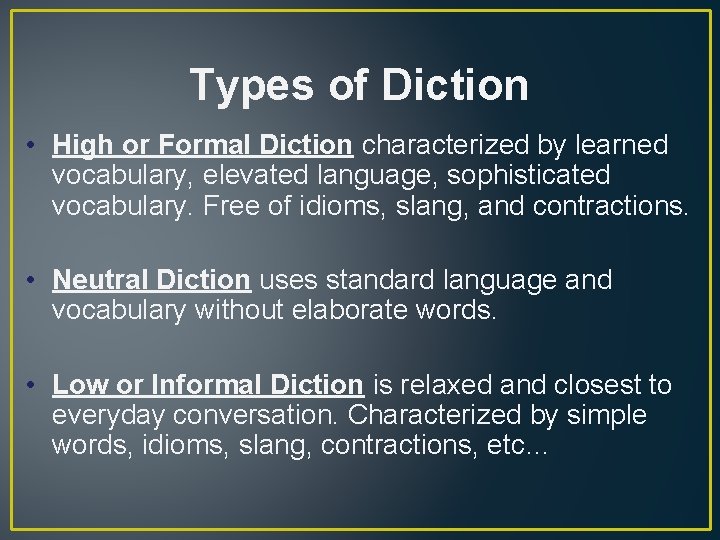
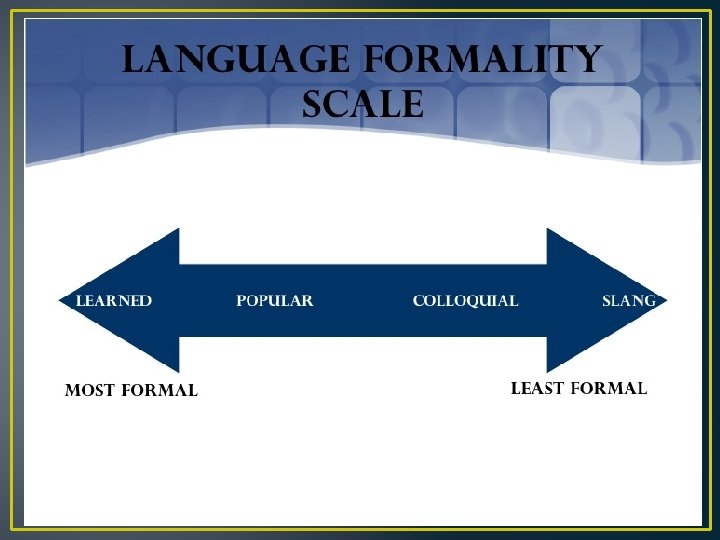
Types of Diction • High or Formal Diction characterized by learned vocabulary, elevated language, sophisticated vocabulary. Free of idioms, slang, and contractions. • Neutral Diction uses standard language and vocabulary without elaborate words. • Low or Informal Diction is relaxed and closest to everyday conversation. Characterized by simple words, idioms, slang, contractions, etc…
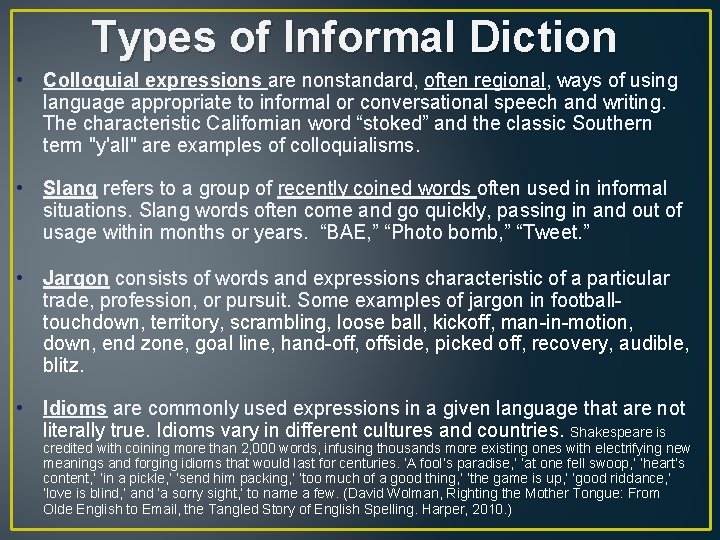
Types of Informal Diction • Colloquial expressions are nonstandard, often regional, ways of using language appropriate to informal or conversational speech and writing. The characteristic Californian word “stoked” and the classic Southern term "y'all" are examples of colloquialisms. • Slang refers to a group of recently coined words often used in informal situations. Slang words often come and go quickly, passing in and out of usage within months or years. “BAE, ” “Photo bomb, ” “Tweet. ” • Jargon consists of words and expressions characteristic of a particular trade, profession, or pursuit. Some examples of jargon in footballtouchdown, territory, scrambling, loose ball, kickoff, man-in-motion, down, end zone, goal line, hand-off, offside, picked off, recovery, audible, blitz. • Idioms are commonly used expressions in a given language that are not literally true. Idioms vary in different cultures and countries. Shakespeare is credited with coining more than 2, 000 words, infusing thousands more existing ones with electrifying new meanings and forging idioms that would last for centuries. ‘A fool’s paradise, ’ ‘at one fell swoop, ’ ‘heart’s content, ’ ‘in a pickle, ’ ‘send him packing, ’ ‘too much of a good thing, ’ ‘the game is up, ’ ‘good riddance, ’ ‘love is blind, ’ and ‘a sorry sight, ’ to name a few. (David Wolman, Righting the Mother Tongue: From Olde English to Email, the Tangled Story of English Spelling. Harper, 2010. )
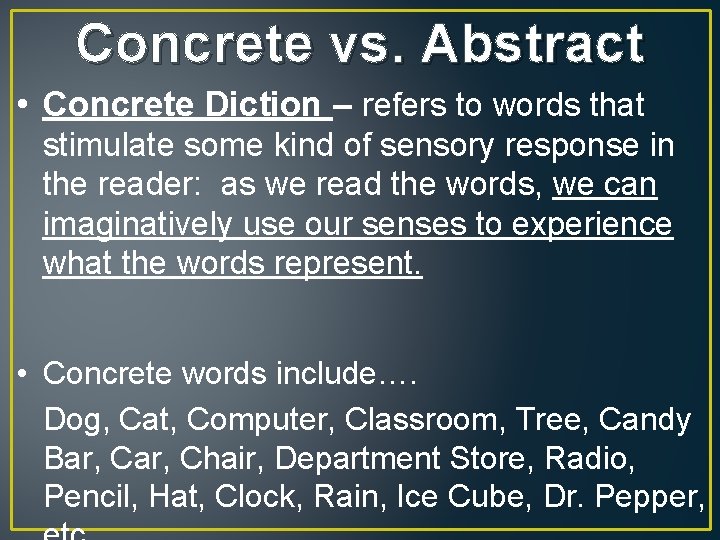
Concrete vs. Abstract • Concrete Diction – refers to words that stimulate some kind of sensory response in the reader: as we read the words, we can imaginatively use our senses to experience what the words represent. • Concrete words include…. Dog, Cat, Computer, Classroom, Tree, Candy Bar, Chair, Department Store, Radio, Pencil, Hat, Clock, Rain, Ice Cube, Dr. Pepper,
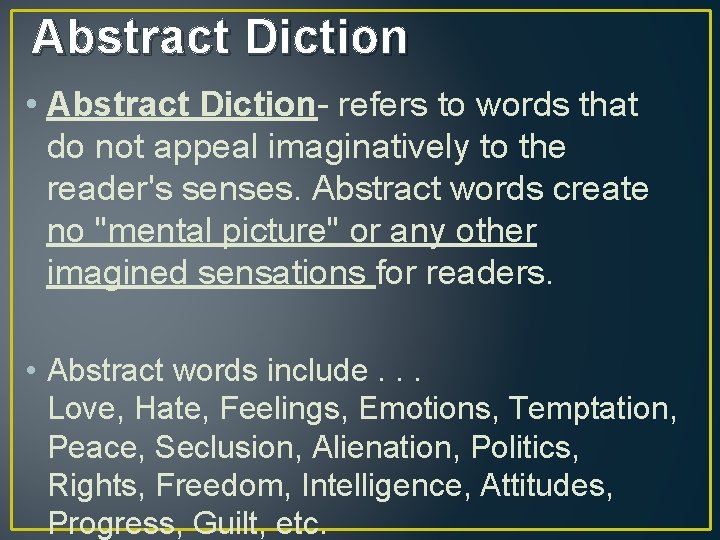
Abstract Diction • Abstract Diction- refers to words that do not appeal imaginatively to the reader's senses. Abstract words create no "mental picture" or any other imagined sensations for readers. • Abstract words include. . . Love, Hate, Feelings, Emotions, Temptation, Peace, Seclusion, Alienation, Politics, Rights, Freedom, Intelligence, Attitudes, Progress, Guilt, etc.
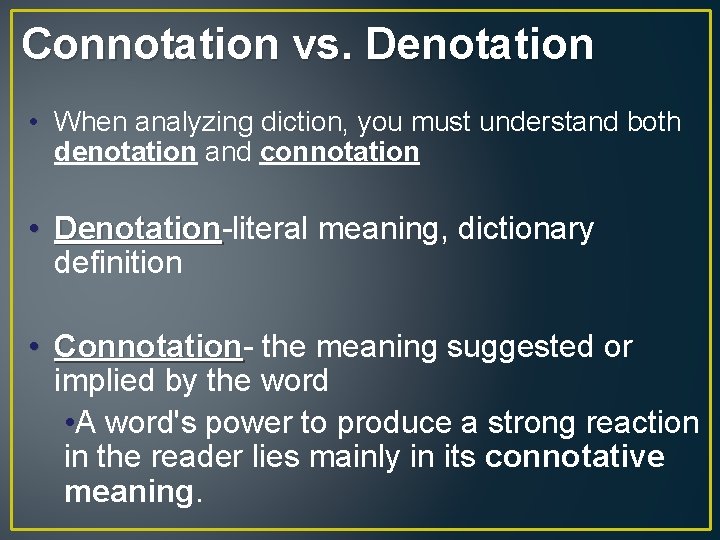
Connotation vs. Denotation • When analyzing diction, you must understand both denotation and connotation • Denotation-literal meaning, dictionary Denotation definition • Connotation the meaning suggested or implied by the word • A word's power to produce a strong reaction in the reader lies mainly in its connotative meaning.
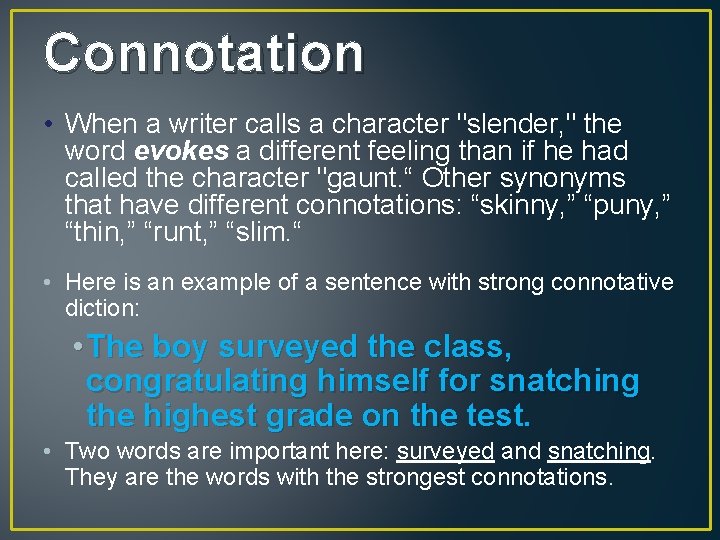
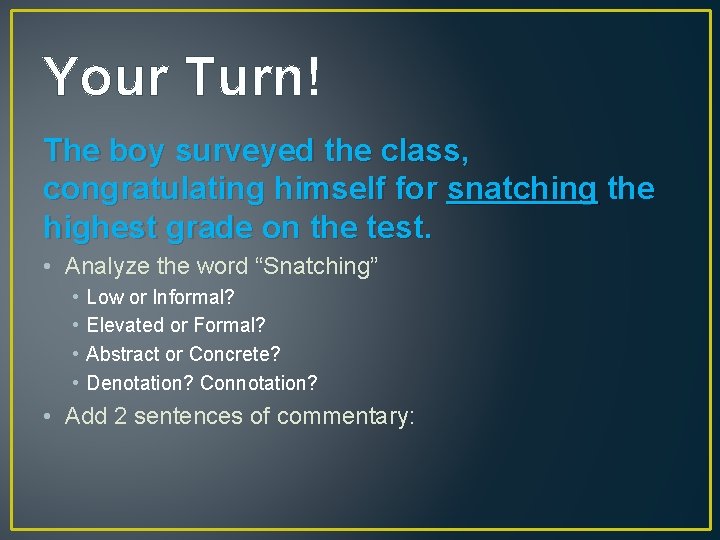
Connotation • When a writer calls a character "slender, " the word evokes a different feeling than if he had called the character "gaunt. “ Other synonyms that have different connotations: “skinny, ” “puny, ” “thin, ” “runt, ” “slim. “ • Here is an example of a sentence with strong connotative diction: • The boy surveyed the class, congratulating himself for snatching the highest grade on the test. • Two words are important here: surveyed and snatching. They are the words with the strongest connotations.
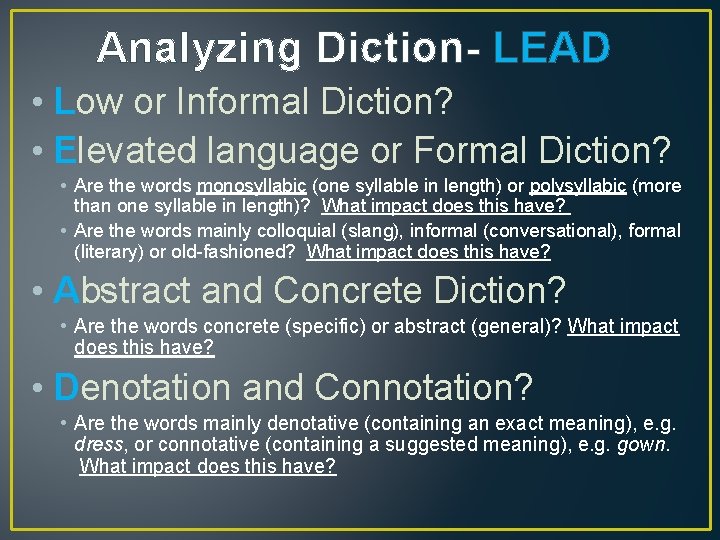
Analyzing Diction- LEAD • Low or Informal Diction? • Elevated language or Formal Diction? • Are the words monosyllabic (one syllable in length) or polysyllabic (more than one syllable in length)? What impact does this have? • Are the words mainly colloquial (slang), informal (conversational), formal (literary) or old-fashioned? What impact does this have? • Abstract and Concrete Diction? • Are the words concrete (specific) or abstract (general)? What impact does this have? • Denotation and Connotation? • Are the words mainly denotative (containing an exact meaning), e. g. dress, or connotative (containing a suggested meaning), e. g. gown. What impact does this have?
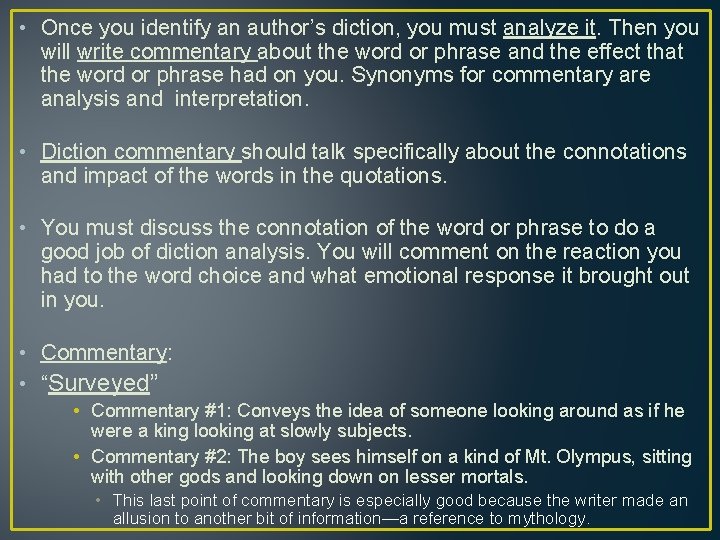
• Once you identify an author’s diction, you must analyze it. Then you will write commentary about the word or phrase and the effect that the word or phrase had on you. Synonyms for commentary are analysis and interpretation. • Diction commentary should talk specifically about the connotations and impact of the words in the quotations. • You must discuss the connotation of the word or phrase to do a good job of diction analysis. You will comment on the reaction you had to the word choice and what emotional response it brought out in you. • Commentary: • “Surveyed” • Commentary #1: Conveys the idea of someone looking around as if he were a king looking at slowly subjects. • Commentary #2: The boy sees himself on a kind of Mt. Olympus, sitting with other gods and looking down on lesser mortals. • This last point of commentary is especially good because the writer made an allusion to another bit of information—a reference to mythology.
Your Turn! The boy surveyed the class, congratulating himself for snatching the highest grade on the test. • Analyze the word “Snatching” • • Low or Informal? Elevated or Formal? Abstract or Concrete? Denotation? Connotation? • Add 2 sentences of commentary:
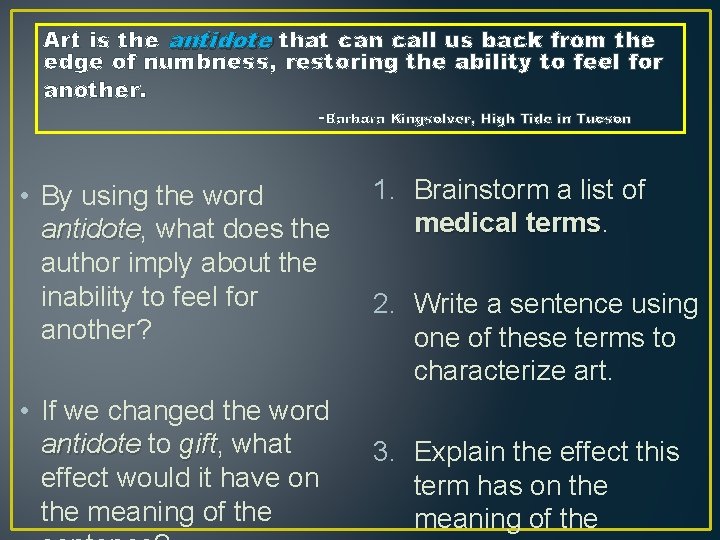
Art is the antidote that can call us back from the edge of numbness, restoring the ability to feel for another. -Barbara Kingsolver, High Tide in Tucson • By using the word antidote, antidote what does the author imply about the inability to feel for another? • If we changed the word antidote to gift, gift what effect would it have on the meaning of the 1. Brainstorm a list of medical terms 2. Write a sentence using one of these terms to characterize art. 3. Explain the effect this term has on the meaning of the
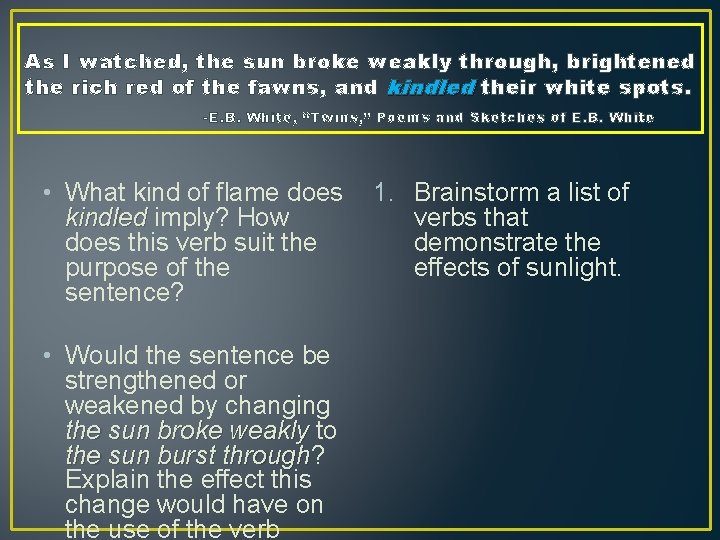
As I watched, the sun broke weakly through, brightened the rich red of the fawns, and kindled their white spots. -E. B. White, “Twins, ” Poems and Sketches of E. B. White • What kind of flame does kindled imply? How does this verb suit the purpose of the sentence? • Would the sentence be strengthened or weakened by changing the sun broke weakly to the sun burst through? through Explain the effect this change would have on the use of the verb 1. Brainstorm a list of verbs that demonstrate the effects of sunlight.
An aged man is but a paltry thing A tattered coat upon a stick… -W. B. Yeats, “Sailing to Byzantium • What picture is created by the use of the word tattered? tattered • By understanding the word connotation of the word tattered, tattered what do we understand about the character’s attitude toward an aged man? 1. List 3 adjectives that can be used to describe a pair of shoes. Each adjective should connote a different feeling about the shoes.