
DICTION Adapted from Grammar Shots by Mamie Webb

DICTION Adapted from Grammar Shots by Mamie Webb Hixon
What Are Colloquialisms? Colloquialisms are expressions common to informal spoken language. The language that people use to speak to their friends is often quite different from the language they use in formal writing. We might “hang out” with “a bunch” of our friends, but we might “engage in productive dialogue” with “several” of our professors. On the next couple of pages, we’re fixin’ to clue you in on some colloquialisms, y’all, so pay extra special attention and keep away from this kind of stuff in your academic writing.
Colloquialisms Could of: colloquialism for could have Should of: colloquialism for should have Might of: colloquialism for might have Would of: colloquialism for would have
Colloquialisms Be sure and: colloquialism for be sure to Try and: colloquialism for try to Use to: colloquialism for used to Suppose to: colloquialism for supposed to Plan on: colloquialism for plan to In regards to: colloquialism for in regard to With regards to: colloquialism for with regard to Anyways: colloquialism for anyway
What Is Diction? The word “diction” refers to a person’s expression of ideas. Good diction involves selecting the right words for things and using multi-word expressions properly. Most of us know that “ain’t” ain’t a word, but many people don’t realize that “enthused” and “irregardless” are also not real words. Additionally, some words are so frequently mistaken for other words that we’ve compiled the following list of words and word pairs that commonly cause confusion.
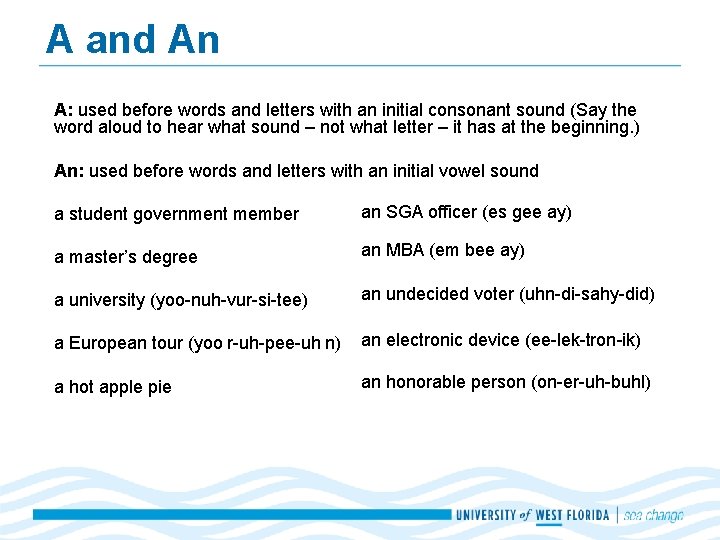
A and An A: used before words and letters with an initial consonant sound (Say the word aloud to hear what sound – not what letter – it has at the beginning. ) An: used before words and letters with an initial vowel sound a student government member an SGA officer (es gee ay) a master’s degree an MBA (em bee ay) a university (yoo-nuh-vur-si-tee) an undecided voter (uhn-di-sahy-did) a European tour (yoo r-uh-pee-uh n) an electronic device (ee-lek-tron-ik) a hot apple pie an honorable person (on-er-uh-buhl)
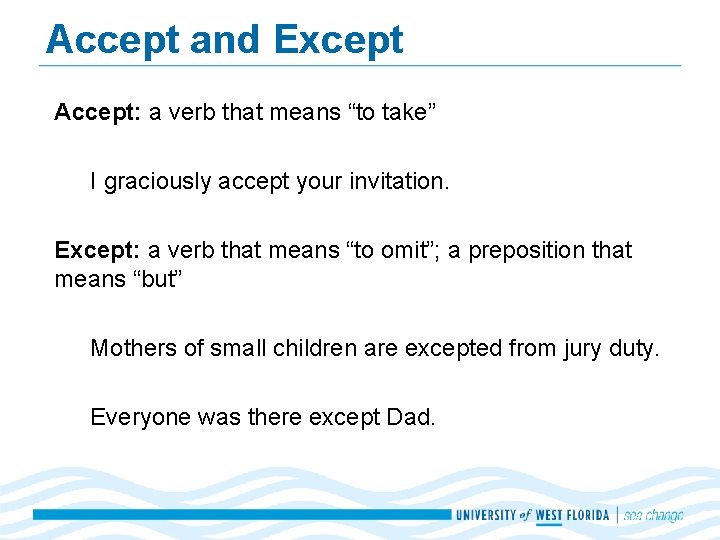
Accept and Except Accept: a verb that means “to take” I graciously accept your invitation. Except: a verb that means “to omit”; a preposition that means “but” Mothers of small children are excepted from jury duty. Everyone was there except Dad.
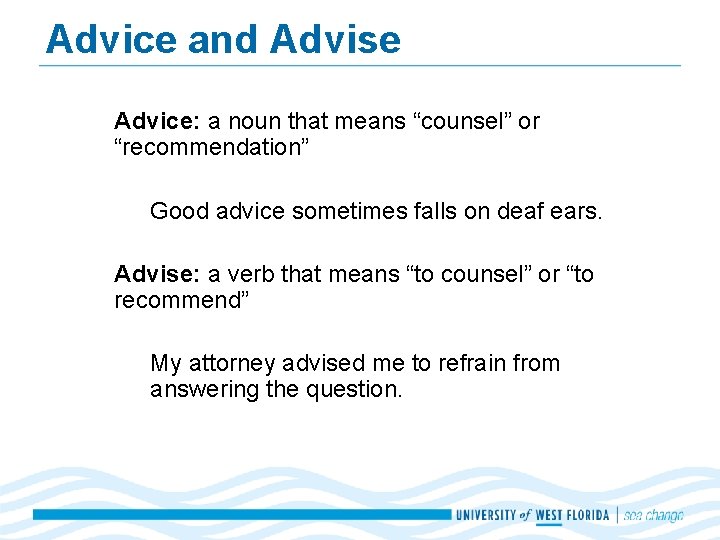
Advice and Advise Advice: a noun that means “counsel” or “recommendation” Good advice sometimes falls on deaf ears. Advise: a verb that means “to counsel” or “to recommend” My attorney advised me to refrain from answering the question.
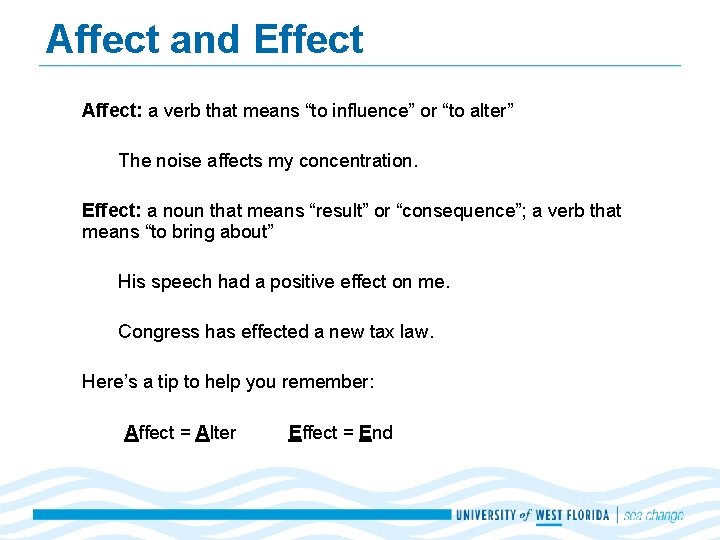
Affect and Effect Affect: a verb that means “to influence” or “to alter” The noise affects my concentration. Effect: a noun that means “result” or “consequence”; a verb that means “to bring about” His speech had a positive effect on me. Congress has effected a new tax law. Here’s a tip to help you remember: Affect = Alter Effect = End
All Ready and Already All ready: a pronoun + an adjective that means “everyone is ready” By the time our taxi arrived, we were all ready for our next big adventure. Already: an adverb that means “previously” or “by a particular time” By the time our taxi arrived, Phillip had already gone ahead of us.
Alright, Alot Alright: an incorrect spelling for “all right” Some people think it’s all right to write “alright, ” but “alright” is not a real word. Alot: an incorrect spelling for “a lot” There is a lot of confusion about the word “alot, ” but “alot” is not a real word.
All Together and Altogether All together: a pronoun + an adjective that means “everyone in one place” or “everyone with a common belief or state of mind” The puppies were all together in the box. Altogether: an adverb that means “entirely” I am altogether unwilling to go along with your plan.
Among and Between Among: used for relationships involving more than two people or things There is a silent closeness among all the family members. Between: used for relationships involving only two people or things Lois and Hattie had only fifty cents between them.
Amount and Number Amount: used with singular (mass) nouns The amount of pay we received was not worth the amount of work we did. Number: used with plural (countable) nouns I’ve dated a number of people, and I’ve made a number of mistakes.
Can and May Can: a verb that means “to be able to” May: a verb that means “to have permission to” Just because you can open my locker, that doesn’t mean you may use my shampoo.
Capital and Capitol Capital: every use of “capital” except the capitol building In her latest volley of angry texts, Harmony yelled at me in all capital letters. Armed kidnapping is a capital crime in the state of Florida. Pensacola was the capital of Florida until 1824. Capitol: a capitol building The children and their field-trip chaperones gathered on the steps of the capitol.
Couldn’t Care Less Could care less: a non-standard usage of the expression “couldn’t care less, ” meaning “There is no way I could possibly care any less than I do now. ” If you could care less, then you can conceive of a situation in which you actually could care even less than you already do, in which case, you feel more ambivalent about the situation than someone who couldn’t care less. Jay is not very friendly toward me, so I couldn’t care less whether he shows up to the block party.
Criteria Criterion: a singular noun that means “a standard or measure for testing or assessment” One criterion is that the applicant have a bachelor’s degree. Criteria: a plural noun that means “a set of standards or measures for testing or assessment” Several criteria for the position exist.
Data Datum: a singular noun that means “a piece of information” One datum is a statistic about health care. Data: a plural noun that means “several pieces of information” The data from the study suggest that certain diseases are increasing.
Different Than and Different From Different Than: used only when a clause (a complete sentence) follows My old school is different than it used to be. “It used to be” is a complete sentence. Different From: used any time except when a clause follows His hairdo is different from yours. “From yours” is not a complete sentence.
Disinterested and Uninterested Disinterested: an adjective that means “unbiased” or “impartial” Members of a jury should be interested in the witnesses’ testimony but disinterested in the outcome of the trial. They should listen carefully without preconceived ideas about what the outcome will be. Uninterested: an adjective that means “not interested” or “indifferent” I am uninterested in excuses; I don’t want to hear any more.
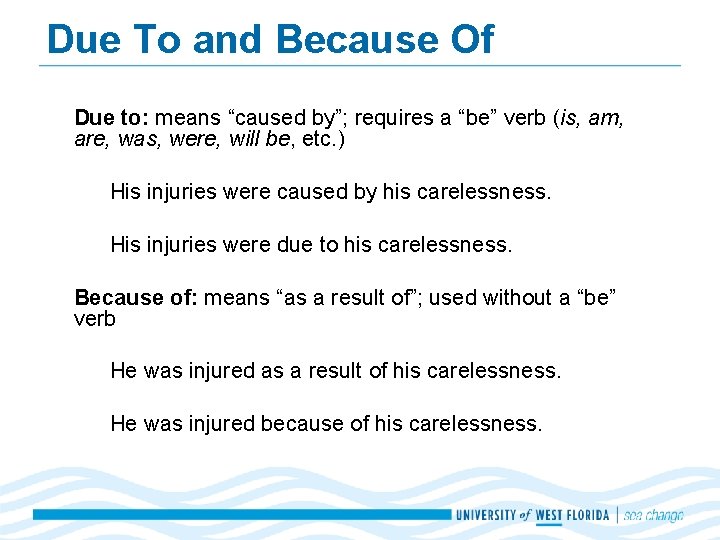
Due To and Because Of Due to: means “caused by”; requires a “be” verb (is, am, are, was, were, will be, etc. ) His injuries were caused by his carelessness. His injuries were due to his carelessness. Because of: means “as a result of”; used without a “be” verb He was injured as a result of his carelessness. He was injured because of his carelessness.
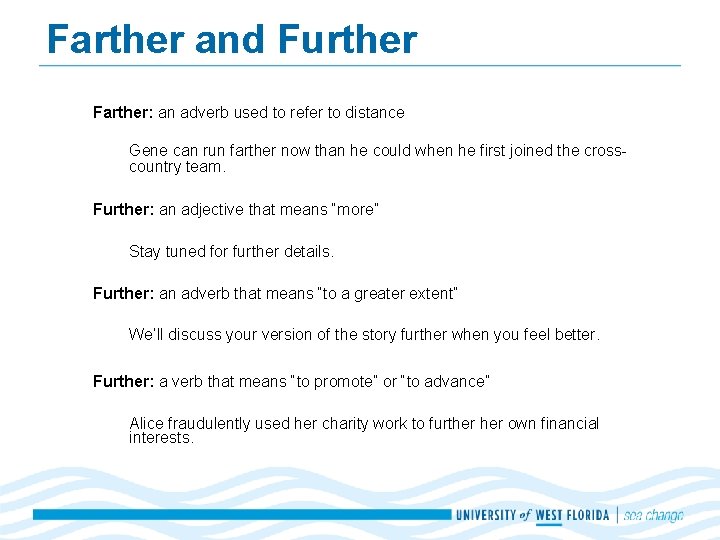
Farther and Further Farther: an adverb used to refer to distance Gene can run farther now than he could when he first joined the crosscountry team. Further: an adjective that means “more” Stay tuned for further details. Further: an adverb that means “to a greater extent” We’ll discuss your version of the story further when you feel better. Further: a verb that means “to promote” or “to advance” Alice fraudulently used her charity work to further own financial interests.
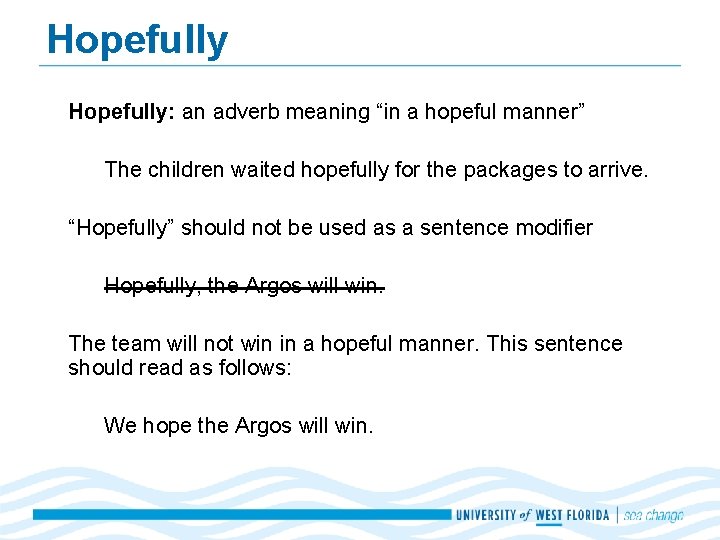
Hopefully: an adverb meaning “in a hopeful manner” The children waited hopefully for the packages to arrive. “Hopefully” should not be used as a sentence modifier Hopefully, the Argos will win. The team will not win in a hopeful manner. This sentence should read as follows: We hope the Argos will win.
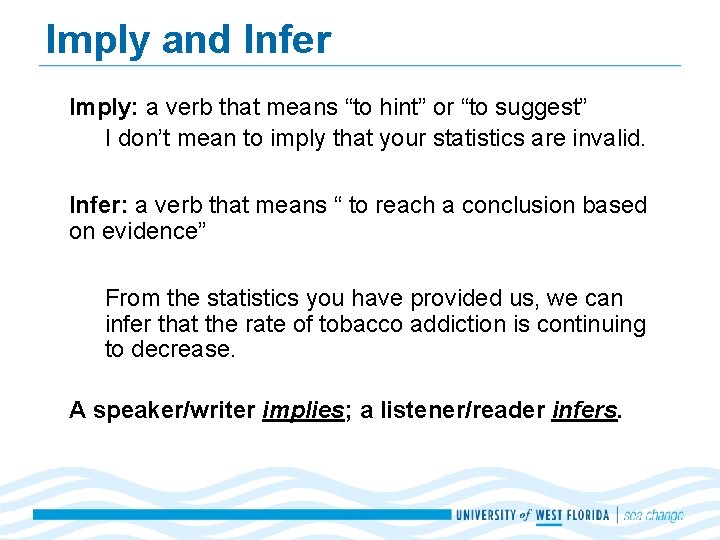
Imply and Infer Imply: a verb that means “to hint” or “to suggest” I don’t mean to imply that your statistics are invalid. Infer: a verb that means “ to reach a conclusion based on evidence” From the statistics you have provided us, we can infer that the rate of tobacco addiction is continuing to decrease. A speaker/writer implies; a listener/reader infers.
Its, It’s, and Its’ Its: the possessive form of “it” The car stopped running when its engine froze for lack of oil. It’s: a contraction meaning “it is” According the forecast, it’s going to rain today. Its’: not a real word
Kind of and Sort of: “kind” and “sort” are nouns meaning “type” or “style I enjoy doing this kind of work. “Kind of” and “sort of” should not be used as adverbs to qualify adjectives. Instead, use “rather, ” “somewhat, ” “almost, ” or “nearly. ” The movie was rather boring. I’m almost sorry I came. I’m somewhat concerned about leaving Kara alone.
Lay vs. Lie: a verb that means “to rest”; its forms are lie, lies, lying, lay, (have) lain. I lie on the sofa when I want to take a nap. I lay on the sofa and took a nap. If you hadn’t called, I would still be lying on the sofa. Lay: a verb that means “to put”; its forms are lay, lays, laying, laid, (have) laid. Where did I lay my keys? I must have laid them down somewhere without thinking. I’m always laying things down and forgetting where I laid them.
Lead and Lead: (rhymes with “feed”) a verb that means “to go first”; its principal parts are lead, leads, leading, led, (has) led. You lead and I’ll follow. Led: (rhymes with “red”) the past tense of the verb “lead” You’ve never led me astray. Lead: (rhymes with “red”) a noun that refers to the graphite in a pencil; a noun that refers to a heavy metal The lead in this pencil is broken. Lead has not been used in paint since 1978.

Lend vs. Loan Lend: a verb that means “to allow the use of” (lend, lends, lending, lent, (have) lent) The credit union lends money to members only. I lent my book to Brandi last week. Loan: a noun that means “something lent for temporary use” Samantha needs to establish credit so she can be eligible for an automobile loan.
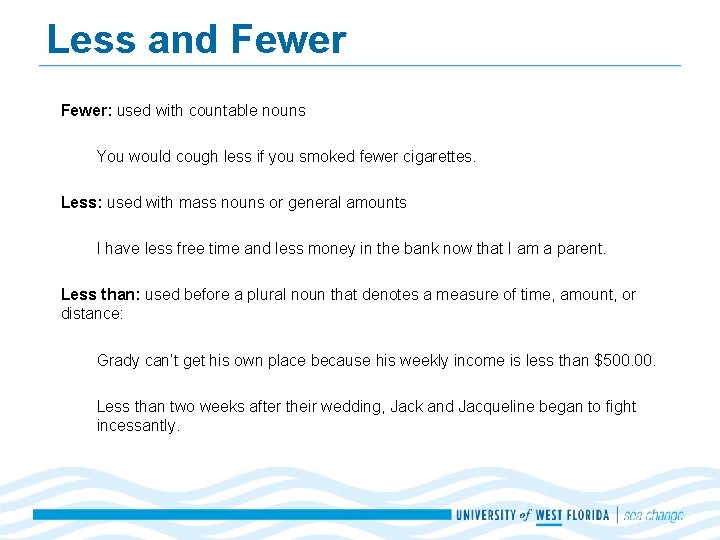
Less and Fewer: used with countable nouns You would cough less if you smoked fewer cigarettes. Less: used with mass nouns or general amounts I have less free time and less money in the bank now that I am a parent. Less than: used before a plural noun that denotes a measure of time, amount, or distance: Grady can’t get his own place because his weekly income is less than $500. Less than two weeks after their wedding, Jack and Jacqueline began to fight incessantly.
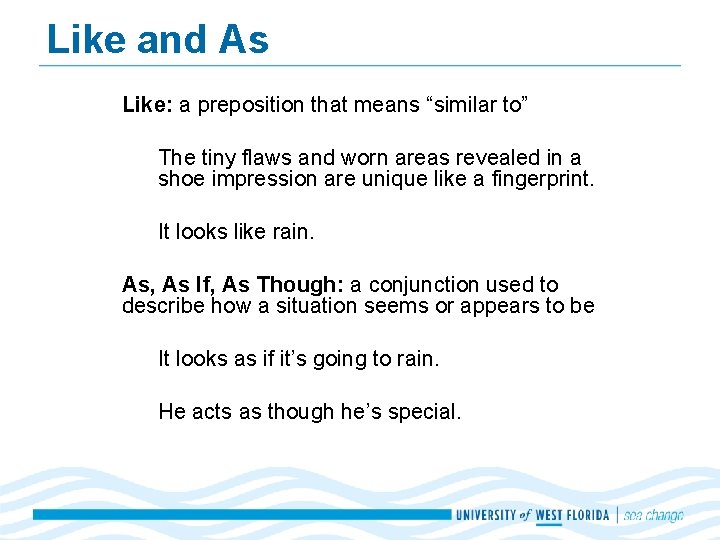
Like and As Like: a preposition that means “similar to” The tiny flaws and worn areas revealed in a shoe impression are unique like a fingerprint. It looks like rain. As, As If, As Though: a conjunction used to describe how a situation seems or appears to be It looks as if it’s going to rain. He acts as though he’s special.
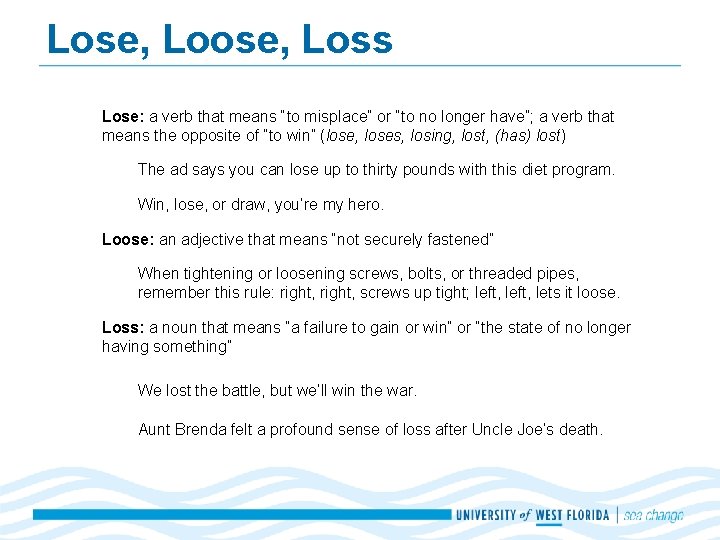
Lose, Loss Lose: a verb that means “to misplace” or “to no longer have”; a verb that means the opposite of “to win” (lose, loses, losing, lost, (has) lost) The ad says you can lose up to thirty pounds with this diet program. Win, lose, or draw, you’re my hero. Loose: an adjective that means “not securely fastened” When tightening or loosening screws, bolts, or threaded pipes, remember this rule: right, screws up tight; left, lets it loose. Loss: a noun that means “a failure to gain or win” or “the state of no longer having something” We lost the battle, but we’ll win the war. Aunt Brenda felt a profound sense of loss after Uncle Joe’s death.
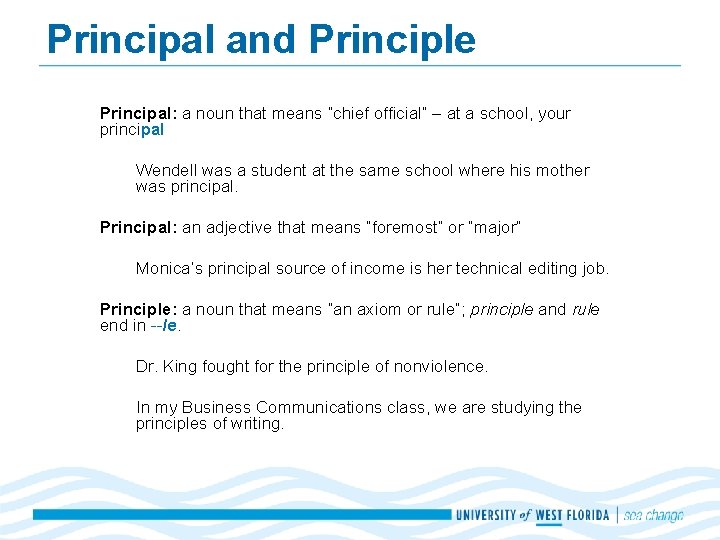
Principal and Principle Principal: a noun that means “chief official” – at a school, your principal Wendell was a student at the same school where his mother was principal. Principal: an adjective that means “foremost” or “major” Monica’s principal source of income is her technical editing job. Principle: a noun that means “an axiom or rule”; principle and rule end in --le. Dr. King fought for the principle of nonviolence. In my Business Communications class, we are studying the principles of writing.
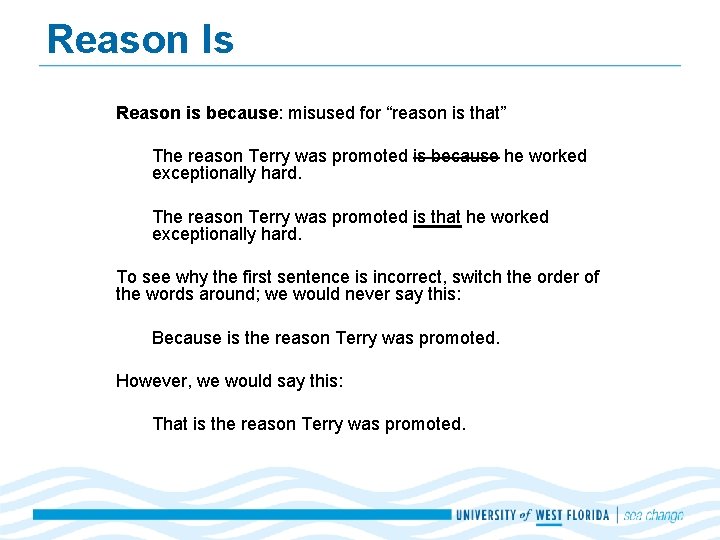
Reason Is Reason is because: misused for “reason is that” The reason Terry was promoted is because he worked exceptionally hard. The reason Terry was promoted is that he worked exceptionally hard. To see why the first sentence is incorrect, switch the order of the words around; we would never say this: Because is the reason Terry was promoted. However, we would say this: That is the reason Terry was promoted.
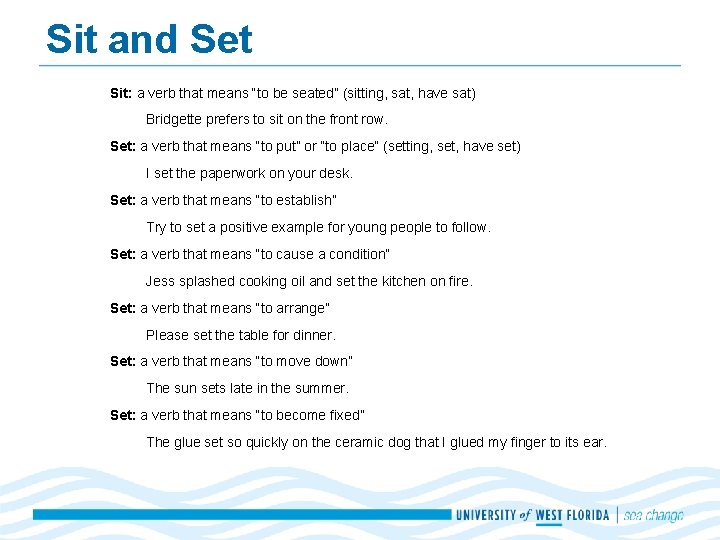
Sit and Set Sit: a verb that means “to be seated” (sitting, sat, have sat) Bridgette prefers to sit on the front row. Set: a verb that means “to put” or “to place” (setting, set, have set) I set the paperwork on your desk. Set: a verb that means “to establish” Try to set a positive example for young people to follow. Set: a verb that means “to cause a condition” Jess splashed cooking oil and set the kitchen on fire. Set: a verb that means “to arrange” Please set the table for dinner. Set: a verb that means “to move down” The sun sets late in the summer. Set: a verb that means “to become fixed” The glue set so quickly on the ceramic dog that I glued my finger to its ear.
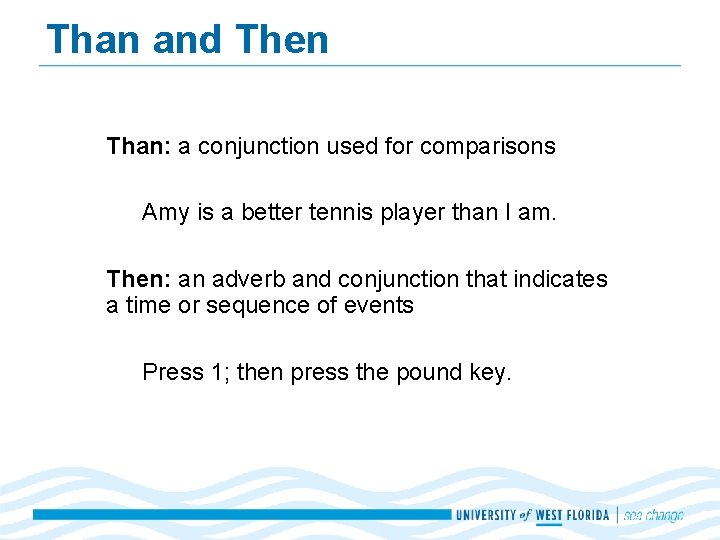
Than and Then Than: a conjunction used for comparisons Amy is a better tennis player than I am. Then: an adverb and conjunction that indicates a time or sequence of events Press 1; then press the pound key.
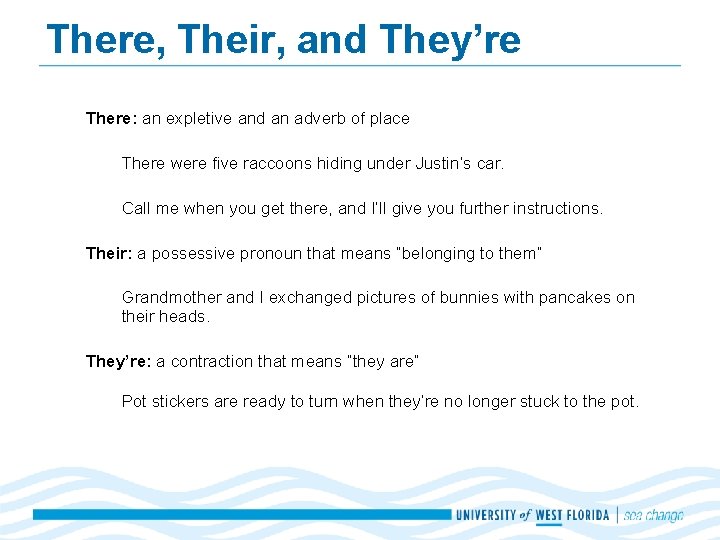
There, Their, and They’re There: an expletive and an adverb of place There were five raccoons hiding under Justin’s car. Call me when you get there, and I’ll give you further instructions. Their: a possessive pronoun that means “belonging to them” Grandmother and I exchanged pictures of bunnies with pancakes on their heads. They’re: a contraction that means “they are” Pot stickers are ready to turn when they’re no longer stuck to the pot.
To, Too, and Two To: a preposition I went to the beach where twenty to thirty seagulls were waiting for me to drop my fries. Two: the spelling for the cardinal number 2 Too: an adverb that means “also” or “very” Two chemists walk into a bar. The first orders H 2 O. The second says, “Sounds good; I’ll have some H 2 O too. ” The second chemist dies.
Is When and Is Where Is when: used to introduce a statement of time, not an explanation Is where: used to introduce a statement of place, not an explanation or definition Twelve o’clock is when your lunch break begins. Indianola, Mississippi, is where I was born. An honorarium is when a person receives a fee for services rendered. An honorarium is a fee paid to a person for professional services rendered.
- Slides: 40