
DICOM Second Generation Radiotherapy Supplement 213 Enhanced RT

- Slides: 20
DICOM Second Generation Radiotherapy Supplement 213 Enhanced RT Image and RT Patient Position Acquisition Instruction DICOM Working Group 07 Radiotherapy
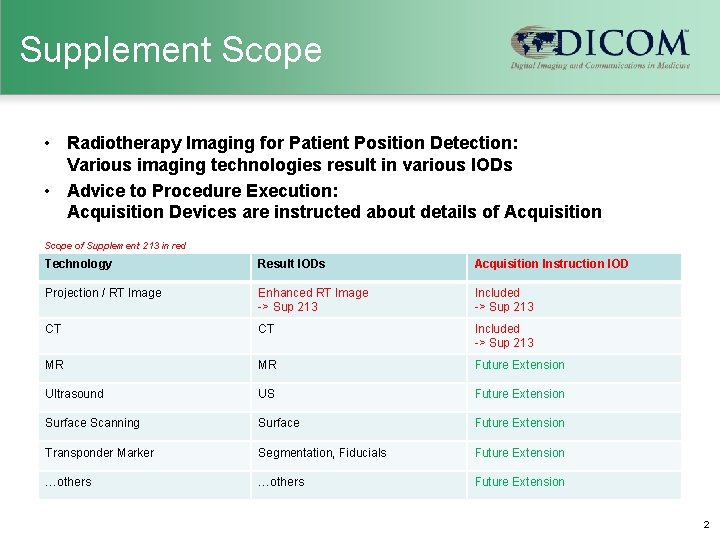
Supplement Scope • Radiotherapy Imaging for Patient Position Detection: Various imaging technologies result in various IODs • Advice to Procedure Execution: Acquisition Devices are instructed about details of Acquisition Scope of Supplement 213 in red Technology Result IODs Acquisition Instruction IOD Projection / RT Image Enhanced RT Image -> Sup 213 Included -> Sup 213 CT CT Included -> Sup 213 MR MR Future Extension Ultrasound US Future Extension Surface Scanning Surface Future Extension Transponder Marker Segmentation, Fiducials Future Extension …others Future Extension 2
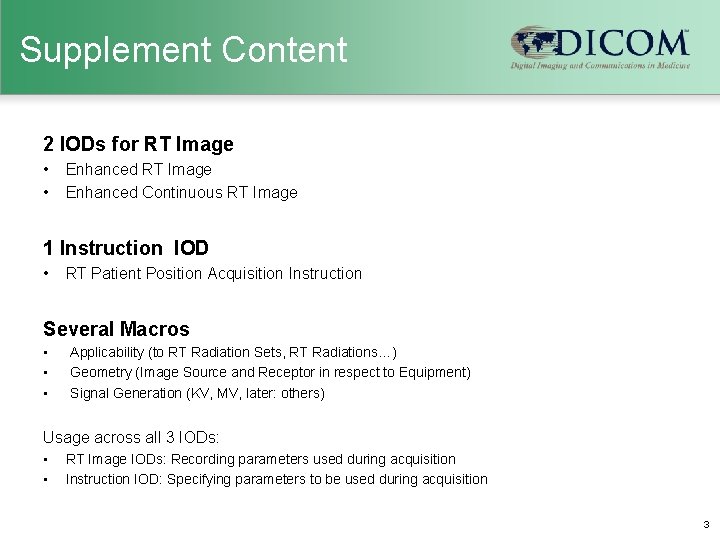
Supplement Content 2 IODs for RT Image • • Enhanced RT Image Enhanced Continuous RT Image 1 Instruction IOD • RT Patient Position Acquisition Instruction Several Macros • • • Applicability (to RT Radiation Sets, RT Radiations…) Geometry (Image Source and Receptor in respect to Equipment) Signal Generation (KV, MV, later: others) Usage across all 3 IODs: • • RT Image IODs: Recording parameters used during acquisition Instruction IOD: Specifying parameters to be used during acquisition 3
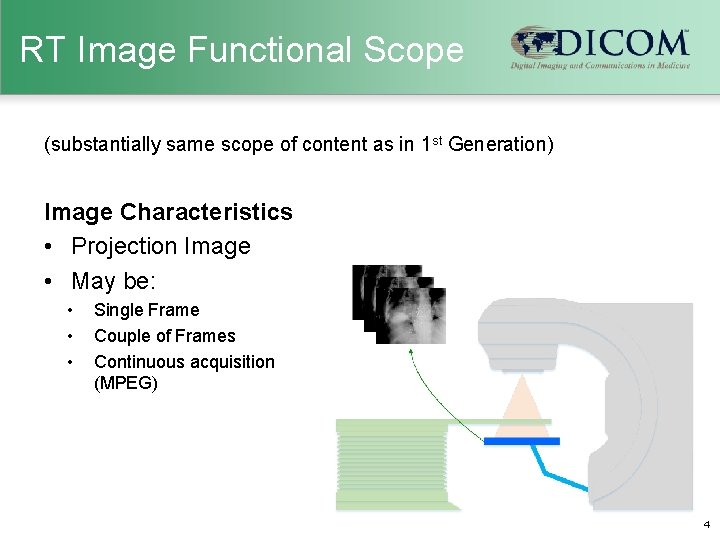
RT Image Functional Scope (substantially same scope of content as in 1 st Generation) Image Characteristics • Projection Image • May be: • • • Single Frame Couple of Frames Continuous acquisition (MPEG) 4
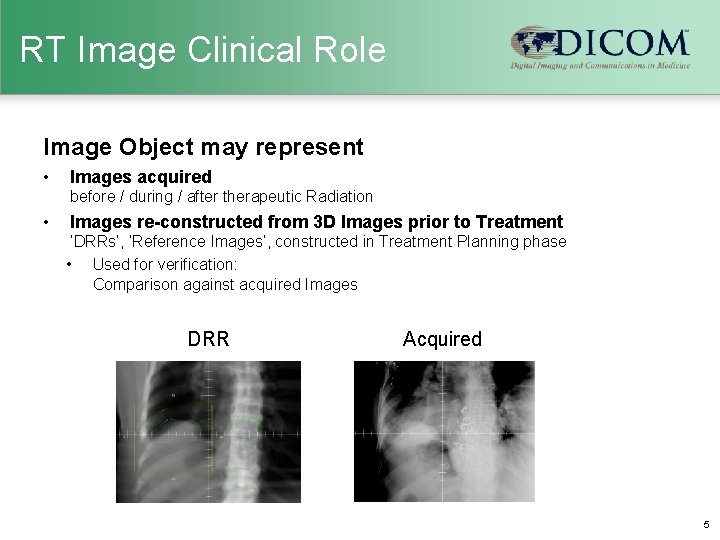
RT Image Clinical Role Image Object may represent • Images acquired before / during / after therapeutic Radiation • Images re-constructed from 3 D Images prior to Treatment ‘DRRs’, ‘Reference Images’, constructed in Treatment Planning phase • Used for verification: Comparison against acquired Images DRR Acquired 5
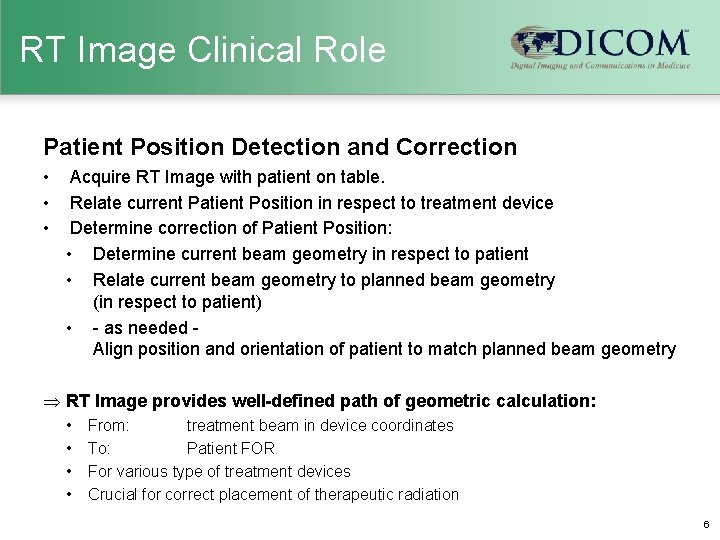
RT Image Clinical Role Patient Position Detection and Correction • • • Acquire RT Image with patient on table. Relate current Patient Position in respect to treatment device Determine correction of Patient Position: • Determine current beam geometry in respect to patient • Relate current beam geometry to planned beam geometry (in respect to patient) • - as needed Align position and orientation of patient to match planned beam geometry Þ RT Image provides well-defined path of geometric calculation: • • From: treatment beam in device coordinates To: Patient FOR For various type of treatment devices Crucial for correct placement of therapeutic radiation 6
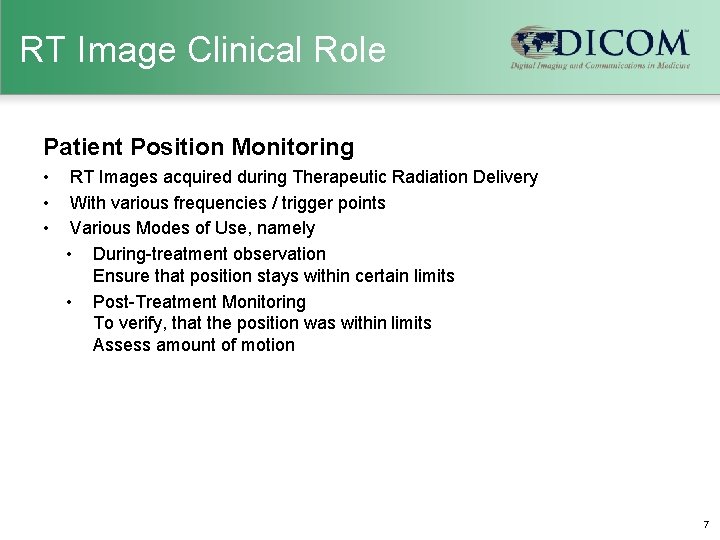
RT Image Clinical Role Patient Position Monitoring • • • RT Images acquired during Therapeutic Radiation Delivery With various frequencies / trigger points Various Modes of Use, namely • During-treatment observation Ensure that position stays within certain limits • Post-Treatment Monitoring To verify, that the position was within limits Assess amount of motion 7
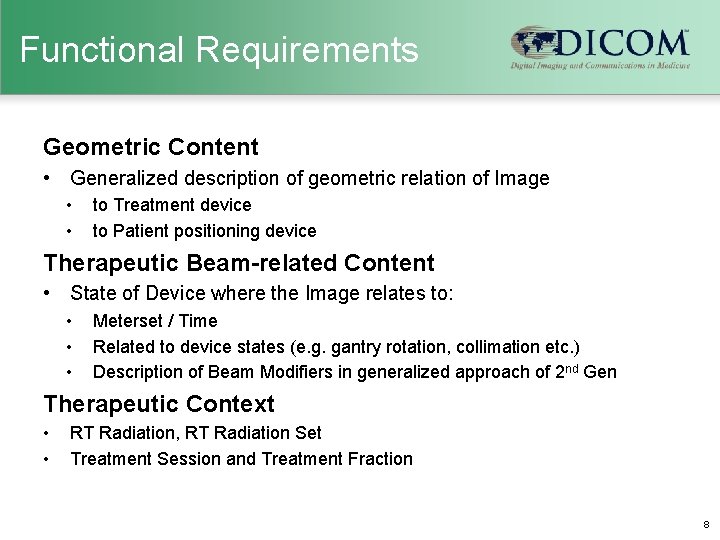
Functional Requirements Geometric Content • Generalized description of geometric relation of Image • • to Treatment device to Patient positioning device Therapeutic Beam-related Content • State of Device where the Image relates to: • • • Meterset / Time Related to device states (e. g. gantry rotation, collimation etc. ) Description of Beam Modifiers in generalized approach of 2 nd Gen Therapeutic Context • • RT Radiation, RT Radiation Set Treatment Session and Treatment Fraction 8
Why 2 nd Generation? Use of 2 nd Gen concepts • • RT Image Context to RT Radiation Sets, RT Radiations Using Equipment Coordinate System Generalizing geometry specification to handle variety of Imaging devices and Treatment Device geometries – re-use Macros Using 2 nd generation macros to describe Patient Position, Beam Modifiers, Radiation – re-use Macros Use of Enhanced Multi-Frame Approach • • Benefit from Multi-Frame Functional Groups formalism Stay in line with current Multi-Frame of other IODs Cleaning up / strengthening / expanding… • the historically grown patchy structure and representation of 1 st Gen RT Image IOD Footer Text 9
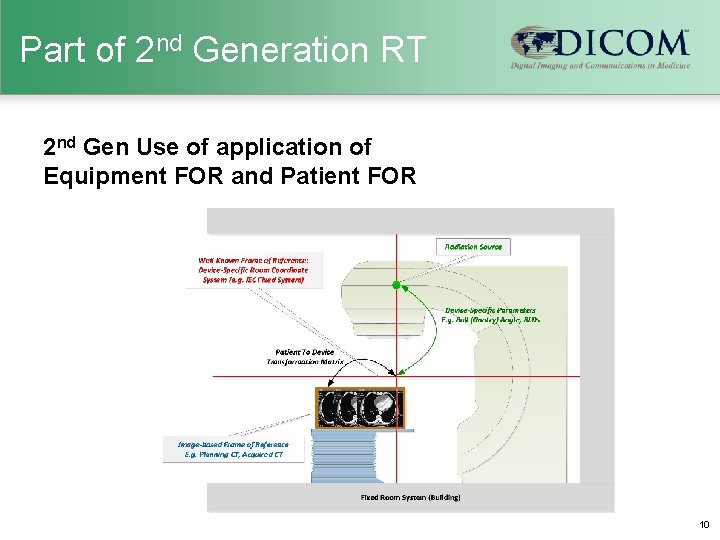
Part of 2 nd Generation RT 2 nd Gen Use of application of Equipment FOR and Patient FOR 10
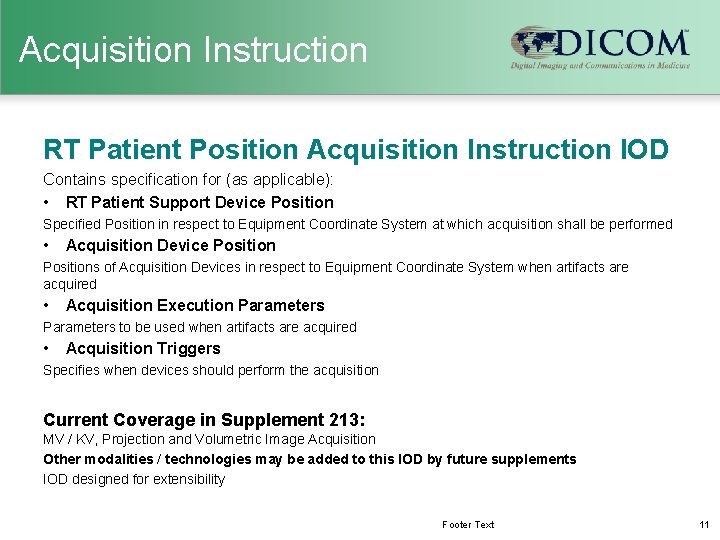
Acquisition Instruction RT Patient Position Acquisition Instruction IOD Contains specification for (as applicable): • RT Patient Support Device Position Specified Position in respect to Equipment Coordinate System at which acquisition shall be performed • Acquisition Device Positions of Acquisition Devices in respect to Equipment Coordinate System when artifacts are acquired • Acquisition Execution Parameters to be used when artifacts are acquired • Acquisition Triggers Specifies when devices should perform the acquisition Current Coverage in Supplement 213: MV / KV, Projection and Volumetric Image Acquisition Other modalities / technologies may be added to this IOD by future supplements IOD designed for extensibility Footer Text 11
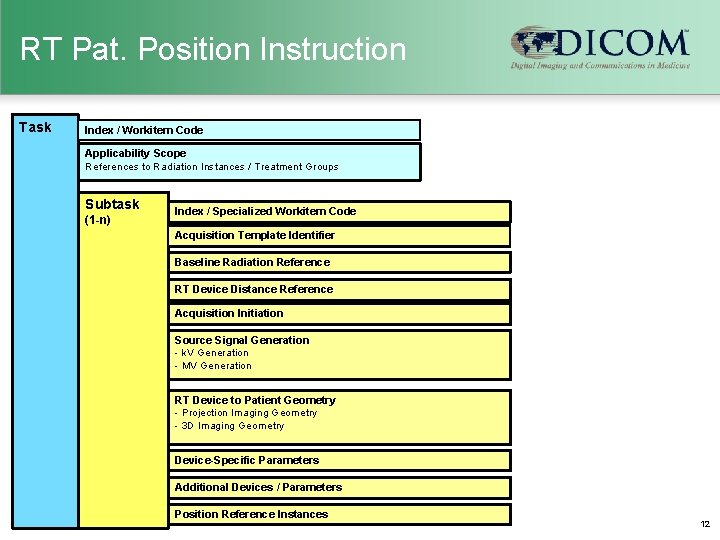
RT Pat. Position Instruction Task Index / Workitem Code Applicability Scope References to Radiation Instances / Treatment Groups Subtask (1 -n) Index / Specialized Workitem Code Acquisition Template Identifier Baseline Radiation Reference RT Device Distance Reference Acquisition Initiation Source Signal Generation - k. V Generation - MV Generation RT Device to Patient Geometry - Projection Imaging Geometry - 3 D Imaging Geometry Device-Specific Parameters Additional Devices / Parameters Position Reference Instances 12
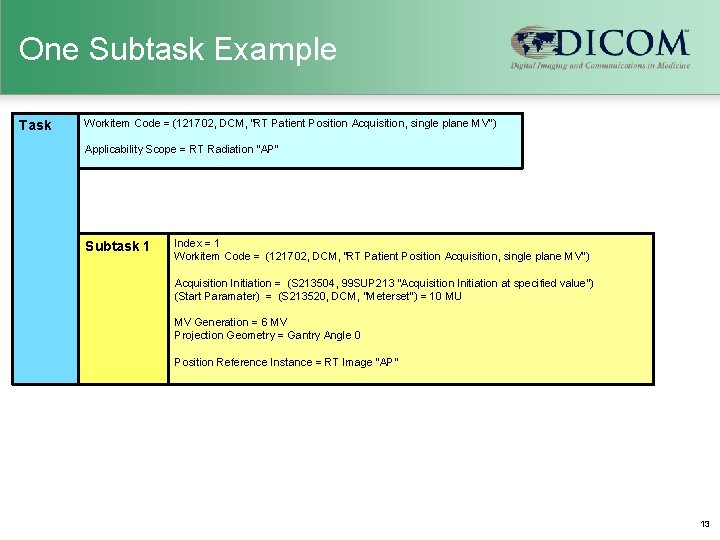
One Subtask Example Task Workitem Code = (121702, DCM, “RT Patient Position Acquisition, single plane MV“) Applicability Scope = RT Radiation “AP” Subtask 1 Index = 1 Workitem Code = (121702, DCM, “RT Patient Position Acquisition, single plane MV“) Acquisition Initiation = (S 213504, 99 SUP 213 “Acquisition Initiation at specified value”) (Start Paramater) = (S 213520, DCM, "Meterset") = 10 MU MV Generation = 6 MV Projection Geometry = Gantry Angle 0 Position Reference Instance = RT Image “AP” 13
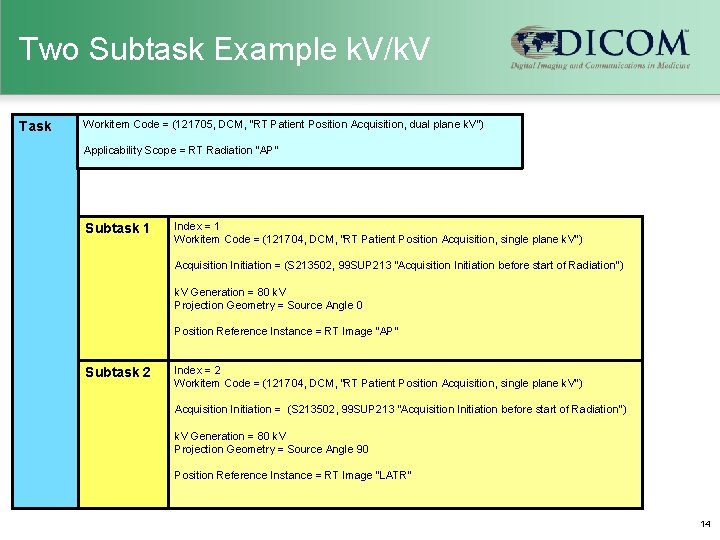
Two Subtask Example k. V/k. V Task Workitem Code = (121705, DCM, “RT Patient Position Acquisition, dual plane k. V“) Applicability Scope = RT Radiation “AP” Subtask 1 Index = 1 Workitem Code = (121704, DCM, “RT Patient Position Acquisition, single plane k. V“) Acquisition Initiation = (S 213502, 99 SUP 213 “Acquisition Initiation before start of Radiation”) k. V Generation = 80 k. V Projection Geometry = Source Angle 0 Position Reference Instance = RT Image “AP” Subtask 2 Index = 2 Workitem Code = (121704, DCM, “RT Patient Position Acquisition, single plane k. V“) Acquisition Initiation = (S 213502, 99 SUP 213 “Acquisition Initiation before start of Radiation”) k. V Generation = 80 k. V Projection Geometry = Source Angle 90 Position Reference Instance = RT Image “LATR” 14
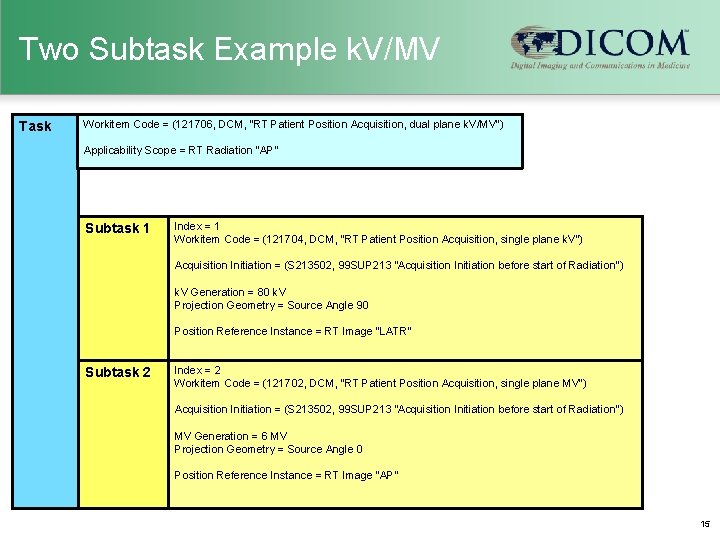
Two Subtask Example k. V/MV Task Workitem Code = (121706, DCM, “RT Patient Position Acquisition, dual plane k. V/MV“) Applicability Scope = RT Radiation “AP” Subtask 1 Index = 1 Workitem Code = (121704, DCM, “RT Patient Position Acquisition, single plane k. V“) Acquisition Initiation = (S 213502, 99 SUP 213 “Acquisition Initiation before start of Radiation”) k. V Generation = 80 k. V Projection Geometry = Source Angle 90 Position Reference Instance = RT Image “LATR” Subtask 2 Index = 2 Workitem Code = (121702, DCM, “RT Patient Position Acquisition, single plane MV“) Acquisition Initiation = (S 213502, 99 SUP 213 “Acquisition Initiation before start of Radiation”) MV Generation = 6 MV Projection Geometry = Source Angle 0 Position Reference Instance = RT Image “AP” 15
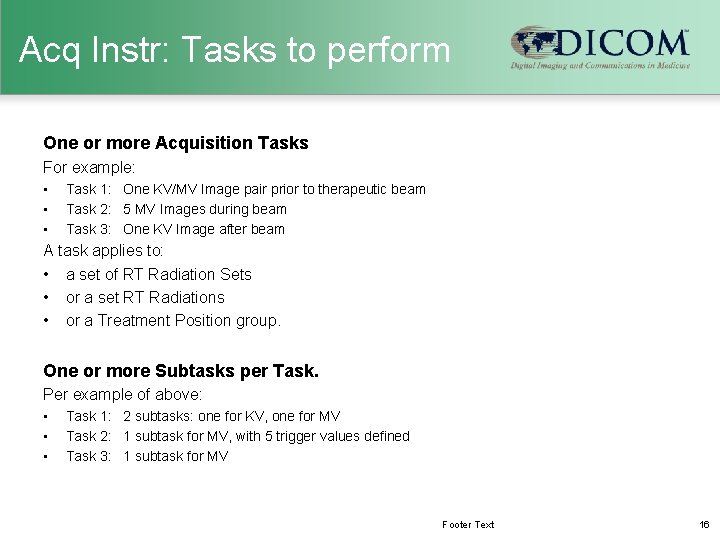
Acq Instr: Tasks to perform One or more Acquisition Tasks For example: • • • Task 1: One KV/MV Image pair prior to therapeutic beam Task 2: 5 MV Images during beam Task 3: One KV Image after beam A task applies to: • a set of RT Radiation Sets • or a set RT Radiations • or a Treatment Position group. One or more Subtasks per Task. Per example of above: • • • Task 1: 2 subtasks: one for KV, one for MV Task 2: 1 subtask for MV, with 5 trigger values defined Task 3: 1 subtask for MV Footer Text 16
Acq Instr: Specification Approaches Parameters are specified by: Indirectly by Protocol • Refer to a protocols knows to the acquisition device • • • by Code, or by ID User may fine-tune this protocol at the acquisition device any time • • • Protocol identification stays the same Protocol Version tracking out of scope Device – based settings may be traced locally at the device Directly by explicit Parameters: • As indicated in the following slides Any combination of Protocol-inferred and explicit Parameters supported Addresses variability of devices in terms of • • Technology Generation Footer Text 17
Acq Instr: Geometry Basis: Equipment FOR • Same approach as used for RT Radiation IODs as well Device Geometries Transformation Matrix from Equipment FOR to • • Imaging Source Coordinate System Image Receptor Coordinate System User-readable decomposition optionally supported for applications, which can´t do this • concept as used in RT Radiations as well Patient Positioner Geometry Use of existing 2 nd Generation Approach • Relate Patient FOR to Equipment FOR • Library Approach • • Specify Patient Position once Apply many times by reference, since most treatments have static positions, but some do not Footer Text 18
Acq Instr: Signal Generation of MV (therapeutic) Beam for Imaging • Use of 2 nd Gen Radiation Generation Macro • Covers MV Photons and Particles • Incl. all beam generation specifics for therapeutic beam devices Generation of KV (therapeutic) Beam for Imaging • Use of existing (KV) X-Ray Attributes • Covers KV Photons (future outlook: Addition of other technologies as needed) Footer Text 19
Contacts Christof Schadt Co-Chair WG-07 Brainlab AG christof. schadt@brainlab. com Jim Percy Co-Chair WG-07 Elekta jim. percy@elekta. com Ulrich Busch (Editor) Member WG-07 Individual ulrich. busch@bluewin. ch