
DICOM Second Generation Radiotherapy Supplement 175 CArm RT
- Slides: 9
DICOM Second Generation Radiotherapy Supplement 175 C-Arm RT Treatment Modalities DICOM Working Group 07 Radiotherapy
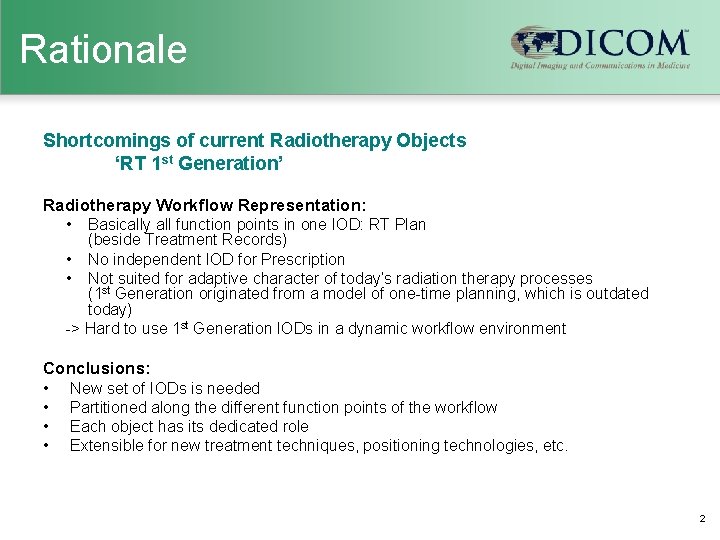
Rationale Shortcomings of current Radiotherapy Objects ‘RT 1 st Generation’ Radiotherapy Workflow Representation: • Basically all function points in one IOD: RT Plan (beside Treatment Records) • No independent IOD for Prescription • Not suited for adaptive character of today’s radiation therapy processes (1 st Generation originated from a model of one-time planning, which is outdated today) -> Hard to use 1 st Generation IODs in a dynamic workflow environment Conclusions: • New set of IODs is needed • Partitioned along the different function points of the workflow • Each object has its dedicated role • Extensible for new treatment techniques, positioning technologies, etc. 2
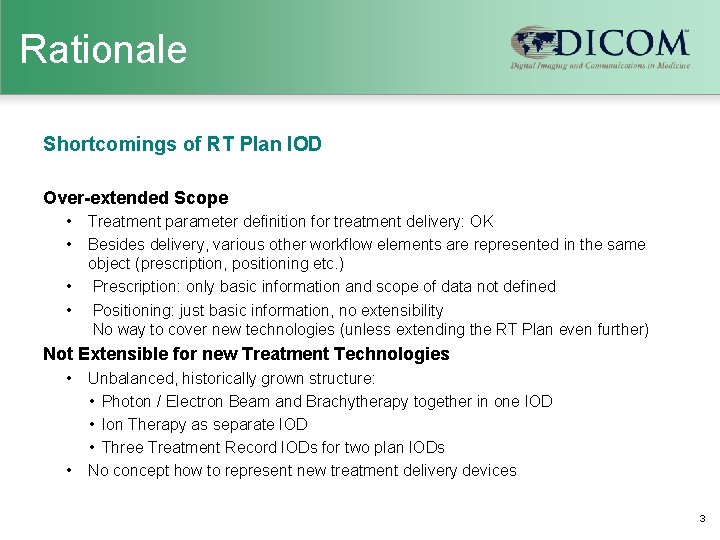
Rationale Shortcomings of RT Plan IOD Over-extended Scope • • Treatment parameter definition for treatment delivery: OK Besides delivery, various other workflow elements are represented in the same object (prescription, positioning etc. ) Prescription: only basic information and scope of data not defined Positioning: just basic information, no extensibility No way to cover new technologies (unless extending the RT Plan even further) Not Extensible for new Treatment Technologies • • Unbalanced, historically grown structure: • Photon / Electron Beam and Brachytherapy together in one IOD • Ion Therapy as separate IOD • Three Treatment Record IODs for two plan IODs No concept how to represent new treatment delivery devices 3
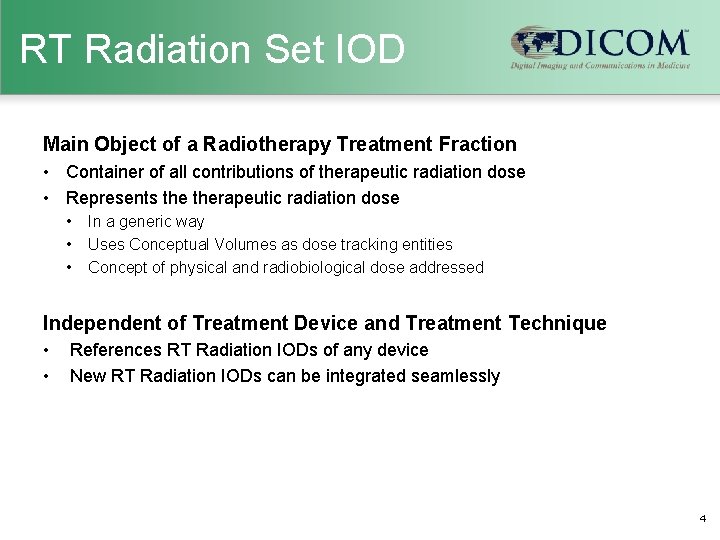
RT Radiation Set IOD Main Object of a Radiotherapy Treatment Fraction • Container of all contributions of therapeutic radiation dose • Represents therapeutic radiation dose • • • In a generic way Uses Conceptual Volumes as dose tracking entities Concept of physical and radiobiological dose addressed Independent of Treatment Device and Treatment Technique • • References RT Radiation IODs of any device New RT Radiation IODs can be integrated seamlessly 4
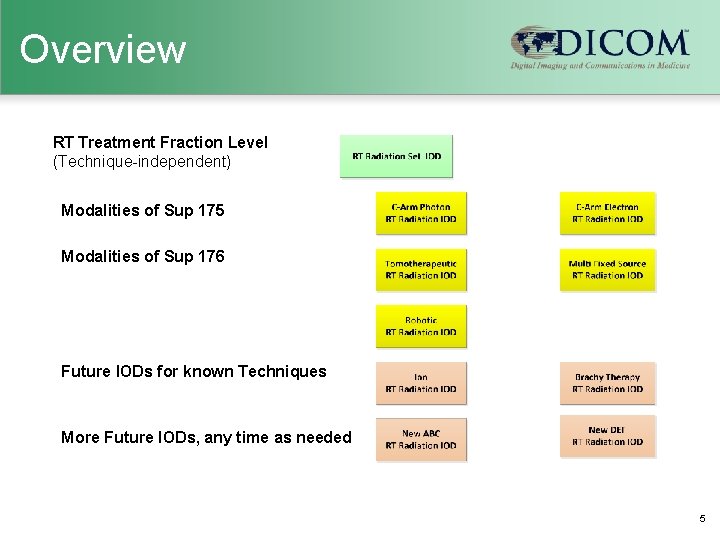
Overview RT Treatment Fraction Level (Technique-independent) Modalities of Sup 175 Modalities of Sup 176 Future IODs for known Techniques More Future IODs, any time as needed 5
Radiation IOD Technique-independent Modules • Serve as container of all Radiation IODs which constitute a radiotherapy treatment fraction • Represent therapeutic radiation dose • Generically (although concept of physical and radiobiological dose are addressed) Technique-specific Modules • • Accommodate specific treatment parameters Use of generic building blocks as needed by the specific technique 6
Radiation IOD Control Points • • Proven concept kept in place Optimized value change representation Energy and Radiation Type • • Rich model, including Beam Generation Modes (“FFF”, etc. ) Re-usable representation Device-Components, Beam Modifiers Re-usable build blocks (Macros) for: • Beam Limiting Devices (Collimators, MLCs) • Applicators • Compensators • Blocks • Wedges • Others in future as needed Generic scheme for identification and classification • High re-use of ‘header data’ 7
Radiation IOD Generalized Geometric Information • IEC 61217 coordinate system where applicable • Other coordinate systems possible as well • Always based on Frame Of Reference Formalism • • • Generic registration of Patient FOR to Device FOR Transformation instead of specific Patient Positioner Parameters Specific Patient Positioner Parameters as annotation available, too Reduced Optionality • Essential Information mandatory (Type 1) Solomon - Analysis objects 8
Contacts Christof Schadt Editor, Vice-Chair WG-07 Brainlab AG christof. schadt@brainlab. com Ulrich Busch Chair WG-07 Varian Medical Systems ulrich. busch@varian. com