
DICOM Digital Imaging and Communications in Medicine 2005
- Slides: 12
DICOM - Digital Imaging and Communications in Medicine © 2005 Stefan Starke
ØDICOM – Contents Ø A short Definition Ø History Ø Facts, Figures, Examples Ø Future © 2005 Stefan Starke
ØDICOM – A short Definition The Digital Imaging and Communications in Medicine standard (short: DICOM) is THE standard for exchanging medical images in a digital format. Currently it consists of 16 different parts, addressing the DICOM protocol, its formats and specifying its conformance. © 2005 Stefan Starke
ØDICOM – History In the early 80‘s, vendors felt comfortable with supporting proprietary communication standards because it locked their customers to purchasing their products. To get rid of this unsatisfying situation the American College of Radiology (ACR) together with the National Electrical Manufacturers Association (NEMA) developed three standard versions in the years from 1981 till 1993 (ARC-NEMA 1. 0 & 2. 0; DICOM 3. 0). © 2005 Stefan Starke
ØDICOM – Facts & Figures (1) ØNo ANSI-Standard Changing to an ANSI-Standard would bring more restrictions than benefits (see HL 7). ØMany different approaches for one goal Developed voluntarily by vendors and users. ØComplexity Language and concepts of the Object-Oriented world of thinking. © 2005 Stefan Starke
ØDICOM – Facts & Figures (2) ØSlow Development DICOM standard is still only being used for medical imaging -> somewhat of a niche application. © 2005 Stefan Starke
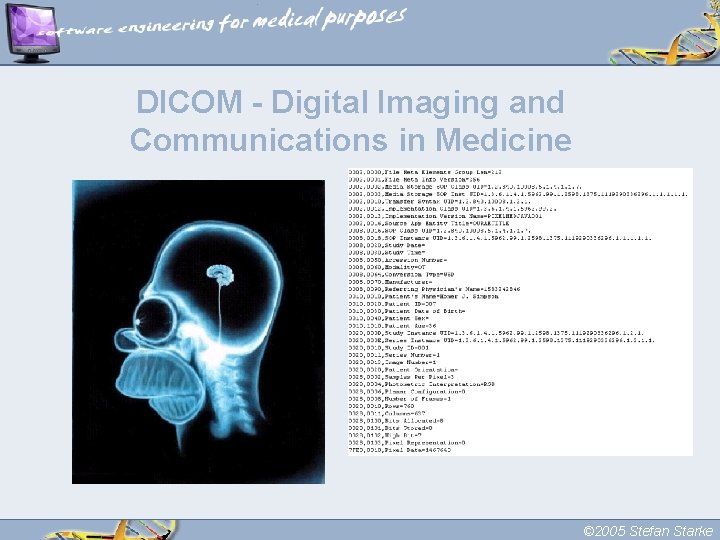
ØDICOM – DICOM Objects ØSmallest Unit of Information Self contained file, not very different from any other file, f. e. a text-document. (CT, MRI, …) ØConsists of the header and the content The header contains a long stream of textual information, specific to the type of content. ØUIDs within the Header Study, Series, Individual Image, Modality, Date, . . . © 2005 Stefan Starke
ØDICOM – SOP Classes The entity that initiates use of a service is known as the service class user (SCU), the provider is known as the service class provider (SCP). When setting up a DICOM connection, there is a negotiation process, where it comes clear what capability the decive supports and what not. These capabilities are clearly specified and identified in the standard as so-called SOP Classes. © 2005 Stefan Starke
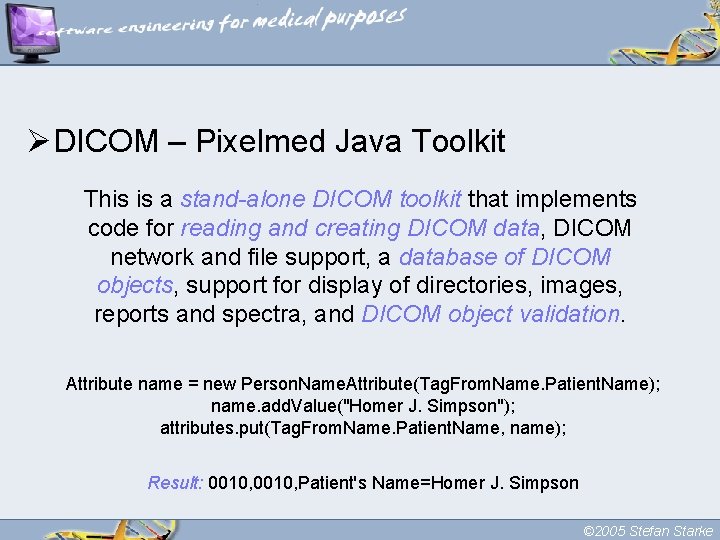
ØDICOM – Pixelmed Java Toolkit This is a stand-alone DICOM toolkit that implements code for reading and creating DICOM data, DICOM network and file support, a database of DICOM objects, support for display of directories, images, reports and spectra, and DICOM object validation. Attribute name = new Person. Name. Attribute(Tag. From. Name. Patient. Name); name. add. Value("Homer J. Simpson"); attributes. put(Tag. From. Name. Patient. Name, name); Result: 0010, Patient's Name=Homer J. Simpson © 2005 Stefan Starke
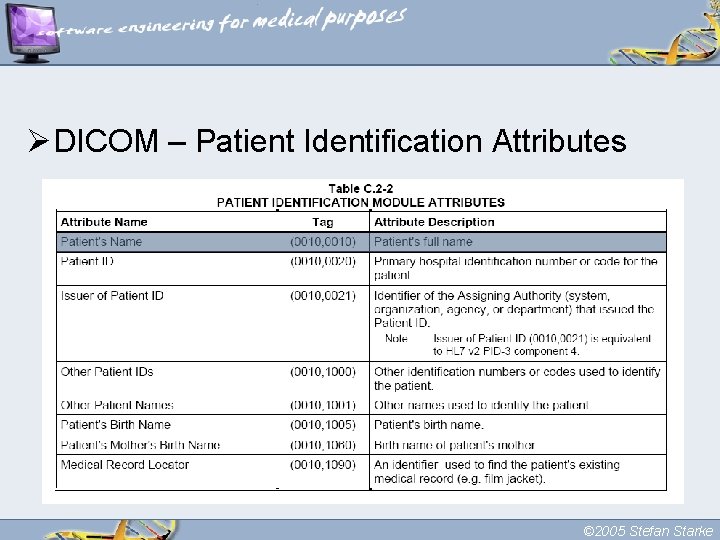
ØDICOM – Patient Identification Attributes © 2005 Stefan Starke
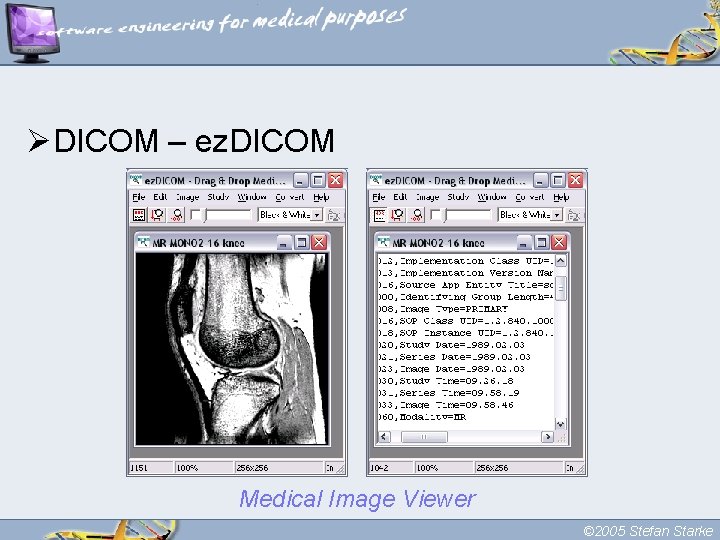
ØDICOM – ez. DICOM Medical Image Viewer © 2005 Stefan Starke
ØDICOM – Future ØUse DICOM for storing data ØNot „only“ sending and printing Ø“New” Image-Types ØEndoscopy, Pathology, other „visible light“ devices ØStandard is and will always be up-to-date ØThe DICOM standard is typically never more than 2 months old. © 2005 Stefan Starke