
Dice Game Implementation Why was dice game implemented
- Slides: 22
Dice Game Implementation • Why was dice game implemented in three 22 V 10 PLDs? • What are the resources needed by the Dice Game? – Outputs: 6 for dice values (3 bits each dice), win, loss – Inputs: Ra, Rb, Reset, Clk – 6 FFs for dice, minimum 3 FFs for FSM, 4 FFs for Point register (13 total) • 22 V 10 has – 12 input-only pins, 10 input/output pins – 10 FFs (1 FF per input/output pin) • Need at least TWO 22 V 10 s just for FFs BR 1/99 1
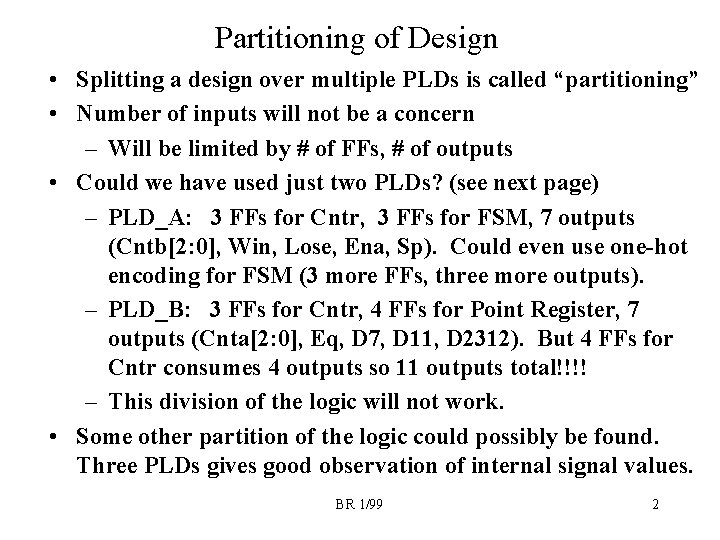
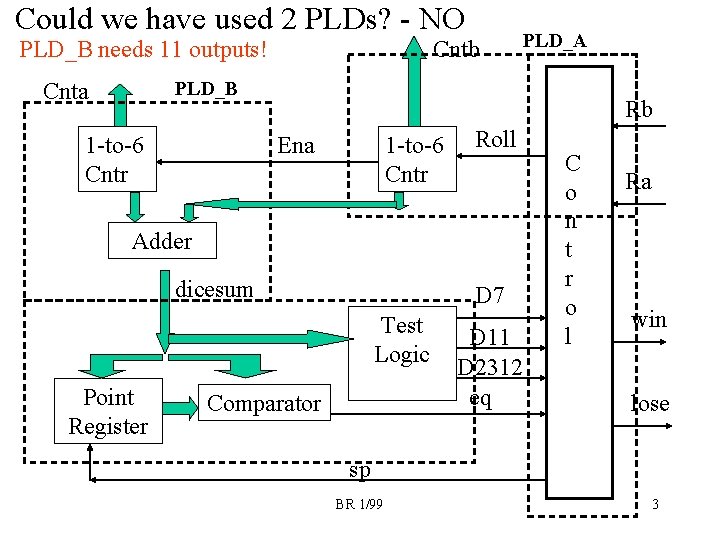
Partitioning of Design • Splitting a design over multiple PLDs is called “partitioning” • Number of inputs will not be a concern – Will be limited by # of FFs, # of outputs • Could we have used just two PLDs? (see next page) – PLD_A: 3 FFs for Cntr, 3 FFs for FSM, 7 outputs (Cntb[2: 0], Win, Lose, Ena, Sp). Could even use one-hot encoding for FSM (3 more FFs, three more outputs). – PLD_B: 3 FFs for Cntr, 4 FFs for Point Register, 7 outputs (Cnta[2: 0], Eq, D 7, D 11, D 2312). But 4 FFs for Cntr consumes 4 outputs so 11 outputs total!!!! – This division of the logic will not work. • Some other partition of the logic could possibly be found. Three PLDs gives good observation of internal signal values. BR 1/99 2
Could we have used 2 PLDs? - NO PLD_B needs 11 outputs! Cntb PLD_A PLD_B Cnta 1 -to-6 Cntr Rb Ena 1 -to-6 Cntr Roll Adder dicesum D 7 Test Logic Point Register Comparator D 11 D 2312 eq C o n t r o l Ra win lose sp BR 1/99 3
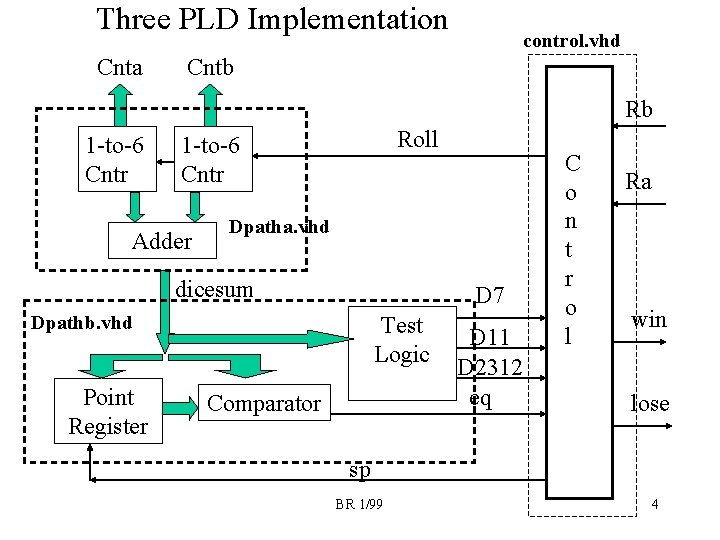
Three PLD Implementation Cnta control. vhd Cntb Rb 1 -to-6 Cntr Roll 1 -to-6 Cntr Adder Dpatha. vhd dicesum D 7 Dpathb. vhd Point Register Test Logic Comparator D 11 D 2312 eq C o n t r o l Ra win lose sp BR 1/99 4
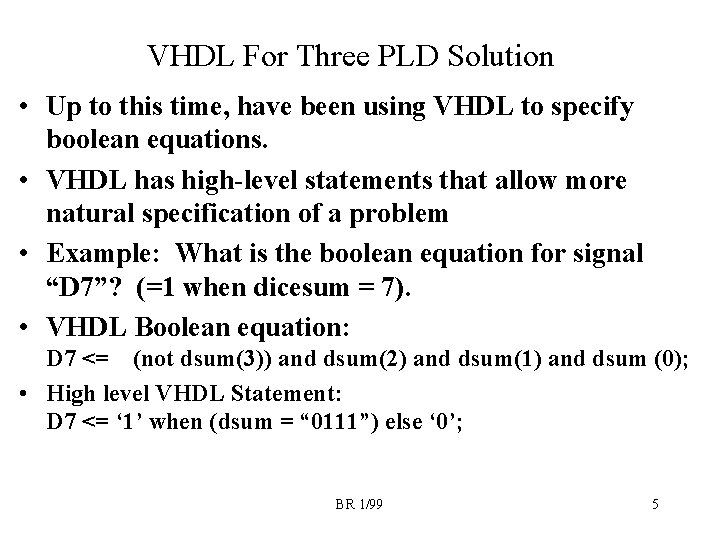
VHDL For Three PLD Solution • Up to this time, have been using VHDL to specify boolean equations. • VHDL has high-level statements that allow more natural specification of a problem • Example: What is the boolean equation for signal “D 7”? (=1 when dicesum = 7). • VHDL Boolean equation: D 7 <= (not dsum(3)) and dsum(2) and dsum(1) and dsum (0); • High level VHDL Statement: D 7 <= ‘ 1’ when (dsum = “ 0111”) else ‘ 0’; BR 1/99 5
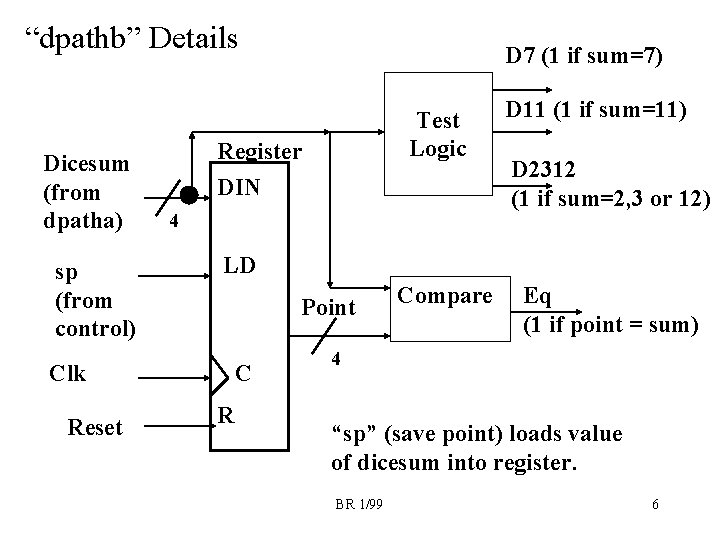
“dpathb” Details Dicesum (from dpatha) sp (from control) Test Logic Register DIN 4 D 11 (1 if sum=11) D 2312 (1 if sum=2, 3 or 12) LD Point Clk Reset D 7 (1 if sum=7) C R Compare Eq (1 if point = sum) 4 “sp” (save point) loads value of dicesum into register. BR 1/99 6
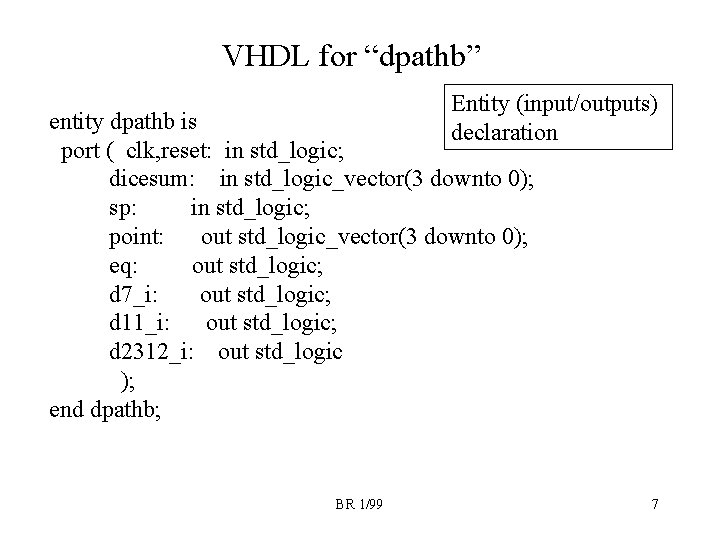
VHDL for “dpathb” Entity (input/outputs) declaration entity dpathb is port ( clk, reset: in std_logic; dicesum: in std_logic_vector(3 downto 0); sp: in std_logic; point: out std_logic_vector(3 downto 0); eq: out std_logic; d 7_i: out std_logic; d 11_i: out std_logic; d 2312_i: out std_logic ); end dpathb; BR 1/99 7
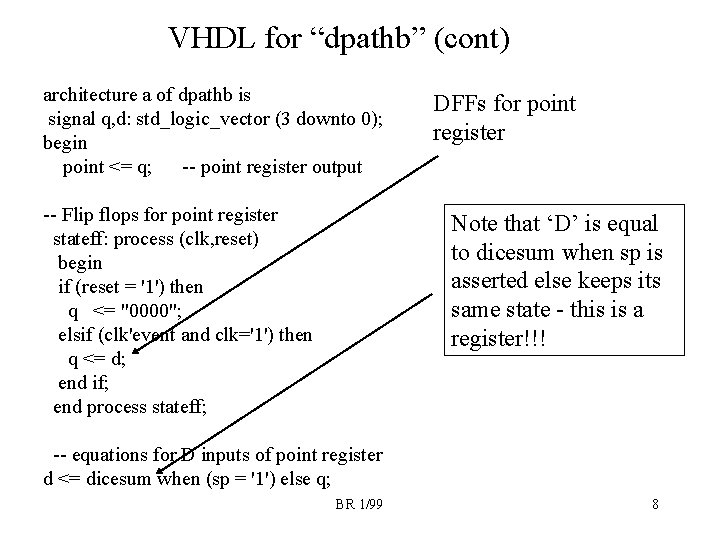
VHDL for “dpathb” (cont) architecture a of dpathb is signal q, d: std_logic_vector (3 downto 0); begin point <= q; -- point register output -- Flip flops for point register stateff: process (clk, reset) begin if (reset = '1') then q <= "0000"; elsif (clk'event and clk='1') then q <= d; end if; end process stateff; DFFs for point register Note that ‘D’ is equal to dicesum when sp is asserted else keeps its same state - this is a register!!! -- equations for D inputs of point register d <= dicesum when (sp = '1') else q; BR 1/99 8
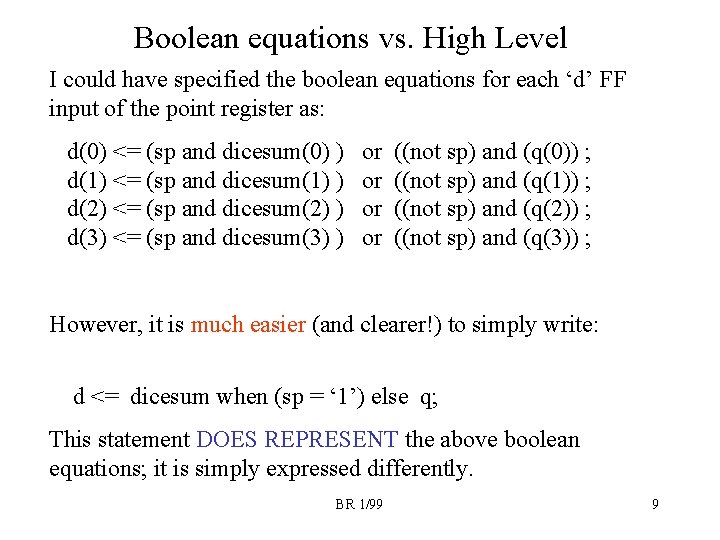
Boolean equations vs. High Level I could have specified the boolean equations for each ‘d’ FF input of the point register as: d(0) <= (sp and dicesum(0) ) d(1) <= (sp and dicesum(1) ) d(2) <= (sp and dicesum(2) ) d(3) <= (sp and dicesum(3) ) or or ((not sp) and (q(0)) ; ((not sp) and (q(1)) ; ((not sp) and (q(2)) ; ((not sp) and (q(3)) ; However, it is much easier (and clearer!) to simply write: d <= dicesum when (sp = ‘ 1’) else q; This statement DOES REPRESENT the above boolean equations; it is simply expressed differently. BR 1/99 9
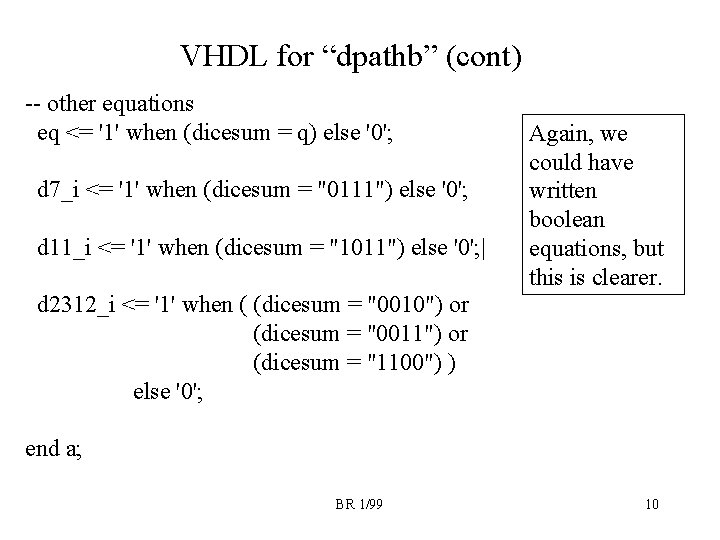
VHDL for “dpathb” (cont) -- other equations eq <= '1' when (dicesum = q) else '0'; d 7_i <= '1' when (dicesum = "0111") else '0'; d 11_i <= '1' when (dicesum = "1011") else '0'; | Again, we could have written boolean equations, but this is clearer. d 2312_i <= '1' when ( (dicesum = "0010") or (dicesum = "0011") or (dicesum = "1100") ) else '0'; end a; BR 1/99 10
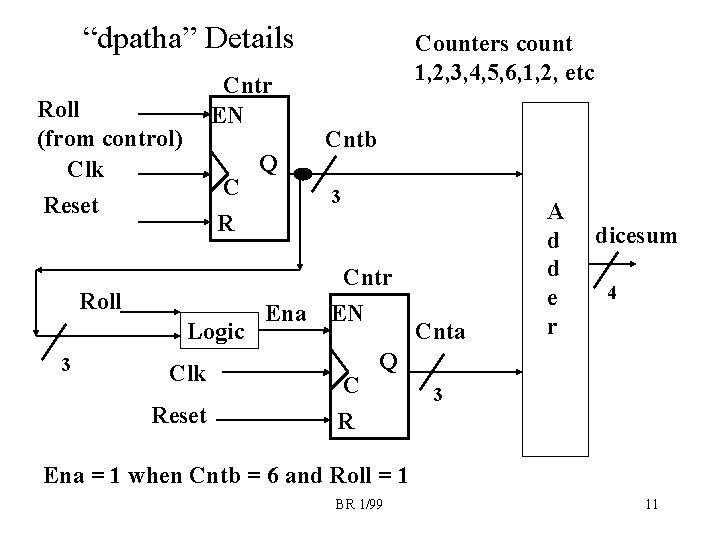
“dpatha” Details Cntr EN Roll (from control) Clk Reset C R Roll Logic 3 Clk Reset Q Counters count 1, 2, 3, 4, 5, 6, 1, 2, etc Cntb 3 Ena Cntr EN C R Cnta A d d e r dicesum 4 Q 3 Ena = 1 when Cntb = 6 and Roll = 1 BR 1/99 11
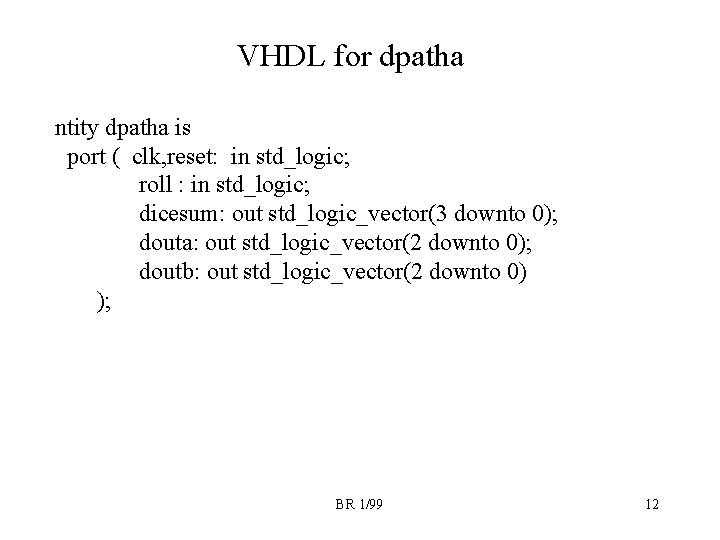
VHDL for dpatha ntity dpatha is port ( clk, reset: in std_logic; roll : in std_logic; dicesum: out std_logic_vector(3 downto 0); douta: out std_logic_vector(2 downto 0); doutb: out std_logic_vector(2 downto 0) ); BR 1/99 12
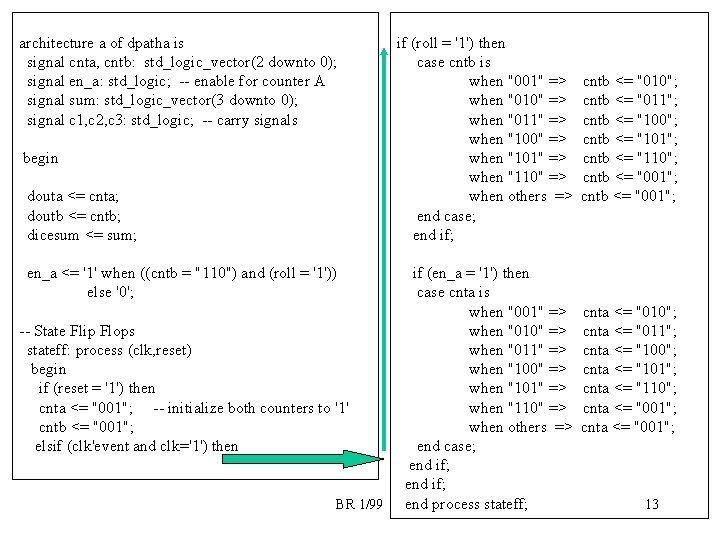
architecture a of dpatha is signal cnta, cntb: std_logic_vector(2 downto 0); signal en_a: std_logic; -- enable for counter A signal sum: std_logic_vector(3 downto 0); signal c 1, c 2, c 3: std_logic; -- carry signals begin douta <= cnta; doutb <= cntb; dicesum <= sum; en_a <= '1' when ((cntb = "110") and (roll = '1')) else '0'; -- State Flip Flops stateff: process (clk, reset) begin if (reset = '1') then cnta <= "001"; -- initialize both counters to '1' cntb <= "001"; elsif (clk'event and clk='1') then BR 1/99 if (roll = '1') then case cntb is when "001" => when "010" => when "011" => when "100" => when "101" => when "110" => when others => end case; end if; if (en_a = '1') then case cnta is when "001" => when "010" => when "011" => when "100" => when "101" => when "110" => when others => end case; end if; end process stateff; cntb <= "010"; cntb <= "011"; cntb <= "100"; cntb <= "101"; cntb <= "110"; cntb <= "001"; cnta <= "010"; cnta <= "011"; cnta <= "100"; cnta <= "101"; cnta <= "110"; cnta <= "001"; 13
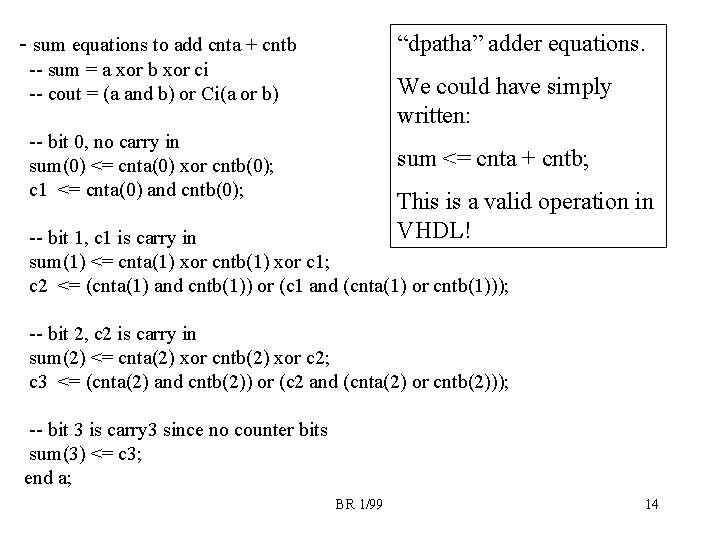
“dpatha” adder equations. - sum equations to add cnta + cntb -- sum = a xor b xor ci -- cout = (a and b) or Ci(a or b) We could have simply written: -- bit 0, no carry in sum(0) <= cnta(0) xor cntb(0); c 1 <= cnta(0) and cntb(0); sum <= cnta + cntb; This is a valid operation in VHDL! -- bit 1, c 1 is carry in sum(1) <= cnta(1) xor cntb(1) xor c 1; c 2 <= (cnta(1) and cntb(1)) or (c 1 and (cnta(1) or cntb(1))); -- bit 2, c 2 is carry in sum(2) <= cnta(2) xor cntb(2) xor c 2; c 3 <= (cnta(2) and cntb(2)) or (c 2 and (cnta(2) or cntb(2))); -- bit 3 is carry 3 since no counter bits sum(3) <= c 3; end a; BR 1/99 14
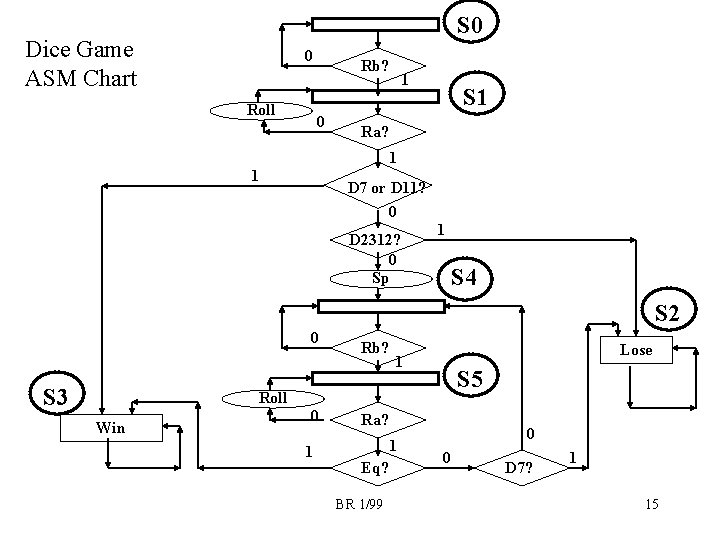
S 0 Dice Game ASM Chart 0 Roll Rb? 0 1 S 1 Ra? 1 1 D 7 or D 11? 0 D 2312? 0 Sp 1 S 4 S 2 0 S 3 Rb? Lose 1 S 5 Roll Win 0 1 Ra? 1 Eq? BR 1/99 0 0 D 7? 1 15
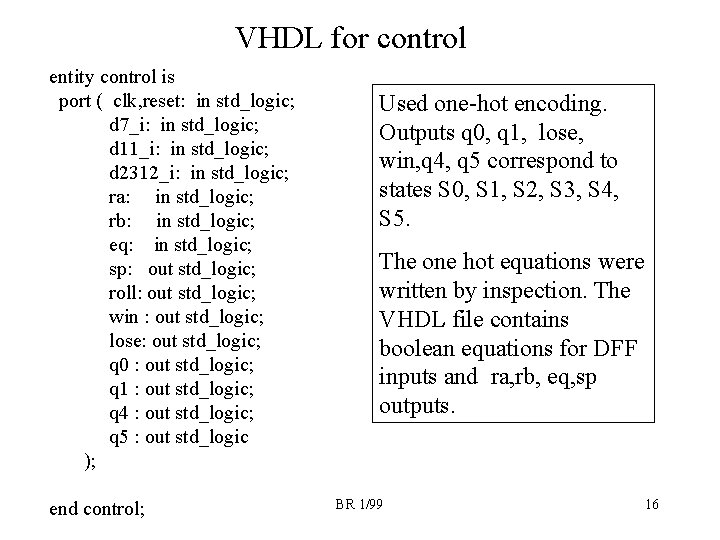
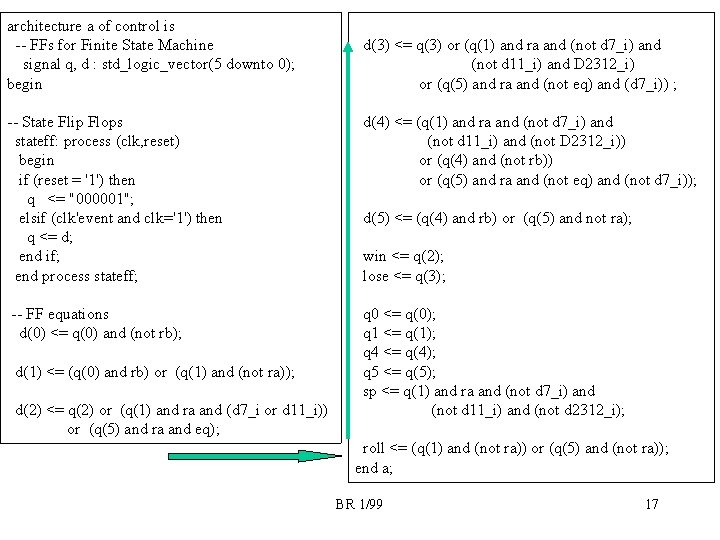
VHDL for control entity control is port ( clk, reset: in std_logic; d 7_i: in std_logic; d 11_i: in std_logic; d 2312_i: in std_logic; ra: in std_logic; rb: in std_logic; eq: in std_logic; sp: out std_logic; roll: out std_logic; win : out std_logic; lose: out std_logic; q 0 : out std_logic; q 1 : out std_logic; q 4 : out std_logic; q 5 : out std_logic ); end control; Used one-hot encoding. Outputs q 0, q 1, lose, win, q 4, q 5 correspond to states S 0, S 1, S 2, S 3, S 4, S 5. The one hot equations were written by inspection. The VHDL file contains boolean equations for DFF inputs and ra, rb, eq, sp outputs. BR 1/99 16
architecture a of control is -- FFs for Finite State Machine signal q, d : std_logic_vector(5 downto 0); begin d(3) <= q(3) or (q(1) and ra and (not d 7_i) and (not d 11_i) and D 2312_i) or (q(5) and ra and (not eq) and (d 7_i)) ; -- State Flip Flops stateff: process (clk, reset) begin if (reset = '1') then q <= "000001"; elsif (clk'event and clk='1') then q <= d; end if; end process stateff; d(4) <= (q(1) and ra and (not d 7_i) and (not d 11_i) and (not D 2312_i)) or (q(4) and (not rb)) or (q(5) and ra and (not eq) and (not d 7_i)); -- FF equations d(0) <= q(0) and (not rb); q 0 <= q(0); q 1 <= q(1); q 4 <= q(4); q 5 <= q(5); sp <= q(1) and ra and (not d 7_i) and (not d 11_i) and (not d 2312_i); d(1) <= (q(0) and rb) or (q(1) and (not ra)); d(2) <= q(2) or (q(1) and ra and (d 7_i or d 11_i)) or (q(5) and ra and eq); d(5) <= (q(4) and rb) or (q(5) and not ra); win <= q(2); lose <= q(3); roll <= (q(1) and (not ra)) or (q(5) and (not ra)); end a; BR 1/99 17
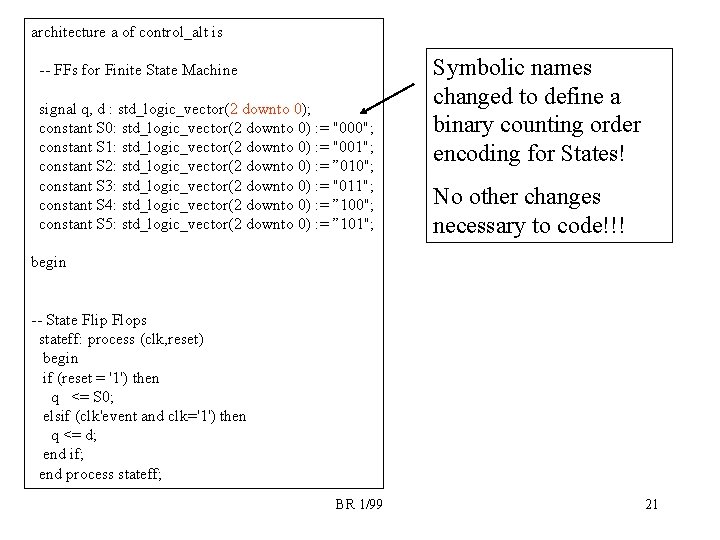
Is there an easier way to do VHDL for a FSM? • There is an easier way to write the VHDL for the finite state machine code • Will use a “case” statement for specifying the FSM action – Will generate the same boolean equations – Will be more readable • Will also use symbolic names for states (S 0, S 1, etc) – Can change state encoding very easily. BR 1/99 18
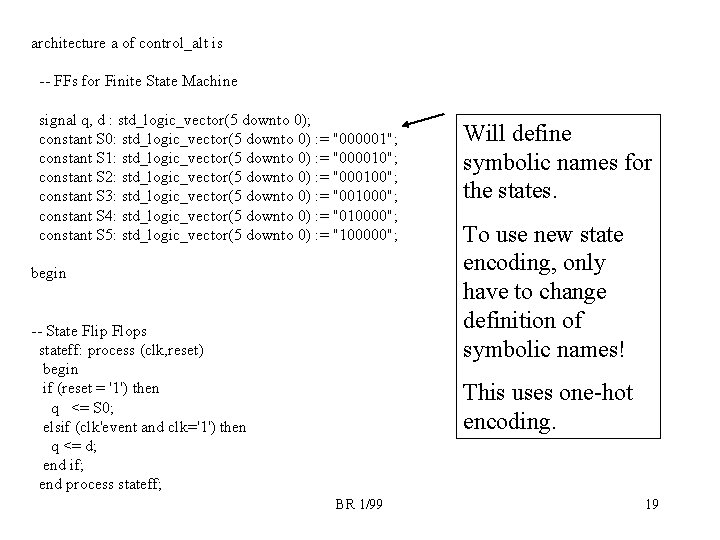
architecture a of control_alt is -- FFs for Finite State Machine signal q, d : std_logic_vector(5 downto 0); constant S 0: std_logic_vector(5 downto 0) : = "000001"; constant S 1: std_logic_vector(5 downto 0) : = "000010"; constant S 2: std_logic_vector(5 downto 0) : = "000100"; constant S 3: std_logic_vector(5 downto 0) : = "001000"; constant S 4: std_logic_vector(5 downto 0) : = "010000"; constant S 5: std_logic_vector(5 downto 0) : = "100000"; begin -- State Flip Flops stateff: process (clk, reset) begin if (reset = '1') then q <= S 0; elsif (clk'event and clk='1') then q <= d; end if; end process stateff; Will define symbolic names for the states. To use new state encoding, only have to change definition of symbolic names! This uses one-hot encoding. BR 1/99 19
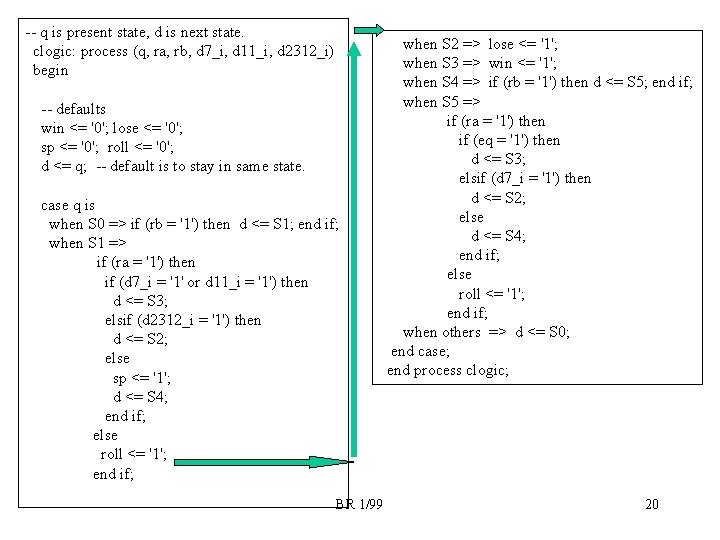
-- q is present state, d is next state. clogic: process (q, ra, rb, d 7_i, d 11_i, d 2312_i) begin -- defaults win <= '0'; lose <= '0'; sp <= '0'; roll <= '0'; d <= q; -- default is to stay in same state. case q is when S 0 => if (rb = '1') then d <= S 1; end if; when S 1 => if (ra = '1') then if (d 7_i = '1' or d 11_i = '1') then d <= S 3; elsif (d 2312_i = '1') then d <= S 2; else sp <= '1'; d <= S 4; end if; else roll <= '1'; end if; BR 1/99 when S 2 => lose <= '1'; when S 3 => win <= '1'; when S 4 => if (rb = '1') then d <= S 5; end if; when S 5 => if (ra = '1') then if (eq = '1') then d <= S 3; elsif (d 7_i = '1') then d <= S 2; else d <= S 4; end if; else roll <= '1'; end if; when others => d <= S 0; end case; end process clogic; 20
architecture a of control_alt is -- FFs for Finite State Machine signal q, d : std_logic_vector(2 downto 0); constant S 0: std_logic_vector(2 downto 0) : = "000"; constant S 1: std_logic_vector(2 downto 0) : = "001"; constant S 2: std_logic_vector(2 downto 0) : = ” 010"; constant S 3: std_logic_vector(2 downto 0) : = "011"; constant S 4: std_logic_vector(2 downto 0) : = ” 100"; constant S 5: std_logic_vector(2 downto 0) : = ” 101"; Symbolic names changed to define a binary counting order encoding for States! No other changes necessary to code!!! begin -- State Flip Flops stateff: process (clk, reset) begin if (reset = '1') then q <= S 0; elsif (clk'event and clk='1') then q <= d; end if; end process stateff; BR 1/99 21
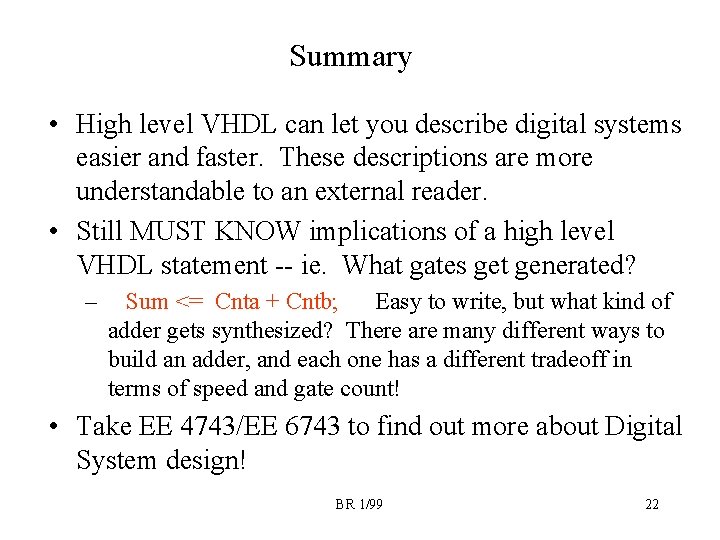
Summary • High level VHDL can let you describe digital systems easier and faster. These descriptions are more understandable to an external reader. • Still MUST KNOW implications of a high level VHDL statement -- ie. What gates get generated? – Sum <= Cnta + Cntb; Easy to write, but what kind of adder gets synthesized? There are many different ways to build an adder, and each one has a different tradeoff in terms of speed and gate count! • Take EE 4743/EE 6743 to find out more about Digital System design! BR 1/99 22