
DIBELS 8 and Dyslexia Applications for Screening and
DIBELS 8 and Dyslexia: Applications for Screening and Progress Monitoring Chris Ives, B. A. , Brian Gearin, M. Ed. & Marissa Pilger Suhr, M. S. Center on Teaching and Learning University of Oregon
Learning Objectives • Describe key dyslexia-related updates to DIBELS 8 subtests • Describe the rationale for validating DIBELS 8 subtests as dyslexia screeners • Describe how specific DIBELS 8 subtests can function as screening tools for measuring dyslexia-related constructs and progress monitoring tools for monitoring progress of students at risk for dyslexia
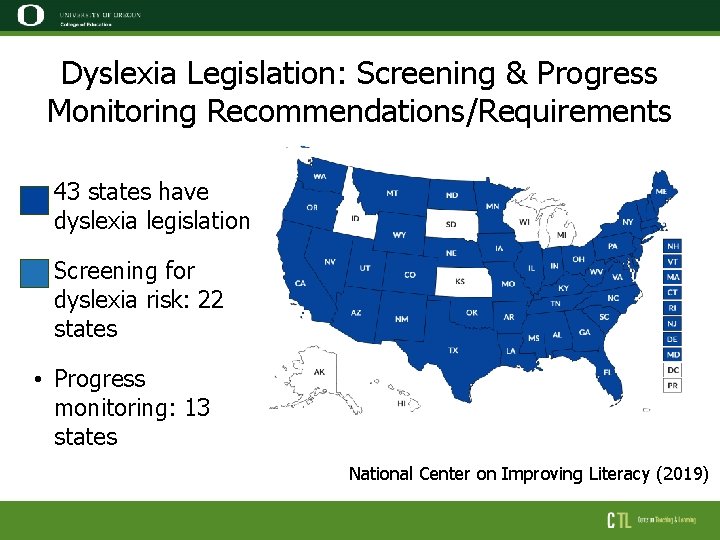
Dyslexia Legislation: Screening & Progress Monitoring Recommendations/Requirements • 43 states have dyslexia legislation • Screening for dyslexia risk: 22 states • Progress monitoring: 13 states National Center on Improving Literacy (2019)
But What and Who to Assess? • Considerable variation in requirements • A summary of common elements Common constructs assessed: • Phonological Awareness • Rapid Automatized Naming (RAN) • Alphabetic Principle • Word Reading – Recommended grades: • K-1 • K-3 –
Using CBMs for Dyslexia Screening & PM • Curriculum-based measures (CBMs) widely adopted for screening and progress monitoring • Useful features of CBMS: – Brief, and easy to administer, score, and interpret – Established measures of important early literacy skills – Seamless system for assessing student reading skill However, CBMs not validated for assessing specific constructs associated with risk for dyslexia
Rationale for Validating DIBELS 8 as a Dyslexia Screener • DIBELS 8 th Edition was developed with dyslexia legislation in mind – Updates have been made to specific subtests to better align DIBELS with dyslexia theory and research • To date, 17 states mention DIBELS in screening guidelines
DIBELS 8 Subtest Updates Three goals: 1. Update subtests to make them stronger predictors of general reading achievement 2. Update subtests to make them stronger predictors of specific dyslexia-related constructs 3. Update forms to make them more equivalent in difficulty across a given school year
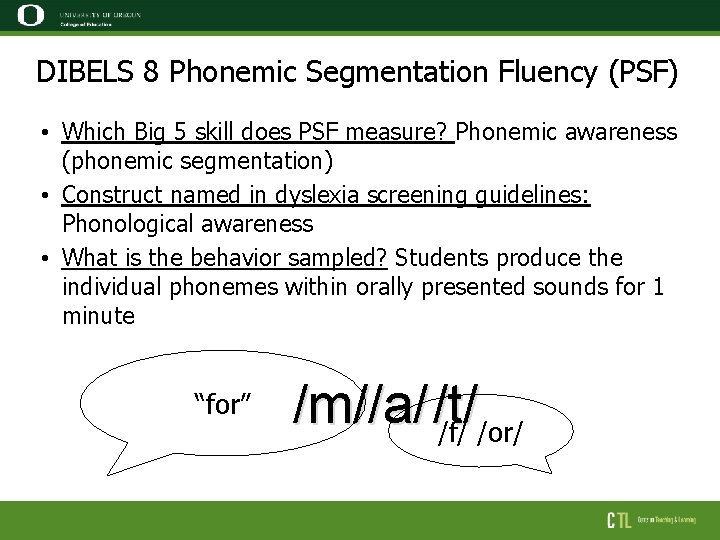
DIBELS 8 Phonemic Segmentation Fluency (PSF) • Which Big 5 skill does PSF measure? Phonemic awareness (phonemic segmentation) • Construct named in dyslexia screening guidelines: Phonological awareness • What is the behavior sampled? Students produce the individual phonemes within orally presented sounds for 1 minute “for” /m//a/ /t/ /f/ /or/
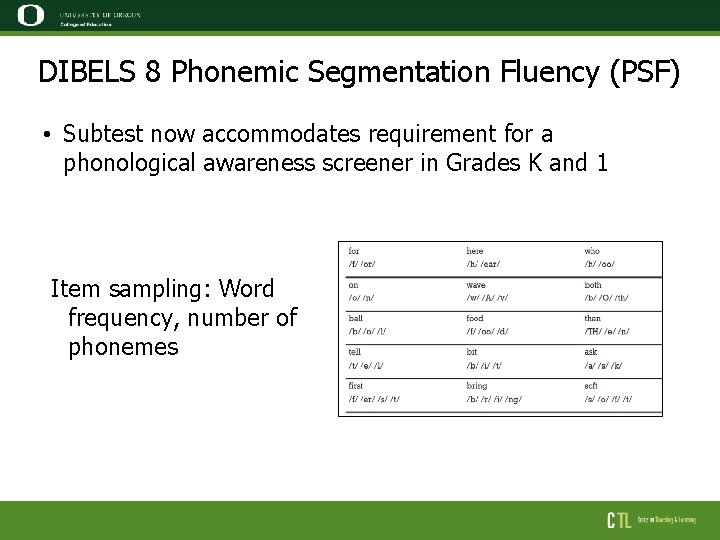
DIBELS 8 Phonemic Segmentation Fluency (PSF) • Subtest now accommodates requirement for a phonological awareness screener in Grades K and 1 Item sampling: Word frequency, number of phonemes
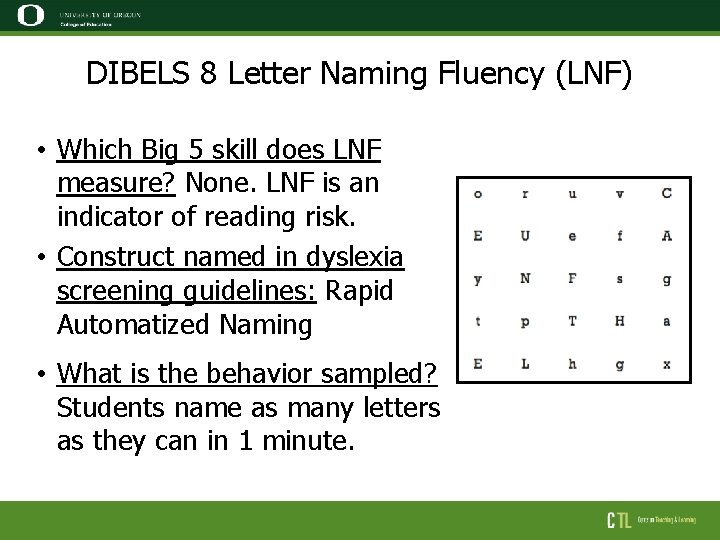
DIBELS 8 Letter Naming Fluency (LNF) • Which Big 5 skill does LNF measure? None. LNF is an indicator of reading risk. • Construct named in dyslexia screening guidelines: Rapid Automatized Naming • What is the behavior sampled? Students name as many letters as they can in 1 minute.
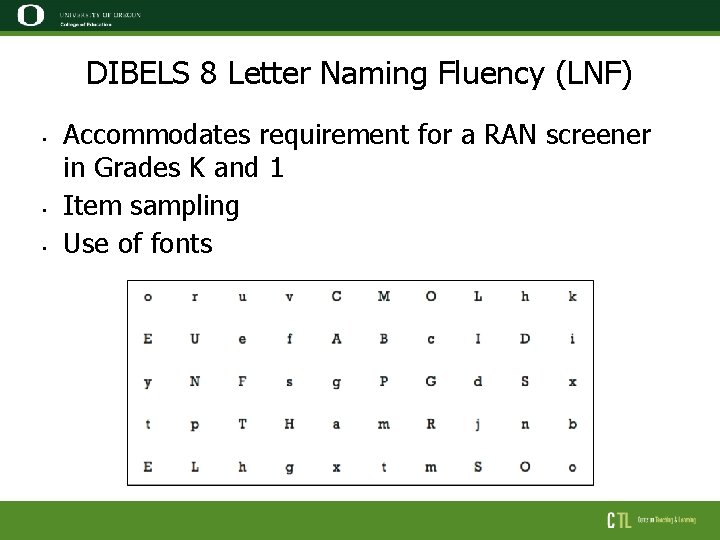
DIBELS 8 Letter Naming Fluency (LNF) • • • Accommodates requirement for a RAN screener in Grades K and 1 Item sampling Use of fonts
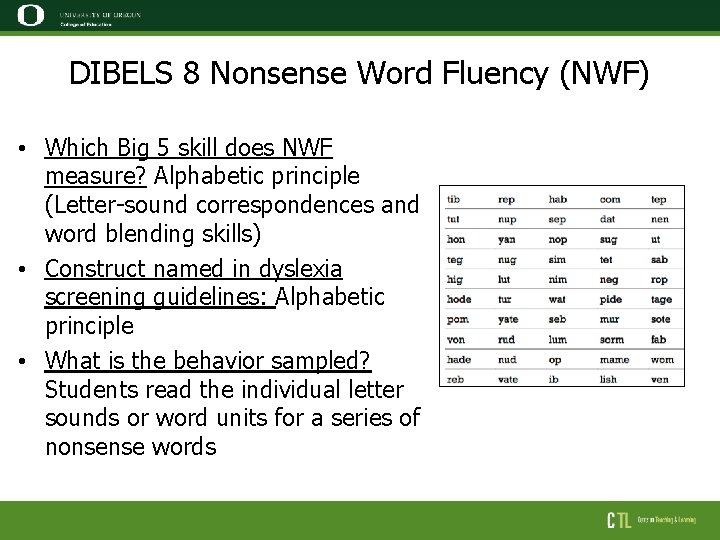
DIBELS 8 Nonsense Word Fluency (NWF) • Which Big 5 skill does NWF measure? Alphabetic principle (Letter-sound correspondences and word blending skills) • Construct named in dyslexia screening guidelines: Alphabetic principle • What is the behavior sampled? Students read the individual letter sounds or word units for a series of nonsense words
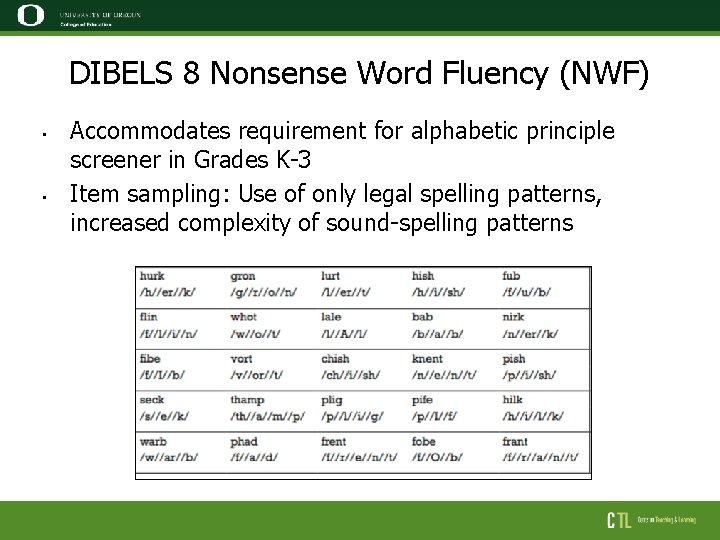
DIBELS 8 Nonsense Word Fluency (NWF) • • Accommodates requirement for alphabetic principle screener in Grades K-3 Item sampling: Use of only legal spelling patterns, increased complexity of sound-spelling patterns
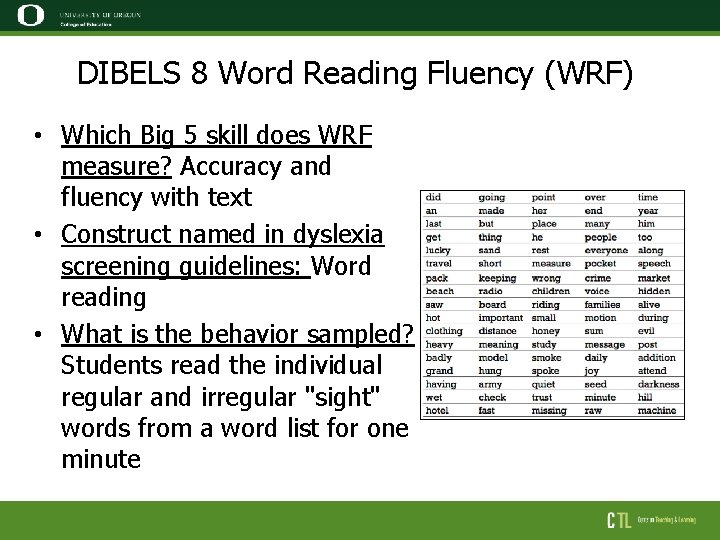
DIBELS 8 Word Reading Fluency (WRF) • Which Big 5 skill does WRF measure? Accuracy and fluency with text • Construct named in dyslexia screening guidelines: Word reading • What is the behavior sampled? Students read the individual regular and irregular "sight" words from a word list for one minute
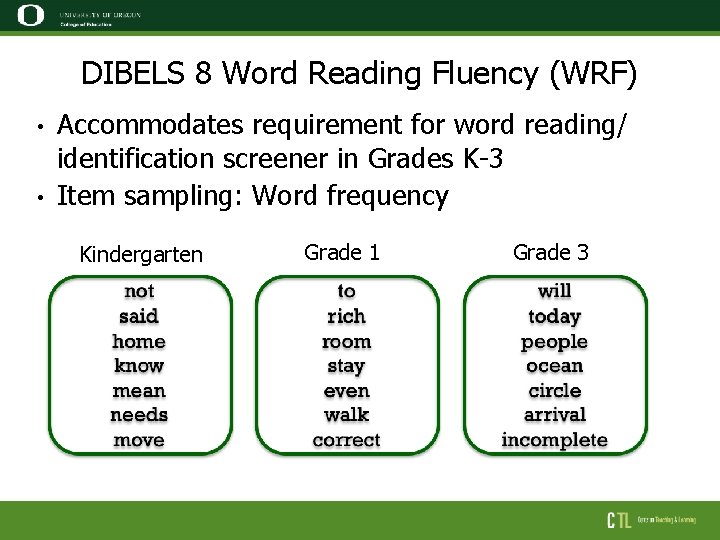
DIBELS 8 Word Reading Fluency (WRF) • • Accommodates requirement for word reading/ identification screener in Grades K-3 Item sampling: Word frequency Kindergarten Grade 1 Grade 3
Why NWF and WRF? • Importance of dual routes to word reading – NWF assesses student skill reading decodable, nonsense words – WRF assesses student skill reading “sight” words • Assessing students with measures of both real and nonsense words captures reading risk missed by either measure alone
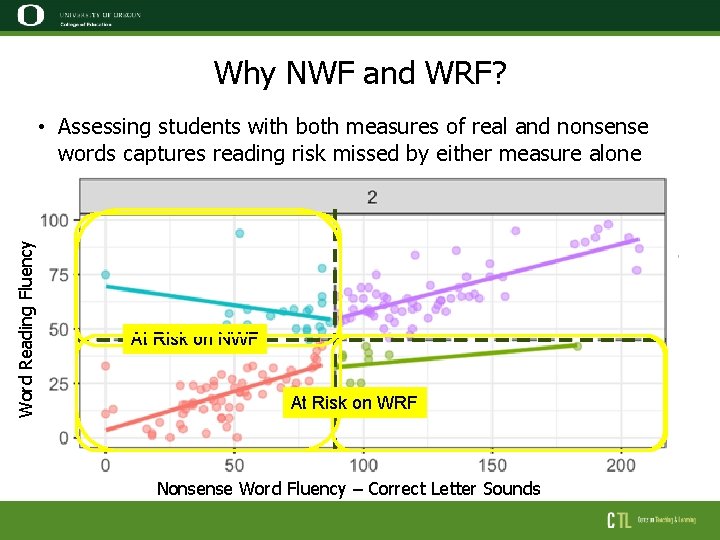
Why NWF and WRF? Word Reading Fluency • Assessing students with both measures of real and nonsense words captures reading risk missed by either measure alone At Risk on NWF At Risk on WRF Nonsense Word Fluency – Correct Letter Sounds
SCREENING FOR DYSLEXIA RISK
Validity Issues • “Validity refers to the degree to which evidence and theory support the interpretation of test scores for proposed uses of tests” (Standards for Educational and Psychological Testing, 2014). • Validity evidence for CBM measures has typically focused on predicting general reading achievement. • What may be included on measures of reading achievement? – – Vocabulary Word Recognition Inference-making Comprehension • Dyslexia screening requires a similar, but more focused evaluation of validity.
Questions That Arose 1. Is Letter Naming Fluency (LNF) a suitable screener for rapid automatized naming deficits?
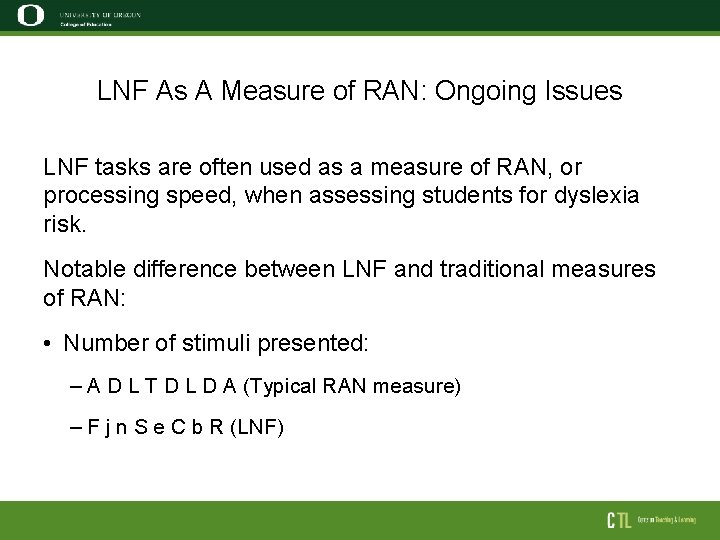
LNF As A Measure of RAN: Ongoing Issues LNF tasks are often used as a measure of RAN, or processing speed, when assessing students for dyslexia risk. Notable difference between LNF and traditional measures of RAN: • Number of stimuli presented: – A D L T D L D A (Typical RAN measure) – F j n S e C b R (LNF)
Questions That Arose 1. Is Letter Naming Fluency (LNF) a suitable screener for rapid automatized naming deficits? 2. Is Phoneme Segmentation Fluency (PSF) an adequate indicator of overall phonological ability across kindergarten and first grade?
PSF As A Measure of Overall PA Ability: Ongoing Issues • Debate about the what phonological tasks may be the most indicative of overall phonological ability. – Phoneme manipulation vs. segmentation – Manipulation tasks are considered more difficult phonological awareness tasks (Cassady, Smith, & Putnam, 2008). – Are PSF’s modifications sufficient to compensate for its mid-level difficulty?
Questions That Arose 1. Is Letter Naming Fluency (LNF) a suitable screener for rapid automatized naming deficits? 2. Is Phoneme Segmentation Fluency (PSF) an adequate indicator of overall phonological ability across kindergarten and first grade? 3. What does it mean to screen for dyslexia?
Challenges of Dyslexia Screening • International Dyslexia Association Definition: – Difficulties with accurate and/or fluent word recognition – Poor spelling and decoding abilities – Deficit in the phonological component of language – Deficits are unexpected in relation to other cognitive abilities and the provision of effective classroom instruction
Challenges of Dyslexia Screening • Diverse constellation of skills that can be incorporated into screening procedures for dyslexia. • There is no singular outcome measure to anchor our screening measures. – Debates continue about how best to distinguish dyslexia from other forms of reading difficulty.
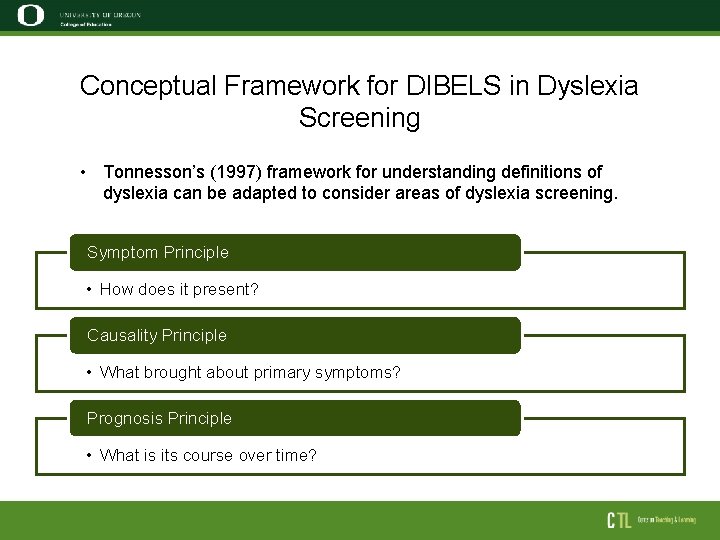
Conceptual Framework for DIBELS in Dyslexia Screening • Tonnesson’s (1997) framework for understanding definitions of dyslexia can be adapted to consider areas of dyslexia screening. Symptom Principle • How does it present? Causality Principle • What brought about primary symptoms? Prognosis Principle • What is its course over time?
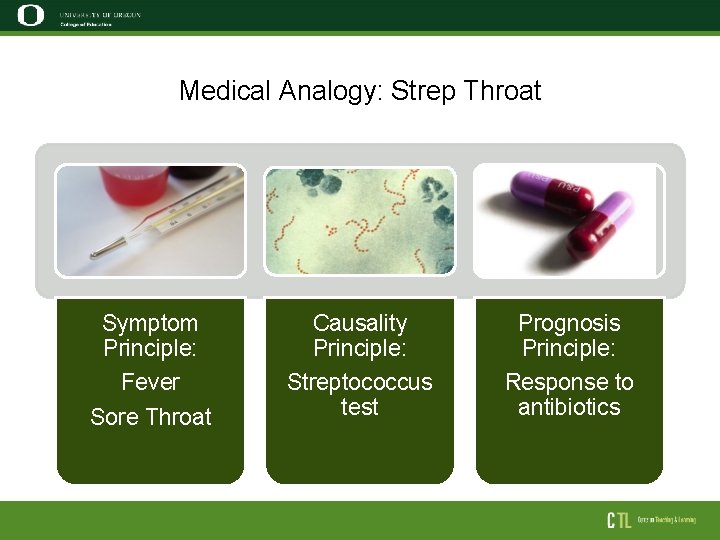
Medical Analogy: Strep Throat Symptom Principle: Causality Principle: Prognosis Principle: Fever Sore Throat Streptococcus test Response to antibiotics
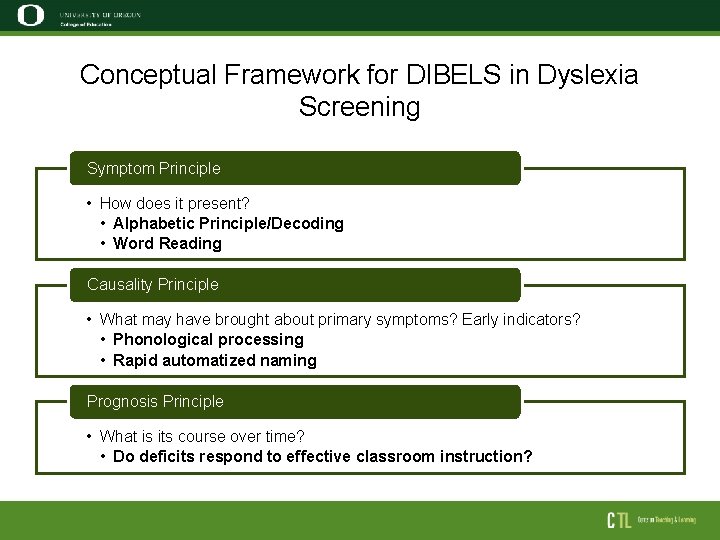
Conceptual Framework for DIBELS in Dyslexia Screening Symptom Principle • How does it present? • Alphabetic Principle/Decoding • Word Reading Causality Principle • What may have brought about primary symptoms? Early indicators? • Phonological processing • Rapid automatized naming Prognosis Principle • What is its course over time? • Do deficits respond to effective classroom instruction?
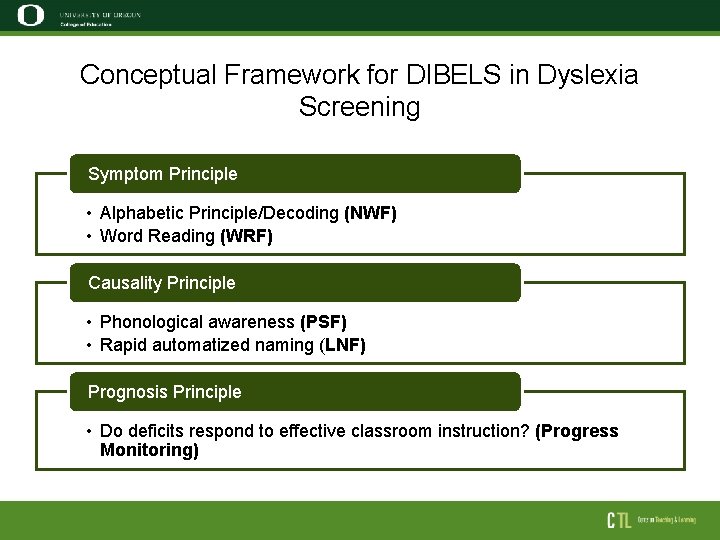
Conceptual Framework for DIBELS in Dyslexia Screening Symptom Principle • Alphabetic Principle/Decoding (NWF) • Word Reading (WRF) Causality Principle • Phonological awareness (PSF) • Rapid automatized naming (LNF) Prognosis Principle • Do deficits respond to effective classroom instruction? (Progress Monitoring)
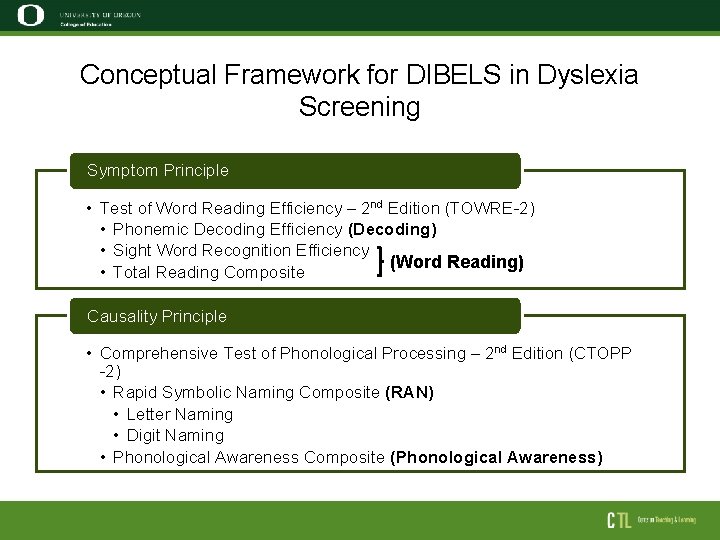
Conceptual Framework for DIBELS in Dyslexia Screening Symptom Principle • Test of Word Reading Efficiency – 2 nd Edition (TOWRE-2) • Phonemic Decoding Efficiency (Decoding) • Sight Word Recognition Efficiency (Word Reading) • Total Reading Composite Causality Principle • Comprehensive Test of Phonological Processing – 2 nd Edition (CTOPP -2) • Rapid Symbolic Naming Composite (RAN) • Letter Naming • Digit Naming • Phonological Awareness Composite (Phonological Awareness)
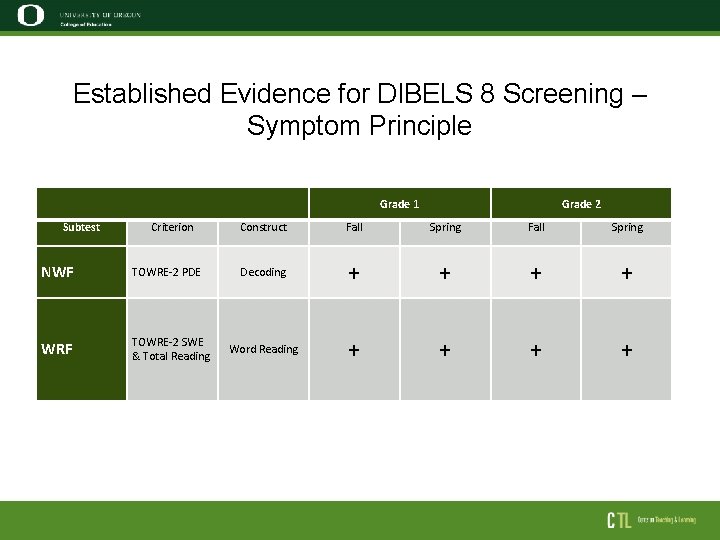
Established Evidence for DIBELS 8 Screening – Symptom Principle Grade 1 Subtest Criterion NWF TOWRE-2 PDE WRF TOWRE-2 SWE & Total Reading Grade 2 Construct Fall Spring Decoding + + Word Reading + +
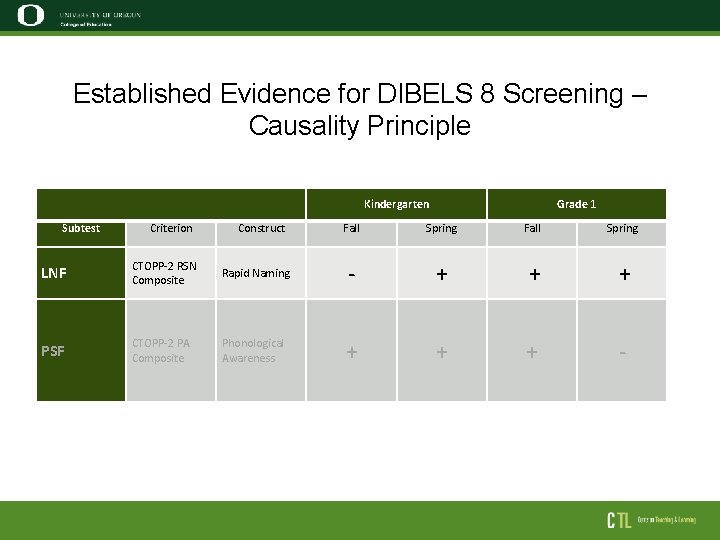
Established Evidence for DIBELS 8 Screening – Causality Principle Kindergarten Subtest Criterion Construct Grade 1 Fall Spring LNF CTOPP-2 RSN Composite Rapid Naming - + + + PSF CTOPP-2 PA Composite Phonological Awareness + + + -
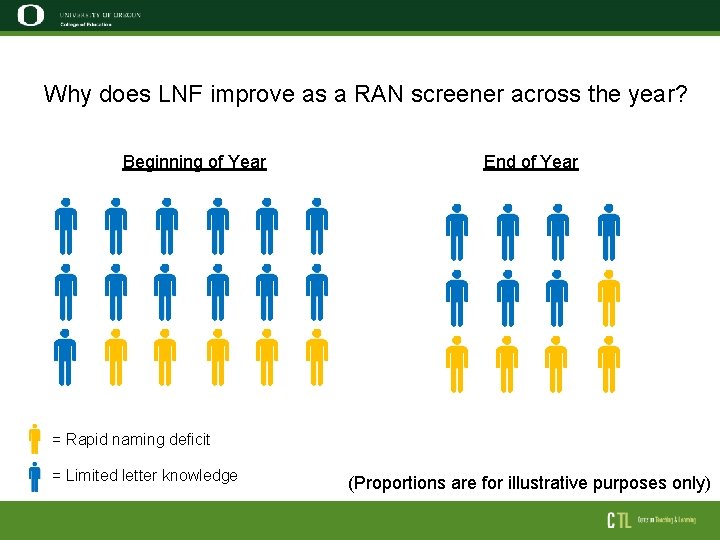
Why does LNF improve as a RAN screener across the year? Beginning of Year End of Year = Rapid naming deficit = Limited letter knowledge (Proportions are for illustrative purposes only)
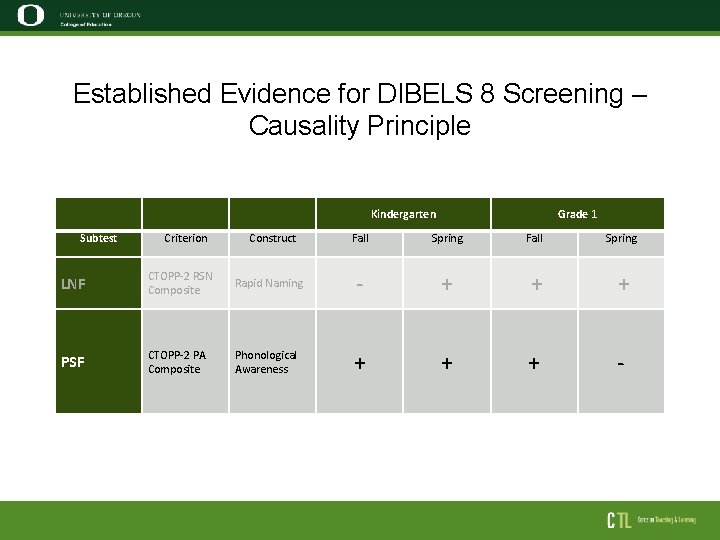
Established Evidence for DIBELS 8 Screening – Causality Principle Kindergarten Subtest Criterion Construct Grade 1 Fall Spring LNF CTOPP-2 RSN Composite Rapid Naming - + + + PSF CTOPP-2 PA Composite Phonological Awareness + + + -
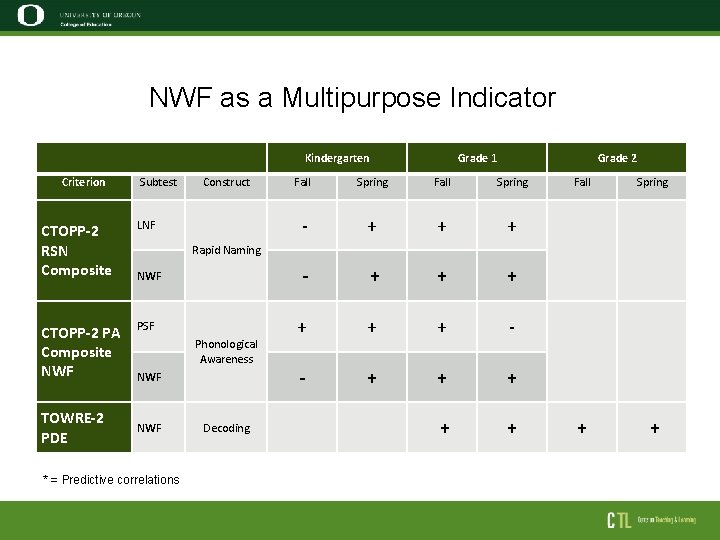
NWF as a Multipurpose Indicator Kindergarten Criterion Subtest Construct Grade 1 Grade 2 Fall Spring - + + + CTOPP-2 RSN Composite LNF NWF - + + + CTOPP-2 PA Composite NWF PSF + + + - - + + + TOWRE-2 PDE Fall Spring + + Rapid Naming Phonological Awareness NWF * = Predictive correlations Decoding
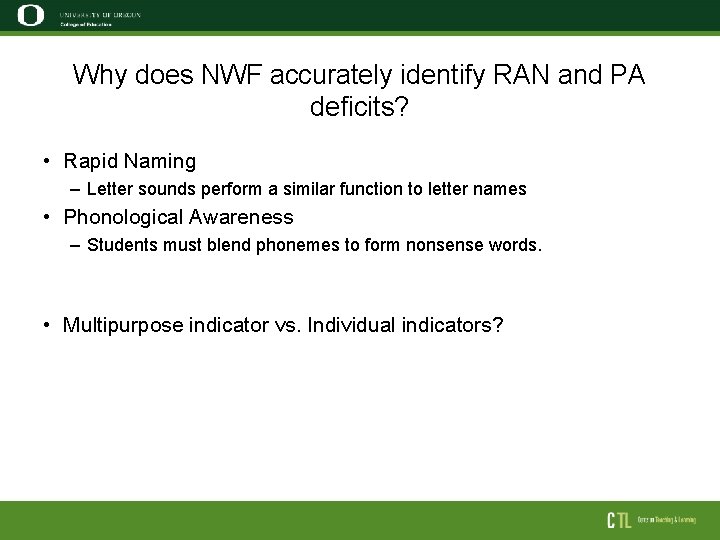
Why does NWF accurately identify RAN and PA deficits? • Rapid Naming – Letter sounds perform a similar function to letter names • Phonological Awareness – Students must blend phonemes to form nonsense words. • Multipurpose indicator vs. Individual indicators?
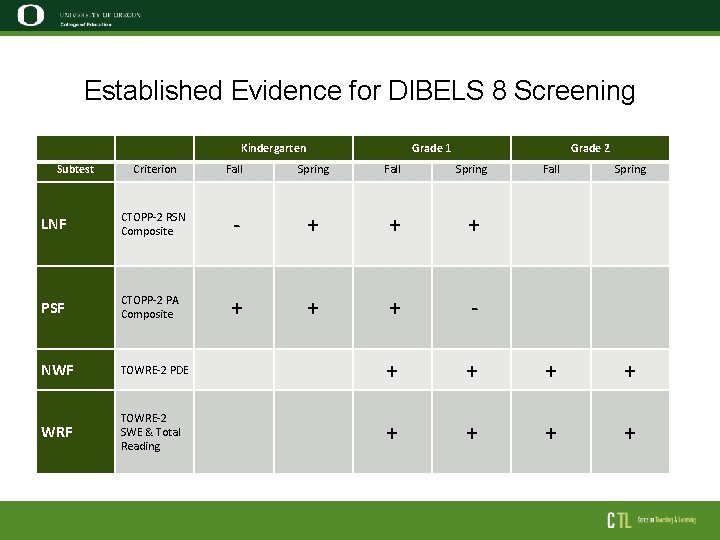
Established Evidence for DIBELS 8 Screening Kindergarten Subtest Grade 1 Grade 2 Criterion Fall Spring LNF CTOPP-2 RSN Composite - + + + PSF CTOPP-2 PA Composite + + + - NWF TOWRE-2 PDE + + WRF TOWRE-2 SWE & Total Reading + +
PROGRESS MONITORING
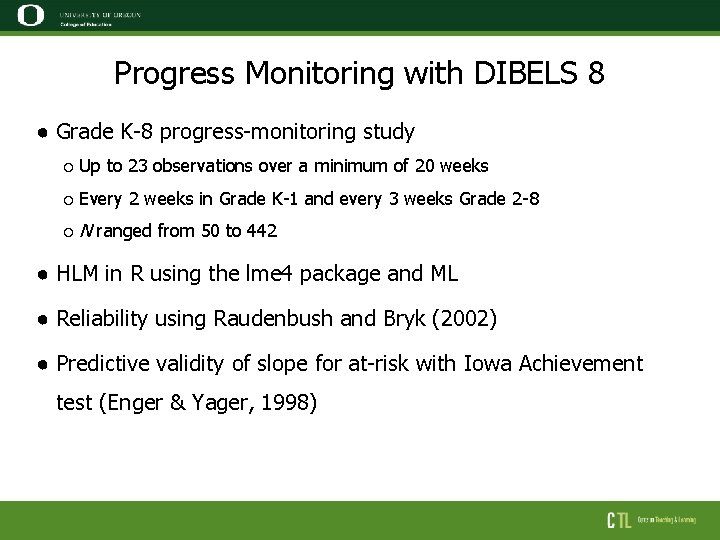
Progress Monitoring with DIBELS 8 ● Grade K-8 progress-monitoring study ○ Up to 23 observations over a minimum of 20 weeks ○ Every 2 weeks in Grade K-1 and every 3 weeks Grade 2 -8 ○ N ranged from 50 to 442 ● HLM in R using the lme 4 package and ML ● Reliability using Raudenbush and Bryk (2002) ● Predictive validity of slope for at-risk with Iowa Achievement test (Enger & Yager, 1998)
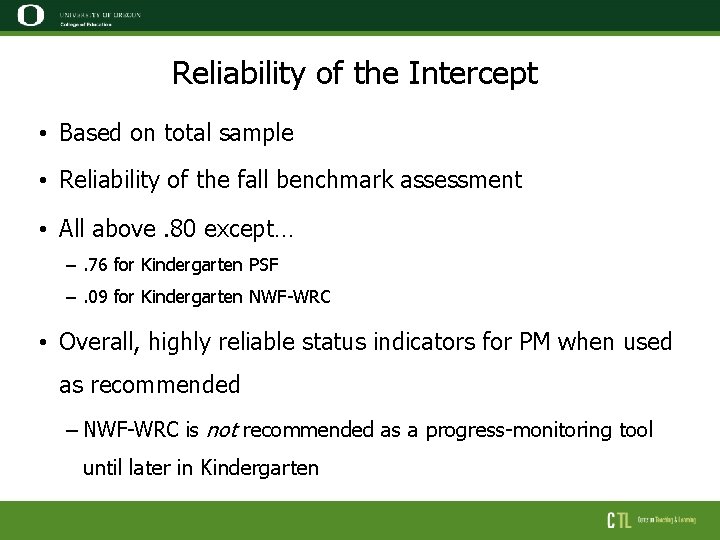
Reliability of the Intercept • Based on total sample • Reliability of the fall benchmark assessment • All above. 80 except… –. 76 for Kindergarten PSF –. 09 for Kindergarten NWF-WRC • Overall, highly reliable status indicators for PM when used as recommended – NWF-WRC is not recommended as a progress-monitoring tool until later in Kindergarten
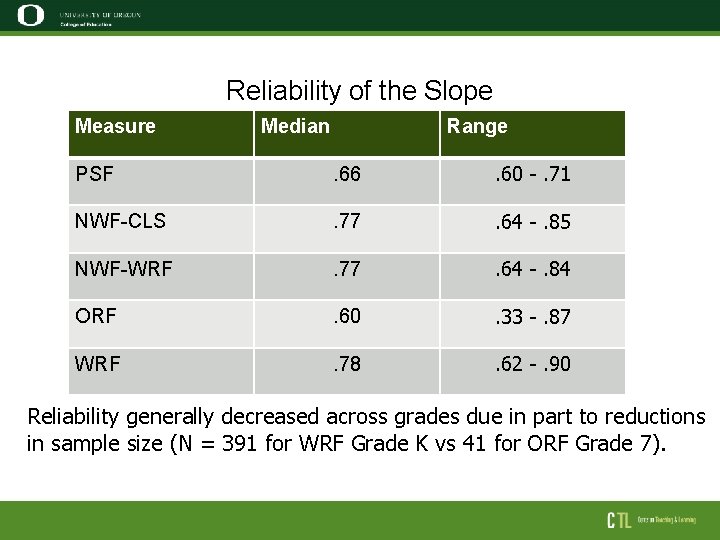
Reliability of the Slope Measure Median Range PSF . 66 . 60 -. 71 NWF-CLS . 77 . 64 -. 85 NWF-WRF . 77 . 64 -. 84 ORF . 60 . 33 -. 87 WRF . 78 . 62 -. 90 Reliability generally decreased across grades due in part to reductions in sample size (N = 391 for WRF Grade K vs 41 for ORF Grade 7).
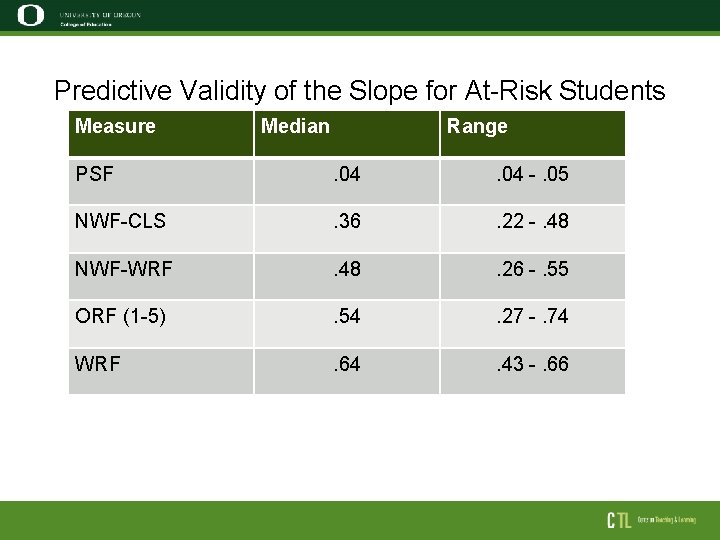
Predictive Validity of the Slope for At-Risk Students Measure Median Range PSF . 04 -. 05 NWF-CLS . 36 . 22 -. 48 NWF-WRF . 48 . 26 -. 55 ORF (1 -5) . 54 . 27 -. 74 WRF . 64 . 43 -. 66
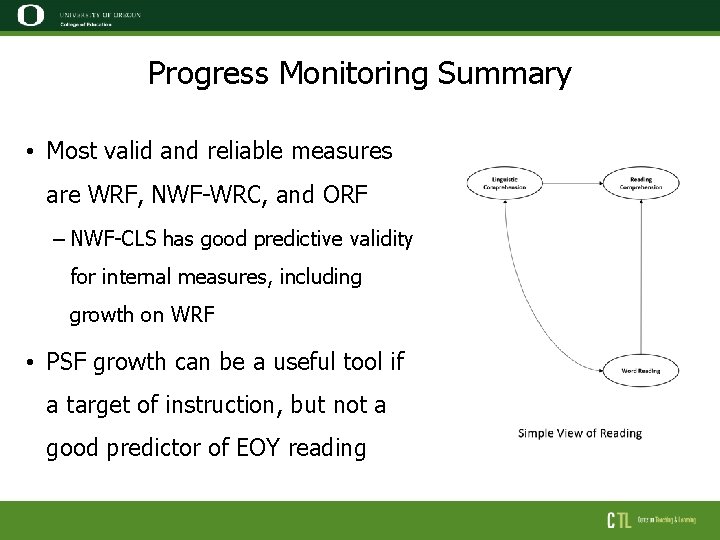
Progress Monitoring Summary • Most valid and reliable measures are WRF, NWF-WRC, and ORF – NWF-CLS has good predictive validity for internal measures, including growth on WRF • PSF growth can be a useful tool if a target of instruction, but not a good predictor of EOY reading
DIBEL 8 Applications for Dyslexia Screening and Progress Monitoring: Key Takeaways • The importance of CBM dyslexia validation studies • Key DIBELS 8 measures may function adequately as dyslexia screeners – PSF (Phonological awareness) – LNF (Rapid Automatized Naming) – NWF (Alphabetic principle) – WRF (Word reading) • Key DIBELS 8 measures may function adequately for progress monitoring, with several exceptions
- Slides: 45