
Diane Pozefsky EXTREME PROGRAMMING 1960s Cowboys wrote software
Diane Pozefsky EXTREME PROGRAMMING

1960’s �“Cowboys” wrote software anyway that they could �Difference between best programmers and worst as high as 28: 1 (many sources) �Start of the “software crisis” � 1968 �Edsger Dijkstra, “GOTO Statement Considered Harmful” (CACM) �Recognition that rules can improve the average programmer
Structuring Software Development Few rules helped immensely � Good rules and practices developed over the 70’s and 80’s � If a few rules are good, more are better… � Late 80’s, major focus on process as a key to quality � �ISO 9000 (first published 1987) �Malcolm Baldrige National Quality Award (just celebrated 25 th anniversary)
ISO 9000 � ISO: International body � 150 national standards organization (US: ANSI) � Originally technical standards � Has broadened its scope: e. g. , quality � ISO 9000: family of standards � Generic management system standard � Not the process but the management of the process ○ Compendium of best practices � Continues to be updated � ISO 9001 key standard
ISO 9001 Requirements � Business � customer requirement based ○ communication and validation � internal audits ○ evaluation and improvements � problem management and effectiveness monitoring ○ non-conformances and bad product � Quality Policy � formal statement from management � understood and followed at all levels by all employees � used to establish employee measurable objectives � Quality System � regularly audited and evaluated for conformance and effectiveness � decisions based on recorded data � records that trace raw materials and products to the source
Why not apply to software development? � Companies started codifying their practices � Large documents and people to manage them �Rise of the project manager � “Honored in the breach” � More large projects and more late or failed projects
1995 Standish Group Study � 50% software projects challenged � 2 x budget � 2 x completion time � 2/3 planned function � 30% impaired �Scrapped � 20% success
Jerry Saltzer Presentation � Who is Jerry Saltzer? �Early time sharing (CTSS) �Multics Operating System (“inspired” Unix) �Project Athena ○ Thin client computing ○ Kerberos ○ LDAP ○ Instant messaging
Software Engineering Processes � Differ by how often you do the steps �Points on the spectrum �Differences in overhead � Three fundamental models �Waterfall �Spiral �Iterative � Widely used models �Integrated Product Development �Unified Software Development Process �Extreme Programming
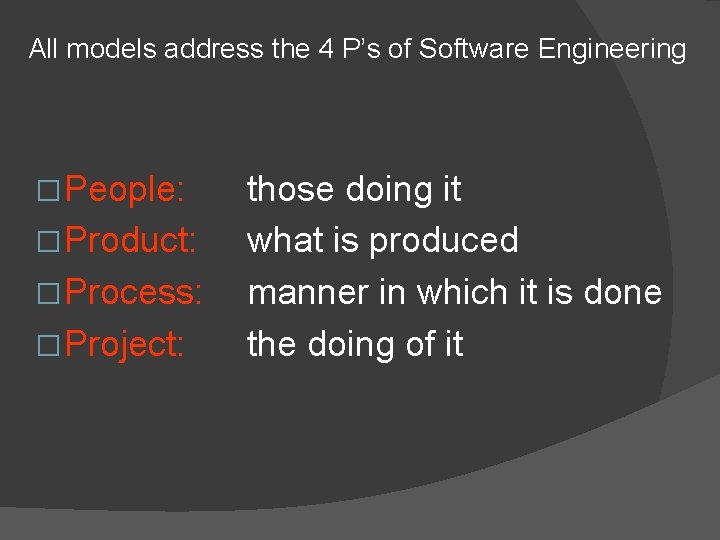
All models address the 4 P’s of Software Engineering � People: � Product: � Process: � Project: those doing it what is produced manner in which it is done the doing of it

Integrated Product Development (IBM) � Originated at GE � Cross-functional teams at all phases � Phased approval (easy to start, easy to kill) �Concept �Plan �Ship �Sunset
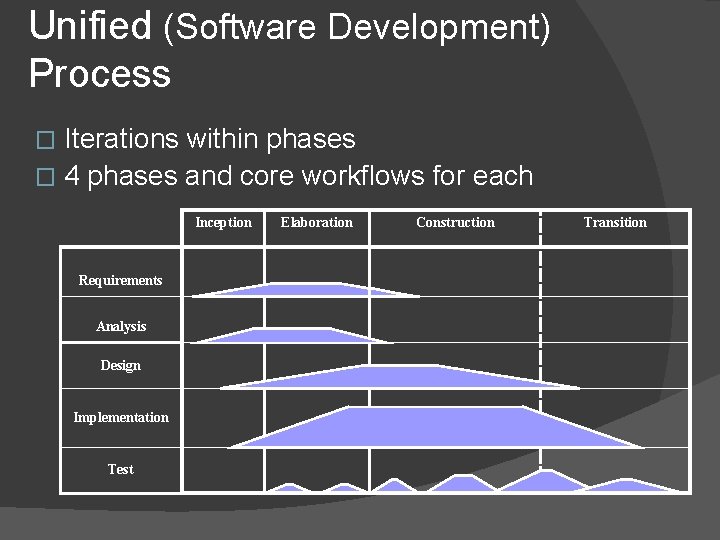
Unified (Software Development) Process Iterations within phases � 4 phases and core workflows for each � Inception Requirements Analysis Design Implementation Test Elaboration Construction Transition
Agile Methodologies
Agile Methodologies � Keep only those rules and processes that help �Antidote to bureaucracy �License to hack � Key characteristics �Adaptive �People-oriented
Agile Manifesto � February 2001 � Representatives from Extreme Programming SCRUM DSDM Adaptive Software Development Crystal Feature-Driven Development Pragmatic Programming
Extreme Programming

Extreme Programming � � � Complete development process First code drop 2 -3 weeks after start (what is the start? ) Customer part of the development team Iterative development to the max Derive requirements with customer through hands-on experimentation Agile methodology
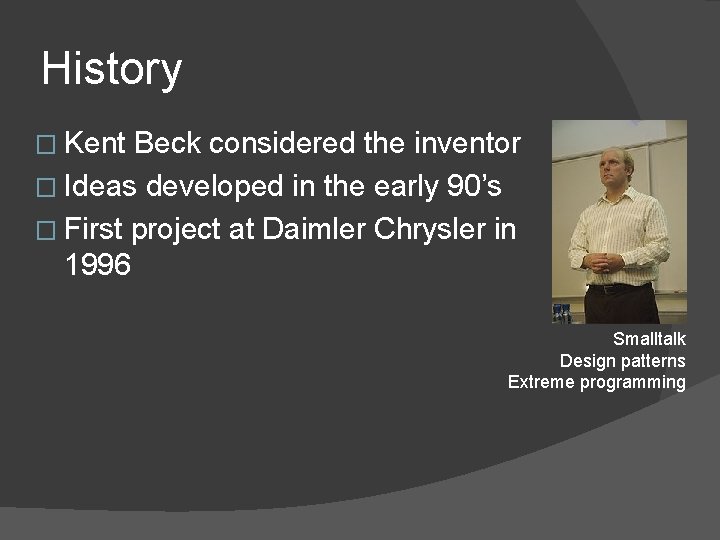
History � Kent Beck considered the inventor � Ideas developed in the early 90’s � First project at Daimler Chrysler in 1996 Smalltalk Design patterns Extreme programming
XP Bills of Rights � Developer has a right to � Clear requirements and priorities � Determine how long a requirement will take to implement � Revise estimates � Always produce quality code � Customer has a right to � An overall plan � See progress in a running system � Change requirements and priorities � Be informed of changes to schedule and have input as to how to adapt � Cancel in the middle and still have something to show for the investment
XP Bills of Rights � Developer has a right to � Clear requirements and priorities � Determine how long a requirement will take to implement � Revise estimates � Always produce quality code � Customer has a right to � An overall plan � See progress in a running system � Change requirements and priorities � Be informed of changes to schedule and have input as to how to adapt � Cancel in the middle and still have something to show for the investment
XP Value System � Communication �Focus on people, not documentation � Simplicity �Of process and code � Feedback �Mechanism to make useful progress � Courage �To trust in people (Bollinger: what you would like to know about software that your life depended on)
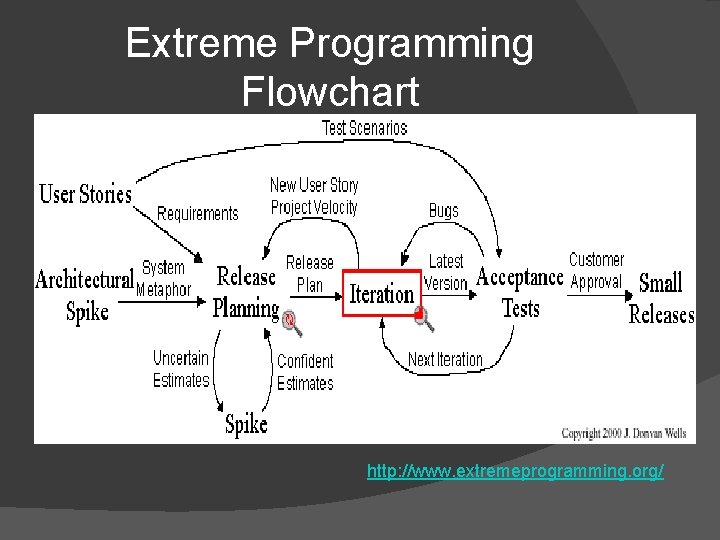
Extreme Programming Flowchart http: //www. extremeprogramming. org/
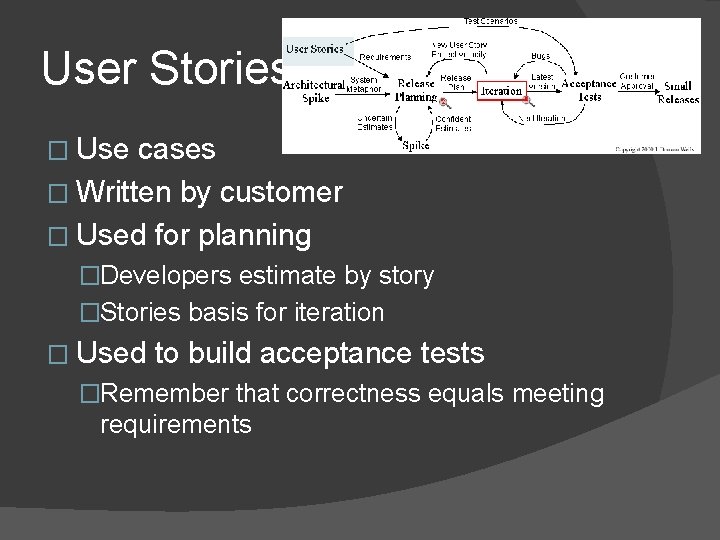
User Stories � Use cases � Written by customer � Used for planning �Developers estimate by story �Stories basis for iteration � Used to build acceptance tests �Remember that correctness equals meeting requirements
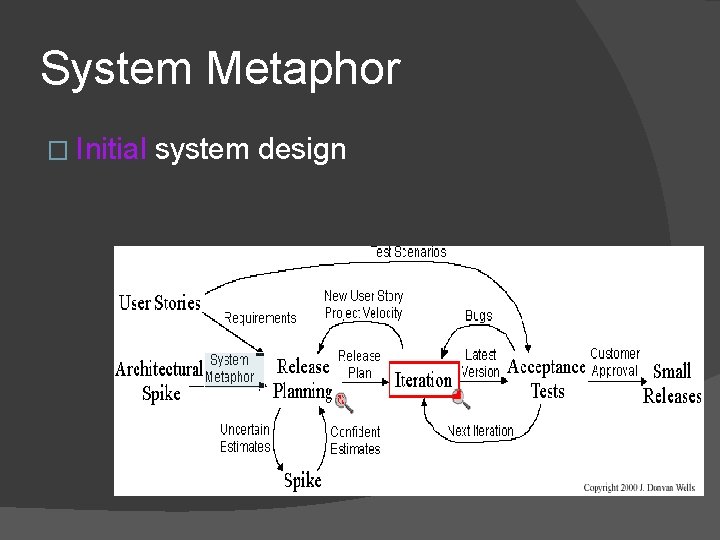
System Metaphor � Initial system design
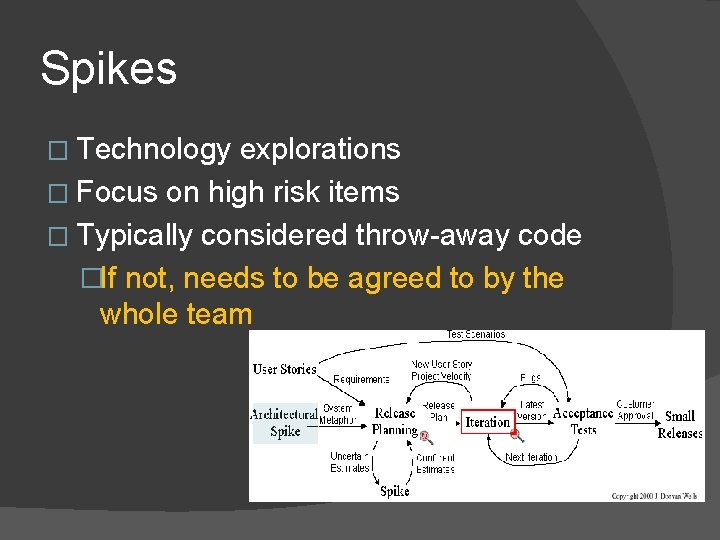
Spikes � Technology explorations � Focus on high risk items � Typically considered throw-away code �If not, needs to be agreed to by the whole team
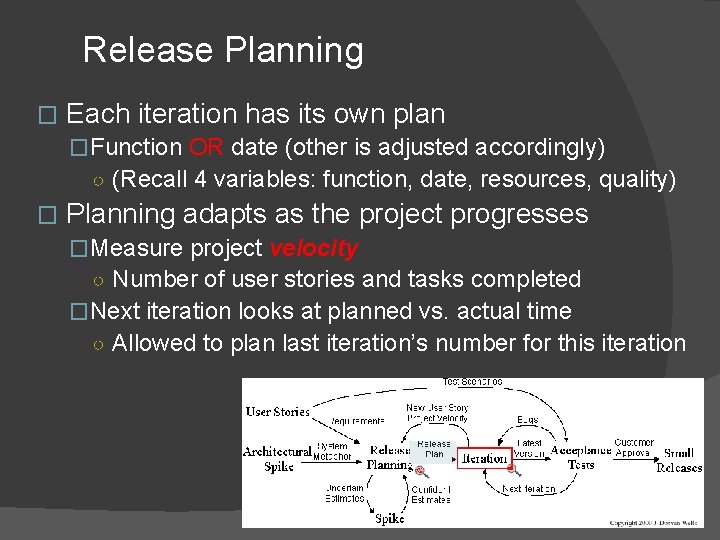
Release Planning � Each iteration has its own plan �Function OR date (other is adjusted accordingly) ○ (Recall 4 variables: function, date, resources, quality) � Planning adapts as the project progresses �Measure project velocity ○ Number of user stories and tasks completed �Next iteration looks at planned vs. actual time ○ Allowed to plan last iteration’s number for this iteration
- Slides: 26