
DIALYSIS TREATMENT FOR KIDNEY DISEASE By Zachary Jacobson
DIALYSIS TREATMENT FOR KIDNEY DISEASE By Zachary Jacobson
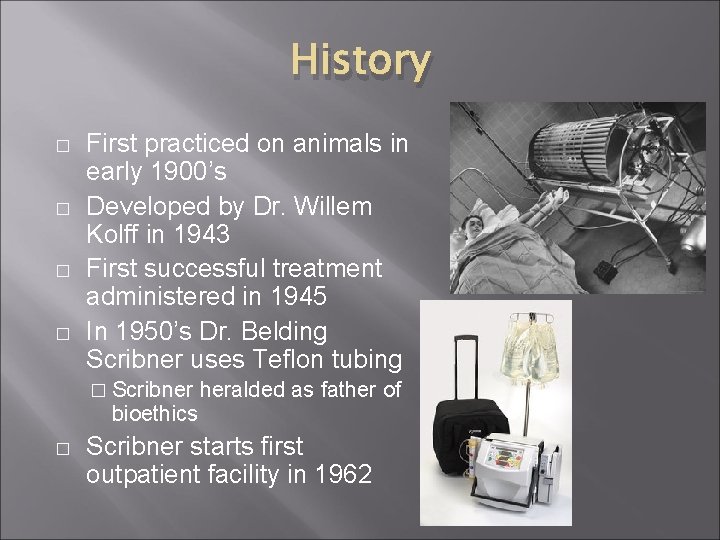
History � � First practiced on animals in early 1900’s Developed by Dr. Willem Kolff in 1943 First successful treatment administered in 1945 In 1950’s Dr. Belding Scribner uses Teflon tubing � Scribner bioethics � heralded as father of Scribner starts first outpatient facility in 1962
Introduction � Function of Kidneys � Nephrons, glomeruli and waste tubules � Hormone secretion support homeostasis � Causes of Chronic Kidney Disease/Failure � Hypertension � Diabetes � Diagnosing Kidney. Disease/Failure � Elevated � mellitus (3 types) proteins and/or blood in urine Function of Dialysis � Filter waste and excess fluid from blood
Methods � Dialysis requires surgery to develop access site � 3 � types: fistula, graft, catheter Filter Membrane � Semi-permeable quality allows only smaller materials(i. e. waste) to diffuse across � Larger waste products and excess fluid require ultrafiltration � Dialysate � Composed of sterile water, electrolytes/chemicals and dextrose Dextrose concentration determines osmotic pressure in PD exchange

How it Works (PD) � Peritoneal Dialysis � Creation of access site Permenant Peritoneal Catheter � Dialysate drawn into abdominal cavity � Peritoneum acts as filter Waste stored in dialysate Dextrose level determines ultrafiltration rate � 2 types: CAPD, CCPD � Dialysate drained from cavity

How it works (HD) � Hemodialysis � Blood filtered outside of body Dialyser �Filters through synthetic membrane �Thousands of thin hollow fibers �Countercurrent ultrafiltration �Different types of filters Dialysis Machine �Monitors time, temp, pressure � Blood returned to body through access
Advantages/Disadventages � PD vs. HD � HD uses more predictable membrane � PD is easier to use and more convenient � PD less likely to cause Hypotension � PD may cause trouble breathing � Dialysis patients require special diet and medication to replace hormonal function.
Limitations � � � � PD and HD do not replicate all kidney functions Access sites can move or become infected Limited movement Body image Time per treatment Blood clotting Expensive without health coverage
Future � � � Shorter Dialysis Time Increased Efficiency in Filtration Increased Portability Recycling of Dialysate Simultaneous monitoring and introduction of synthetic hormones
WORKS CITED 1. Salvatore, David. "Evolution and Physical Principles of Convection-based Dialysis Treatment. " Giornale Italiano Di Nefrologia 29. 55 (2012): 3 -11. Print. 2. Wakasugi, M. , Kawamura, K. , Yamamoto, S. , Kazama, J. J. and Narita, I. (2012), High Mortality Rate of Infectious Diseases in Dialysis Patients: A Comparison With the General Population in Japan. Therapeutic Apheresis and Dialysis, 16: 226– 231. doi: 10. 1111/j. 1744 -9987. 2012. 01062. x 3. Saran, R. , J. L. Bragg-Gresham, N. W. Levin, Z. J. Twardowski, V. Wizemann, A. Saito, N. Kimata, B. W. Gillespie, C. Combe, J. Bommer, T. Akiba, D. L. Mapes, E. W. Young, and F. K. Port. "Longer Treatment Time and Slower Ultrafiltration in Hemodialysis: Associations with Reduced Mortality in the DOPPS. " Kidney International 69. 7 (2006): 1222 -228. Print. 4. "Home Dialysis Central. " Home Dialysis Central. Medical Education Institute, Inc, Oct. 2012. Web. 22 Oct. 2012. <http: //homedialysis. org/>. 5. Vienken, Jörg, Michael Diamantoglou, Werner Henne, and Bernd Nederlof. "Artificial Dialysis Membranes: From Concept to Large Scale Production. " American Journal of Nephrology 19. 2 (1999): 355 -62. Print. 6. Misra, Madhukar. "The Basics of Hemodialysis Equipment. " Hemodialysis International 9. 1 (2005): 30 -36. Print. 7. "Dialysis. " Wikipedia. Wikimedia Foundation, 22 Oct. 2012. Web. 22 Oct. 2012. <http: //en. wikipedia. org/wiki/Dialysis>.
- Slides: 10