
Dialysis Competency Staff Training Objectives Upon completion of
Dialysis Competency Staff Training
Objectives Upon completion of the program, attendees should be able to: • Verbalize the importance of compliance with F 698 Dialysis • Provide and review facility policies and procedures for dialysis including emergency procedures specific for dialysis resident care • Verbalize understanding of the documentation requirements for dialysis • Verbalize understanding of importance of communication and collaboration between nursing facility and dialysis center This document is for general informational purposes only. It does not represent legal advice nor relied upon as supporting documentation or advice with CMS or other regulatory entities. © Pathway Health Services, Inc. – All Rights Reserved – Copy with Permission Only
F 698 DIALYSIS • § 483. 25(l) Dialysis. • The facility must ensure that residents who require dialysis receive such services, consistent with professional standards of practice, the comprehensive person -centered care plan, and the residents’ goals and preferences. https: //www. cms. gov/Regulations-and. Guidance/Manuals/downloads/som 107 ap_pp_guidelines_ltcf. pdf This document is for general informational purposes only. It does not represent legal advice nor relied upon as supporting documentation or advice with CMS or other regulatory entities. © Pathway Health Services, Inc. – All Rights Reserved – Copy with Permission Only
F 698 DIALYSIS Intent of § 483. 25(l) : • The intent of this requirement is that the facility assures that each resident receives care and services for the provision of hemodialysis and/or peritoneal dialysis consistent with professional standards of practice including the: • https: //www. cms. gov/Regulations-and. Guidance/Manuals/downloads/som 107 ap_pp_guidelines_ltcf. pdf This document is for general informational purposes only. It does not represent legal advice nor relied upon as supporting documentation or advice with CMS or other regulatory entities. © Pathway Health Services, Inc. – All Rights Reserved – Copy with Permission Only
F 698 DIALYSIS https: //www. cms. gov/Regulations-and. Guidance/Manuals/downloads/so m 107 ap_pp_guidelines_ltcf. pdf Intent of § 483. 25(l) : • Ongoing assessment of the resident’s condition and monitoring for complications before and after dialysis treatments received at a certified dialysis facility; • Safe administration of hemodialysis at the bedside and/or peritoneal dialysis in the nursing home provided by qualified trained staff/caregivers, in accordance with State and Federal laws and regulations; • Ongoing assessment and oversight of the resident before, during and after dialysis treatments, including monitoring the resident’s condition during treatments, monitoring for complications, implementing appropriate interventions, and using appropriate infection control practices; and • Ongoing communication and collaboration with the dialysis facility regarding dialysis care and services. This document is for general informational purposes only. It does not represent legal advice nor relied upon as supporting documentation or advice with CMS or other regulatory entities. © Pathway Health Services, Inc. – All Rights Reserved – Copy with Permission Only
F 698 DIALYSIS Responsibility for the provision of Dialysis Care Services: • If the nursing home has made the decision to provided dialysis care and services according to the previous options, there must be, in accordance with the current standards of practice, coordination and collaboration between the nursing home and dialysis facility https: //www. cms. gov/Regulations-and. Guidance/Manuals/downloads/som 107 ap_pp_guidelines _ltcf. pdf This document is for general informational purposes only. It does not represent legal advice nor relied upon as supporting documentation or advice with CMS or other regulatory entities. © Pathway Health Services, Inc. – All Rights Reserved – Copy with Permission Only
F 698 DIALYSIS Responsibility for the provision of Dialysis Care Services: (Cont. ) • The nursing home remains responsible for the overall quality of care the resident receives and must provide the same services to a resident who is receiving dialysis as it furnishes to its residents who are not. • This includes the ongoing provision of assessment, care planning and provision of care. • There must be a coordinated plan for dialysis treatments developed with input from both the nursing home and dialysis facility. • The resident should not experience any lack of nursing home services or care because of his or her dialysis status. • https: //www. cms. gov/Regulations-and-Guidance/Manuals/downloads/som 107 ap_pp_guidelines_ltcf. pdf This document is for general informational purposes only. It does not represent legal advice nor relied upon as supporting documentation or advice with CMS or other regulatory entities. © Pathway Health Services, Inc. – All Rights Reserved – Copy with Permission Only
F 698 DIALYSIS Shared Communication between the Nursing Home and the Dialysis facility: • It is essential that a communication process be established between the nursing home and the dialysis facility to be used 24 -hours a day. The care of the resident receiving dialysis services must reflect ongoing communication, coordination and collaboration between the nursing home and the dialysis staff. • https: //www. cms. gov/Regulations-and-Guidance/Manuals/downloads/som 107 ap_pp_guidelines_ltcf. pdf This document is for general informational purposes only. It does not represent legal advice nor relied upon as supporting documentation or advice with CMS or other regulatory entities. © Pathway Health Services, Inc. – All Rights Reserved – Copy with Permission Only
F 698 DIALYSIS Coordination of Physician Services between the Nursing Home and Dialysis facility: For a resident receiving dialysis, the nursing home staff must • Immediately contact and communicate with the attending physician/practitioner, resident/resident representative, and designated dialysis staff (i. e. , nephrologist, registered nurse) regarding any significant changes in the resident’s status related to clinical complications or emergent situations that may impact the dialysis portion of the care plan. • (Refer to F 580 – Notification of Changes in condition) These situations may include but are not limited to changes in cognition or sudden unexpected decline in condition, dialysis complications such as bleeding, hypotension, or adverse consequences to a medication or therapy, or other situations. • Any changes in the resident’s care initiated by the dialysis facility must be communicated to the resident’s nursing home attending physician/practitioner. • https: //www. cms. gov/Regulations-and-Guidance/Manuals/downloads/som 107 ap_pp_guidelines_ltcf. pdf This document is for general informational purposes only. It does not represent legal advice nor relied upon as supporting documentation or advice with CMS or other regulatory entities. © Pathway Health Services, Inc. – All Rights Reserved – Copy with Permission Only
F 698 DIALYSIS Hospital Transfer: • The dialysis facility must ensure access to a hospital for emergency services that has the capacity to provide emergency dialysis care • In case of the need to transfer to an acute care facility to manage dialysis complications or other care concerns, the nursing home must have ongoing communication with the dialysis facility and have knowledge of the location and how to access the hospital that has the capacity to provide emergency dialysis care, as identified by the dialysis facility. https: //www. cms. gov/Regulations-and. Guidance/Manuals/downloads/som 107 ap_pp_guidelines_ltcf. pdf This document is for general informational purposes only. It does not represent legal advice nor relied upon as supporting documentation or advice with CMS or other regulatory entities. © Pathway Health Services, Inc. – All Rights Reserved – Copy with Permission Only
F 698 DIALYSIS Resident Care Policies and Staffing Specific to Dialysis Care and Services: • • • Some State licensure rules don’t allow for the provision of HHD in a nursing home and/or a State’s nurse practice act or scope of practice may preclude certain health care workers from performing HHD treatments. Some State licensing rules may have specific regulations related to the provision of HHD/PD in a nursing home, such as specifying patient to staff ratio requirements. The nursing home must identify who is allowed to provide HHD/PD treatments to a resident, such as a licensed nurse or nurse aide. The dialysis facility is responsible for providing training and assuring the competency of staff or individuals that are allowed to initiate, access and discontinue dialysis treatments. The nursing home must maintain documentation of completion of training/competency for staff or other individuals providing the dialysis treatments. https: //www. cms. gov/Regulations-and-Guidance/Manuals/downloads/som 107 ap_pp_guidelines_ltcf. pdf This document is for general informational purposes only. It does not represent legal advice nor relied upon as supporting documentation or advice with CMS or other regulatory entities. © Pathway Health Services, Inc. – All Rights Reserved – Copy with Permission Only
F 698 DIALYSIS Resident Care Policies and Staffing Specific to Dialysis Care and Services: (Cont. ) • If PD treatments are provided, the treatments may only be administered by an individual trained by the qualified dialysis trainer from the certified dialysis facility. An LPN/LVN may administer the PD treatment if not in conflict with the States Nurse Practice Act/Scope of practice • A nursing home, that provides dialysis treatments, in collaboration with the nursing home medical director and the dialysis facility, must develop dialysis specific policies/procedures, based upon current standards of practice. This includes the care of a resident receiving dialysis services whether in the facility or at an offsite location https: //www. cms. gov/Regulations-and. Guidance/Manuals/downloads/som 107 ap_pp_guidelines_ltcf. pdf This document is for general informational purposes only. It does not represent legal advice nor relied upon as supporting documentation or advice with CMS or other regulatory entities. © Pathway Health Services, Inc. – All Rights Reserved – Copy with Permission Only
F 698 DIALYSIS Affiliation: • All people receiving dialysis are affiliated with a dialysis center • Know dialysis facility name and number • Have this information readily available in an area with easy access e. g. , medical record, care plan • Include resident and resident representative in affiliation preferences This document is for general informational purposes only. It does not represent legal advice nor relied upon as supporting documentation or advice with CMS or other regulatory entities. © Pathway Health Services, Inc. – All Rights Reserved – Copy with Permission Only

Dialysis Assessment Documentation of assessment information must be found in the residents medical record: • admission assessment, • hospital records, • history and physical, • dialysis records • MDS This document is for general informational purposes only. It does not represent legal advice nor relied upon as supporting documentation or advice with CMS or other regulatory entities. © Pathway Health Services, Inc. – All Rights Reserved – Copy with Permission Only

Dialysis Assessments/Observations Side Effects Post-Hemodialysis may include, but are not limited to: • • • Bleeding Leg cramps Seizures Nausea/vomiting Unsteady gait Headache • Fatigue • Signs and symptoms of infection • Hypotension • Chest pain • Electrolyte imbalance • Fluid imbalance This document is for general informational purposes only. It does not represent legal advice nor relied upon as supporting documentation or advice with CMS or other regulatory entities. © Pathway Health Services, Inc. – All Rights Reserved – Copy with Permission Only
F 698: Care of the Access Site • Auscultation/palpation of the AV fistula (pulse, bruit and thrill) to assure adequate blood flow; • Significant changes in the extremity when compared to the opposite extremity (edema, pain, redness); • Steal Syndrome (pain, numbness, discoloration, or cold to touch in the fingers or hand indicating inadequate arterial flow); https: //www. cms. gov/Regulations-and. Guidance/Manuals/downloads/som 107 ap_pp_guidelines_ltcf. pdf This document is for general informational purposes only. It does not represent legal advice nor relied upon as supporting documentation or advice with CMS or other regulatory entities. © Pathway Health Services, Inc. – All Rights Reserved – Copy with Permission Only
F 698: Care of the Access Site Continued: • Skin integrity (waxy skin, ulcerations, drainage from incisions); • Bruising/hematoma; • Collateral vein distension (veins in access arm close to AV fistula becoming larger); • Complaints of pain or numbness; or • Evidence of infection at the surgical site, such as drainage, redness, tenderness at incision site, fever. https: //www. cms. gov/Regulations-and. Guidance/Manuals/downloads/som 107 ap_pp_guidelines_ltcf. pdf This document is for general informational purposes only. It does not represent legal advice nor relied upon as supporting documentation or advice with CMS or other regulatory entities. © Pathway Health Services, Inc. – All Rights Reserved – Copy with Permission Only
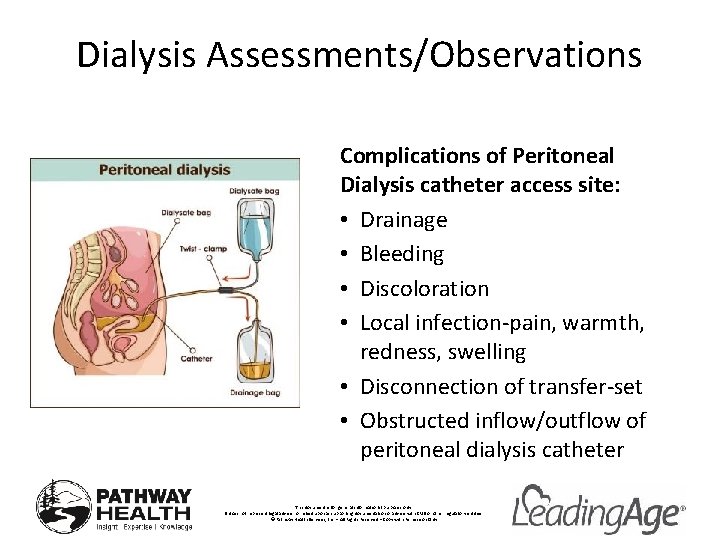
Dialysis Assessments/Observations Complications of Peritoneal Dialysis catheter access site: • Drainage • Bleeding • Discoloration • Local infection-pain, warmth, redness, swelling • Disconnection of transfer-set • Obstructed inflow/outflow of peritoneal dialysis catheter This document is for general informational purposes only. It does not represent legal advice nor relied upon as supporting documentation or advice with CMS or other regulatory entities. © Pathway Health Services, Inc. – All Rights Reserved – Copy with Permission Only
Dialysis Assessments/Observations Post-dwell/exchange complications may include, but are not limited to: • • Bleeding Leg cramps Seizures Nausea/vomiting Unsteady gait Headache Pulmonary edema • Fatigue • Signs and symptoms of infection • Hypotension • Chest pain/arrhythmias • Electrolyte imbalance • Fluid imbalance • Pleural effusion This document is for general informational purposes only. It does not represent legal advice nor relied upon as supporting documentation or advice with CMS or other regulatory entities. © Pathway Health Services, Inc. – All Rights Reserved – Copy with Permission Only
Emergency Procedures Bleeding/Hemorrhage: 1. Gloves, gauze and goggles should be at the bedside in case of emergency 2. Observe for bleeding at the fistula/graft site 3. Apply pressure to the exact site of bleeding for 15 min-but if you put too much pressure on a WIDE area of the fistula you may damage it. 4. If unable to stop hemorrhage, call 911 5. Notify Physician and resident representative for change in condition This document is for general informational purposes only. It does not represent legal advice nor relied upon as supporting documentation or advice with CMS or other regulatory entities. © Pathway Health Services, Inc. – All Rights Reserved – Copy with Permission Only

Dialysis Nursing Care should include: – Auscultation/palpation of the AV fistula (pulse, bruit and thrill) to assure adequate blood flow; – Significant changes in the extremity when compared to the opposite extremity (edema, pain, redness); – Steal Syndrome (pain, numbness, discoloration, or cold to touch in the fingers or hand indicating inadequate arterial flow); – Skin integrity (waxy skin, ulcerations, drainage from incisions); • Bruising/hematoma; • Collateral vein distension (veins in access arm close to AV fistula becoming larger); – Complaints of pain or numbness; or – Evidence of infection at the surgical site, such as drainage, redness, tenderness at incision site, fever. – BP and IV’s should not be performed on the arm with a fistula or graft This document is for general informational purposes only. It does not represent legal advice nor relied upon as supporting documentation or advice with CMS or other regulatory entities. © Pathway Health Services, Inc. – All Rights Reserved – Copy with Permission Only
F 698 DIALYSIS Transportation: • Assist/schedule transportation for dialysis • Know transport service or person name, number and scheduled pick-up time • Have this information readily available in an area with easy access e. g. , medical record, care plan • Include resident and resident representative in transportation preferences and schedule • If the facility provides transportation, the driver will be trained on emergency procedures for fistula bleeding during transport This document is for general informational purposes only. It does not represent legal advice nor relied upon as supporting documentation or advice with CMS or other regulatory entities. © Pathway Health Services, Inc. – All Rights Reserved – Copy with Permission Only

Communication with Dialysis Facility Provide the following information to dialysis treatment facility by sending a completed dialysis communication form with the resident: • Access location site • Bruit • Thrill • Bleeding at graft/fistula site after last dialysis treatment (describe) • Post-dialysis complication • Signs of infection • Blood pressure, pulse and respiration • Time of last meal • Diet • Medications given prior to dialysis treatment • New medications since last dialysis treatment This document is for general informational purposes only. It does not represent legal advice nor relied upon as supporting documentation or advice with CMS or other regulatory entities. © Pathway Health Services, Inc. – All Rights Reserved – Copy with Permission Only

Communication with Dialysis Center Insert facility Dialysis Communication Form here This document is for general informational purposes only. It does not represent legal advice nor relied upon as supporting documentation or advice with CMS or other regulatory entities. © Pathway Health Services, Inc. – All Rights Reserved – Copy with Permission Only
Communication FROM the Dialysis Center Following Dialysis, the Dialysis facility should provide communication to the facility on: • Lab work/results if available • Pre-dialysis blood pressure, pulse, respiration and weight • Post-dialysis blood pressure, pulse, respiration and weight • Access site difficulties • Signs of infection • Change in resident condition after dialysis treatment • Medication given at dialysis facility • New medications started at dialysis facility This document is for general informational purposes only. It does not represent legal advice nor relied upon as supporting documentation or advice with CMS or other regulatory entities. © Pathway Health Services, Inc. – All Rights Reserved – Copy with Permission Only
Care Planning • It is important that the facility follow the care process (accurate assessment, care planning, consistent implementation and monitoring of the care plan) with evaluation of the effectiveness of the interventions, and revision, as appropriate. • The facility staff and dialysis center staff will work collaboratively and develop the care plan. This document is for general informational purposes only. It does not represent legal advice nor relied upon as supporting documentation or advice with CMS or other regulatory entities. © Pathway Health Services, Inc. – All Rights Reserved – Copy with Permission Only
INTERVENTIONS should be: Care Planning • Individualized based upon the assessment process and resident preference This document is for general informational purposes only. It does not represent legal advice nor relied upon as supporting documentation or advice with CMS or other regulatory entities. © Pathway Health Services, Inc. – All Rights Reserved – Copy with Permission Only
Infection Control Ensure staff follow ALL Infection Control Policies and Procedures: • Hand Hygiene • Standard Precautions • Transmission-Based Precautions if indicated • Use of PPE • Blood Borne Pathogens This document is for general informational purposes only. It does not represent legal advice nor relied upon as supporting documentation or advice with CMS or other regulatory entities. © Pathway Health Services, Inc. – All Rights Reserved – Copy with Permission Only

In Summary This document is for general informational purposes only. It does not represent legal advice nor relied upon as supporting documentation or advice with CMS or other regulatory entities. © Pathway Health Services, Inc. – All Rights Reserved – Copy with Permission Only

This document is for general informational purposes only. It does not represent legal advice nor relied upon as supporting documentation or advice with CMS or other regulatory entities. © Pathway Health Services, Inc. – All Rights Reserved – Copy with Permission Only
References and Resources • Centers for Medicare & Medicaid Services State Operations Manual, Appendix PP – Guidance to Surveyors for Long Term Care Facilities (Rev. 173, 11 -22 -17): https: //www. cms. gov/Regulationsand. Guidance/Manuals/downloads/som 107 ap_pp_guidelines _ltcf. pdf • LTC Survey Pathways (Download) https: //www. cms. gov/medicare/provider-enrollment-andcertification/guidanceforlawsandregulations/nursing-homes. html • Centers for Medicare & Medicaid Services Long-Term Care Facility Resident Assessment Instrument 3. 0 User’s Manual, Version 1. 16. October 2018: https: //www. cms. gov/Medicare/Quality-Initiatives. Patient-Assessment. Instruments/Nursing. Home. Quality. Inits/MDS 30 RAIManual. html This document is for general informational purposes only. It does not represent legal advice nor relied upon as supporting documentation or advice with CMS or other regulatory entities. © Pathway Health Services, Inc. – All Rights Reserved – Copy with Permission Only
References and Resources • Centers for disease Control and Prevention. Dialysis Safety: https: //www. cdc. gov/dialysis/patient/index. html • National Kidney Foundation: https: //www. kidney. org/professionals/guidelines/gu idelines_commentaries • Nursing Skills Reference Manuals • Manufacturer’s Recommendations on equipment, adaptive equipment, supplies, etc. This document is for general informational purposes only. It does not represent legal advice nor relied upon as supporting documentation or advice with CMS or other regulatory entities. © Pathway Health Services, Inc. – All Rights Reserved – Copy with Permission Only
Disclaimer “This presentation provided is copyrighted information of Pathway Health. Please note the presentation date on the title page in relation to the need to verify any new updates and resources that were listed in this presentation. This presentation is intended to be informational. The information does not constitute either legal or professional consultation. This presentation is not to be sold or reused without written authorization. ” This document is for general informational purposes only. It does not represent legal advice nor relied upon as supporting documentation or advice with CMS or other regulatory entities. © Pathway Health Services, Inc. – All Rights Reserved – Copy with Permission Only
- Slides: 33