
Dialectical Behavior Therapy Presentation Materials The Behavioral Technology

Dialectical Behavior Therapy Presentation Materials The Behavioral Technology Transfer Group 4556 University Way NE l Seattle, WA 98105 Phone 206/675 -8588 l Fax 206/675 -8590 Web: www. behavioraltech. com information@behavioraltech. com 1
Theory of Borderline Personality Disorder in DBT 2

BPD is a Pervasive Disorder of the Emotion Regulation System BPD criterion behaviors function to regulate emotions or are a natural consequence of emotion dysregulation 3

Biosocial Theory of BPD Biological Dysfunction in the Emotion Regulation System Invalidating Environment Pervasive Emotion Dysregulation 4
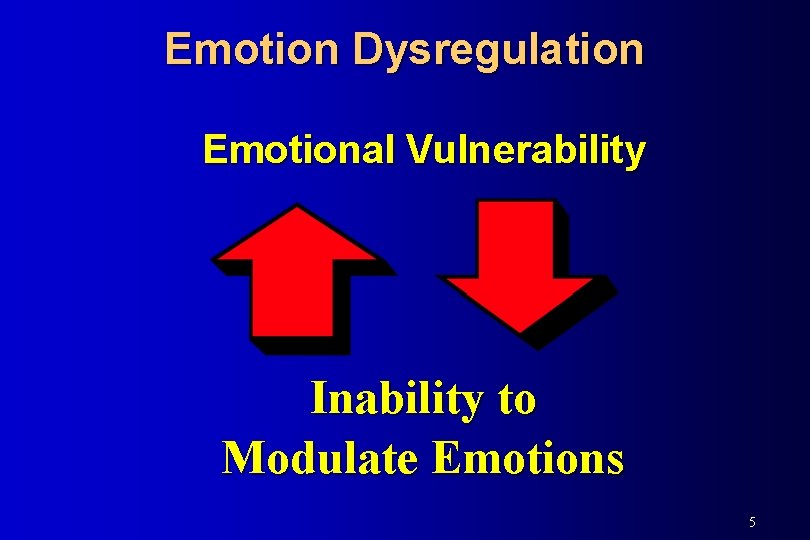
Emotion Dysregulation Emotional Vulnerability Inability to Modulate Emotions 5

Invalidating Environment Pervasively negates or dismisses behavior independent of the actual validity of the behavior 6
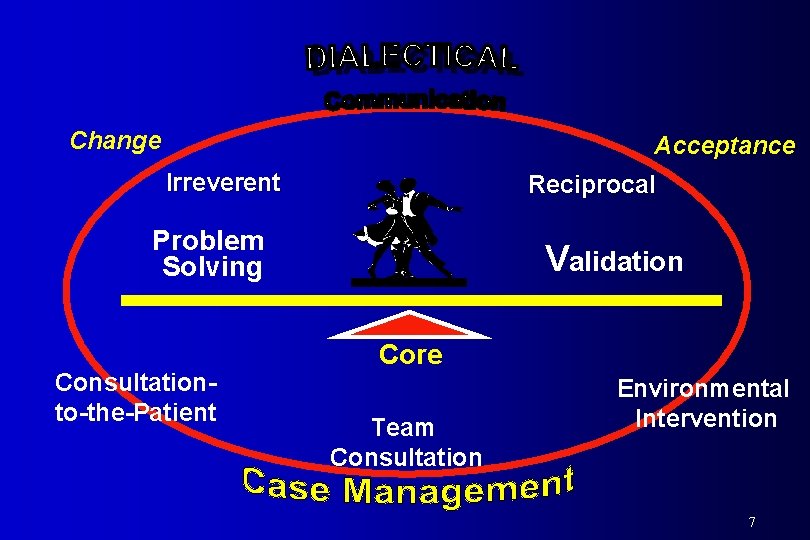
Change Acceptance Irreverent Reciprocal Problem Solving Consultationto-the-Patient Validation Core Team Consultation Environmental Intervention 7
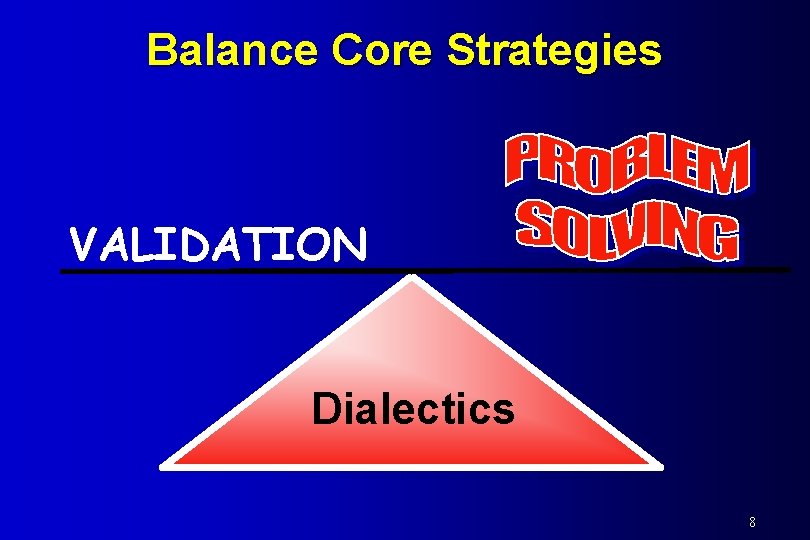
Balance Core Strategies VALIDATION Dialectics 8
Dialectics as Persuasion A method of logic or argumentation by disclosing the contradictions (antithesis) in an opponent’s argument (thesis) and overcoming them (synthesis). 9
Dialectics within therapy l Dialectics can be used within therapy to help clients start to think less in black and white and more in “gray” (e. g. , a person can be be “good” but still make a mistake) 10
Translating a Dialectical World View into Treatment Provides foundation of biosocial etiology 1. Transactional development and maintenance 2. Systemic disorder Dialectically informs treatment strategies 1. Balance of Acceptance vs. Change 2. Search for "what is left out" 3. Emphasis on speed, movement, flow Dialectically informs treatment goals 1. 2. 3. 4. Emotion regulation Interpersonal effectiveness Mindfulness Distress tolerance 11
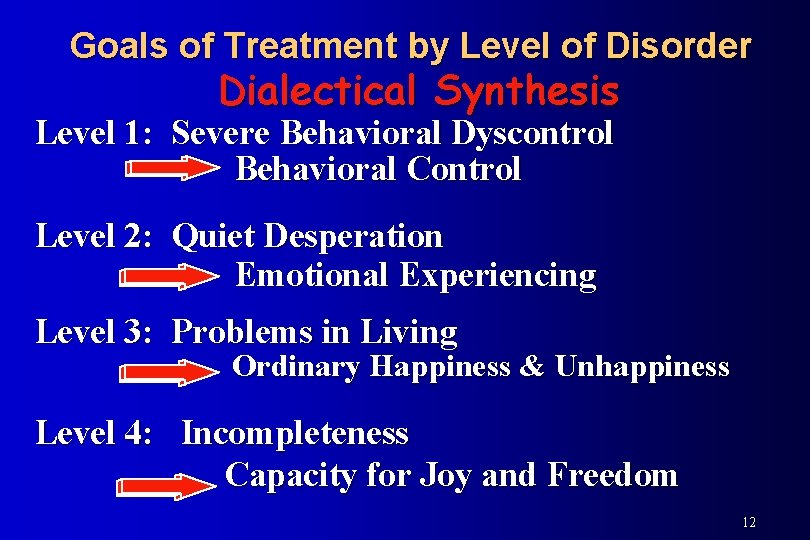
Goals of Treatment by Level of Disorder Dialectical Synthesis Level 1: Severe Behavioral Dyscontrol Behavioral Control Level 2: Quiet Desperation Emotional Experiencing Level 3: Problems in Living Ordinary Happiness & Unhappiness Level 4: Incompleteness Capacity for Joy and Freedom 12
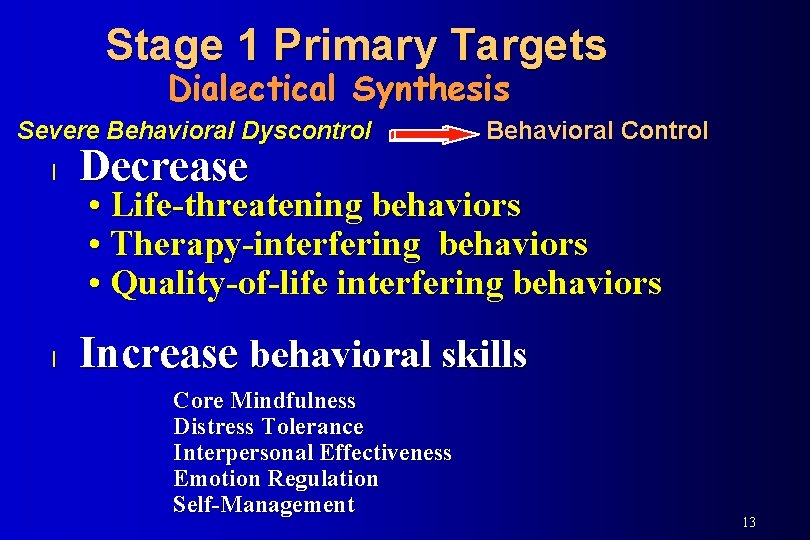
Stage 1 Primary Targets Dialectical Synthesis Severe Behavioral Dyscontrol Behavioral Control l Decrease l Increase behavioral skills • Life-threatening behaviors • Therapy-interfering behaviors • Quality-of-life interfering behaviors Core Mindfulness Distress Tolerance Interpersonal Effectiveness Emotion Regulation Self-Management 13
Structure the Milieu and Modes of Treatment Standard DBT is Outpatient Treatment 14
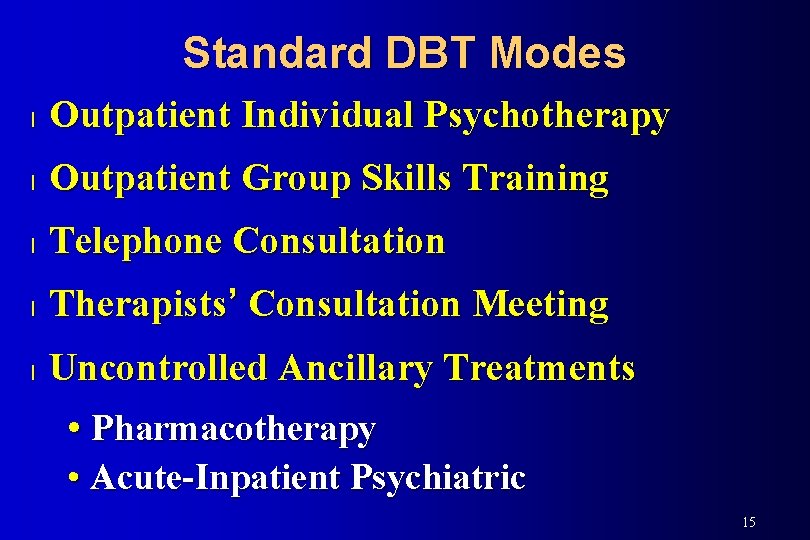
Standard DBT Modes l Outpatient Individual Psychotherapy l Outpatient Group Skills Training l Telephone Consultation l Therapists’ Consultation Meeting l Uncontrolled Ancillary Treatments • Pharmacotherapy • Acute-Inpatient Psychiatric 15
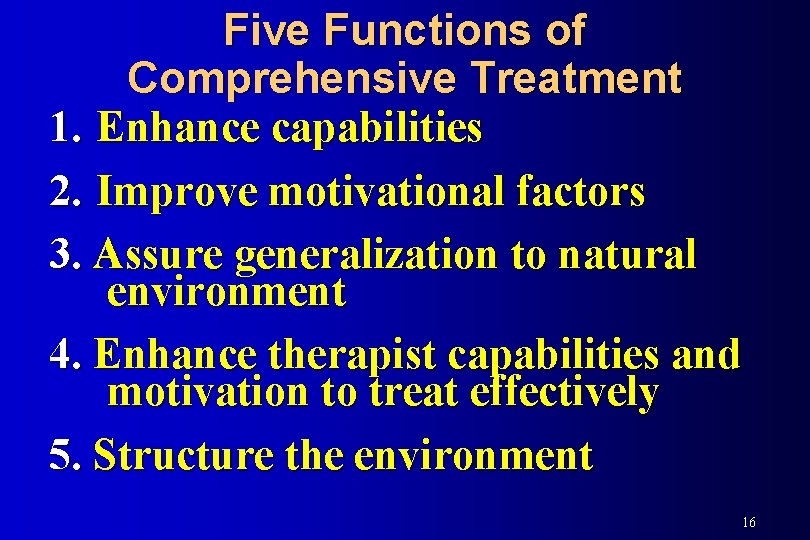
Five Functions of Comprehensive Treatment 1. Enhance capabilities 2. Improve motivational factors 3. Assure generalization to natural environment 4. Enhance therapist capabilities and motivation to treat effectively 5. Structure the environment 16
The Overarching DBT Goal is. . . 17
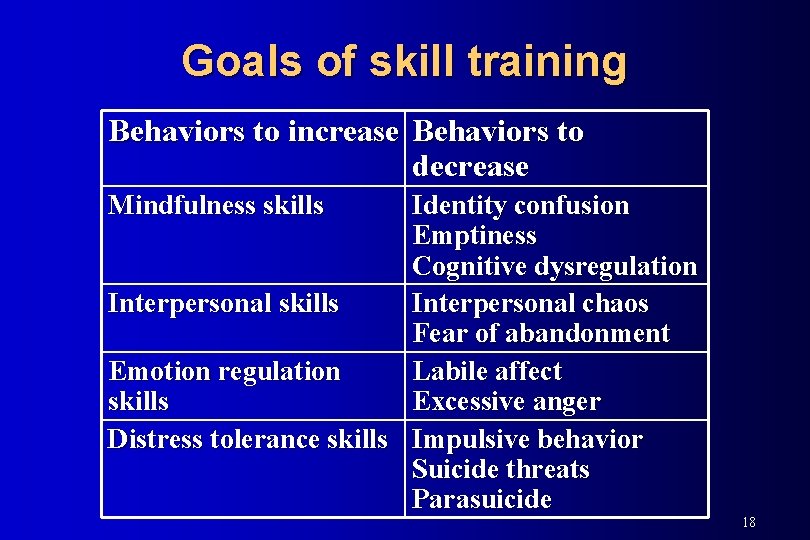
Goals of skill training Behaviors to increase Behaviors to decrease Mindfulness skills Identity confusion Emptiness Cognitive dysregulation Interpersonal skills Interpersonal chaos Fear of abandonment Emotion regulation Labile affect skills Excessive anger Distress tolerance skills Impulsive behavior Suicide threats Parasuicide 18
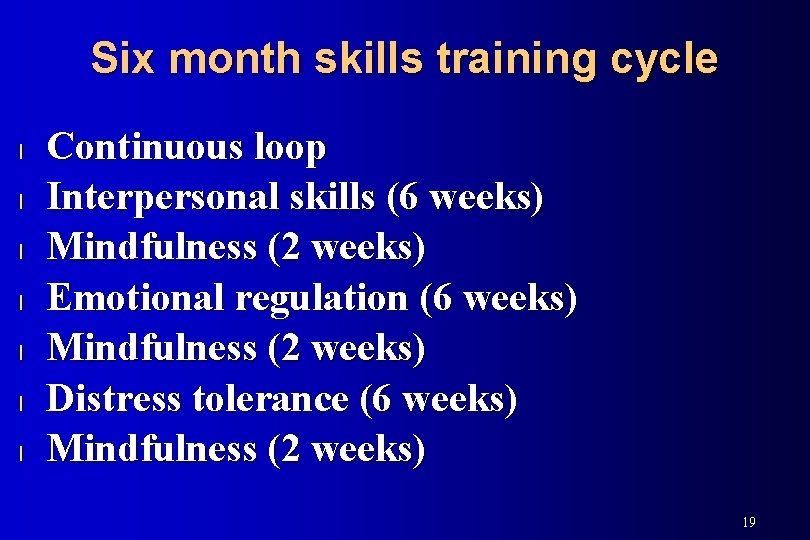
Six month skills training cycle l l l l Continuous loop Interpersonal skills (6 weeks) Mindfulness (2 weeks) Emotional regulation (6 weeks) Mindfulness (2 weeks) Distress tolerance (6 weeks) Mindfulness (2 weeks) 19
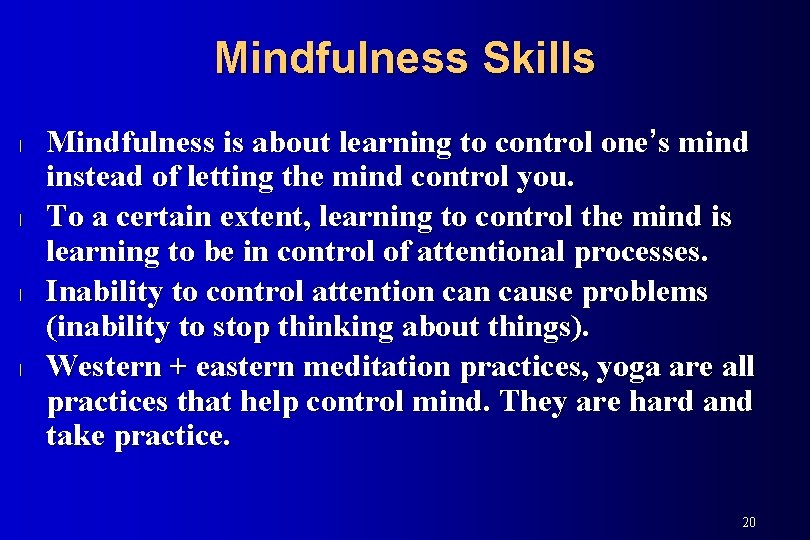
Mindfulness Skills l l Mindfulness is about learning to control one’s mind instead of letting the mind control you. To a certain extent, learning to control the mind is learning to be in control of attentional processes. Inability to control attention cause problems (inability to stop thinking about things). Western + eastern meditation practices, yoga are all practices that help control mind. They are hard and take practice. 20
Mindfulness Skills: Three types of mind l l l Rational Mind: rational, thinking, logical mind. Emotional Mind: In emotional mind when your emotions are in control of thinking or behavior. Emotional mind is important. Wise mind: integration of rational mind and emotional mind. Wise mind is that part of each person that can know and experience truth. It is the integration of many types of knowing, knowing by observing, analyzing, knowing by what we experience in our bodies. 21
Mindfulness: being a personal scientist: what skills l l Observe: pay attention to current moment. • Step back and watch what’s happening inside of you and outside of you. • Control attention but not content. Describe: Put words to experience. Just describe facts without your own theories. • Feel the feelings -- Drop the story-line l Participate- Enter completely into the moment. 22
- Slides: 22