
Dialectical Behavior Therapy for Adolescents and Young Adults
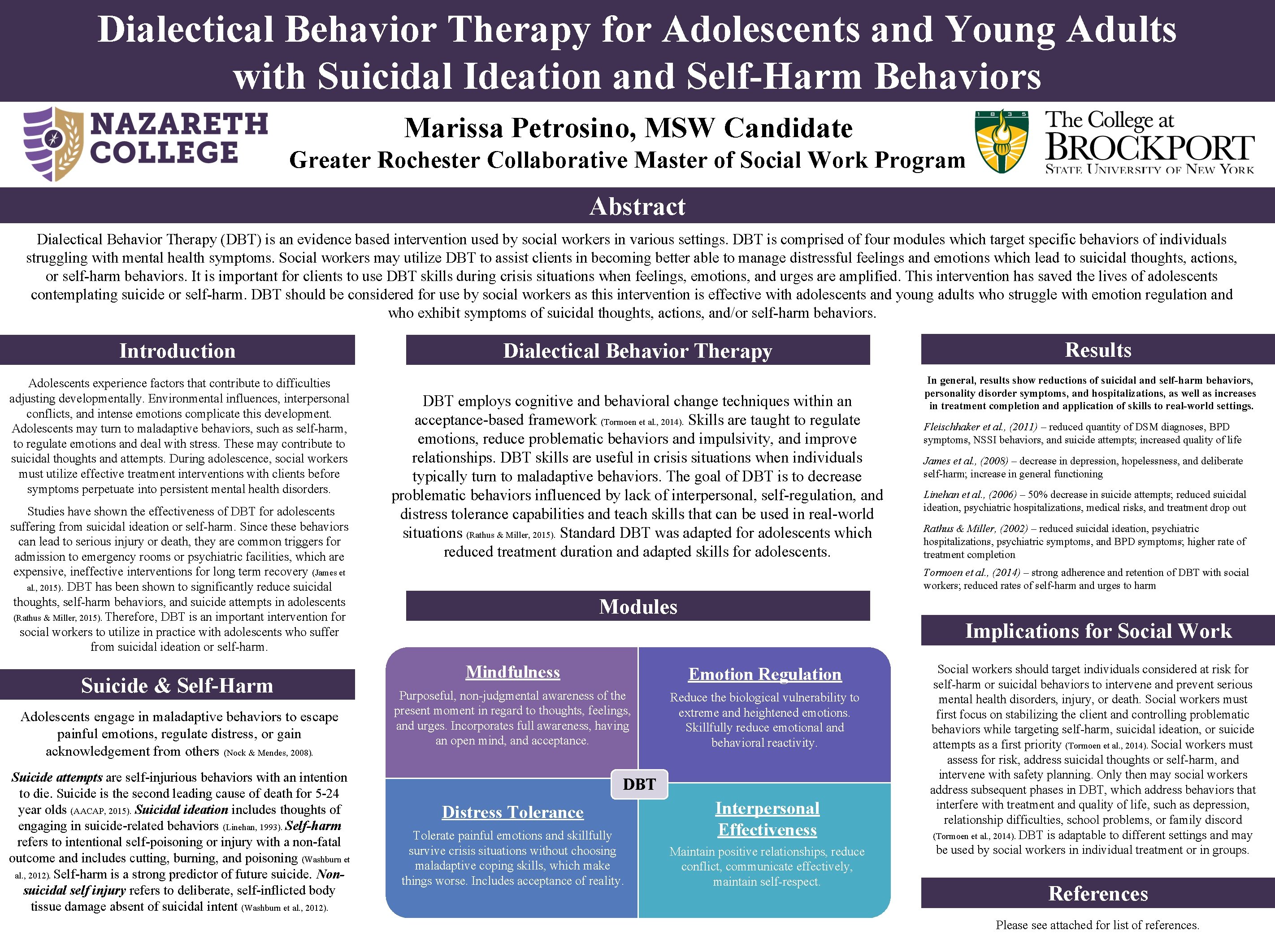
Dialectical Behavior Therapy for Adolescents and Young Adults with Suicidal Ideation and Self-Harm Behaviors Marissa Petrosino, MSW Candidate Greater Rochester Collaborative Master of Social Work Program Abstract Dialectical Behavior Therapy (DBT) is an evidence based intervention used by social workers in various settings. DBT is comprised of four modules which target specific behaviors of individuals struggling with mental health symptoms. Social workers may utilize DBT to assist clients in becoming better able to manage distressful feelings and emotions which lead to suicidal thoughts, actions, or self-harm behaviors. It is important for clients to use DBT skills during crisis situations when feelings, emotions, and urges are amplified. This intervention has saved the lives of adolescents contemplating suicide or self-harm. DBT should be considered for use by social workers as this intervention is effective with adolescents and young adults who struggle with emotion regulation and who exhibit symptoms of suicidal thoughts, actions, and/or self-harm behaviors. Introduction Adolescents experience factors that contribute to difficulties adjusting developmentally. Environmental influences, interpersonal conflicts, and intense emotions complicate this development. Adolescents may turn to maladaptive behaviors, such as self-harm, to regulate emotions and deal with stress. These may contribute to suicidal thoughts and attempts. During adolescence, social workers must utilize effective treatment interventions with clients before symptoms perpetuate into persistent mental health disorders. Studies have shown the effectiveness of DBT for adolescents suffering from suicidal ideation or self-harm. Since these behaviors can lead to serious injury or death, they are common triggers for admission to emergency rooms or psychiatric facilities, which are expensive, ineffective interventions for long term recovery (James et al. , 2015). DBT has been shown to significantly reduce suicidal thoughts, self-harm behaviors, and suicide attempts in adolescents (Rathus & Miller, 2015). Therefore, DBT is an important intervention for social workers to utilize in practice with adolescents who suffer from suicidal ideation or self-harm. Suicide & Self-Harm Adolescents engage in maladaptive behaviors to escape painful emotions, regulate distress, or gain acknowledgement from others (Nock & Mendes, 2008). Suicide attempts are self-injurious behaviors with an intention to die. Suicide is the second leading cause of death for 5 -24 year olds (AACAP, 2015). Suicidal ideation includes thoughts of engaging in suicide-related behaviors (Linehan, 1993). Self-harm refers to intentional self-poisoning or injury with a non-fatal outcome and includes cutting, burning, and poisoning (Washburn et al. , 2012). Self-harm is a strong predictor of future suicide. Nonsuicidal self injury refers to deliberate, self-inflicted body tissue damage absent of suicidal intent (Washburn et al. , 2012). Dialectical Behavior Therapy DBT employs cognitive and behavioral change techniques within an acceptance-based framework (Tormoen et al. , 2014). Skills are taught to regulate emotions, reduce problematic behaviors and impulsivity, and improve relationships. DBT skills are useful in crisis situations when individuals typically turn to maladaptive behaviors. The goal of DBT is to decrease problematic behaviors influenced by lack of interpersonal, self-regulation, and distress tolerance capabilities and teach skills that can be used in real-world situations (Rathus & Miller, 2015). Standard DBT was adapted for adolescents which reduced treatment duration and adapted skills for adolescents. Results In general, results show reductions of suicidal and self-harm behaviors, personality disorder symptoms, and hospitalizations, as well as increases in treatment completion and application of skills to real-world settings. Fleischhaker et al. , (2011) – reduced quantity of DSM diagnoses, BPD symptoms, NSSI behaviors, and suicide attempts; increased quality of life James et al. , (2008) – decrease in depression, hopelessness, and deliberate self-harm; increase in general functioning Linehan et al. , (2006) – 50% decrease in suicide attempts; reduced suicidal ideation, psychiatric hospitalizations, medical risks, and treatment drop out Rathus & Miller, (2002) – reduced suicidal ideation, psychiatric hospitalizations, psychiatric symptoms, and BPD symptoms; higher rate of treatment completion Tormoen et al. , (2014) – strong adherence and retention of DBT with social workers; reduced rates of self-harm and urges to harm Modules Implications for Social Work Mindfulness Emotion Regulation Purposeful, non-judgmental awareness of the present moment in regard to thoughts, feelings, and urges. Incorporates full awareness, having an open mind, and acceptance. Reduce the biological vulnerability to extreme and heightened emotions. Skillfully reduce emotional and behavioral reactivity. DBT Distress Tolerance Tolerate painful emotions and skillfully survive crisis situations without choosing maladaptive coping skills, which make things worse. Includes acceptance of reality. Interpersonal Effectiveness Maintain positive relationships, reduce conflict, communicate effectively, maintain self-respect. Social workers should target individuals considered at risk for self-harm or suicidal behaviors to intervene and prevent serious mental health disorders, injury, or death. Social workers must first focus on stabilizing the client and controlling problematic behaviors while targeting self-harm, suicidal ideation, or suicide attempts as a first priority (Tormoen et al. , 2014). Social workers must assess for risk, address suicidal thoughts or self-harm, and intervene with safety planning. Only then may social workers address subsequent phases in DBT, which address behaviors that interfere with treatment and quality of life, such as depression, relationship difficulties, school problems, or family discord (Tormoen et al. , 2014). DBT is adaptable to different settings and may be used by social workers in individual treatment or in groups. References Please see attached for list of references.
- Slides: 1