
Diagramming circuits Ohms Law Mnemonic Definitions Current the
- Slides: 7
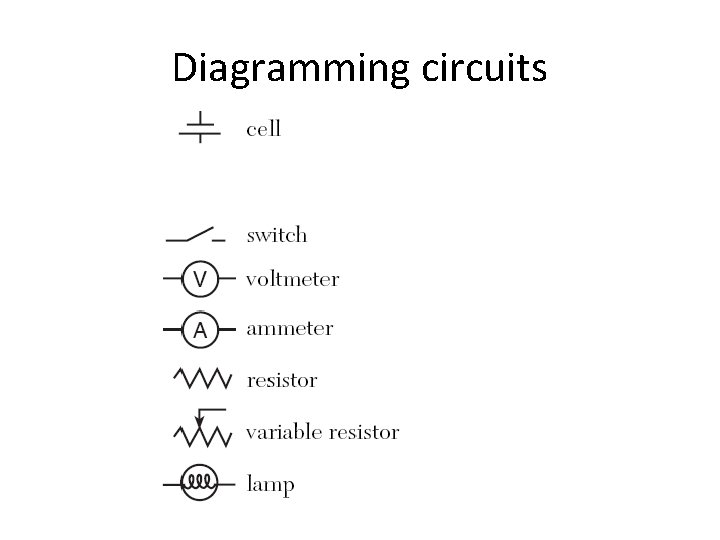
Diagramming circuits
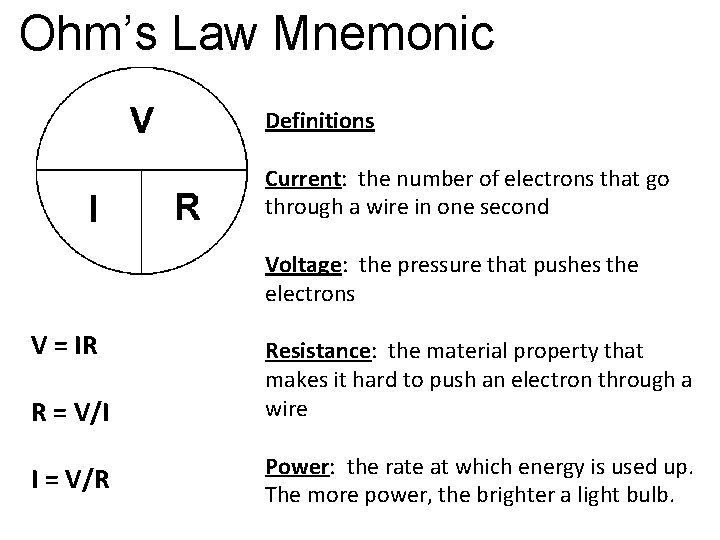
Ohm’s Law Mnemonic Definitions Current: the number of electrons that go through a wire in one second Voltage: the pressure that pushes the electrons V = IR R = V/I I = V/R Resistance: the material property that makes it hard to push an electron through a wire Power: the rate at which energy is used up. The more power, the brighter a light bulb.
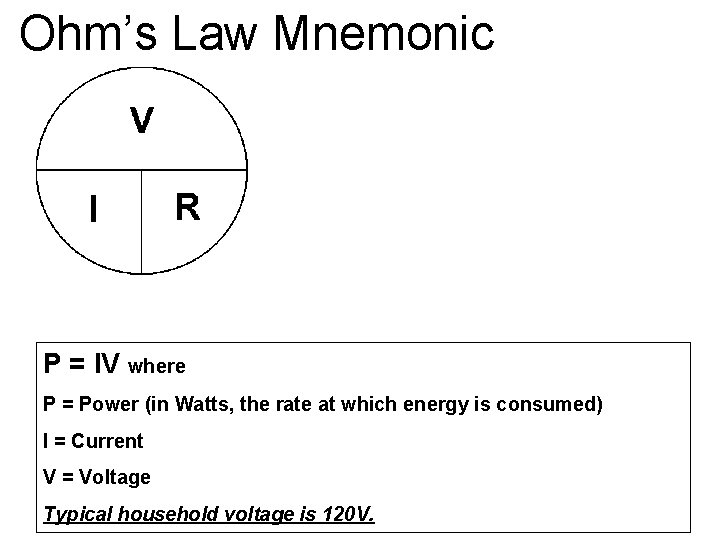
Ohm’s Law Mnemonic P = IV where P = Power (in Watts, the rate at which energy is consumed) I = Current V = Voltage Typical household voltage is 120 V.
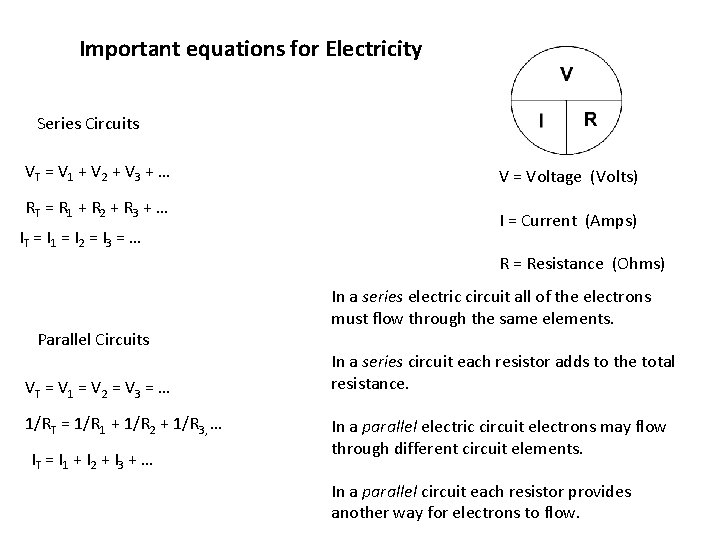
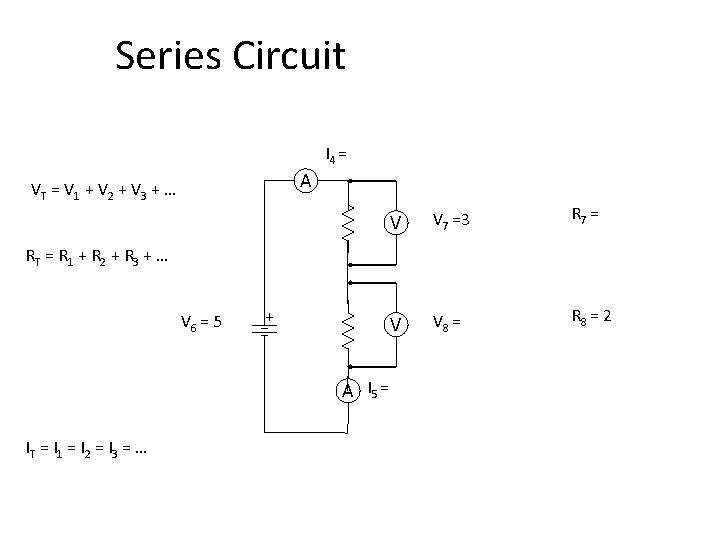
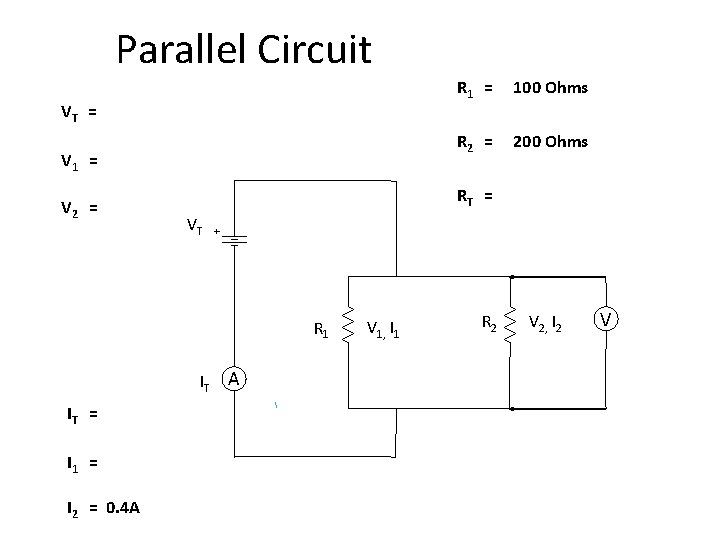
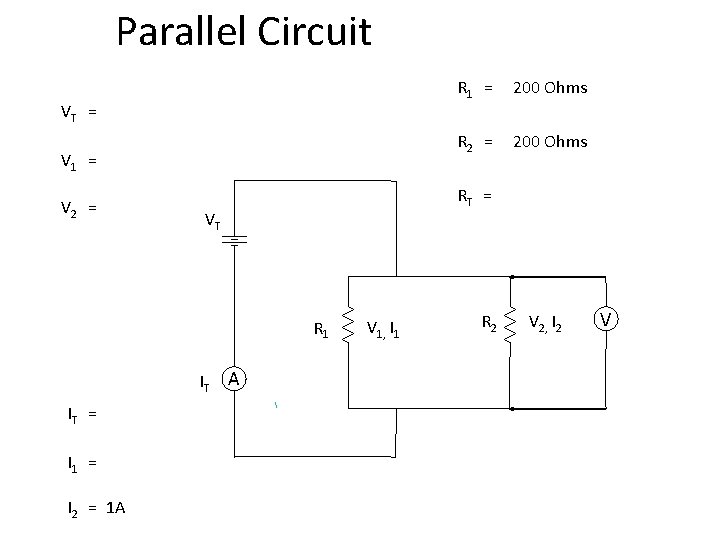
Important equations for Electricity Series Circuits VT = V 1 + V 2 + V 3 + … RT = R 1 + R 2 + R 3 + … IT = I 1 = I 2 = I 3 = … V = Voltage (Volts) I = Current (Amps) R = Resistance (Ohms) Parallel Circuits VT = V 1 = V 2 = V 3 = … 1/RT = 1/R 1 + 1/R 2 + 1/R 3, … IT = I 1 + I 2 + I 3 + … In a series electric circuit all of the electrons must flow through the same elements. In a series circuit each resistor adds to the total resistance. In a parallel electric circuit electrons may flow through different circuit elements. In a parallel circuit each resistor provides another way for electrons to flow.
Series Circuit I 4 = A VT = V 1 + V 2 + V 3 + … V V 7 =3 R 7 = V V 8 = R 8 = 2 RT = R 1 + R 2 + R 3 + … V 6 = 5 + A I 5 = IT = I 1 = I 2 = I 3 = …
Parallel Circuit VT = V 1 = V 2 = VT IT I 1 = I 2 = 0. 4 A 100 Ohms R 2 = 200 Ohms RT = + R 1 IT = R 1 = A V 1, I 1 R 2 V 2, I 2 V
Parallel Circuit VT = V 1 = V 2 = R 1 IT = I 1 = I 2 = 1 A 200 Ohms R 2 = 200 Ohms RT = VT IT R 1 = A V 1, I 1 R 2 V 2, I 2 V