
DIAGNOSIS Purpose of Diagnosis To develop understanding plus


- Slides: 43
DIAGNOSIS
Purpose of Diagnosis To develop understanding plus a set of critical issues – Usually problems or threats, sometimes opportunities – Small number - to provide focus – Issues that should be central and vital to top management – Both short- and long-range considerations – Framed as issues, rather than solutions
Diagnosis Overview Current mission, strategic objectives, & strategies Performance Scan & analyze external environment – Task (Competitive) environment – Societal (General) environment
Scan & analyze internal environment – Need to break up into manageable pieces – Two main ways: Value chain analysis Functional area analysis Critical success factors S. W. O. T. table Set of “Critical Issues”
Scan & Analyze External Environment
Have to be selective and smart in scanning Competitive Environment – Porter’s 5 -force model of the industry competitive environment General Environment – Technological – Political-legal – Economic – Social-cultural Stakeholders (within above and others)
"Awareness of the environment is not a special project to be undertaken only when warning of change becomes deafening. “ (Kenneth R. Andrews)
"It is not the strongest of the species that survive, nor the most intelligent, but the ones most responsive to change. “ (Charles Darwin)
The key point is that an organization needs to be in tune with its often turbulent external environment Since there is so much happening in the external universe, we have to be selective and smart in scanning: • "Things are always different -- the art is figuring out which differences matter. " (Laszlo Birinyi) • For a given industry (sometimes is country, industry, company-specific), certain aspects of the external environment tend to be more important and should receive primary attention • It helps to scan initially fairly quickly, then zoom in on areas where something of importance seems to be happening
Key Strategic Questions What are the industry's dominant features, especially economic ones? What is competition like and how strong are each of the competitive forces? What is causing the industry's competitive structure and business environment to change? Who are the major competitors and what are their relative competitive strengths? What strategic moves are rivals likely to make next? What are the key factors for competitive success? Is the industry attractive and what are the prospects for above-average profitability?
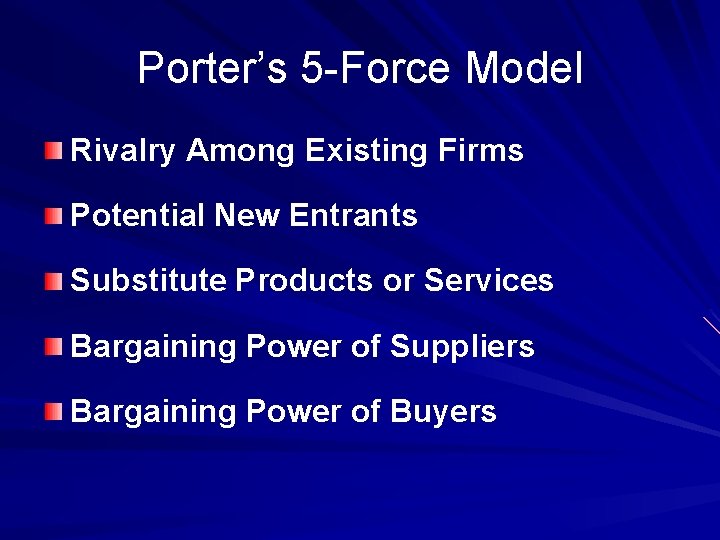
Porter’s 5 -Force Model Rivalry Among Existing Firms Potential New Entrants Substitute Products or Services Bargaining Power of Suppliers Bargaining Power of Buyers
General Environment Although usually only a few factors and trends are important, it is important to identify them Is useful to think of four main aspects of the general environment – Technological – Political-Legal – Economic – Social-Cultural
Stakeholder Analysis What is a stakeholder? We need to be selective, consider MAJOR stakeholders: – Power – Interest
Identify topic (usually a change) for analysis Identify major stakeholders Determine their degree of support or opposition to the action or change Assess the balance of support If not sufficient, work on changing – Decrease larger opposing forces – Increase supporting forces Ideas re how to do this?
Where We Are Diagnosis overview Scan & analyze external environment Scan & analyze internal ◄ – – Mission, objectives, strategies, performance Functional areas: Financial Marketing Production/operations Technology Organizational
Mission, Objectives, Strategies Identify and evaluate – Consistent – Current – Appropriate – Implemented well – Effective (performance vs. objectives)
Internal Diagnosis In either value chain or functional area analysis: – Subdivide organization into several segments – For each, identify what is being done, how well it is being done, strengths and weaknesses – Examine linkages and potential synergies among various value chains & their segments, and/or among functional areas – Look for opportunities to improve and create sustainable competitive advantages
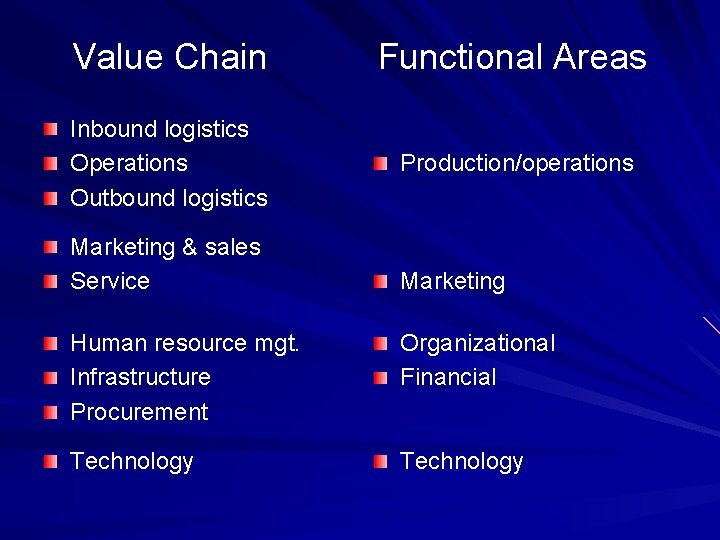
Value chain and functional area analysis differ primarily in the way of subdividing the organization (to aid analysis)
Value Chain Functional Areas Inbound logistics Operations Outbound logistics Production/operations Marketing & sales Service Marketing Human resource mgt. Infrastructure Procurement Organizational Financial Technology
Financial
Financial Diagnosis Do not need exotic skills for our purposes Do need to do more than generate numbers and comment on trends. . . need to EVALUATE & DRAW CONCLUSIONS
Analyze Historical Have initial data (balance sheets & income statements for several years) Need to develop conclusions about financial health of organization – Are there significant strengths or weaknesses? – Implications for strategy formulation & implementation? How can we get from data to conclusions?
Calculate some financial ratios Analyze trends Compare with other companies or industry Develop and state conclusions – Overall financial condition – Specifics, especially problems
Also Look at Future Primarily to estimate needs and potential sources of strategic funds Can get perspective even from a simple forecast model Could use Index of Sustainable Growth What are major sources of additional financing?
Marketing Functional Area
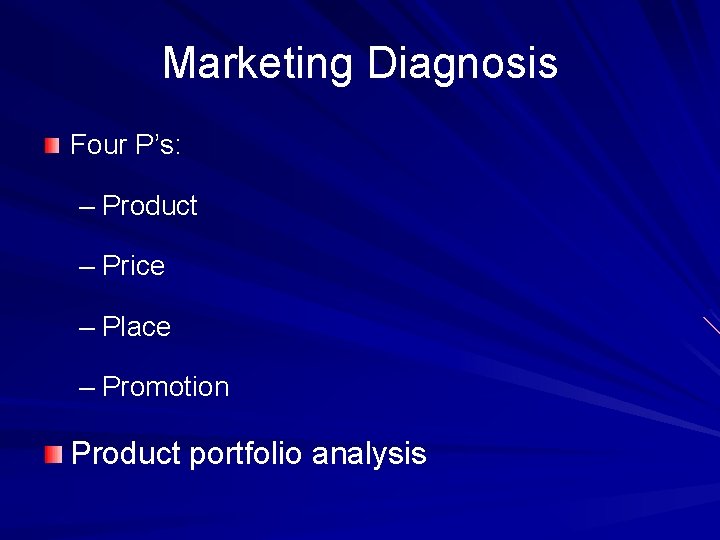
Marketing Diagnosis Four P’s: – Product – Price – Place – Promotion Product portfolio analysis
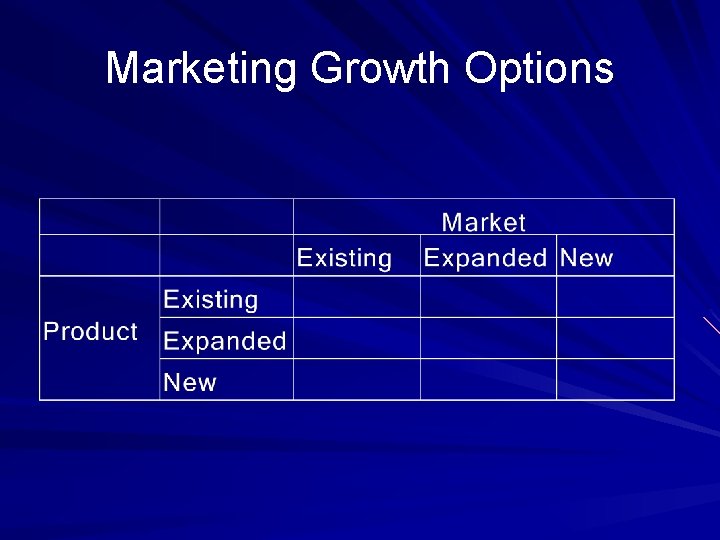
Marketing Growth Options
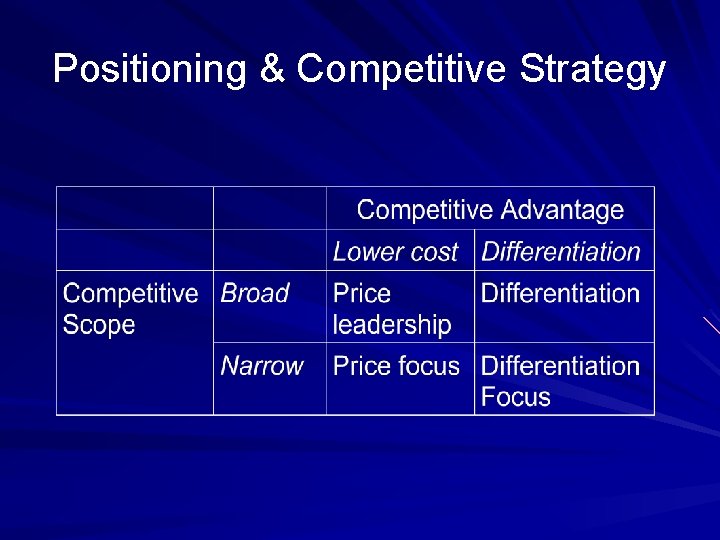
Positioning & Competitive Strategy
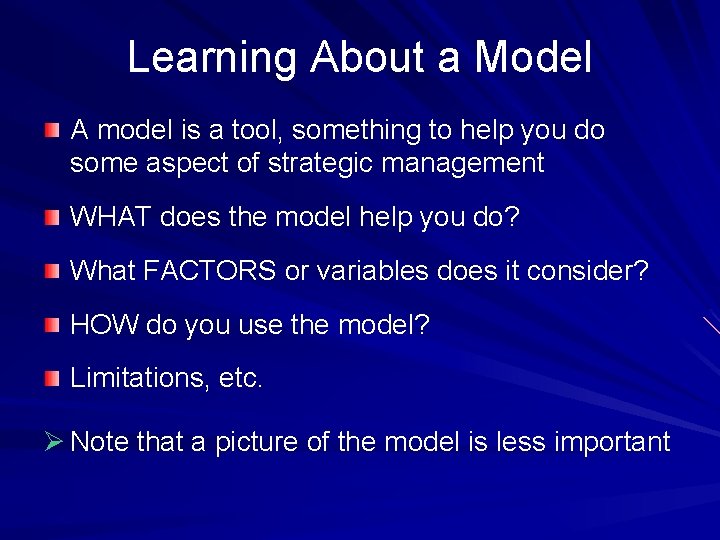
Learning About a Model A model is a tool, something to help you do some aspect of strategic management WHAT does the model help you do? What FACTORS or variables does it consider? HOW do you use the model? Limitations, etc. Ø Note that a picture of the model is less important
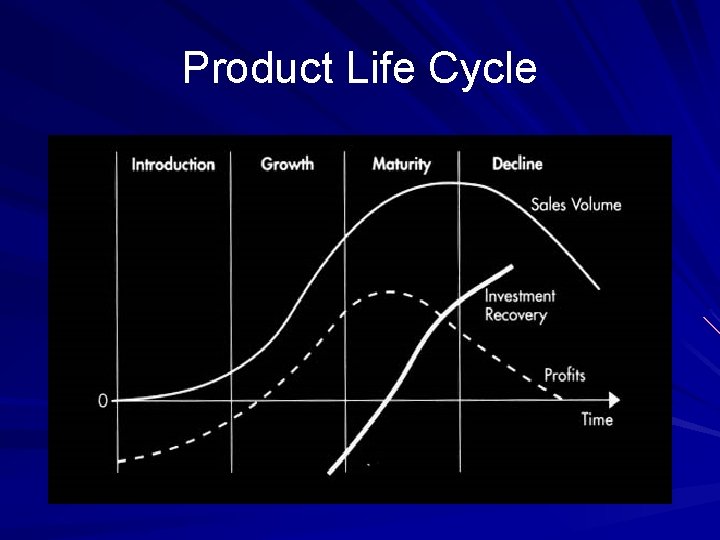
Product Life Cycle
Production/Operations
Production/Operations Often neglected Much of COGS here Also large effects on competitive position
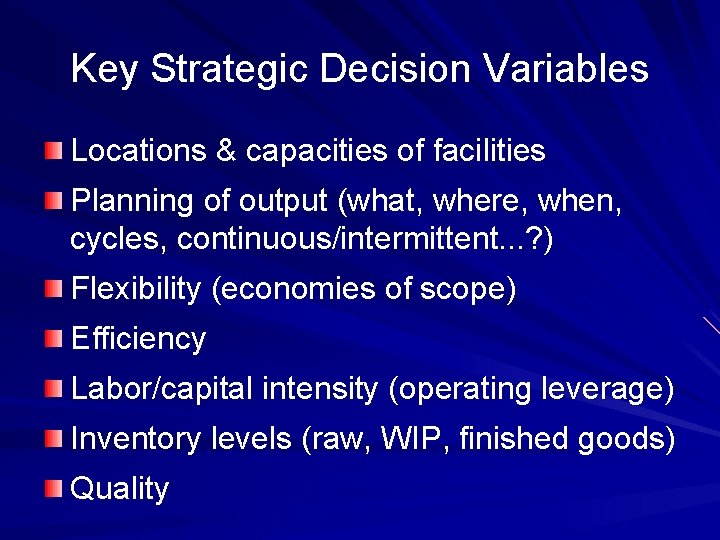
Key Strategic Decision Variables Locations & capacities of facilities Planning of output (what, where, when, cycles, continuous/intermittent. . . ? ) Flexibility (economies of scope) Efficiency Labor/capital intensity (operating leverage) Inventory levels (raw, WIP, finished goods) Quality
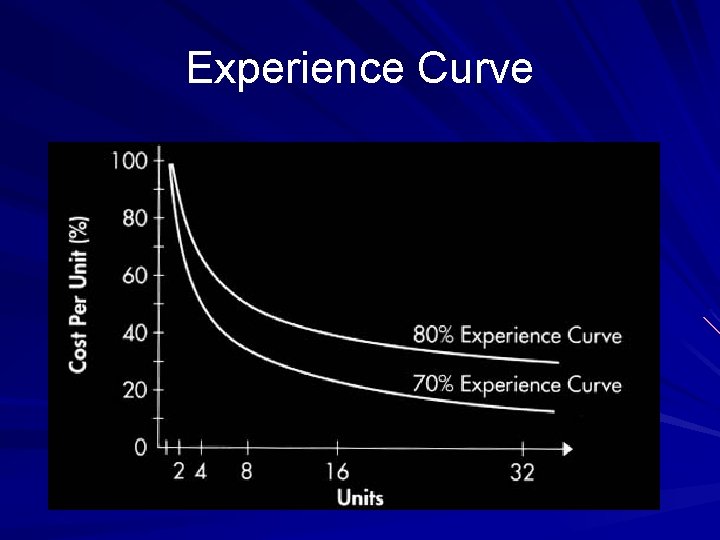
Experience Curve
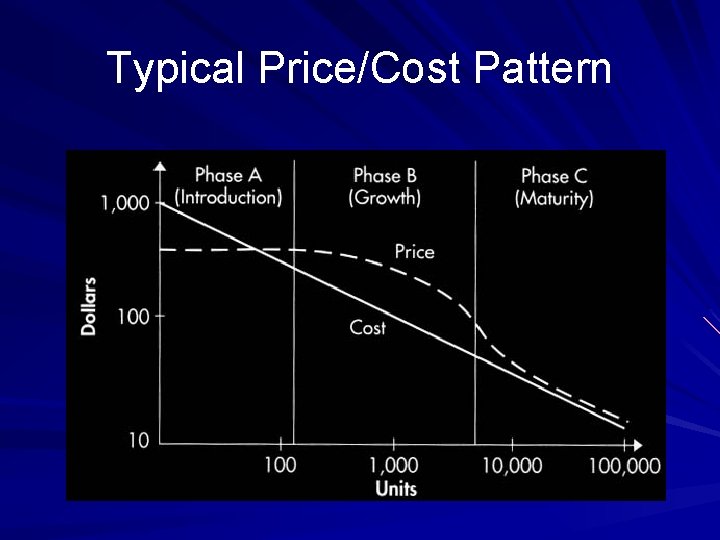
Typical Price/Cost Pattern
Technology
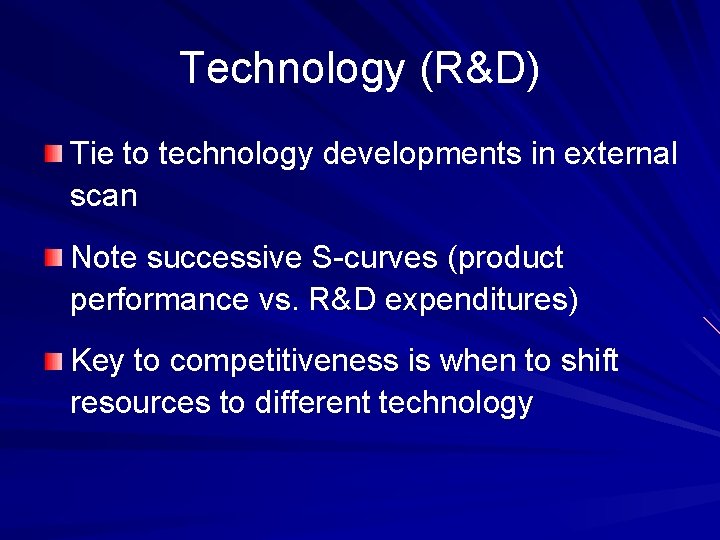
Technology (R&D) Tie to technology developments in external scan Note successive S-curves (product performance vs. R&D expenditures) Key to competitiveness is when to shift resources to different technology
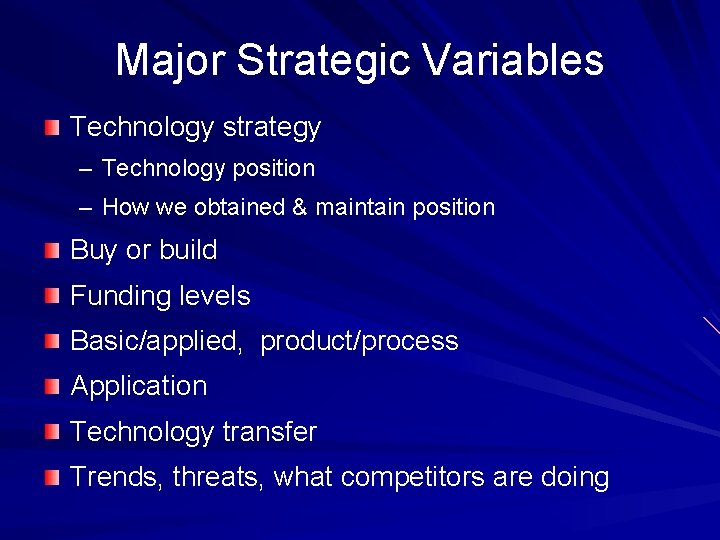
Major Strategic Variables Technology strategy – Technology position – How we obtained & maintain position Buy or build Funding levels Basic/applied, product/process Application Technology transfer Trends, threats, what competitors are doing
Organizational
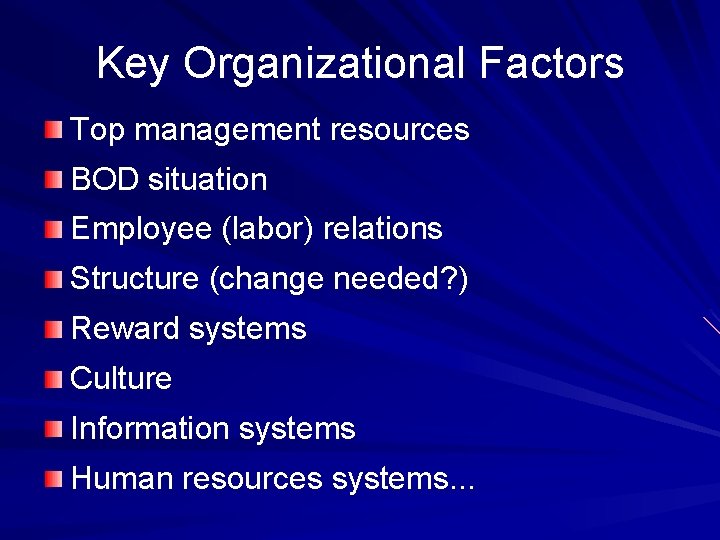
Key Organizational Factors Top management resources BOD situation Employee (labor) relations Structure (change needed? ) Reward systems Culture Information systems Human resources systems. . .
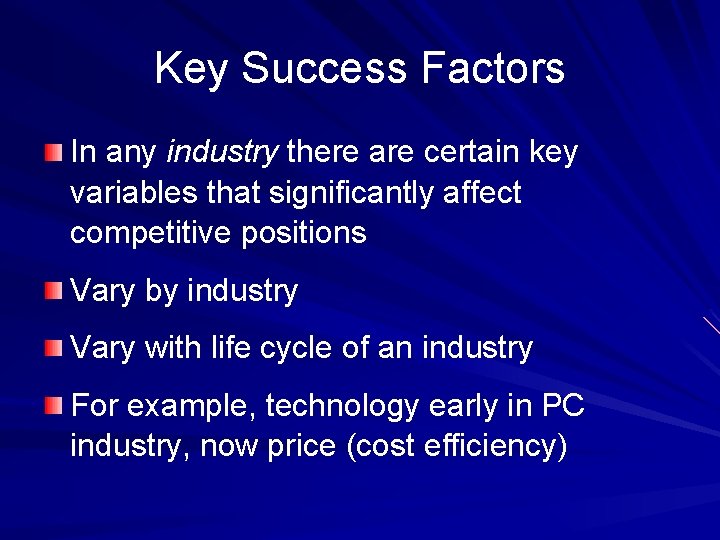
Key Success Factors In any industry there are certain key variables that significantly affect competitive positions Vary by industry Vary with life cycle of an industry For example, technology early in PC industry, now price (cost efficiency)
Finish Diagnosis SWOT table (list) Critical Issues – Central & vital, typically 2 -4 – Usually problems or threats, sometimes opportunities – Both short- and long-range considerations – Framed as issues, rather than solutions