
Diagnosis and Management of Parkinsons Disease Theresa A
- Slides: 47
Diagnosis and Management of Parkinson’s Disease Theresa A. Zesiewicz, MD Associate Professor of Neurology University of South Florida
What is Parkinson’s Disease? n Neurologic disease caused by degeneration of dopamine neurons n Only neurodegenerative disease whose symptoms can so readily be treated by medication
Pathophysiology n n Movement in the body is produced by the MOTOR CORTEX Main motor pathway consists of the pyramidal system The EXTRAPYRAMIDAL system (EPS) modulates the pyramidal system EPS: substantia nigra, striatum, subthalamic nucleus, globus pallidus, thalamus
Pathophysiology Normal movement dependent on dopamine production in the substantia nigra that innervates the striatum n PD is associated with massive degeneration of dopamine-producing neurons in substantia nigra n When 60 to 80% of these neurons are lost, symptoms of PD appear n
Parkinson’s Disease: Pathology n The pathognomic hallmark of the disease is the Lewy Body n It is found intracerebrally n Also found in the autonomic nervous system
Clinical Features of PD Resting Tremor (70%) n Bradykinesia n Rigidity n Postural Instability – Signs start in one limb, usually an arm, and spread to the other limb on that side n
Parkinson’s Disease Symptoms n Secondary disease: features of the n Depression n Dementia n Dysphagia n Anxiety n Orthostatic hypotension n Constipation
Hoehn and Yahr Stages of PD n n n Stage I: unilateral symptoms of disease Stage II: bilateral symptoms of disease Stage III: all of above, plus postural instability Stage IV: all of above, plus patient need assistance Stage V: patient cannot function independently
Prognosis n First 5 years are the “honeymoon period”, and patients generally do well n Between 5 and 10 years, most patients experience medicationrelated difficulty n By 10 years, many develop poor balance
Treatment of Parkinson’s Disease n n Neurodegenerative disease whose symptoms can be readily treatable by medication Levodopa treatment of PD: Breakthrough in the 20 th century
Treatment of Parkinson’s Disease Make correct diagnosis n Differentiate between Parkinson’s disease and Atypical Parkinsonism n Atypical Parkinsonism: n – Early speech and balance disorder – Poor response to levodopa – Less commonly characterized by tremor
Treatment of PD n After diagnosis of PD is made, treatment depends on: – Functional disability of the symptoms – Work status of the patient – The presence or absence of cognitive (mental) difficulties – The financial situation of the patient
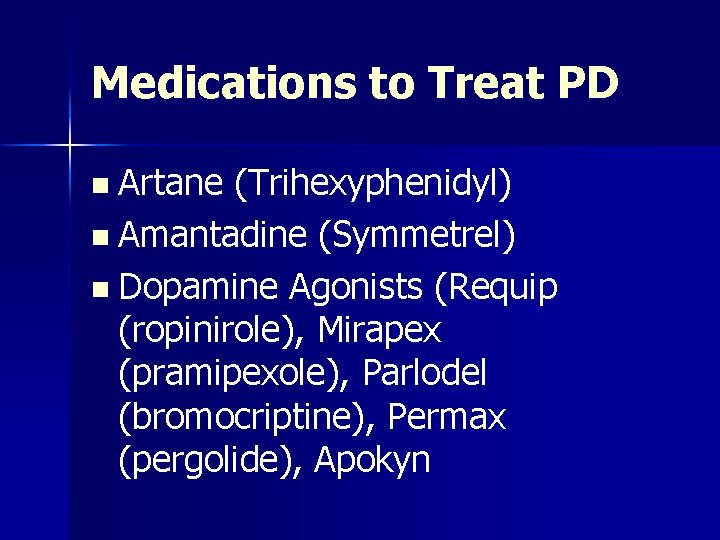
Medications to Treat PD n Artane (Trihexyphenidyl) n Amantadine (Symmetrel) n Dopamine Agonists (Requip (ropinirole), Mirapex (pramipexole), Parlodel (bromocriptine), Permax (pergolide), Apokyn
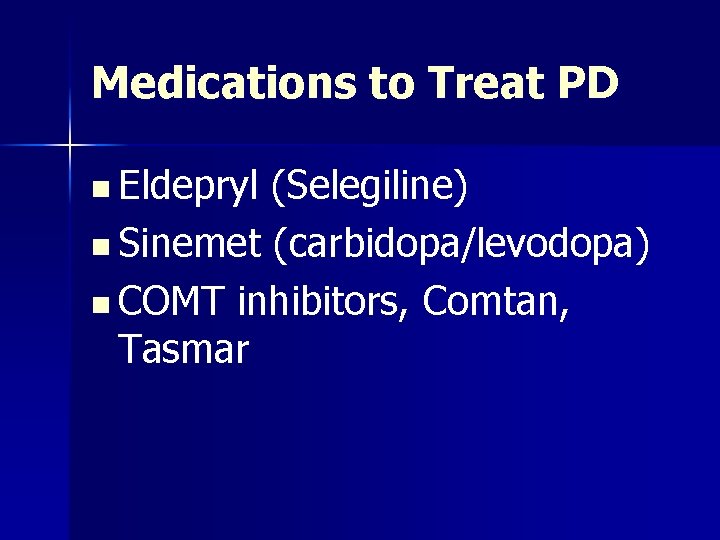
Medications to Treat PD n Eldepryl (Selegiline) n Sinemet (carbidopa/levodopa) n COMT inhibitors, Comtan, Tasmar
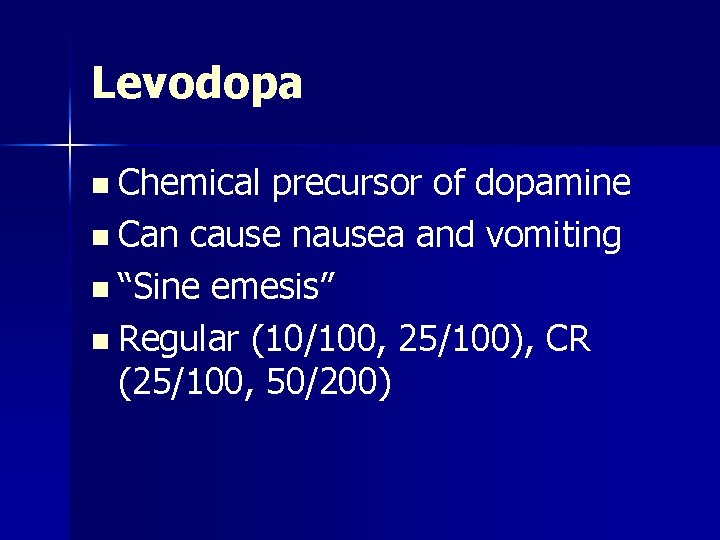
Levodopa n Chemical precursor of dopamine n Can cause nausea and vomiting n “Sine emesis” n Regular (10/100, 25/100), CR (25/100, 50/200)
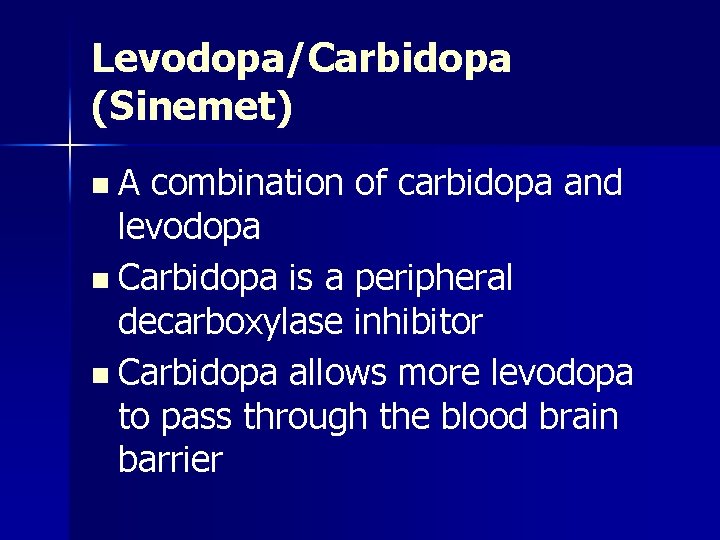
Levodopa/Carbidopa (Sinemet) n. A combination of carbidopa and levodopa n Carbidopa is a peripheral decarboxylase inhibitor n Carbidopa allows more levodopa to pass through the blood brain barrier
Levodopa Most effective medication to reduce or treat PD symptoms n PD patients will eventually need levodopa in the form of Sinemet n Associated with higher incidence of motor fluctuations n Associated with earlier onset of dyskinesia n
Dopamine Agonists n Non-ergots: Requip and Mirapex n Ergots: Permax and Parlodel n Apomorphine, Cabergoline n Apokyn
Dopamine Agonists Act like dopamine in the brain at dopamine receptors n Do not need to be metabolized like levodopa n Have longer half-lives than levodopa n More expensive the levodopa, more cognitive side effects n
Pramipexole (Mirapex) n Pramipexole is a non-ergot D 2/D 3 agonist n Synthetic amino-benzathiazol derivative n Side effects: somnolence, nausea, constipation, insomnia, hallucinations
Pramipexole (Mirapex) Effective is early MONOTHERAPY and ADJUNCT therapy n Compared to placebo in early disease, significantly improves motor function and activities of daily living n In one study, “off” time was reduced by 17% compared to 8% with placebo n Allows for the reduction of levodopa n
Pramipexole (Mirapex) n n CALM-PD Study (Comparison of the agonist pramipexole with levodopa on motor complications of PD) 2 year study, 301 PD patients Patients were randomized to receive pramipexole or levodopa At study conclusion, patients assigned to levodopa had greater improvement in motor function
CALM-PD study n Only 28% of patients on pramipexole developed motor fluctuations, compared to 51% of patients on levodopa n Somnolence, hallucinations, peripheral edema were more common in compared to 6% with placebo
Ropinirole (Requip) Non-ergot dopamine agonist n Double-blind, placebo-controlled trials indicate that ropinirole is effective as mono- and adjunct therapy in PD n 5 -year study by Rascol et al n Patients randomized to ropinirole or levodopa n
Ropinirole (Requip) n The time to onset of dyskinesia was significantly longer in patients taking ropinirole than levodopa (p < 0. 001) n At 5 years, incidence of dyskinesia was 20% in the ropinirole group and 45% in the levodopa group
Dopamine Agonists and Somnolence n Somnolence, excessive daytime sleepiness, and sleep attacks are associated with virtually all antiparkinsonian medications n Appear to be most common with dopamine agonists.
Anticholinergics n Artane (trihexyphenidyl) n Used to reduce tremor n One of the first antiparkinsonian medications n Initial therapy or adjunct therapy
Trihexyphenidyl (Artane) n Side effects: – Confusion – Memory Impairment – Hallucinations – Dry Mouth – Blurred Vision
Symmetrel (Amatadine) An anti-viral medication with dopaminergic properties n Initial therapy or adjunct therapy n Provides mild to moderate benefit n Neuropsychiatric side effects: confusion, hallucinations, nightmares, insomnia n Leg swelling, livdeo reticularis n Withdraw gradually n
Eldepryl (Selegiline) Irreversible MAO-B inhibitor n Developed as an anti-depressant; metabolized to methamphetamine n Used as a Sinemet booster n No firm data to indicate that it slows progression in PD n Should not be used in conjunction with antidepressants n
COMT inhibitors Entacapone (Comtan) n Tolcapone (Tasmar) hepatic toxicity n Allow more Sinemet to pass through the blood brain barrier n Can only be used in combination with Sinemet n Diarrhea, mandatory monitoring of liver function enzymes with Tasmar n
Stalevo Triple combination tablet of levodopa/carbidopa/entacapone in PD patients n Three strengths: 50/12. 5/200, 100/25/200 and 150/37. 5/200 mg n
Stalevo Reduces 3 -OMD, a by-product of Sinemet that may interfere with its absorption n Allows for 35% to 40% of levodopa to pass through the blood brain barrier (BBB) n Without Comtan (Stalevo), only about 10% of Sinemet tablet passes through BBB n
Complications of Long-term Therapy with Sinemet Motor Fluctuations, dyskinesia, predictable wearing-off n On/Off states n Dyskinesia: involuntary abnormal movements associated with medication intake n
Complications of medications 50% of patients treated for 5 years of longer will develop motor fluctuations n 90% will experience them by 15 years after diagnosis n Therapeutic window: target zone to treat patients n This window becomes narrower with time n
Continuous Dopaminergic Stimulation (CDS) Dopamine neurons normally release dopamine in a stable, continuous manner n In early PD, remaining dopamine neurons take up levodopa, convert it to dopamine, store it, and slowly release it n Over time, as more dopamine neurons are lost, this storage and release n
Continuous Dopamine Stimulation (CDS) The loss of intraneuronal storage and slow release capacity is expressed as a SHORTENED duration of benefit from levodopa n Once this capacity is lost, patients fluctuate in concert with levodopa fluctuations in the blood n
Information to have Ready for your doctor Know all doses of medications and times they are taken n Know whether dose of PD medication lasts from dose to dose n Know how much dyskinesia the patient has, if any, during each dose interval n Know how long it takes for medication to take effect n
Information for your doctor n What percent of the day do you have dyskinesia? n What percent of the day do you experience “off” time? n This will help you determine what the patient’s major problems are
Treatment of PD Disease of “timing” n Doctor will carefully assess your motor and non-motor function during the day n Information comes from patient history, diary n
Treatment of PD: Cases 62 year old woman comes into clinic with slight rest tremor n Diagnosed with PD n If the tremor doesn’t bother her, we may do nothing n May use medication specifically for tremor, like artane n
Treatment of PD: cases 56 year old man who comes into the office with stiffness of one arm, slowness, tremor n Symptoms are bothering him n We would treat this patient n Options include dopamine agonist, selegiline (usually hold Sinemet until later) n
Treatment of PD: cases We will ask you what your major symptom is n If you are depressed, but motor symptoms are well controlled, treat depression n
Treatment of PD: cases 70 year old woman who has had PD for 5 years n She is taking Mirapex maximum dose n Medication is not lasting from pill to pill n At some point, it will be time to add SINEMET n
Treatment of PD: cases Will consider other options before Sinemet n Eventually, PD patients will need to take Sinemet n
Treatment of PD: cases We will ask you exact times you take your medication n How much off time, dyskinesia, tremor you have between doses n
Treatment of PD: cases As disease advanced, it may be more difficult to treat patients medically n At some point, patients may be referred to surgery n