
DIABETIC KETOACIDOSIS PROTOCOL 2019 REVISION DIAGNOSIS OF DKA
DIABETIC KETOACIDOSIS PROTOCOL 2019 REVISION
DIAGNOSIS OF DKA • hyperglycemia: glucose ≥ 11. 1 mmol/L • acidosis: p. H <7. 3 or HCO 3– <15 mmol/L • ketones in blood and/or urine • ~10– 20% of kids with new-onset T 1 D present in DKA • DDx: hyperglycemic hyperosmolar state 2
SEVERITY OF DKA mild moderate severe p. H <7. 3 <7. 2 <7. 1 HCO 3– <15 <10 <5 3
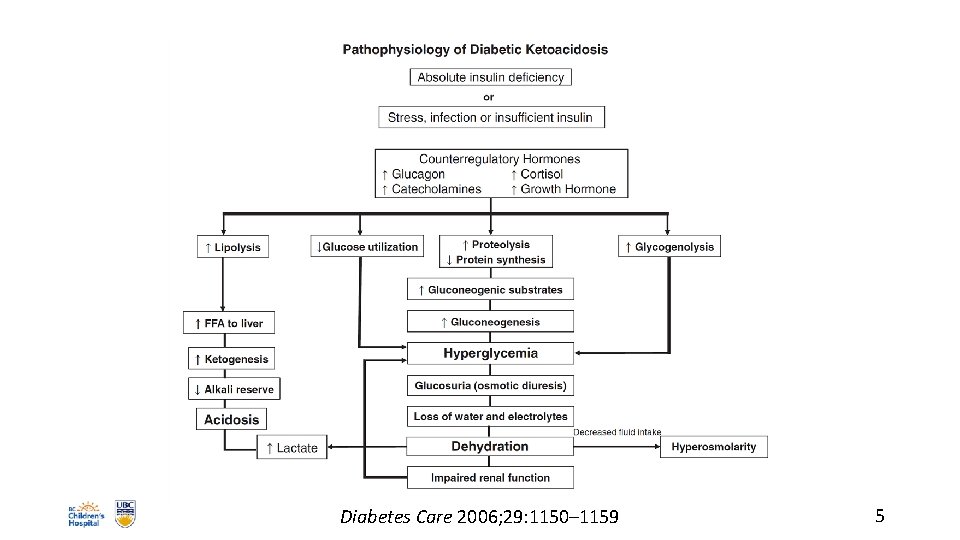
DKA: PATHOPHYSIOLOGY • metabolic effects of insulinopenia • glucose uptake into muscle, fat, liver • gluconeogenesis, glycogenolysis, lipolysis, ketogenesis • hyperglycemia, obligate diuresis • stress hormones aggravate situation • metabolic acidosis: ketones, lactate • huge losses of H 2 O, Na+, K+, HCO 3–, Pi 4
Diabetes Care 2006; 29: 1150– 1159 5
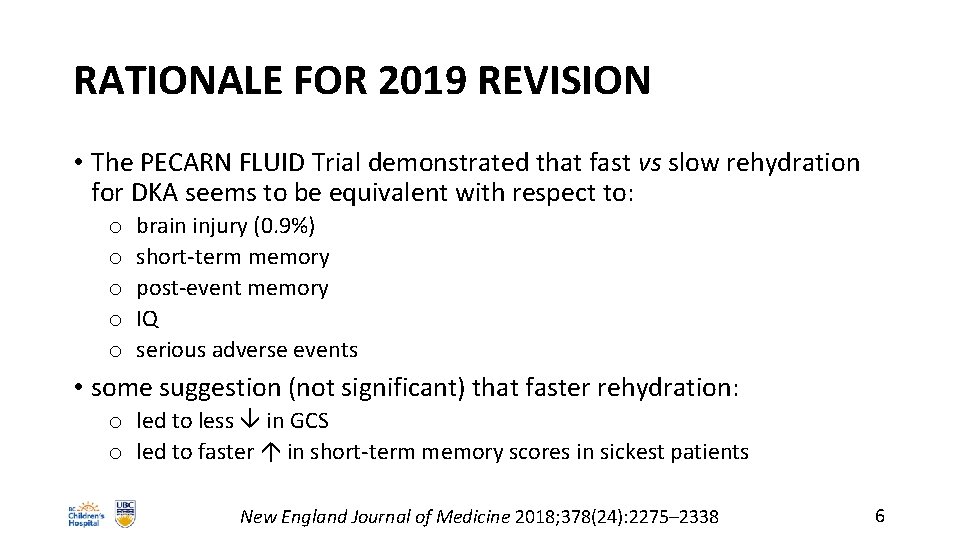
RATIONALE FOR 2019 REVISION • The PECARN FLUID Trial demonstrated that fast vs slow rehydration for DKA seems to be equivalent with respect to: o o o brain injury (0. 9%) short-term memory post-event memory IQ serious adverse events • some suggestion (not significant) that faster rehydration: o led to less in GCS o led to faster in short-term memory scores in sickest patients New England Journal of Medicine 2018; 378(24): 2275– 2338 6
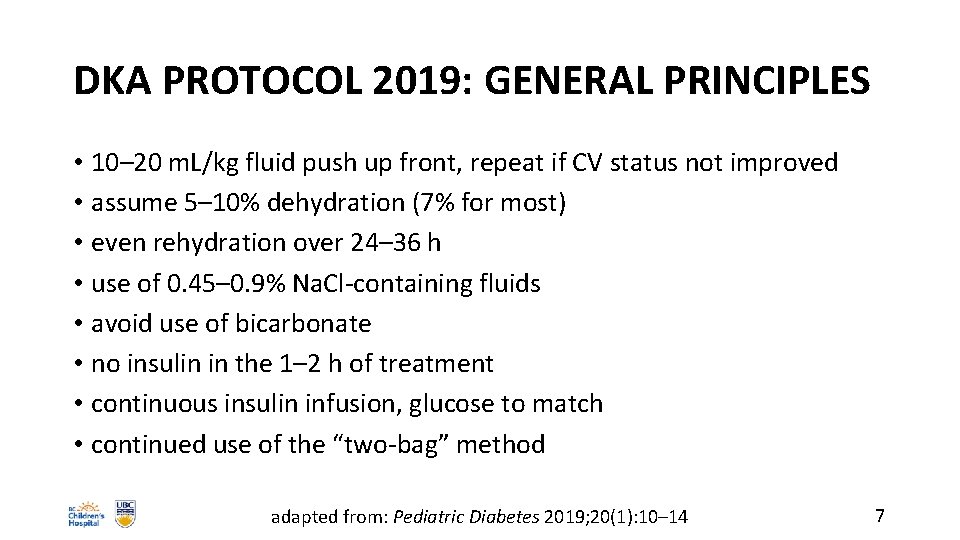
DKA PROTOCOL 2019: GENERAL PRINCIPLES • 10– 20 m. L/kg fluid push up front, repeat if CV status not improved • assume 5– 10% dehydration (7% for most) • even rehydration over 24– 36 h • use of 0. 45– 0. 9% Na. Cl-containing fluids • avoid use of bicarbonate • no insulin in the 1– 2 h of treatment • continuous insulin infusion, glucose to match • continued use of the “two-bag” method adapted from: Pediatric Diabetes 2019; 20(1): 10– 14 7
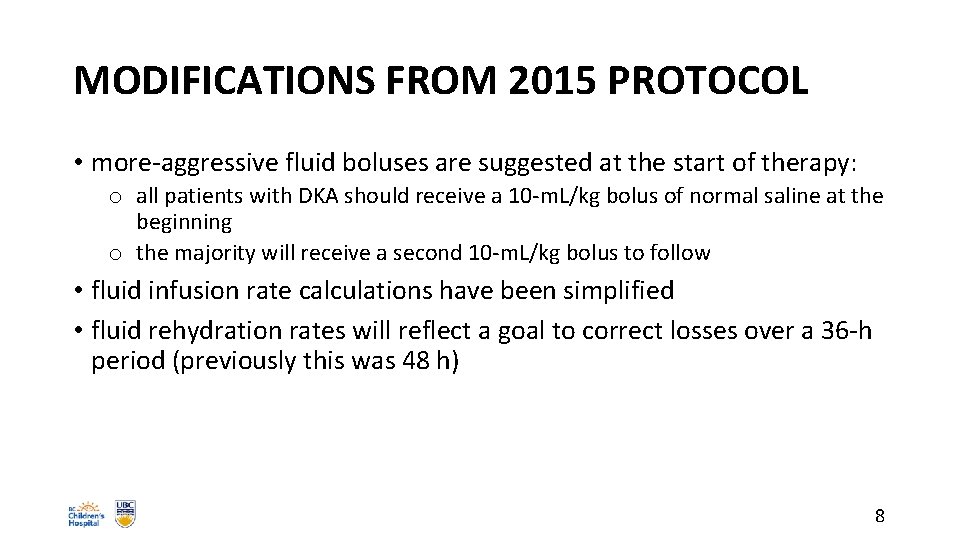
MODIFICATIONS FROM 2015 PROTOCOL • more-aggressive fluid boluses are suggested at the start of therapy: o all patients with DKA should receive a 10 -m. L/kg bolus of normal saline at the beginning o the majority will receive a second 10 -m. L/kg bolus to follow • fluid infusion rate calculations have been simplified • fluid rehydration rates will reflect a goal to correct losses over a 36 -h period (previously this was 48 h) 8
DKA PROTOCOLS: DISCLAIMER • no DKA protocol has been shown to eliminate the risk of cerebral injury • current gold standard: ISPAD Clinical Practice Consensus Guidelines 2018 • guidelines should not replace intelligent thought and should be tailored to meet the needs of each individual patient • involve Pediatric Endocrinology early! Pediatric Diabetes 2014; 15(Suppl 20): 154– 179 9
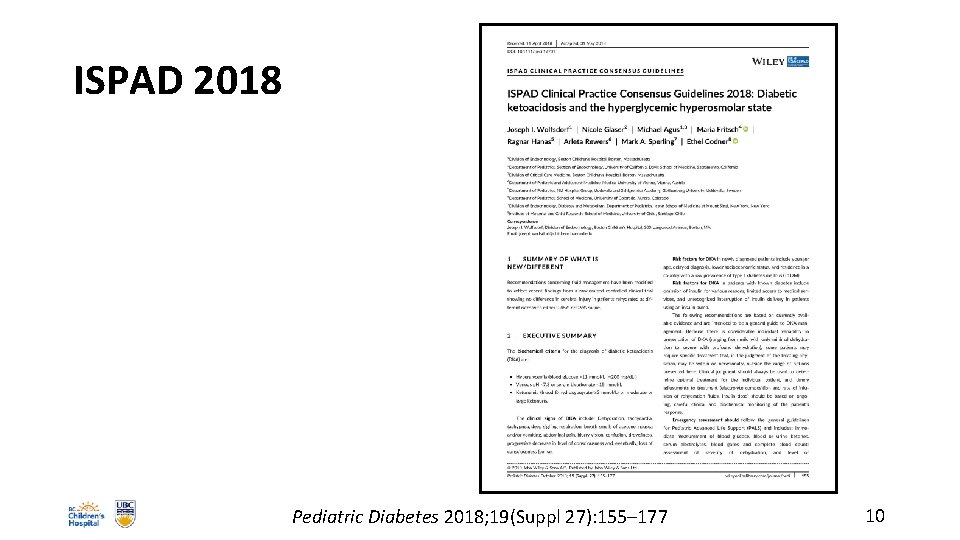
ISPAD 2018 Pediatric Diabetes 2018; 19(Suppl 27): 155– 177 10
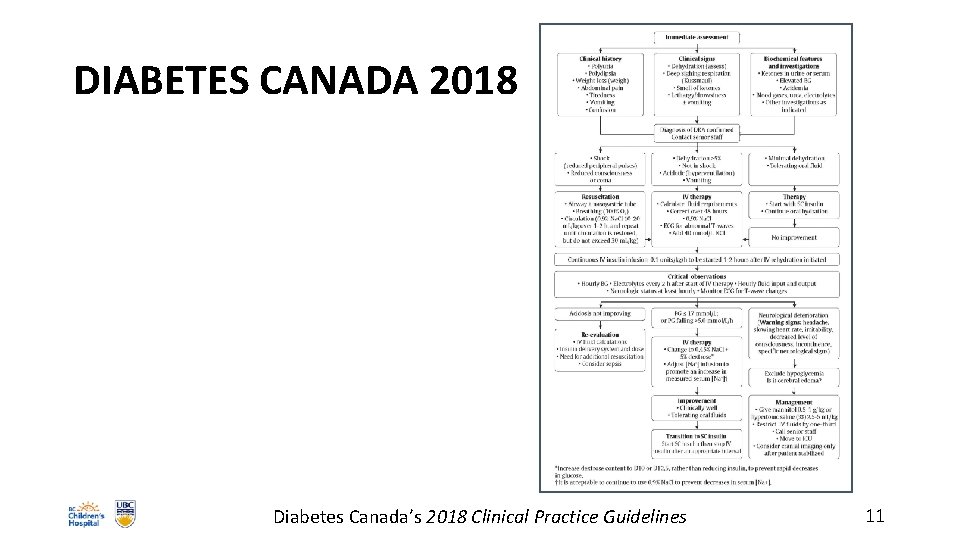
DIABETES CANADA 2018 Diabetes Canada’s 2018 Clinical Practice Guidelines 11
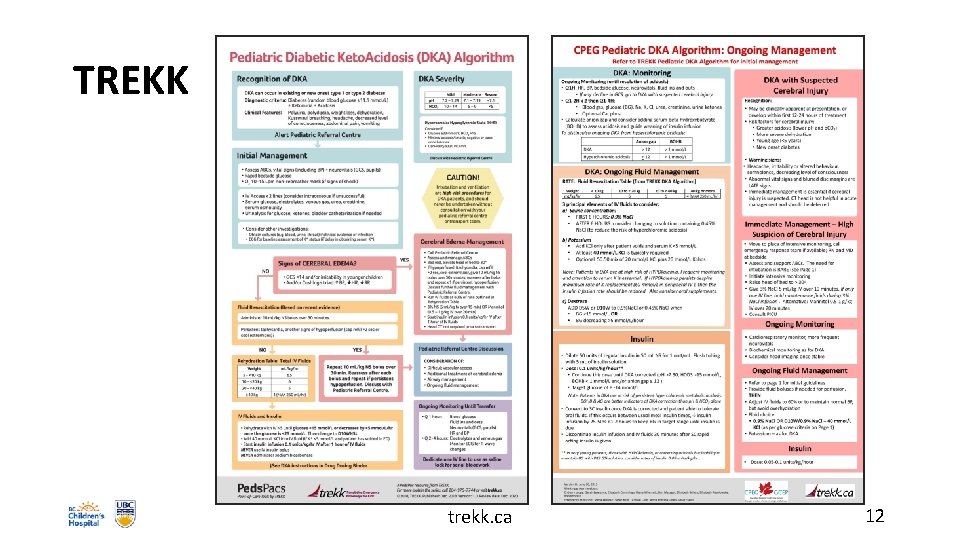
TREKK trekk. ca 12
2019 BCCH DKA PROTOCOL 13
2019 BCCH DKA PROTOCOL 14
2019 BCCH DKA PROTOCOL – FILLABLE 15
DKA MEDICAL DOCUMENTS 16
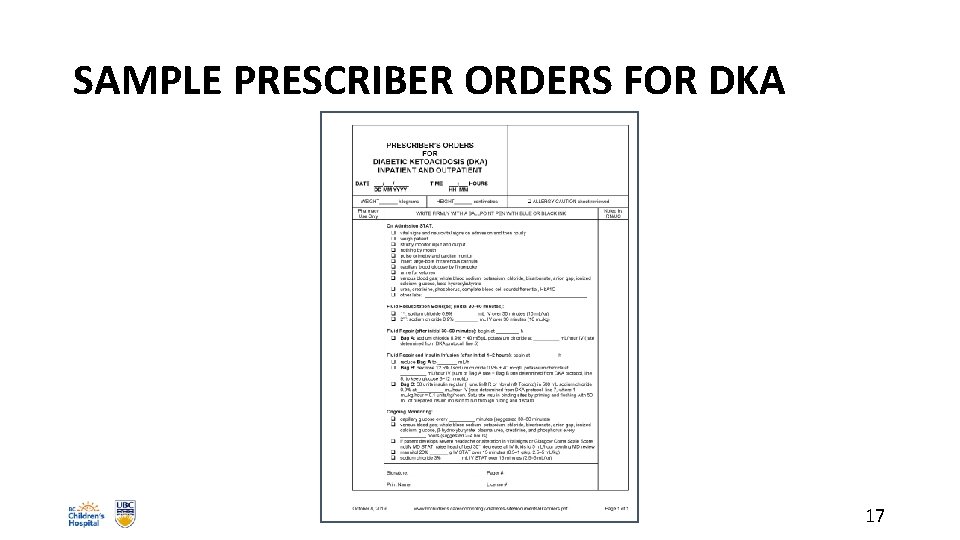
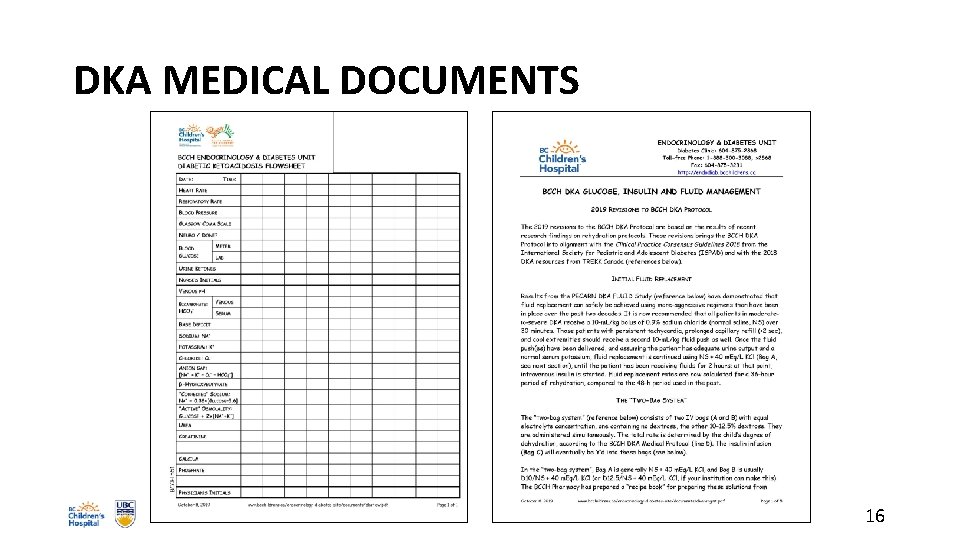
SAMPLE PRESCRIBER ORDERS FOR DKA 17
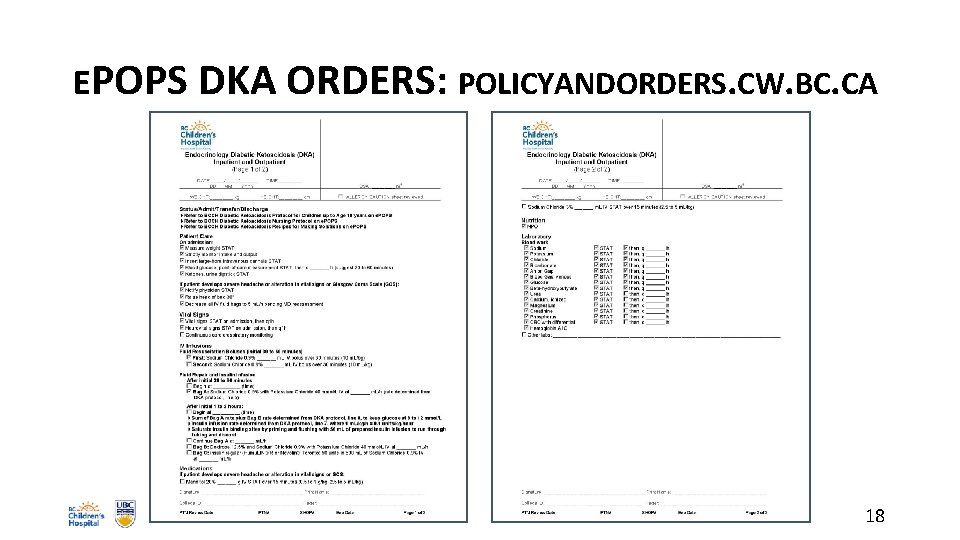
EPOPS DKA ORDERS: POLICYANDORDERS. CW. BC. CA 18
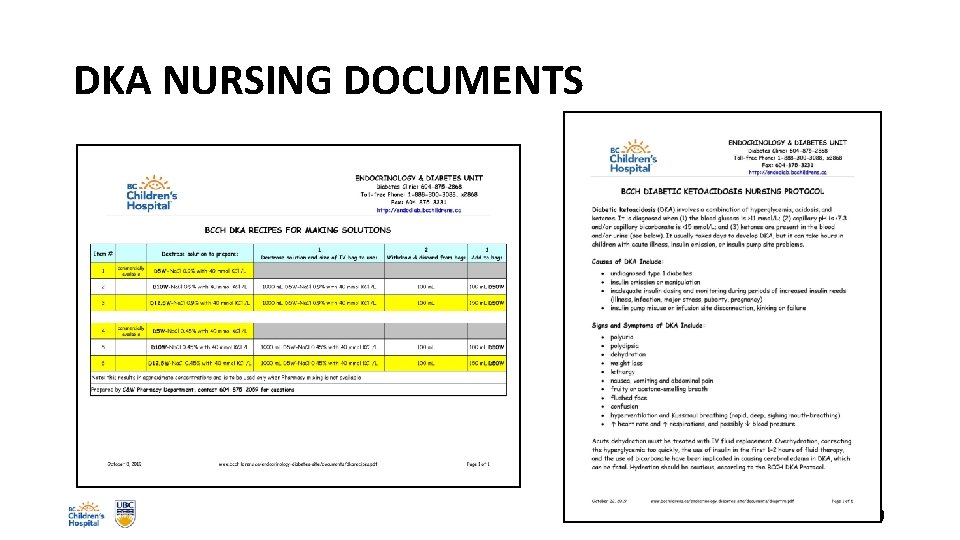
DKA NURSING DOCUMENTS 19
BCCH DKA PROTOCOL 2019: TIMELINE • on admission: weight, vitals, assessment and stabilization • first 30– 60 minutes: fluid resuscitation • 60 min– 36 h: o fluid replacement o insulin infusion o addition of glucose • throughout: o careful monitoring, reassessment o titration of fluids, electrolytes, glucose, insulin 20
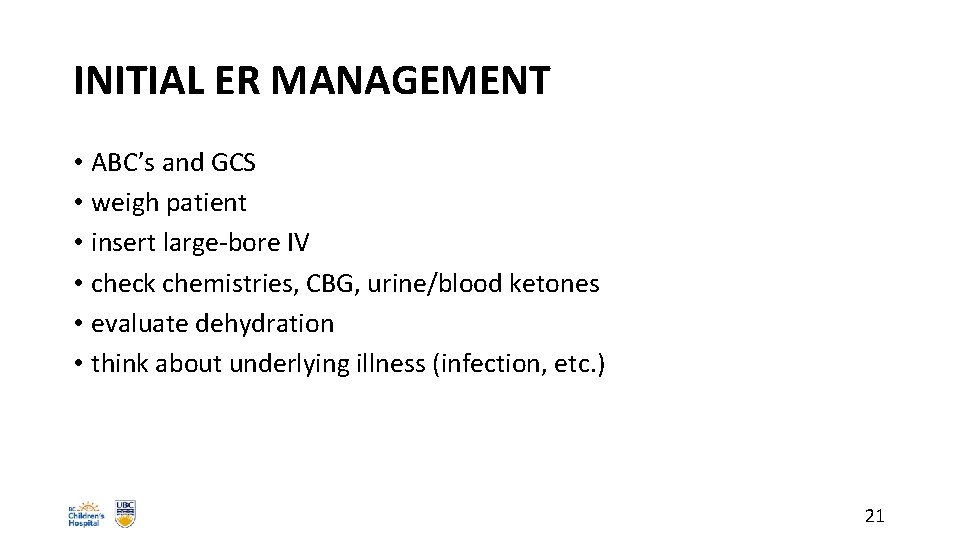
INITIAL ER MANAGEMENT • ABC’s and GCS • weigh patient • insert large-bore IV • check chemistries, CBG, urine/blood ketones • evaluate dehydration • think about underlying illness (infection, etc. ) 21
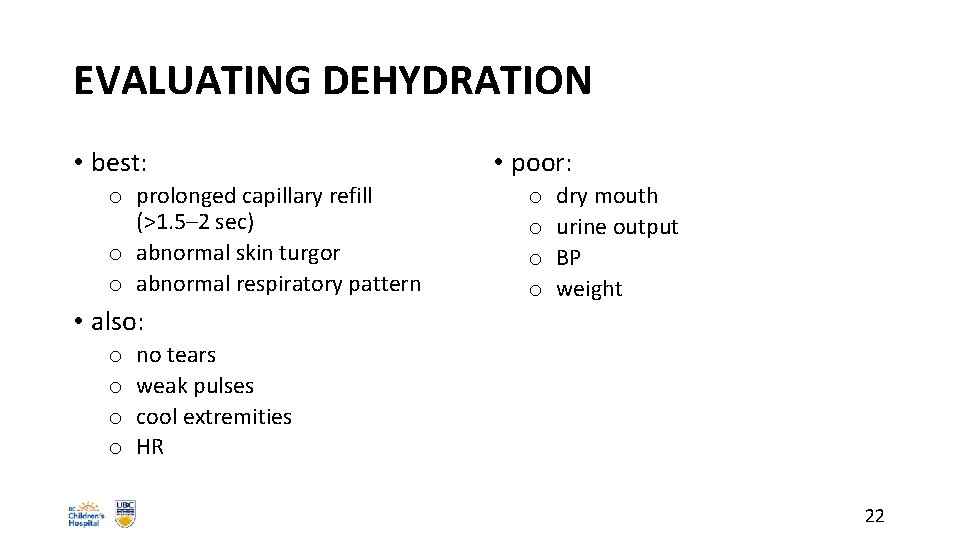
EVALUATING DEHYDRATION • best: o prolonged capillary refill (>1. 5– 2 sec) o abnormal skin turgor o abnormal respiratory pattern • poor: o o dry mouth urine output BP weight • also: o o no tears weak pulses cool extremities HR 22
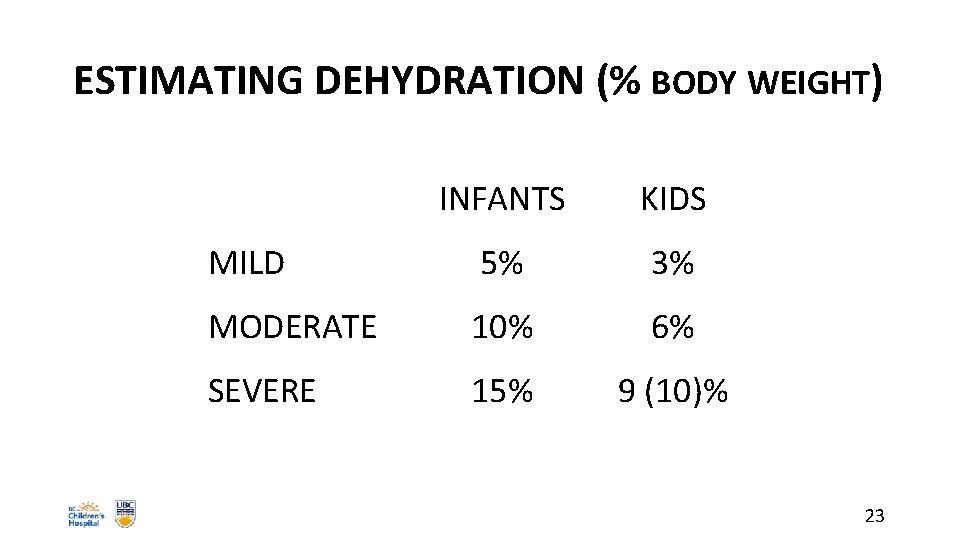
ESTIMATING DEHYDRATION (% BODY WEIGHT) INFANTS KIDS MILD 5% 3% MODERATE 10% 6% SEVERE 15% 9 (10)% 23
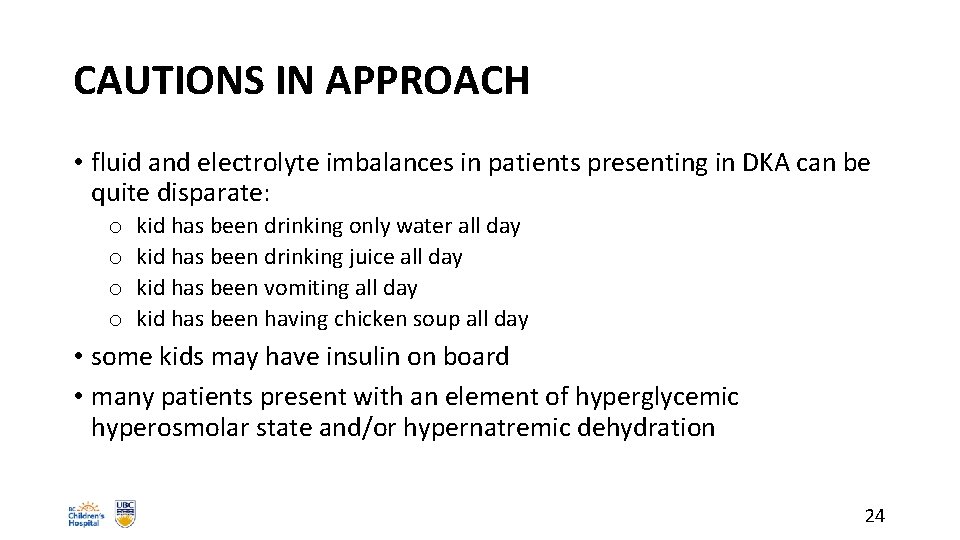
CAUTIONS IN APPROACH • fluid and electrolyte imbalances in patients presenting in DKA can be quite disparate: o o kid has been drinking only water all day kid has been drinking juice all day kid has been vomiting all day kid has been having chicken soup all day • some kids may have insulin on board • many patients present with an element of hyperglycemic hyperosmolar state and/or hypernatremic dehydration 24
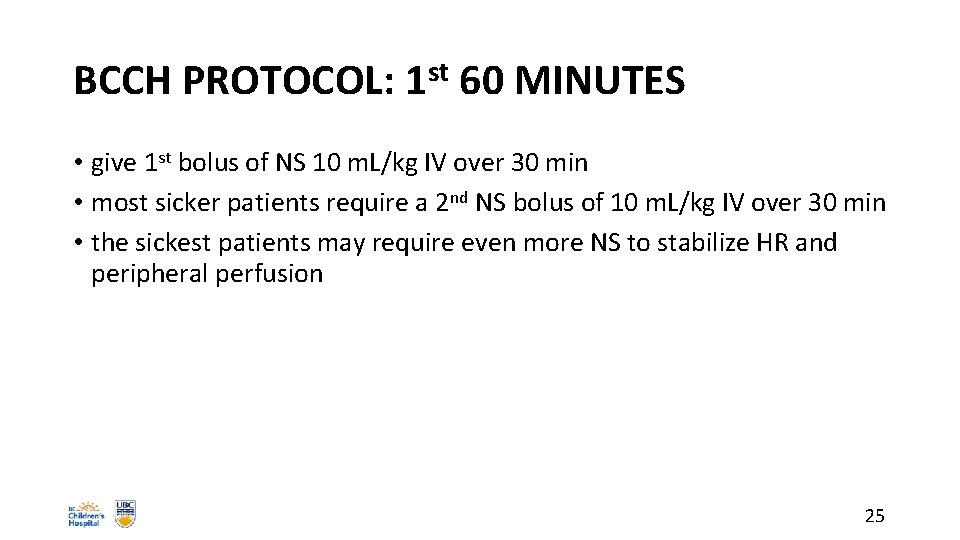
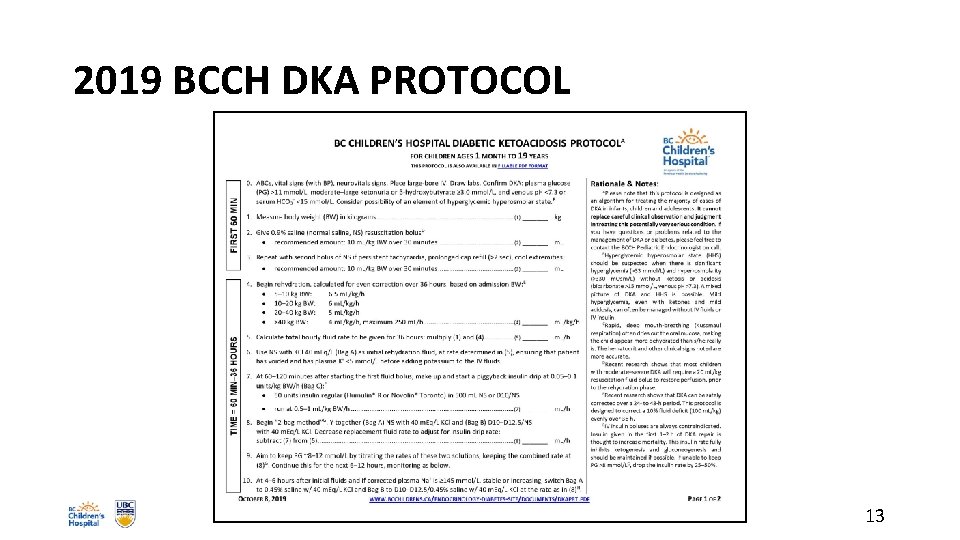
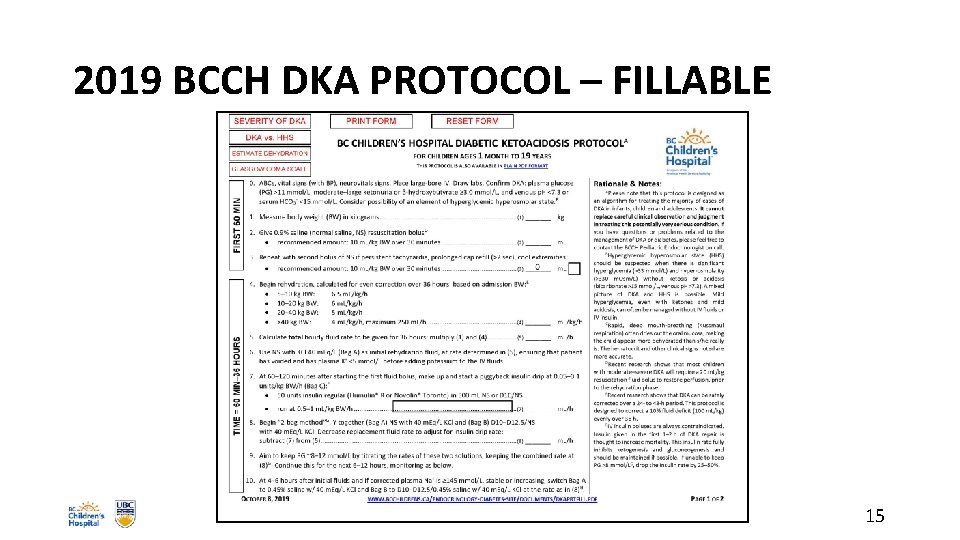
BCCH PROTOCOL: 1 st 60 MINUTES • give 1 st bolus of NS 10 m. L/kg IV over 30 min • most sicker patients require a 2 nd NS bolus of 10 m. L/kg IV over 30 min • the sickest patients may require even more NS to stabilize HR and peripheral perfusion 25
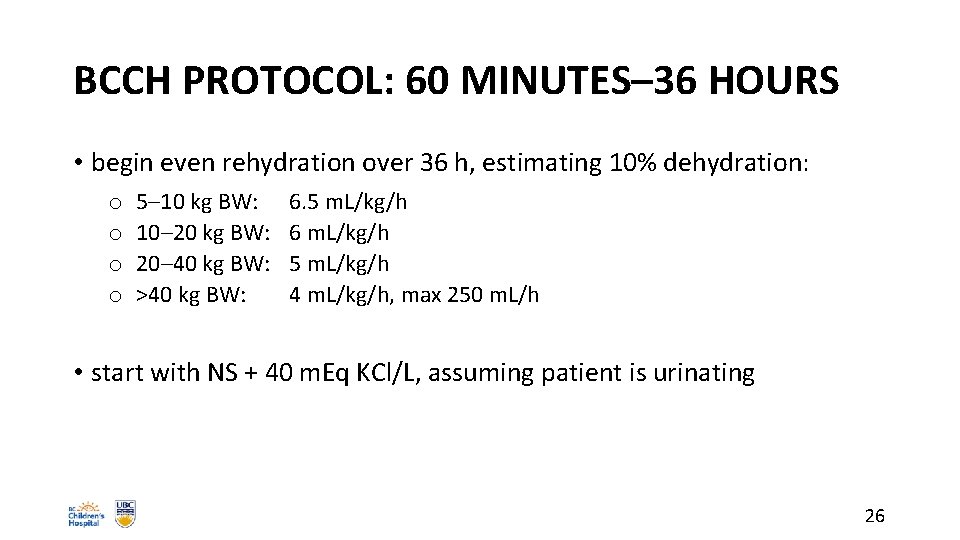
BCCH PROTOCOL: 60 MINUTES– 36 HOURS • begin even rehydration over 36 h, estimating 10% dehydration: o o 5– 10 kg BW: 10– 20 kg BW: 20– 40 kg BW: >40 kg BW: 6. 5 m. L/kg/h 6 m. L/kg/h 5 m. L/kg/h 4 m. L/kg/h, max 250 m. L/h • start with NS + 40 m. Eq KCl/L, assuming patient is urinating 26
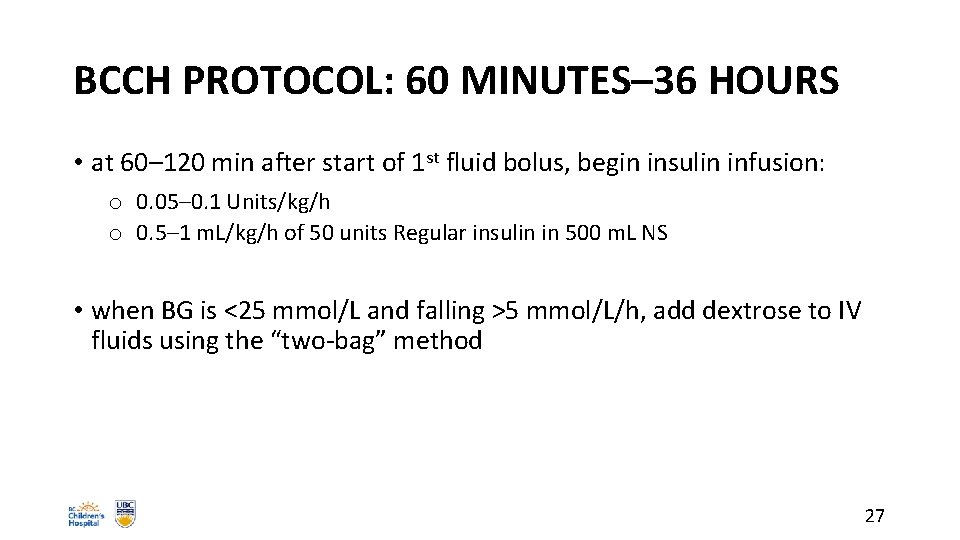
BCCH PROTOCOL: 60 MINUTES– 36 HOURS • at 60– 120 min after start of 1 st fluid bolus, begin insulin infusion: o 0. 05– 0. 1 Units/kg/h o 0. 5– 1 m. L/kg/h of 50 units Regular insulin in 500 m. L NS • when BG is <25 mmol/L and falling >5 mmol/L/h, add dextrose to IV fluids using the “two-bag” method 27
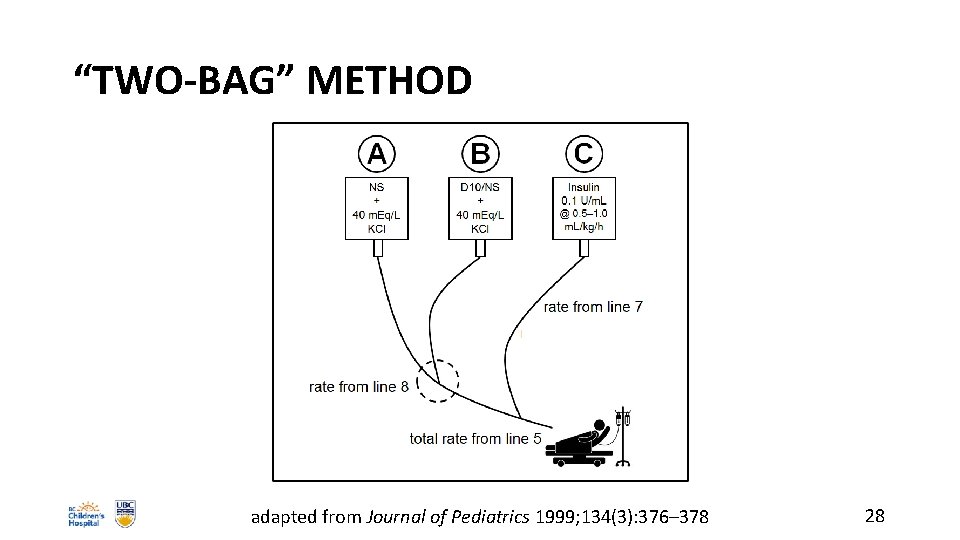
“TWO-BAG” METHOD adapted from Journal of Pediatrics 1999; 134(3): 376– 378 28
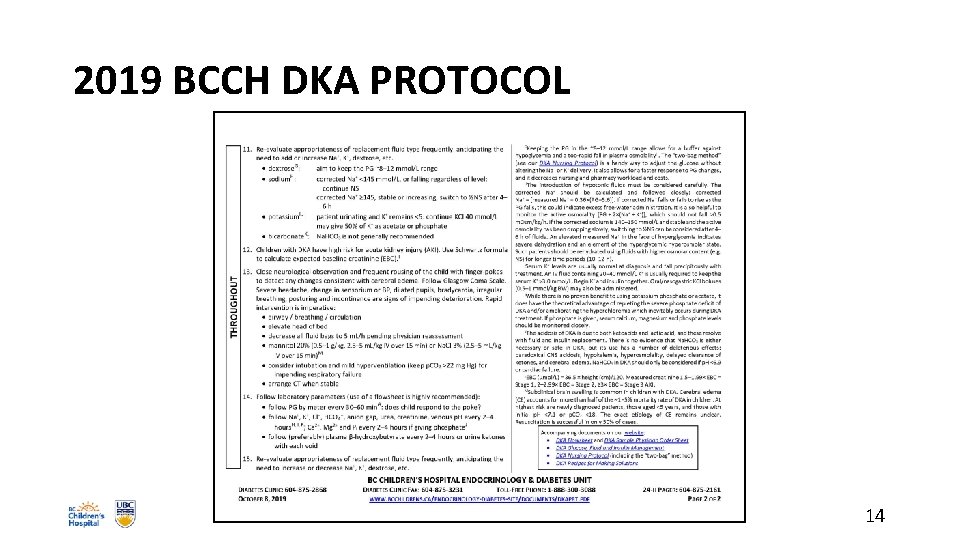
BCCH PROTOCOL: 60 MINUTES– 36 HOURS • aim to keep BG in the ~8– 12 mmol/L range by titrating the rates of the two Bags A and B • a general rule is to make changes of approximately 10– 20% of the total rate every hour • if the patient’s BG is lower than desired, despite maximal dextrose infusion from Bag B, you may (in order of safety): o cut the insulin infusion rate by ~25%, provided the acidosis is correcting o give the patient a small amount (1– 2 m. L/kg) of juice or 2– 4 dextrose tablets (being mindful of the overall fluid balance) o change the insulin Bag C to D 10/NS o in institutions with intensive-care capabilities, consider placing a central line and using a higher concentration of dextrose (e. g. D 20) in Bag B 29
BCCH PROTOCOL: 60 MINUTES– 36 HOURS • at 4– 6 h after initial fluids and if corrected Na+ is ≥ 145 mmol/L, stable or increasing: o switch Bag A to ½NS + 40 m. Eq/L KCl o switch Bag B to D 10/½NS + 40 m. Eq/L KCl • if unable to get K+ >3. 5 mmol/L with IV fluids: consider PO/NG KCl • may give 50% of K+ as phosphate (order by the mmol of K+) o may prevent ensuing hyperchloremia, but no clear evidence of benefit • bicarbonate: rarely if ever needed 30
ONGOING MONITORING • BG by meter q 30– 60 min (may need lab BG if >30 mmol/L) • Na+, K+, Cl−, HCO 3−, anion gap, urea, creatinine, venous p. H q 2– 4 h • Ca 2+, Mg 2+, Pi q 2– 4 h if giving phosphate • β-hydroxybutyrate (preferably) or urine ketones q 2– 4 h • neurovital signs/GCS q 30– 60 min • corrected Na+ = [measured Na+ + 0. 36×(BG− 5. 6)] • active osmolality = [BG + 2×(Na++K+)] 31
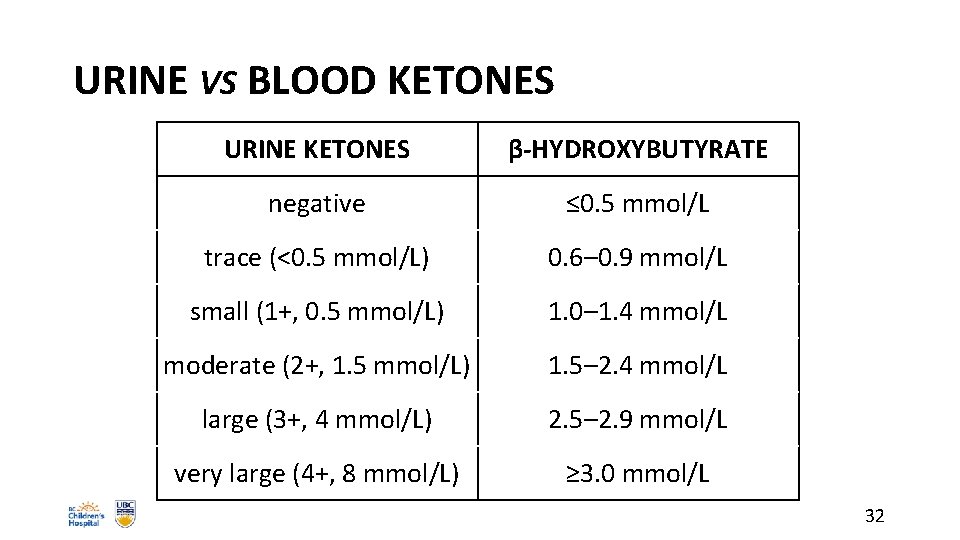
URINE VS BLOOD KETONES URINE KETONES β-HYDROXYBUTYRATE negative ≤ 0. 5 mmol/L trace (<0. 5 mmol/L) 0. 6– 0. 9 mmol/L small (1+, 0. 5 mmol/L) 1. 0– 1. 4 mmol/L moderate (2+, 1. 5 mmol/L) 1. 5– 2. 4 mmol/L large (3+, 4 mmol/L) 2. 5– 2. 9 mmol/L very large (4+, 8 mmol/L) ≥ 3. 0 mmol/L 32
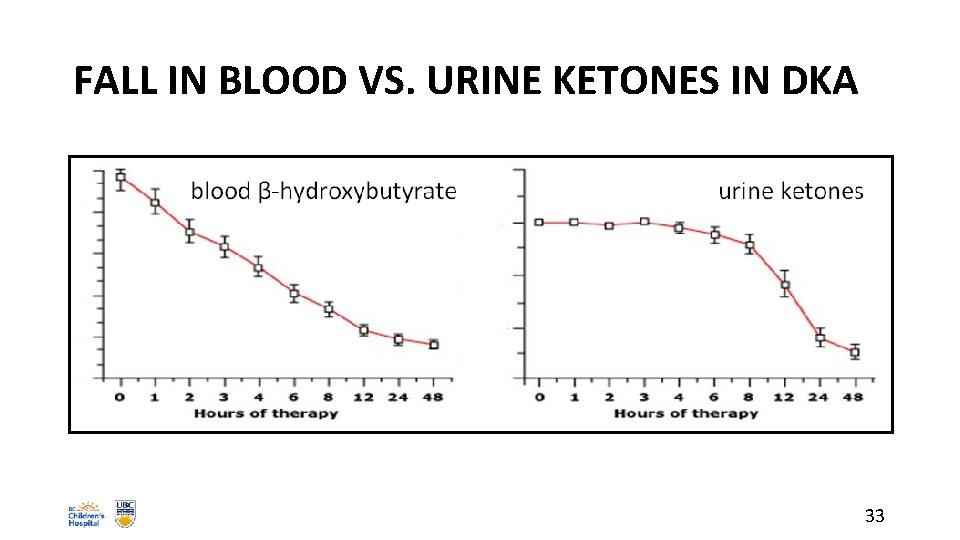
FALL IN BLOOD VS. URINE KETONES IN DKA 33
ACUTE KIDNEY INJURY • DKA should be considered a multiple organ dysfunction syndrome • kids in DKA have a high risk (64%) of acute kidney injury (AKI) • use Schwartz formula to calculate expected baseline creatinine: o o EBC (µmol/L) = 36. 5 × height (cm)/120 measured creatinine 1. 5– 1. 99× EBC = Stage 1 measured creatinine 2– 2. 99× EBC = Stage 2 measured creatinine ≥ 3× EBC = Stage 3 • some creatinine assays have cross-reactivity with ketones! JAMA Pediatrics 2017; 171(5): e 170020 34
MECHANISMS OF CEREBRAL INJURY • vasogenic edema: leakage across altered BBB o o o hypoxia cerebral hypoperfusion/reperfusion neuroinflammation (IL-6, etc. ) ketones (altered BBB) hypocapnia ( cerebral blood flow) • other possible factors: o o role of Na+–H+ antiporter-3 (insulin) and Na+–K+–Cl− cotransporter-1 continued absorption of H 2 O from GI tract vasopressin, atrial natriuretic peptide cellular edema: osmotic shifts across cell membrane 35
CEREBRAL INJURY: MORTALITY • can be present at diagnosis before treatment • usually occurs in first 12– 24 hours of treatment • DKA still has ~0. 5– 1% risk of cerebral injury • ~25% mortality rate, ~35% serious morbidity rate • 70– 80% of diabetes-related deaths in kids <12 • greatest contributor (~50%) to mortality of DKA, not hyperglycemia or shock • subclinical CE with subtle sequelae may be frequent in DKA 36
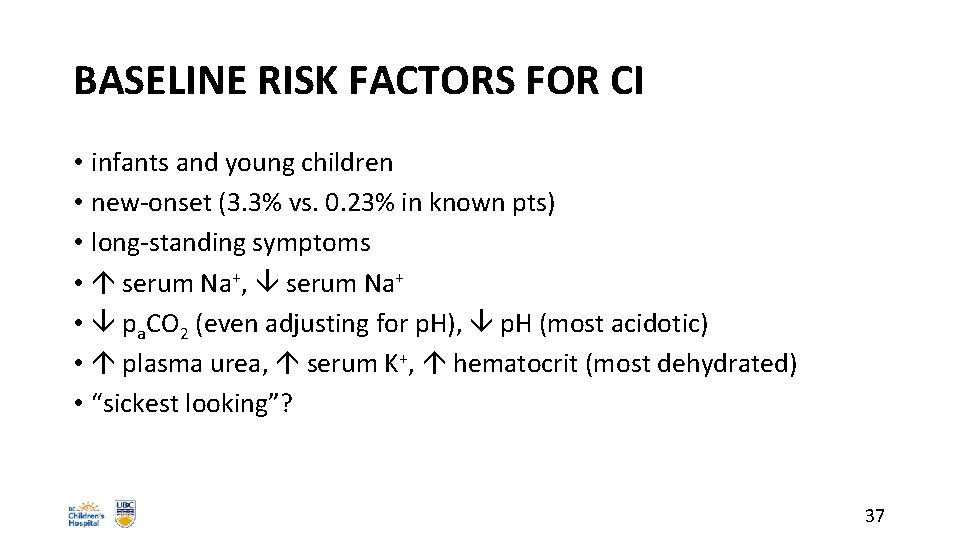
BASELINE RISK FACTORS FOR CI • infants and young children • new-onset (3. 3% vs. 0. 23% in known pts) • long-standing symptoms • serum Na+, serum Na+ • pa. CO 2 (even adjusting for p. H), p. H (most acidotic) • plasma urea, serum K+, hematocrit (most dehydrated) • “sickest looking”? 37
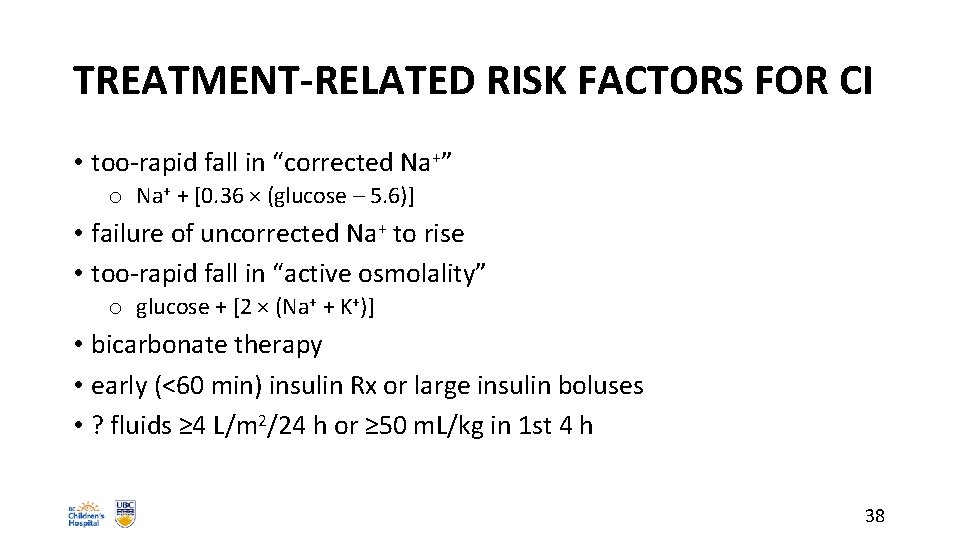
TREATMENT-RELATED RISK FACTORS FOR CI • too-rapid fall in “corrected Na+” o Na+ + [0. 36 × (glucose – 5. 6)] • failure of uncorrected Na+ to rise • too-rapid fall in “active osmolality” o glucose + [2 × (Na+ + K+)] • bicarbonate therapy • early (<60 min) insulin Rx or large insulin boluses • ? fluids ≥ 4 L/m 2/24 h or ≥ 50 m. L/kg in 1 st 4 h 38
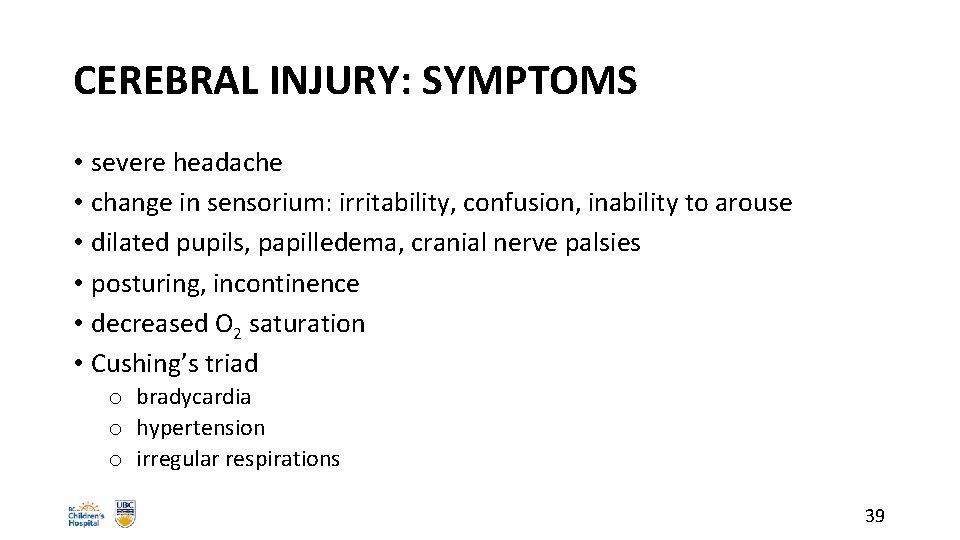
CEREBRAL INJURY: SYMPTOMS • severe headache • change in sensorium: irritability, confusion, inability to arouse • dilated pupils, papilledema, cranial nerve palsies • posturing, incontinence • decreased O 2 saturation • Cushing’s triad o bradycardia o hypertension o irregular respirations 39
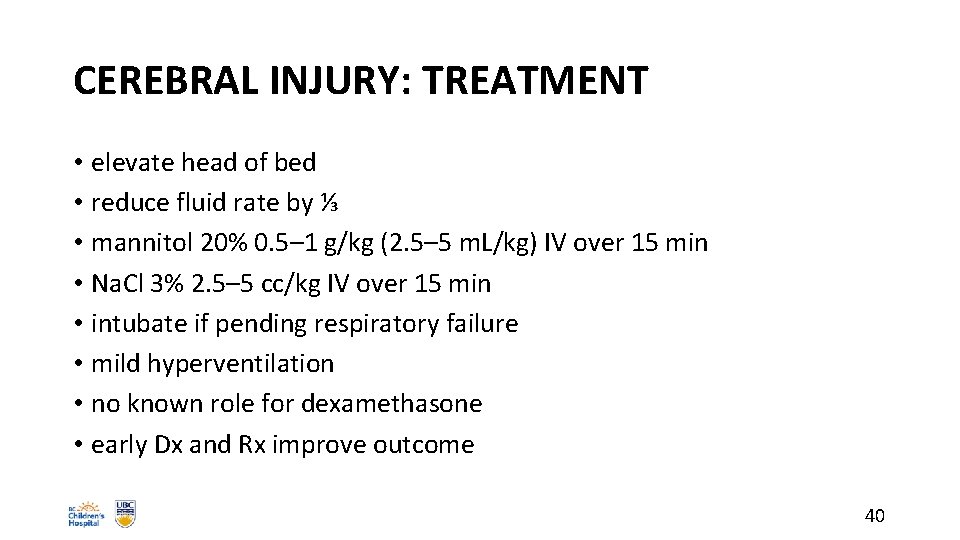
CEREBRAL INJURY: TREATMENT • elevate head of bed • reduce fluid rate by ⅓ • mannitol 20% 0. 5– 1 g/kg (2. 5– 5 m. L/kg) IV over 15 min • Na. Cl 3% 2. 5– 5 cc/kg IV over 15 min • intubate if pending respiratory failure • mild hyperventilation • no known role for dexamethasone • early Dx and Rx improve outcome 40
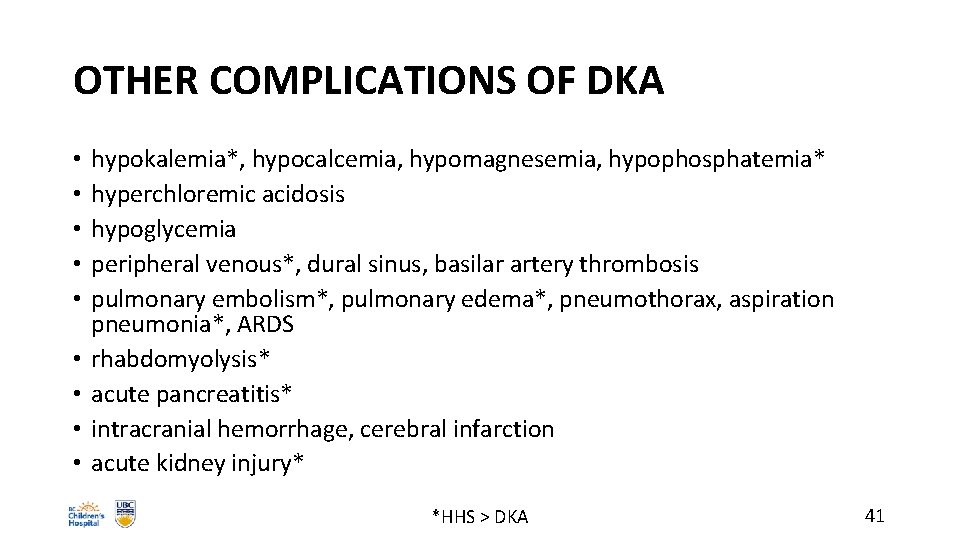
OTHER COMPLICATIONS OF DKA • • • hypokalemia*, hypocalcemia, hypomagnesemia, hypophosphatemia* hyperchloremic acidosis hypoglycemia peripheral venous*, dural sinus, basilar artery thrombosis pulmonary embolism*, pulmonary edema*, pneumothorax, aspiration pneumonia*, ARDS rhabdomyolysis* acute pancreatitis* intracranial hemorrhage, cerebral infarction acute kidney injury* *HHS > DKA 41
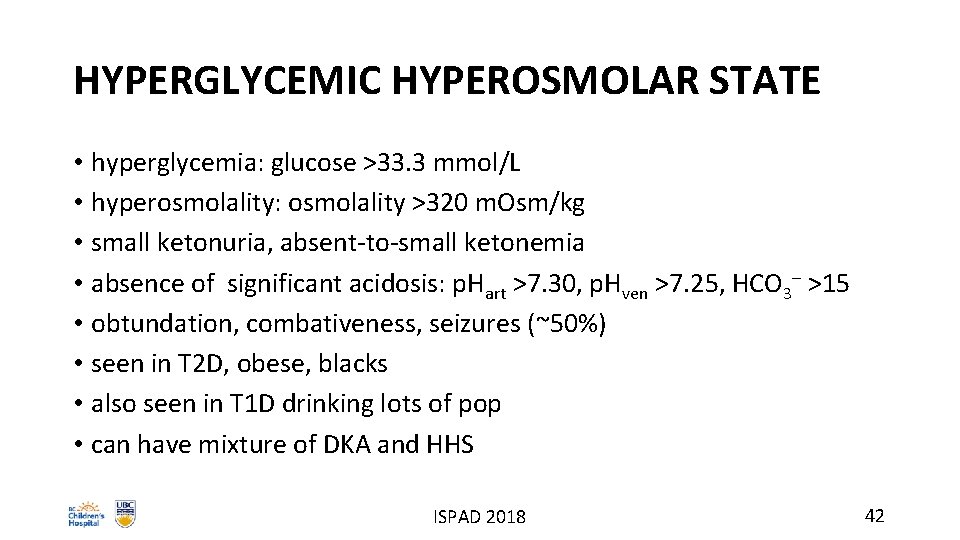
HYPERGLYCEMIC HYPEROSMOLAR STATE • hyperglycemia: glucose >33. 3 mmol/L • hyperosmolality: osmolality >320 m. Osm/kg • small ketonuria, absent-to-small ketonemia • absence of significant acidosis: p. Hart >7. 30, p. Hven >7. 25, HCO 3– >15 • obtundation, combativeness, seizures (~50%) • seen in T 2 D, obese, blacks • also seen in T 1 D drinking lots of pop • can have mixture of DKA and HHS ISPAD 2018 42
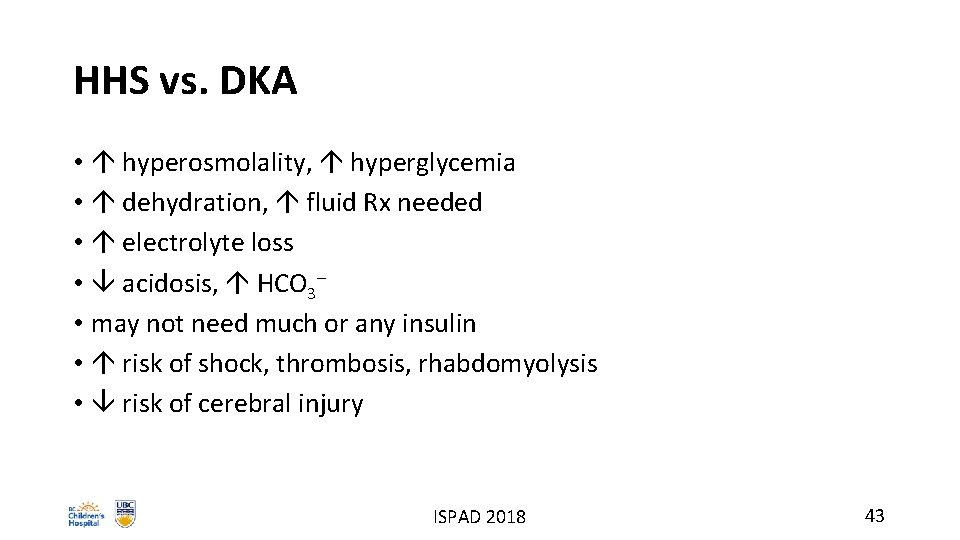
HHS vs. DKA • hyperosmolality, hyperglycemia • dehydration, fluid Rx needed • electrolyte loss • acidosis, HCO 3– • may not need much or any insulin • risk of shock, thrombosis, rhabdomyolysis • risk of cerebral injury ISPAD 2018 43
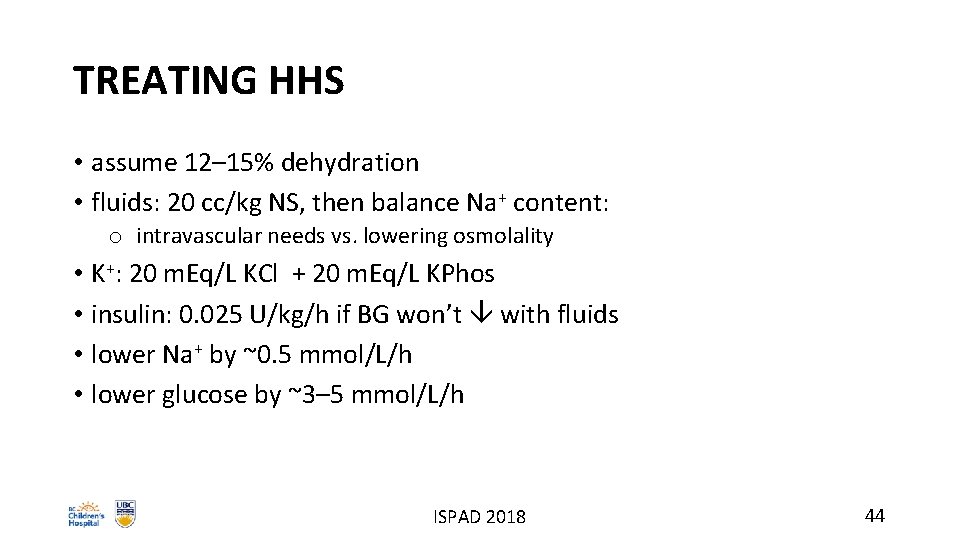
TREATING HHS • assume 12– 15% dehydration • fluids: 20 cc/kg NS, then balance Na+ content: o intravascular needs vs. lowering osmolality • K+: 20 m. Eq/L KCl + 20 m. Eq/L KPhos • insulin: 0. 025 U/kg/h if BG won’t with fluids • lower Na+ by ~0. 5 mmol/L/h • lower glucose by ~3– 5 mmol/L/h ISPAD 2018 44
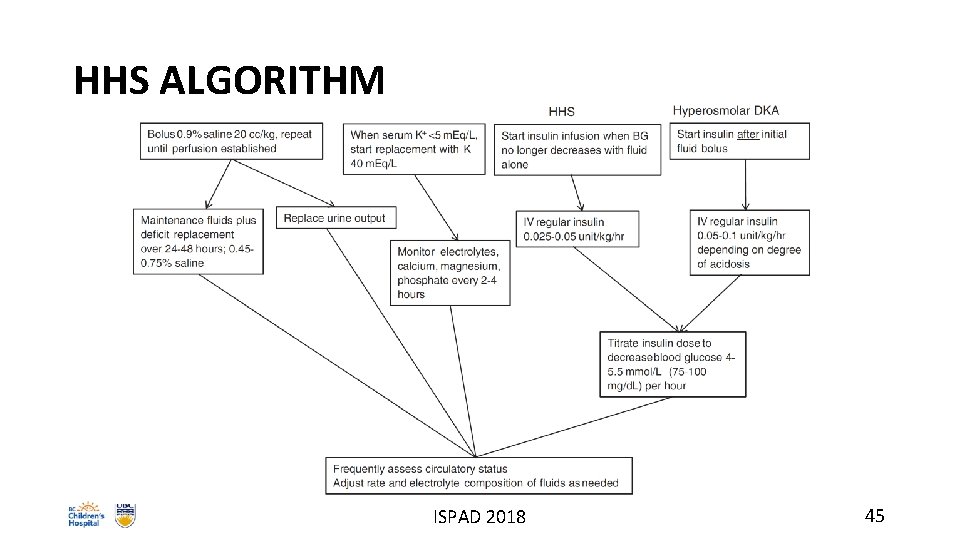
HHS ALGORITHM ISPAD 2018 45
RECURRENT DKA • most often seen in: o o very small kids with GI illness unsupervised kids non-compliant teens insulin pump site problems • nearly all cases of recurrent DKA are preventable! • get an A 1 C! 46
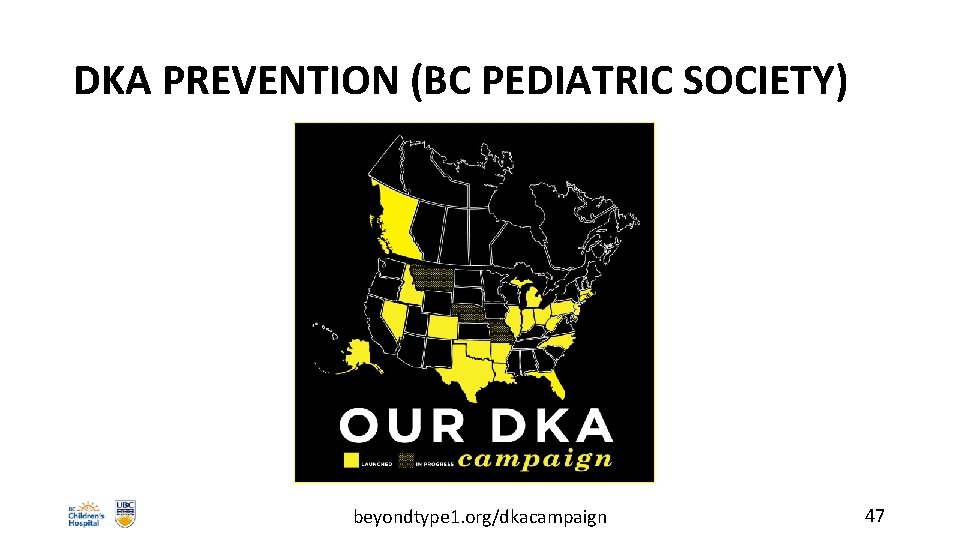
DKA PREVENTION (BC PEDIATRIC SOCIETY) beyondtype 1. org/dkacampaign 47
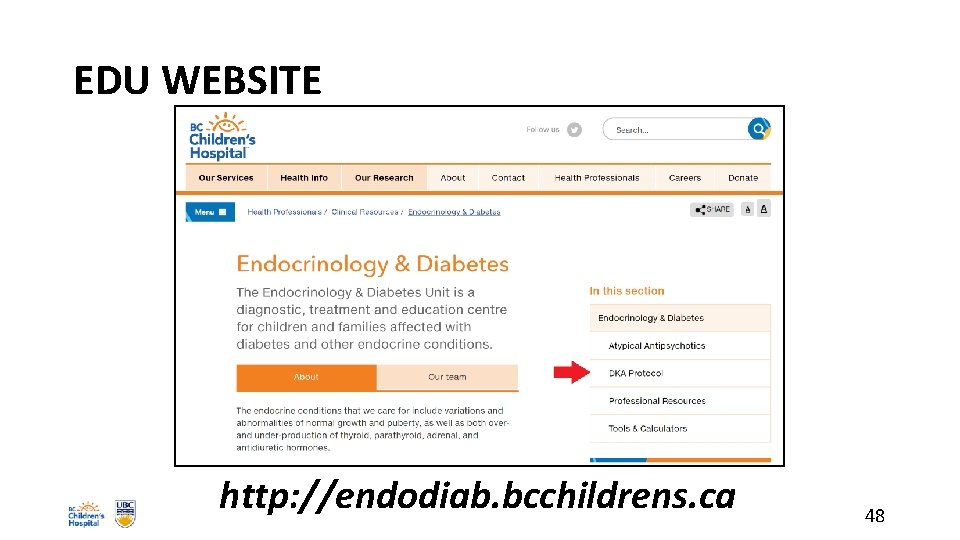
EDU WEBSITE http: //endodiab. bcchildrens. ca 48
REFERENCES • Wherrett DK, Ho J, Huot C, Legault L, Nakhla N, Rosolowsky E. Diabetes Canada Clinical Practice Guidelines Expert Committee. Diabetes Canada 2018 Clinical practice guidelines for the prevention and management of diabetes in Canada: Type 1 diabetes in children and adolescents. Can J Diabetes 2018; 42(Suppl 1): S 234 -S 246. • Wolfsdorf JI, Glaser N, Agus M, Fritsch M, Hanas R, Rewers A, Sperling MA, Codner E. ISPAD Clinical Practice Consensus Guidelines 2018: Diabetic ketoacidosis and the hyperglycemic hyperosmolar state. Pediatr Diabetes 2018: 19(Suppl 27): 155‒ 177. • Kuppermann N, Ghetti S, Schunk JE, Stoner MJ, Rewers A, Mc. Manemy JK, Myers SR, Nigrovic LE, Garro A, Brown KM, Quayle KS, Trainor JL, Tzimenatos L, Bennett JE, De. Piero AD, Kwok MY, Perry CS 3 rd, Olsen CS, Casper TC, Dean JM, Glaser NS; PECARN DKA FLUID Study Group. Clinical trial of fluid infusion rates for pediatric diabetic ketoacidosis. NEJM 2018; 378(24): 2275 -2287. • Grimberg A, Cerri RW, Satin-Smith M, Cohen P. The “two bag system” for variable intravenous dextrose and fluid administration: Benefits in diabetic ketoacidosis management. J Pediatr 1999; 134(3): 376– 378. • Translating Emergency Knowledge for Kids (TREKK Canada): http: //trekk. ca. • Glaser N, Kuppermann N. Fluid treatment for children with diabetic ketoacidosis: how do the results of the PECARN FLUID Trial change our perspective? Pediatr Diabetes 2019; 20(1): 10– 14. • BC Children’s Hospital e. POPS (Electronic Policies, Order Sets, Procedures and Standards): http: //policyandorders. cw. bc. ca. 49
- Slides: 49