
Diabetic Foot Dr Amit Gupta Associate Professor Dept
Diabetic Foot Dr. Amit Gupta Associate Professor Dept of Surgery
Objectives • Define diabetic foot • Explain etiopathogenesis of diabetic foot ulcer • Wagner grades • Understand Charcot’s foot • Explain prevention strategies to patient
Definition A foot with a constellation of pathologic changes affecting the lower extremity in diabetics, often leading to amputation and/or death due to complications; the common initial lesion leading to amputation is a nonhealing skin ulcer, induced by regional pressure, pathogenically linked to sensory neuropathy, ischemia, infection -
Extent • 20 million DM patients in India ( 2 Crore) • DM largest cause of neuropathy • Half don’t know • Foot ulcerations is most common cause of hospital admissions for Diabetics • Expensive to treat, may lead to amputation and need for chronic institutionalized care
• After amputation 30% lose other limb in 3 years • After amputation 2/3 rds die in five years • Type II can be worse • 15% of diabetic will develop a foot ulcer
Pathophysiology • Vascular disease • Neuropathy • Sensory • Motor • Autonomic

Neuropathy • Changes in the vasonervosum with resulting ischemia ? cause • Increased sorbitol in feeding vessels block flow and causes nerve ischemia • Intraneural accumulation of advanced products of glycosylation Abnormalities of all three neurologic systems contribute to ulceration
Vascular Disease • 30 times more prevalent in diabetics • Diabetics get arthrosclerosis obliterans or “lead pipe arteries” • Calcification of the tunica media • Endothelial changes • Often increased blood flow with lack of elastic properties of the arterioles • Not considered to be a primary cause of foot ulcers
Autonomic Neuropathy • Regulates sweating and perfusion to the limb • Loss of autonomic control inhibits thermoregulatory function and sweating • Result is dry, scaly and stiff skin that is prone to cracking and allows a portal of entry for bacteria
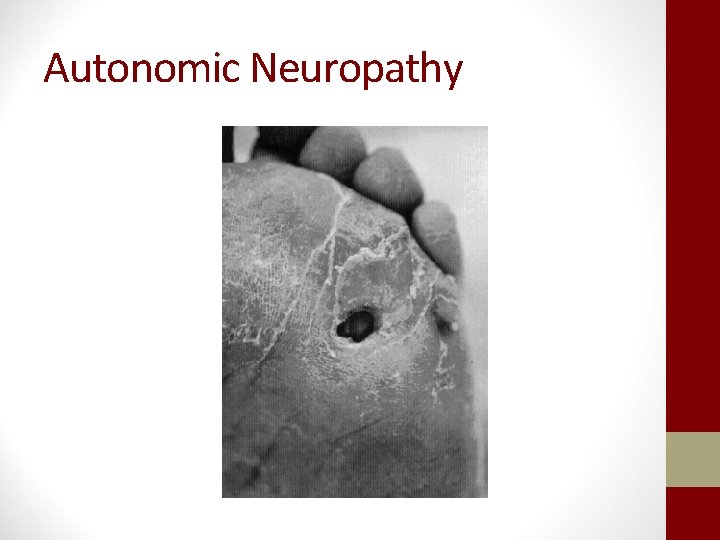
Autonomic Neuropathy
Motor Neuropathy • Mostly affects forefoot ulceration • Intrinsic muscle wasting – claw toes • Equinus contracture
Sensory Neuropathy • Loss of protective sensation • Starts distally and migrates proximally in “stocking” distribution • Large fibre loss – light touch and proprioception • Small fibre loss – pain and temperature • Usually a combination of the two
Sensory Neuropathy • Two mechanisms of Ulceration • Unacceptable stress few times • rock in shoe, glass, burn • Acceptable or moderate stress repeatedly • Improper shoe s • deformity
Patient Evaluation • Medical • Vascular • Orthopedic • Identification of “Foot at Risk”
Patient Evaluation Semmes-Weinstein Monofilament Aesthesiometer • 5. 07 (10 g) seems to be threshold • 90% of ulcer patients can’t feel it • Only helpful as a screening tool
Patient Evaluation • Medical • Optimized glucose control • Decreases by 50% chance of foot problems

• Vascular • Assessment of peripheral pulses of paramount importance • If any concern, vascular assessment • ABI (n>0. 45) • Sclerotic vessels • Toe pressures (n>40 -50 mm. Hg) • Tc. O 2 >30 mm. Hg • Expensive but helpful in amp. level UCMS DELHI Patient Evaluation

• Orthopedic • Ulceration • Deformity and prominences • Contractures UCMS DELHI Patient Evaluation
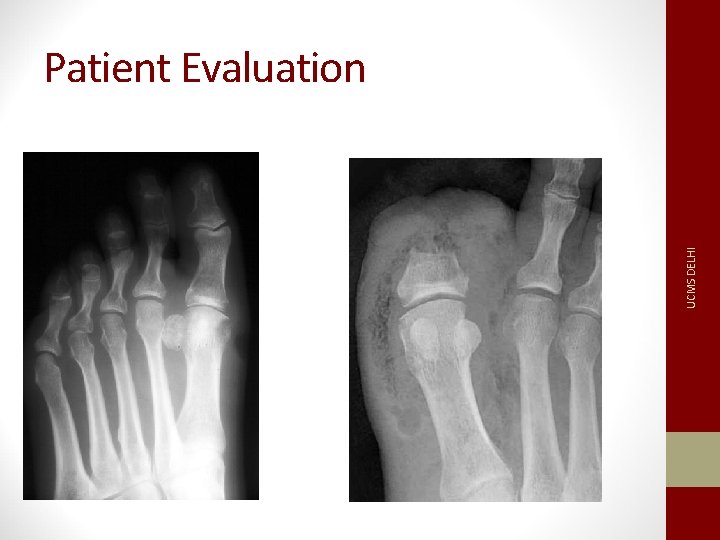
Patient Evaluation UCMS DELHI • X-ray • Lead pipe arteries • Bony destruction (Charcot or osteomyelitis)
UCMS DELHI Patient Evaluation
• Nuclear medicine • Overused • Combination Bone scan and Indium scan be helpful in questionable cases (i. e. Normal Xrays) • Gallium scan useless in these patients • Best screen – indium – and if Positive – bone scan to differentiate between bone and soft tissue infection UCMS DELHI Patient Evaluation
• CT can be helpful in visualizing bony anatomy for abscess, extent of disease • MRI has a role instead of nuclear medicine scans in uncertain cases of osteomyelitis UCMS DELHI Patient Evaluation
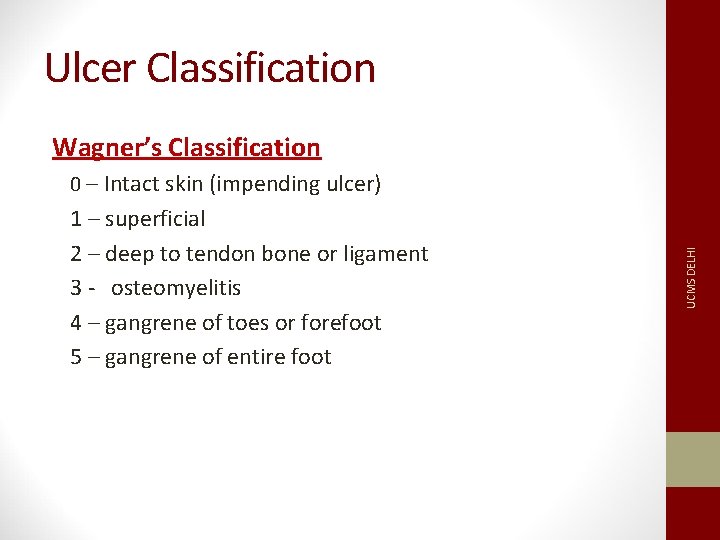
Ulcer Classification Wagner’s Classification 1 – superficial 2 – deep to tendon bone or ligament 3 - osteomyelitis 4 – gangrene of toes or forefoot 5 – gangrene of entire foot UCMS DELHI 0 – Intact skin (impending ulcer)
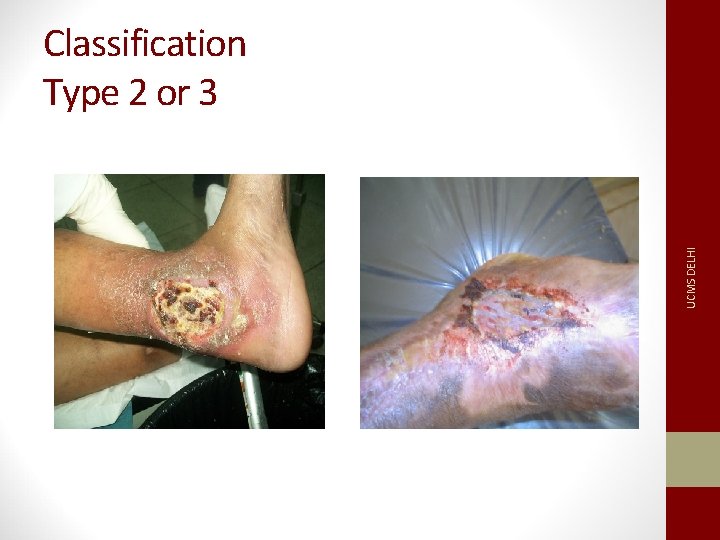
UCMS DELHI Classification Type 2 or 3
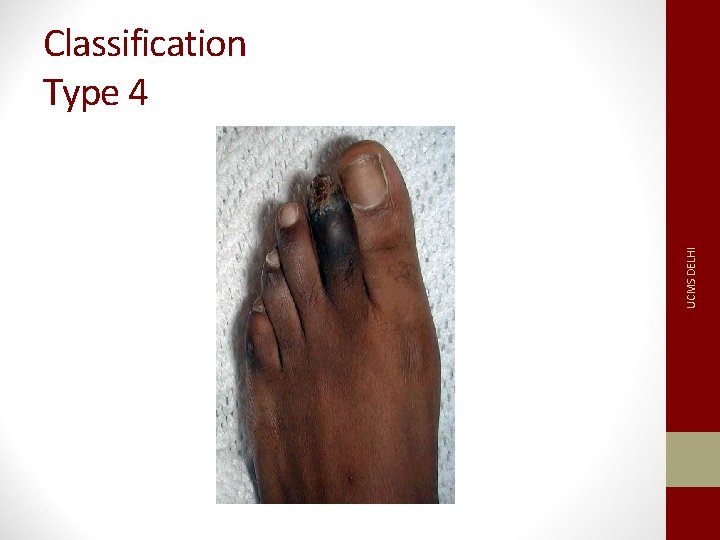
UCMS DELHI Classification Type 4
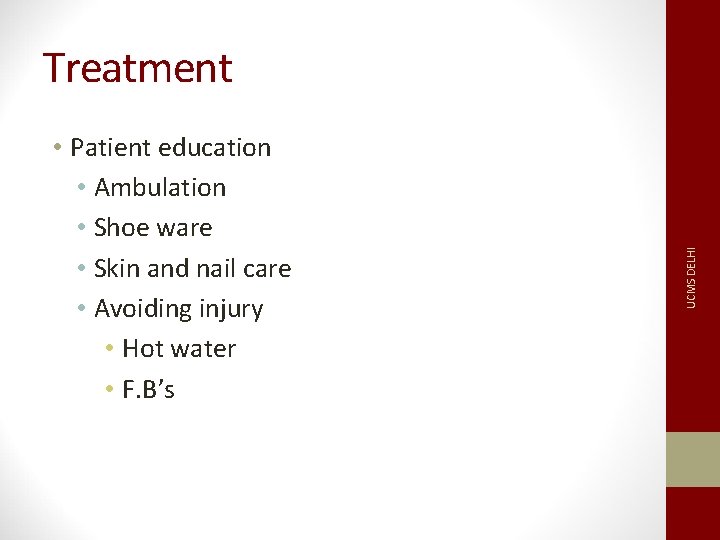
• Patient education • Ambulation • Shoe ware • Skin and nail care • Avoiding injury • Hot water • F. B’s UCMS DELHI Treatment

Six intervention demonstrate efficacy in diabetic foot management 1 - off loading 2 - Debridement and drainage 3 - wound dressing 4 - appropriate use of antibiotic 5 - revascularization 6 - limited amputation
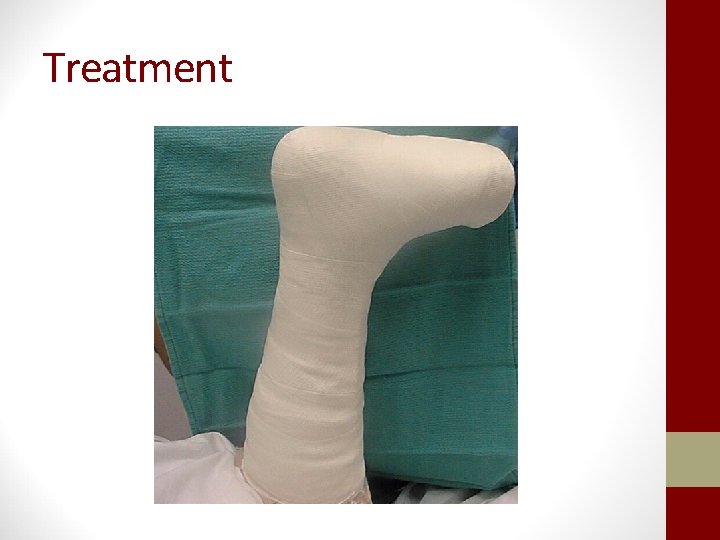
Treatment • Wagner 0 -2 • Total contact cast • Distributes pressure and allows patients to continue ambulation • Principles of application • Changes, Padding, removal • Antibiotics if infected
Treatment

Treatment • Wagner 0 -2 • Surgical if deformity present that will reulcerate • Correct deformity • exostectomy
Treatment • Wagner 3 • Excision of infected bone • Wound allowed to granulate • Grafting (skin or bone) not generally effective
Treatment • Wagner 4 -5 • Amputation • ? level

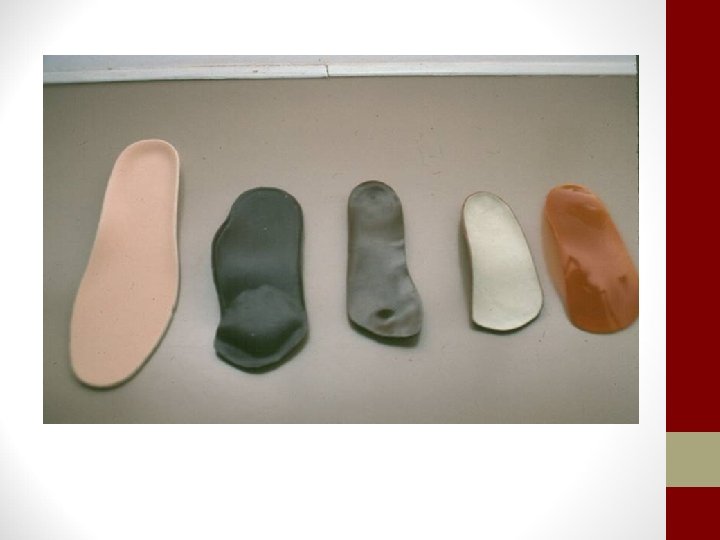
Treatment • After ulcer healed • Orthopedic shoes with accommodative (custom made insert) • Education to prevent recurrence
Charcot Foot • More dramatic – less common 1% • Severe non-infective bony collapse with secondary ulceration • Two theories • Neurotraumatic • Neurovascular
Charcot Foot • Neurotraumatic • Decreased sensation + repetitive trauma = joint and bone collapse • Neurovascular • Increased blood flow → increased osteoclast activity → osteopenia → Bony collapse • Glycolization of ligaments → brittle and fail → Joint collapse

Classification • Eichenholtz • 1 – acute inflammatory process • Often mistaken for infection • 2 – coalescing phase • 3 - consolidation

Indications for Amputation • Uncontrollable infection or sepsis • Inability to obtain a plantar grade, dry foot that can tolerate weight bearing • Non-ambulatory patient • Decision not always straightforward
Conclusion • Multi-disciplinary approach needed • Going to be an increasing problem • High morbidity and cost • Solution is probably in prevention • Most feet can be spared…at least for a while
Prevention • Diabetic control • Foot care
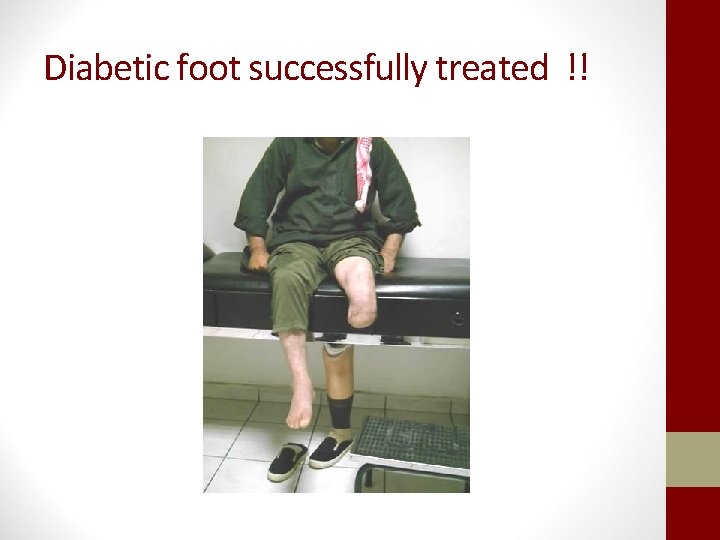
Diabetic foot successfully treated !!
- Slides: 43