
Diabetes Update Ching Yee Ngan Medication Review Pharmacist
Diabetes Update Ching Yee Ngan Medication Review Pharmacist City and Hackney CCG
Contents • • Joint formulary – diabetes QIPP, including joint guideline Diabetes clinical update SGLT-2 inhibitors Free. Style Libre MUR and NMS Case studies
Learning Objectives • To familiarise with the C&H joint formulary for diabetes, QIPP and joint guideline • To understand the current NICE guidance on T 2 diabetes • To improve knowledge on important current evidence in diabetes, including SGLT-2 inhibitors • To learn the up-to-date info on Free. Style Libre • To discuss MUR and NMS for diabetic patients

Diabetes Formulary Update Summary Table Class Drug Formulary Status Sulfonylureas (SU) Gliclazide 1 st line SU SU Glibenclamide, glipizide and glimepride 2 nd line SU SU Tolbutamide Specialist initiation Other antidiabetic drugs Acarbose Specialist initiation Dipeptidylpeptidase-4 (DPP-4) inhibitor Sitagliptin 1 st line DPP-4 Inhibitor Linagliptin New addition Rational / info Alternative for patients with impaired and fluctuating renal function.

Diabetes Formulary Update Summary Table Class Drug Formulary Status Rational / Info Sodium-Glucose Co -Transporter 2 (SGLT 2) Inhibitor Empagliflozin Specialist initiation, 1 st line NICE TA SGLT 2 Inhibitor SGLT 2 inhibitor Dapagliflozin Specialist initiation NICE TA SGLT 2 inhibitor Canagliflozin Specialist initiation NICE TA

Diabetes Formulary Update Summary Table Class Drug Formulary Status Rational / Info Glucagon-like Liraglutide peptide-1 receptor OD dosing agonist (GLP-1) Specialist initiation NICE TA GLP-1 Exenatide BD dosing Non-formulary Not for initiation GLP-1 Exenatide M/R Once a week dosing Specialist initiation NICE TA GLP-1 Lixisenatide OD dosing Specialist initiation New addition Cheapest GLP-1 receptor agonist GLP-1 Dulaglutide Once a week dosing Specialist initiation New addition Easier device to use compared with exenatide MR
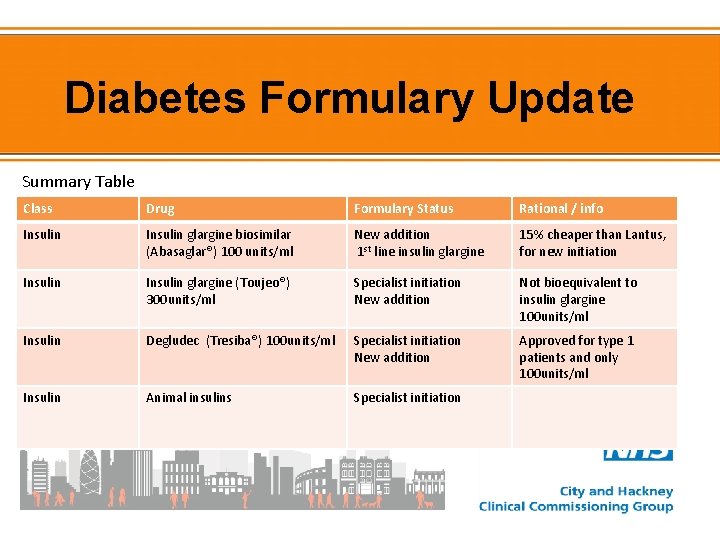
Diabetes Formulary Update Summary Table Class Drug Formulary Status Rational / info Insulin glargine biosimilar (Abasaglar®) 100 units/ml New addition 1 st line insulin glargine 15% cheaper than Lantus, for new initiation Insulin glargine (Toujeo®) 300 units/ml Specialist initiation New addition Not bioequivalent to insulin glargine 100 units/ml Insulin Degludec (Tresiba®) 100 units/ml Specialist initiation New addition Approved for type 1 patients and only 100 units/ml Insulin Animal insulins Specialist initiation
Linagliptin • DPP-4 inhibitor • Excreted primarily unchanged via the faeces • Dose adjustment not required in patients with renal impairment
Dulaglutide • • GLP-1 agonist Initiated by diabetes specialist if once a week dosing is preferred and: v Unable to use exenatide MR (Bydureon®) device and/or v With renal impairment of e. GFR ≥ 30 ml/min/1. 73 m² but ≤ 50 ml/min/1. 73 m² when Bydureon® cannot be used and/or v Use is in combination with insulins • Use in line with NICE NG 28
Lixisenatide • • • GLP-1 agonist Once a day SC preparation Cost effective alternative Initiation by diabetes specialist Use in line with NICE NG 28
Biosimilar Insulin Glargine • • • Abasaglar® 100 units in 1 ml Available as cartridge and prefilled pen (Kwikpen) What is a biosimilar? v A biological medicine developed to be highly similar and clinically equivalent to an existing biological medicine (reference medicine) v Similarity in terms of quality, structural characteristics, biological activity, safety and efficacy v Not the same as generic medicines
Insulin Glargine High Strength • • • Toujeo® 300 units in 1 ml Injection may be less painful due to smaller volume needed, especially Type 2 patients who are very insulin resistant and use very high basal insulin doses Could be considered in patients on 60 units or more of insulin glargine 100 units in 1 ml Not bioequivalent to insulin glargine 100 units/ml Brand prescribing important Initiation by diabetes specialist only
Insulin Degludec Tresiba® 100 units in 1 ml Most expensive insulin Approved for Type 1 adults if other long acting insulin analogues not effective and where: v Patients would benefit from flexible dosing, insulin degludec allows varying daily injection time v Patients have erratic blood glucose control or recurrent hypo, before progression to insulin pump • Secondary care initiation • • •
QIPP • Analogue long acting/human NPH insulin switching • Switching tolbutamide to gliclazide or repaglinide if appropriate • Reducing hypoglycaemia in T 2 patients on insulin and/or sulfonylureas – older people ≥ 65, low Hb. A 1 c <7% (53 mmol/mol), reduced renal function, co-morbidities, interacting drugs
Guideline • Choice of blood glucose meters, testing strips and lancets in adults with uncomplicated type 2 diabetes v v TEE 2 Contour Accu-Chek Performa Accu-Chek Mobile test cassette
Self-monitoring of blood glucose for type 2 diabetes (NICE NG 28) • Take the DVLA guide to the current medical standards of fitness to drive into account when offering self monitoring of blood glucose levels for adults with T 2 DM • Do not routinely offer self-monitoring of blood glucose levels for adults with T 2 DM unless: v the person is on insulin OR v there is evidence of hypoglycaemic episodes OR v the person is on oral medication that may increase their risk of hypoglycaemia while driving or operating machinery OR v the person is pregnant, or is planning to become pregnant OR v Consider short-term self-monitoring when starting treatment with oral or IV corticosteroids or to confirm suspected hypo
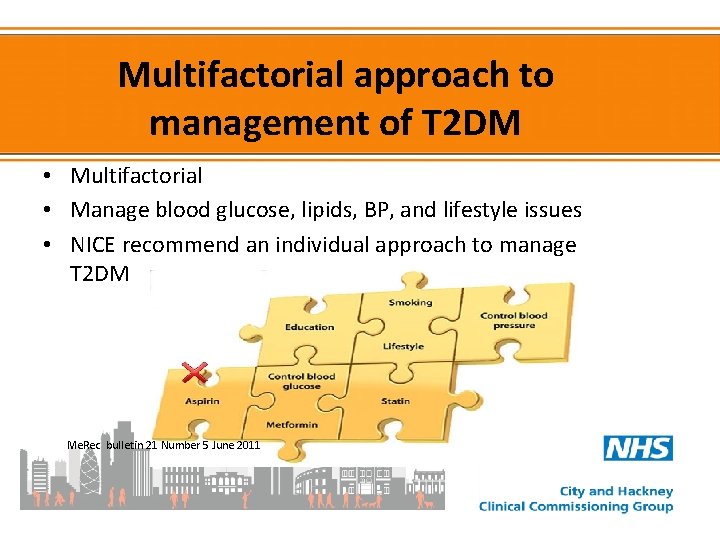
Multifactorial approach to management of T 2 DM • Multifactorial • Manage blood glucose, lipids, BP, and lifestyle issues • NICE recommend an individual approach to manage T 2 DM Me. Rec bulletin 21 Number 5 June 2011

Algorithm for blood glucose lowering therapy (NICE NG 28) • INSERT ALGORITHM 18
CV Risk Management NICE guidance regarding blood pressure management: • BP of < 130/80 mm. Hg if kidney, eye or cerebrovascular damage • Otherwise < 140/80 mm. Hg for most people with T 2 DM • ACEI is 1 st line – except in Afro-Caribbean decent or women likely to become pregnant • African-Caribbean: ACEI plus CCB or diuretic • Likely to become pregnant: CCB
CV Risk Management NICE guidance regarding statins in T 2 DM: • Offer atorvastatin 20 mg for primary prevention to T 2 patients who have a 10% or greater 10 -year risk of developing CVD NICE guidance regarding antiplatelet therapy: • Do not offer antiplatelet therapy (aspirin or clopidogrel) for T 2 adults without CVD
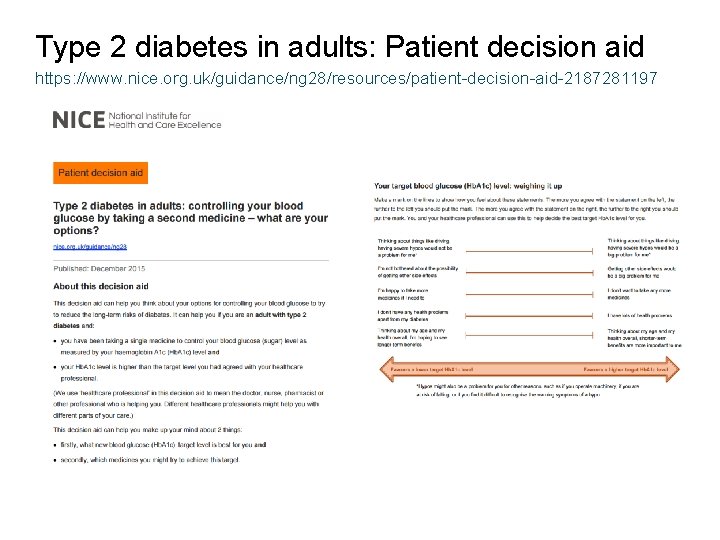
Type 2 diabetes in adults: Patient decision aid https: //www. nice. org. uk/guidance/ng 28/resources/patient-decision-aid-2187281197
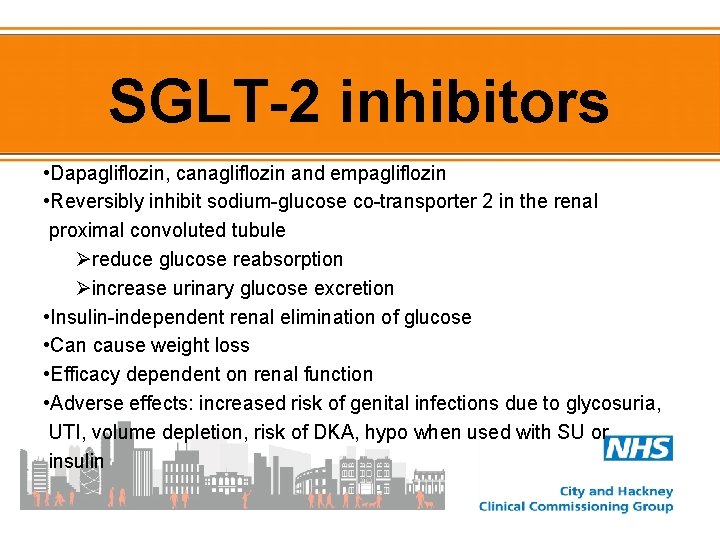
SGLT-2 inhibitors • Dapagliflozin, canagliflozin and empagliflozin • Reversibly inhibit sodium-glucose co-transporter 2 in the renal proximal convoluted tubule Øreduce glucose reabsorption Øincrease urinary glucose excretion • Insulin-independent renal elimination of glucose • Can cause weight loss • Efficacy dependent on renal function • Adverse effects: increased risk of genital infections due to glycosuria, UTI, volume depletion, risk of DKA, hypo when used with SU or insulin
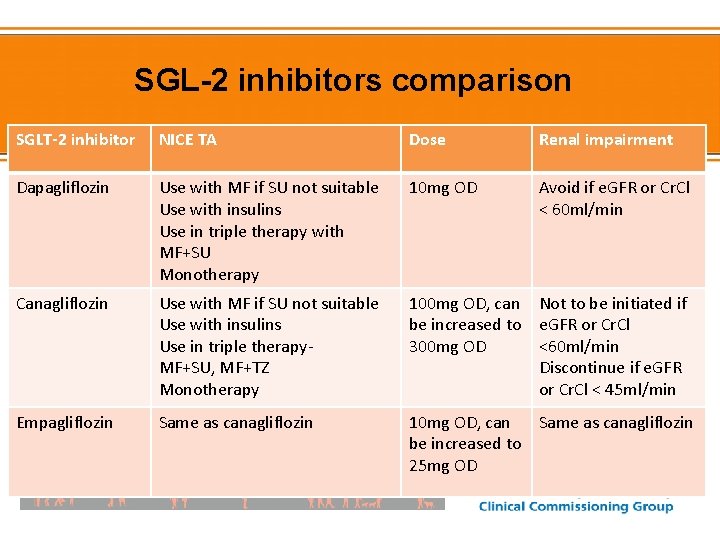
SGL-2 inhibitors comparison SGLT-2 inhibitor NICE TA Dose Renal impairment Dapagliflozin Use with MF if SU not suitable Use with insulins Use in triple therapy with MF+SU Monotherapy 10 mg OD Avoid if e. GFR or Cr. Cl < 60 ml/min Canagliflozin Use with MF if SU not suitable Use with insulins Use in triple therapy. MF+SU, MF+TZ Monotherapy 100 mg OD, can Not to be initiated if be increased to e. GFR or Cr. Cl 300 mg OD <60 ml/min Discontinue if e. GFR or Cr. Cl < 45 ml/min Empagliflozin Same as canagliflozin 10 mg OD, can Same as canagliflozin be increased to 25 mg OD
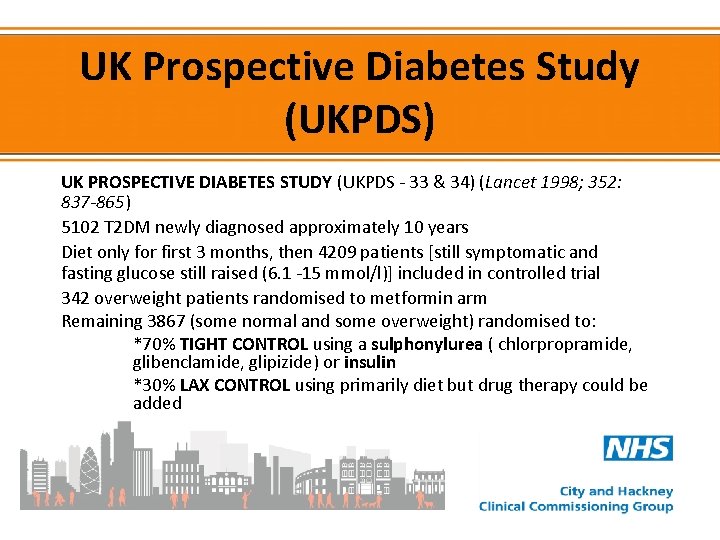
UK Prospective Diabetes Study (UKPDS) UK PROSPECTIVE DIABETES STUDY (UKPDS - 33 & 34) (Lancet 1998; 352: 837 -865) 5102 T 2 DM newly diagnosed approximately 10 years Diet only for first 3 months, then 4209 patients [still symptomatic and fasting glucose still raised (6. 1 -15 mmol/l)] included in controlled trial 342 overweight patients randomised to metformin arm Remaining 3867 (some normal and some overweight) randomised to: *70% TIGHT CONTROL using a sulphonylurea ( chlorpropramide, glibenclamide, glipizide) or insulin *30% LAX CONTROL using primarily diet but drug therapy could be added
UKPDS Outcomes • Results - TIGHT Hb. A 1 c 7. 0% vs LAX group Hb. A 1 c 7. 7% • TIGHTER CONTROL carried: v 12% reduced risk for any diabetes complication (macro or microvascular) v 25% reduced risk for microvascular end points (mainly retinal laser therapy) v 24% reduced risk for cataract extraction • No difference in risk reduction in the TIGHT group between drugs (but study not adequately powered to distinguish) • Each 1% reduction in Hb. A 1 c is associated with: v 21% reduction in the risk of diabetes-related death v 14 % reduction in MI over 10 yrs
UKPDS Outcomes Overweight Metformin group: • fewer diabetes related major complications & diabetes related deaths than other drugs • 39% reduction in MI • 32% risk reduction for any diabetes-related end point • 42% risk reduction for diabetes related death • 36% risk reduction for all cause mortality • no effect of lowering blood glucose on CVD observed
EMPA-REG OUTCOME (2015) • CV outcome trial for empagliflozin over 3 yrs • 7020 patients with T 2 DM and prevalent CVD • Empagliflozin reduced the combined CV endpoint of CV death, non-fatal MI and non-fatal stroke by 14% • Also reduced the individual endpoints of CV death by 38% and hospitalisation for HF by 35% • NNT 39 over 3 yrs to prevent one death • Beneficial effects might be due to wt loss, BP lowering, sodium depletion, renal haemodynamic effects • Class effect? ?
CANVAS trials (2017) CV and renal endpoints studies for canagliflozin over 8 yrs Two trials – CANVAS and CANVAS-R Total of 10, 142 patients with T 2 DM and high CV risk Canagliflozin reduced overall risk of CVD by 14% Also reduced risk of hospitalisation for HF by 33% and cut rate of renal decline by 40% • BUT the risk of lower-limb amputation doubled, mainly the toe and metatarsal • • •
CVD-REAL (2017) • A real world evidence study comparing new users of SGLT-2 inhibitors with new users of other T 2 DM meds • Over 300, 000 patients assessed • 87% patients did not have a history of CVD • Data showed reduction of hospitalisation rate for HF by 39% and all-cause mortality by 51% • Possible benefit of SGLT-2 inhibitors in primary prevention of CVD in T 2 DM? • Results showed class effect
MHRA drug safety update on amputation risk • Canagliflozin may increase risk of lower-limb amputation (mainly toes) – from CANVAS and CANVAS-R studies which involve patients with high CVD • Consider stopping canagliflozin if patients develop foot complications • Dapagliflozin and empagliflozin not shown to have increased risk but this may be a class effect • Preventive foot care important
MHRA drug safety update on risk of DKA When treating patients who are taking an SGLT 2 inhibitor (canagliflozin, dapagliflozin or empagliflozin): • test for raised ketones in patients with symptoms of diabetic ketoacidosis (DKA); omitting this test could delay diagnosis of DKA • if you suspect DKA, stop SGLT 2 inhibitor treatment • if DKA is confirmed, take appropriate measures to correct the DKA and to monitor glucose levels • inform patients of the symptoms and signs of DKA; advise them to get immediate medical help if these occur • be aware that SGLT 2 inhibitors are not approved for treatment of type 1 diabetes
LEADER study • Liraglutide 1. 8 mg vs placebo • Cardiovascular study which involved 9340 T 2 patients with high risk of CV events, over 3. 5 to 5 years • 22% lower rate of CV death • NNT was 66 for the Major Adverse Cardiac Event (MACE) • Class effect unlikely as Lixisenatide in ELIXA study only showed neutral results
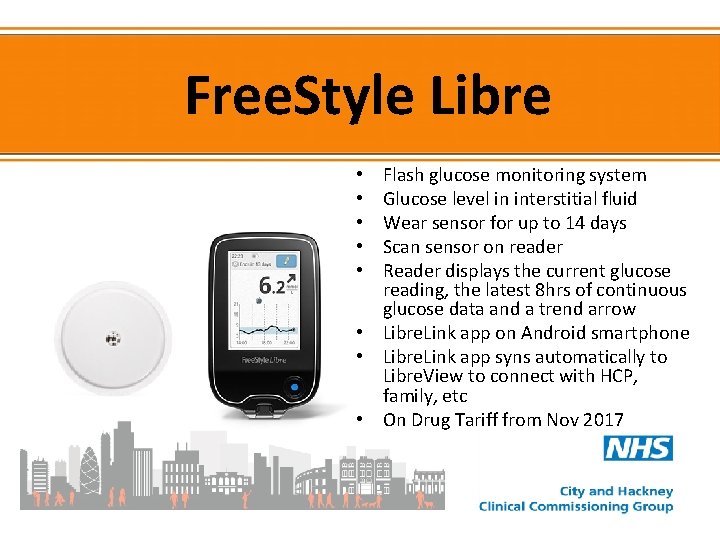
Free. Style Libre Flash glucose monitoring system Glucose level in interstitial fluid Wear sensor for up to 14 days Scan sensor on reader Reader displays the current glucose reading, the latest 8 hrs of continuous glucose data and a trend arrow • Libre. Link app on Android smartphone • Libre. Link app syns automatically to Libre. View to connect with HCP, family, etc • On Drug Tariff from Nov 2017 • • •
Free. Style Libre • • • CCG position Prescribing guidance across NHS in London For T 1 DM , under specialist care, using multiple daily inj (MDI – 4 or more doses of insulin a day) or insulin pump Initiation carried out by local specialist diabetes team Prescribing to be transferred to primary care at 2 mths Transfer of care documents to be used
Free. Style Libre CCG position • Category 1 – T 1 DM on MDI or insulin pump who test frequently v To reduce test strips by at least 8 strips a day (7 in children aged 0 -19 yrs). v Reduction in use of SMBG test strips should be gradual and takes place over the initial 6 wks v Self-funders – primary care prescribing data for test strips prior to initiation and 6 mths post initiation to be reviewed
Free. Style Libre CCG position • Category 2 – T 1 DM with Hb. A 1 c >8. 5% (69. 4 mmol/mol) or disabling hypo who would be eligible for insulin pump as per NICE v To reduce Hb. A 1 c by 0. 6% (6. 6 mmol/mol) and/or reduce severe hypo episodes by 75%, as per NICE v Review of outcomes with specialist around 3 -6 mths v Libre is not a like-for-like alternative to CGM devices or insulin pump v Self-funders – sustained improvements to be demonstrated post initiation over a period of 6 mths or more
Free. Style Libre CCG position • Category 3 – T 1 DM on MDI or insulin pump where conventional monitoring not possible with SMBG testing v To ensure appropriate monitoring of glucose levels v Primary care or specialist to review and determine continuation of prescribing at 6 -8 wks v Not appropriate if adequate monitoring in place even if via a third party; not appropriate if compliance issues are the sole barrier v Self-funders – Prescribing data for test strips to be reviewed for the previous year (also recent meter download info) with consideration of monitoring prior and post initiation of Libre
Free. Style Libre Supply info • Free. Style Libre readers (with one sensor) will be supplied to clinics free of charge by Abbott • The Diabetes Clinical Network and London Procurement Partnership recommend that specialist to supply a further 3 sensors and then long-term continuation in primary care
NMS/MUR General advice/info for patients • • • Symptoms of diabetes - feeling thirsty, need to pass urine a lot and tiredness Advantages of controlling blood sugar include controlling the symptoms and reducing risk of having a heart attack and stroke, having bad foot problems, developing kidney, eye or nerve problems Lifestyle changes important - stopping smoking, exercise and diet; discuss portion size, sugar in drinks Hb. A 1 c blood test done every 6 or 12 months or more frequently, this reflects average blood sugar level over the past 2 -3 months Agree your target Hb. A 1 c with your doctor or nurse The target level could be 48 mmol/mol (6. 5%) or 53 mmol/mol (7%) or higher
NMS/MUR Advice for hypoglycaemia (when BG <4) • • Symptoms: Sweating, pounding heart, tremor, hunger, nausea, headache, confusion, drowsiness, speech difficulty, lack of coordination, atypical behaviour Night time hypos: patients might not be aware, may wake up feeling tired, with a headache or have a hangover sensation. Could check levels if concerned, have night time snack Causes: Incorrect doses, missed meals, insufficient CHO, alcohol, strenuous activity Treatment for mild hypos: Lucozade, fruit juice, cola, glucose tabs, sweets, sugar. If hypo resolved, have some slow-releasing CHO food such as bread, biscuits, fruit, next meal
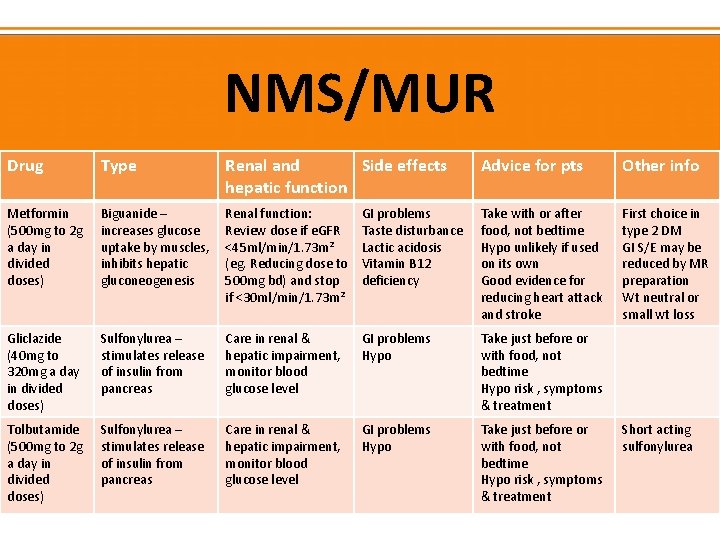
NMS/MUR Drug Type Renal and Side effects hepatic function Advice for pts Other info Metformin (500 mg to 2 g a day in divided doses) Biguanide – increases glucose uptake by muscles, inhibits hepatic gluconeogenesis Renal function: Review dose if e. GFR <45 ml/min/1. 73 m² (eg. Reducing dose to 500 mg bd) and stop if <30 ml/min/1. 73 m² GI problems Taste disturbance Lactic acidosis Vitamin B 12 deficiency Take with or after food, not bedtime Hypo unlikely if used on its own Good evidence for reducing heart attack and stroke First choice in type 2 DM GI S/E may be reduced by MR preparation Wt neutral or small wt loss Gliclazide (40 mg to 320 mg a day in divided doses) Sulfonylurea – stimulates release of insulin from pancreas Care in renal & hepatic impairment, monitor blood glucose level GI problems Hypo Take just before or with food, not bedtime Hypo risk , symptoms & treatment Tolbutamide (500 mg to 2 g a day in divided doses) Sulfonylurea – stimulates release of insulin from pancreas Care in renal & hepatic impairment, monitor blood glucose level GI problems Hypo Take just before or with food, not bedtime Hypo risk , symptoms & treatment Short acting sulfonylurea
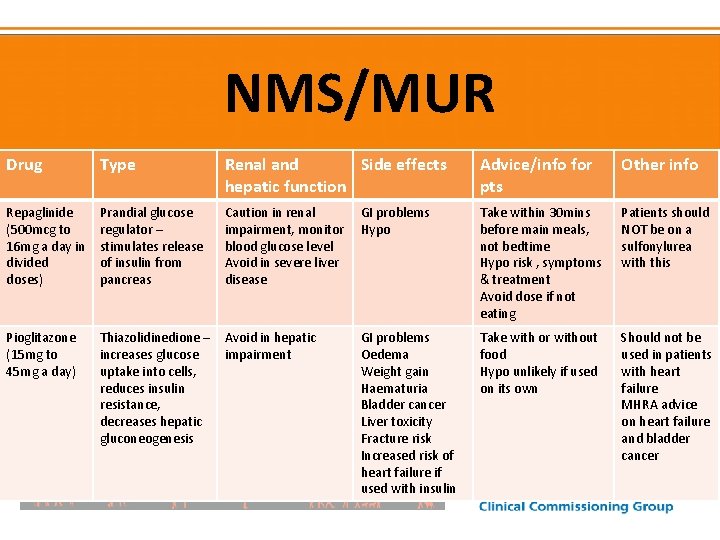
NMS/MUR Drug Type Renal and Side effects hepatic function Advice/info for pts Other info Repaglinide (500 mcg to 16 mg a day in divided doses) Prandial glucose regulator – stimulates release of insulin from pancreas Caution in renal GI problems impairment, monitor Hypo blood glucose level Avoid in severe liver disease Take within 30 mins before main meals, not bedtime Hypo risk , symptoms & treatment Avoid dose if not eating Patients should NOT be on a sulfonylurea with this Pioglitazone (15 mg to 45 mg a day) Thiazolidinedione – Avoid in hepatic increases glucose impairment uptake into cells, reduces insulin resistance, decreases hepatic gluconeogenesis Take with or without food Hypo unlikely if used on its own Should not be used in patients with heart failure MHRA advice on heart failure and bladder cancer GI problems Oedema Weight gain Haematuria Bladder cancer Liver toxicity Fracture risk Increased risk of heart failure if used with insulin
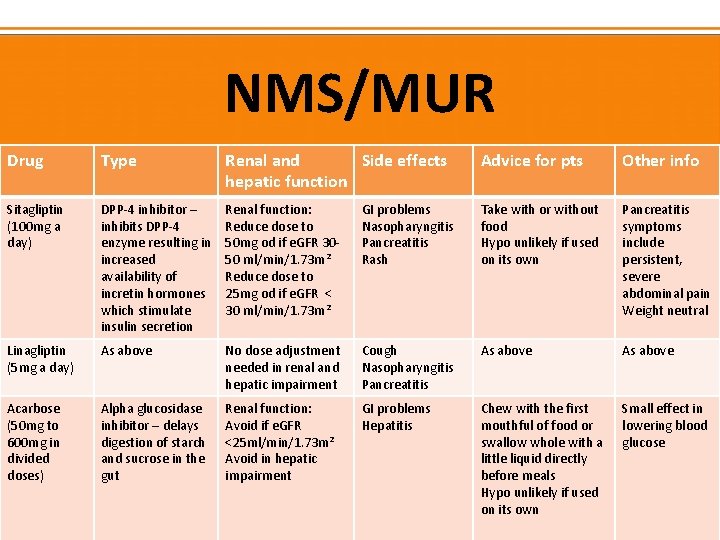
NMS/MUR Drug Type Renal and Side effects hepatic function Advice for pts Other info Sitagliptin (100 mg a day) DPP-4 inhibitor – inhibits DPP-4 enzyme resulting in increased availability of incretin hormones which stimulate insulin secretion Renal function: Reduce dose to 50 mg od if e. GFR 3050 ml/min/1. 73 m² Reduce dose to 25 mg od if e. GFR < 30 ml/min/1. 73 m² GI problems Nasopharyngitis Pancreatitis Rash Take with or without food Hypo unlikely if used on its own Pancreatitis symptoms include persistent, severe abdominal pain Weight neutral Linagliptin (5 mg a day) As above No dose adjustment needed in renal and hepatic impairment Cough Nasopharyngitis Pancreatitis As above Acarbose (50 mg to 600 mg in divided doses) Alpha glucosidase inhibitor – delays digestion of starch and sucrose in the gut Renal function: Avoid if e. GFR <25 ml/min/1. 73 m² Avoid in hepatic impairment GI problems Hepatitis Chew with the first mouthful of food or swallow whole with a little liquid directly before meals Hypo unlikely if used on its own Small effect in lowering blood glucose
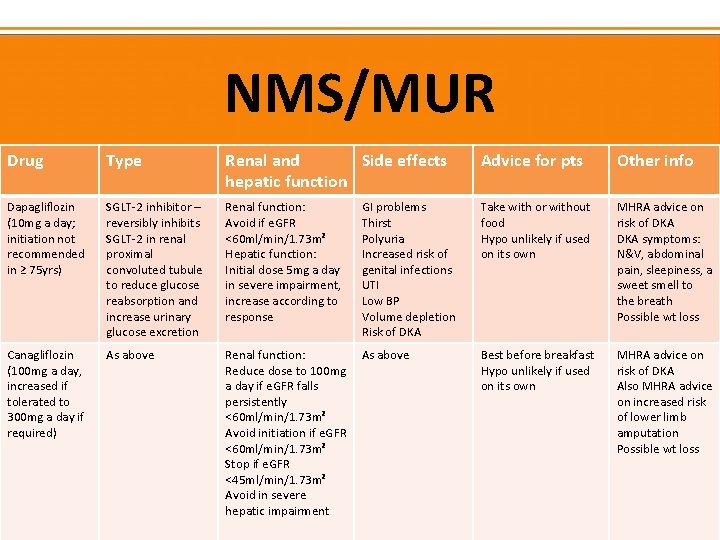
NMS/MUR Drug Type Renal and Side effects hepatic function Advice for pts Other info Dapagliflozin (10 mg a day; initiation not recommended in ≥ 75 yrs) SGLT-2 inhibitor – reversibly inhibits SGLT-2 in renal proximal convoluted tubule to reduce glucose reabsorption and increase urinary glucose excretion Renal function: Avoid if e. GFR <60 ml/min/1. 73 m² Hepatic function: Initial dose 5 mg a day in severe impairment, increase according to response Take with or without food Hypo unlikely if used on its own MHRA advice on risk of DKA symptoms: N&V, abdominal pain, sleepiness, a sweet smell to the breath Possible wt loss Canagliflozin (100 mg a day, increased if tolerated to 300 mg a day if required) As above Renal function: As above Reduce dose to 100 mg a day if e. GFR falls persistently <60 ml/min/1. 73 m² Avoid initiation if e. GFR <60 ml/min/1. 73 m² Stop if e. GFR <45 ml/min/1. 73 m² Avoid in severe hepatic impairment Best before breakfast Hypo unlikely if used on its own MHRA advice on risk of DKA Also MHRA advice on increased risk of lower limb amputation Possible wt loss GI problems Thirst Polyuria Increased risk of genital infections UTI Low BP Volume depletion Risk of DKA
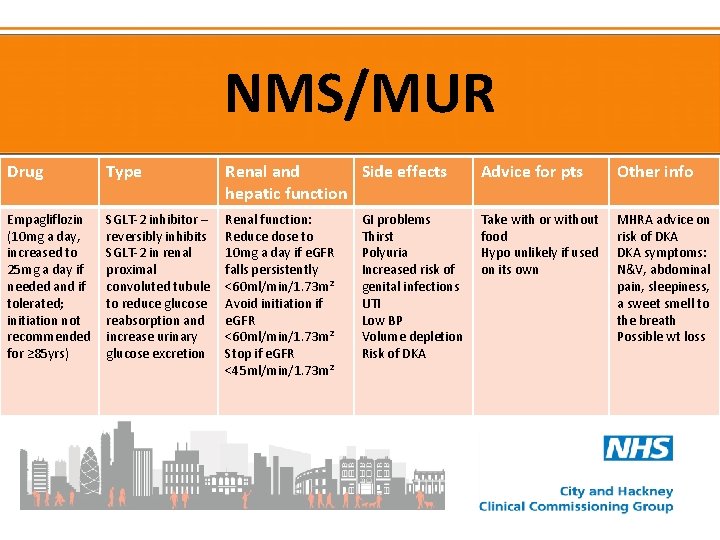
NMS/MUR Drug Type Renal and Side effects hepatic function Advice for pts Other info Empagliflozin (10 mg a day, increased to 25 mg a day if needed and if tolerated; initiation not recommended for ≥ 85 yrs) SGLT-2 inhibitor – reversibly inhibits SGLT-2 in renal proximal convoluted tubule to reduce glucose reabsorption and increase urinary glucose excretion Renal function: Reduce dose to 10 mg a day if e. GFR falls persistently <60 ml/min/1. 73 m² Avoid initiation if e. GFR <60 ml/min/1. 73 m² Stop if e. GFR <45 ml/min/1. 73 m² Take with or without food Hypo unlikely if used on its own MHRA advice on risk of DKA symptoms: N&V, abdominal pain, sleepiness, a sweet smell to the breath Possible wt loss GI problems Thirst Polyuria Increased risk of genital infections UTI Low BP Volume depletion Risk of DKA
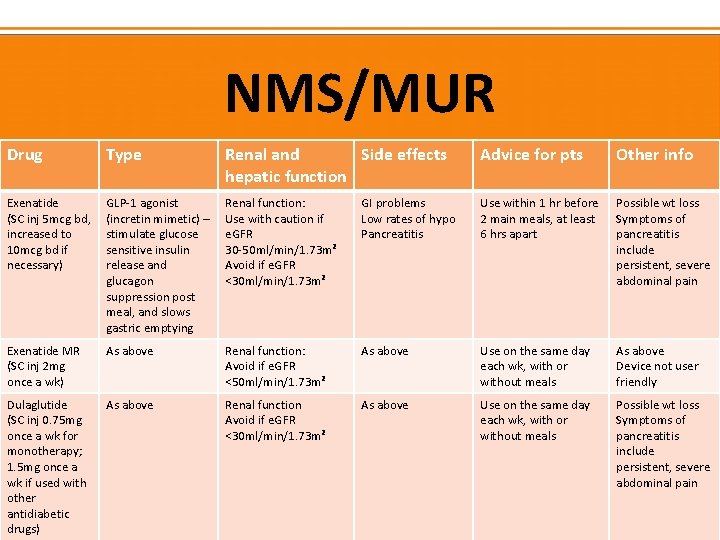
NMS/MUR Drug Type Renal and Side effects hepatic function Advice for pts Other info Exenatide (SC inj 5 mcg bd, increased to 10 mcg bd if necessary) GLP-1 agonist (incretin mimetic) – stimulate glucose sensitive insulin release and glucagon suppression post meal, and slows gastric emptying Renal function: Use with caution if e. GFR 30 -50 ml/min/1. 73 m² Avoid if e. GFR <30 ml/min/1. 73 m² GI problems Low rates of hypo Pancreatitis Use within 1 hr before 2 main meals, at least 6 hrs apart Possible wt loss Symptoms of pancreatitis include persistent, severe abdominal pain Exenatide MR (SC inj 2 mg once a wk) As above Renal function: Avoid if e. GFR <50 ml/min/1. 73 m² As above Use on the same day each wk, with or without meals As above Device not user friendly Dulaglutide (SC inj 0. 75 mg once a wk for monotherapy; 1. 5 mg once a wk if used with other antidiabetic drugs) As above Renal function Avoid if e. GFR <30 ml/min/1. 73 m² As above Use on the same day each wk, with or without meals Possible wt loss Symptoms of pancreatitis include persistent, severe abdominal pain
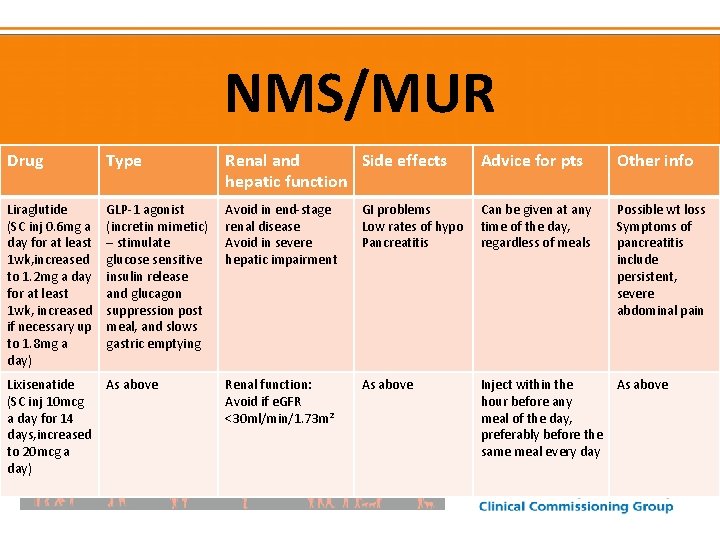
NMS/MUR Drug Type Renal and Side effects hepatic function Advice for pts Other info Liraglutide (SC inj 0. 6 mg a day for at least 1 wk, increased to 1. 2 mg a day for at least 1 wk, increased if necessary up to 1. 8 mg a day) GLP-1 agonist (incretin mimetic) – stimulate glucose sensitive insulin release and glucagon suppression post meal, and slows gastric emptying Avoid in end-stage renal disease Avoid in severe hepatic impairment GI problems Low rates of hypo Pancreatitis Can be given at any time of the day, regardless of meals Possible wt loss Symptoms of pancreatitis include persistent, severe abdominal pain Renal function: Avoid if e. GFR <30 ml/min/1. 73 m² As above Inject within the As above hour before any meal of the day, preferably before the same meal every day Lixisenatide As above (SC inj 10 mcg a day for 14 days, increased to 20 mcg a day)
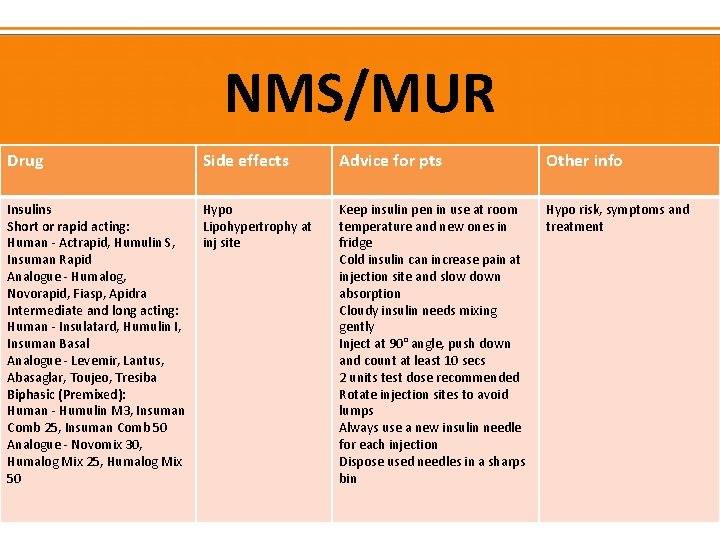
NMS/MUR Drug Side effects Advice for pts Other info Insulins Short or rapid acting: Human - Actrapid, Humulin S, Insuman Rapid Analogue - Humalog, Novorapid, Fiasp, Apidra Intermediate and long acting: Human - Insulatard, Humulin I, Insuman Basal Analogue - Levemir, Lantus, Abasaglar, Toujeo, Tresiba Biphasic (Premixed): Human - Humulin M 3, Insuman Comb 25, Insuman Comb 50 Analogue - Novomix 30, Humalog Mix 25, Humalog Mix 50 Hypo Lipohypertrophy at inj site Keep insulin pen in use at room temperature and new ones in fridge Cold insulin can increase pain at injection site and slow down absorption Cloudy insulin needs mixing gently Inject at 90° angle, push down and count at least 10 secs 2 units test dose recommended Rotate injection sites to avoid lumps Always use a new insulin needle for each injection Dispose used needles in a sharps bin Hypo risk, symptoms and treatment
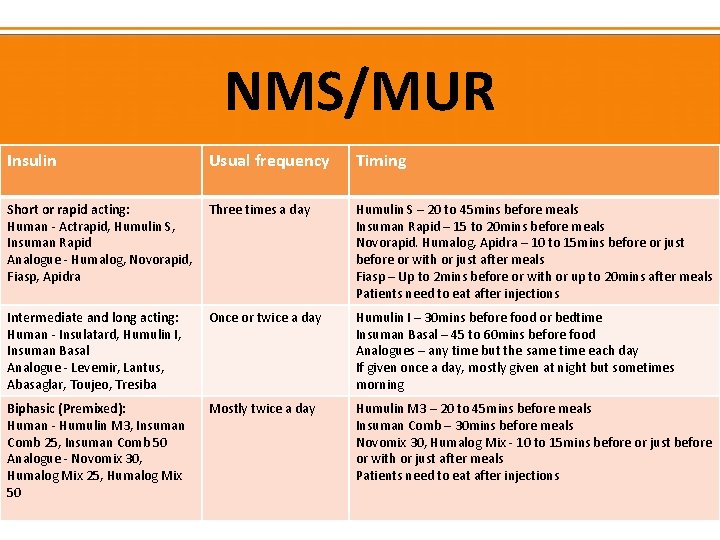
NMS/MUR Insulin Usual frequency Timing Short or rapid acting: Three times a day Human - Actrapid, Humulin S, Insuman Rapid Analogue - Humalog, Novorapid, Fiasp, Apidra Humulin S – 20 to 45 mins before meals Insuman Rapid – 15 to 20 mins before meals Novorapid. Humalog, Apidra – 10 to 15 mins before or just before or with or just after meals Fiasp – Up to 2 mins before or with or up to 20 mins after meals Patients need to eat after injections Intermediate and long acting: Human - Insulatard, Humulin I, Insuman Basal Analogue - Levemir, Lantus, Abasaglar, Toujeo, Tresiba Once or twice a day Humulin I – 30 mins before food or bedtime Insuman Basal – 45 to 60 mins before food Analogues – any time but the same time each day If given once a day, mostly given at night but sometimes morning Biphasic (Premixed): Human - Humulin M 3, Insuman Comb 25, Insuman Comb 50 Analogue - Novomix 30, Humalog Mix 25, Humalog Mix 50 Mostly twice a day Humulin M 3 – 20 to 45 mins before meals Insuman Comb – 30 mins before meals Novomix 30, Humalog Mix - 10 to 15 mins before or just before or with or just after meals Patients need to eat after injections
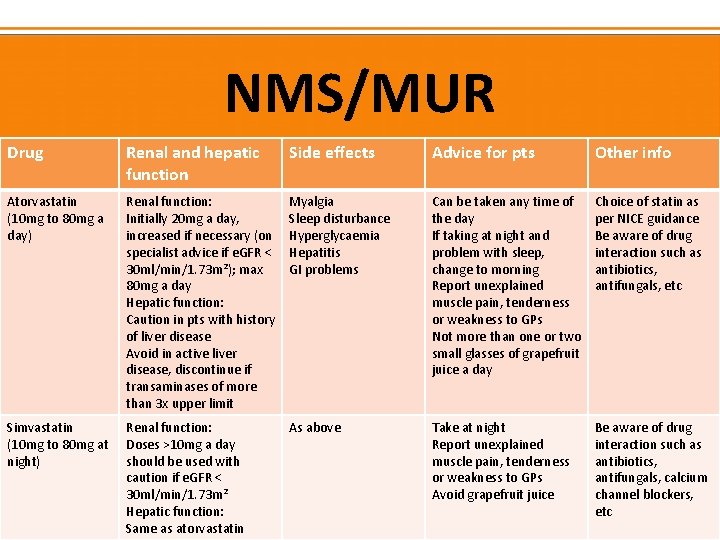
NMS/MUR Drug Renal and hepatic function Side effects Advice for pts Other info Atorvastatin (10 mg to 80 mg a day) Renal function: Initially 20 mg a day, increased if necessary (on specialist advice if e. GFR < 30 ml/min/1. 73 m²); max 80 mg a day Hepatic function: Caution in pts with history of liver disease Avoid in active liver disease, discontinue if transaminases of more than 3 x upper limit Myalgia Sleep disturbance Hyperglycaemia Hepatitis GI problems Can be taken any time of the day If taking at night and problem with sleep, change to morning Report unexplained muscle pain, tenderness or weakness to GPs Not more than one or two small glasses of grapefruit juice a day Choice of statin as per NICE guidance Be aware of drug interaction such as antibiotics, antifungals, etc Simvastatin (10 mg to 80 mg at night) Renal function: Doses >10 mg a day should be used with caution if e. GFR < 30 ml/min/1. 73 m² Hepatic function: Same as atorvastatin As above Take at night Report unexplained muscle pain, tenderness or weakness to GPs Avoid grapefruit juice Be aware of drug interaction such as antibiotics, antifungals, calcium channel blockers, etc
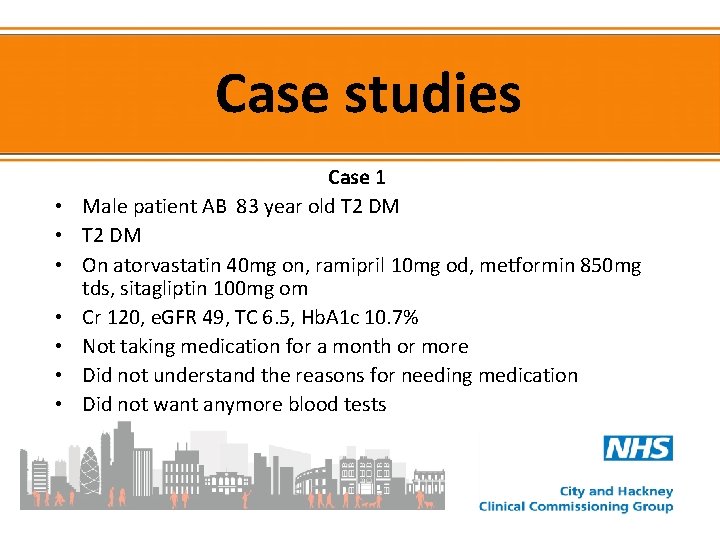
Case studies • • Case 1 Male patient AB 83 year old T 2 DM On atorvastatin 40 mg on, ramipril 10 mg od, metformin 850 mg tds, sitagliptin 100 mg om Cr 120, e. GFR 49, TC 6. 5, Hb. A 1 c 10. 7% Not taking medication for a month or more Did not understand the reasons for needing medication Did not want anymore blood tests
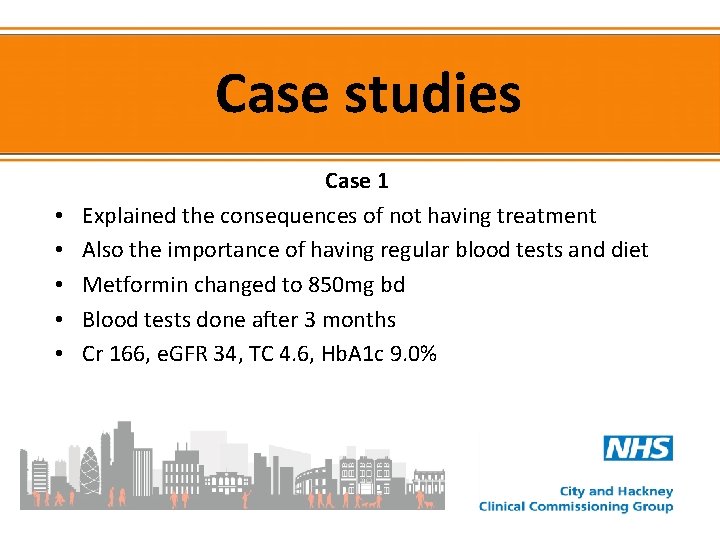
Case studies • • • Case 1 Explained the consequences of not having treatment Also the importance of having regular blood tests and diet Metformin changed to 850 mg bd Blood tests done after 3 months Cr 166, e. GFR 34, TC 4. 6, Hb. A 1 c 9. 0%
Case studies • • Case 1 Metformin reduced to 500 mg bd, sitagliptin changed to linagliptin 5 mg od Referred to DSN Repaglinide 0. 5 mg tds added Blister pack started
Case studies • • • Case 2 Female patient CD, 54 year old T 2 DM On metformin 2 x 850 mg bd, Novorapid flexpen 6 units tds and Lantus solostar 18 units on Cr 112, e. GFR 44, Hb. A 1 c 11. 6% Keeping all insulin pens in fridge Confused about timing of insulins
Case studies • • • Case 2 Advised patient to keep insulin pens in use at room temp Patient said hypo sometimes if using Novorapid 15 to 20 mins before food whilst she was preparing her meals, also had evening meal late, around 9 -10 pm Suggested to have Novorapid just before meals or with meals and have evening meal earlier Metformin reduced to 850 mg bd Blood tests done after a few months: Cr 85, e. GFR 60, Hb. A 1 c 9. 5%
Case studies • • • Case 3 Female patient EF, 77 year old T 2 DM Cr 115, e. GFR 49, TC 5. 5, Hb. A 1 c 7. 2% On metformin 1 g tds, insulin glargine 100 units/ml pen 40 units om, tolbutamide 500 mg bd, simvastatin 40 mg on Occasional hypo 2 x/wk, BG could be as low as 2 Simvastatin dose missed sometimes, problem with sleep
Case studies • • • Case 3 Suggested to reduce metformin to 1 g bd Insulin glargine confirmed as Lantus Explored the reason for hypo eg. Missing meals? Insufficient carb for dinner? Treatment needing adjustment? Changed simvastatin to atorvastatin 40 mg om Discussed patient with practice nurse, referred to DSN Blood tests done after a few months: Cr 91, e. GFR 61, TC 4. 1, Hb. A 1 c 7. 4%
Too much stock? ? • Too many insulin pens, lancets, testing strips, needles at home • Don’t forget most insulin pens/cartridges have 300 units in 3 ml • How can we tackle this problem? Patients / Community Pharmacists / GPs? • Not to supply these items monthly automatically • Always check with patients /family • Need to reduce wastage
Useful websites • All NICE diabetes guidelines; Accessed via http: //www. nice. org. uk • NHS choices www. nhs. uk • Diabetes UK www. diabetes. org. uk • www. diabetes. co. uk – info for patients • Diabetes on the net www. diabetesonthenet. com – access to journals and education for HCP
- Slides: 59