
Diabetes mellitus and pregnany Helen Imseeh pregestational diabetes

Diabetes mellitus and pregnany Helen Imseeh
pregestational diabetes" / "preexisting diabetes
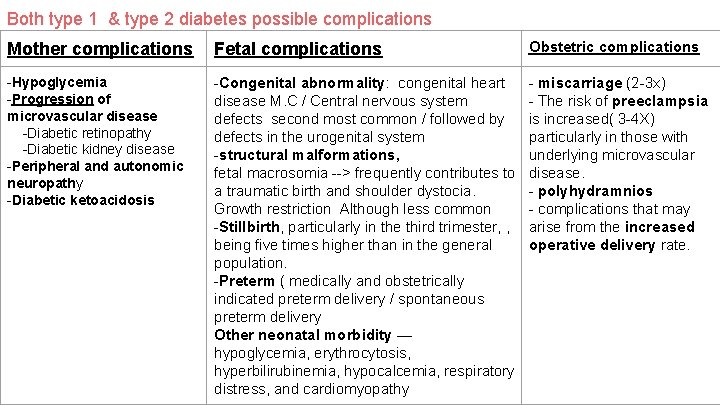
Both type 1 & type 2 diabetes possible complications Mother complications Fetal complications Obstetric complications -Hypoglycemia -Progression of microvascular disease -Diabetic retinopathy -Diabetic kidney disease -Peripheral and autonomic neuropathy -Diabetic ketoacidosis -Congenital abnormality: congenital heart disease M. C / Central nervous system defects second most common / followed by defects in the urogenital system -structural malformations, fetal macrosomia --> frequently contributes to a traumatic birth and shoulder dystocia. Growth restriction Although less common -Stillbirth, particularly in the third trimester, , being five times higher than in the general population. -Preterm ( medically and obstetrically indicated preterm delivery / spontaneous preterm delivery Other neonatal morbidity — hypoglycemia, erythrocytosis, hyperbilirubinemia, hypocalcemia, respiratory distress, and cardiomyopathy - miscarriage (2 -3 x) - The risk of preeclampsia is increased( 3 -4 X) particularly in those with underlying microvascular disease. - polyhydramnios - complications that may arise from the increased operative delivery rate.
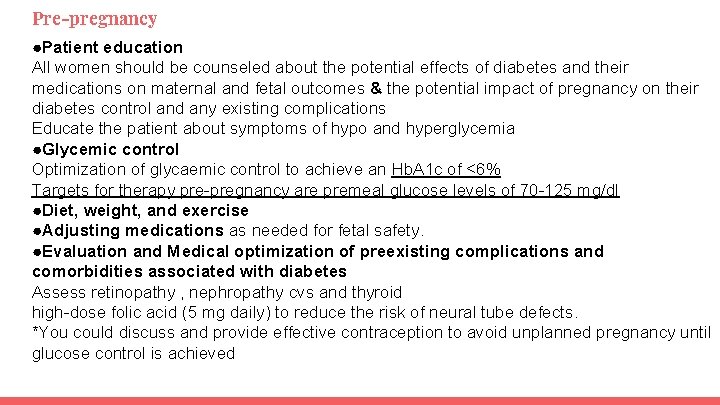
Pre-pregnancy ●Patient education All women should be counseled about the potential effects of diabetes and their medications on maternal and fetal outcomes & the potential impact of pregnancy on their diabetes control and any existing complications Educate the patient about symptoms of hypo and hyperglycemia ●Glycemic control Optimization of glycaemic control to achieve an Hb. A 1 c of <6% Targets for therapy pre-pregnancy are premeal glucose levels of 70 -125 mg/dl ●Diet, weight, and exercise ●Adjusting medications as needed for fetal safety. ●Evaluation and Medical optimization of preexisting complications and comorbidities associated with diabetes Assess retinopathy , nephropathy cvs and thyroid high-dose folic acid (5 mg daily) to reduce the risk of neural tube defects. *You could discuss and provide effective contraception to avoid unplanned pregnancy until glucose control is achieved
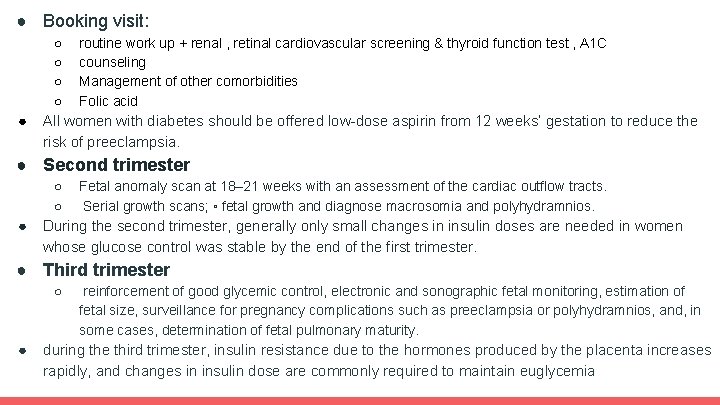
● Booking visit: ○ ○ ● routine work up + renal , retinal cardiovascular screening & thyroid function test , A 1 C counseling Management of other comorbidities Folic acid All women with diabetes should be offered low-dose aspirin from 12 weeks’ gestation to reduce the risk of preeclampsia. ● Second trimester ○ ○ ● Fetal anomaly scan at 18– 21 weeks with an assessment of the cardiac outflow tracts. Serial growth scans; ◦ fetal growth and diagnose macrosomia and polyhydramnios. During the second trimester, generally only small changes in insulin doses are needed in women whose glucose control was stable by the end of the first trimester. ● Third trimester ○ ● reinforcement of good glycemic control, electronic and sonographic fetal monitoring, estimation of fetal size, surveillance for pregnancy complications such as preeclampsia or polyhydramnios, and, in some cases, determination of fetal pulmonary maturity. during the third trimester, insulin resistance due to the hormones produced by the placenta increases rapidly, and changes in insulin dose are commonly required to maintain euglycemia
Management of types 1 and 2 diabetes in pregnancy ● The primary goal is to optimize glycaemic control. ● Blood glucose monitoring is encouraged 7 times a day (before and 2 hour after meals) with targets of 72 -108 mg/dl (4 -6 mmol/l) and 2 -hour postprandial levels of <108 -144 mg/dl (<6 -8 mmol/l) ● use of oral hypoglycaemic agents such as metformin and/or insulin where appropriate,
Delivery ● ● Timing and mode of delivery should be determined on an individual basis. Maternal diabetes alone is not an indication for cesarean birth in the absence of the usual obstetric indications. ○ However, the development of macrosomia or maternal complications such as preeclampsia, together with the rate of failed induction, is such that the caesarean section rate amongst diabetic women often is as high as 50%. In general, provided the pregnancy has gone well, the aim would be to achieve a vaginal delivery at between 38 and 39 weeks. deliver at 36+0 to 38+6 weeks if poorly controlled glucose levels or vascular disease (even earlier if severity of complications warrants earlier delivery); expectant management beyond 40+0 weeks is not recommended

Gestational DM
Pathophysiology Pregnancy is accompanied by insulin resistance Due placental secretion of diabetogenic hormones including growth hormone, corticotropin-releasing hormone, placental lactogen prolactin(Insulin antagonists). Pregnancy is an insulin resistance condition, with changes exacerbated in the 3 rd trimester Pancreas will secret more insulin normally GDM develops during pregnancy in women whose pancreatic function is insufficient to overcome the insulin resistance associated with the pregnant state. Glucose crosses the placenta so fetal glucose follows maternal level normally
CONSEQUENCES OF GDM Short-term : women with true GDM are not at increased risk of having an infant with congenital malformations because the onset of the disorder is after organogenesis, and they do not experience diabetesrelated vasculopathy because of the short duration of the disorder. ● Large for gestational age (LGA) infant and macrosomia Both GDM and obesity are associated with an increased risk of LGA. Truncal asymmetry (disproportion in the ratio of the size of the shoulder- or abdomento-head) in infants of diabetic mothers also appears to increase these risks Macrosomia and fetal truncal asymmetry are associated with an increased risk of operative delivery (cesarean or instrumental vaginal) and adverse neonatal outcomes, such as shoulder dystocia and its associated complications: brachial plexus injury & fracture.
● ● Preeclampsia&gestational hypertension Polyhydramnios Stillbirth. This risk appears to be related primarily to poor glycemic control Neonatal morbidity increased risk of multiple, often transient, morbidities, including hypoglycemia hyperbilirubinemia hypocalcemia Hypomagnesemia Polycythemia respiratory distress and/or cardiomyopathy ● These risks are related, to maternal hyperglycemia. Long-term consequences ● GDM is a strong marker for maternal development of type 2 diabetes, including diabetes-related vascular disease. ● GDM increases the offspring's risk for developing obesity, impaired glucose tolerance, and diabetes. Poorly controlled maternal diabetes during pregnancy may impact neurodevelopmental outcome; however, evidence is circumstantial and of poor quality.
Risk factors ● Personal history of impaired glucose tolerance or gestational diabetes mellitus in a previous pregnancy. ● Ethnic groups, Hispanic American, African American, Native American, South or East Asian ● Family history of diabetes, especially in first-degree relatives ● Pre-pregnancy weight ≥ 110 percent of ideal body weight or BMI >30 kg/m 2, ● Older maternal age (>30 years of age). ● Previous unexplained perinatal loss or birth of a malformed infant. ● Glycosuria at the first prenatal visit. ● Previous birth of an infant ≥ 4000 or 4500 g ● Medical condition such as metabolic syndrome, polycystic ovary syndrome, current use of glucocorticoids, hypertension or cardiovascular disease, acanthosis nigricans. ● Multiple gestation.
Timing of screening/diagnosis While there are no proven benefits to screening/testing for diabetes in early pregnancy, testing can be performed as early as the first prenatal visit if there is a high degree of suspicion that the pregnant woman has undiagnosed type 2 diabetes In the absence of early testing or if early testing is negative, universal screening is performed at 24 to 28 weeks of gestation.
Screening at 24 to 28 weeks of gestation. Screening can be performed as a two-step process where step one identifies individuals at increased risk for the disease so that step two, diagnostic testing, which is definitive but usually more complicated or costly than the screening test, can be limited to these individuals and avoided in low-risk individuals. Alternatively, a diagnostic test can be administered to all individuals, which is a one-step process. One-step and two-step approaches Two-step approach The two-step approach is the most widely used approach for identifying pregnant women with GDM. - The first step is a 50 -gram one-hour glucose challenge test (GCT) without regard to time of day/previous meals. Screen-positive patients go on to the second step, a 100 -gram, three-hour oral glucose tolerance test (GTT), which is the diagnostic test for gestational diabetes mellitus.
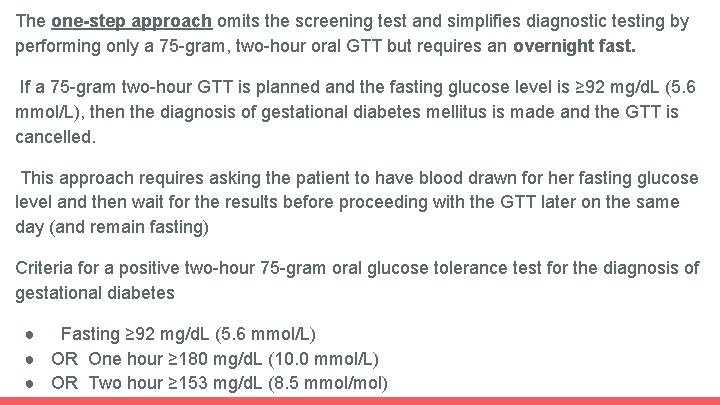
The one-step approach omits the screening test and simplifies diagnostic testing by performing only a 75 -gram, two-hour oral GTT but requires an overnight fast. If a 75 -gram two-hour GTT is planned and the fasting glucose level is ≥ 92 mg/d. L (5. 6 mmol/L), then the diagnosis of gestational diabetes mellitus is made and the GTT is cancelled. This approach requires asking the patient to have blood drawn for her fasting glucose level and then wait for the results before proceeding with the GTT later on the same day (and remain fasting) Criteria for a positive two-hour 75 -gram oral glucose tolerance test for the diagnosis of gestational diabetes ● Fasting ≥ 92 mg/d. L (5. 6 mmol/L) ● OR One hour ≥ 180 mg/d. L (10. 0 mmol/L) ● OR Two hour ≥ 153 mg/d. L (8. 5 mmol/mol)
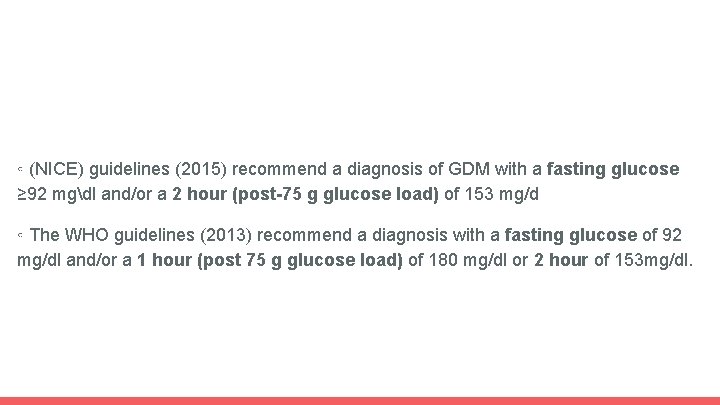
◦ (NICE) guidelines (2015) recommend a diagnosis of GDM with a fasting glucose ≥ 92 mgdl and/or a 2 hour (post-75 g glucose load) of 153 mg/d ◦ The WHO guidelines (2013) recommend a diagnosis with a fasting glucose of 92 mg/dl and/or a 1 hour (post 75 g glucose load) of 180 mg/dl or 2 hour of 153 mg/dl.
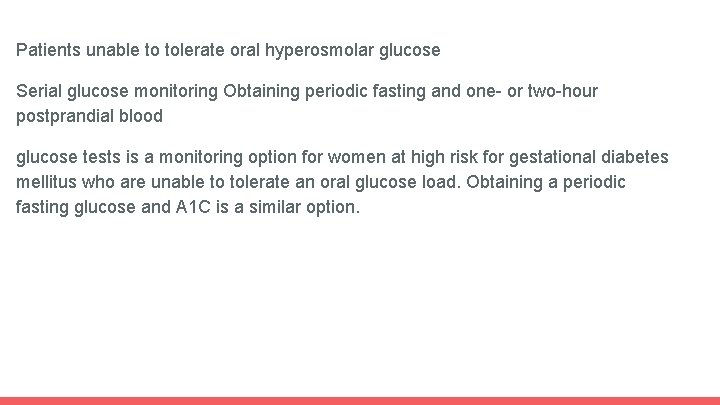
Patients unable to tolerate oral hyperosmolar glucose Serial glucose monitoring Obtaining periodic fasting and one- or two-hour postprandial blood glucose tests is a monitoring option for women at high risk for gestational diabetes mellitus who are unable to tolerate an oral glucose load. Obtaining a periodic fasting glucose and A 1 C is a similar option.
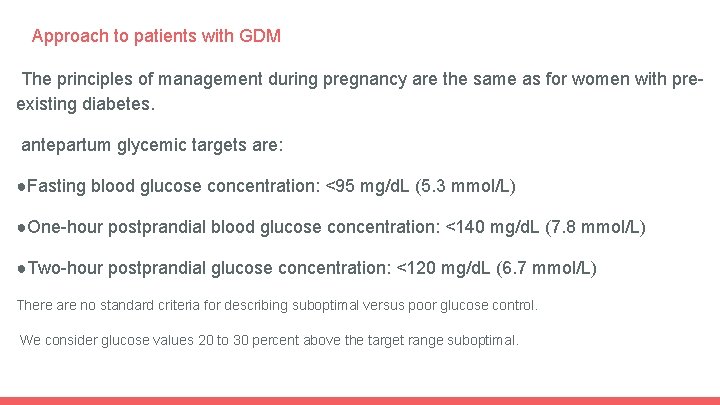
Approach to patients with GDM The principles of management during pregnancy are the same as for women with preexisting diabetes. antepartum glycemic targets are: ●Fasting blood glucose concentration: <95 mg/d. L (5. 3 mmol/L) ●One-hour postprandial blood glucose concentration: <140 mg/d. L (7. 8 mmol/L) ●Two-hour postprandial glucose concentration: <120 mg/d. L (6. 7 mmol/L) There are no standard criteria for describing suboptimal versus poor glucose control. We consider glucose values 20 to 30 percent above the target range suboptimal.
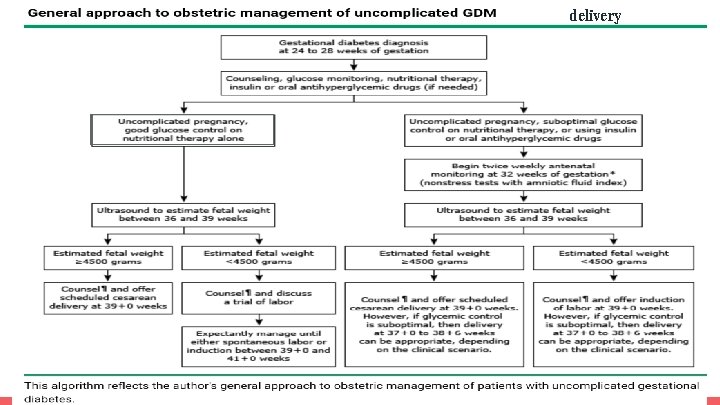
delivery
Insulin requirements usually decrease during labor as oral caloric intake is typically reduced and the work of labor, particularly uterine contractions, requires extra energy. ● Women with GDM who were euglycemic without use of insulin or oral antihyperglycemic drugs during pregnancy do not normally develop hyperglycemia during labor and delivery and thus do not need their blood glucose levels checked. However, because of concerns about the validity of baseline glycemic assessments in the outpatient environment, some practitioners and centers choose to assess blood glucose levels in labor.
● Women with GDM who used insulin or oral antihyperglycemic drugs to maintain antepartum euglycemia may need insulin during labor and delivery to maintain euglycemia. Periodic assessment of maternal glucose levels during labor and treatment of hyperglycemia are prudent, although intrapartum maternal hyperglycemia leading to an adverse neonatal outcome is infrequent. The goal of treatment is to reduce the risk of neonatal hypoglycemia; transient hypoglycemia can be caused by intrapartum maternal hyperglycemia, which induces an acute rise in fetal insulin The Endocrine Society suggests target glucose levels of 72 to 126 mg/d. L (4. 0 to 7. 0 mmol/L) check blood glucose measurements every two hours during labor ● For women undergoing scheduled cesarean delivery, insulin or antihyperglycemic drugs are withheld the morning of surgery and the woman is not allowed any oral intake after midnight.
POSTPARTUM MANAGEMENT AND FOLLOW-UP Women with gestational diabetes mellitus (GDM) should be able to resume a normal diet postpartum. After delivery, the hyperglycemic effects of placental hormones dissipate rapidly. Thus, most women revert back to their pre-pregnancy glycemic status almost immediately. Contraception — While any type of contraception is acceptable, as long as the usual medical contraindications to use are absent, we recommend long-acting reversible contraception (LARC; eg, intrauterine device, contraceptive implant) because of the minimal risk of unplanned pregnancy with these methods Breastfeeding — Breastfeeding should be encouraged, as it benefits both mother and child Breastfeeding improves maternal glucose metabolism and thus may reduce the glucose levels obtained during a postpartum glucose tolerance test
Screening for overt diabetes — Since some women with GDM may have previously unrecognized type 2 diabetes mellitus. check glucose concentrations for 24 to 72 hours after delivery to exclude ongoing hyperglycemia. If fasting glucose concentrations suggest overt diabetes (fasting glucose ≥ 126 mg/d. L [7 mmol/L] or a postprandial glucose is ≥ 200 mg/d. L [11. 1 mmol/L]), treatment of hyperglycemia is warranted. Women who have fasting glucose levels below 126 mg/d. L (7 mmol/L) after delivery should have a two-hour 75 gram oral GTT 4 to 12 weeks postpartum to test for diabetes or prediabetes Women with a normal GTT are counseled about their future risk of developing type 2 diabetes and cardiovascular disease, encouraged to adopt lifestyle changes for risk reduction (eg, healthy diet, weight loss, exercise), and informed about the importance of close follow-up with their primary care provider and rescreening at appropriate intervals.

Resources ● Dr lama’ s slides 5 the year ● OBSTETRICS | 20 th EDITION by Ten Teachers ● Uptodate

Thank you
- Slides: 25