
Diabetes Management in the Hospital Case Studies Bruce
Diabetes Management in the Hospital: Case Studies Bruce W. Bode, MD, FACE Atlanta Diabetes Associates Atlanta, Georgia
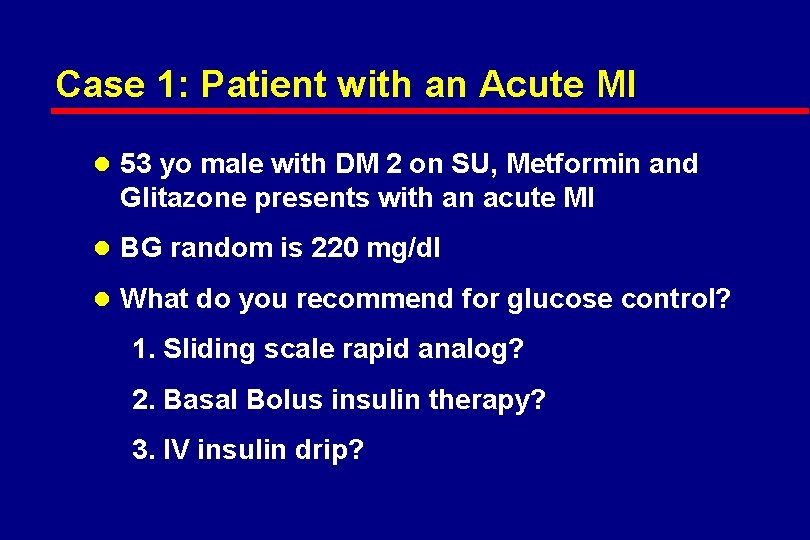
Case 1: Patient with an Acute MI l 53 yo male with DM 2 on SU, Metformin and Glitazone presents with an acute MI l BG random is 220 mg/dl l What do you recommend for glucose control? 1. Sliding scale rapid analog? 2. Basal Bolus insulin therapy? 3. IV insulin drip?
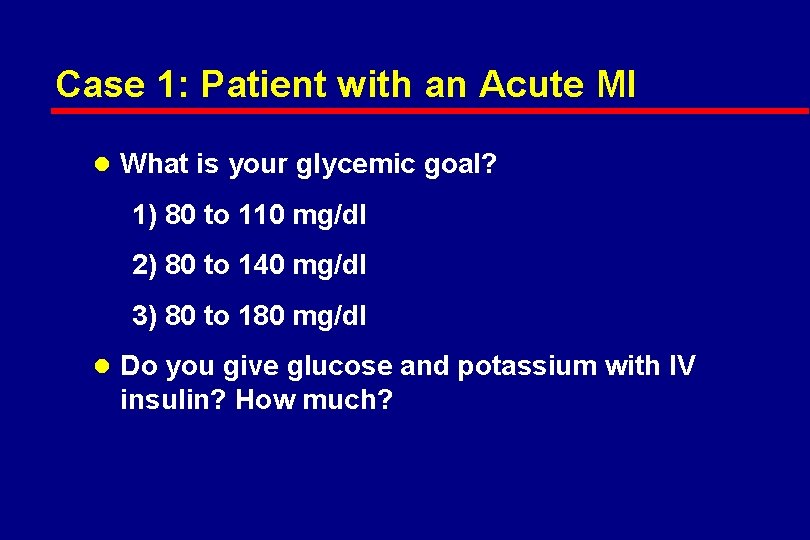
Case 1: Patient with an Acute MI l What is your glycemic goal? 1) 80 to 110 mg/dl 2) 80 to 140 mg/dl 3) 80 to 180 mg/dl l Do you give glucose and potassium with IV insulin? How much?
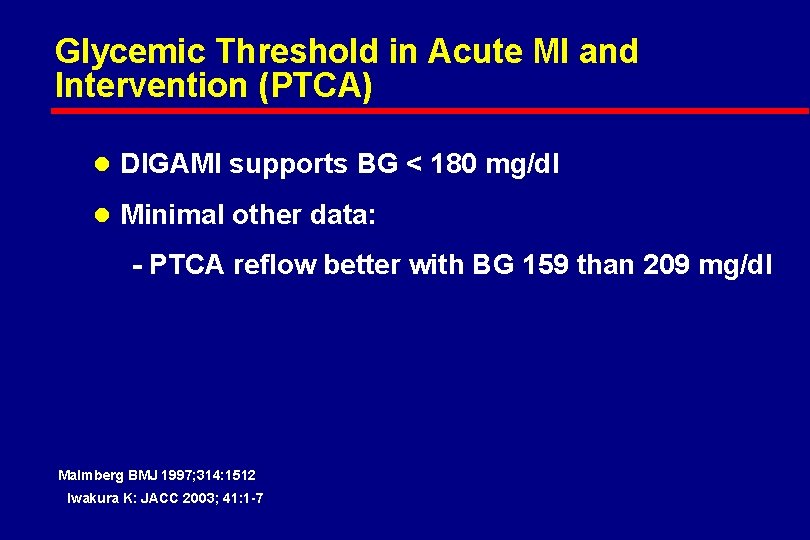
Glycemic Threshold in Acute MI and Intervention (PTCA) l DIGAMI supports BG < 180 mg/dl l Minimal other data: - PTCA reflow better with BG 159 than 209 mg/dl Malmberg BMJ 1997; 314: 1512 Iwakura K: JACC 2003; 41: 1 -7
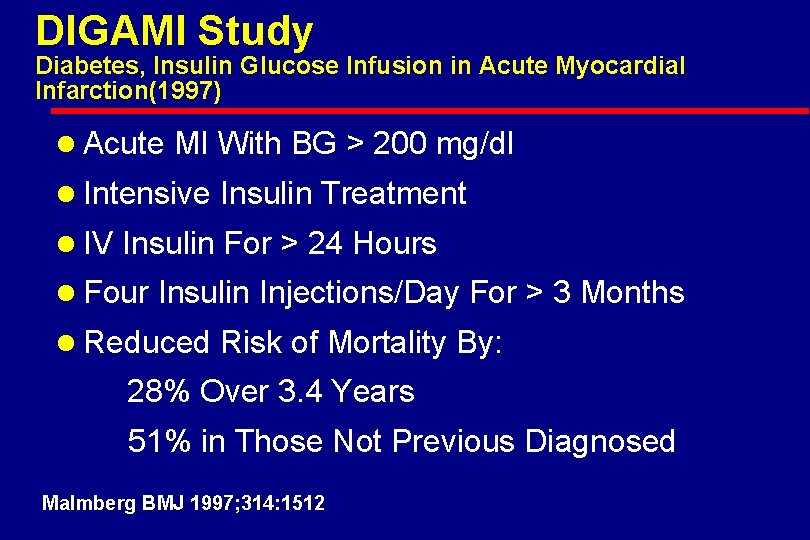
DIGAMI Study Diabetes, Insulin Glucose Infusion in Acute Myocardial Infarction(1997) l Acute MI With BG > 200 mg/dl l Intensive Insulin Treatment l IV Insulin For > 24 Hours l Four Insulin Injections/Day For > 3 Months l Reduced Risk of Mortality By: 28% Over 3. 4 Years 51% in Those Not Previous Diagnosed Malmberg BMJ 1997; 314: 1512
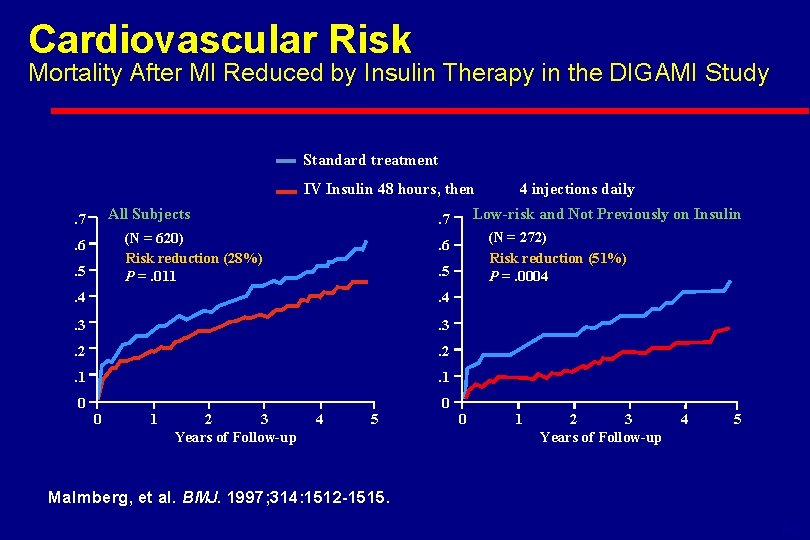
Cardiovascular Risk Mortality After MI Reduced by Insulin Therapy in the DIGAMI Study Standard treatment IV Insulin 48 hours, then All Subjects . 7. 5 . 5. 4 . 3 . 2 . 1 0 0 1 2 3 Years of Follow-up (N = 272) Risk reduction (51%) P =. 0004 . 6 . 4 0 Low-risk and Not Previously on Insulin . 7 (N = 620) Risk reduction (28%) P =. 011 . 6 4 5 4 injections daily 0 1 2 3 Years of Follow-up 4 5 Malmberg, et al. BMJ. 1997; 314: 1512 -1515. 6 -11
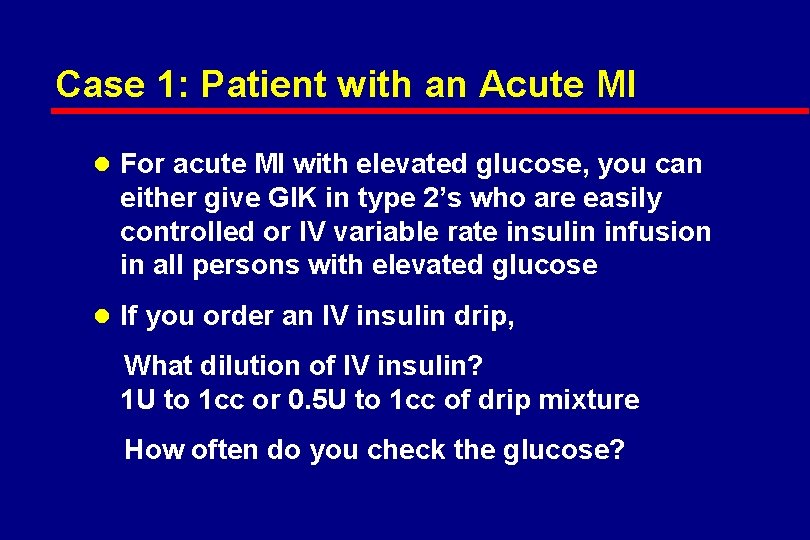
Case 1: Patient with an Acute MI l For acute MI with elevated glucose, you can either give GIK in type 2’s who are easily controlled or IV variable rate insulin infusion in all persons with elevated glucose l If you order an IV insulin drip, What dilution of IV insulin? 1 U to 1 cc or 0. 5 U to 1 cc of drip mixture How often do you check the glucose?

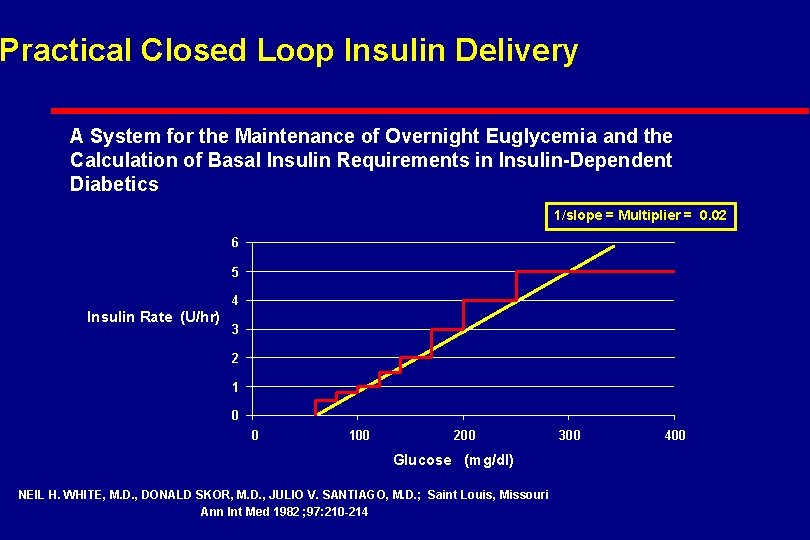
Continuous Variable Rate IV Insulin Drip l Mix Drip with 125 units Regular Insulin into 250 cc NS l Starting Rate Units / hour = (BG – 60) x 0. 02 where BG is current Blood Glucose and 0. 02 is the multiplier l Check glucose every hour and adjust drip l Adjust Multiplier to keep in desired glucose target range (100 to 140 mg/dl)
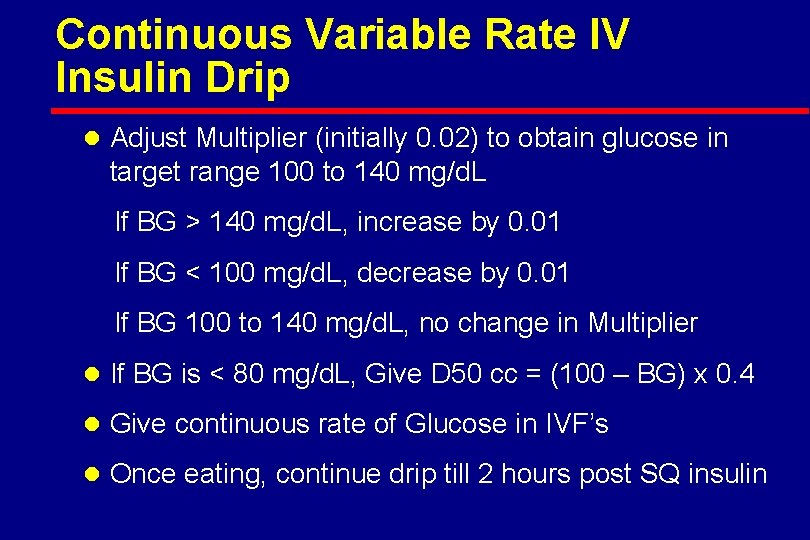
Continuous Variable Rate IV Insulin Drip l Adjust Multiplier (initially 0. 02) to obtain glucose in target range 100 to 140 mg/d. L If BG > 140 mg/d. L, increase by 0. 01 If BG < 100 mg/d. L, decrease by 0. 01 If BG 100 to 140 mg/d. L, no change in Multiplier l If BG is < 80 mg/d. L, Give D 50 cc = (100 – BG) x 0. 4 l Give continuous rate of Glucose in IVF’s l Once eating, continue drip till 2 hours post SQ insulin
Practical Closed Loop Insulin Delivery A System for the Maintenance of Overnight Euglycemia and the Calculation of Basal Insulin Requirements in Insulin-Dependent Diabetics 1/slope = Multiplier = 0. 02 6 5 4 Insulin Rate (U/hr) 3 2 1 0 0 100 200 Glucose (mg/dl) NEIL H. WHITE, M. D. , DONALD SKOR, M. D. , JULIO V. SANTIAGO, M. D. ; Saint Louis, Missouri Ann Int Med 1982 ; 97: 210 -214 300 400
The Ideal IV Insulin Protocol l Easily ordered (signature only) l Effective (Gets to goal quickly) l Safe (Minimal risk of hypoglycemia) l Easily implemented l Able to be used hospital wide
Essentials of a good IV Insulin Algorithm l Easily implemented by nursing staff l Able to seek BG range via: - Hourly BG monitoring - Adjusts to the insulin sensitivity of the patient
Methods For Managing Hospitalized Persons with Diabetes l Continuous Variable Rate IV Insulin Drip Major Surgery, NPO, Unstable, MI, DKA, Hyperglycemia, Steroids, Gastroparesis, Delivery, etc l Basal / Bolus Therapy (MDI) when eating
Case 1: Patient with an Acute MI now plans to go for CABG l What is your glycemic goal? 1) 80 to 110 mg/dl 2) 80 to 140 mg/dl 3) 80 to 180 mg/dl l Do you give glucose and potassium with IV insulin? How much?
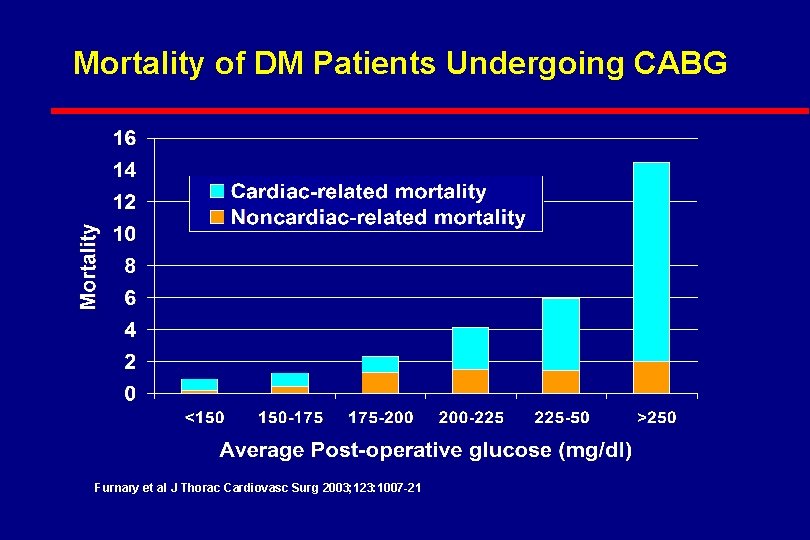
Mortality of DM Patients Undergoing CABG Furnary et al J Thorac Cardiovasc Surg 2003; 123: 1007 -21
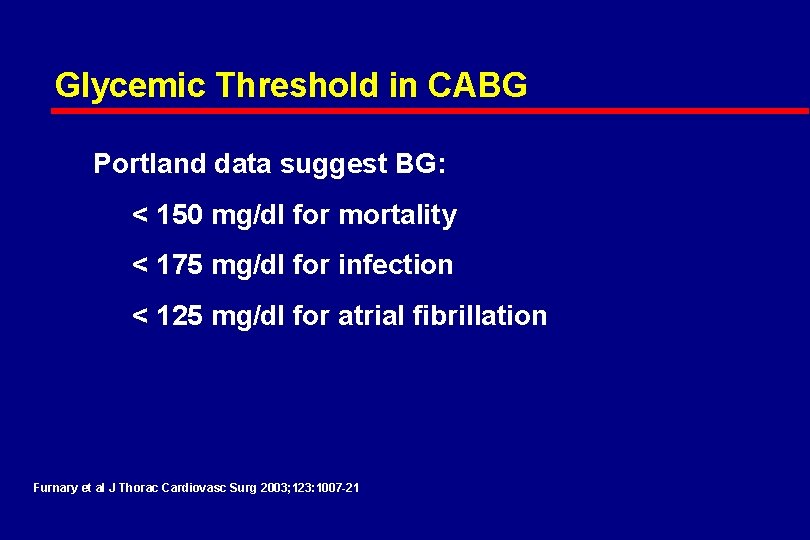
Glycemic Threshold in CABG Portland data suggest BG: < 150 mg/dl for mortality < 175 mg/dl for infection < 125 mg/dl for atrial fibrillation Furnary et al J Thorac Cardiovasc Surg 2003; 123: 1007 -21
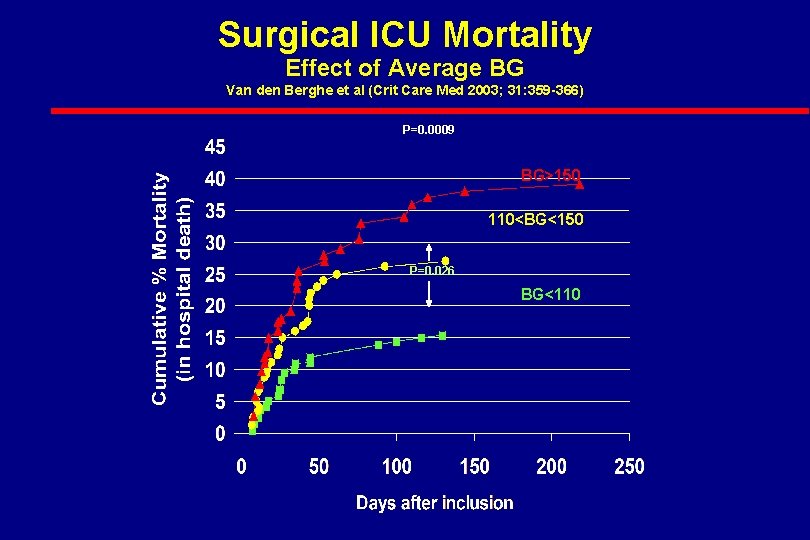
Surgical ICU Mortality Effect of Average BG Van den Berghe et al (Crit Care Med 2003; 31: 359 -366) P=0. 0009 BG>150 110<BG<150 P=0. 026 BG<110
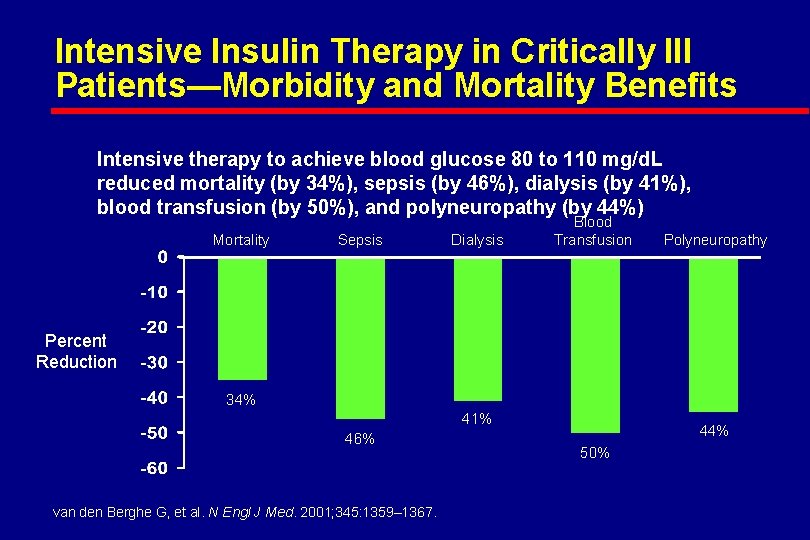
Intensive Insulin Therapy in Critically Ill Patients—Morbidity and Mortality Benefits Intensive therapy to achieve blood glucose 80 to 110 mg/d. L reduced mortality (by 34%), sepsis (by 46%), dialysis (by 41%), blood transfusion (by 50%), and polyneuropathy (by 44%) Mortality Sepsis Dialysis Blood Transfusion Polyneuropathy Percent Reduction 34% 41% 46% van den Berghe G, et al. N Engl J Med. 2001; 345: 1359– 1367. 44% 50%
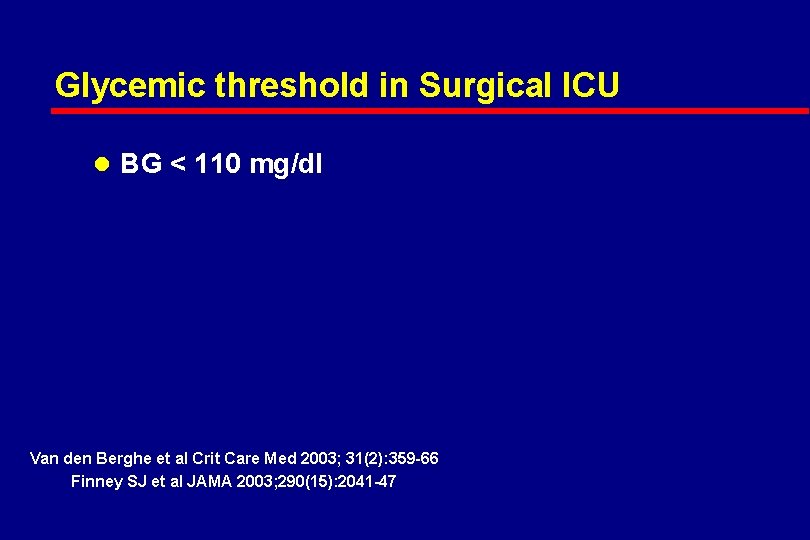
Glycemic threshold in Surgical ICU l BG < 110 mg/dl Van den Berghe et al Crit Care Med 2003; 31(2): 359 -66 Finney SJ et al JAMA 2003; 290(15): 2041 -47
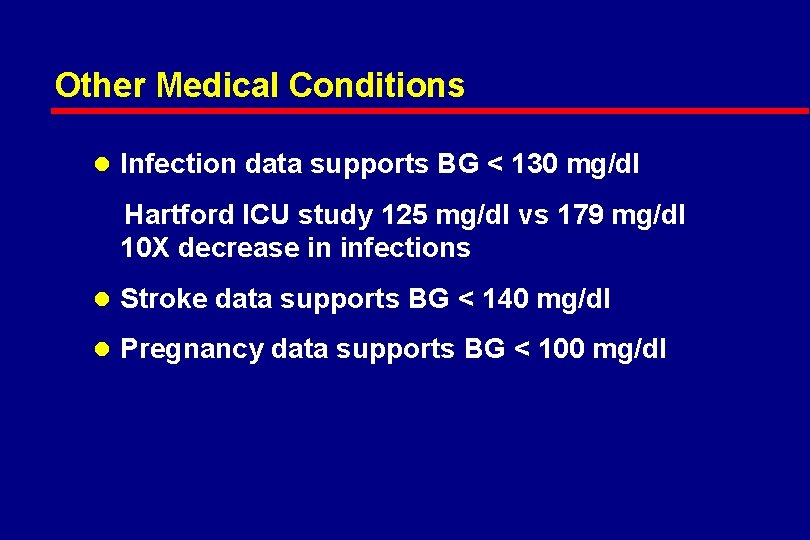
Other Medical Conditions l Infection data supports BG < 130 mg/dl Hartford ICU study 125 mg/dl vs 179 mg/dl 10 X decrease in infections l Stroke data supports BG < 140 mg/dl l Pregnancy data supports BG < 100 mg/dl
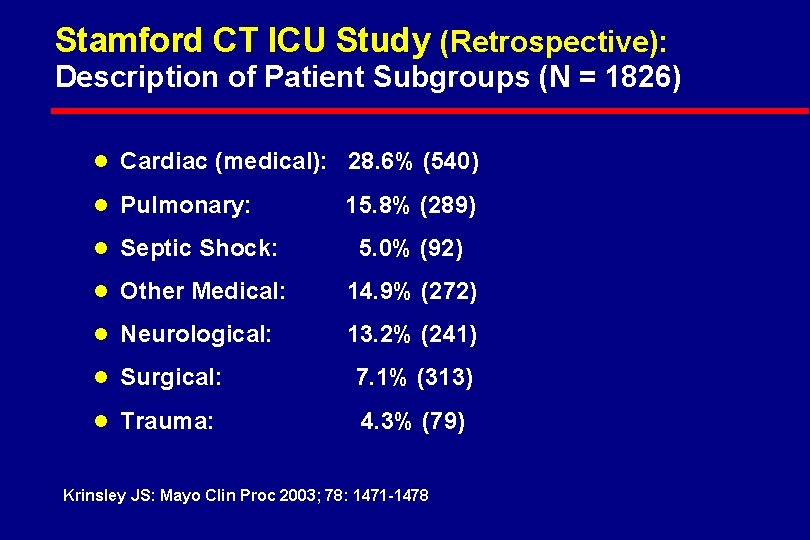
Stamford CT ICU Study (Retrospective): Description of Patient Subgroups (N = 1826) l Cardiac (medical): 28. 6% (540) l Pulmonary: 15. 8% (289) l Septic Shock: 5. 0% (92) l Other Medical: 14. 9% (272) l Neurological: 13. 2% (241) l Surgical: 7. 1% (313) l Trauma: 4. 3% (79) Krinsley JS: Mayo Clin Proc 2003; 78: 1471 -1478
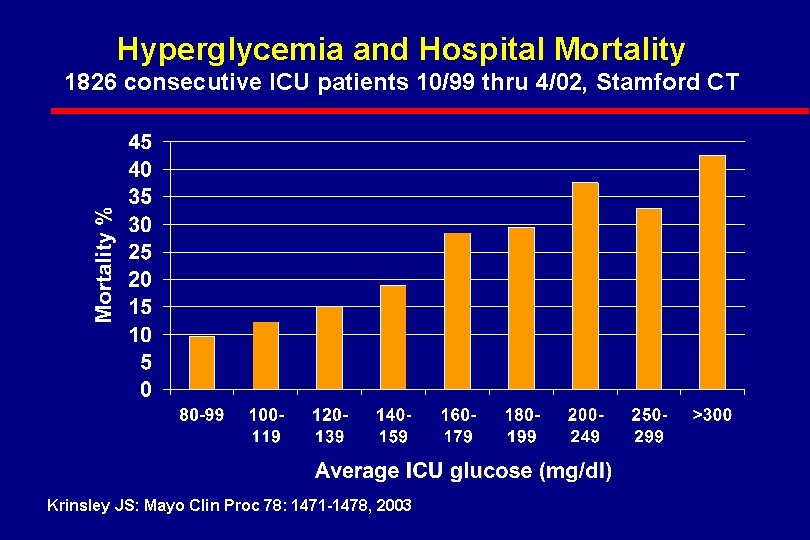
Hyperglycemia and Hospital Mortality 1826 consecutive ICU patients 10/99 thru 4/02, Stamford CT Krinsley JS: Mayo Clin Proc 78: 1471 -1478, 2003
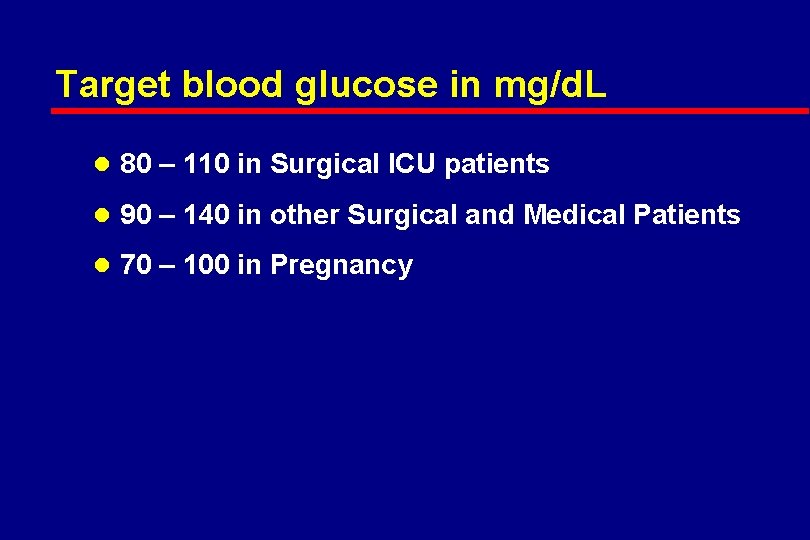
Target blood glucose in mg/d. L l 80 – 110 in Surgical ICU patients l 90 – 140 in other Surgical and Medical Patients l 70 – 100 in Pregnancy
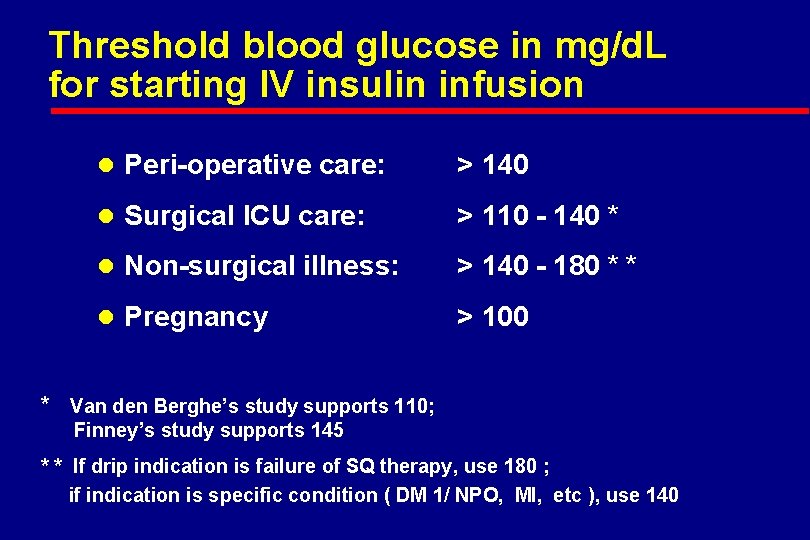
Threshold blood glucose in mg/d. L for starting IV insulin infusion l Peri-operative care: > 140 l Surgical ICU care: > 110 - 140 * l Non-surgical illness: > 140 - 180 * * l Pregnancy > 100 * Van den Berghe’s study supports 110; Finney’s study supports 145 * * If drip indication is failure of SQ therapy, use 180 ; if indication is specific condition ( DM 1/ NPO, MI, etc ), use 140
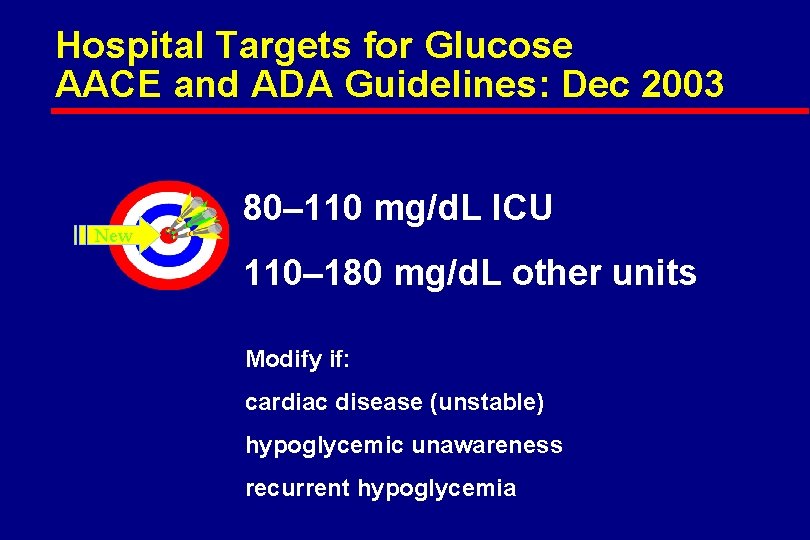
Hospital Targets for Glucose AACE and ADA Guidelines: Dec 2003 New 80– 110 mg/d. L ICU 110– 180 mg/d. L other units Modify if: cardiac disease (unstable) hypoglycemic unawareness recurrent hypoglycemia
Case 1: Patient with an Acute MI now post CABG and ready to eat l Currently on IV insulin at ~2 units IV per hour l What do you now do? 1. Sliding scale rapid acting insulin only? 2. Basal Bolus insulin therapy? 3. Premixed insulin therapy?
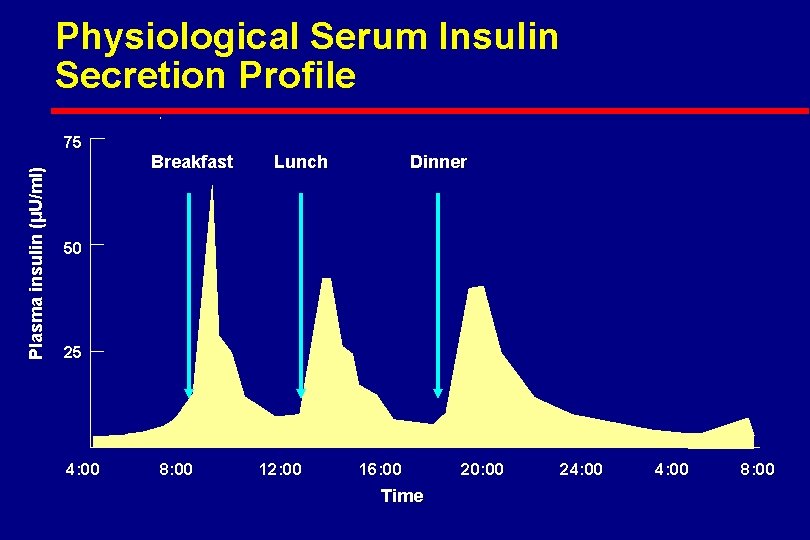
Physiological Serum Insulin Secretion Profile Plasma insulin (µU/ml) 75 Breakfast Lunch Dinner 50 25 4: 00 8: 00 12: 00 16: 00 Time 20: 00 24: 00 8: 00
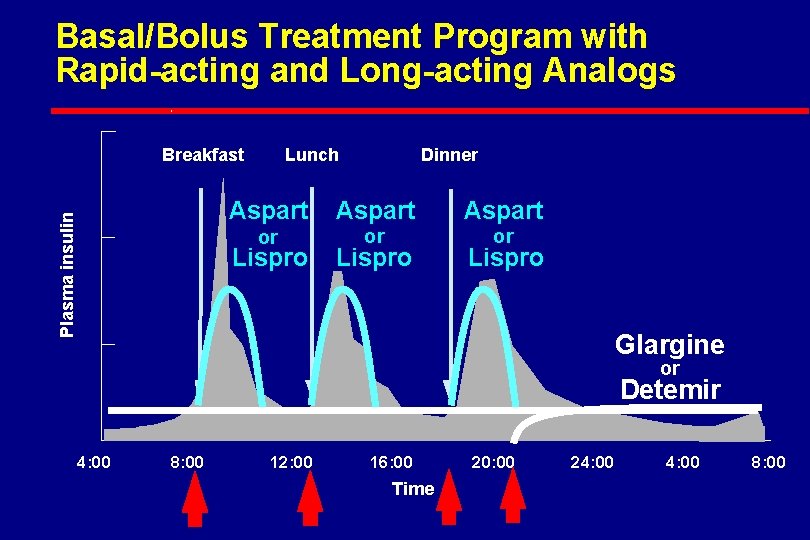
Basal/Bolus Treatment Program with Rapid-acting and Long-acting Analogs Plasma insulin Breakfast Lunch Dinner Aspart or or or Lispro Glargine or Detemir 4: 00 8: 00 12: 00 16: 00 Time 20: 00 24: 00 8: 00
Converting to SC insulin l If More than 0. 5 u/hr IV insulin required with normal BG, start long-acting insulin (glargine) l Must start SC insulin at least 2 hours before stopping IV insulin l Some centers start long-acting insulin on initiation of IV insulin or the night before stopping the drip
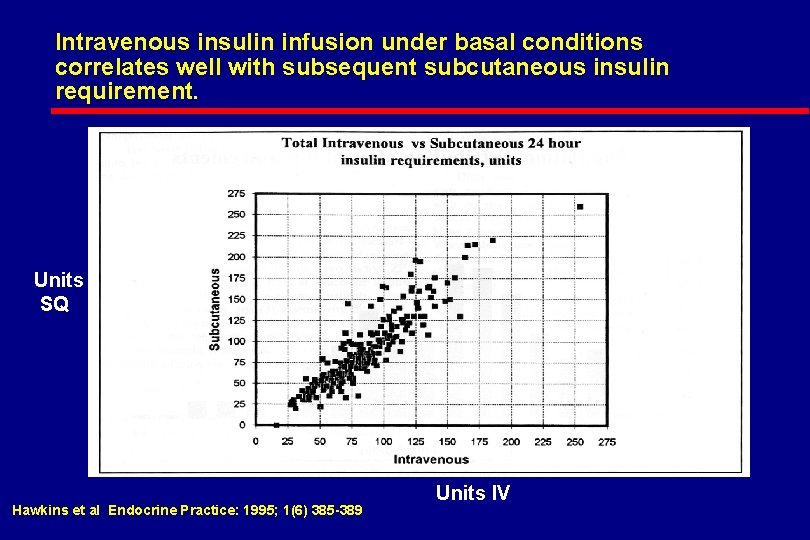
Intravenous insulin infusion under basal conditions correlates well with subsequent subcutaneous insulin requirement. Overwrite Units SQ Hawkins et al Endocrine Practice: 1995; 1(6) 385 -389 Units IV
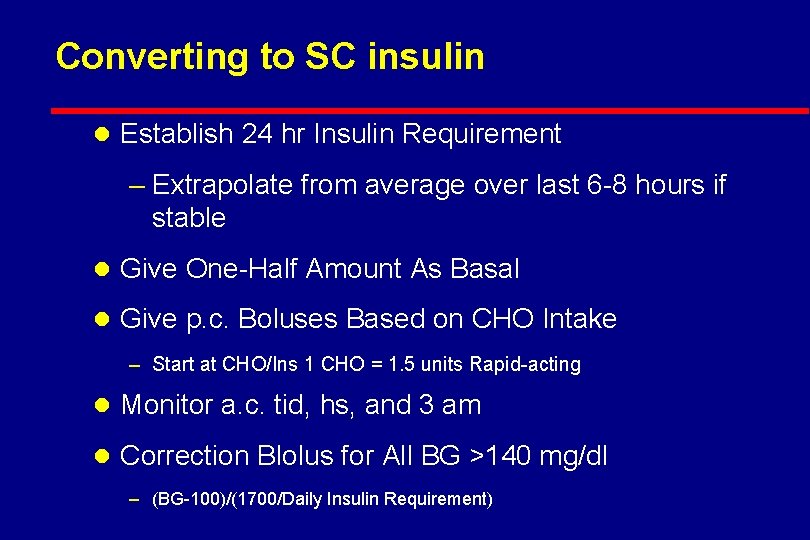
Converting to SC insulin l Establish 24 hr Insulin Requirement – Extrapolate from average over last 6 -8 hours if stable l Give One-Half Amount As Basal l Give p. c. Boluses Based on CHO Intake – Start at CHO/Ins 1 CHO = 1. 5 units Rapid-acting l Monitor a. c. tid, hs, and 3 am l Correction Blolus for All BG >140 mg/dl – (BG-100)/(1700/Daily Insulin Requirement)
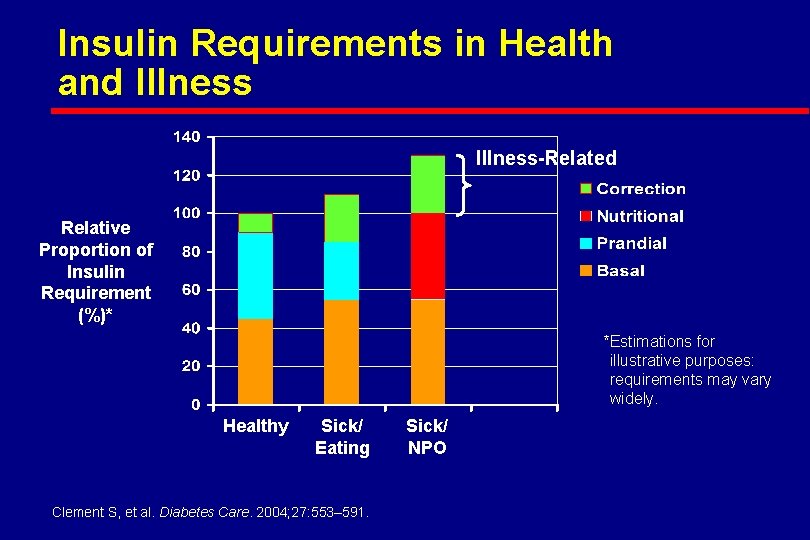
Insulin Requirements in Health and Illness-Related Relative Proportion of Insulin Requirement (%)* *Estimations for illustrative purposes: requirements may vary widely. Healthy Sick/ Eating Clement S, et al. Diabetes Care. 2004; 27: 553– 591. Sick/ NPO
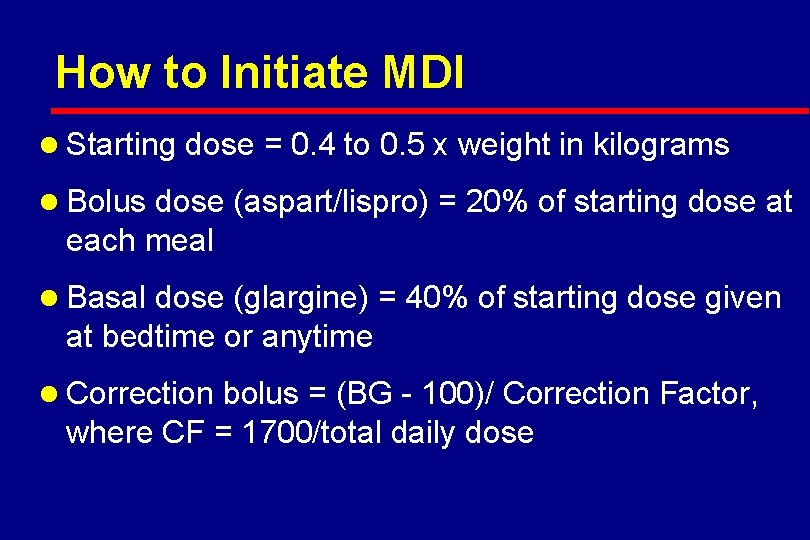
How to Initiate MDI l Starting dose = 0. 4 to 0. 5 x weight in kilograms l Bolus dose (aspart/lispro) = 20% of starting dose at each meal l Basal dose (glargine) = 40% of starting dose given at bedtime or anytime l Correction bolus = (BG - 100)/ Correction Factor, where CF = 1700/total daily dose
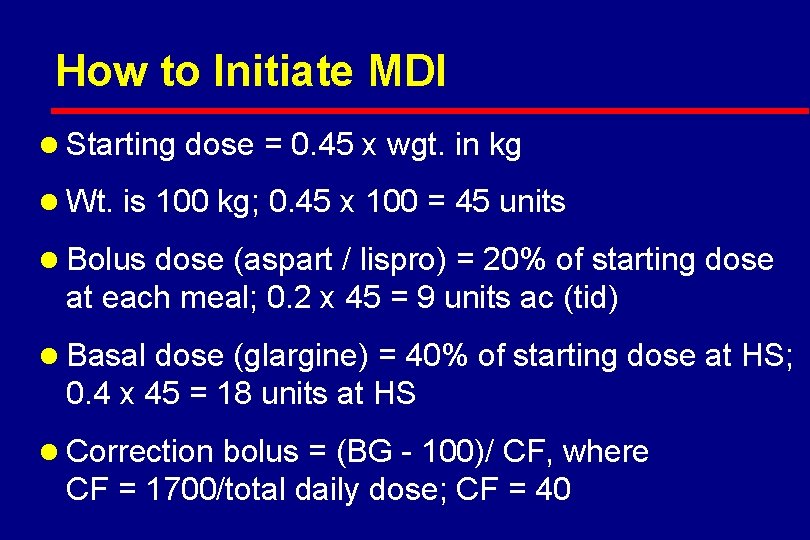
How to Initiate MDI l Starting dose = 0. 45 x wgt. in kg l Wt. is 100 kg; 0. 45 x 100 = 45 units l Bolus dose (aspart / lispro) = 20% of starting dose at each meal; 0. 2 x 45 = 9 units ac (tid) l Basal dose (glargine) = 40% of starting dose at HS; 0. 4 x 45 = 18 units at HS l Correction bolus = (BG - 100)/ CF, where CF = 1700/total daily dose; CF = 40
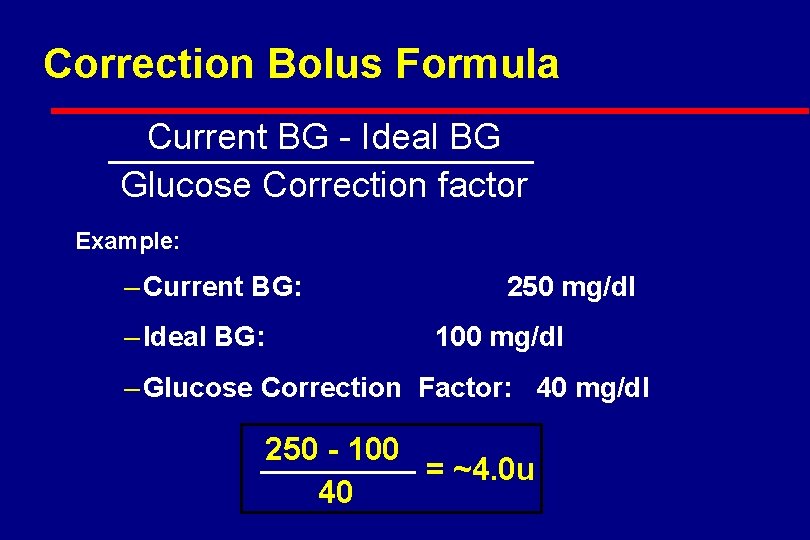
Correction Bolus Formula Current BG - Ideal BG Glucose Correction factor Example: – Current BG: – Ideal BG: 250 mg/dl 100 mg/dl – Glucose Correction Factor: 40 mg/dl 250 - 100 = ~4. 0 u 40
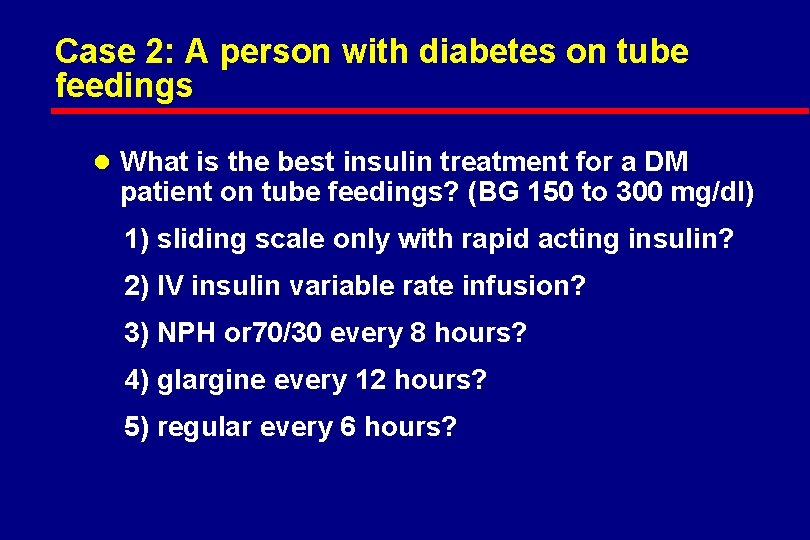
Case 2: A person with diabetes on tube feedings l What is the best insulin treatment for a DM patient on tube feedings? (BG 150 to 300 mg/dl) 1) sliding scale only with rapid acting insulin? 2) IV insulin variable rate infusion? 3) NPH or 70/30 every 8 hours? 4) glargine every 12 hours? 5) regular every 6 hours?
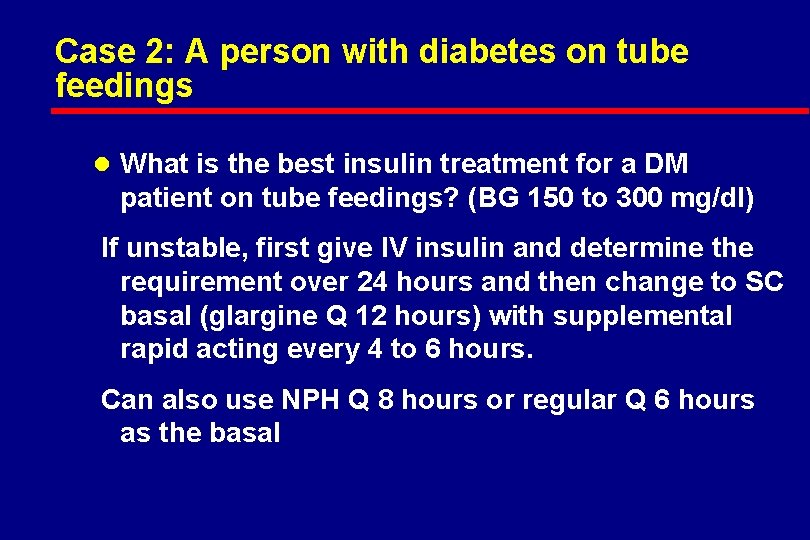
Case 2: A person with diabetes on tube feedings l What is the best insulin treatment for a DM patient on tube feedings? (BG 150 to 300 mg/dl) If unstable, first give IV insulin and determine the requirement over 24 hours and then change to SC basal (glargine Q 12 hours) with supplemental rapid acting every 4 to 6 hours. Can also use NPH Q 8 hours or regular Q 6 hours as the basal
Case 3: A person with diabetes on TPN l What is the best insulin treatment for a DM patient on TPN? (BG 150 to 300 mg/dl) If unstable, first give IV insulin variable drip and determine the requirement over 24 hours and then add all the insulin to the TPN bag. Continue to supplement every 4 to 6 hours with SC rapid acting insulin using BG – 100 / CF where CF is equal to 3000 divided by weight in kg. On average, CF = ~ 30 to 40
Case 4: DM 1 patient going for outpatient surgery l What do you tell the patient to do? 1) Hold insulin 2) Take half their dose 3) Take their basal only with supplement if needed (>180 mg/dl) 4) Hold insulin and will start IV insulin
Case 4: DM 1 patient in DKA (ph 7. 0; BG 400 mg/dl: weight 80 kg) l How much fluids do you give immediately? 1) 1 liter saline 2) 2 liters saline 3) 1 liter 0. 45% saline 4) 2 liters 0. 45% saline
Case 4: DM 1 patient in DKA (ph 7. 0; BG 400 mg/dl: weight 80 kg) l Do you give Na. CO 3? l When do you start potassium and how much? l When do you start dextrose and how much? My preference is 2 liters saline followed by D 50. 45 saline with 40 meq KCL/liter at 250 ml/hour. Monitor electrolytes Q 4 to 8 hours.
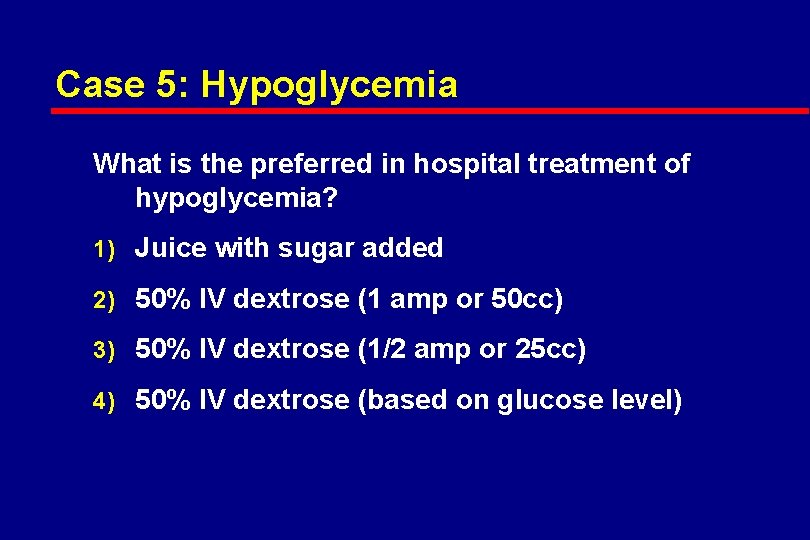
Case 5: Hypoglycemia What is the preferred in hospital treatment of hypoglycemia? 1) Juice with sugar added 2) 50% IV dextrose (1 amp or 50 cc) 3) 50% IV dextrose (1/2 amp or 25 cc) 4) 50% IV dextrose (based on glucose level)
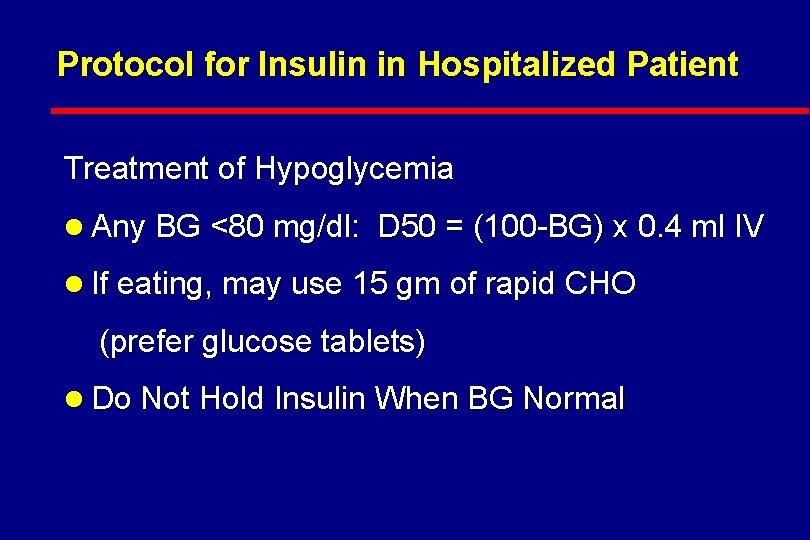
Protocol for Insulin in Hospitalized Patient Treatment of Hypoglycemia l Any BG <80 mg/dl: D 50 = (100 -BG) x 0. 4 ml IV l If eating, may use 15 gm of rapid CHO (prefer glucose tablets) l Do Not Hold Insulin When BG Normal
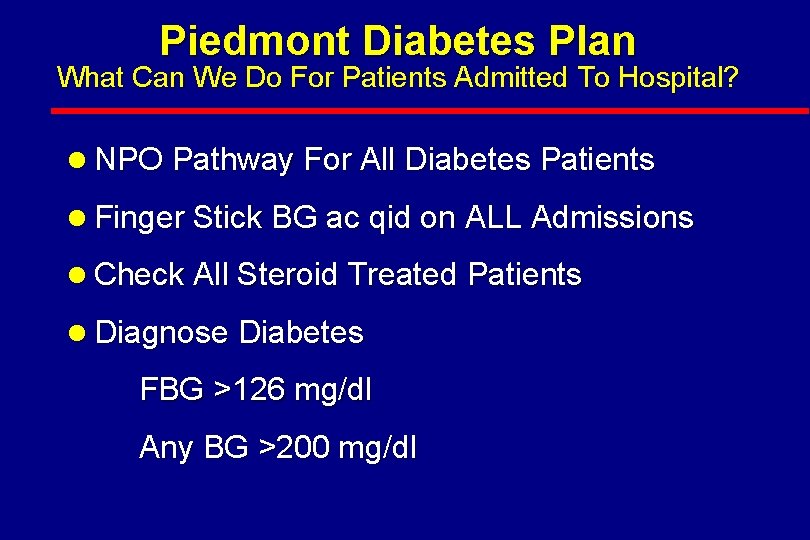
Piedmont Diabetes Plan What Can We Do For Patients Admitted To Hospital? l NPO Pathway For All Diabetes Patients l Finger Stick BG ac qid on ALL Admissions l Check All Steroid Treated Patients l Diagnose Diabetes FBG >126 mg/dl Any BG >200 mg/dl
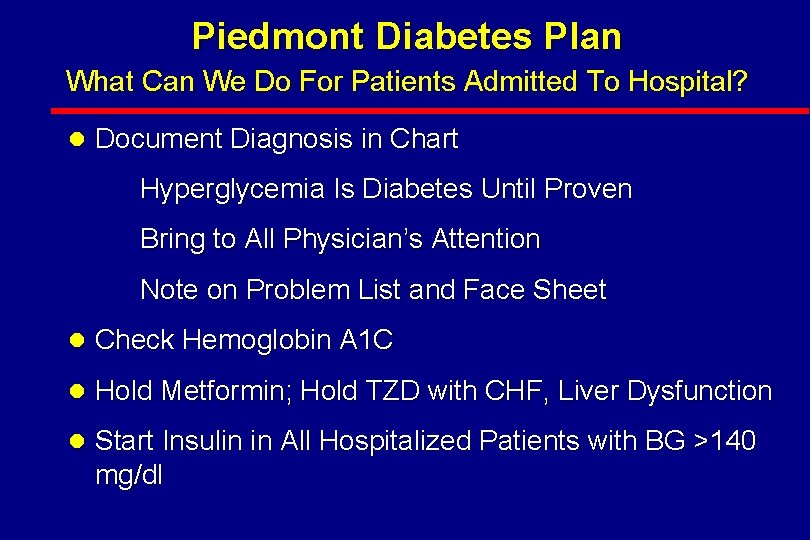
Piedmont Diabetes Plan What Can We Do For Patients Admitted To Hospital? l Document Diagnosis in Chart Hyperglycemia Is Diabetes Until Proven Bring to All Physician’s Attention Note on Problem List and Face Sheet l Check Hemoglobin A 1 C l Hold Metformin; Hold TZD with CHF, Liver Dysfunction l Start Insulin in All Hospitalized Patients with BG >140 mg/dl
Piedmont Diabetes Plan What Can We Do For Patients Admitted To Hospital? l Get Diabetes Education Consult l Instruct Patient in Monitoring and Recording See That Patient Has Meter on Discharge l Decide on Case Specific Program for Discharge l Arrange Early F/U with PCP
Protocol for Insulin in Hospitalized Patient l Treat Any Patient With BG >140 mg/dl With Insulin – Treat Any BG >140 mg/dl with Rapid-acting Insulin (BG-100) / (3000 / wt kg) or 1700 / total daily insulin – Treat Any Recurrent BG >180 mg/dl with IV Insulin if failing SC therapy or >140 mg/dl if NPO, acute MI, perioperative, ICU, or >100 mg/dl if pregnant l If More than 0. 5 u/hr IV Insulin Required with Normal BG Start Long Acting Insulin
Protocol for Insulin in Hospitalized Patient l Daily Total: Pre-Admission or Weight (#) x 0. 2 u – 40 % as Glargine (Basal) – 60% as Rapid-acting insulin (Bolus) • Give in Proportion to Meal’s CHO Eaten l BG >140 mg/dl: (BG-100) / CF CF = 1700 / Total Daily Insulin or 3000 / wgt kg Do Not Use Sliding Scale As Only Diabetes Management
Diabetes at Piedmont Hospital Conclusions 3 l Discharge Plan For BG Control l You Are the Link Between the Best Diabetes Care and the Patient l Use Your Diabetes Resources Diabetes Education Center Endocrinologists
Conclusion All hospital patients should have normal glucose
Insulin only The most powerful agent we have to control glucose

QUESTIONS l For a copy or viewing of these slides, contact l WWW. adaendo. com
- Slides: 52