
DGPK guideline Double Outlet Right Ventricle DORV H
DGPK guideline Double Outlet Right Ventricle (DORV) H. Bertram, MHH, Hannover J. Weil, UKE, Hamburg J. Sachweh, UKE, Hamburg DGPK guideline committee
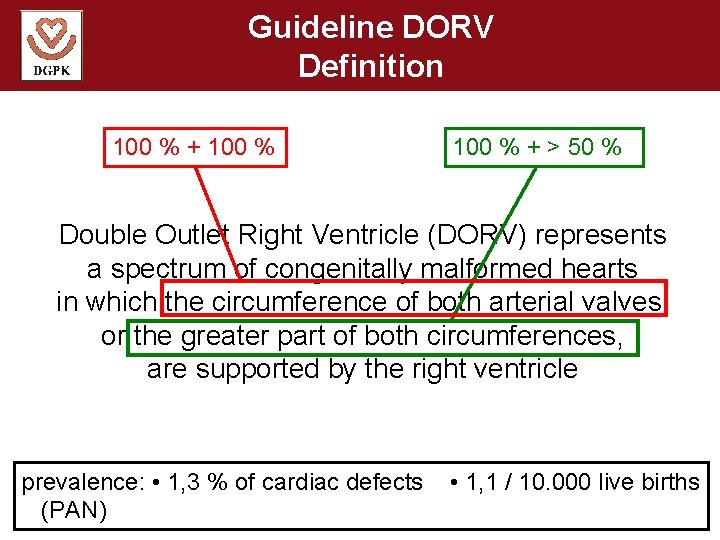
Guideline DORV Definition 100 % + > 50 % Double Outlet Right Ventricle (DORV) represents a spectrum of congenitally malformed hearts in which the circumference of both arterial valves, or the greater part of both circumferences, are supported by the right ventricle prevalence: • 1, 3 % of cardiac defects (PAN) • 1, 1 / 10. 000 live births
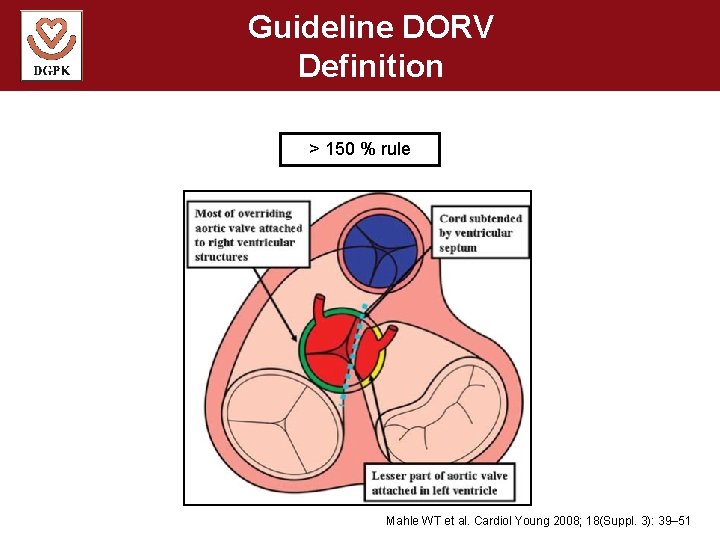
Guideline DORV Definition > 150 % rule Mahle WT et al. Cardiol Young 2008; 18(Suppl. 3): 39– 51
Guideline DORV Definition Double Outlet Right Ventricle (DORV) represents a spectrum of congenitally malformed hearts in which the circumference of both arterial valves, or the greater part of both circumferences, are supported by the right ventricle • same ventriculo-arterial connection, but variations in - infundibular morphology - arterial interrelationship - coronary arterial anatomy • any arrangement of the atrial appendages, or situs • any atrioventricular connection • multiple combinations of associated malformations
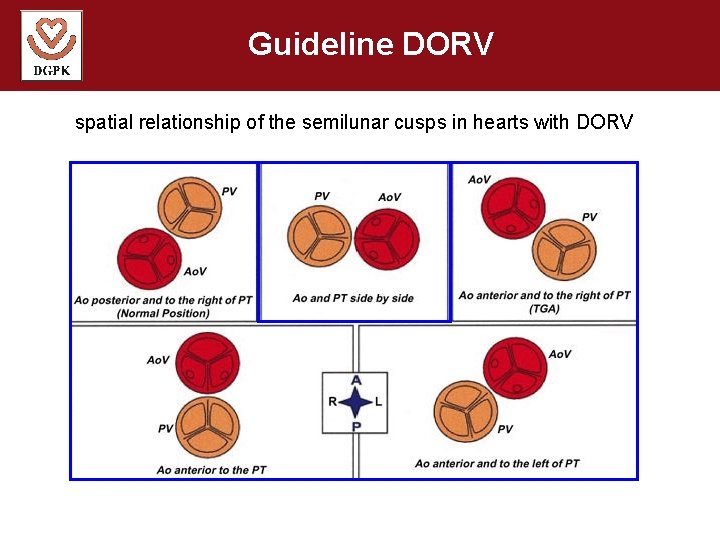
Guideline DORV spatial relationship of the semilunar cusps in hearts with DORV
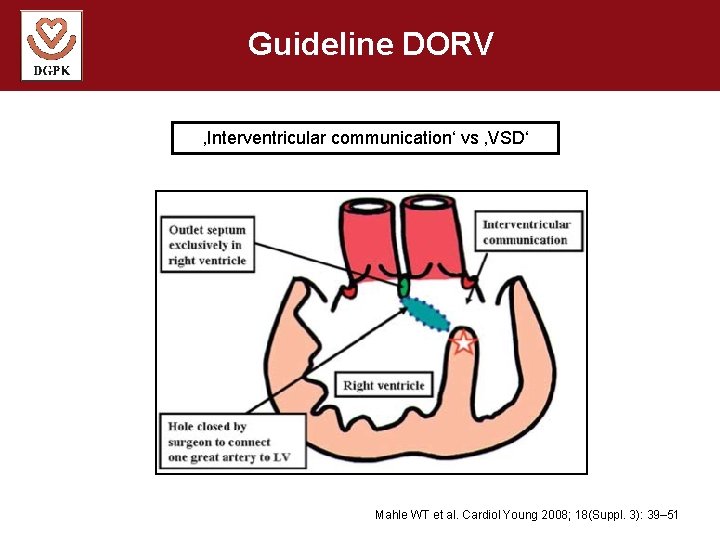
Guideline DORV ‚Interventricular communication‘ vs ‚VSD‘ Mahle WT et al. Cardiol Young 2008; 18(Suppl. 3): 39– 51
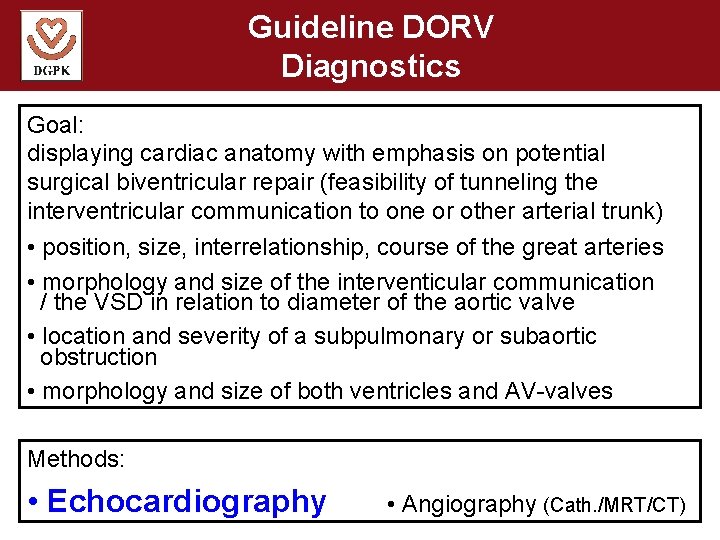
Guideline DORV Diagnostics Goal: displaying cardiac anatomy with emphasis on potential surgical biventricular repair (feasibility of tunneling the interventricular communication to one or other arterial trunk) • position, size, interrelationship, course of the great arteries • morphology and size of the interventicular communication / the VSD in relation to diameter of the aortic valve • location and severity of a subpulmonary or subaortic obstruction • morphology and size of both ventricles and AV-valves Methods: • Echocardiography • Angiography (Cath. /MRT/CT)
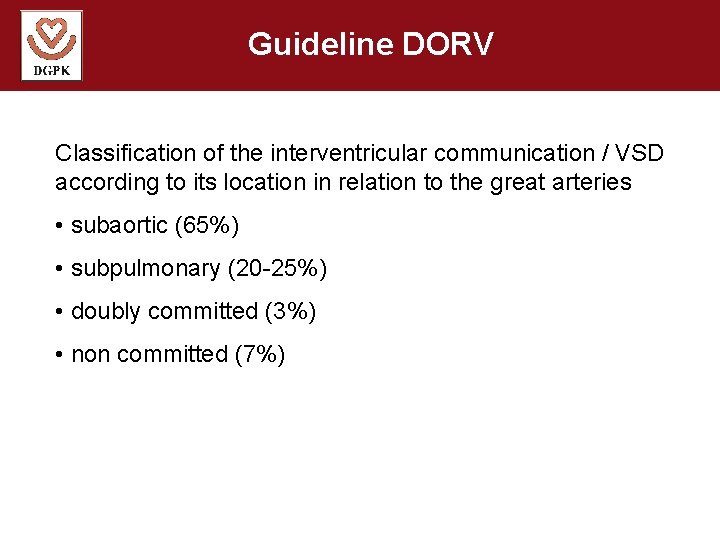
Guideline DORV Classification of the interventricular communication / VSD according to its location in relation to the great arteries • subaortic (65%) • subpulmonary (20 -25%) • doubly committed (3%) • non committed (7%)
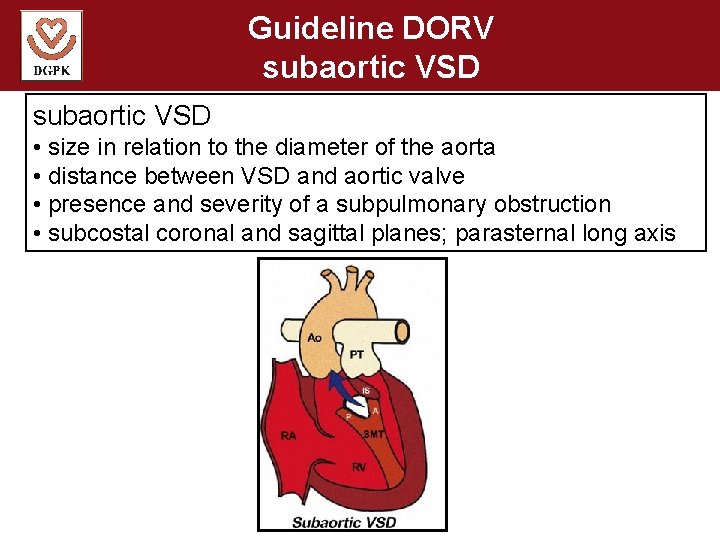
Guideline DORV subaortic VSD • size in relation to the diameter of the aorta • distance between VSD and aortic valve • presence and severity of a subpulmonary obstruction • subcostal coronal and sagittal planes; parasternal long axis
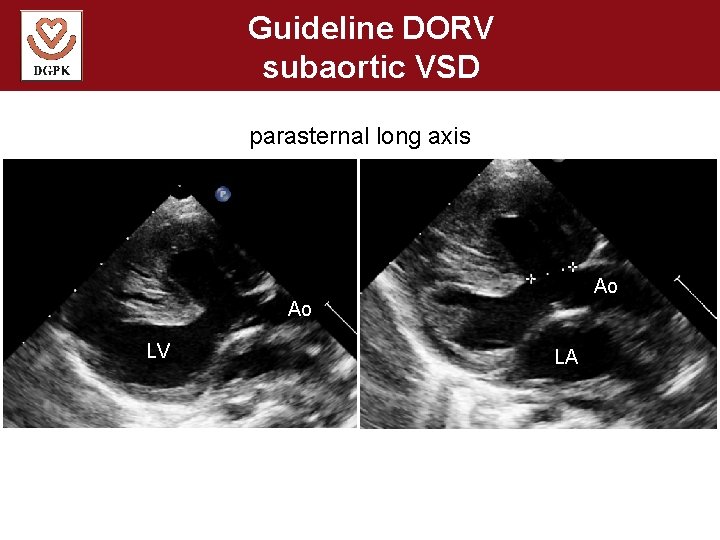
Guideline DORV subaortic VSD parasternal long axis Ao Ao LV LA
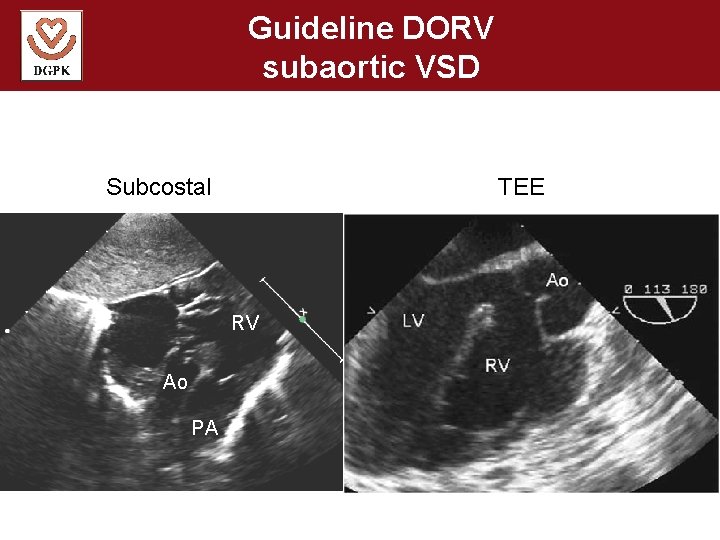
Guideline DORV subaortic VSD Subcostal TEE RV Ao PA
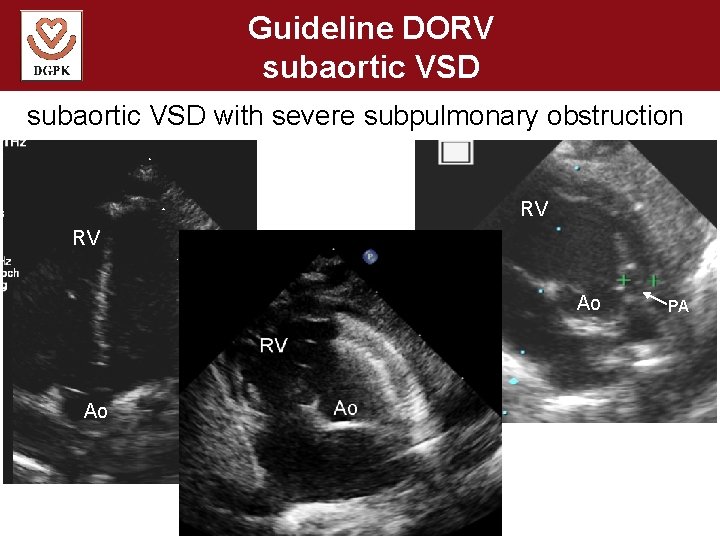
Guideline DORV subaortic VSD with severe subpulmonary obstruction RV RV Ao Ao PA
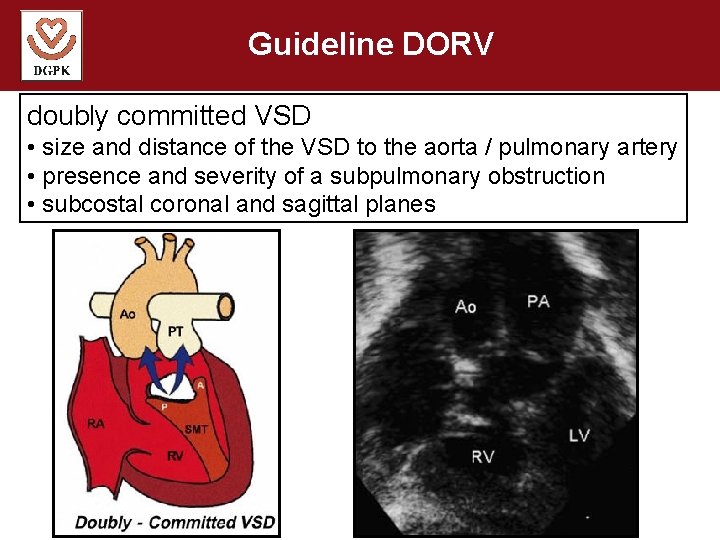
Guideline DORV doubly committed VSD • size and distance of the VSD to the aorta / pulmonary artery • presence and severity of a subpulmonary obstruction • subcostal coronal and sagittal planes
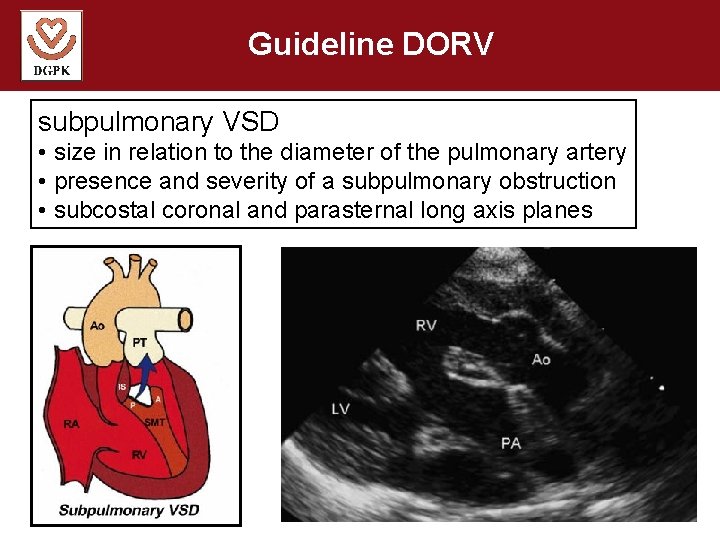
Guideline DORV subpulmonary VSD • size in relation to the diameter of the pulmonary artery • presence and severity of a subpulmonary obstruction • subcostal coronal and parasternal long axis planes
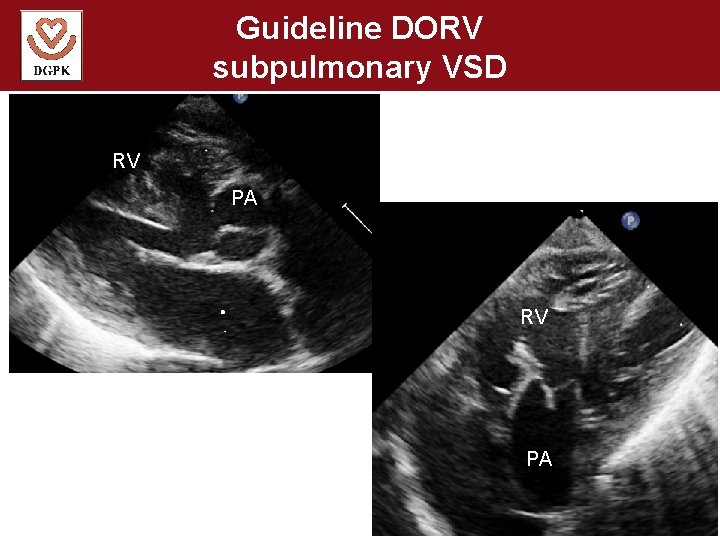
Guideline DORV subpulmonary VSD RV PA
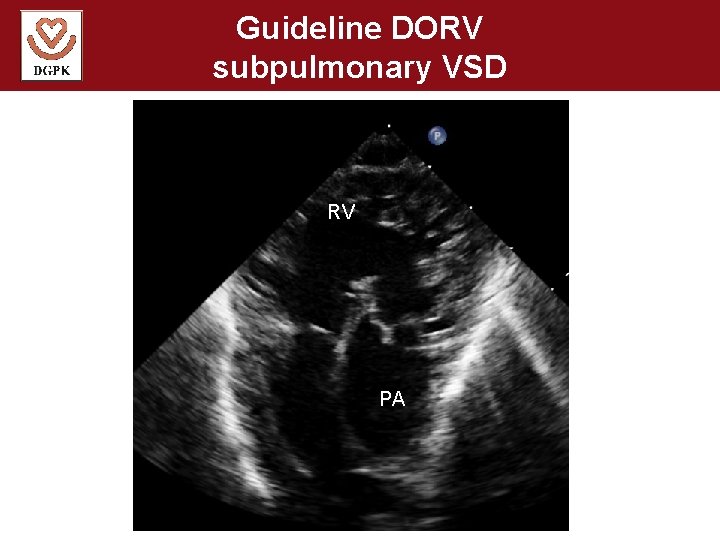
Guideline DORV subpulmonary VSD RV PA
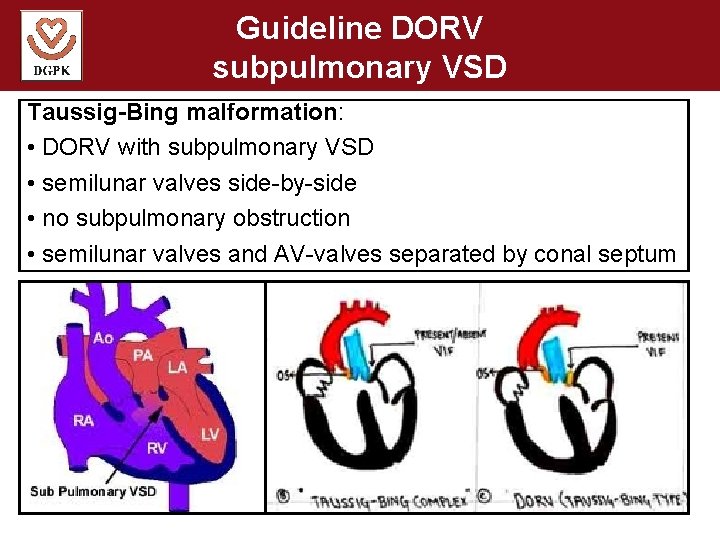
Guideline DORV subpulmonary VSD Taussig-Bing malformation: • DORV with subpulmonary VSD • semilunar valves side-by-side • no subpulmonary obstruction • semilunar valves and AV-valves separated by conal septum
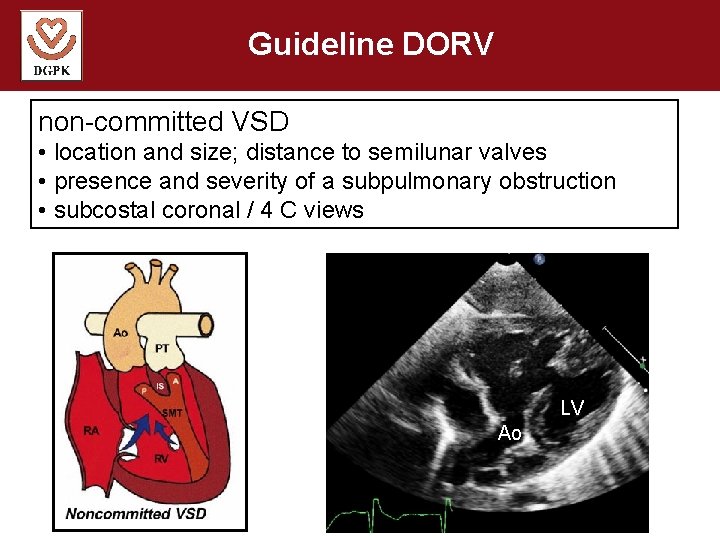
Guideline DORV non-committed VSD • location and size; distance to semilunar valves • presence and severity of a subpulmonary obstruction • subcostal coronal / 4 C views LV Ao
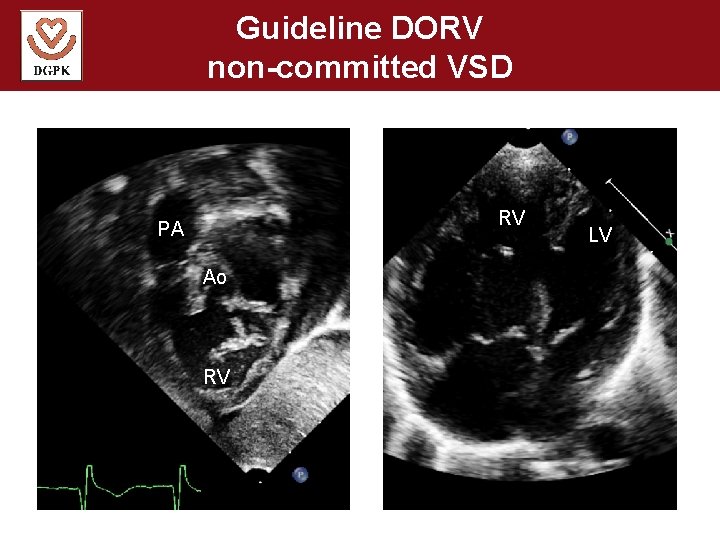
Guideline DORV non-committed VSD RV PA Ao RV LV
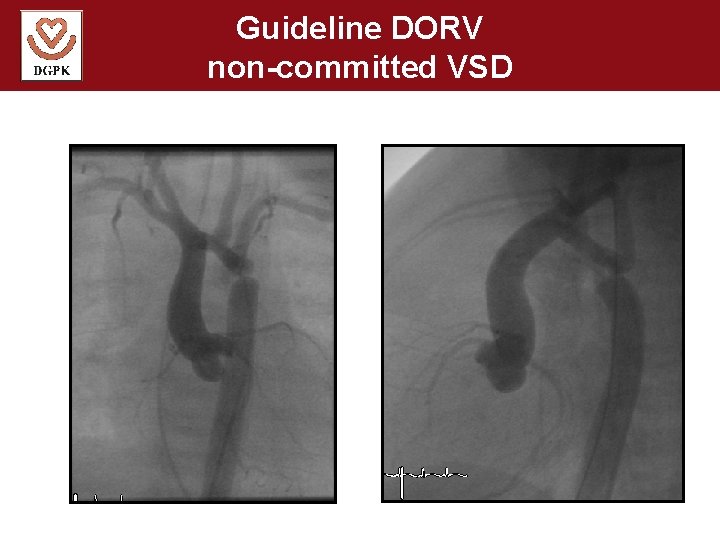
Guideline DORV non-committed VSD
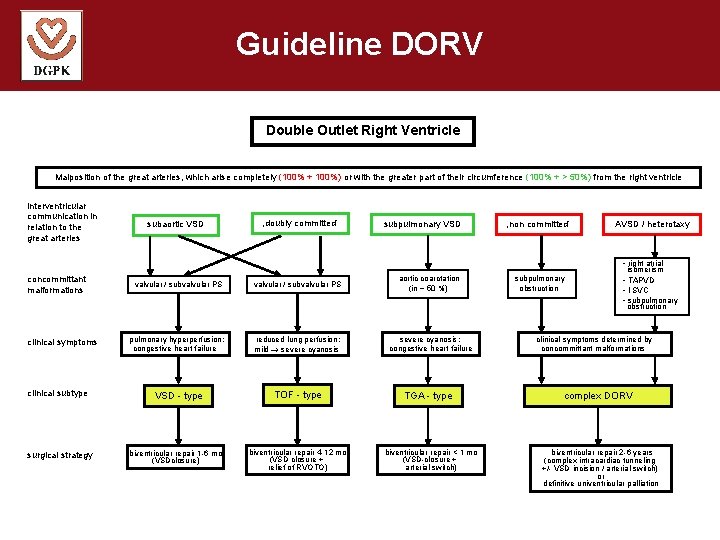
Guideline DORV Double Outlet Right Ventricle Malposition of the great arteries, which arise completely (100% + 100%) or with the greater part of their circumference (100% + > 50%) from the right ventricle interventricular communication in relation to the great arteries subaortic VSD ‚doubly committed‘ subpulmonary VSD ‚non committed‘ AVSD / heterotaxy • right atrial isomerism concommittant malformations valvular / subvalvular PS aortic coarctation (in ~ 50 %) subpulmonary obstruction • TAPVD • l-SVC • subpulmonary obstruction clinical symptoms clinical subtype surgical strategy pulmonary hyperperfusion; congestive heart failure reduced lung perfusion; mild severe cyanosis VSD - type TOF - type biventricular repair 1 -6 mo (VSDclosure) biventricular repair 4 -12 mo (VSD closure + relief of RVOTO) severe cyanosis; congestive heart failure TGA - type biventricular repair < 1 mo (VSD-closure + arterial switch) clinical symptoms determined by concommittant malformations complex DORV biventricular repair 2 -6 years (complex intracardiac tunneling +/- VSD incision / arterial switch) or definitive univentricular palliation
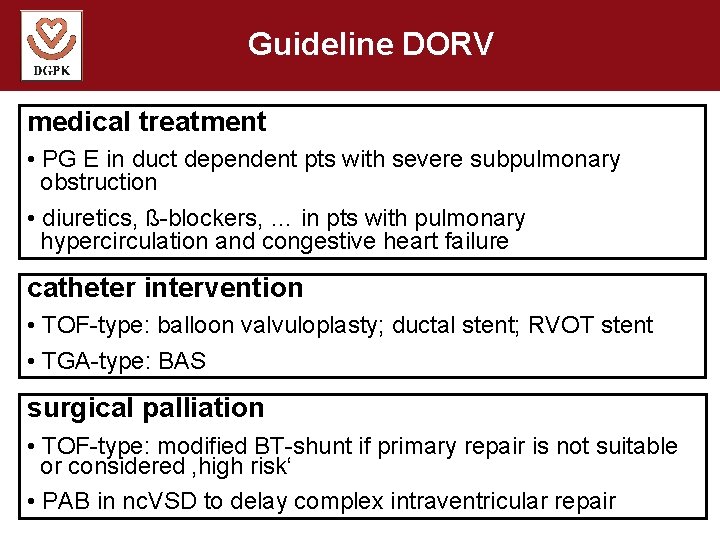
Guideline DORV medical treatment • PG E in duct dependent pts with severe subpulmonary obstruction • diuretics, ß-blockers, … in pts with pulmonary hypercirculation and congestive heart failure catheter intervention • TOF-type: balloon valvuloplasty; ductal stent; RVOT stent • TGA-type: BAS surgical palliation • TOF-type: modified BT-shunt if primary repair is not suitable or considered ‚high risk‘ • PAB in nc. VSD to delay complex intraventricular repair
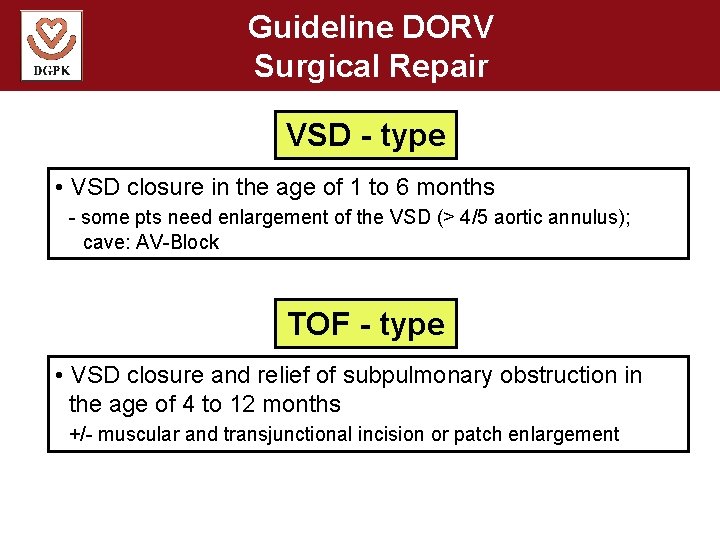
Guideline DORV Surgical Repair VSD - type • VSD closure in the age of 1 to 6 months - some pts need enlargement of the VSD (> 4/5 aortic annulus); cave: AV-Block TOF - type • VSD closure and relief of subpulmonary obstruction in the age of 4 to 12 months +/- muscular and transjunctional incision or patch enlargement
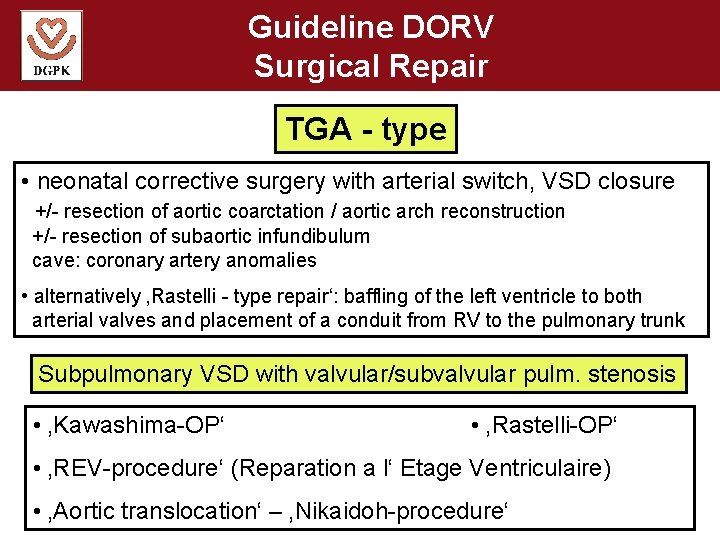
Guideline DORV Surgical Repair TGA - type • neonatal corrective surgery with arterial switch, VSD closure +/- resection of aortic coarctation / aortic arch reconstruction +/- resection of subaortic infundibulum cave: coronary artery anomalies • alternatively ‚Rastelli - type repair‘: baffling of the left ventricle to both arterial valves and placement of a conduit from RV to the pulmonary trunk Subpulmonary VSD with valvular/subvalvular pulm. stenosis • ‚Kawashima-OP‘ • ‚Rastelli-OP‘ • ‚REV-procedure‘ (Reparation a l‘ Etage Ventriculaire) • ‚Aortic translocation‘ – ‚Nikaidoh-procedure‘
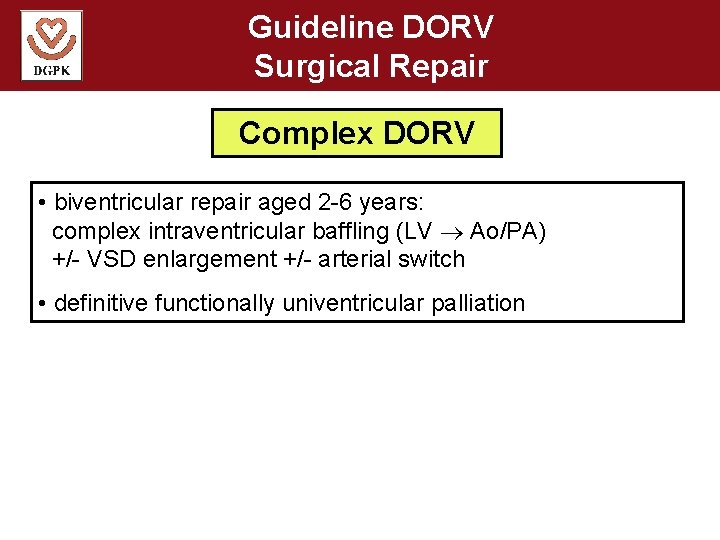
Guideline DORV Surgical Repair Complex DORV • biventricular repair aged 2 -6 years: complex intraventricular baffling (LV Ao/PA) +/- VSD enlargement +/- arterial switch • definitive functionally univentricular palliation
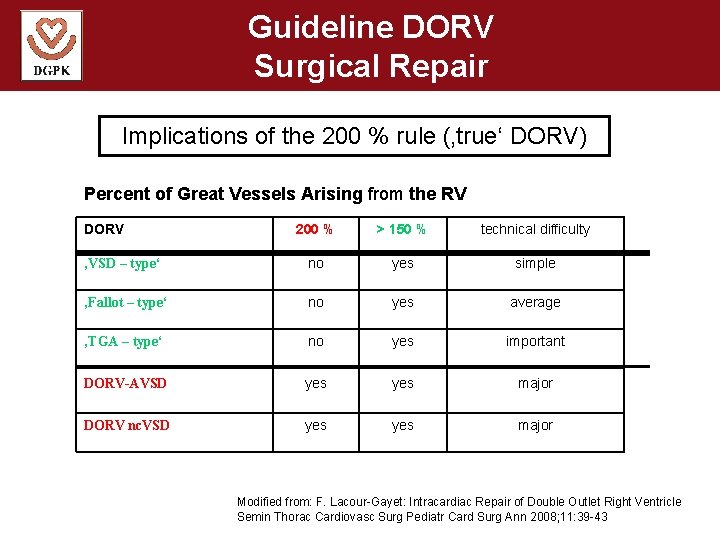
Guideline DORV Surgical Repair Implications of the 200 % rule (‚true‘ DORV) Percent of Great Vessels Arising from the RV DORV 200 % > 150 % technical difficulty ‚VSD – type‘ no yes simple ‚Fallot – type‘ no yes average ‚TGA – type‘ no yes important DORV-AVSD yes major DORV nc. VSD yes major Modified from: F. Lacour-Gayet: Intracardiac Repair of Double Outlet Right Ventricle Semin Thorac Cardiovasc Surg Pediatr Card Surg Ann 2008; 11: 39 -43
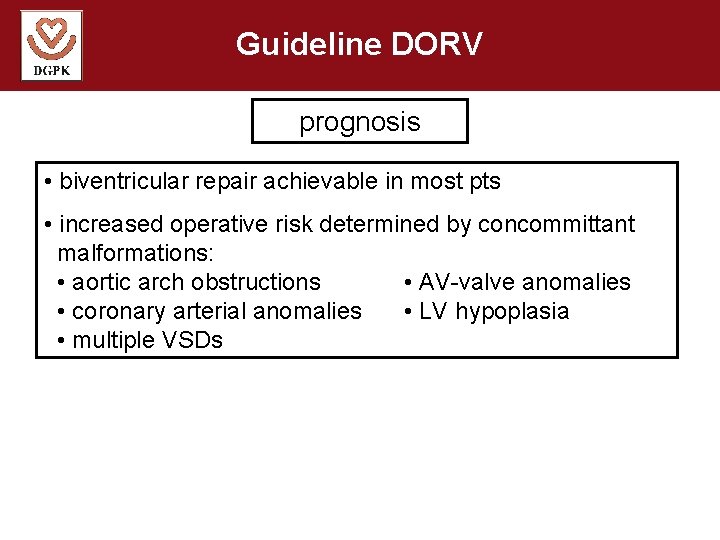
Guideline DORV prognosis • biventricular repair achievable in most pts • increased operative risk determined by concommittant malformations: • aortic arch obstructions • AV-valve anomalies • coronary arterial anomalies • LV hypoplasia • multiple VSDs
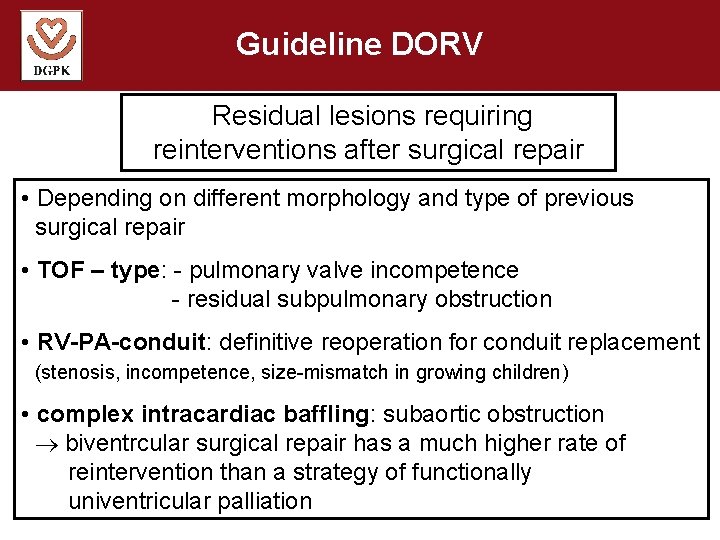
Guideline DORV Residual lesions requiring reinterventions after surgical repair • Depending on different morphology and type of previous surgical repair • TOF – type: - pulmonary valve incompetence - residual subpulmonary obstruction • RV-PA-conduit: definitive reoperation for conduit replacement (stenosis, incompetence, size-mismatch in growing children) • complex intracardiac baffling: subaortic obstruction biventrcular surgical repair has a much higher rate of reintervention than a strategy of functionally univentricular palliation
Guideline DORV Follow-up • Life-long follow-up by pediatric cardiologists and subsequently specialists for adult congenital heart disease is mandatory
- Slides: 29