
DG Education and Culture Training of Teachers and
- Slides: 16
DG Education and Culture Training of Teachers and Trainers in the e. Learning Action Plan TTnet Conference, CEDEFOP, 13 December 2001 Brian Holmes Multimedia for Education, Training and Culture DG Education and Culture European Commission
DG Education and Culture Training of Teachers and Trainers in the e. Learning Action Plan 3 Political imperative 3 e. Learning Initiative and Action Plan 3 e. Learning Call for Proposals 3 e. Learning implementation 3 Teacher/Tutor training 3 Future directions European Commission
DG Education and Culture The Political Imperative Towards a Knowledge Society Europe should become …. “the most competitive and dynamic knowledge-based economy in the world, capable of sustainable economic growth with more and better jobs and greater social cohesion” European Council Lisbon March 2000 European Commission
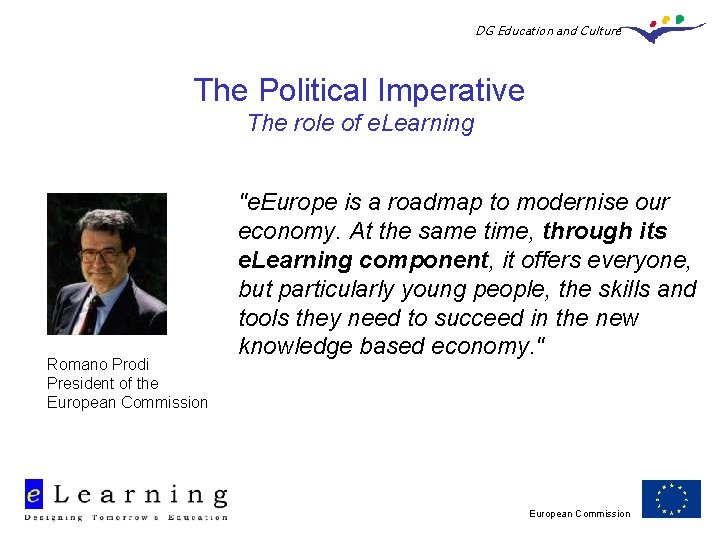
DG Education and Culture The Political Imperative The role of e. Learning Romano Prodi President of the European Commission "e. Europe is a roadmap to modernise our economy. At the same time, through its e. Learning component, it offers everyone, but particularly young people, the skills and tools they need to succeed in the new knowledge based economy. " European Commission
DG Education and Culture The Political Imperative The role of e. Learning • The Lisbon Summit placed education at the top of the political agenda, and called for the adaptation of education and training systems to the knowledge society • e. Learning helps to answer this request by fostering the integration of ICT in education as a lever for change, and as an opportunity for increased quality and diversity European Commission
DG Education and Culture The e. Learning Initiative To mobilise the educational and cultural communities, as well as the economic and social players in Europe…. . . in order to co-ordinate community actions concerned with e-learning, such as those in e. Europe, in the Employment Guidelines, in the research programmes, etc European Commission
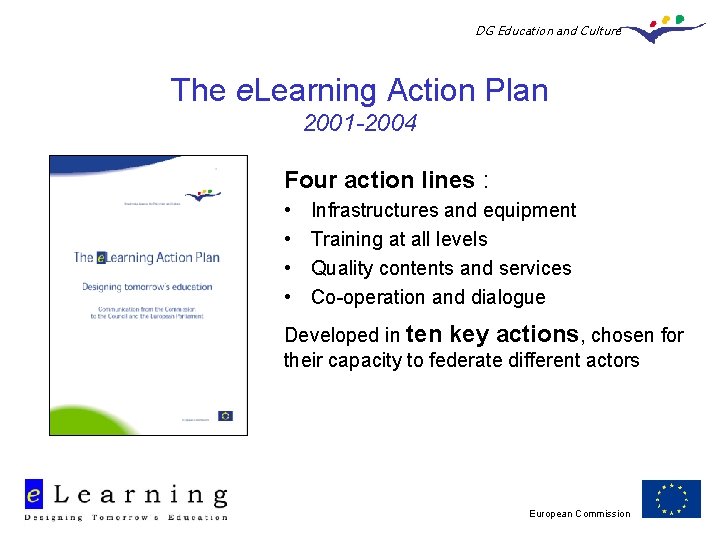
DG Education and Culture The e. Learning Action Plan 2001 -2004 Four action lines : • • Infrastructures and equipment Training at all levels Quality contents and services Co-operation and dialogue Developed in ten key actions, chosen for their capacity to federate different actors European Commission
DG Education and Culture e. Learning Implementation measures include: • Tender for strategic studies covering schools, universities and links to cultural institutions • Working groups with national experts on ICT indicators, ICT skills, women and ICT, special needs • Support for the e. Learning standards programme in co-operation with CEDEFOP • Joint action on public learning centres • Co-operation in the follow-up to the Report on the objectives of education systems • Co-operation with the IST programme for research, with the European Investment Bank for financial instruments and with Eurostat for statistics. European Commission
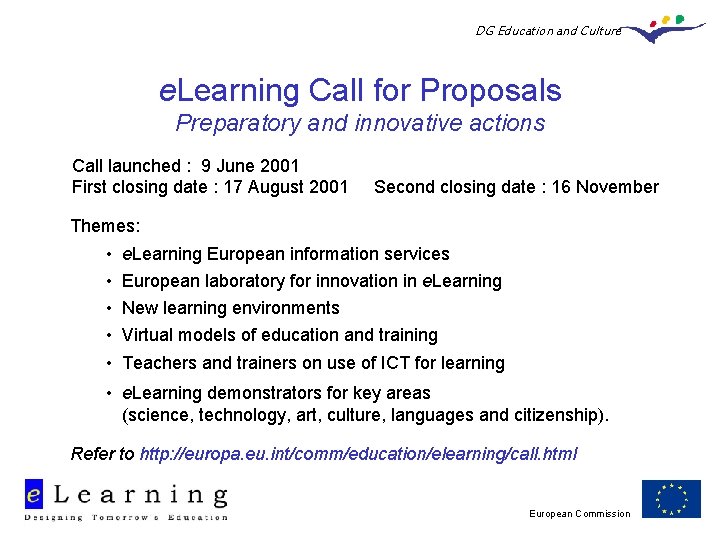
DG Education and Culture e. Learning Call for Proposals Preparatory and innovative actions Call launched : 9 June 2001 First closing date : 17 August 2001 Second closing date : 16 November Themes: • • • e. Learning European information services European laboratory for innovation in e. Learning New learning environments Virtual models of education and training Teachers and trainers on use of ICT for learning • e. Learning demonstrators for key areas (science, technology, art, culture, languages and citizenship). Refer to http: //europa. eu. int/comm/education/elearning/call. html European Commission
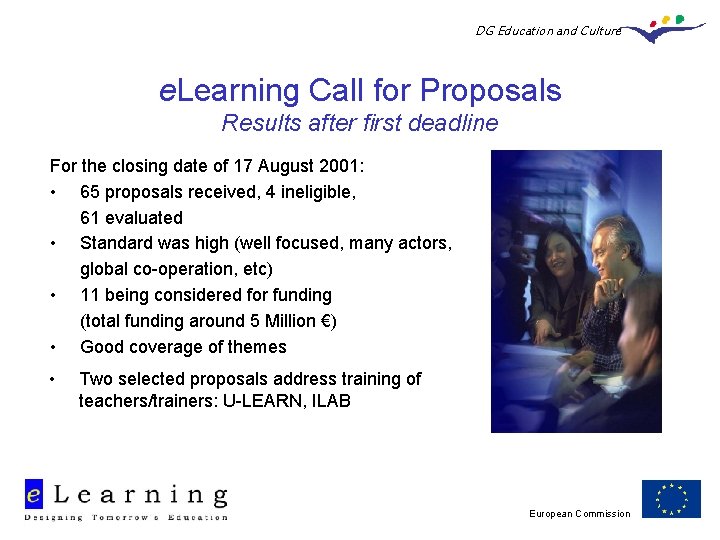
DG Education and Culture e. Learning Call for Proposals Results after first deadline For the closing date of 17 August 2001: • 65 proposals received, 4 ineligible, 61 evaluated • Standard was high (well focused, many actors, global co-operation, etc) • 11 being considered for funding (total funding around 5 Million €) • Good coverage of themes • Two selected proposals address training of teachers/trainers: U-LEARN, ILAB European Commission
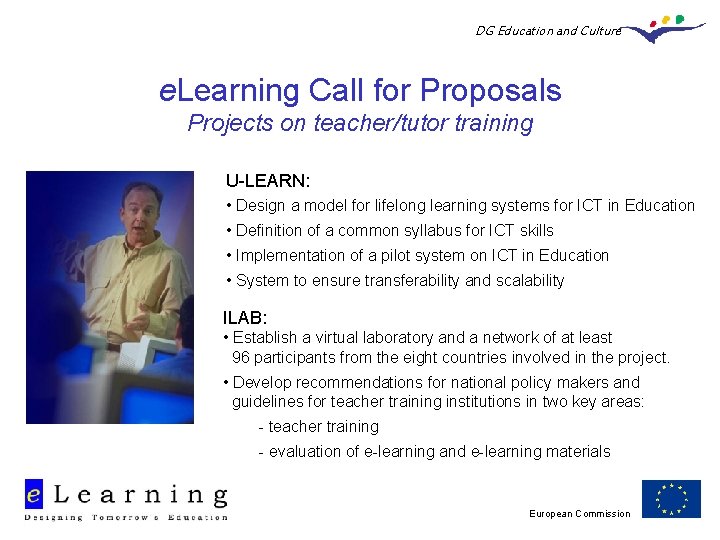
DG Education and Culture e. Learning Call for Proposals Projects on teacher/tutor training U-LEARN: • Design a model for lifelong learning systems for ICT in Education • Definition of a common syllabus for ICT skills • Implementation of a pilot system on ICT in Education • System to ensure transferability and scalability ILAB: • Establish a virtual laboratory and a network of at least 96 participants from the eight countries involved in the project. • Develop recommendations for national policy makers and guidelines for teacher training institutions in two key areas: - teacher training - evaluation of e-learning and e-learning materials European Commission
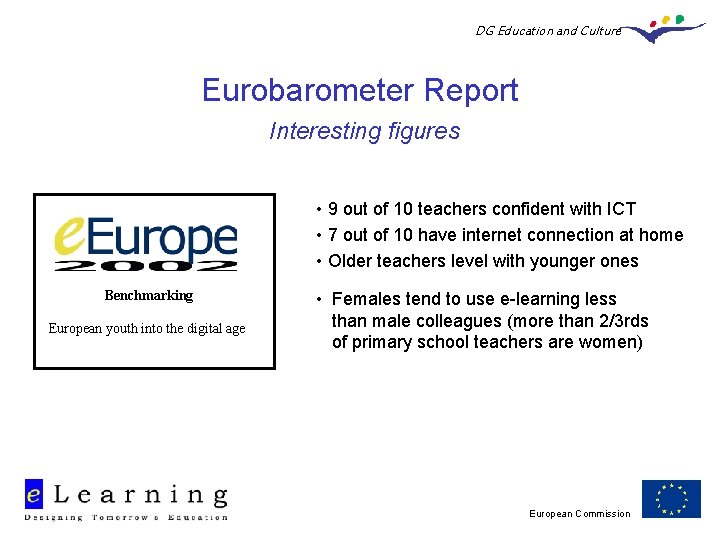
DG Education and Culture Eurobarometer Report Interesting figures • 9 out of 10 teachers confident with ICT • 7 out of 10 have internet connection at home • Older teachers level with younger ones Benchmarking European youth into the digital age • Females tend to use e-learning less than male colleagues (more than 2/3 rds of primary school teachers are women) European Commission
DG Education and Culture Ongoing Dialogue DG EAC has established a focus group on teacher training. Important issues have already been mentioned: - the need for support and maintenance - the need for incentives - the need for appropriate training Networking of teachers is as important as training Several initiatives already underway to support teacher networking & training: - European Schoolnet (EUN) - e. Schola European Commission
DG Education and Culture Future Directions Important challenges ahead Interest in e. Learning is increasing - from politicians, academia and industry - and expectations are high. However. . . • Learners need to see the tangible benefits and added-value • Decision makers need appropriate benchmarks and indicators • Emphasis must now be placed on quality, standards and pedagogy • Organisational issues and teacher/tutor training need greater consideration • Evaluation methodologies need to be developed for these new learning paradigms • Research must be strengthened with increased emphasis on sharing experience and best practice • Public-Private-Partnerships need to be explored and the market for e. Learning content needs to be developed European Commission
DG Education and Culture Future Directions e. Learning - realising the potential As we move towards the Knowledge Society, Europe - with its excellent Education and Training Systems - is well placed to take advantage of the revolution in learning e. Learning is now at the top of the political agenda, but many key issues still need to be addressed if the potential is to be realised By mobilising and co-ordinating Europe’s efforts, the e. Learning Initiative is playing an important role in helping Europe to realise its potential to be the world leader in learning products and services. European Commission
DG Education and Culture Thank you for your attention ! For more information : Directorate-General for Education and Culture Unit : Multimedia - Education, Training, Culture (B 100 3/7) B-1049 Brussels e-mail : e. Learning@cec. eu. int http: //europa. eu. int/comm/education/elearning European Commission