
DG ECHO Policy on Gender in Humanitarian Aid
- Slides: 12
DG ECHO Policy on Gender in Humanitarian Aid: Different Needs, Adapted Assistance
EU Commitment European Consensus on Humanitarian Aid 23. "Recognising the different needs, capacities and contributions of women, girls, boys and men, the EU highlights the importance of integrating gender considerations into humanitarian aid". 24. "The EU recognises that the active participation of women in humanitarian aid is essential, and commits to promoting that involvement". 39. "In responding to humanitarian needs particular vulnerabilities must be taken into account. In this context, the EU will pay special attention to women, children, the elderly, sick and disabled people, and to addressing their specific needs. Moreover, protection strategies against sexual and gender based violence must be incorporated in all aspects of humanitarian assistance".
Origins of the Policy the introduction of a new ol to foste r anaid Review of gender issuestoin humanitarian d track gender sen sitive Issues Paper humanitarian act ions: Policy Paper (first draft) gender and age m arker Stakeholder Consultation 2009 2010 2011 2012 2013 Commission Inter-Service Consultation and Staff Working Document (22 July 2013)
Gender in humanitarian assistance ‘The term gender refers to the social differences between females and males throughout the life cycle that are learned, and though deeply rooted in every culture, are changeable over time and have wide variations both within and between cultures. Gender determines the roles, power and resources for females and males in any culture. ’ IASC 2006
Principles • Humanity, neutrality, impartiality and independence • ‘Do no harm’ concept • Non-discrimination • People-centred approach • Gender equality
Principal Objective "To improve the quality of humanitarian operations by systematically tailoring responses to the specific needs of women and men of all ages, effectively helping the most vulnerable".
Specific Objectives based on the European Consensus • Gender integration • Participation • Protection Haiti – Earthquake 2010. Protection project
Phases of intervention ü NEW ACUTE CRISIS ü RECURRENT SITUATIONS ü PREPAREDNESS AND RECOVERY ü PROTRACTED CRISIS - Every intervention in any sector, context or location and in any type of emergency or crisis, must be gendersensitive - The Commission considers gender to be a quality criterion in the selection ofhumanitarian projects.
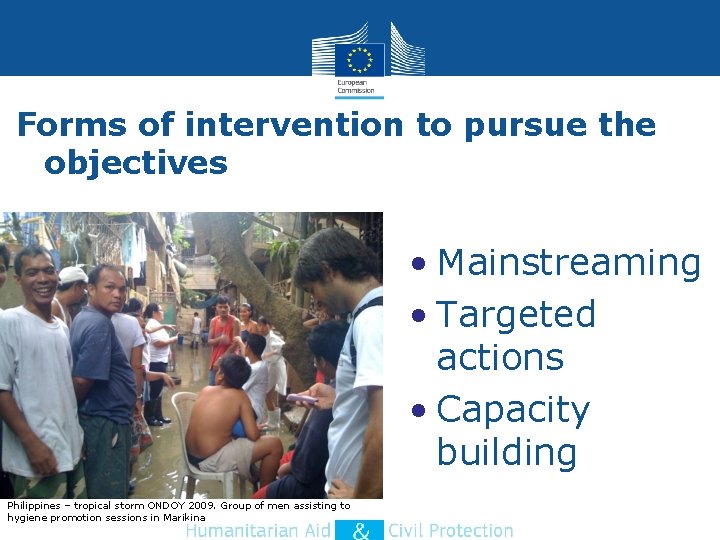
Forms of intervention to pursue the objectives • Mainstreaming • Targeted actions • Capacity building Philippines – tropical storm ONDOY 2009. Group of men assisting to hygiene promotion sessions in Marikina
Sexual and gender-based violence • Different types of SGBV • Under-reported, underaddressed and complex • Lack of accurate data and complexity should not prevent action • Importance of assisting all survivors and engaging also with men and boys • Sexual exploitation and abuse ü Prevention ü Protection ü Comprehensive, multi-sectorial approach ü Coordination ü Awareness
Coordination and Advocacy • Coordination with key actors inside/outside the EU • Advocacy towards humanitarian partners and other relevant stakeholders From policy to practice • • Gender and Age Marker Revised procedures and practices Adequate resources and monitoring of results Implementation Framework
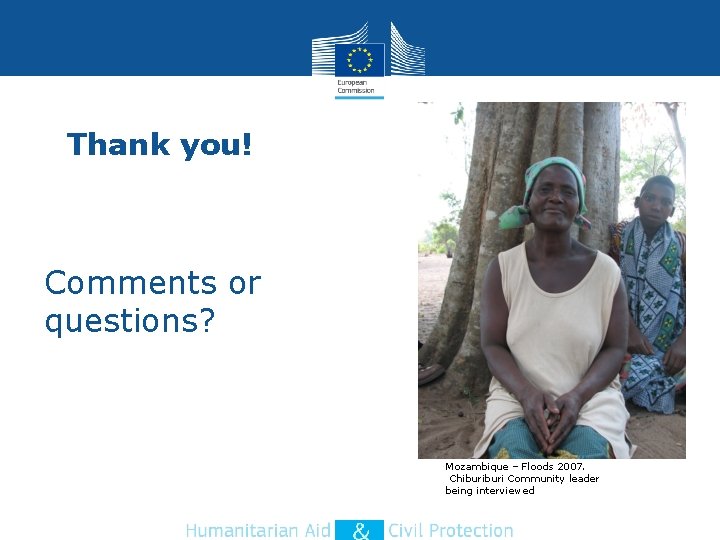
Thank you! Comments or questions? Mozambique – Floods 2007. Chiburi Community leader being interviewed