
DFX Concept Design Summary W Bailey Y Yang
DFX – Concept Design Summary W Bailey, Y Yang: University of Southampton HL-LHC-UK collaboration funded by STFC UK and CERN Acknowledgement: Y Leclercq, R Betemps, J Fleiter, I Falorio, S Claudet, V Parma, A Ballarino DFX –CDR 31 Jan 2019, CERN 1
Outline § Interfaces and functional specifications § § Constraints, design choices, DFX layout § § SC-Link Cryogenics Concept schematics Mechanical design for the interfaces/integration and functions § § § § § Electrical Cryogenics Vacuum SC-Link Nb. Ti-Nb. Ti splices D 1 -plug Cryogenic lines and cryo-jumper Instrumentations Controls Maintainability/exchangeability Safety devices Test and qualifications DFX –CDR 31 Jan 2019 2
Interfaces and functional specifications § Electrical § § § Cryogenics § § § LHe inlet GHe vent Line E 2 F in/out Line E 2 H in Vacuum § § § SC-Link with Mg. B 2 -LTS splices and LTS bus-bar He-I/He-II plug with LTS bus-bar LTS-LTS splices Instrumentations Barrier to SC-Link Isolated from Cryo-jumper and D 1 Control § § GHe flow for cooling the SC-Link, splices in DFH, HTS cables, and current leads LHe level for Mg. B 2 -Nb. Ti splices DFX –CDR 31 Jan 2019 3
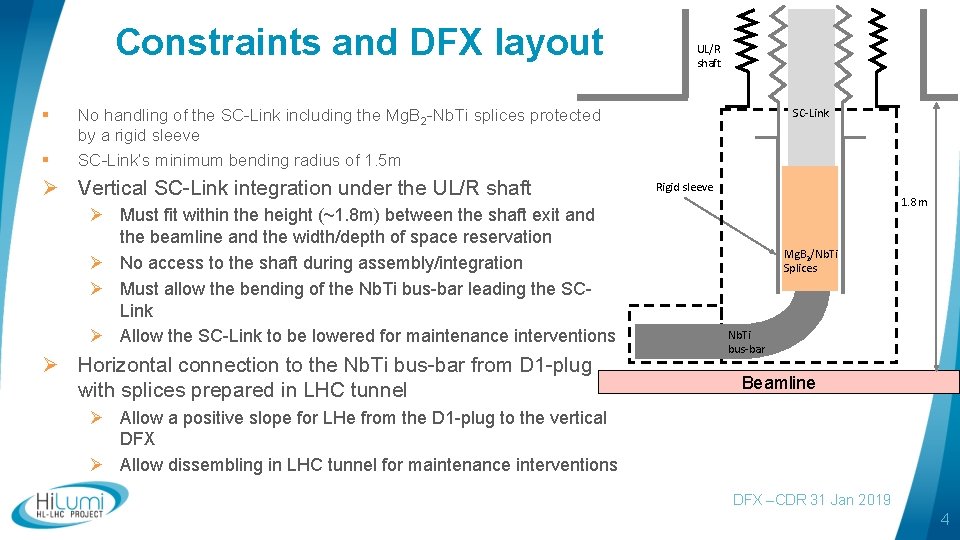
Constraints and DFX layout § § UL/R shaft No handling of the SC-Link including the Mg. B 2 -Nb. Ti splices protected by a rigid sleeve SC-Link’s minimum bending radius of 1. 5 m Ø Vertical SC-Link integration under the UL/R shaft Ø Must fit within the height (~1. 8 m) between the shaft exit and the beamline and the width/depth of space reservation Ø No access to the shaft during assembly/integration Ø Must allow the bending of the Nb. Ti bus-bar leading the SCLink Ø Allow the SC-Link to be lowered for maintenance interventions Ø Horizontal connection to the Nb. Ti bus-bar from D 1 -plug with splices prepared in LHC tunnel SC-Link Rigid sleeve 1. 8 m Mg. B 2/Nb. Ti Splices Nb. Ti bus-bar Beamline Ø Allow a positive slope for LHe from the D 1 -plug to the vertical DFX Ø Allow dissembling in LHC tunnel for maintenance interventions DFX –CDR 31 Jan 2019 4
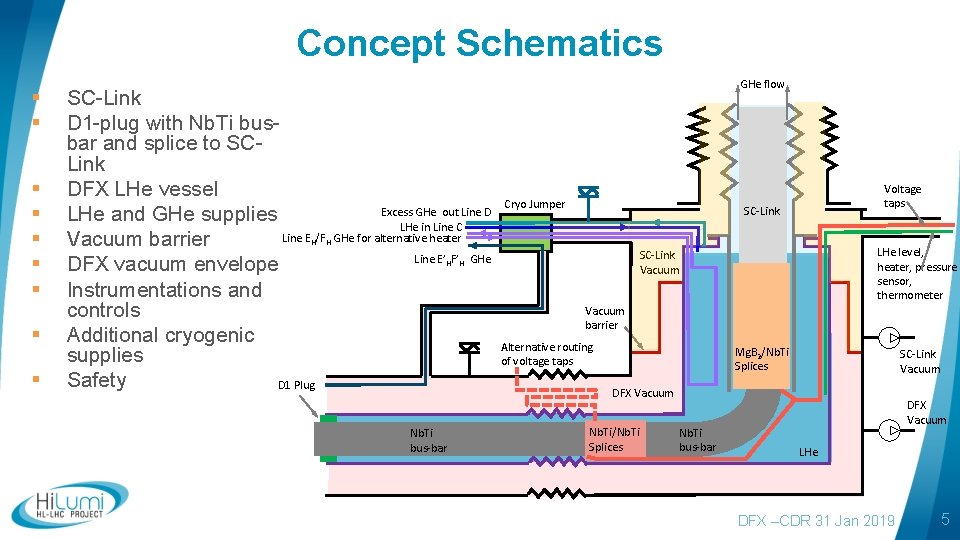
Concept Schematics § § § § § SC-Link D 1 -plug with Nb. Ti busbar and splice to SCLink DFX LHe vessel LHe and GHe supplies Line E /F Vacuum barrier DFX vacuum envelope Instrumentations and controls Additional cryogenic supplies Safety D 1 Plug H GHe flow Excess GHe out Line D LHe in Line C GHe for alternative heater H Cryo Jumper Voltage taps SC-Link LHe level, heater, pressure sensor, thermometer SC-Link Vacuum Line E’HF’H GHe Vacuum barrier Alternative routing of voltage taps Mg. B 2/Nb. Ti Splices SC-Link Vacuum DFX Vacuum Nb. Ti bus-bar Nb. Ti/Nb. Ti Splices Nb. Ti bus-bar DFX Vacuum LHe DFX –CDR 31 Jan 2019 5

DFX Component Vessels § Vertical DFX in two parts § Upper: inner and outer pre-assembled § § § Interfaces for cryo-lines and instrumentations on the side due to lack of access to the shaft Rigid vacuum barrier linking the inner and outer Flexibility by SC-Link cryostat Lower: assembled and welded after the integration of SCLink and bending of the Nb. Ti bus-bar Horizontal DFX in several sections § § § Reversible splice section (location to be optimised) Link sections to the vertical DFX on one side and D 1 -plug on the other Assembled sequentially from the vertical DFX to D 1 -plug DFX –CDR 31 Jan 2019 6
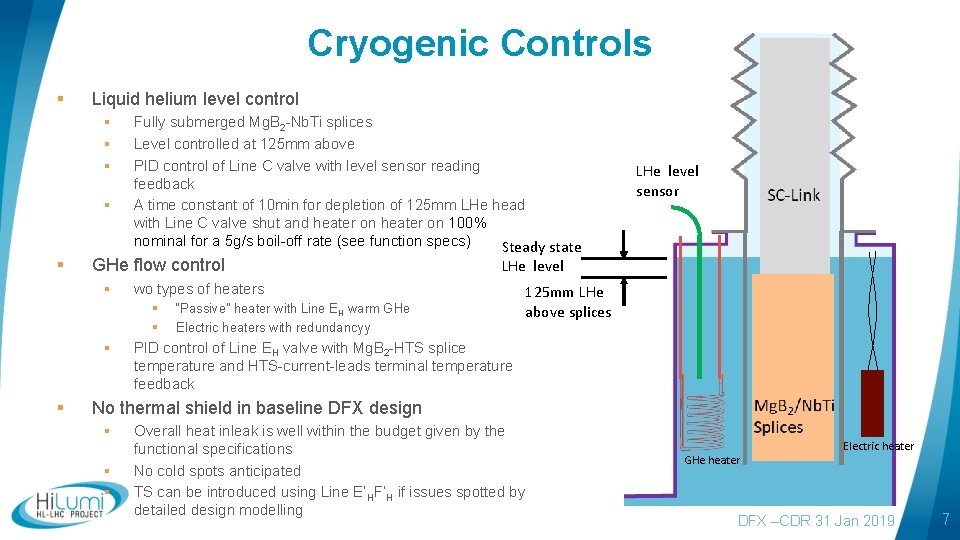
Cryogenic Controls § Liquid helium level control § § § Fully submerged Mg. B 2 -Nb. Ti splices Level controlled at 125 mm above PID control of Line C valve with level sensor reading feedback A time constant of 10 min for depletion of 125 mm LHe head with Line C valve shut and heater on 100% nominal for a 5 g/s boil-off rate (see function specs) Steady state GHe flow control § § § LHe level wo types of heaters § § LHe level sensor “Passive” heater with Line E H warm GHe Electric heaters with redundancyy 125 mm LHe above splices PID control of Line EH valve with Mg. B 2 -HTS splice temperature and HTS-current-leads terminal temperature feedback No thermal shield in baseline DFX design § § § Overall heat inleak is well within the budget given by the functional specifications No cold spots anticipated TS can be introduced using Line E’HF’H if issues spotted by detailed design modelling GHe heater Electric heater DFX –CDR 31 Jan 2019 7
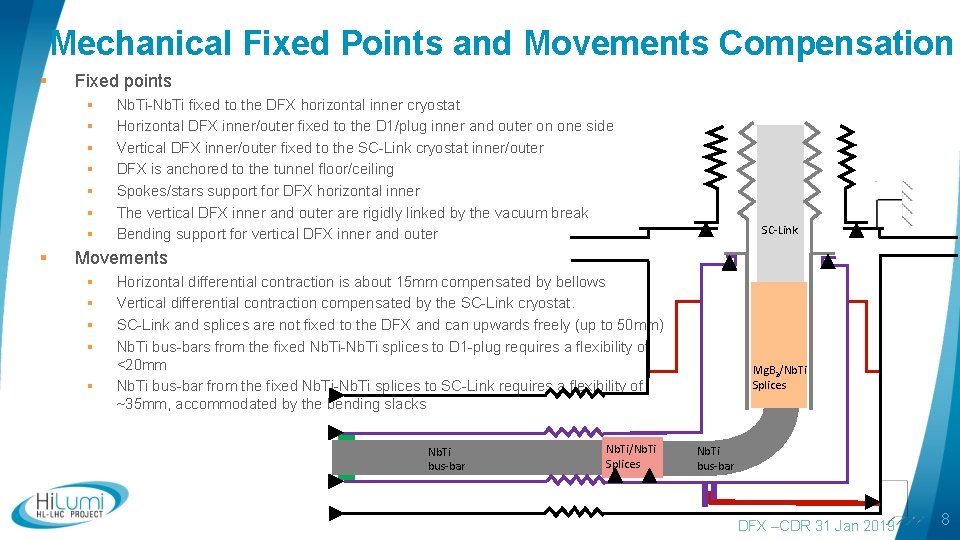
Mechanical Fixed Points and Movements Compensation § Fixed points § § § § Nb. Ti-Nb. Ti fixed to the DFX horizontal inner cryostat Horizontal DFX inner/outer fixed to the D 1/plug inner and outer on one side Vertical DFX inner/outer fixed to the SC-Link cryostat inner/outer DFX is anchored to the tunnel floor/ceiling Spokes/stars support for DFX horizontal inner The vertical DFX inner and outer are rigidly linked by the vacuum break Bending support for vertical DFX inner and outer SC-Link Movements § § § Horizontal differential contraction is about 15 mm compensated by bellows Vertical differential contraction compensated by the SC-Link cryostat. SC-Link and splices are not fixed to the DFX and can upwards freely (up to 50 mm) Nb. Ti bus-bars from the fixed Nb. Ti-Nb. Ti splices to D 1 -plug requires a flexibility of <20 mm Nb. Ti bus-bar from the fixed Nb. Ti-Nb. Ti splices to SC-Link requires a flexibility of ~35 mm, accommodated by the bending slacks Nb. Ti bus-bar Nb. Ti/Nb. Ti Splices Mg. B 2/Nb. Ti Splices Nb. Ti bus-bar DFX –CDR 31 Jan 2019 8
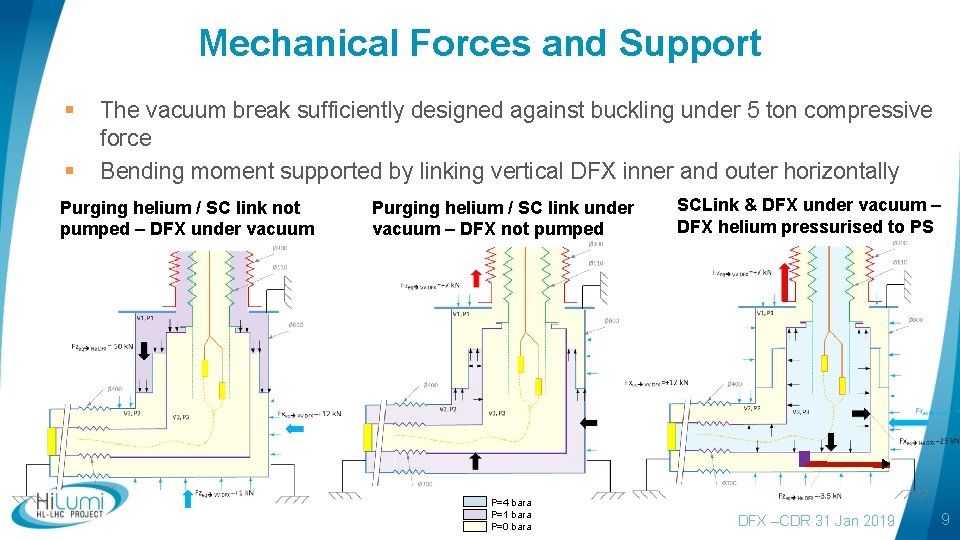
Mechanical Forces and Support § § The vacuum break sufficiently designed against buckling under 5 ton compressive force Bending moment supported by linking vertical DFX inner and outer horizontally Purging helium / SC link not pumped – DFX under vacuum Purging helium / SC link under vacuum – DFX not pumped P=4 bara P=1 bara P=0 bara SCLink & DFX under vacuum – DFX helium pressurised to PS DFX –CDR 31 Jan 2019 9
Warm Feedthroughs § 160 voltage wires from splices (JF) § Heat load for 160 x(10 x 0. 1 mm wire) is ~2 W per metre length of wires, thus 2 m lengths seems reasonable § Assuming feedthroughs using 10 -15 Fischers connectors or CERN equivalents, condensation is unlikely: § The thermal links to the warm wires on the feedthrough plugs § The thermal contact resistance between the voltage pins and the surrounding ceramic insulation followed by an effective natural convection area of 100150 cm 2. § Wires for other instrumentations/controls (pressure, level, thermometers, heaters) are less than 30 in total DFX –CDR 31 Jan 2019 10
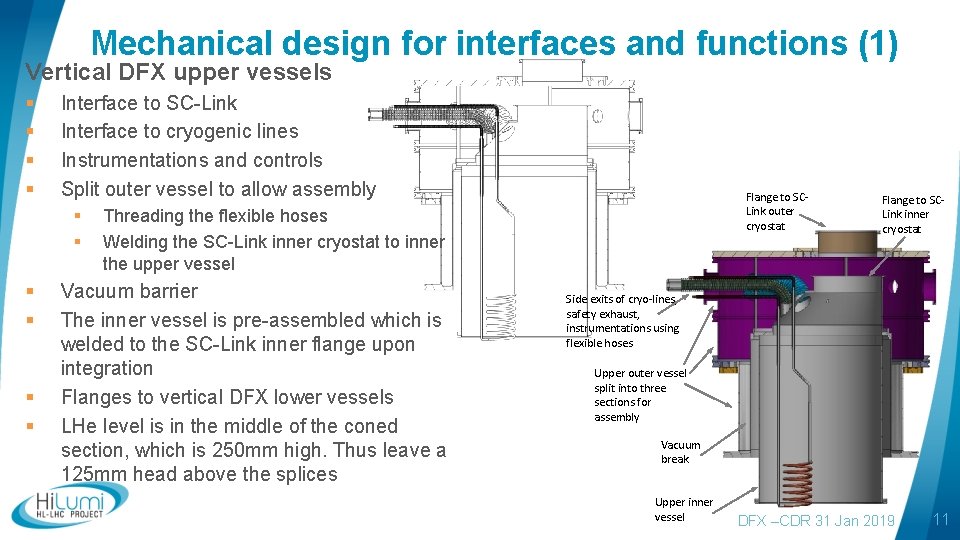
Mechanical design for interfaces and functions (1) Vertical DFX upper vessels § § Interface to SC-Link Interface to cryogenic lines Instrumentations and controls Split outer vessel to allow assembly § § § Flange to SCLink outer cryostat Threading the flexible hoses Welding the SC-Link inner cryostat to inner the upper vessel Vacuum barrier The inner vessel is pre-assembled which is welded to the SC-Link inner flange upon integration Flanges to vertical DFX lower vessels LHe level is in the middle of the coned section, which is 250 mm high. Thus leave a 125 mm head above the splices Flange to SCLink inner cryostat Side exits of cryo-lines, safety exhaust, instrumentations using flexible hoses Upper outer vessel split into three sections for assembly Vacuum break Upper inner vessel DFX –CDR 31 Jan 2019 11
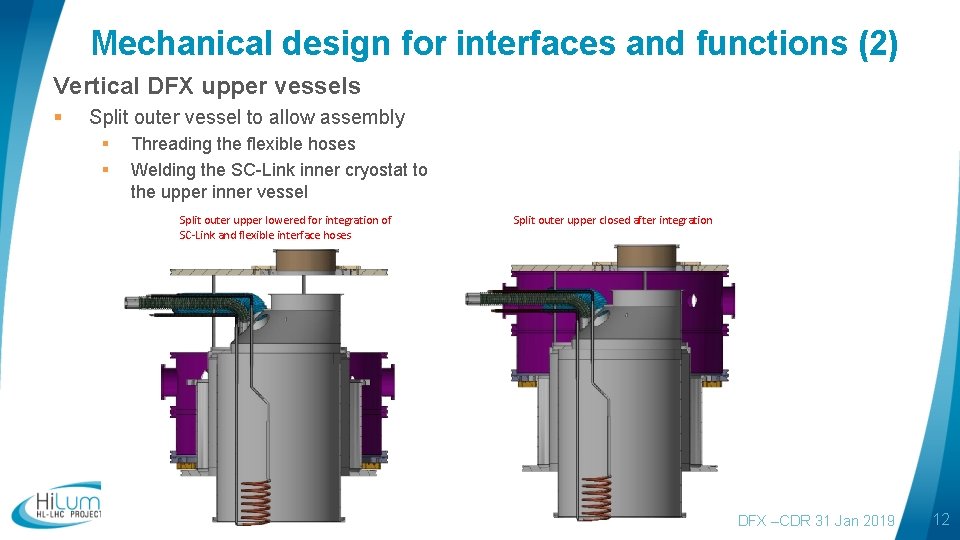
Mechanical design for interfaces and functions (2) Vertical DFX upper vessels § Split outer vessel to allow assembly § § Threading the flexible hoses Welding the SC-Link inner cryostat to the upper inner vessel Split outer upper lowered for integration of SC-Link and flexible interface hoses Split outer upper closed after integration DFX –CDR 31 Jan 2019 12
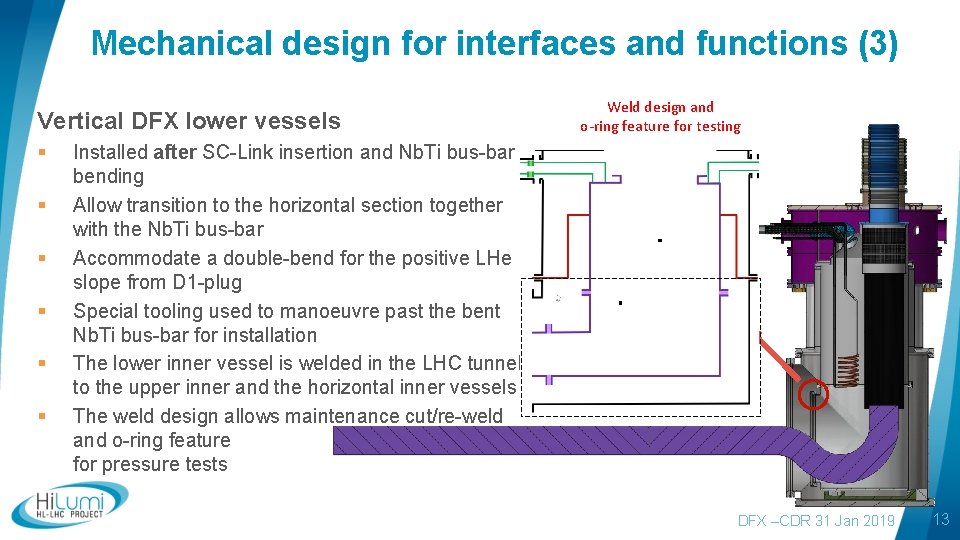
Mechanical design for interfaces and functions (3) Vertical DFX lower vessels § § § Installed after SC-Link insertion and Nb. Ti bus-bar bending Allow transition to the horizontal section together with the Nb. Ti bus-bar Accommodate a double-bend for the positive LHe slope from D 1 -plug Special tooling used to manoeuvre past the bent Nb. Ti bus-bar for installation The lower inner vessel is welded in the LHC tunnel to the upper inner and the horizontal inner vessels The weld design allows maintenance cut/re-weld and o-ring feature for pressure tests Weld design and o-ring feature for testing Welds O-ring groove DFX –CDR 31 Jan 2019 13
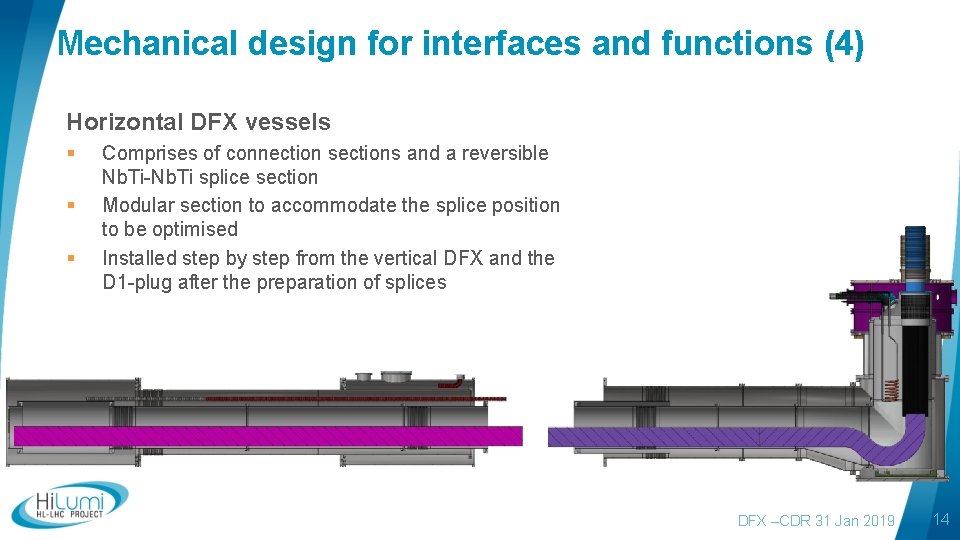
Mechanical design for interfaces and functions (4) Horizontal DFX vessels § § § Comprises of connection sections and a reversible Nb. Ti-Nb. Ti splice section Modular section to accommodate the splice position to be optimised Installed step by step from the vertical DFX and the D 1 -plug after the preparation of splices DFX –CDR 31 Jan 2019 14
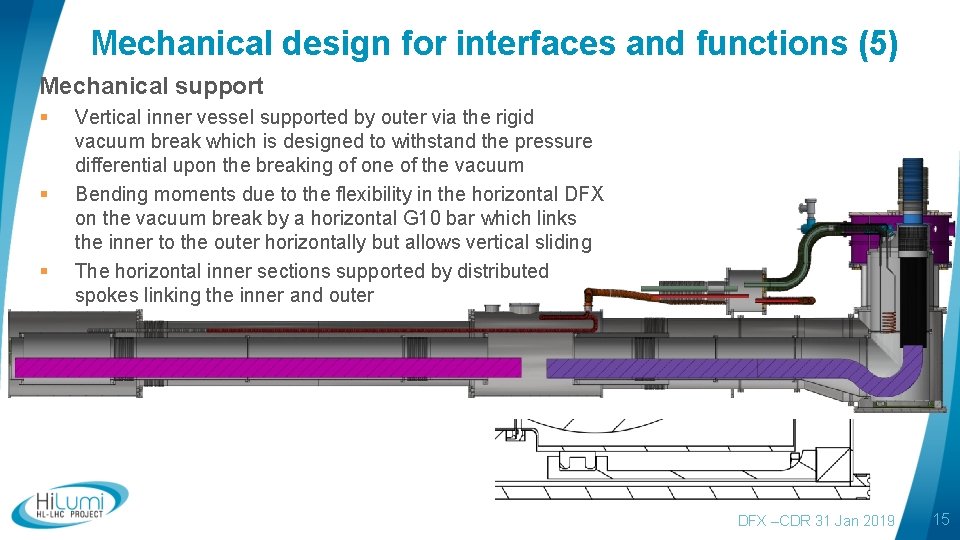
Mechanical design for interfaces and functions (5) Mechanical support § § § Vertical inner vessel supported by outer via the rigid vacuum break which is designed to withstand the pressure differential upon the breaking of one of the vacuum Bending moments due to the flexibility in the horizontal DFX on the vacuum break by a horizontal G 10 bar which links the inner to the outer horizontally but allows vertical sliding The horizontal inner sections supported by distributed spokes linking the inner and outer DFX –CDR 31 Jan 2019 15
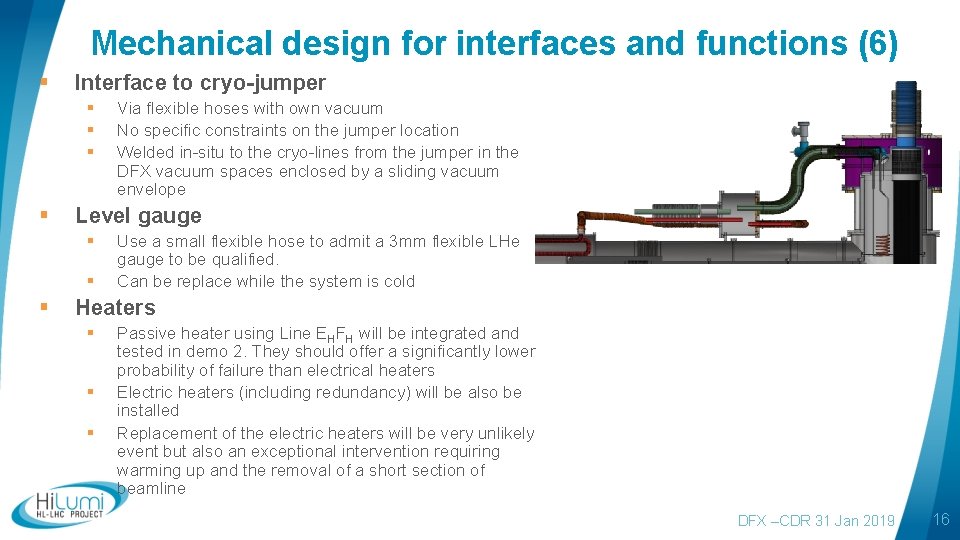
Mechanical design for interfaces and functions (6) § Interface to cryo-jumper § § Level gauge § § § Via flexible hoses with own vacuum No specific constraints on the jumper location Welded in-situ to the cryo-lines from the jumper in the DFX vacuum spaces enclosed by a sliding vacuum envelope Use a small flexible hose to admit a 3 mm flexible LHe gauge to be qualified. Can be replace while the system is cold Heaters § § § Passive heater using Line EHFH will be integrated and tested in demo 2. They should offer a significantly lower probability of failure than electrical heaters Electric heaters (including redundancy) will be also be installed Replacement of the electric heaters will be very unlikely event but also an exceptional intervention requiring warming up and the removal of a short section of beamline DFX –CDR 31 Jan 2019 16
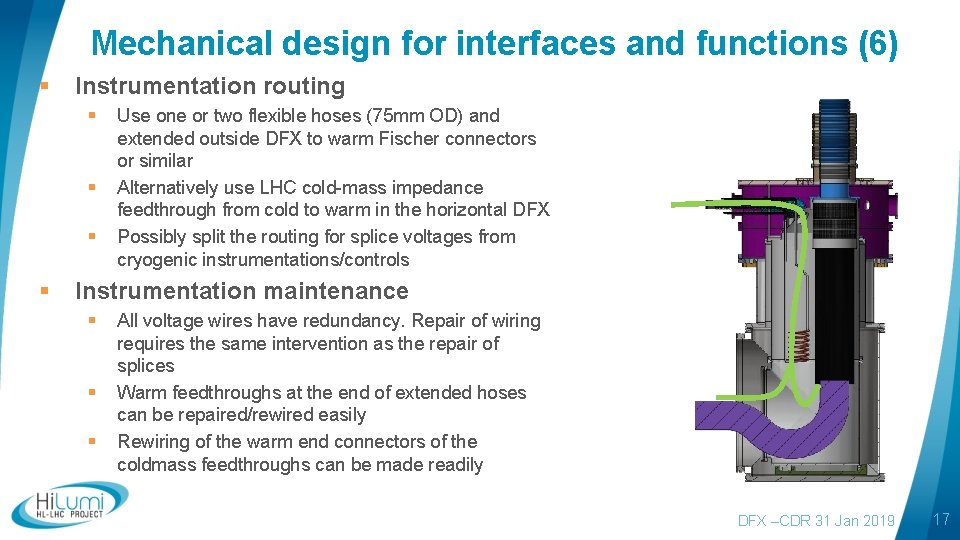
Mechanical design for interfaces and functions (6) § Instrumentation routing § § Use one or two flexible hoses (75 mm OD) and extended outside DFX to warm Fischer connectors or similar Alternatively use LHC cold-mass impedance feedthrough from cold to warm in the horizontal DFX Possibly split the routing for splice voltages from cryogenic instrumentations/controls Instrumentation maintenance § § § All voltage wires have redundancy. Repair of wiring requires the same intervention as the repair of splices Warm feedthroughs at the end of extended hoses can be repaired/rewired easily Rewiring of the warm end connectors of the coldmass feedthroughs can be made readily DFX –CDR 31 Jan 2019 17
Mechanical design for interfaces and functions (8) Safety Devices § § LHe vent upon vacuum loss or the quench of busbars/splices via a flexible hose of 75 mm ID DFX vacuum space vent installed on a horizontal section, virtually no constraints on the vent size (DIN 200+) DFX –CDR 31 Jan 2019 18
Test and Qualification § Pressure vessel tests will be carried out according to the appropriate standards and working pressures stipulated in the functional specifications at component level as well as assembled system. Exact procedures including cryogenic cycling to be agreed with CERN § Design features required for the tests are in place § Warm leak tightness tests will be carried out on the assembled system DFX –CDR 31 Jan 2019 19
Conclusions § Concept design compliant with the functional specifications, especially the constraints due to the SCLink interfaces and LHC tunnel geometry § The design is conservative/generous in dimensioning. The practicality of assembly has been checked at conceptual level and a little beyond § The tightness of the scheduling to DDR and production is fully appreciated. The current concept has moved into considerable mechanical details than presented here DFX - CPS review 3 July 2017 20
Thank you for your attention DFX - CPS review 3 July 2017 21
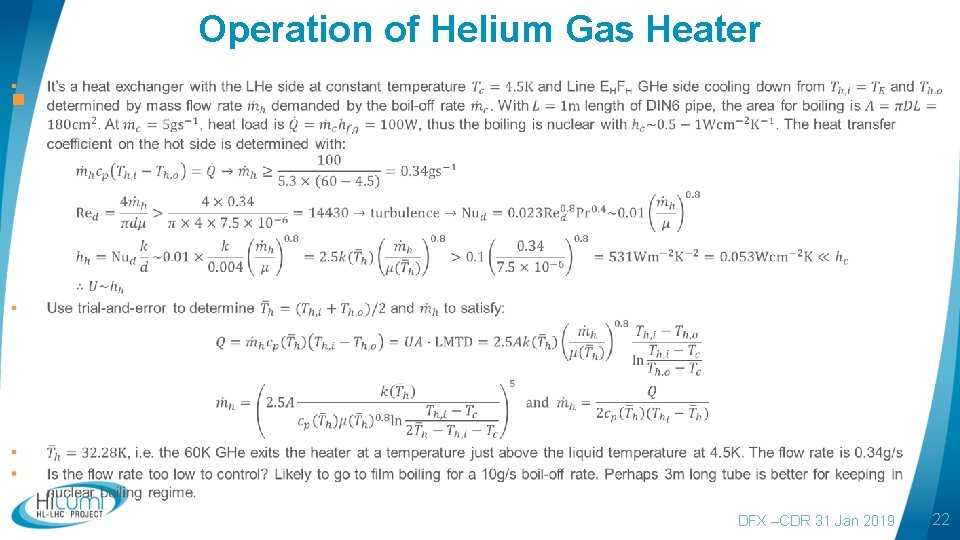
Operation of Helium Gas Heater § DFX –CDR 31 Jan 2019 22
Assembling in LHC tunnel and possible toolings DFX –CDR 31 Jan 2019 23
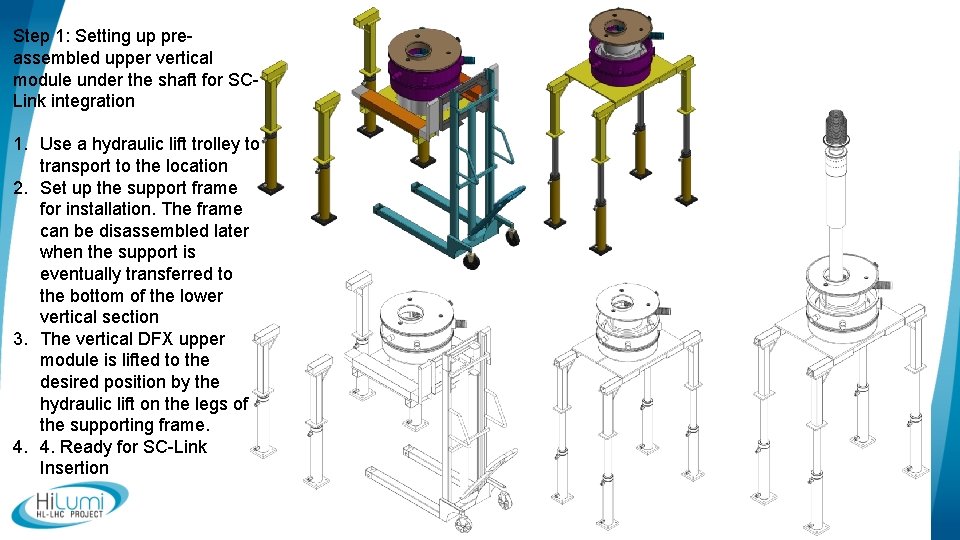
Step 1: Setting up preassembled upper vertical module under the shaft for SCLink integration 1. Use a hydraulic lift trolley to transport to the location 2. Set up the support frame for installation. The frame can be disassembled later when the support is eventually transferred to the bottom of the lower vertical section 3. The vertical DFX upper module is lifted to the desired position by the hydraulic lift on the legs of the supporting frame. 4. 4. Ready for SC-Link Insertion
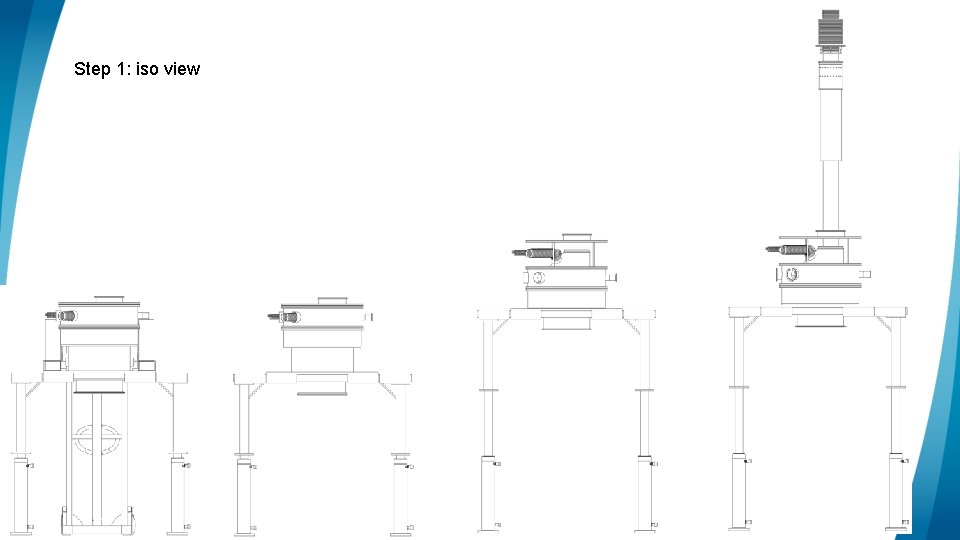
Step 1: iso view
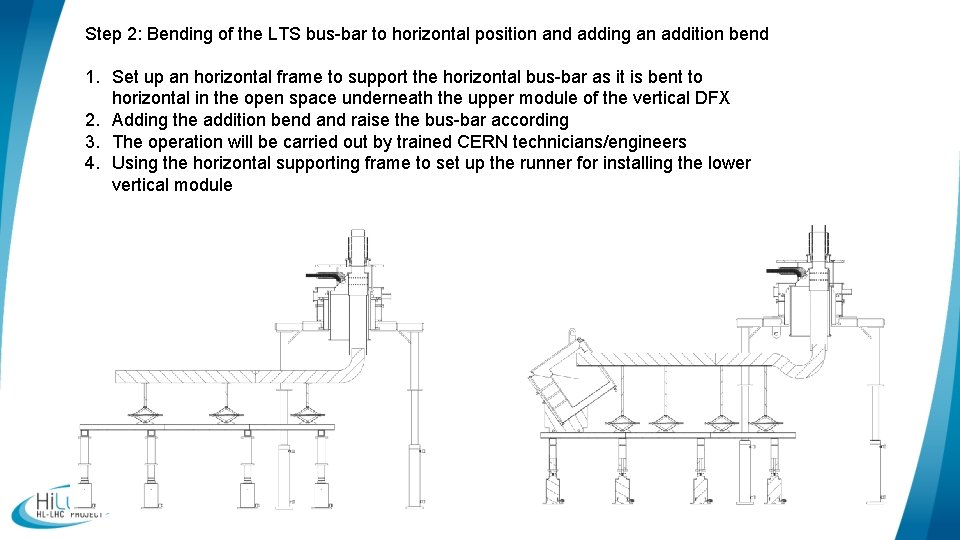
Step 2: Bending of the LTS bus-bar to horizontal position and adding an addition bend 1. Set up an horizontal frame to support the horizontal bus-bar as it is bent to horizontal in the open space underneath the upper module of the vertical DFX 2. Adding the addition bend and raise the bus-bar according 3. The operation will be carried out by trained CERN technicians/engineers 4. Using the horizontal supporting frame to set up the runner for installing the lower vertical module
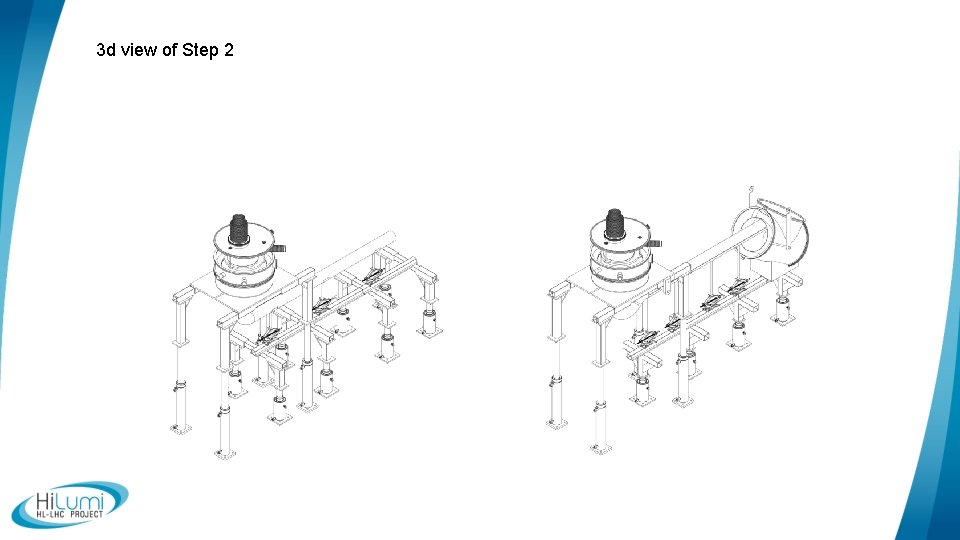
3 d view of Step 2
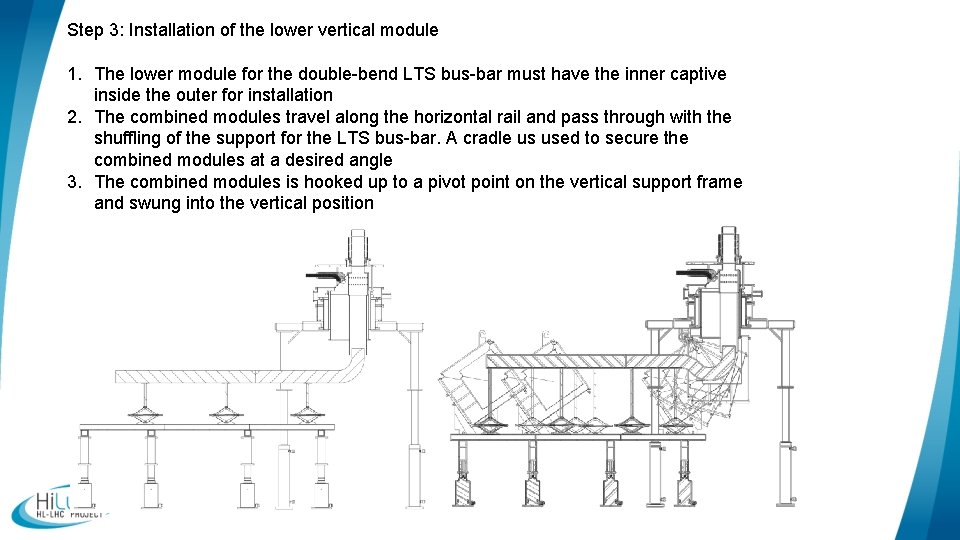
Step 3: Installation of the lower vertical module 1. The lower module for the double-bend LTS bus-bar must have the inner captive inside the outer for installation 2. The combined modules travel along the horizontal rail and pass through with the shuffling of the support for the LTS bus-bar. A cradle us used to secure the combined modules at a desired angle 3. The combined modules is hooked up to a pivot point on the vertical support frame and swung into the vertical position
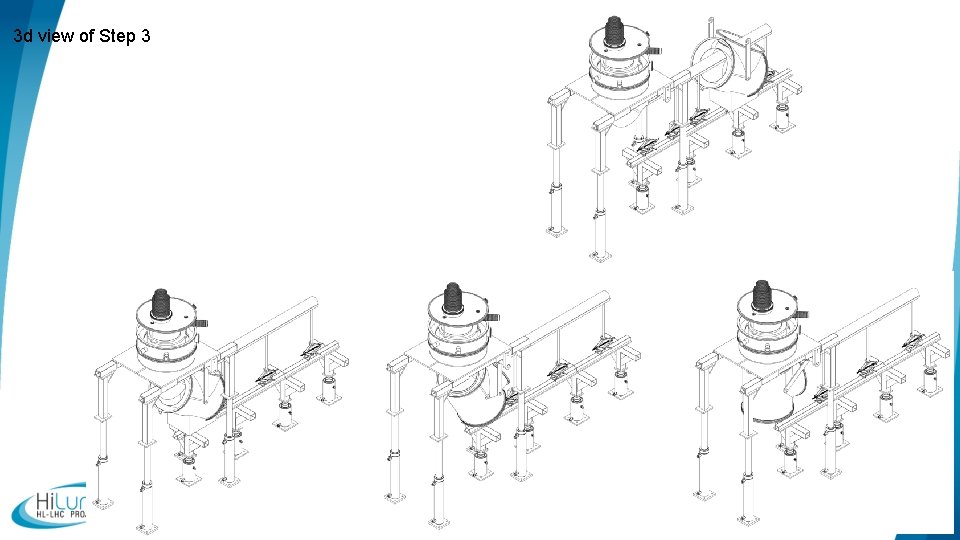
3 d view of Step 3
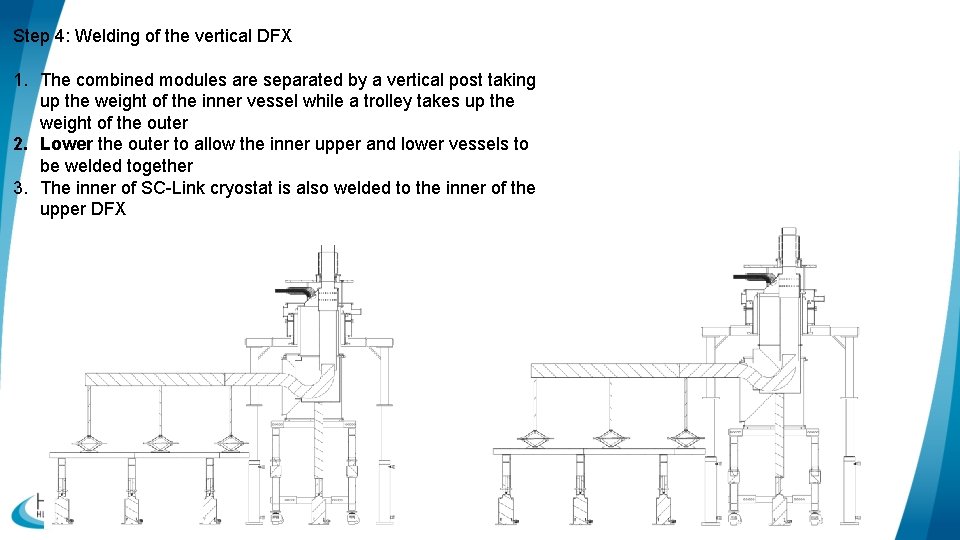
Step 4: Welding of the vertical DFX 1. The combined modules are separated by a vertical post taking up the weight of the inner vessel while a trolley takes up the weight of the outer 2. Lower the outer to allow the inner upper and lower vessels to be welded together 3. The inner of SC-Link cryostat is also welded to the inner of the upper DFX
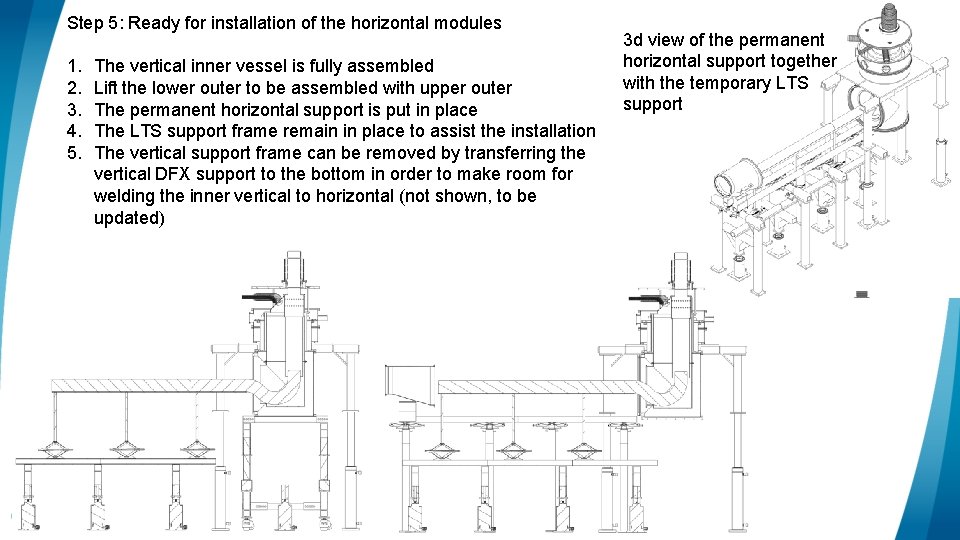
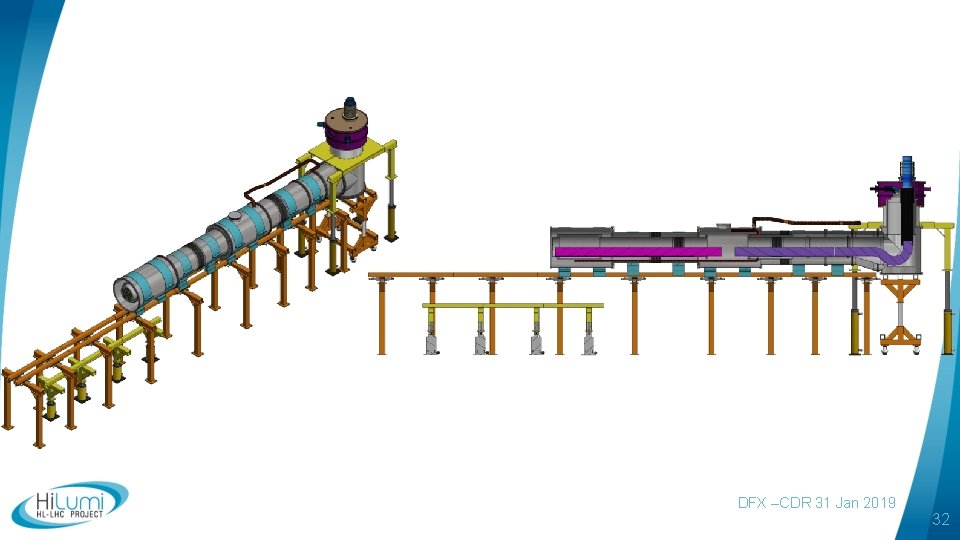
Step 5: Ready for installation of the horizontal modules 1. 2. 3. 4. 5. The vertical inner vessel is fully assembled Lift the lower outer to be assembled with upper outer The permanent horizontal support is put in place The LTS support frame remain in place to assist the installation The vertical support frame can be removed by transferring the vertical DFX support to the bottom in order to make room for welding the inner vertical to horizontal (not shown, to be updated) 3 d view of the permanent horizontal support together with the temporary LTS support
DFX –CDR 31 Jan 2019 32
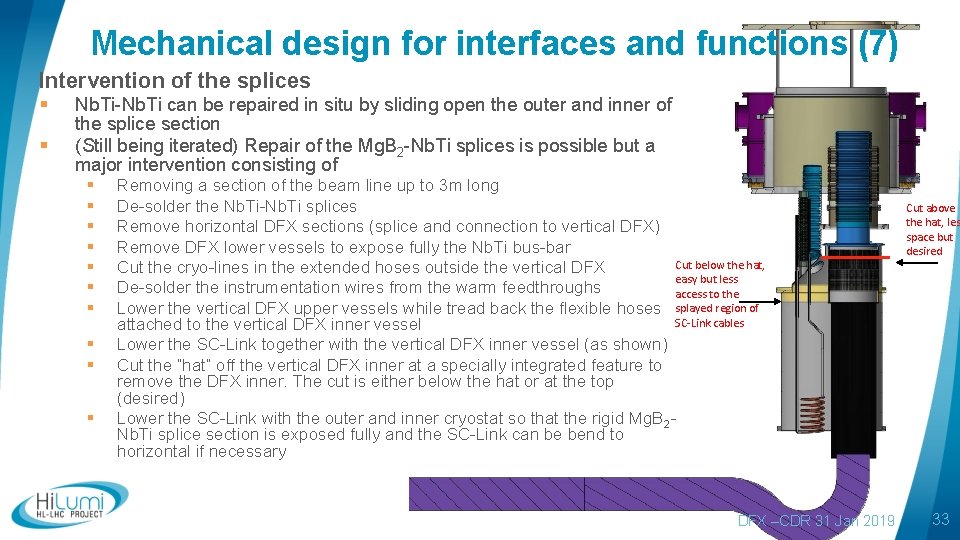
Mechanical design for interfaces and functions (7) Intervention of the splices § § Nb. Ti-Nb. Ti can be repaired in situ by sliding open the outer and inner of the splice section (Still being iterated) Repair of the Mg. B 2 -Nb. Ti splices is possible but a major intervention consisting of § § § § § Removing a section of the beam line up to 3 m long De-solder the Nb. Ti-Nb. Ti splices Remove horizontal DFX sections (splice and connection to vertical DFX) Remove DFX lower vessels to expose fully the Nb. Ti bus-bar Cut below the hat, Cut the cryo-lines in the extended hoses outside the vertical DFX easy but less De-solder the instrumentation wires from the warm feedthroughs access to the Lower the vertical DFX upper vessels while tread back the flexible hoses splayed region of SC-Link cables attached to the vertical DFX inner vessel Lower the SC-Link together with the vertical DFX inner vessel (as shown) Cut the “hat” off the vertical DFX inner at a specially integrated feature to remove the DFX inner. The cut is either below the hat or at the top (desired) Lower the SC-Link with the outer and inner cryostat so that the rigid Mg. B 2 Nb. Ti splice section is exposed fully and the SC-Link can be bend to horizontal if necessary DFX –CDR 31 Jan 2019 Cut above the hat, les space but desired 33
- Slides: 33