
DFT Discrete Fourier Transform Frequency analysis of discrete
- Slides: 9
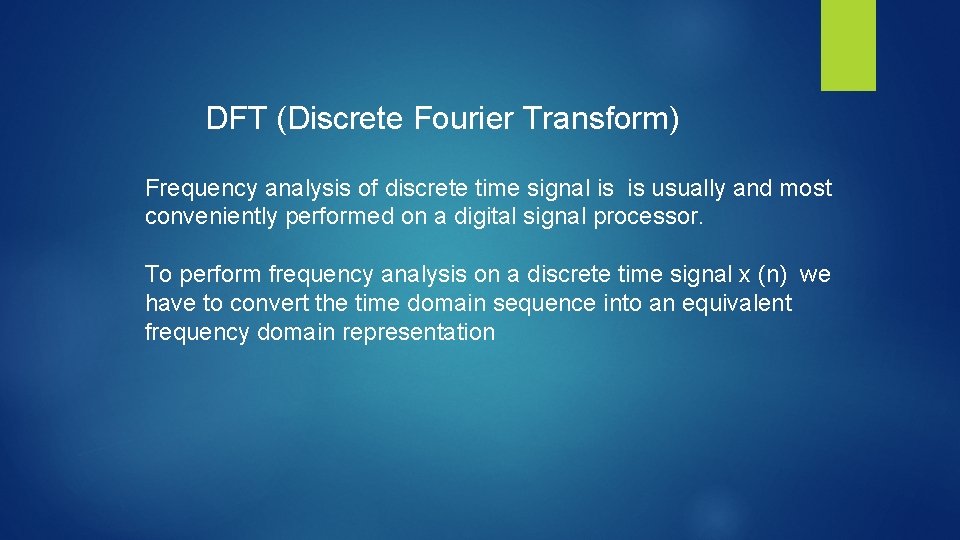
DFT (Discrete Fourier Transform) Frequency analysis of discrete time signal is is usually and most conveniently performed on a digital signal processor. To perform frequency analysis on a discrete time signal x (n) we have to convert the time domain sequence into an equivalent frequency domain representation
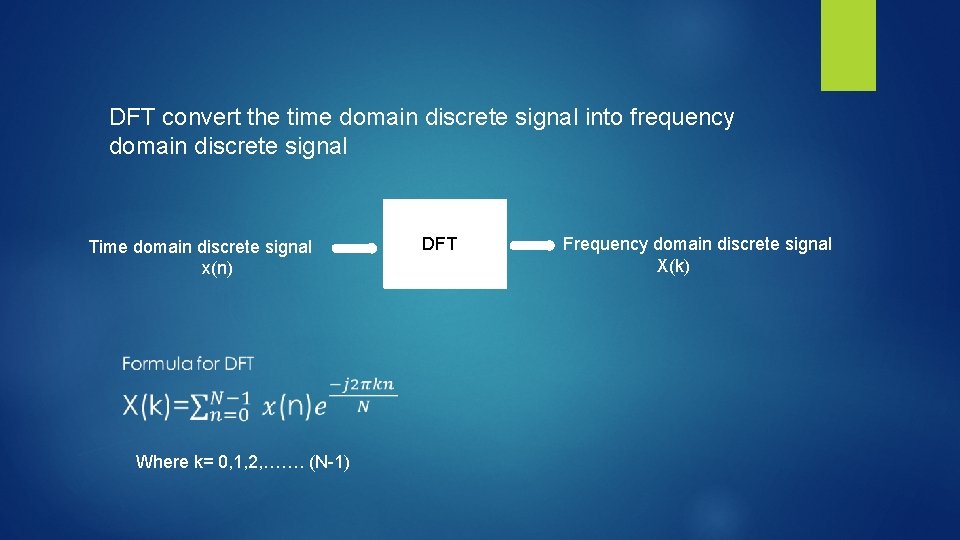
DFT convert the time domain discrete signal into frequency domain discrete signal Time domain discrete signal x(n) Where k= 0, 1, 2, ……. (N-1) DFT Frequency domain discrete signal X(k)
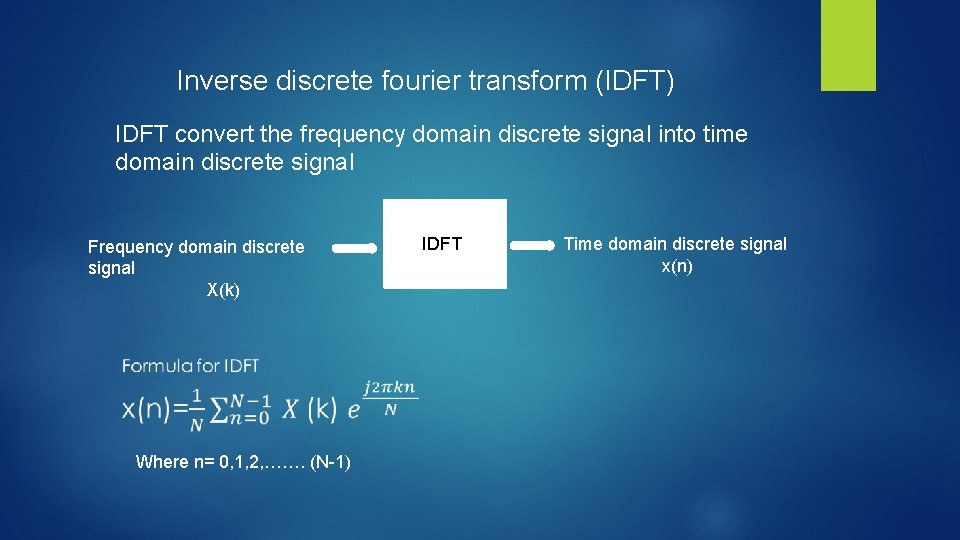
Inverse discrete fourier transform (IDFT) IDFT convert the frequency domain discrete signal into time domain discrete signal Frequency domain discrete signal X(k) Where n= 0, 1, 2, ……. (N-1) IDFT Time domain discrete signal x(n)
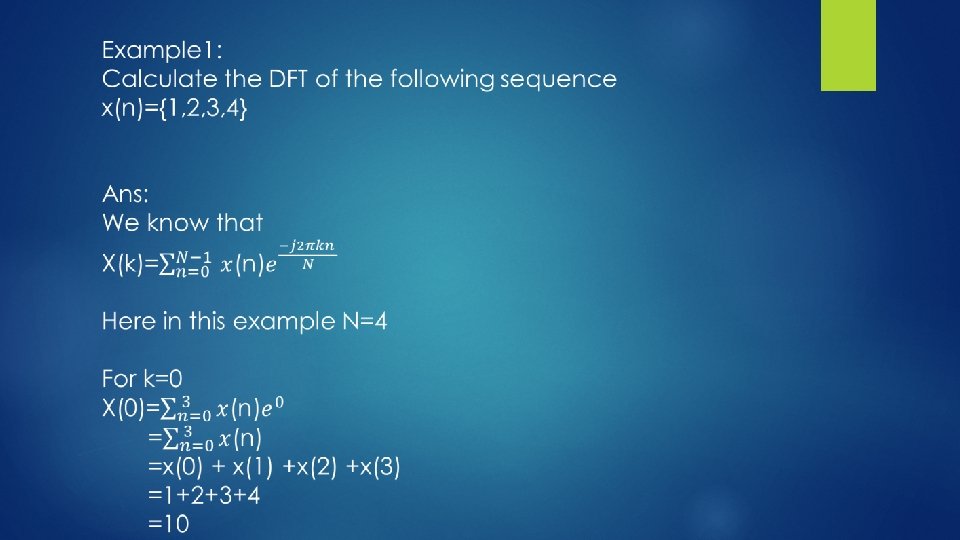
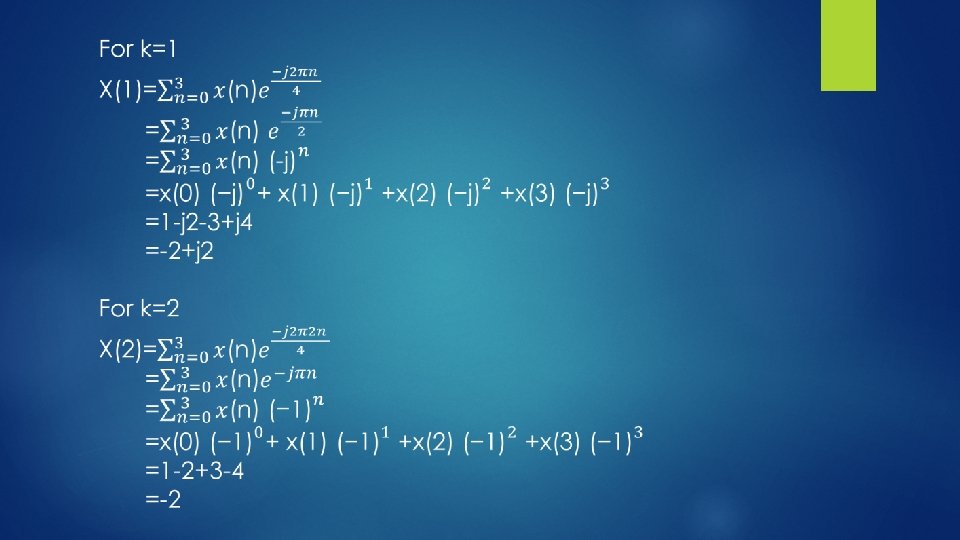
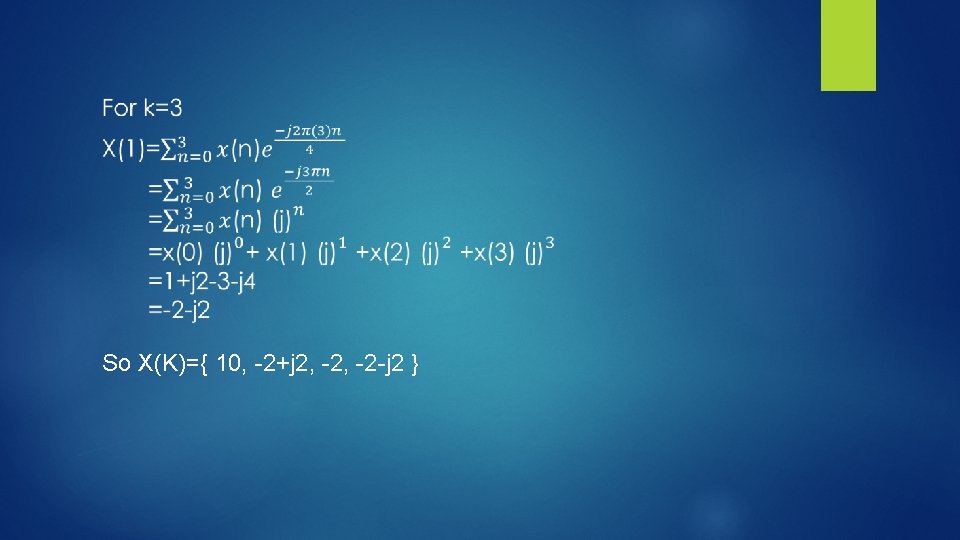
So X(K)={ 10, -2+j 2, -2 -j 2 }
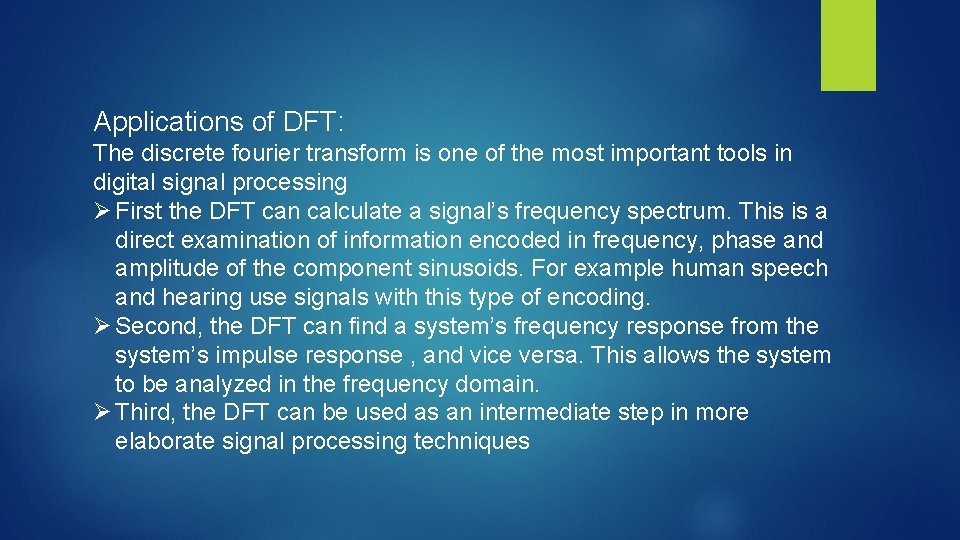
Applications of DFT: The discrete fourier transform is one of the most important tools in digital signal processing Ø First the DFT can calculate a signal’s frequency spectrum. This is a direct examination of information encoded in frequency, phase and amplitude of the component sinusoids. For example human speech and hearing use signals with this type of encoding. Ø Second, the DFT can find a system’s frequency response from the system’s impulse response , and vice versa. This allows the system to be analyzed in the frequency domain. Ø Third, the DFT can be used as an intermediate step in more elaborate signal processing techniques
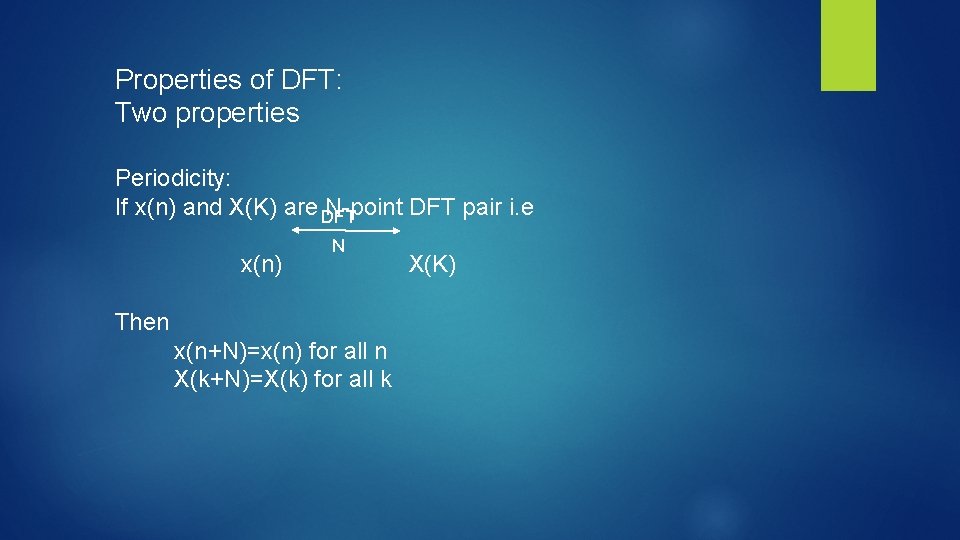
Properties of DFT: Two properties Periodicity: If x(n) and X(K) are DFT N-point DFT pair i. e x(n) N Then x(n+N)=x(n) for all n X(k+N)=X(k) for all k X(K)
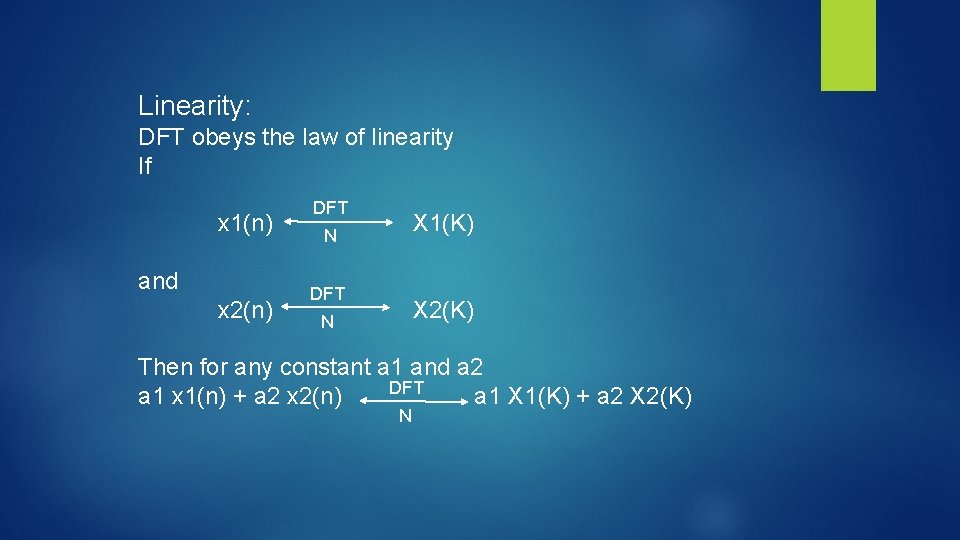
Linearity: DFT obeys the law of linearity If x 1(n) and x 2(n) DFT X 1(K) N DFT X 2(K) N Then for any constant a 1 and a 2 DFT a 1 x 1(n) + a 2 x 2(n) a 1 X 1(K) + a 2 X 2(K) N