
DFT CALCULATIONS FOR SIMPLE SOLIDS 2 1 PERIODIC
- Slides: 17
DFT CALCULATIONS FOR SIMPLE SOLIDS
2. 1 PERIODIC STRUCTURES, SUPERCELLS, AND LATTICE PARAMETERS The vectors that define the cell volume and the atom positions within the cell are collectively referred to as the supercell, and the definition of a supercell is the most basic input into a DFT calculation. 2
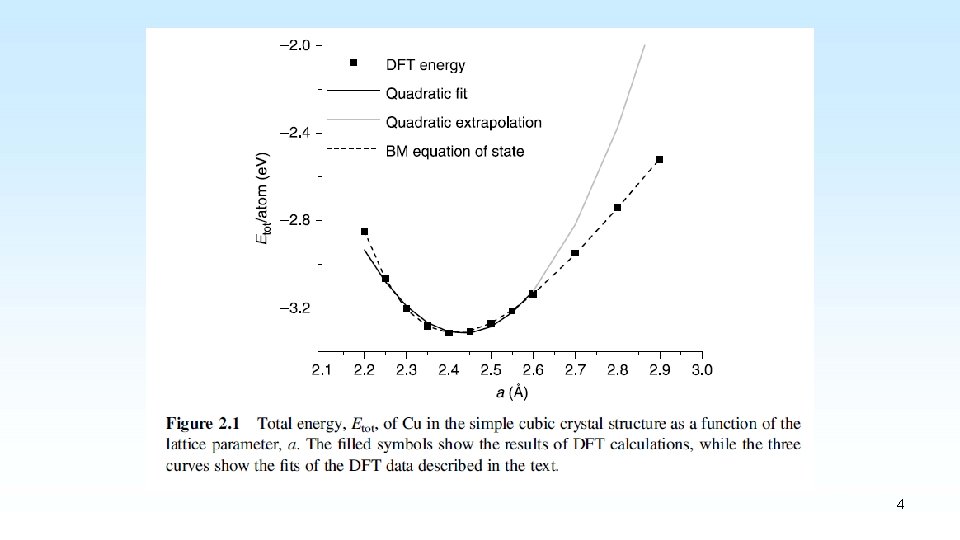
How can we use calculations of this type to determine the lattice constant of our simple cubic metal that would be observed in nature? 3
4
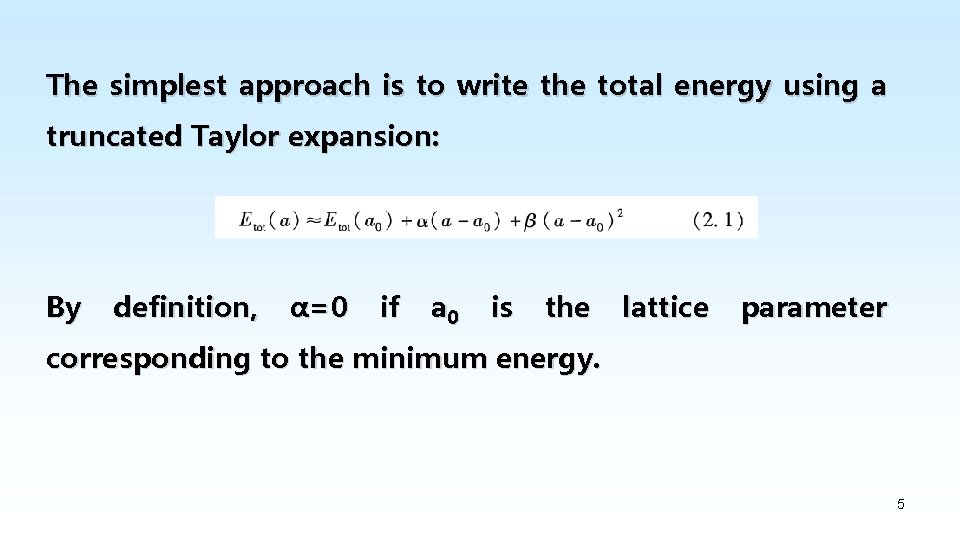
The simplest approach is to write the total energy using a truncated Taylor expansion: By definition, α=0 if a 0 is the lattice parameter corresponding to the minimum energy. 5
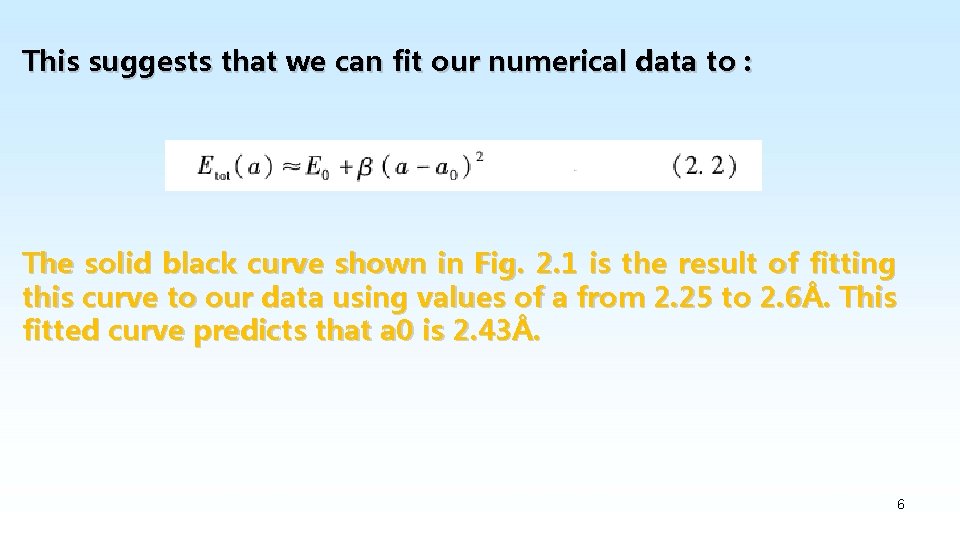
This suggests that we can fit our numerical data to : The solid black curve shown in Fig. 2. 1 is the result of fitting this curve to our data using values of a from 2. 25 to 2. 6Å. This fitted curve predicts that a 0 is 2. 43Å. 6
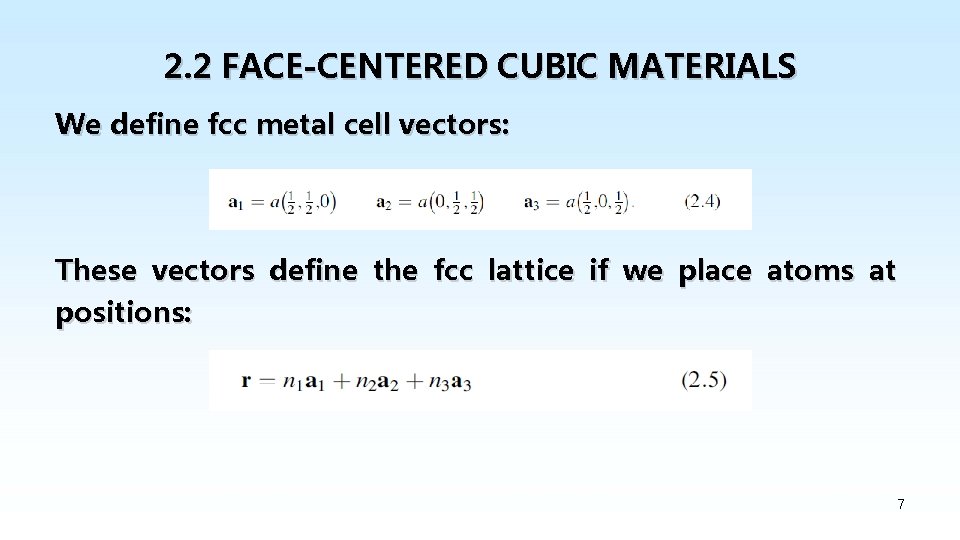
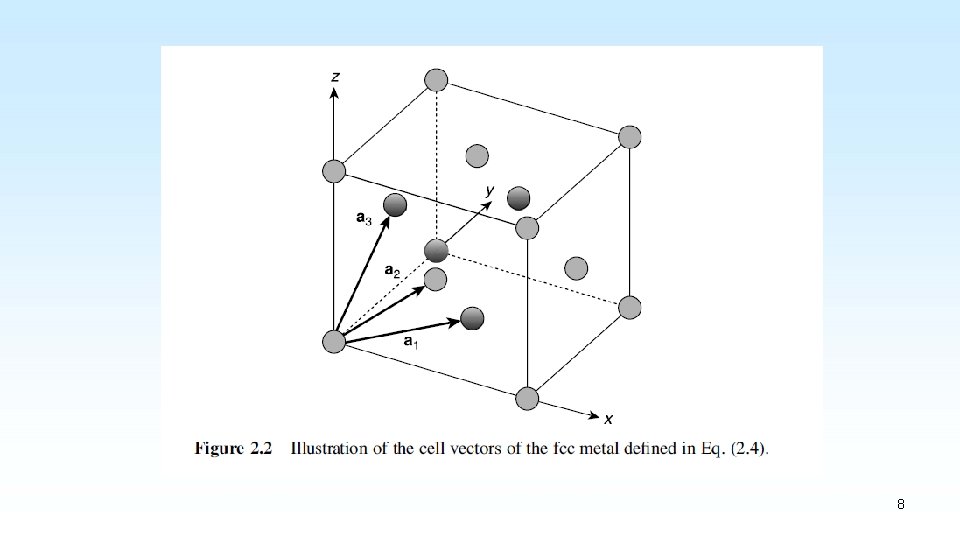
2. 2 FACE-CENTERED CUBIC MATERIALS We define fcc metal cell vectors: These vectors define the fcc lattice if we place atoms at positions: 7
8
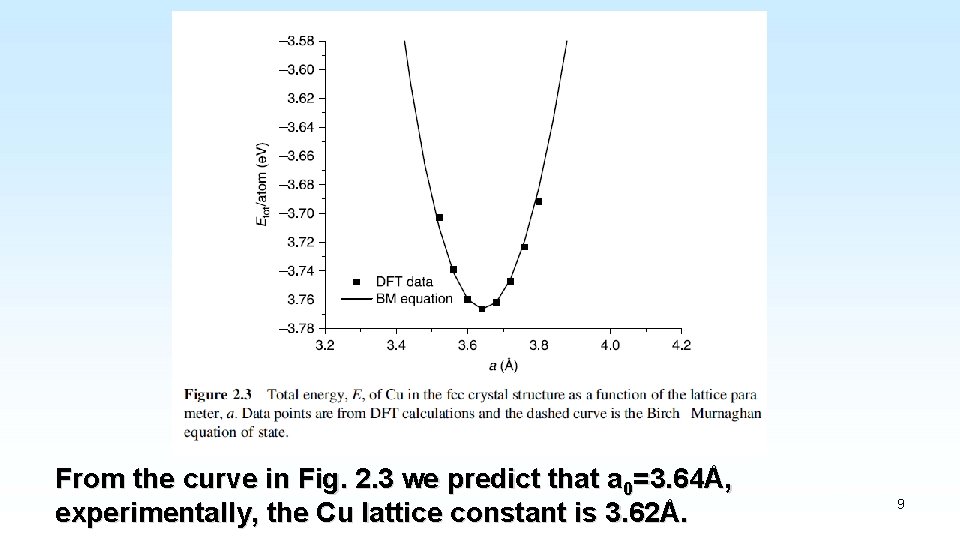
From the curve in Fig. 2. 3 we predict that a 0=3. 64Å, experimentally, the Cu lattice constant is 3. 62Å. 9
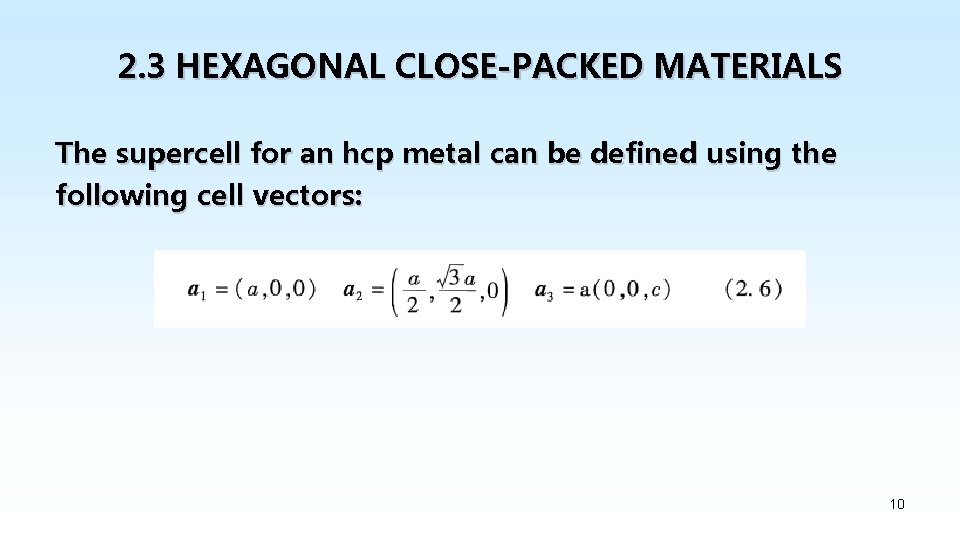
2. 3 HEXAGONAL CLOSE-PACKED MATERIALS The supercell for an hcp metal can be defined using the following cell vectors: 10
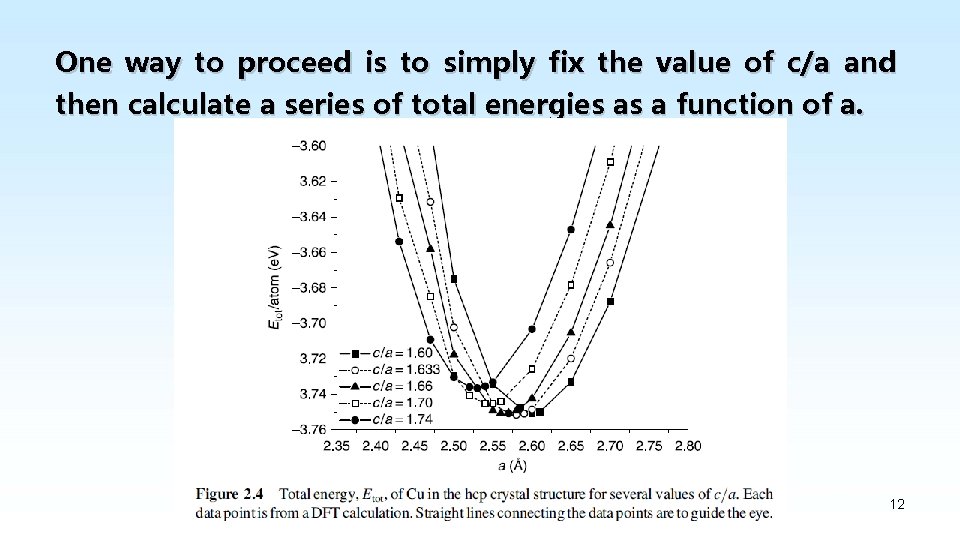
Using DFT to predict the lattice constant of Cu in the simple cubic or fcc crystal structures was straightforward; we just did a series of calculations of the total energy as a function of the lattice parameter, a. The fact that the hcp structure has two independent parameters, a and c, complicates this process. 11
One way to proceed is to simply fix the value of c/a and then calculate a series of total energies as a function of a. 12
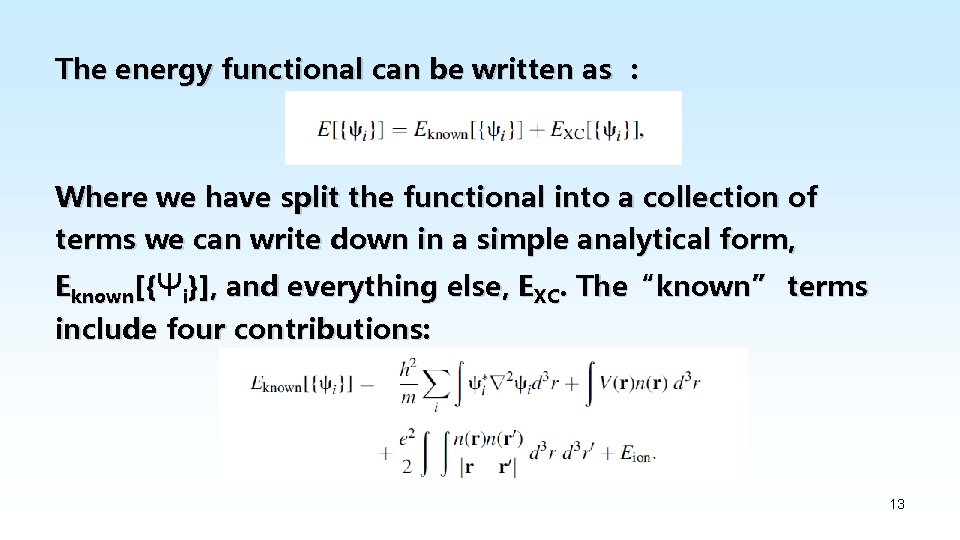
The energy functional can be written as : Where we have split the functional into a collection of terms we can write down in a simple analytical form, Eknown[{Ψi}], and everything else, EXC. The“known” terms include four contributions: 13
2. 4 CRYSTAL STRUCTURE PREDICTION The main message from this discussion is that DFT is very well suited to predicting the energy of crystal structures within a set of potential structures, but calculations alone are almost never sufficient to truly predict new structures in the absence of experimental data. 14
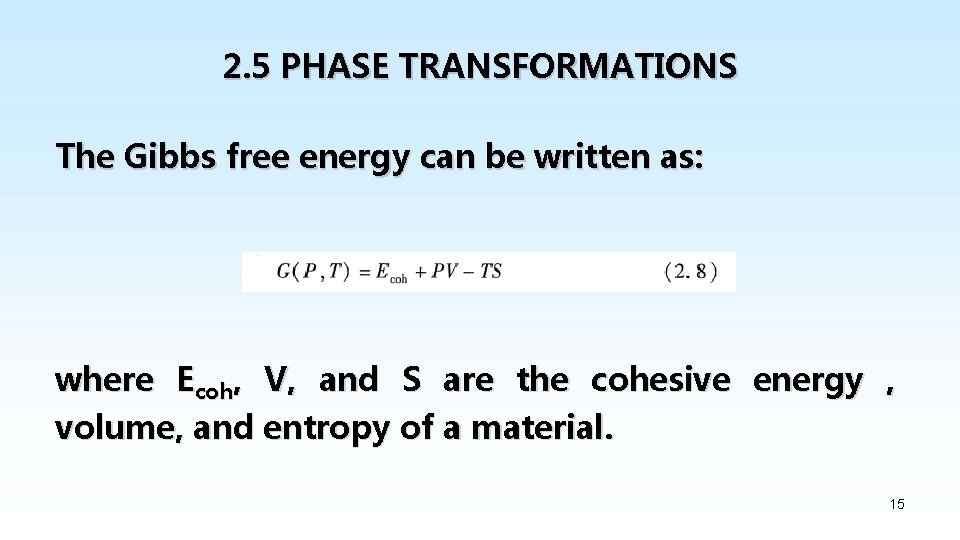
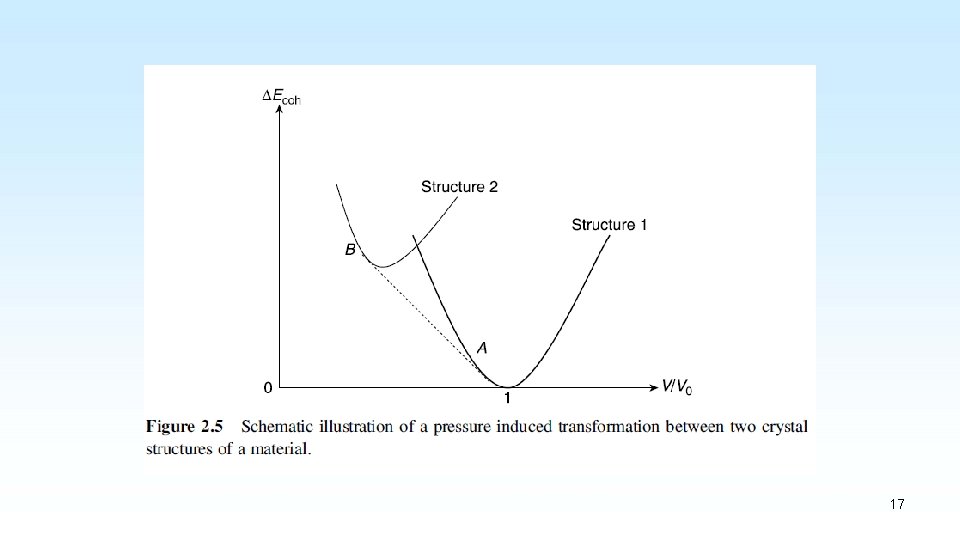
2. 5 PHASE TRANSFORMATIONS The Gibbs free energy can be written as: where Ecoh, V, and S are the cohesive energy , volume, and entropy of a material. 15
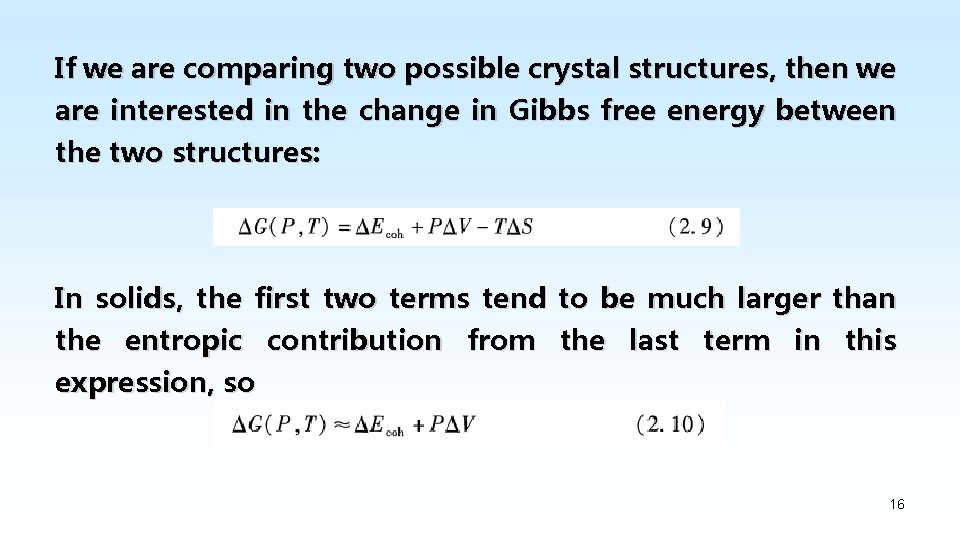
If we are comparing two possible crystal structures, then we are interested in the change in Gibbs free energy between the two structures: In solids, the first two terms tend to be much larger than the entropic contribution from the last term in this expression, so 16
17