
DFT and Vd W interactions Marcus Elstner Physical


- Slides: 49
DFT and Vd. W interactions Marcus Elstner Physical and Theoretical Chemistry, Technical University of Braunschweig
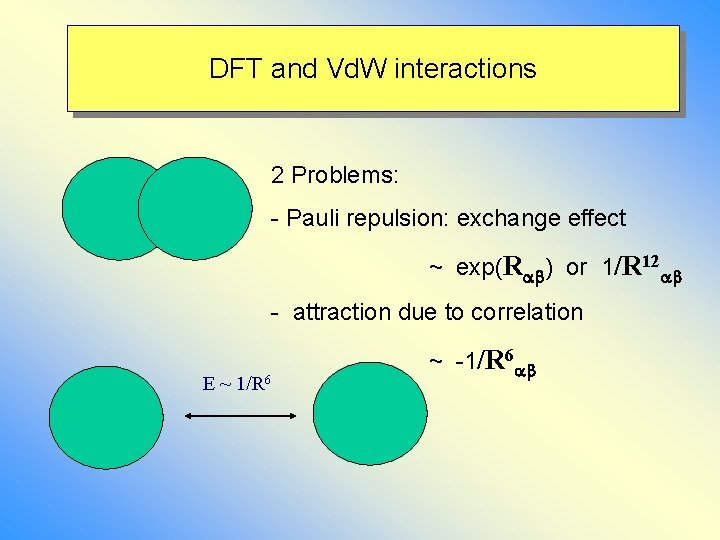
DFT and Vd. W interactions 2 Problems: - Pauli repulsion: exchange effect ~ exp(R ) or 1/R 12 - attraction due to correlation E ~ 1/R 6 ~ -1/R 6
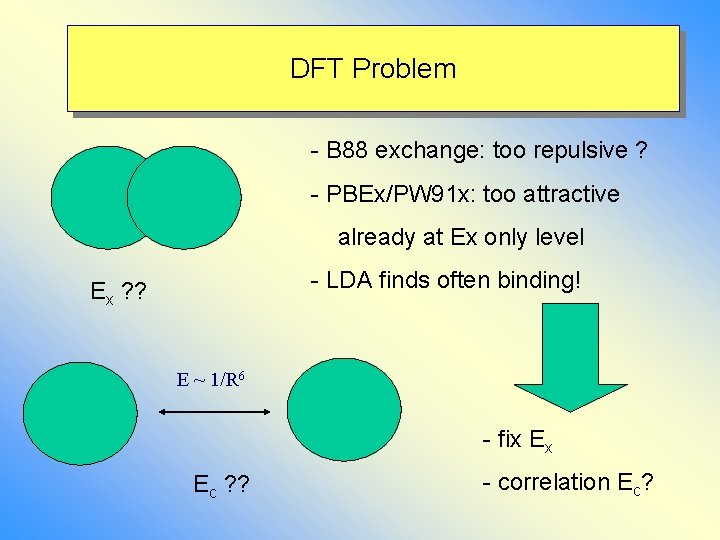
DFT Problem - B 88 exchange: too repulsive ? - PBEx/PW 91 x: too attractive already at Ex only level - LDA finds often binding! Ex ? ? E ~ 1/R 6 - fix Ex Ec ? ? - correlation Ec?
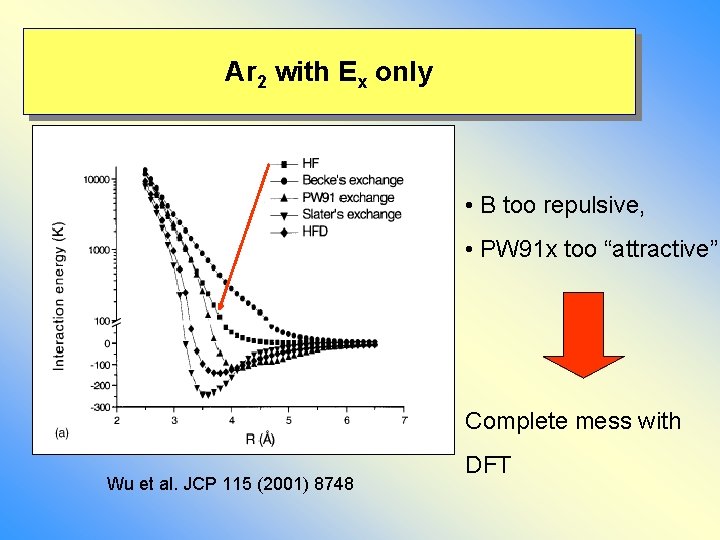
Ar 2 with Ex only • B too repulsive, • PW 91 x too “attractive” Complete mess with Wu et al. JCP 115 (2001) 8748 DFT
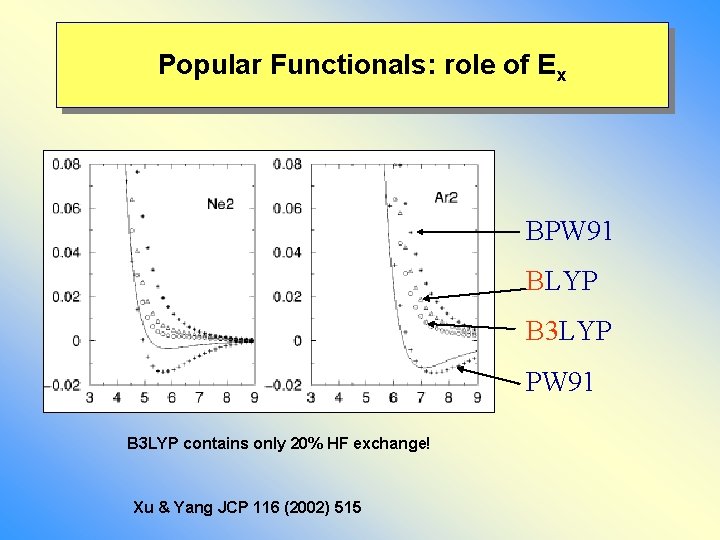
Popular Functionals: role of Ex BPW 91 BLYP B 3 LYP PW 91 B 3 LYP contains only 20% HF exchange! Xu & Yang JCP 116 (2002) 515
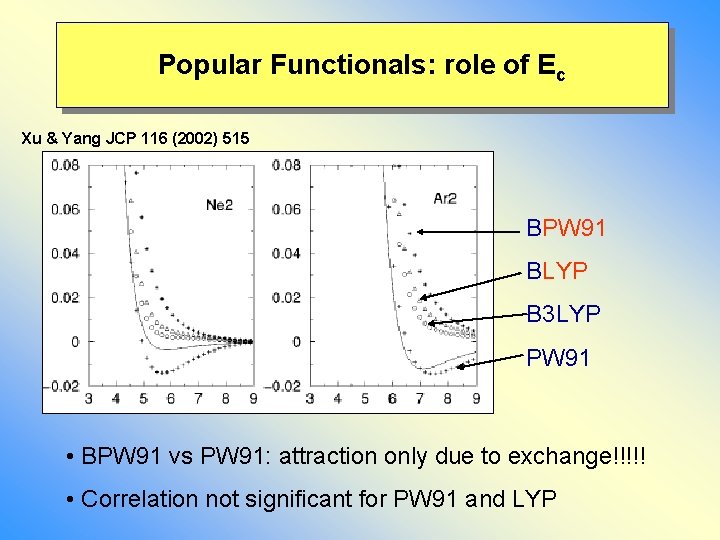
Popular Functionals: role of Ec Xu & Yang JCP 116 (2002) 515 BPW 91 BLYP B 3 LYP PW 91 • BPW 91 vs PW 91: attraction only due to exchange!!!!! • Correlation not significant for PW 91 and LYP
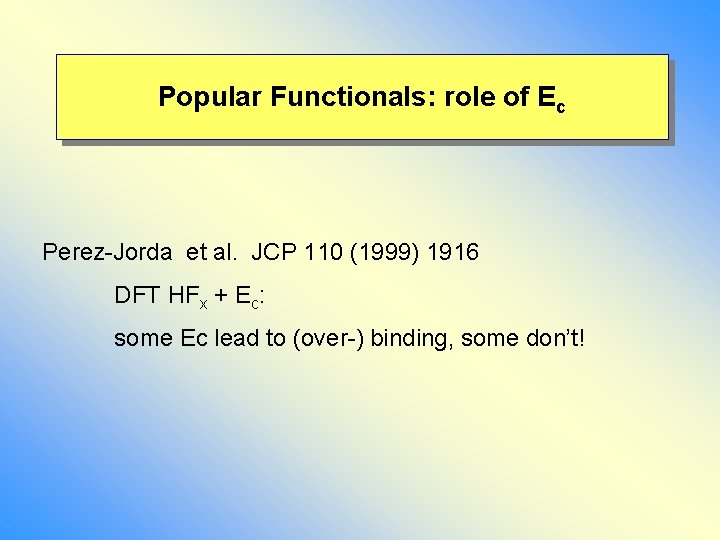
Popular Functionals: role of Ec Perez-Jorda et al. JCP 110 (1999) 1916 DFT HFx + Ec: some Ec lead to (over-) binding, some don’t!
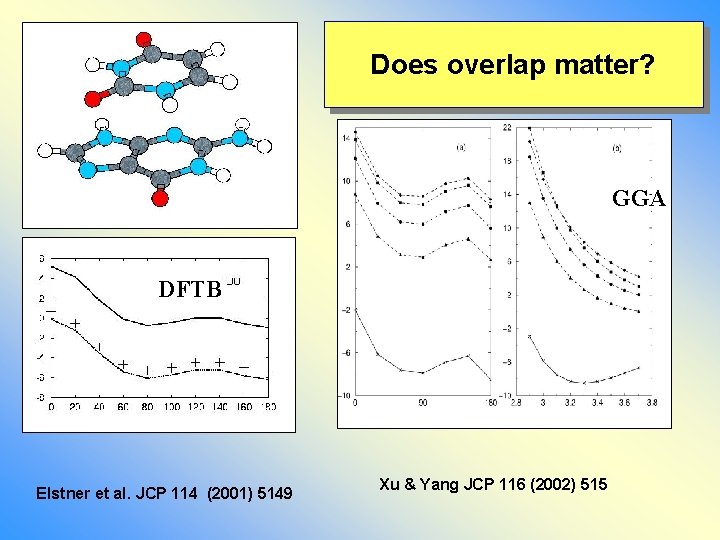
Does overlap matter? GGA DFTB Elstner et al. JCP 114 (2001) 5149 Xu & Yang JCP 116 (2002) 515
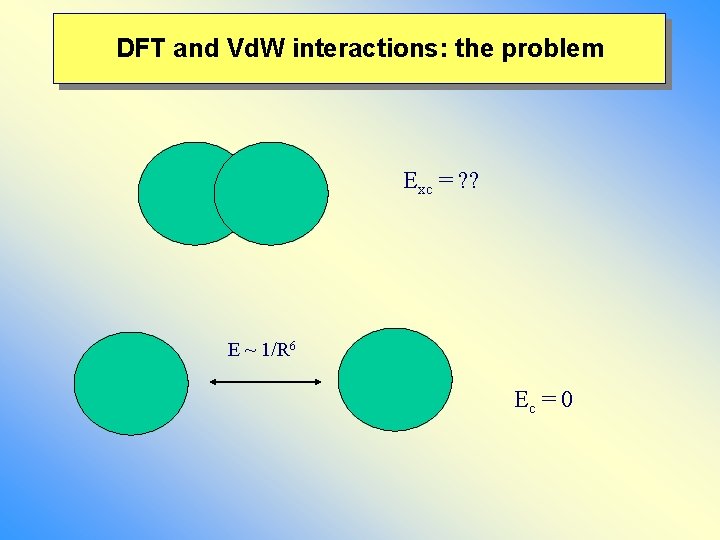
DFT and Vd. W interactions: the problem Exc = ? ? E ~ 1/R 6 Ec = 0
DFT and Vd. W interactions: solutions Adding empirical dispersion Elstner et al. JCP 114 (2001) 5149 Xu & Yang JCP 116 (2002) 515 Zimmerli et al. JCP 120 (2004) 2693 Grimme JCC 25 (2004) 1463 DFT model for empircal dispersion on top of HF Becke & Johnson JCP 124 (2006) 014104 Put it into the pseudopotential v. Lilienfeld et al. PRB 71 (2005) 195119 Find a new dispersion functional Dion, et al. Phys. Rev. Lett. 92 (2004) 246401; [JCP 124 (2006) 164106] Kamiya et al. JCP 117 (2002) 6010.
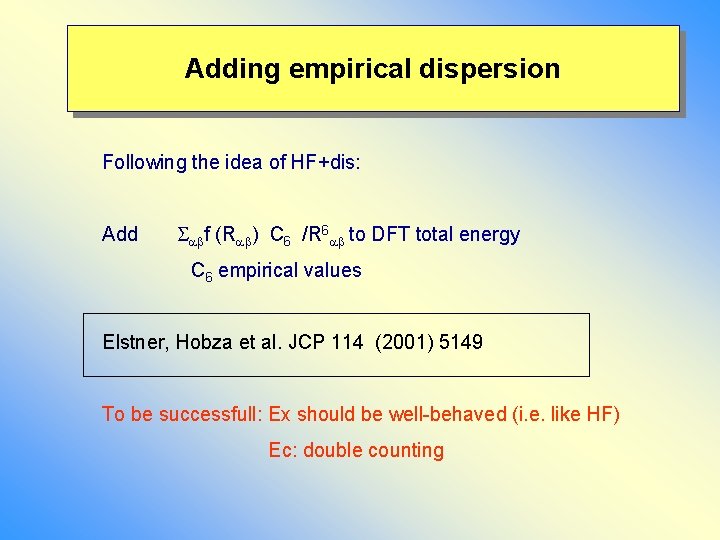
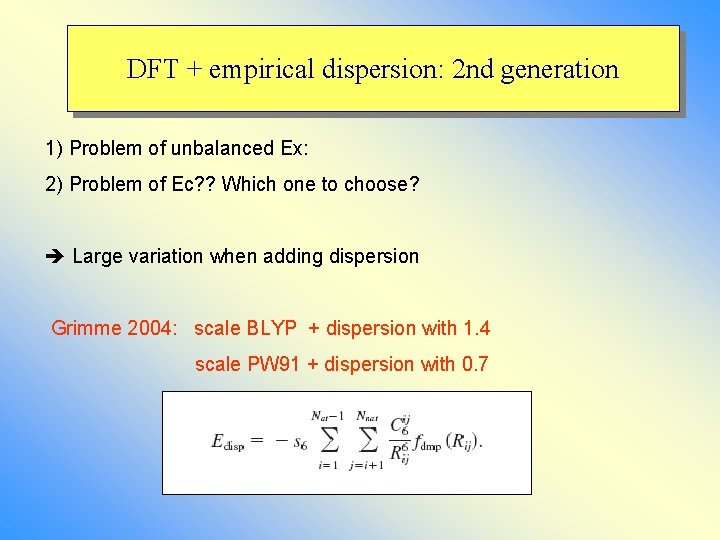
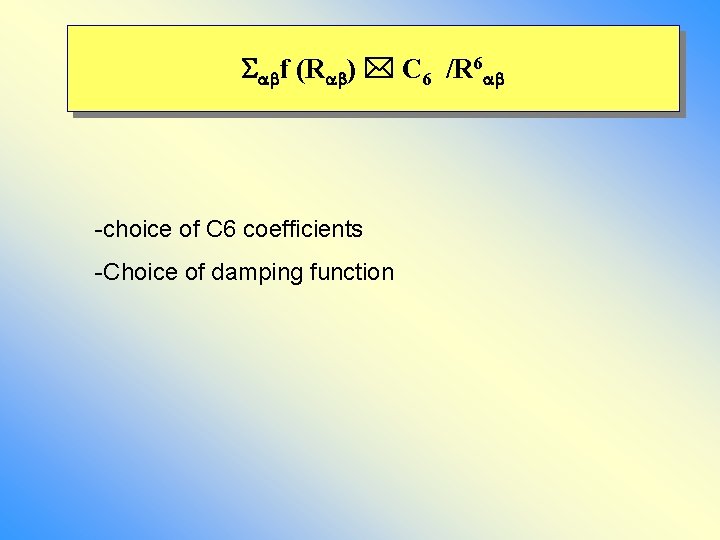
Adding empirical dispersion Following the idea of HF+dis: Add f (R ) C 6 /R 6 to DFT total energy C 6 empirical values Elstner, Hobza et al. JCP 114 (2001) 5149 To be successfull: Ex should be well-behaved (i. e. like HF) Ec: double counting
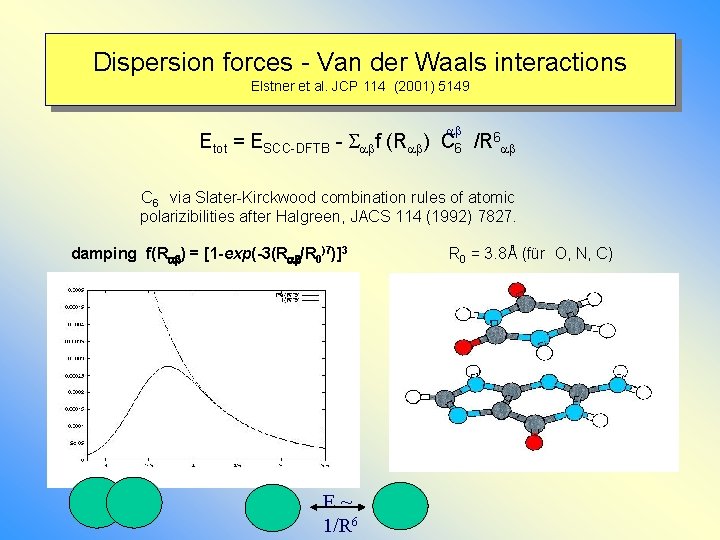
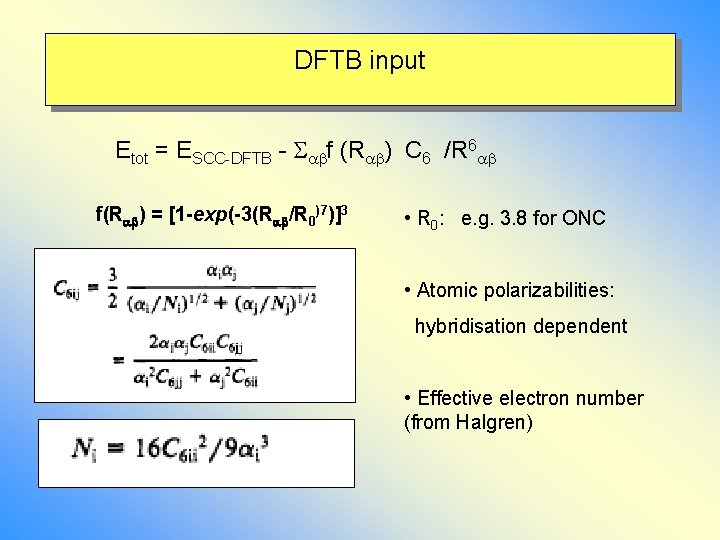
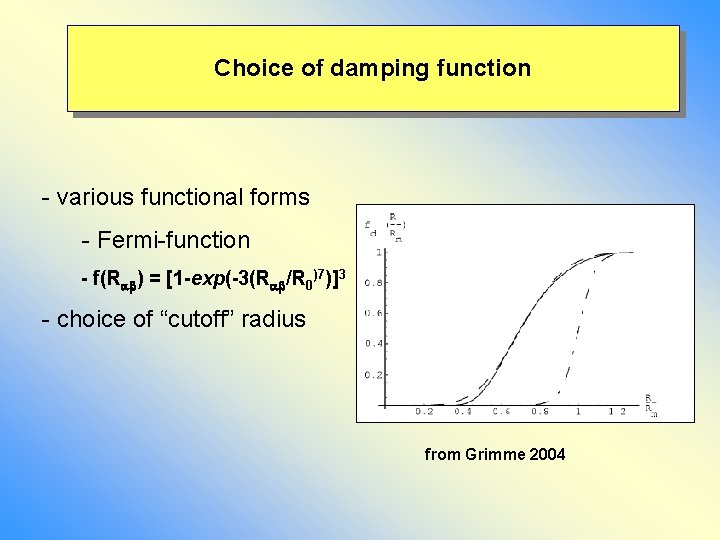
Dispersion forces - Van der Waals interactions Elstner et al. JCP 114 (2001) 5149 Etot = ESCC-DFTB - f (R ) C 6 /R 6 C 6 via Slater-Kirckwood combination rules of atomic polarizibilities after Halgreen, JACS 114 (1992) 7827. damping f(R ) = [1 -exp(-3(R /R 0)7)]3 E~ 1/R 6 R 0 = 3. 8Å (für O, N, C)
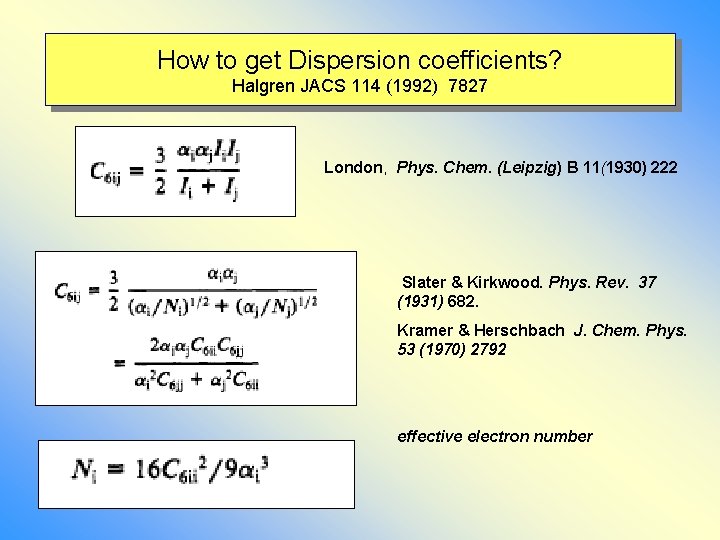
How to get Dispersion coefficients? Halgren JACS 114 (1992) 7827 London, Phys. Chem. (Leipzig) B 11(1930) 222 Slater & Kirkwood. Phys. Rev. 37 (1931) 682. Kramer & Herschbach J. Chem. Phys. 53 (1970) 2792 effective electron number
DFTB input Etot = ESCC-DFTB - f (R ) C 6 /R 6 f(R ) = [1 -exp(-3(R /R 0)7)]3 • R 0: e. g. 3. 8 for ONC • Atomic polarizabilities: hybridisation dependent • Effective electron number (from Halgren)
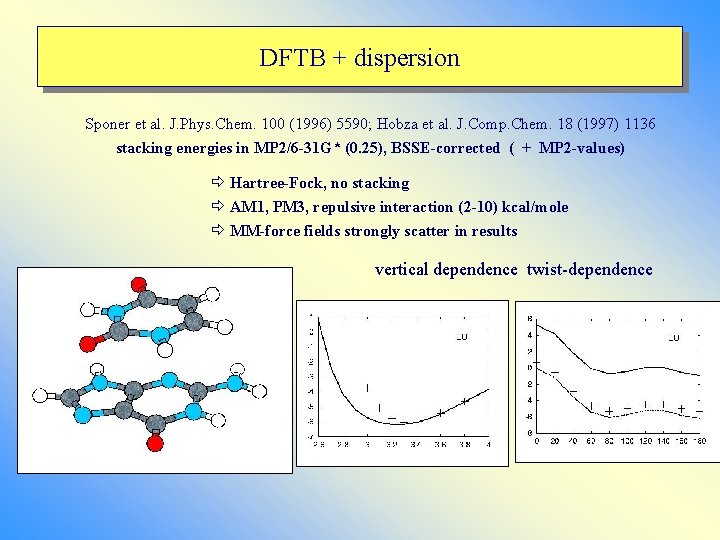
DFTB + dispersion Sponer et al. J. Phys. Chem. 100 (1996) 5590; Hobza et al. J. Comp. Chem. 18 (1997) 1136 stacking energies in MP 2/6 -31 G* (0. 25), BSSE-corrected ( + MP 2 -values) ð Hartree-Fock, no stacking ð AM 1, PM 3, repulsive interaction (2 -10) kcal/mole ð MM-force fields strongly scatter in results vertical dependence twist-dependence
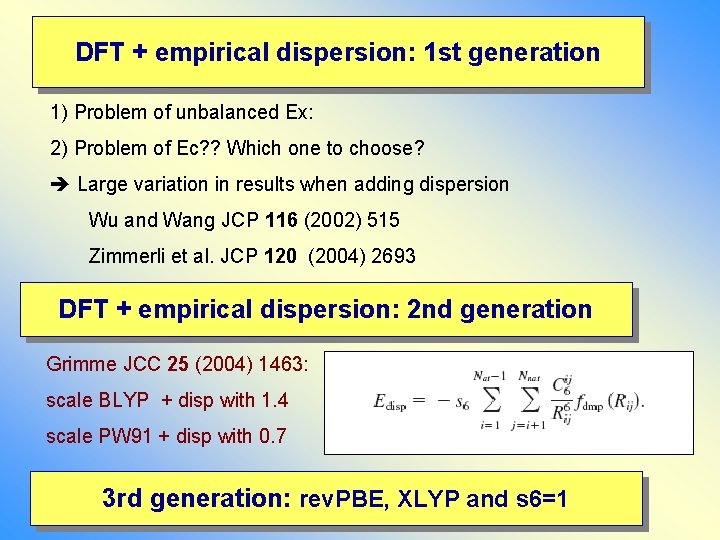
DFT + empirical dispersion: 1 st generation 1) Problem of unbalanced Ex: 2) Problem of Ec? ? Which one to choose? Large variation in results when adding dispersion Wu and Wang 2002 Zimmerli et al 2004
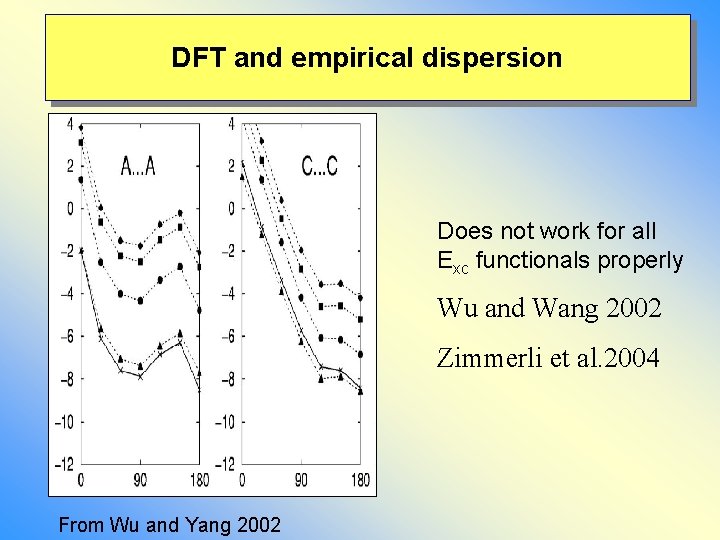
DFT and empirical dispersion Does not work for all Exc functionals properly Wu and Wang 2002 Zimmerli et al. 2004 From Wu and Yang 2002
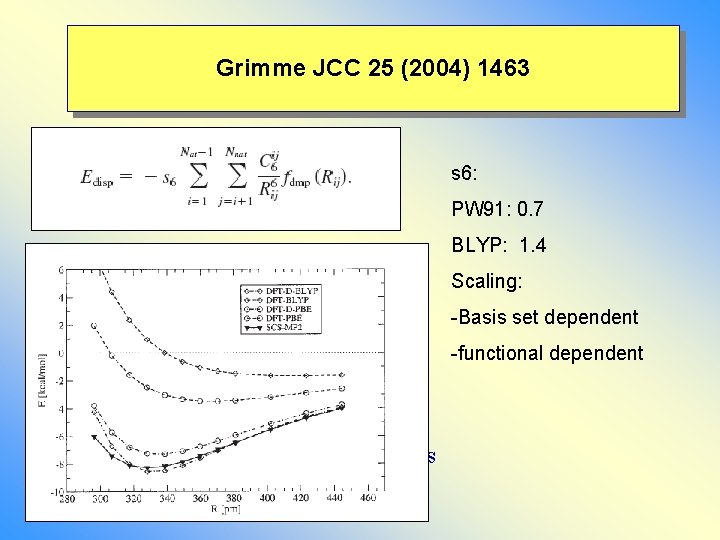
DFT + empirical dispersion: 2 nd generation 1) Problem of unbalanced Ex: 2) Problem of Ec? ? Which one to choose? Large variation when adding dispersion Grimme 2004: scale BLYP + dispersion with 1. 4 scale PW 91 + dispersion with 0. 7
f (R ) C 6 /R 6 -choice of C 6 coefficients -Choice of damping function
Choice of C 6 coefficients - hybridisation dependence vs. atomic values - empirical values Very similar in various approaches
Choice of damping function - various functional forms - Fermi-function - f(R ) = [1 -exp(-3(R /R 0)7)]3 - choice of “cutoff” radius from Grimme 2004
Choice of fdamp balances several effects - contribution from Ex/Ec in overlap region - double counting of Ec - BSSE and BSIE - missing higher order terms 1/R**8 … Determination completely empirical Choose, to reproduce interaction energies for large set of stacked compounds
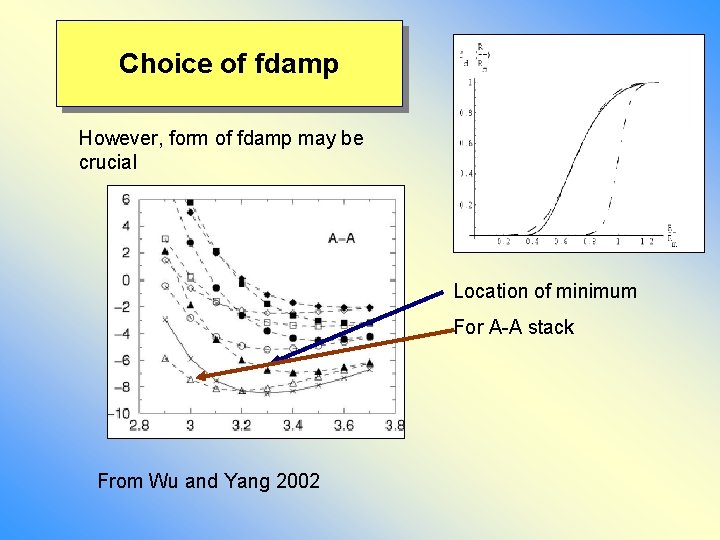
Choice of fdamp However, form of fdamp may be crucial Location of minimum For A-A stack From Wu and Yang 2002
Grimme JCC 25 (2004) 1463 s 6: PW 91: 0. 7 BLYP: 1. 4 Scaling: - hybridisation dependence - empirical vs. new fits Very similar in various approaches -Basis set dependent -functional dependent
DFT + empirical dispersion: 3 rd generation 1) Problem of unbalanced Ex: 2) Problem of Ec? ? Which one to choose? Large variation in results when adding dispersion - mix PW 91 x and Bx - rev. PBE - meta GGA? ? + balanced damping function, no scaling
DFT + empirical dispersion: 1 st generation 1) Problem of unbalanced Ex: 2) Problem of Ec? ? Which one to choose? Large variation in results when adding dispersion Wu and Wang JCP 116 (2002) 515 Zimmerli et al. JCP 120 (2004) 2693 DFT + empirical dispersion: 2 nd generation Grimme JCC 25 (2004) 1463: scale BLYP + disp with 1. 4 scale PW 91 + disp with 0. 7 3 rd generation: rev. PBE, XLYP and s 6=1
Applications of DFTB-D
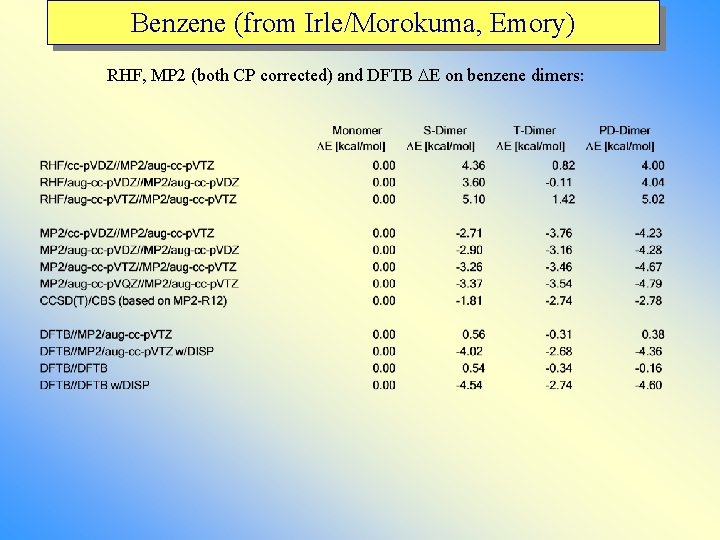
Benzene (from Irle/Morokuma, Emory)
Benzene (from Irle/Morokuma, Emory) RHF, MP 2 (both CP corrected) and DFTB DE on benzene dimers:
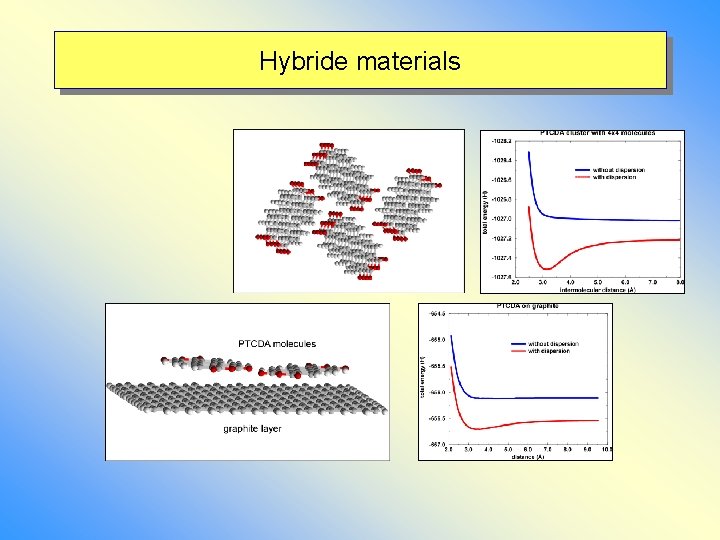
Hybride materials
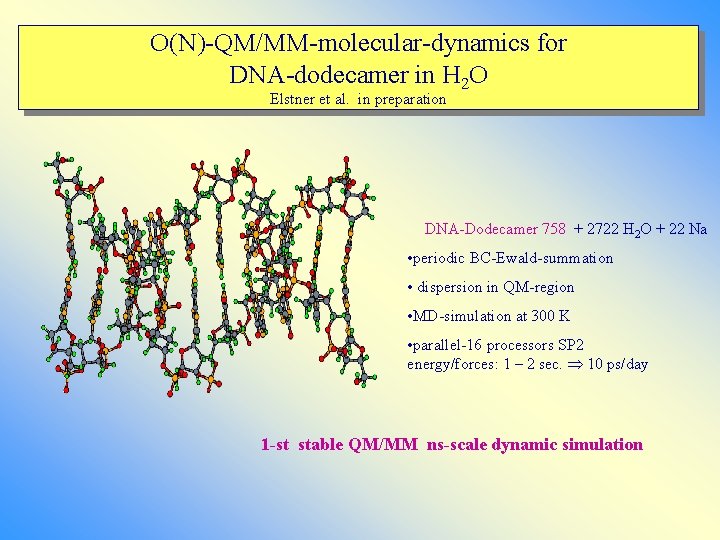
O(N)-QM/MM-molecular-dynamics for DNA-dodecamer in H 2 O Elstner et al. in preparation DNA-Dodecamer 758 + 2722 H 2 O + 22 Na • periodic BC-Ewald-summation • dispersion in QM-region • MD-simulation at 300 K • parallel-16 processors SP 2 energy/forces: 1 – 2 sec. 10 ps/day 1 -st stable QM/MM ns-scale dynamic simulation
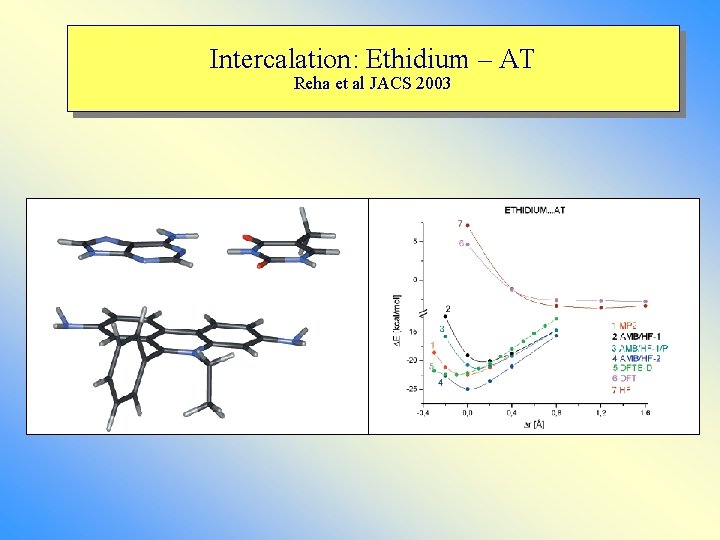
Intercalation: Ethidium – AT Reha et al JACS 2003
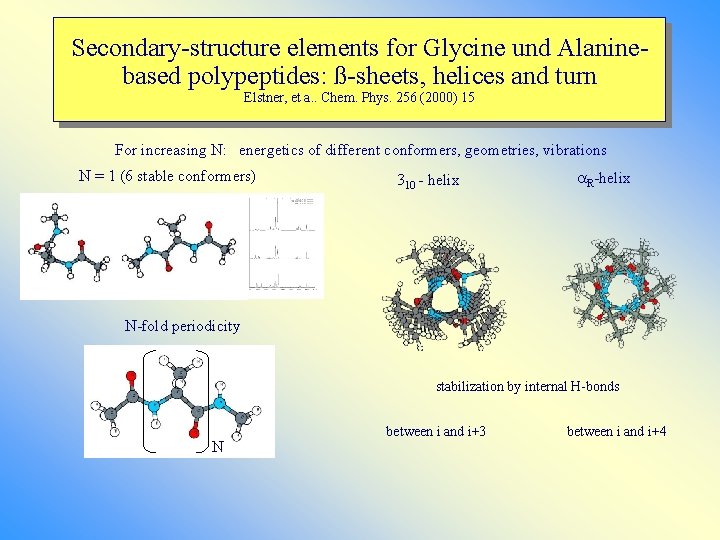
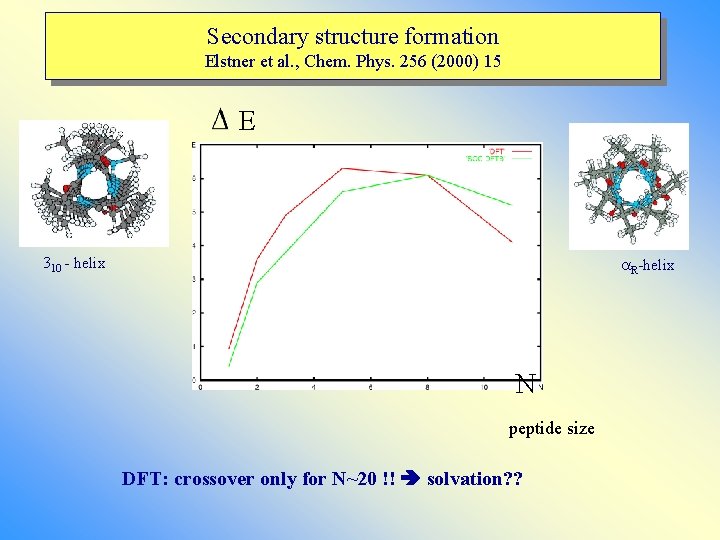
Secondary-structure elements for Glycine und Alaninebased polypeptides: ß-sheets, helices and turn Elstner, et a. . Chem. Phys. 256 (2000) 15 For increasing N: energetics of different conformers, geometries, vibrations N = 1 (6 stable conformers) 310 - helix R-helix N-fold periodicity stabilization by internal H-bonds N between i and i+3 between i and i+4
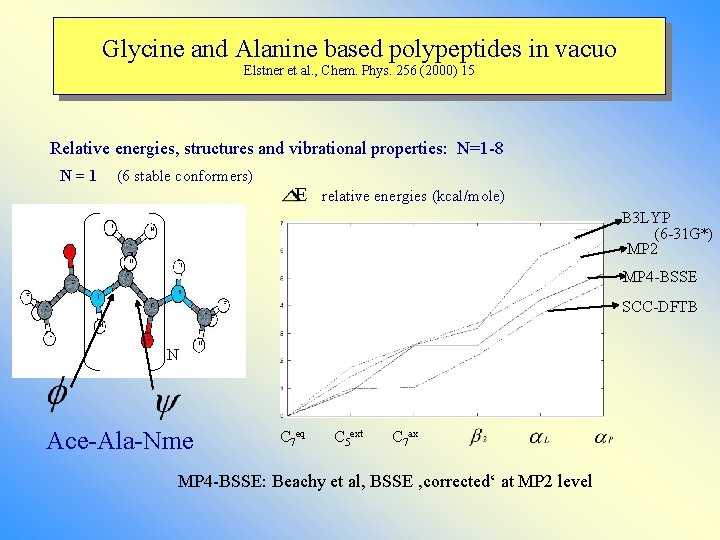
Glycine and Alanine based polypeptides in vacuo Elstner et al. , Chem. Phys. 256 (2000) 15 Relative energies, structures and vibrational properties: N=1 -8 N=1 (6 stable conformers) E relative energies (kcal/mole) B 3 LYP (6 -31 G*) MP 2 MP 4 -BSSE SCC-DFTB N Ace-Ala-Nme C 7 eq C 5 ext C 7 ax MP 4 -BSSE: Beachy et al, BSSE ‚corrected‘ at MP 2 level
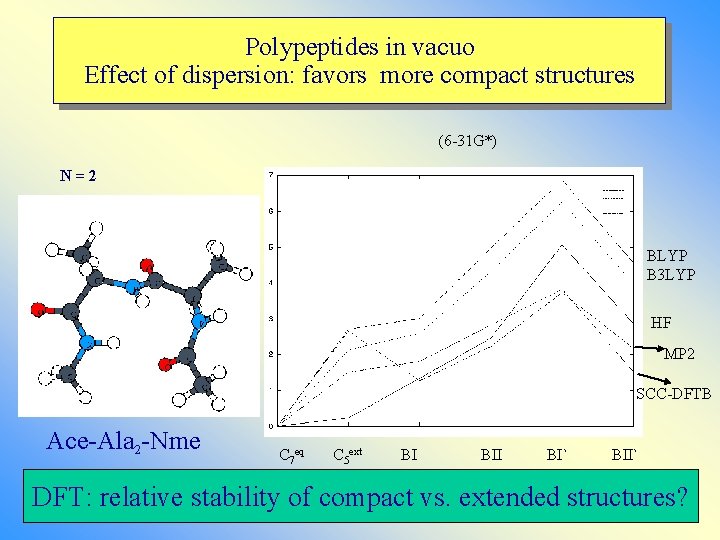
Polypeptides in vacuo Effect of dispersion: favors more compact structures (6 -31 G*) N=2 BLYP B 3 LYP HF MP 2 SCC-DFTB Ace-Ala 2 -Nme C 7 eq C 5 ext BI BI` BII` DFT: relative stability of compact vs. extended structures?
Secondary structure formation Elstner et al. , Chem. Phys. 256 (2000) 15 E 310 - helix DFT/DFTB ? R-helix N peptide size DFT: crossover only for N~20 !! solvation? ?
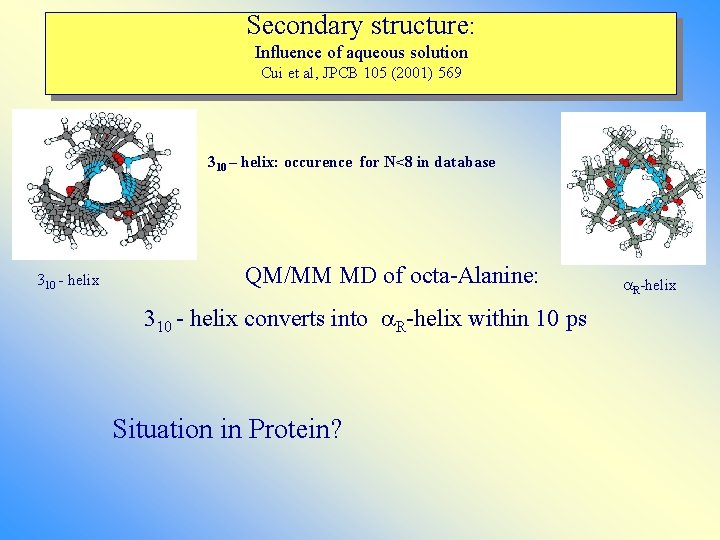
Secondary structure: Influence of aqueous solution Cui et al, JPCB 105 (2001) 569 310 – helix: occurence for N<8 in database 310 - helix QM/MM MD of octa-Alanine: 310 - helix converts into R-helix within 10 ps Situation in Protein? R-helix
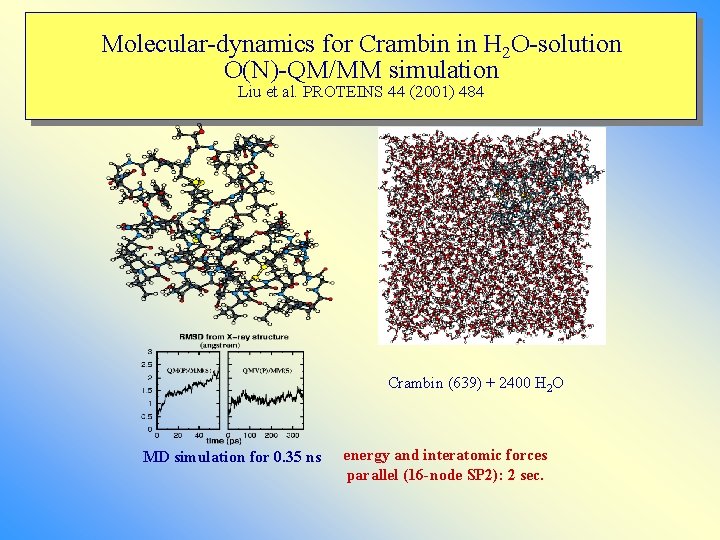
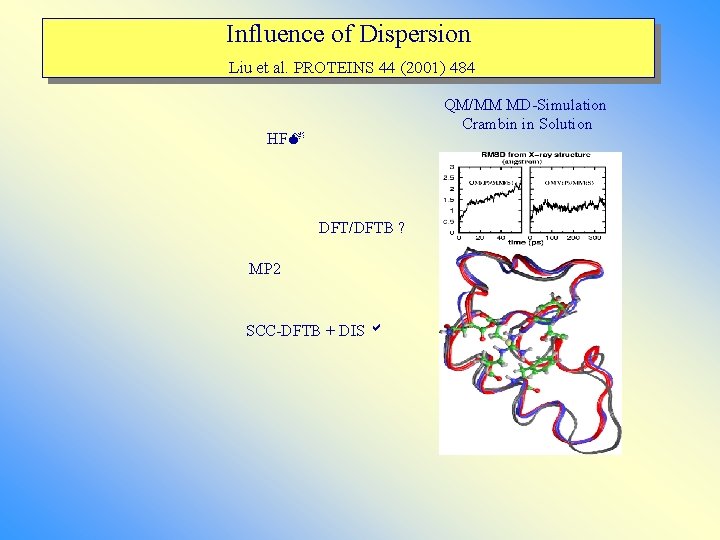
Molecular-dynamics for Crambin in H 2 O-solution O(N)-QM/MM simulation Liu et al. PROTEINS 44 (2001) 484 Crambin (639) + 2400 H 2 O MD simulation for 0. 35 ns energy and interatomic forces parallel (16 -node SP 2): 2 sec.
Influence of Dispersion Liu et al. PROTEINS 44 (2001) 484 QM/MM MD-Simulation Crambin in Solution HF DFT/DFTB ? MP 2 SCC-DFTB + DIS
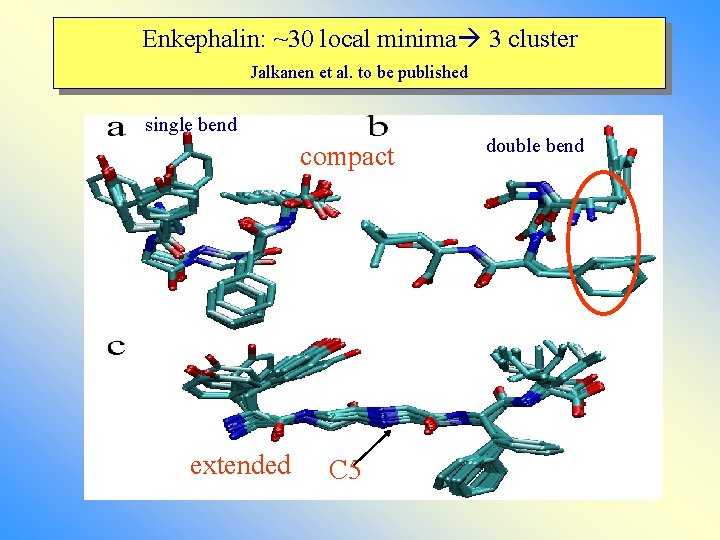
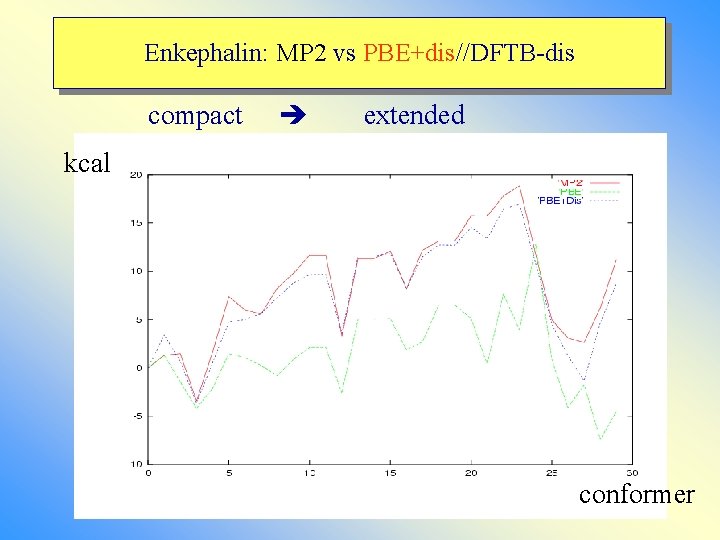
Enkephalin: ~30 local minima 3 cluster Jalkanen et al. to be published single bend compact extended C 5 double bend
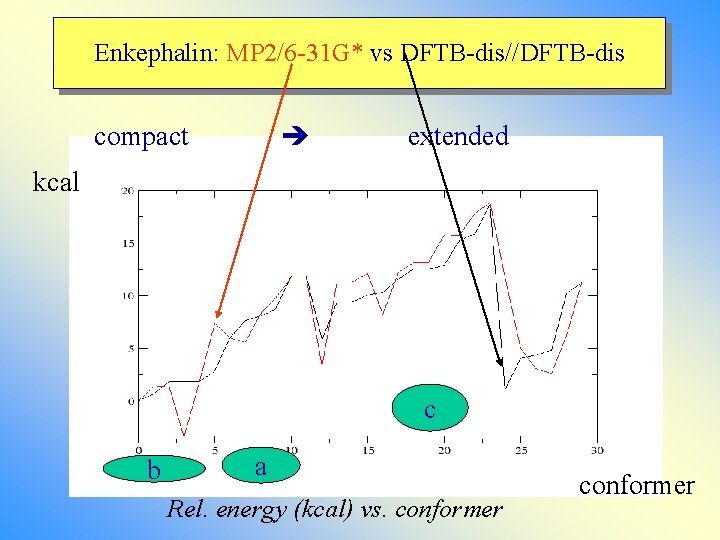
Enkephalin: MP 2/6 -31 G* vs DFTB-dis//DFTB-dis compact extended kcal c b a Rel. energy (kcal) vs. conformer
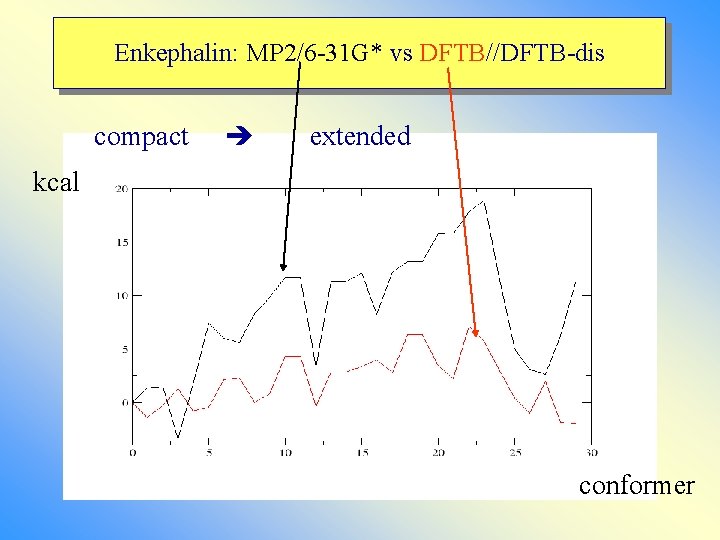
Enkephalin: MP 2/6 -31 G* vs DFTB//DFTB-dis compact extended kcal conformer
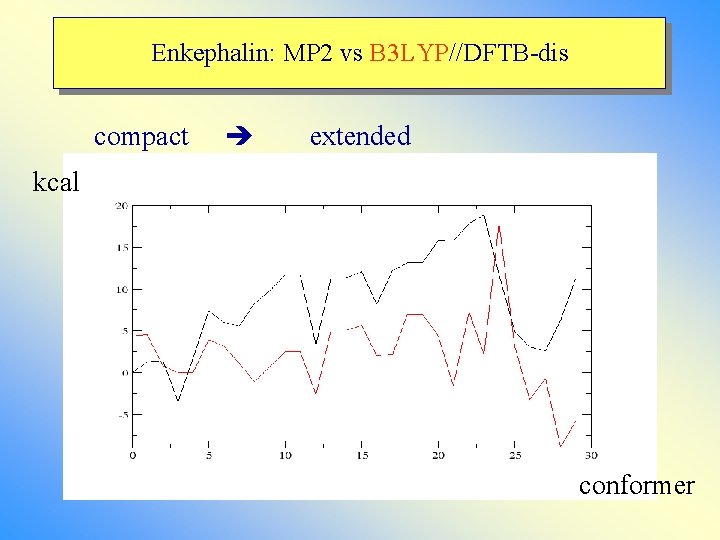
Enkephalin: MP 2 vs B 3 LYP//DFTB-dis compact extended kcal conformer
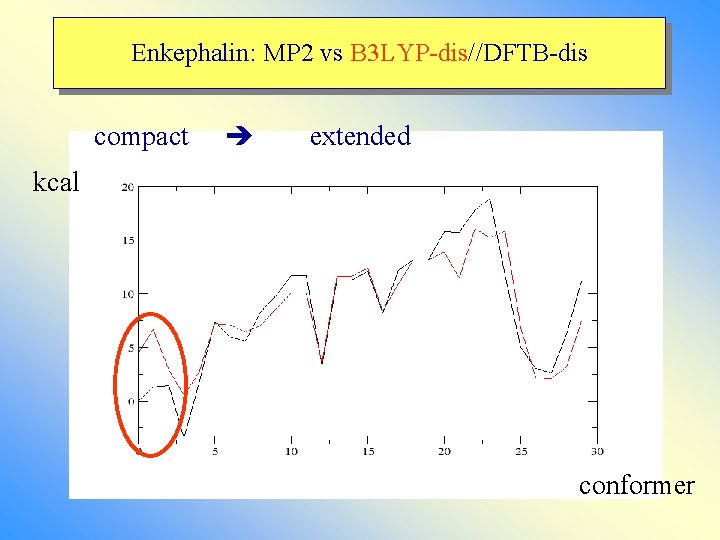
Enkephalin: MP 2 vs B 3 LYP-dis//DFTB-dis compact extended kcal conformer
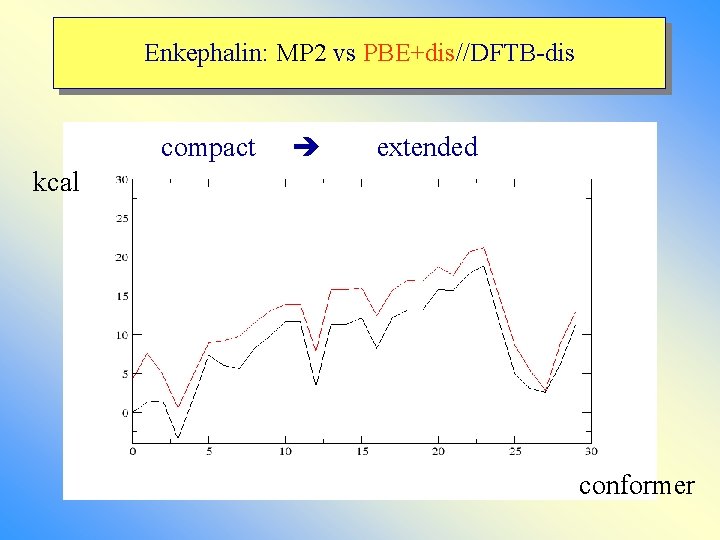
Enkephalin: MP 2 vs PBE+dis//DFTB-dis compact extended kcal conformer
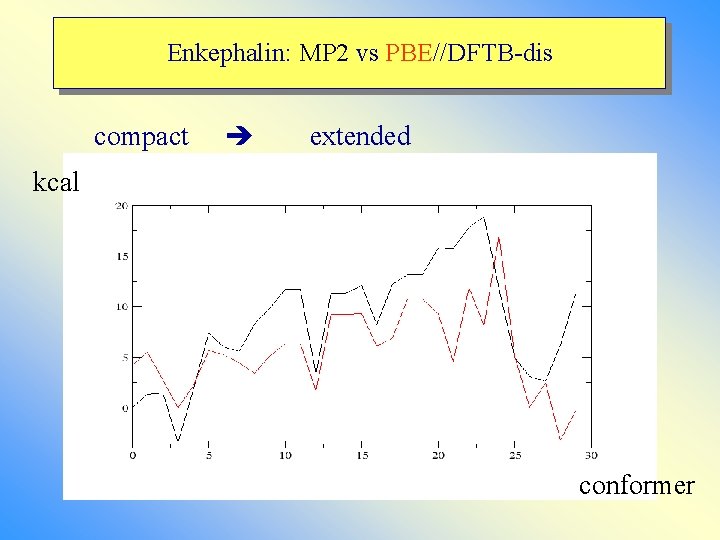
Enkephalin: MP 2 vs PBE//DFTB-dis compact extended kcal conformer
Enkephalin: MP 2 vs PBE+dis//DFTB-dis compact extended kcal conformer
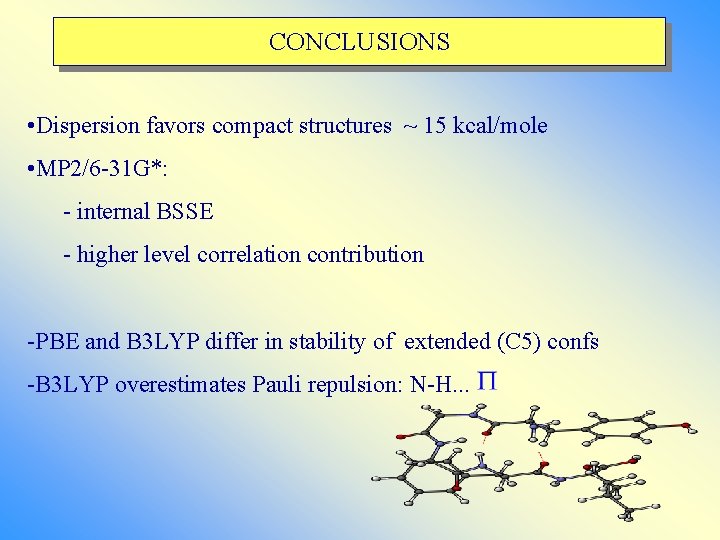
CONCLUSIONS • Dispersion favors compact structures ~ 15 kcal/mole • MP 2/6 -31 G*: - internal BSSE - higher level correlation contribution -PBE and B 3 LYP differ in stability of extended (C 5) confs -B 3 LYP overestimates Pauli repulsion: N-H. . .
DFT+large soft matter structures: don‘t do without dispersion! - large impact on relative energies - stabilizes more compact structures: relevant secondary structures may not be stable without!