
DFA Implementation Issues CAS Risk and Capital Management



- Slides: 36
DFA Implementation Issues CAS Risk and Capital Management Seminar Toronto, Ontario, Canada July 8 -9, 2002
Speakers • Jen Ehrenfeld, ACAS, MAAA American Re-Insurance Company • Gerald Kirschner, FCAS, MAAA Classic Solutions Risk Management, Inc. • Elizabeth Wiesner, FCAS, MAAA Accident Fund Company 2
Large Company Perspective Jen Ehrenfeld
DFA Implementation Issues Agenda • Lessons Learned with… – Building the Model – Parameterizing Model – Presenting Results – Corporate Structure 4
Building The Model • Right resources in-house • Priority of DFA Model – can’t do this and your day job too • Recognition of Investment Up Front before any Returns 5
Parameterizing Model • Company Organization vs. RiskLine Segmentation • Politically Sensitive Issues vs. Reality • Highlights areas of concernDue Diligence on own Company – If unable to model risks well, how well are they being monitored and managed. 6
Parameterizing Model Continued • Risk = New Planned Loss Plus Historical Reserves • Planned Losses at least as variable as Reserves • Reserve Modeling – Symmetric distribution or Adverse Development more likely 7
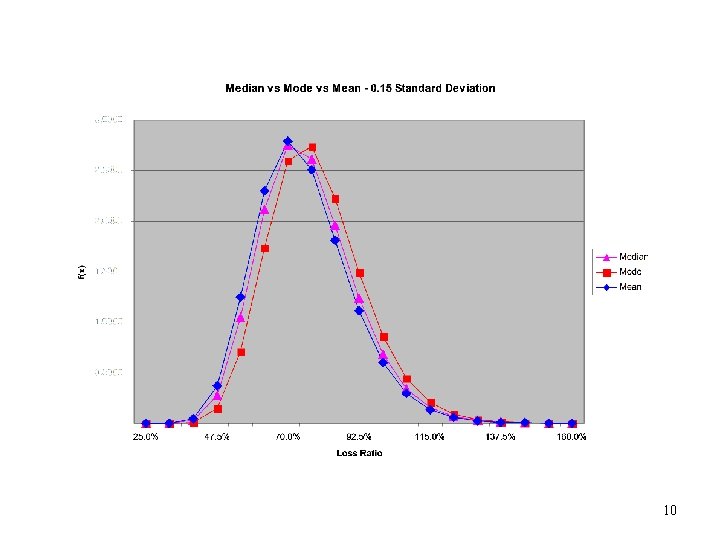
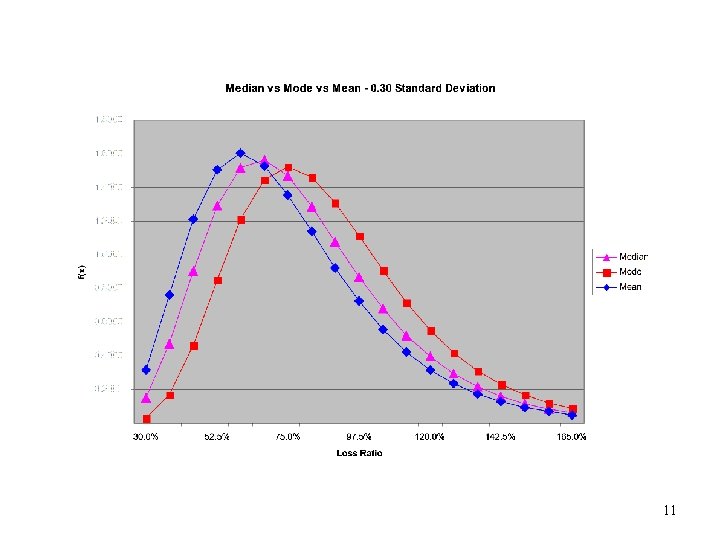
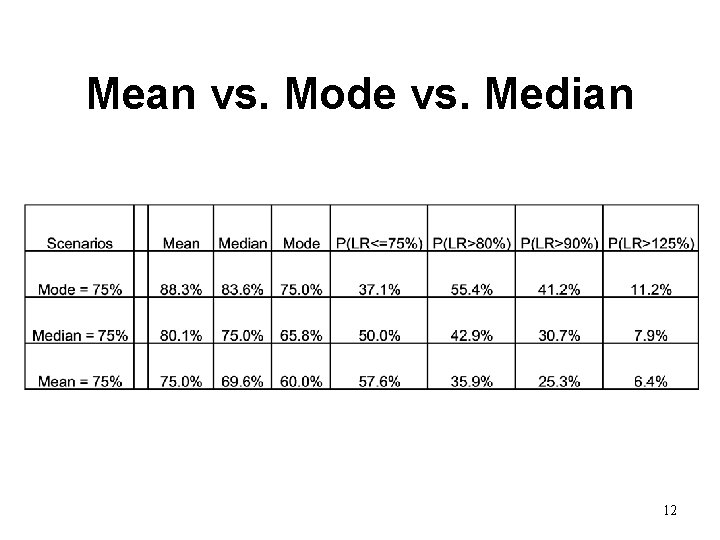
Mean vs. Mode vs. Median • Plan Loss Ratio – Where does it lie on the distribution? • There are three measures of central tendency. 1. Mode - the most frequent observation 2. Median - the 50 th percentile 3. Mean - the average value of the distribution 8
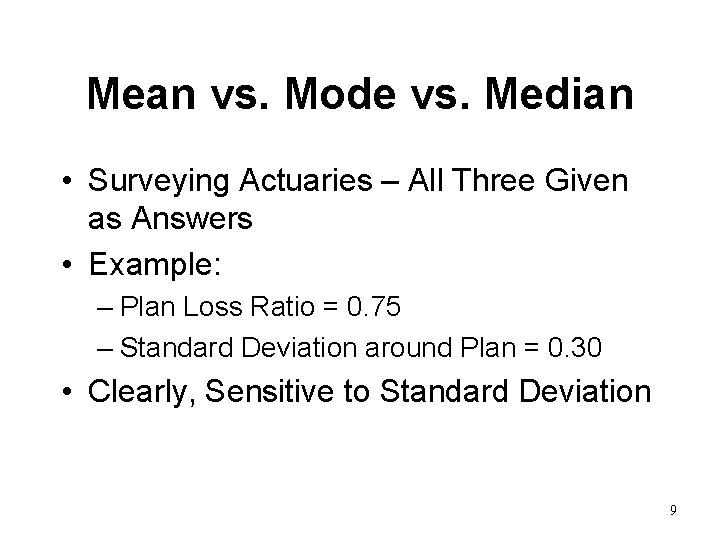
Mean vs. Mode vs. Median • Surveying Actuaries – All Three Given as Answers • Example: – Plan Loss Ratio = 0. 75 – Standard Deviation around Plan = 0. 30 • Clearly, Sensitive to Standard Deviation 9
10
11
Mean vs. Mode vs. Median 12
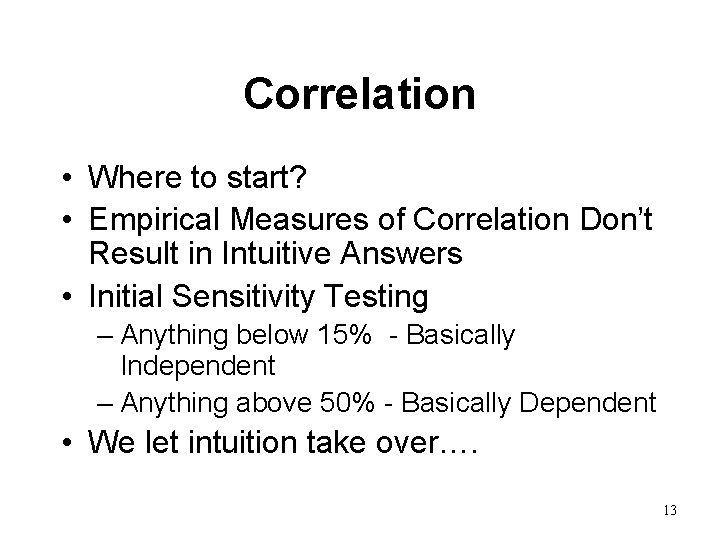
Correlation • Where to start? • Empirical Measures of Correlation Don’t Result in Intuitive Answers • Initial Sensitivity Testing – Anything below 15% - Basically Independent – Anything above 50% - Basically Dependent • We let intuition take over…. 13
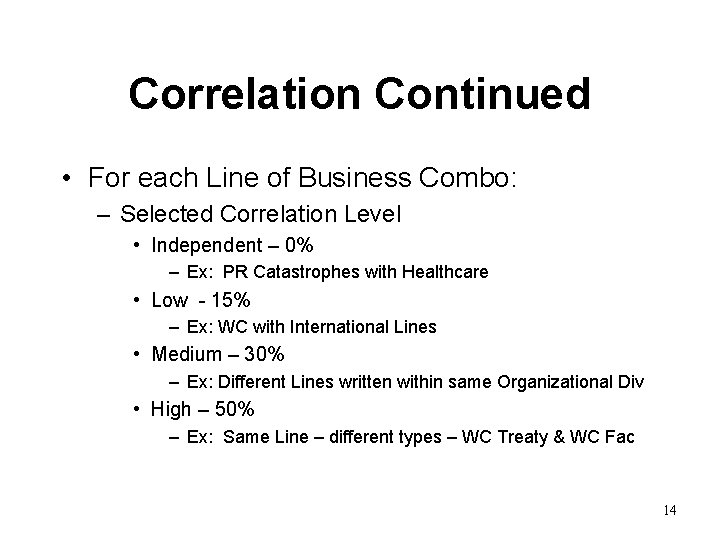
Correlation Continued • For each Line of Business Combo: – Selected Correlation Level • Independent – 0% – Ex: PR Catastrophes with Healthcare • Low - 15% – Ex: WC with International Lines • Medium – 30% – Ex: Different Lines written within same Organizational Div • High – 50% – Ex: Same Line – different types – WC Treaty & WC Fac 14
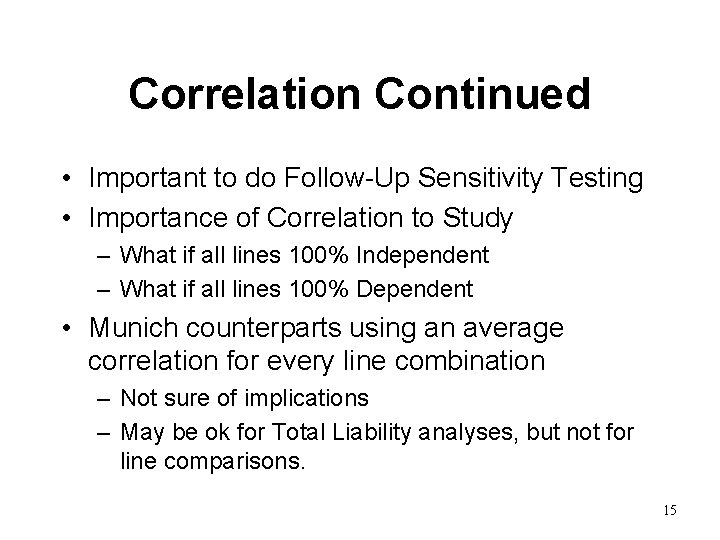
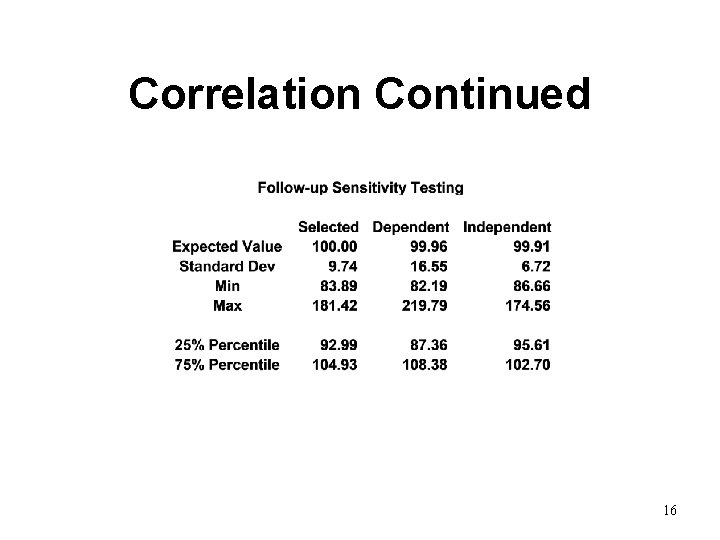
Correlation Continued • Important to do Follow-Up Sensitivity Testing • Importance of Correlation to Study – What if all lines 100% Independent – What if all lines 100% Dependent • Munich counterparts using an average correlation for every line combination – Not sure of implications – May be ok for Total Liability analyses, but not for line comparisons. 15
Correlation Continued 16
Correlation Continued • Once Correlations are defined, if change detail of analysis, need to adjust correlations – “Answer” should stay the same no matter what detail you review the company – Break down into more detail between line correlations must decrease to get the same overall variance. – Gets hairy fast 17
Presenting Results • REASONABILITY CHECK!!! • “Can’t DFA tell you that? ? ? ” • Not too much at once - even for very savvy audiences • DFA, in some respects, may be too much of a leap from current practices • Start simple - Get buy-in – Expand Analyses – Plan Variability – Reinsurance Analyses 18
Corporate Structure • Need Dedicated Resources – From time of building model – implementation • Need Interaction & Coordination with All Areas of Company • Need High Exposure & Support from Top Management • Need to be able to have a Tangible Impact 19
Success vs. Failure • Failure - After describing a work issue or project, someone instantly is reminded of a Dilbert cartoon. • Success - Not receiving any Dilbert cartoons for a week. 20
Large Company / Outside Consultant / Software Vendor Perspective Gerald Kirschner Classic Solutions Risk Management, Inc. www. csrmi. com
Key item to remember There is no silver bullet - A DFA model can NOT do anything and everything 22
Large Company Perspective
Internal Obstacles – unrealistic timelines Implementation of a DFA model should be measured in years and not weeks or even months. Øfirst year – figure out what you’re trying to do – usually requires a narrowing of scope Øsecond year – improve efficiency of process Øthird year – start adding to the process 24
Internal Obstacles – desire to cross tie with other systems • There may be other systems in the company that are doing valuations or projections of parts of the company, and those may overlap with parts of the DFA model scope • Expecting or demanding that the two tie out in a precise manner may be unrealistic, given the assumptions being used by the different systems 25
Internal Obstacles – overly detailed modeling • Just because data exists to allow you to model at the nth degree of detail, don’t necessarily do it. • Where company data does not allow you to create a logical set of assumptions, don’t overwork the assumptions that you can make. 26
Getting the consultants involved…company preparation • know what you want to accomplish and be realistic as to short and long term goals • be willing to be flexible • be ready to invest significant time and resources • have a small-scale test case that can be used in a trial run • take advantage of your trial run to learn the software’s strengths and weaknesses 27
Outside Consultant / Software Vendor Perspective
Getting the consultants involved…consultant preparation • Listen first, talk second • Ask lots of questions about company: – company expectations – desired use(s) of model – unique aspects of the company’s operations (these will be the ones to challenge your model) • Be honest about your model strengths and weaknesses – in the long run, an inappropriate sale is worse than no sale 29
Consultant preparation continued • Identify appropriate contact persons for the client company – these should encompass all the areas of expertise upon which the client will need help • Be realistic as to what the client can learn on his/her own and be patient – you are the ones who know the model inside and out and the client is going up a steep learning curve 30
Once you are under way… • Company – read the user manuals – invest the time to learn the software – tell your vendor about software problems you encounter • Consultant / Software Vendor – check in frequently with the client – rein in “scope creep” 31
Small Company Perspective Elizabeth Wiesner
Business Needs • Everything driven by business needs • Complete assessment • Compare alternatives for fit with company – prioritize needs – costs – determine and include other interested parties 33
Examples • • • Strategic planning Financial projections Coordination among company operations Loss reserving Management training Cost Time of delivery Complexity of use Thoroughness of model 34
Implementation Issues • • Buy/build Transfer knowledge to internal staff Spread of knowledge internally Keeping all interested departments involved • Keep it simple 35
Issues with ‘Day to Day’ Use • • • Desire to use as crystal ball Acceptance throughout company Understandable communication ‘Changing’ results Following a project process and using DFA as a tool, not the project itself 36