
DFA Global Equity Portfolio Class F Performance Report
DFA Global Equity Portfolio (Class F) Performance Report Q 2 2020 This presentation has been prepared by Dimensional Fund Advisors Canada ULC (“DFA Canada”), manager of the Dimensional Funds. This presentation is provided for educational purposes only and should not be construed as investment advice or an offer of any security for sale. [Unauthorized copying, reproducing, duplicating or transmitting of this material is prohibited]. The information provided in this presentation has been compiled from sources believed to be reliable and current, but accuracy should be placed in the context of the underlying assumptions. Commissions, trailing commissions, management fees and expenses all may be associated with mutual fund investments. Please read the prospectus before investing. Mutual funds are not guaranteed, their values change frequently and past performance may not be repeated. To obtain further information for the Dimensional Funds please visit www. dimensional. com. The returns and other characteristics in this presentation are based on the relative weights of the underlying funds in the DFA Global Equity Portfolio–Class F. All data is in Canadian dollars. The indicated rates of return are the historical annual compounded total returns including changes in (share or unit) value and reinvestment of all (dividends or distributions) and do not take into account sales, redemption, distribution, or optional charges or income taxes payable by any security holder that would have reduced returns.

Portfolio Overview As of June 30, 2020 DFA Global Equity Portfolio – Class F The portfolio seeks to offer diversified exposure to the global equity markets through a fund of funds structure. The Periodic Returns table at right features the portfolio’s performance over three months, one, three, five, and ten years (as applicable), and since its first full month (FFM). Periodic Returns (%)1 Asset Allocation The Asset Allocation chart (middle right) shows the portfolio’s percent weighting to equity (by region), real estate and fixed income asset classes. The Holdings table (bottom right) lists the funds held in the portfolio and their quarter-end weightings. The following pages provide a more detailed view of the portfolio’s characteristics and returns by region, country, and asset class. Past performance is not a guarantee of future results. Holdings are subject to change. 1. Periodic Returns are for Class F shares of the DFA Global Equity Portfolio. The Global Real Estate allocation excludes REITs in the hedged and unhedged classes of the Canadian, US, and International Core Equity funds (see holdings). *Since First Full Month. Holdings 1
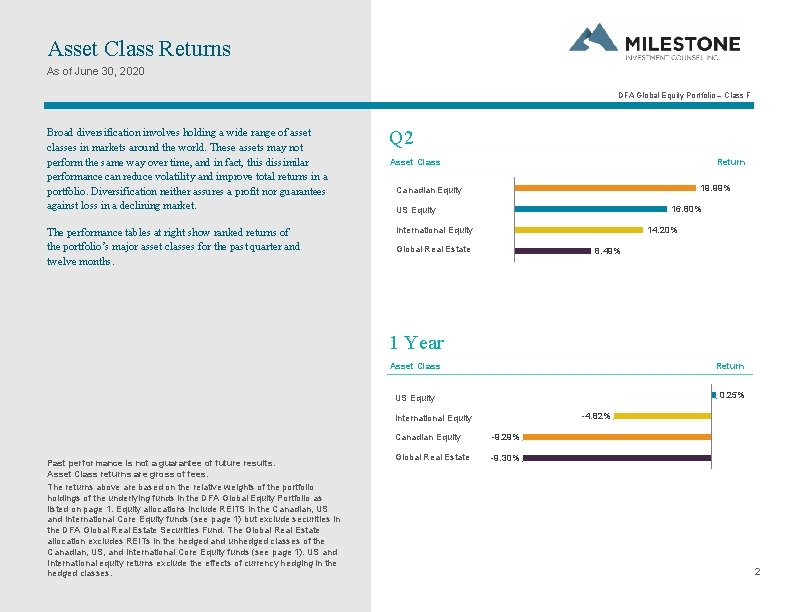
Asset Class Returns As of June 30, 2020 DFA Global Equity Portfolio – Class F Broad diversification involves holding a wide range of asset classes in markets around the world. These assets may not perform the same way over time, and in fact, this dissimilar performance can reduce volatility and improve total returns in a portfolio. Diversification neither assures a profit nor guarantees against loss in a declining market. The performance tables at right show ranked returns of the portfolio’s major asset classes for the past quarter and twelve months. Q 2 Asset Class Return 19. 99% Canadian Equity 16. 80% US Equity International Equity 14. 20% Global Real Estate 8. 49% 1 Year Asset Class Return US Equity 0. 25% -4. 82% International Equity Past performance is not a guarantee of future results. Asset Class returns are gross of fees. The returns above are based on the relative weights of the portfolio holdings of the underlying funds in the DFA Global Equity Portfolio as listed on page 1. Equity allocations include REITS in the Canadian, US and International Core Equity funds (see page 1) but exclude securities in the DFA Global Real Estate Securities Fund. The Global Real Estate allocation excludes REITs in the hedged and unhedged classes of the Canadian, US, and International Core Equity funds (see page 1). US and International equity returns exclude the effects of currency hedging in the hedged classes. Canadian Equity -9. 29% Global Real Estate -9. 30% 2

Equity Returns by Country As of June 30, 2020 DFA Global Equity Portfolio – Class F Global diversification can help reduce the risks of investing in a single country. Diversification neither assures a profit nor guarantees against loss in a declining market. The vertical bar graphs display one-year ranked returns for countries in the portfolio’s equity allocations. The tables indicate equity allocation weights and number of holdings per country. Developed Markets Emerging Markets Past performance is not a guarantee of future results. Country Returns are gross of fees. Holdings are subject to change. Country Weights and Number of Holdings are an average over the past year taken at the beginning of each month and do not include allocation to cash in the portfolio; therefore, country weights may not sum to 100%. The returns above are based on the relative weights of the portfolio holdings of the underlying funds in the DFA Global Equity Portfolio as listed on page 1. Country returns, weights, and number of holdings exclude securities in the DFA Global Real Estate Securities Fund. US, International Developed and Emerging Markets equity returns exclude the effects of currency hedging in the hedged classes. Country weights are broken down as a percentage of the equity allocation and not of the portfolio as a whole. 3
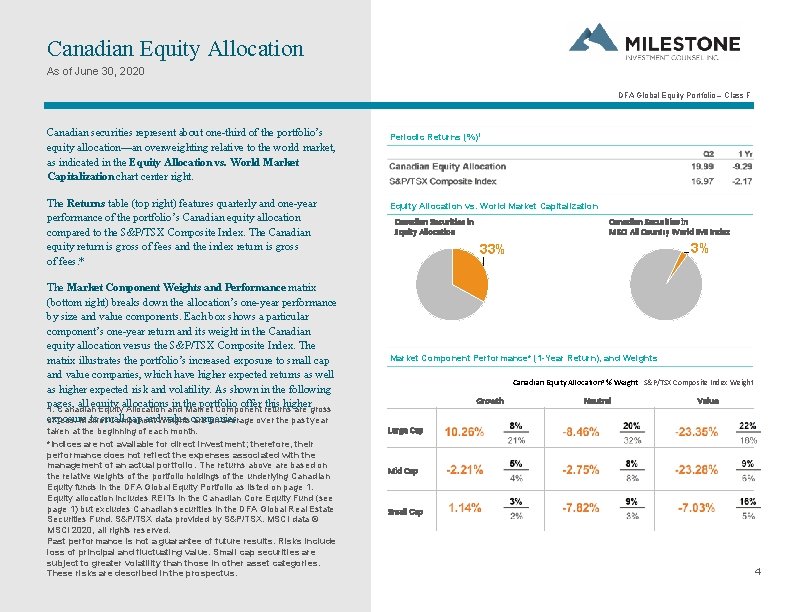
Canadian Equity Allocation As of June 30, 2020 DFA Global Equity Portfolio – Class F Canadian securities represent about one-third of the portfolio’s equity allocation—an overweighting relative to the world market, as indicated in the Equity Allocation vs. World Market Capitalization chart center right. The Returns table (top right) features quarterly and one-year performance of the portfolio’s Canadian equity allocation compared to the S&P/TSX Composite Index. The Canadian equity return is gross of fees and the index return is gross of fees. * The Market Component Weights and Performance matrix (bottom right) breaks down the allocation’s one-year performance by size and value components. Each box shows a particular component’s one-year return and its weight in the Canadian equity allocation versus the S&P/TSX Composite Index. The matrix illustrates the portfolio’s increased exposure to small cap and value companies, which have higher expected returns as well as higher expected risk and volatility. As shown in the following pages, all equity allocations in the portfolio offer this higher 1. Canadian Equity Allocation and Market Component returns are gross exposure to small cap and. Weights value companies. of fees. Market Component are an average over the past year taken at the beginning of each month. *Indices are not available for direct investment; therefore, their performance does not reflect the expenses associated with the management of an actual portfolio. The returns above are based on the relative weights of the portfolio holdings of the underlying Canadian Equity funds in the DFA Global Equity Portfolio as listed on page 1. Equity allocation includes REITs in the Canadian Core Equity Fund (see page 1) but excludes Canadian securities in the DFA Global Real Estate Securities Fund. S&P/TSX data provided by S&P/TSX. MSCI data © MSCI 2020, all rights reserved. Past performance is not a guarantee of future results. Risks include loss of principal and fluctuating value. Small cap securities are subject to greater volatility than those in other asset categories. These risks are described in the prospectus. Periodic Returns (%)1 Equity Allocation vs. World Market Capitalization Canadian Securities in Equity Allocation Canadian Securities in MSCI All Country World IMI Index 3% 33% Market Component Performance* (1 -Year Return), and Weights Canadian Equity Allocation 1 % Weight S&P/TSX Composite Index Weight Growth Neutral Value Large Cap Mid Cap Small Cap 4
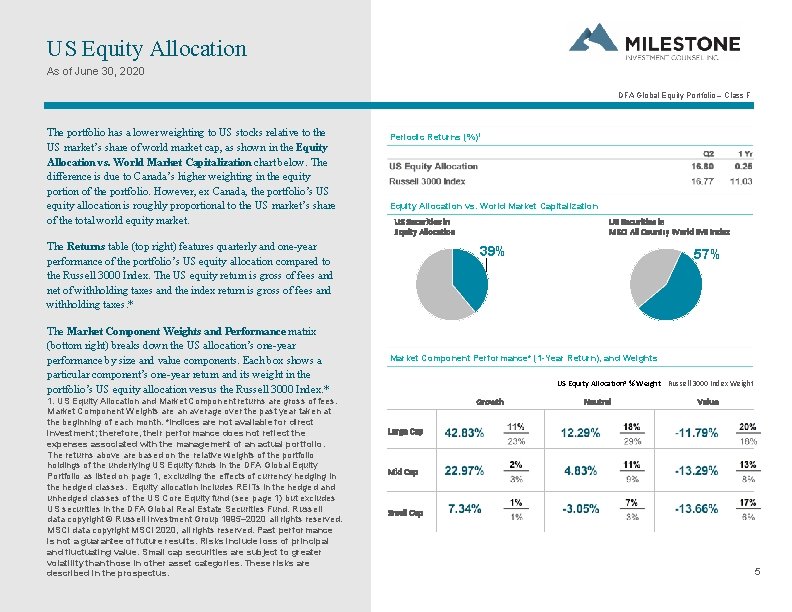
US Equity Allocation As of June 30, 2020 DFA Global Equity Portfolio – Class F The portfolio has a lower weighting to US stocks relative to the US market’s share of world market cap, as shown in the Equity Allocation vs. World Market Capitalization chart below. The difference is due to Canada’s higher weighting in the equity portion of the portfolio. However, ex Canada, the portfolio’s US equity allocation is roughly proportional to the US market’s share of the total world equity market. Periodic Returns (%)1 Equity Allocation vs. World Market Capitalization US Securities in Equity Allocation The Returns table (top right) features quarterly and one-year performance of the portfolio’s US equity allocation compared to the Russell 3000 Index. The US equity return is gross of fees and net of withholding taxes and the index return is gross of fees and withholding taxes. * The Market Component Weights and Performance matrix (bottom right) breaks down the US allocation’s one-year performance by size and value components. Each box shows a particular component’s one-year return and its weight in the portfolio’s US equity allocation versus the Russell 3000 Index. * 1. US Equity Allocation and Market Component returns are gross of fees. Market Component Weights are an average over the past year taken at the beginning of each month. *Indices are not available for direct investment; therefore, their performance does not reflect the expenses associated with the management of an actual portfolio. The returns above are based on the relative weights of the portfolio holdings of the underlying US Equity funds in the DFA Global Equity Portfolio as listed on page 1, excluding the effects of currency hedging in the hedged classes. Equity allocation includes REITs in the hedged and unhedged classes of the US Core Equity fund (see page 1) but excludes US securities in the DFA Global Real Estate Securities Fund. Russell data copyright © Russell Investment Group 1995– 2020 all rights reserved. MSCI data copyright MSCI 2020, all rights reserved. Past performance is not a guarantee of future results. Risks include loss of principal and fluctuating value. Small cap securities are subject to greater volatility than those in other asset categories. These risks are described in the prospectus. US Securities in MSCI All Country World IMI Index 39% 57% Market Component Performance* (1 -Year Return), and Weights US Equity Allocation 1 % Weight Russell 3000 Index Weight Growth Neutral Value Large Cap Mid Cap Small Cap 5

International Equity Allocation As of June 30, 2020 DFA Global Equity Portfolio – Class F The portfolio’s allocation to international developed (ex US ex Canada) and emerging market securities is lower than the international equity market’s share of the world market, as indicated in the Equity Allocation vs. World Market Capitalization chart below. However, after adjusting for Canada’s higher weighting in the portfolio, the international equity allocation’s weighting in the portfolio is similar to world market cap weightings. Periodic Returns (%)1 Equity Allocation vs. World Market Capitalization International Securities in Equity Allocation 28% The Returns table (top right) features quarterly and one-year performance of the portfolio’s international equity allocation compared to the MSCI EAFE plus Emerging Markets Index (net div. ). The international equity return is gross of fees and net of withholding taxes and the index return is gross of fees and net of withholding taxes. * The Market Component Weights and Performance matrix (bottom right) breaks down the allocation’s one-year performance by size and value components. Each box shows a particular component’s one-year return and its weight in the portfolio’s international equity allocation 1. International Equity Allocation and Markets Component returns versus the MSCI EAFE plus Emerging Index (netare div. ). * gross of fees. Market Component Weights are an average over the past year taken at the beginning of each month. *Indices are not available for direct investment; therefore, their performance does not reflect the expenses associated with the management of an actual portfolio. The returns above are based on the relative weights of the portfolio holdings of the underlying International Equity funds in the DFA Global Equity Portfolio as listed on page 1, excluding the effects of currency hedging in the hedged classes. Equity allocation includes REITs in the hedged and unhedged classes of the International Core Equity Fund (see page 1) but excludes International securities in the DFA Global Real Estate Securities Fund. MSCI data copyright MSCI 2020, all rights reserved. Past performance is not a guarantee of future results. Risks include loss of principal and fluctuating value. International investing involves special risks such as currency fluctuation and political instability. Investing in emerging markets may accentuate these risks. These risks are described in the prospectus. International Securities in MSCI All Country World IMI Index 40% Market Component Performance* (1 -Year Return), and Weights International Equity Allocation 1 % Weight MSCI EAFE + EM Index Weight Growth Neutral Value Large Cap Mid Cap Small Cap 6

Global Real Estate Allocation As of June 30, 2020 DFA Global Equity Portfolio – Class F The portfolio’s allocation to real estate securities offers costeffective exposure to real estate and diversification by country, by type, and by size of REITs within the global real estate asset class. The Returns table (top right) shows quarterly and one-year performance for the portfolio’s global real estate allocation, compared to the S&P Developed REIT Index (net div. ). The allocation’s return is gross of fees and the index return is gross of fees. * The vertical bar graph in the Returns by Country table (bottom right) shows one-year ranked returns of countries represented in the portfolio’s global real estate allocation. The table also indicates weights and number of holdings by country. Global Real Estate Allocation and Country Returns are gross of fees. Country Weights and Number of Holdings are an average over the past year taken at the beginning of each month. *Indices are not available for direct investment; therefore, their performance does not reflect the expenses associated with the management of an actual portfolio. The returns above are based on the relative weights of the Global Real Estate Allocation and not of the portfolio as a whole. The Global Real Estate Allocation excludes REITs in the hedged and unhedged classes of the Canadian, US, and International Core Equity funds (see page 1). The S&P data are provided by Standard & Poor’s Index Services Group. Past performance is not a guarantee of future results. Risks include loss of principal and fluctuating value. International investing involves special risks such as currency fluctuation and political instability. These risks are described in the prospectus. Diversification does not eliminate the risk of market loss. Periodic Returns (%)1 Global Real Estate Allocation Real Estate Securities in Total Portfolio Allocation [VA LUE ] 7
- Slides: 8