
Devron S Newman GSK 2262021 DIPLOMA IN INTERNATIONAL
- Slides: 31
Devron S. Newman - GSK 2/26/2021 DIPLOMA IN INTERNATIONAL SHIPPING & LOGISTICS General Ship Knowledge ML 301. 1(3. 0) 1
Devron S. Newman - GSK 2/26/2021 Lesson 1: Displacement Lesson 2: Displacement Calculations Lesson 3: Trim, Hogging & Sagging UNIT 4 – DRAFT AND LOADLINES 2
Devron S. Newman - GSK 2/26/2021 LESSON 1: DISPLACEMENT We discussed displacement in Unit 3. Now we will go further with the concept so that we can understand how the calculations are done and how we can determine how much cargo is to be loaded or discharged at a particular time during the cargo operation. But first, we must understand the principle of displacement. 3
Devron S. Newman - GSK 2/26/2021 DISPLACEMENT - KNOW Displacement is based on Archimedes Principle of Flotation. It states that… “…the apparent loss in weight of a body immersed in a fluid is equal to the weight of the displaced fluid”; or a floating vessel displaces a volume of liquid, the weight of which is equal to the weight of the vessel. 4
Devron S. Newman - GSK 2/26/2021 DENSITY Another term that we must understand is density. The density of a liquid is its mass per unit volume. In this context, and for calculation purposes, we will use kg/m³ as the units. Typical examples of densities are: Sea water: 1, 025 kg/m³ Fresh water: 1, 000 kg/m³ Dock water: 1, 019 kg/m³ 5
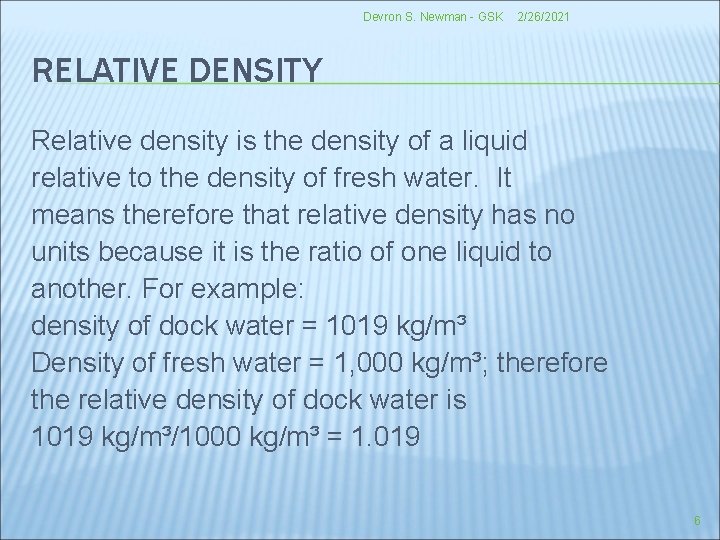
Devron S. Newman - GSK 2/26/2021 RELATIVE DENSITY Relative density is the density of a liquid relative to the density of fresh water. It means therefore that relative density has no units because it is the ratio of one liquid to another. For example: density of dock water = 1019 kg/m³ Density of fresh water = 1, 000 kg/m³; therefore the relative density of dock water is 1019 kg/m³/1000 kg/m³ = 1. 019 6
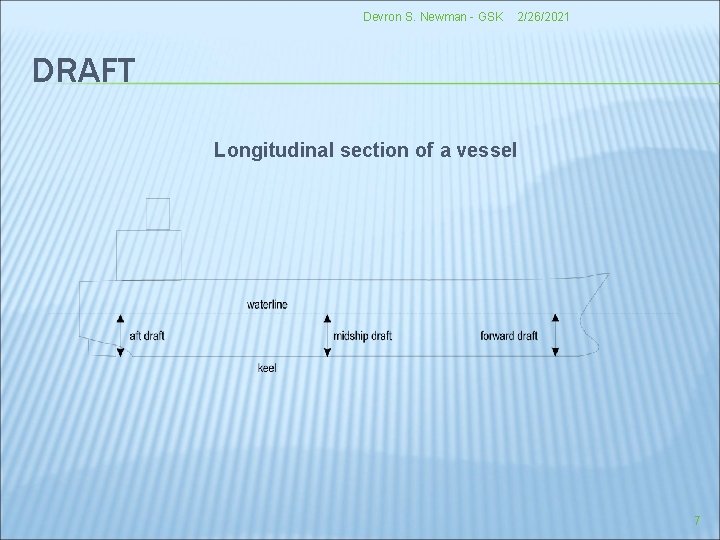
Devron S. Newman - GSK 2/26/2021 DRAFT Longitudinal section of a vessel 7
Devron S. Newman - GSK 2/26/2021 DRAFT The draft of a vessel is measured from the bottom of the keel to the water line. It has to be measured at the fore and aft of the vessel. Some calculations require that we find the mean draft. Simply put, the mean draft is the mean of the two readings. Therefore we just add both values and divide by 2. We must however, be careful with our calculations depending on the whether we are using metres or feet and inches. 8
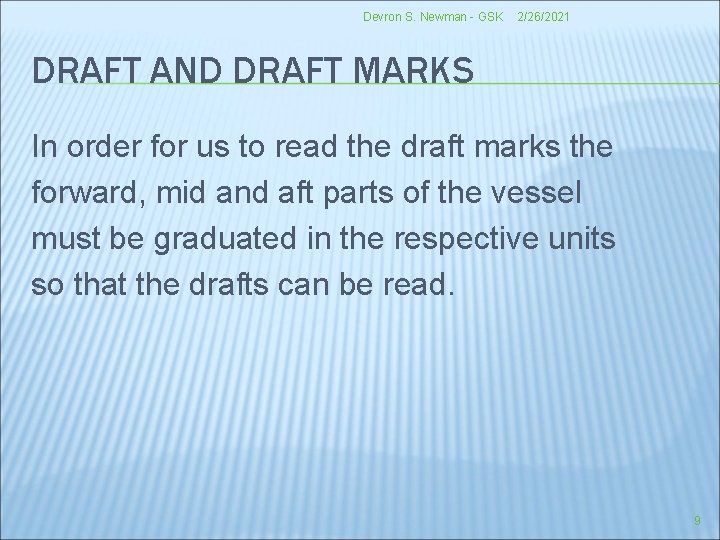
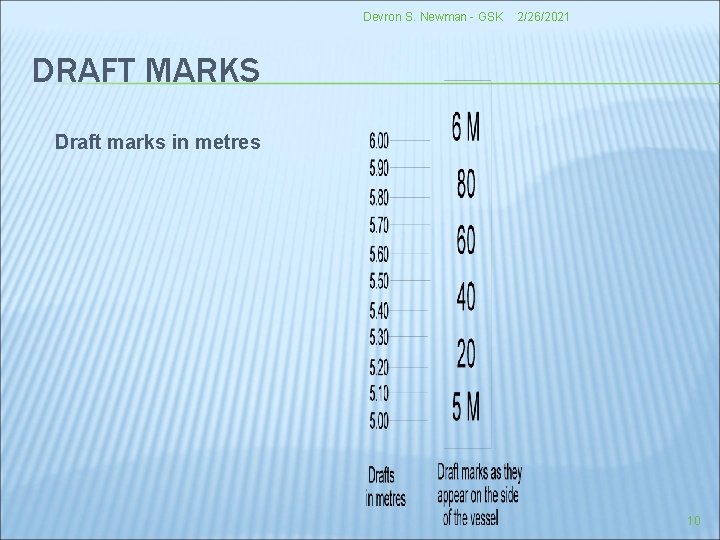
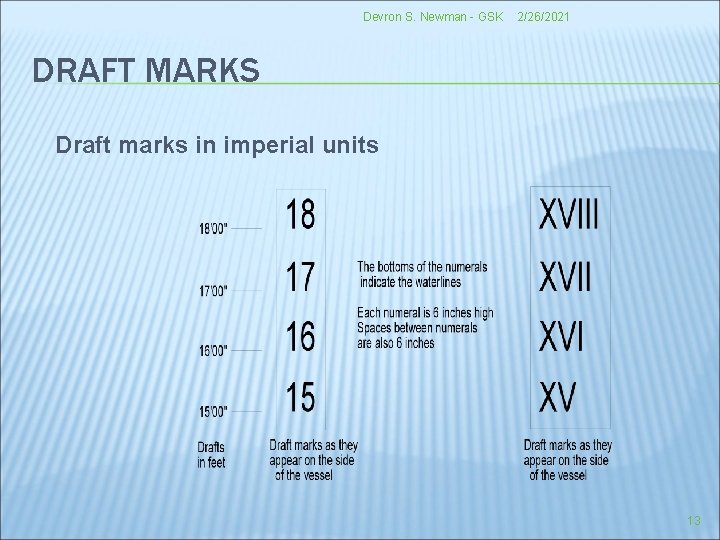
Devron S. Newman - GSK 2/26/2021 DRAFT AND DRAFT MARKS In order for us to read the draft marks the forward, mid and aft parts of the vessel must be graduated in the respective units so that the drafts can be read. 9
Devron S. Newman - GSK 2/26/2021 DRAFT MARKS Draft marks in metres 10
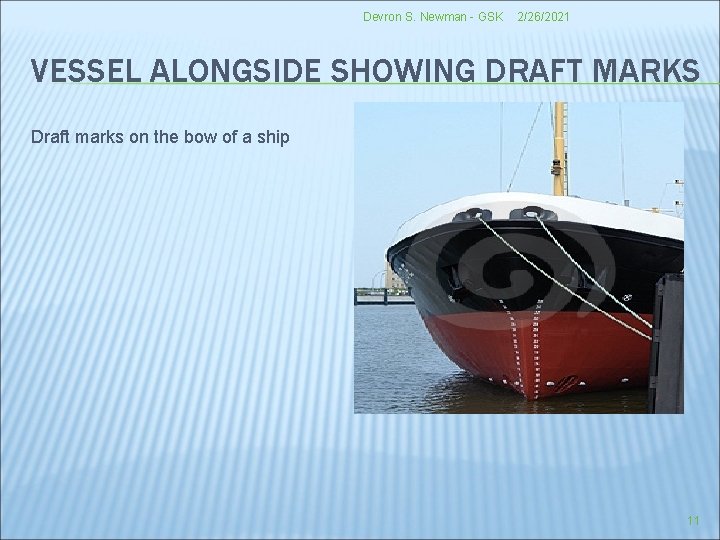
Devron S. Newman - GSK 2/26/2021 VESSEL ALONGSIDE SHOWING DRAFT MARKS Draft marks on the bow of a ship 11
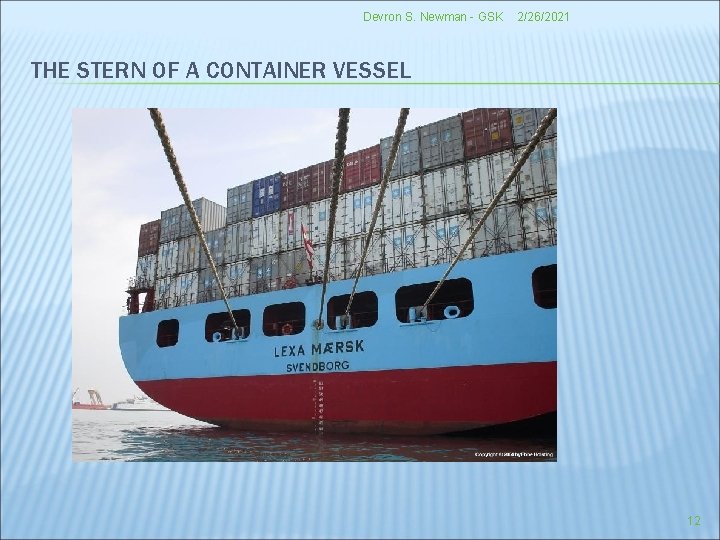
Devron S. Newman - GSK 2/26/2021 THE STERN OF A CONTAINER VESSEL 12
Devron S. Newman - GSK 2/26/2021 DRAFT MARKS Draft marks in imperial units 13
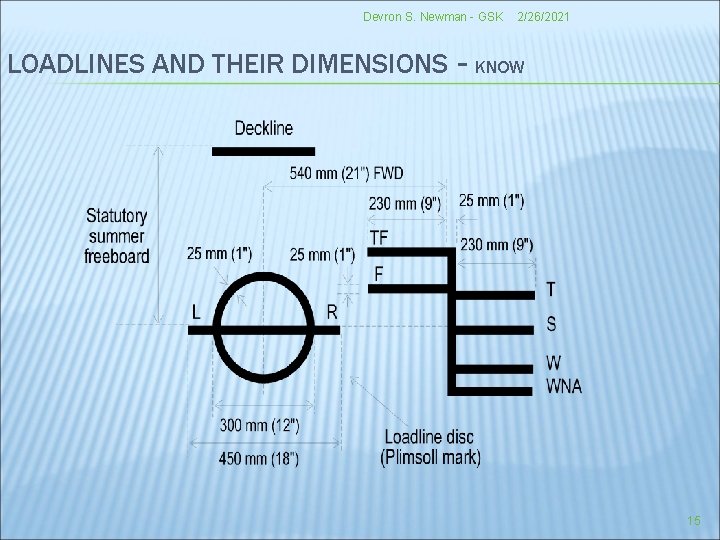
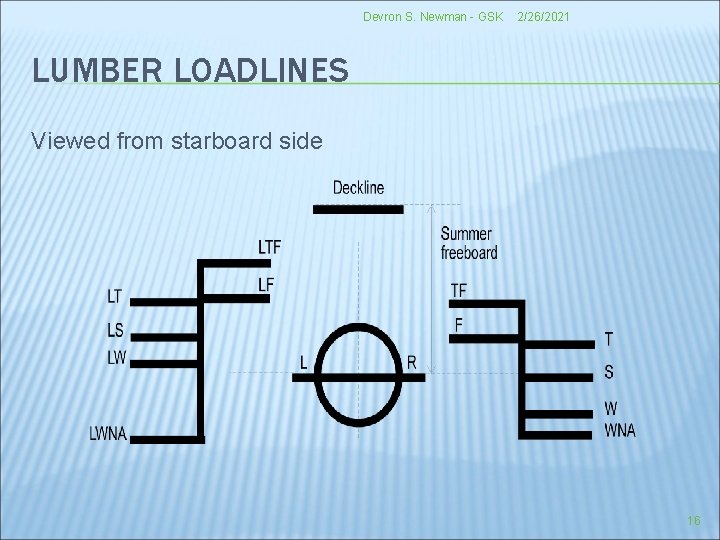
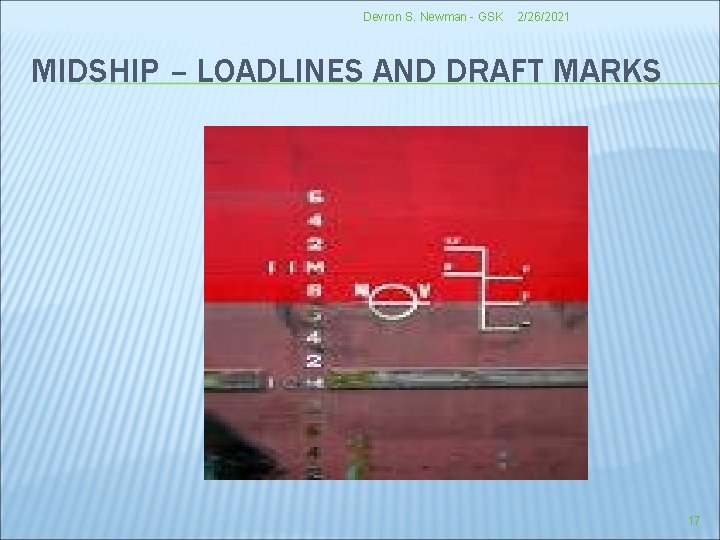
Devron S. Newman - GSK 2/26/2021 LOADLINES Loadlines are line cut into the side of a vessel to indicate how far down a ship may be loaded in a particular season. They are marked on both sides of the vessel at midship. 14
Devron S. Newman - GSK LOADLINES AND THEIR DIMENSIONS 2/26/2021 - KNOW 15
Devron S. Newman - GSK 2/26/2021 LUMBER LOADLINES Viewed from starboard side 16
Devron S. Newman - GSK 2/26/2021 MIDSHIP – LOADLINES AND DRAFT MARKS 17
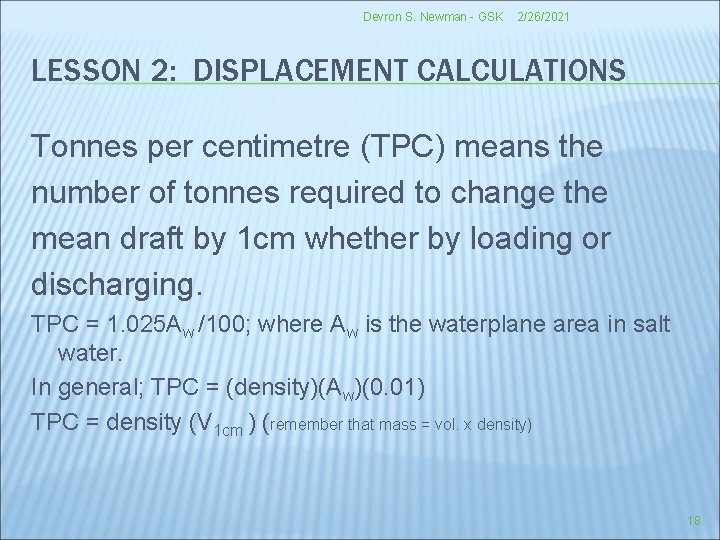
Devron S. Newman - GSK 2/26/2021 LESSON 2: DISPLACEMENT CALCULATIONS Tonnes per centimetre (TPC) means the number of tonnes required to change the mean draft by 1 cm whether by loading or discharging. TPC = 1. 025 Aw /100; where Aw is the waterplane area in salt water. In general; TPC = (density)(Aw)(0. 01) TPC = density (V 1 cm ) (remember that mass = vol. x density) 18
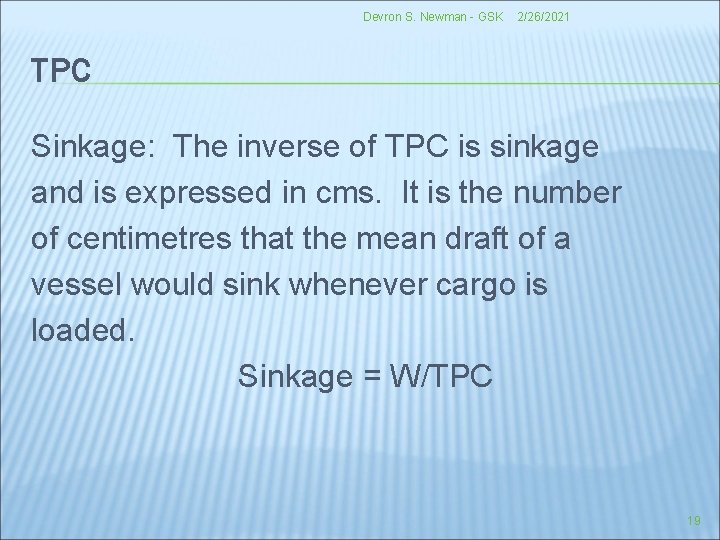
Devron S. Newman - GSK 2/26/2021 TPC Sinkage: The inverse of TPC is sinkage and is expressed in cms. It is the number of centimetres that the mean draft of a vessel would sink whenever cargo is loaded. Sinkage = W/TPC 19
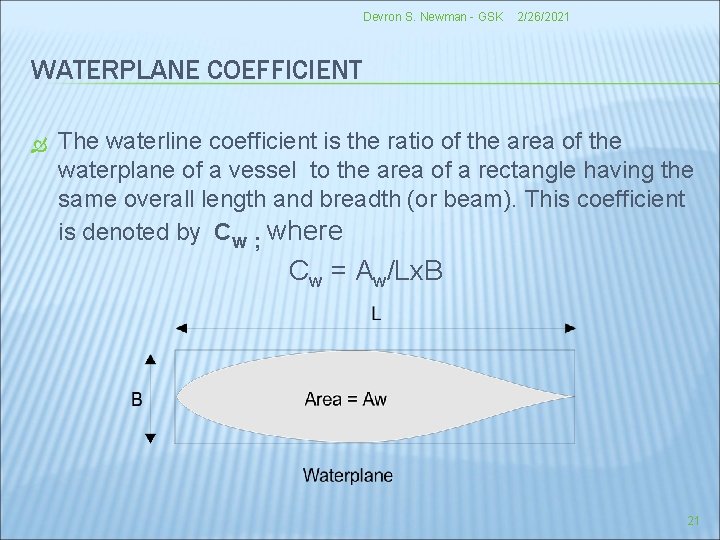
Devron S. Newman - GSK 2/26/2021 FORM COEFFICIENTS In deepening our knowledge of displacement, draft and loadlines. We must know a little about two types of form coefficients. 1. Waterplane coefficient, and; 2. Block coefficient 20
Devron S. Newman - GSK 2/26/2021 WATERPLANE COEFFICIENT The waterline coefficient is the ratio of the area of the waterplane of a vessel to the area of a rectangle having the same overall length and breadth (or beam). This coefficient is denoted by Cw ; where Cw = Aw/Lx. B 21
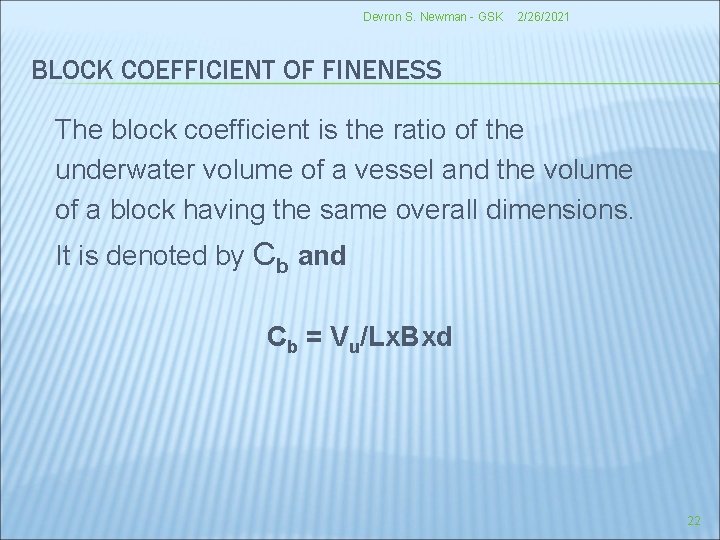
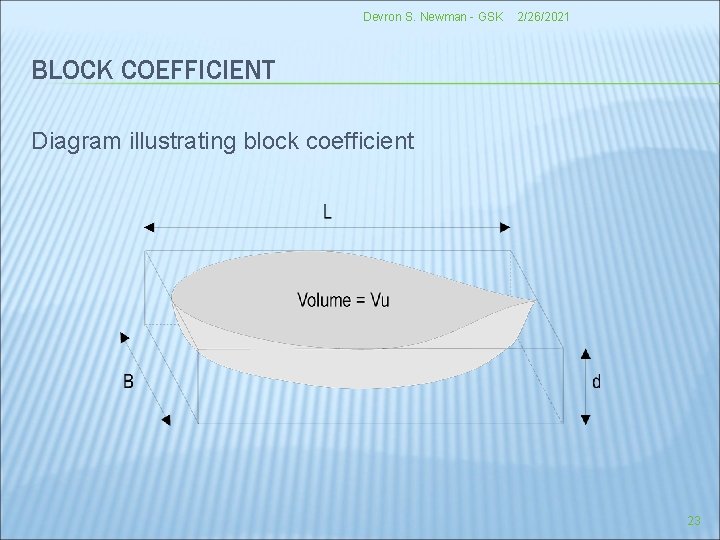
Devron S. Newman - GSK 2/26/2021 BLOCK COEFFICIENT OF FINENESS The block coefficient is the ratio of the underwater volume of a vessel and the volume of a block having the same overall dimensions. It is denoted by Cb and Cb = Vu/Lx. Bxd 22
Devron S. Newman - GSK 2/26/2021 BLOCK COEFFICIENT Diagram illustrating block coefficient 23
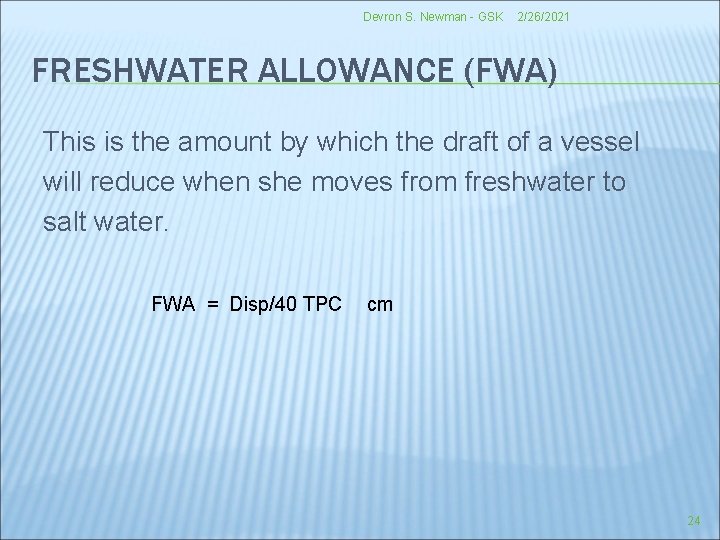
Devron S. Newman - GSK 2/26/2021 FRESHWATER ALLOWANCE (FWA) This is the amount by which the draft of a vessel will reduce when she moves from freshwater to salt water. FWA = Disp/40 TPC cm 24
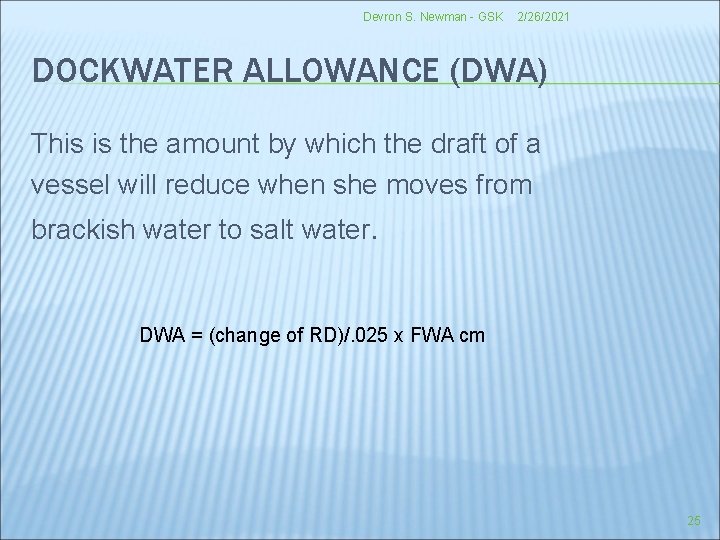
Devron S. Newman - GSK 2/26/2021 DOCKWATER ALLOWANCE (DWA) This is the amount by which the draft of a vessel will reduce when she moves from brackish water to salt water. DWA = (change of RD)/. 025 x FWA cm 25
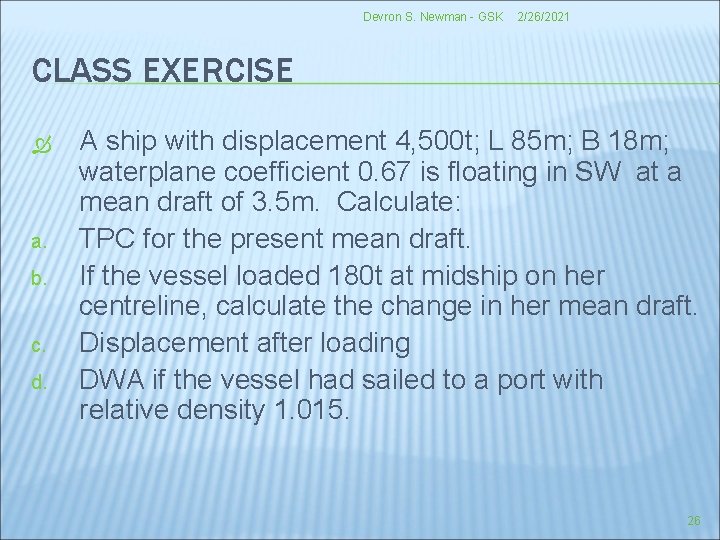
Devron S. Newman - GSK 2/26/2021 CLASS EXERCISE a. b. c. d. A ship with displacement 4, 500 t; L 85 m; B 18 m; waterplane coefficient 0. 67 is floating in SW at a mean draft of 3. 5 m. Calculate: TPC for the present mean draft. If the vessel loaded 180 t at midship on her centreline, calculate the change in her mean draft. Displacement after loading DWA if the vessel had sailed to a port with relative density 1. 015. 26
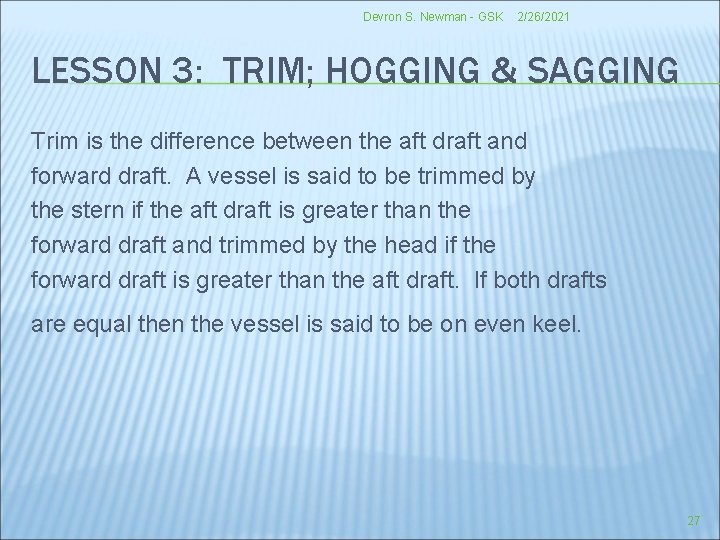
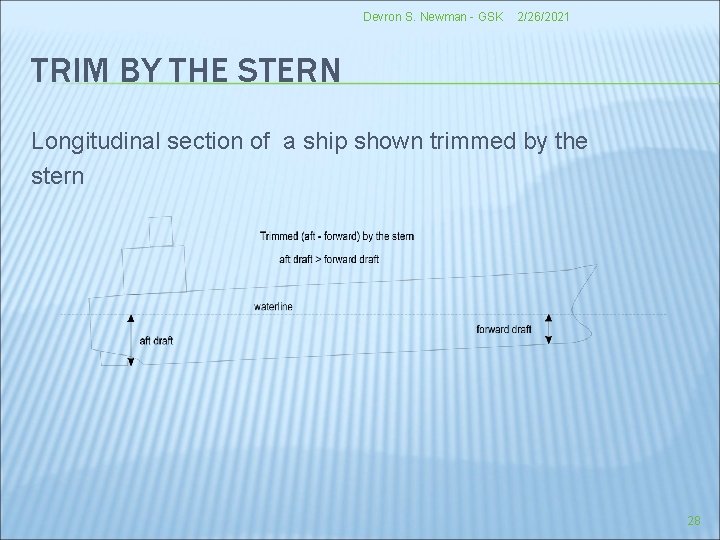
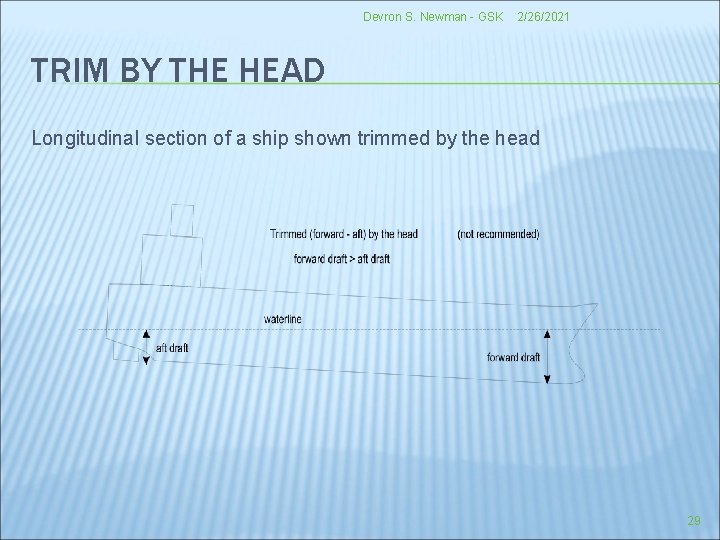
Devron S. Newman - GSK 2/26/2021 LESSON 3: TRIM; HOGGING & SAGGING Trim is the difference between the aft draft and forward draft. A vessel is said to be trimmed by the stern if the aft draft is greater than the forward draft and trimmed by the head if the forward draft is greater than the aft draft. If both drafts are equal then the vessel is said to be on even keel. 27
Devron S. Newman - GSK 2/26/2021 TRIM BY THE STERN Longitudinal section of a ship shown trimmed by the stern 28
Devron S. Newman - GSK 2/26/2021 TRIM BY THE HEAD Longitudinal section of a ship shown trimmed by the head 29
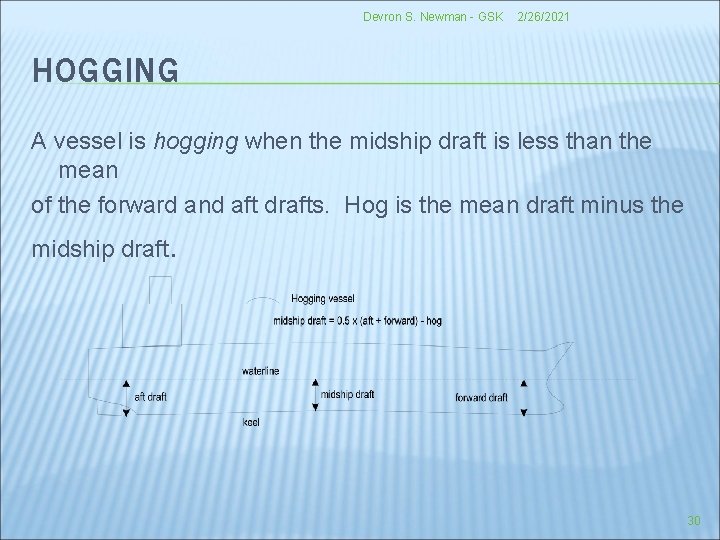
Devron S. Newman - GSK 2/26/2021 HOGGING A vessel is hogging when the midship draft is less than the mean of the forward and aft drafts. Hog is the mean draft minus the midship draft. 30
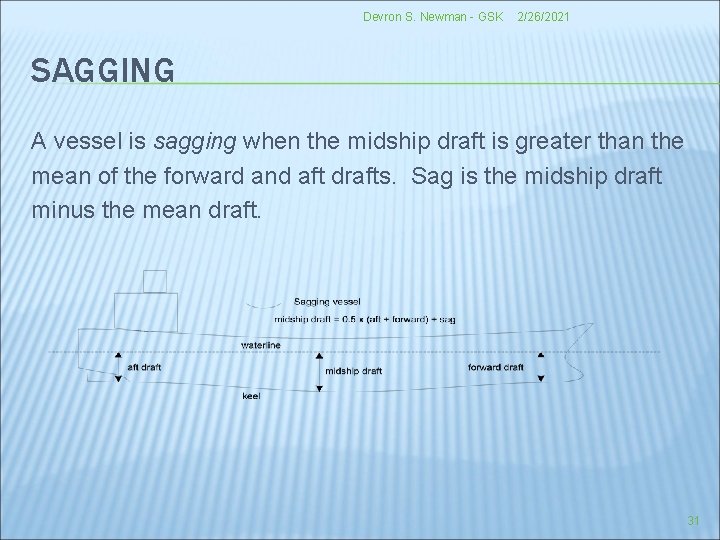
Devron S. Newman - GSK 2/26/2021 SAGGING A vessel is sagging when the midship draft is greater than the mean of the forward and aft drafts. Sag is the midship draft minus the mean draft. 31