
DEVIATING FROM SOCIAL NORMS DEFINITION Limitations Of The
- Slides: 13
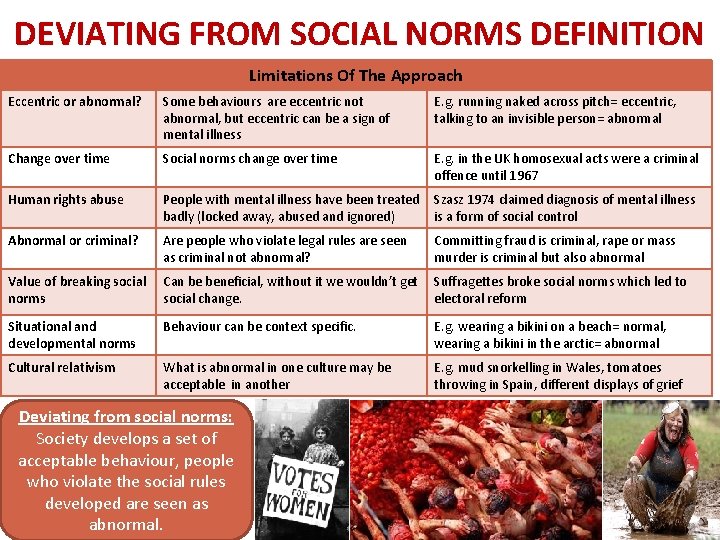
DEVIATING FROM SOCIAL NORMS DEFINITION Limitations Of The Approach Eccentric or abnormal? Some behaviours are eccentric not abnormal, but eccentric can be a sign of mental illness E. g. running naked across pitch= eccentric, talking to an invisible person= abnormal Change over time Social norms change over time E. g. in the UK homosexual acts were a criminal offence until 1967 Human rights abuse People with mental illness have been treated badly (locked away, abused and ignored) Szasz 1974 claimed diagnosis of mental illness is a form of social control Abnormal or criminal? Are people who violate legal rules are seen as criminal not abnormal? Committing fraud is criminal, rape or mass murder is criminal but also abnormal Value of breaking social norms Can be beneficial, without it we wouldn’t get social change. Suffragettes broke social norms which led to electoral reform Situational and developmental norms Behaviour can be context specific. E. g. wearing a bikini on a beach= normal, wearing a bikini in the arctic= abnormal Cultural relativism What is abnormal in one culture may be acceptable in another E. g. mud snorkelling in Wales, tomatoes throwing in Spain, different displays of grief Deviating from social norms: Society develops a set of acceptable behaviour, people who violate the social rules developed are seen as abnormal.
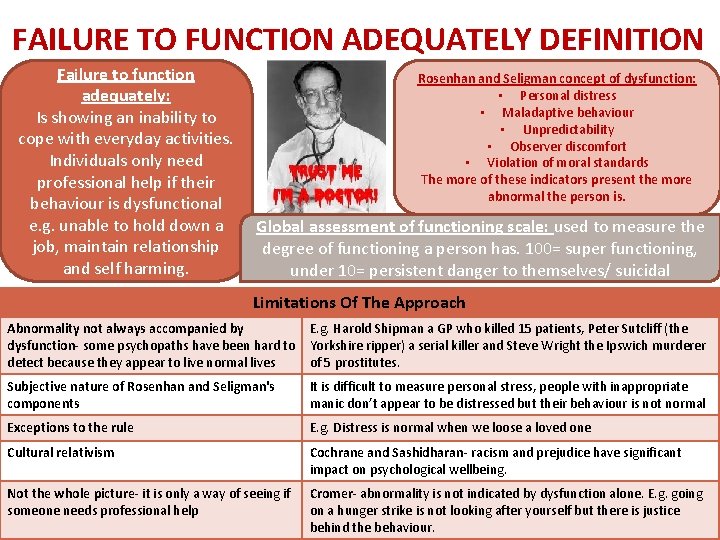
FAILURE TO FUNCTION ADEQUATELY DEFINITION Failure to function adequately: Is showing an inability to cope with everyday activities. Individuals only need professional help if their behaviour is dysfunctional e. g. unable to hold down a job, maintain relationship and self harming. Rosenhan and Seligman concept of dysfunction: • Personal distress • Maladaptive behaviour • Unpredictability • Observer discomfort • Violation of moral standards The more of these indicators present the more abnormal the person is. Global assessment of functioning scale: used to measure the degree of functioning a person has. 100= super functioning, under 10= persistent danger to themselves/ suicidal Limitations Of The Approach Abnormality not always accompanied by dysfunction- some psychopaths have been hard to detect because they appear to live normal lives E. g. Harold Shipman a GP who killed 15 patients, Peter Sutcliff (the Yorkshire ripper) a serial killer and Steve Wright the Ipswich murderer of 5 prostitutes. Subjective nature of Rosenhan and Seligman's components It is difficult to measure personal stress, people with inappropriate manic don’t appear to be distressed but their behaviour is not normal Exceptions to the rule E. g. Distress is normal when we loose a loved one Cultural relativism Cochrane and Sashidharan- racism and prejudice have significant impact on psychological wellbeing. Not the whole picture- it is only a way of seeing if someone needs professional help Cromer- abnormality is not indicated by dysfunction alone. E. g. going on a hunger strike is not looking after yourself but there is justice behind the behaviour.
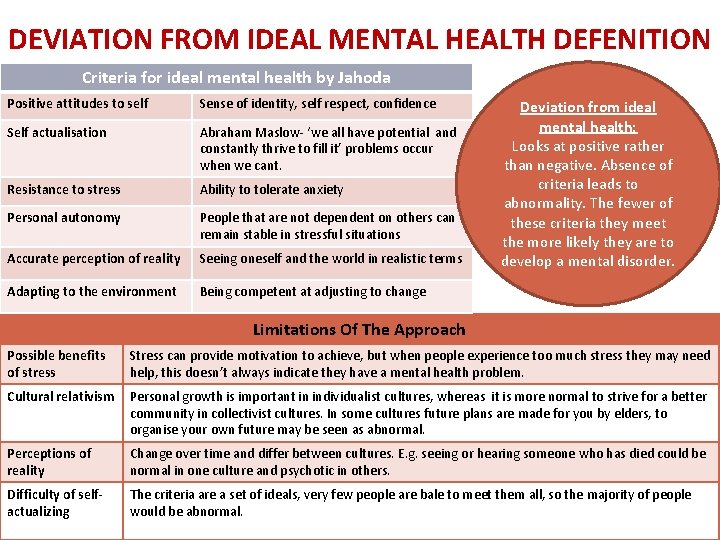
DEVIATION FROM IDEAL MENTAL HEALTH DEFENITION Criteria for ideal mental health by Jahoda Positive attitudes to self Sense of identity, self respect, confidence Self actualisation Abraham Maslow- ‘we all have potential and constantly thrive to fill it’ problems occur when we cant. Resistance to stress Ability to tolerate anxiety Personal autonomy People that are not dependent on others can remain stable in stressful situations Accurate perception of reality Seeing oneself and the world in realistic terms Adapting to the environment Being competent at adjusting to change Deviation from ideal mental health: Looks at positive rather than negative. Absence of criteria leads to abnormality. The fewer of these criteria they meet the more likely they are to develop a mental disorder. Limitations Of The Approach Possible benefits of stress Stress can provide motivation to achieve, but when people experience too much stress they may need help, this doesn’t always indicate they have a mental health problem. Cultural relativism Personal growth is important in individualist cultures, whereas it is more normal to strive for a better community in collectivist cultures. In some cultures future plans are made for you by elders, to organise your own future may be seen as abnormal. Perceptions of reality Change over time and differ between cultures. E. g. seeing or hearing someone who has died could be normal in one culture and psychotic in others. Difficulty of selfactualizing The criteria are a set of ideals, very few people are bale to meet them all, so the majority of people would be abnormal.
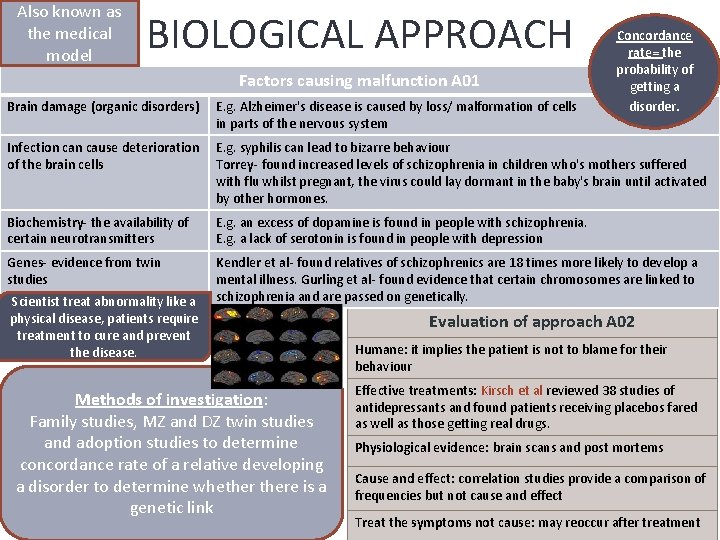
Also known as the medical model BIOLOGICAL APPROACH Factors causing malfunction A 01 Concordance rate= the probability of getting a disorder. Brain damage (organic disorders) E. g. Alzheimer's disease is caused by loss/ malformation of cells in parts of the nervous system Infection cause deterioration of the brain cells E. g. syphilis can lead to bizarre behaviour Torrey- found increased levels of schizophrenia in children who's mothers suffered with flu whilst pregnant, the virus could lay dormant in the baby's brain until activated by other hormones. Biochemistry- the availability of certain neurotransmitters E. g. an excess of dopamine is found in people with schizophrenia. E. g. a lack of serotonin is found in people with depression Genes- evidence from twin studies Kendler et al- found relatives of schizophrenics are 18 times more likely to develop a mental illness. Gurling et al- found evidence that certain chromosomes are linked to schizophrenia and are passed on genetically. Scientist treat abnormality like a physical disease, patients require treatment to cure and prevent the disease. Methods of investigation: Family studies, MZ and DZ twin studies and adoption studies to determine concordance rate of a relative developing a disorder to determine whethere is a genetic link Evaluation of approach A 02 Humane: it implies the patient is not to blame for their behaviour Effective treatments: Kirsch et al reviewed 38 studies of antidepressants and found patients receiving placebos fared as well as those getting real drugs. Physiological evidence: brain scans and post mortems Cause and effect: correlation studies provide a comparison of frequencies but not cause and effect Treat the symptoms not cause: may reoccur after treatment
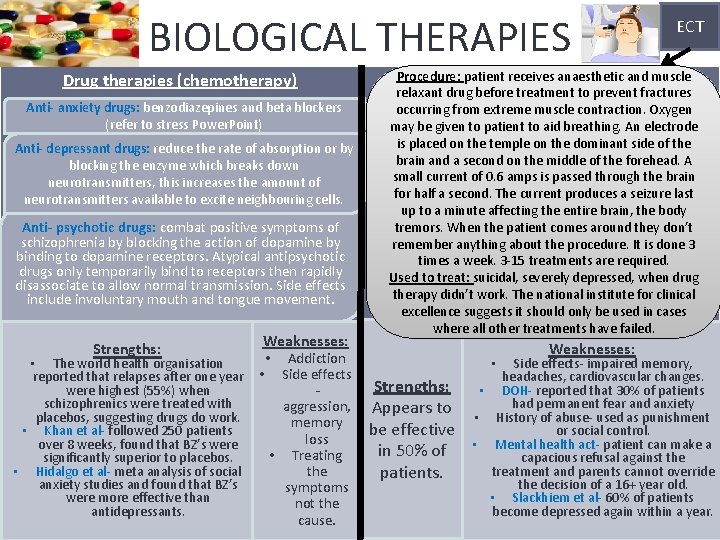
BIOLOGICAL THERAPIES Drug therapies (chemotherapy) Anti- anxiety drugs: benzodiazepines and beta blockers (refer to stress Power. Point) Anti- depressant drugs: reduce the rate of absorption or by blocking the enzyme which breaks down neurotransmitters, this increases the amount of neurotransmitters available to excite neighbouring cells. Anti- psychotic drugs: combat positive symptoms of schizophrenia by blocking the action of dopamine by binding to dopamine receptors. Atypical antipsychotic drugs only temporarily bind to receptors then rapidly disassociate to allow normal transmission. Side effects include involuntary mouth and tongue movement. Weaknesses: • Addiction • The world health organisation reported that relapses after one year • Side effects Procedure: patient receives anaesthetic and muscle relaxant drug before treatment to prevent fractures occurring from extreme muscle contraction. Oxygen may be given to patient to aid breathing. An electrode is placed on the temple on the dominant side of the brain and a second on the middle of the forehead. A small current of 0. 6 amps is passed through the brain for half a second. The current produces a seizure last up to a minute affecting the entire brain, the body tremors. When the patient comes around they don’t remember anything about the procedure. It is done 3 times a week. 3 -15 treatments are required. Used to treat: suicidal, severely depressed, when drug therapy didn’t work. The national institute for clinical excellence suggests it should only be used in cases where all other treatments have failed. Strengths: were highest (55%) when schizophrenics were treated with placebos, suggesting drugs do work. • Khan et al- followed 250 patients over 8 weeks, found that BZ’s were significantly superior to placebos. • Hidalgo et al- meta analysis of social anxiety studies and found that BZ’s were more effective than antidepressants. aggression, memory loss • Treating the symptoms not the cause. ECT Side effects- impaired memory, headaches, cardiovascular changes. • DOH- reported that 30% of patients had permanent fear and anxiety • History of abuse- used as punishment or social control. • Mental health act- patient can make a capacious refusal against the treatment and parents cannot override the decision of a 16+ year old. • Slackhiem et al- 60% of patients become depressed again within a year. • Strengths: Appears to be effective in 50% of patients. Weaknesses:
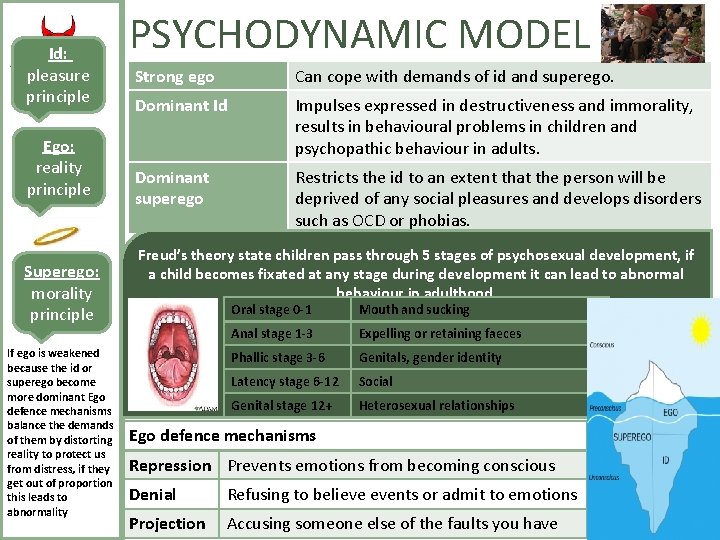
Id: pleasure principle Ego: reality principle Superego: morality principle If ego is weakened because the id or superego become more dominant Ego defence mechanisms balance the demands of them by distorting reality to protect us from distress, if they get out of proportion this leads to abnormality PSYCHODYNAMIC MODEL Strong ego Can cope with demands of id and superego. Dominant Id Impulses expressed in destructiveness and immorality, results in behavioural problems in children and psychopathic behaviour in adults. Dominant superego Restricts the id to an extent that the person will be deprived of any social pleasures and develops disorders such as OCD or phobias. Freud’s theory state children pass through 5 stages of psychosexual development, if a child becomes fixated at any stage during development it can lead to abnormal behaviour in adulthood. Oral stage 0 -1 Mouth and sucking Anal stage 1 -3 Expelling or retaining faeces Phallic stage 3 -6 Genitals, gender identity Latency stage 6 -12 Social Genital stage 12+ Heterosexual relationships Ego defence mechanisms Repression Prevents emotions from becoming conscious Denial Refusing to believe events or admit to emotions Projection Accusing someone else of the faults you have
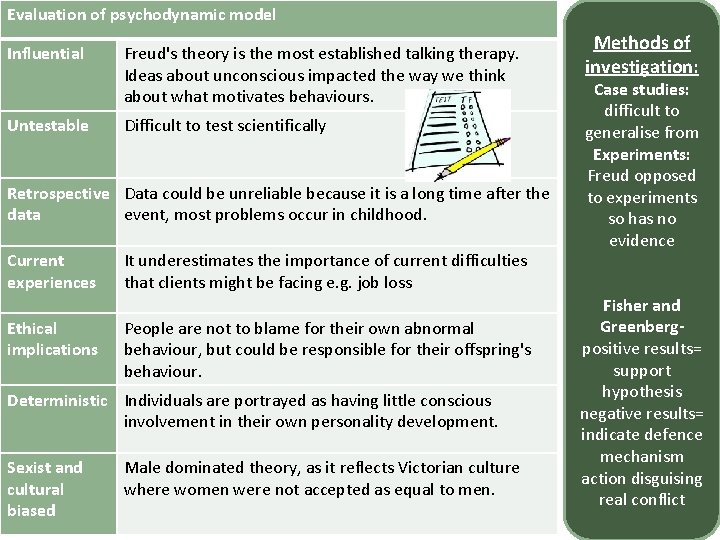
Evaluation of psychodynamic model Influential Untestable Freud's theory is the most established talking therapy. Ideas about unconscious impacted the way we think about what motivates behaviours. Difficult to test scientifically Retrospective Data could be unreliable because it is a long time after the data event, most problems occur in childhood. Current experiences Ethical implications It underestimates the importance of current difficulties that clients might be facing e. g. job loss People are not to blame for their own abnormal behaviour, but could be responsible for their offspring's behaviour. Deterministic Individuals are portrayed as having little conscious involvement in their own personality development. Sexist and cultural biased Male dominated theory, as it reflects Victorian culture where women were not accepted as equal to men. Methods of investigation: Case studies: difficult to generalise from Experiments: Freud opposed to experiments so has no evidence Fisher and Greenbergpositive results= support hypothesis negative results= indicate defence mechanism action disguising real conflict
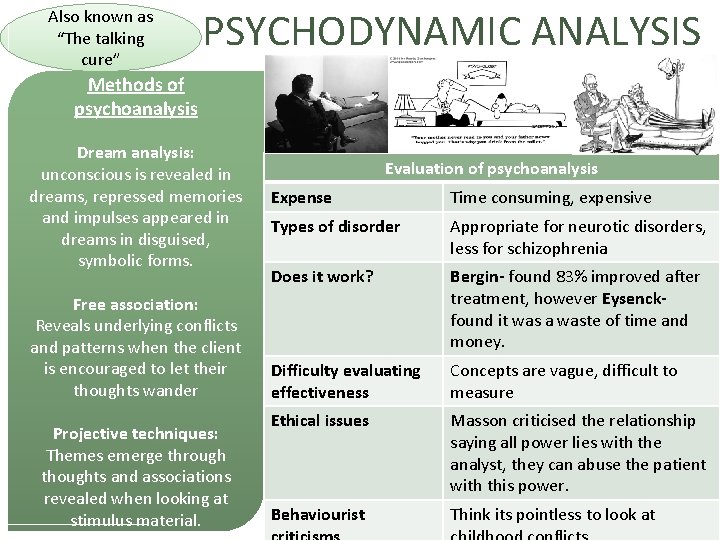
Also known as “The talking cure” PSYCHODYNAMIC ANALYSIS Methods of psychoanalysis Dream analysis: unconscious is revealed in dreams, repressed memories and impulses appeared in dreams in disguised, symbolic forms. Free association: Reveals underlying conflicts and patterns when the client is encouraged to let their thoughts wander Projective techniques: Themes emerge through thoughts and associations revealed when looking at stimulus material. Evaluation of psychoanalysis Expense Time consuming, expensive Types of disorder Appropriate for neurotic disorders, less for schizophrenia Does it work? Bergin- found 83% improved after treatment, however Eysenckfound it was a waste of time and money. Difficulty evaluating effectiveness Concepts are vague, difficult to measure Ethical issues Masson criticised the relationship saying all power lies with the analyst, they can abuse the patient with this power. Behaviourist Think its pointless to look at
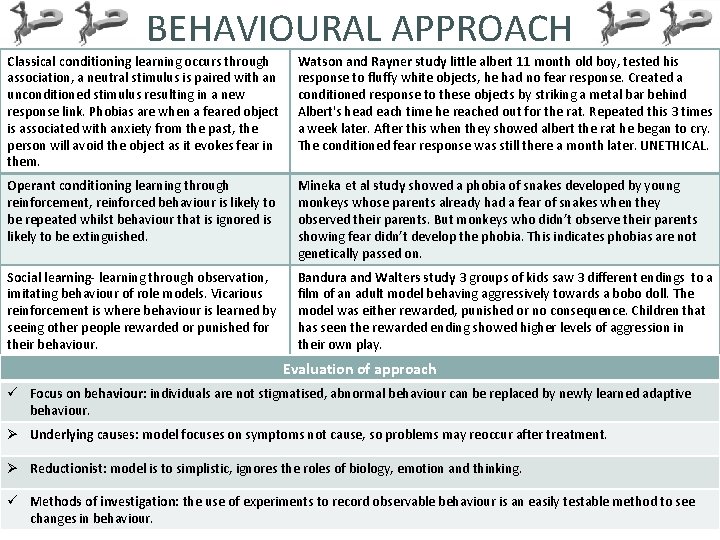
BEHAVIOURAL APPROACH Classical conditioning learning occurs through association, a neutral stimulus is paired with an unconditioned stimulus resulting in a new response link. Phobias are when a feared object is associated with anxiety from the past, the person will avoid the object as it evokes fear in them. Watson and Rayner study little albert 11 month old boy, tested his response to fluffy white objects, he had no fear response. Created a conditioned response to these objects by striking a metal bar behind Albert's head each time he reached out for the rat. Repeated this 3 times a week later. After this when they showed albert the rat he began to cry. The conditioned fear response was still there a month later. UNETHICAL. Operant conditioning learning through reinforcement, reinforced behaviour is likely to be repeated whilst behaviour that is ignored is likely to be extinguished. Mineka et al study showed a phobia of snakes developed by young monkeys whose parents already had a fear of snakes when they observed their parents. But monkeys who didn’t observe their parents showing fear didn’t develop the phobia. This indicates phobias are not genetically passed on. Social learning- learning through observation, imitating behaviour of role models. Vicarious reinforcement is where behaviour is learned by seeing other people rewarded or punished for their behaviour. Bandura and Walters study 3 groups of kids saw 3 different endings to a film of an adult model behaving aggressively towards a bobo doll. The model was either rewarded, punished or no consequence. Children that has seen the rewarded ending showed higher levels of aggression in their own play. Evaluation of approach ü Focus on behaviour: individuals are not stigmatised, abnormal behaviour can be replaced by newly learned adaptive behaviour. Ø Underlying causes: model focuses on symptoms not cause, so problems may reoccur after treatment. Ø Reductionist: model is to simplistic, ignores the roles of biology, emotion and thinking. ü Methods of investigation: the use of experiments to record observable behaviour is an easily testable method to see changes in behaviour.
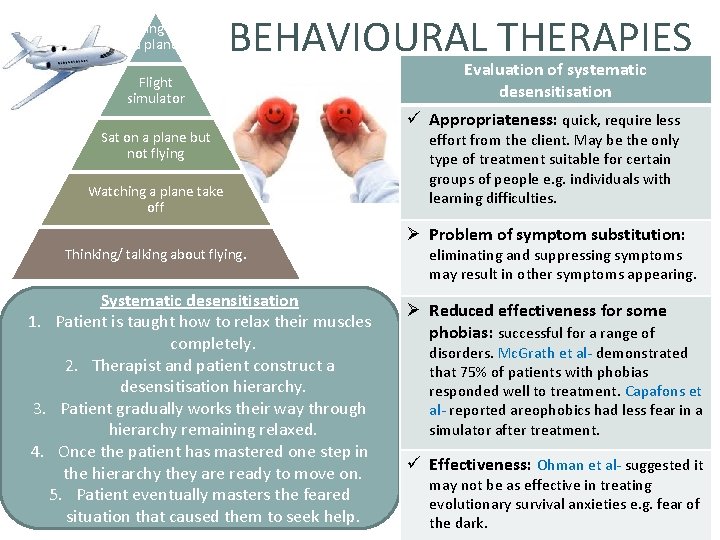
Flying on a plane BEHAVIOURAL THERAPIES Flight simulator Sat on a plane but not flying Watching a plane take off Thinking/ talking about flying. Systematic desensitisation 1. Patient is taught how to relax their muscles completely. 2. Therapist and patient construct a desensitisation hierarchy. 3. Patient gradually works their way through hierarchy remaining relaxed. 4. Once the patient has mastered one step in the hierarchy they are ready to move on. 5. Patient eventually masters the feared situation that caused them to seek help. Evaluation of systematic desensitisation ü Appropriateness: quick, require less effort from the client. May be the only type of treatment suitable for certain groups of people e. g. individuals with learning difficulties. Ø Problem of symptom substitution: eliminating and suppressing symptoms may result in other symptoms appearing. Ø Reduced effectiveness for some phobias: successful for a range of disorders. Mc. Grath et al- demonstrated that 75% of patients with phobias responded well to treatment. Capafons et al- reported areophobics had less fear in a simulator after treatment. ü Effectiveness: Ohman et al- suggested it may not be as effective in treating evolutionary survival anxieties e. g. fear of the dark.
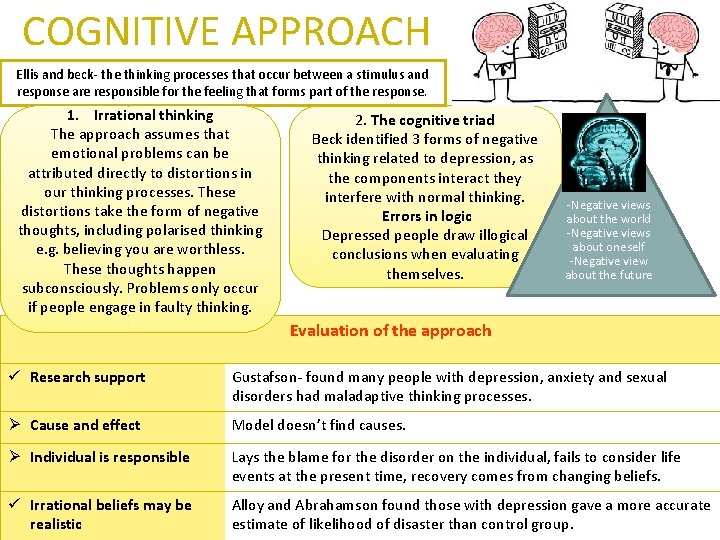
COGNITIVE APPROACH Ellis and beck- the thinking processes that occur between a stimulus and response are responsible for the feeling that forms part of the response. 1. Irrational thinking The approach assumes that emotional problems can be attributed directly to distortions in our thinking processes. These distortions take the form of negative thoughts, including polarised thinking e. g. believing you are worthless. These thoughts happen subconsciously. Problems only occur if people engage in faulty thinking. 2. The cognitive triad Beck identified 3 forms of negative thinking related to depression, as the components interact they interfere with normal thinking. Errors in logic Depressed people draw illogical conclusions when evaluating themselves. -Negative views about the world -Negative views about oneself -Negative view about the future Evaluation of the approach ü Research support Gustafson- found many people with depression, anxiety and sexual disorders had maladaptive thinking processes. Ø Cause and effect Model doesn’t find causes. Ø Individual is responsible Lays the blame for the disorder on the individual, fails to consider life events at the present time, recovery comes from changing beliefs. ü Irrational beliefs may be realistic Alloy and Abrahamson found those with depression gave a more accurate estimate of likelihood of disaster than control group.
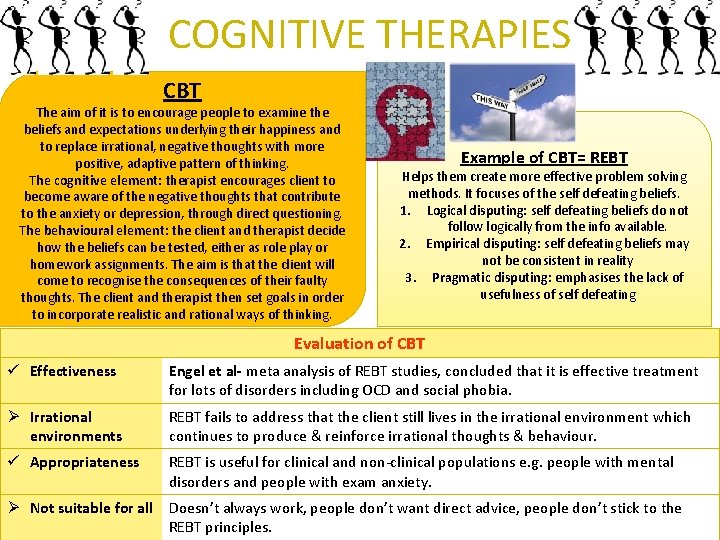
COGNITIVE THERAPIES CBT The aim of it is to encourage people to examine the beliefs and expectations underlying their happiness and to replace irrational, negative thoughts with more positive, adaptive pattern of thinking. The cognitive element: therapist encourages client to become aware of the negative thoughts that contribute to the anxiety or depression, through direct questioning. The behavioural element: the client and therapist decide how the beliefs can be tested, either as role play or homework assignments. The aim is that the client will come to recognise the consequences of their faulty thoughts. The client and therapist then set goals in order to incorporate realistic and rational ways of thinking. Example of CBT= REBT Helps them create more effective problem solving methods. It focuses of the self defeating beliefs. 1. Logical disputing: self defeating beliefs do not follow logically from the info available. 2. Empirical disputing: self defeating beliefs may not be consistent in reality 3. Pragmatic disputing: emphasises the lack of usefulness of self defeating Evaluation of CBT ü Effectiveness Engel et al- meta analysis of REBT studies, concluded that it is effective treatment for lots of disorders including OCD and social phobia. Ø Irrational environments REBT fails to address that the client still lives in the irrational environment which continues to produce & reinforce irrational thoughts & behaviour. ü Appropriateness REBT is useful for clinical and non-clinical populations e. g. people with mental disorders and people with exam anxiety. Ø Not suitable for all Doesn’t always work, people don’t want direct advice, people don’t stick to the REBT principles.