
Deviance The recognized violation of cultural norms Sociology
- Slides: 31
Deviance The recognized violation of cultural norms Sociology, 13 h Edition by John Macionis Copyright © 2010 Pearson Education, Inc. All rights reserved.
Deviance The recognized violation of cultural norms • Norms guide almost all human activities • Most familiar examples are negative instances of rule-breaking. • Especially righteous people also might be called “deviant. ” • “Different” or “unexpected” are often used to describe deviance from a sociological perspective. • Some categories of people are defined as deviant regardless of action or choice • http: //www. youtube. com/watch? v=kgso 3 Y-l 0 h 8 – “Doing Nothing” Sociology, 13 h Edition by John Macionis Copyright © 2010 Pearson Education, Inc. All rights reserved.
Social Control Attempts by society to regulate people’s thoughts and behavior • Informal Social Control – parents; teachers; peers • Formal Social Control - Criminal Justice System: A formal response by police, courts, and prison officials to alleged violations of the law. http: //video. google. com/videoplay? docid=7970234619945159767# Sociology, 13 h Edition by John Macionis Copyright © 2010 Pearson Education, Inc. All rights reserved.
Explanations for Deviance Biological context • Genetic factors together with environmental factors (especially abuse early in life) are strong predictors of adult crime and violence. Personality factors • Deviance is viewed as unsuccessful “socialization. ” • Reckless and Dinitz – Containment Theory Sociology, 13 h Edition by John Macionis Copyright © 2010 Pearson Education, Inc. All rights reserved.
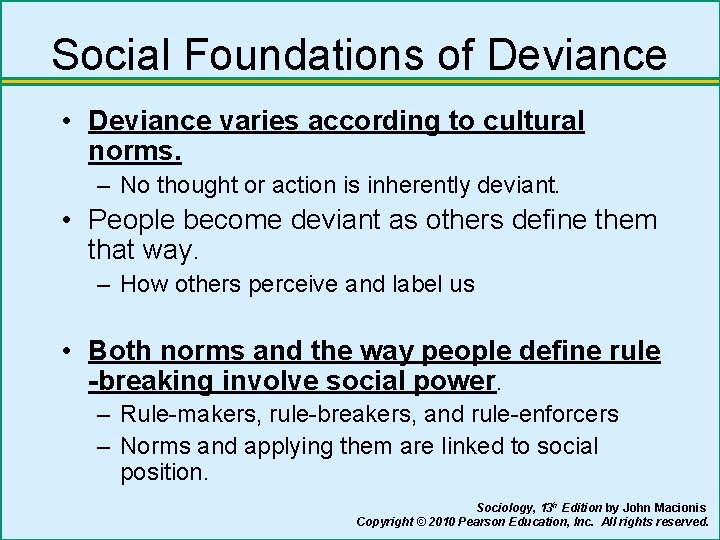
Social Foundations of Deviance • Deviance varies according to cultural norms. – No thought or action is inherently deviant. • People become deviant as others define them that way. – How others perceive and label us • Both norms and the way people define rule -breaking involve social power. – Rule-makers, rule-breakers, and rule-enforcers – Norms and applying them are linked to social position. Sociology, 13 h Edition by John Macionis Copyright © 2010 Pearson Education, Inc. All rights reserved.
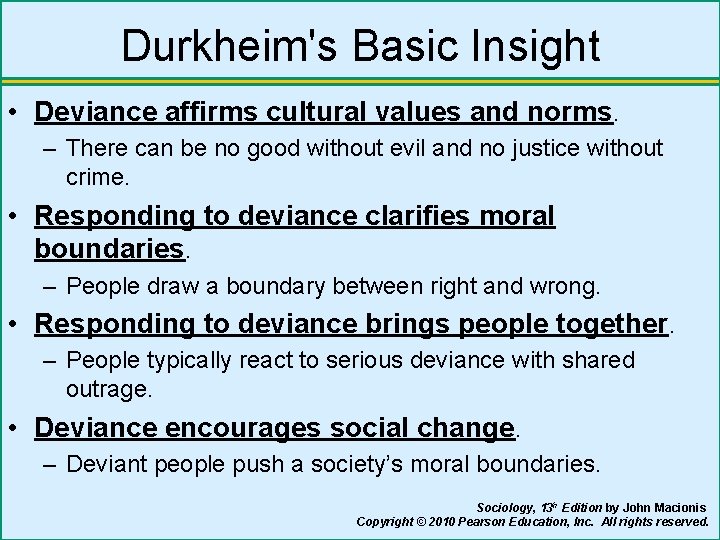
Durkheim's Basic Insight • Deviance affirms cultural values and norms. – There can be no good without evil and no justice without crime. • Responding to deviance clarifies moral boundaries. – People draw a boundary between right and wrong. • Responding to deviance brings people together. – People typically react to serious deviance with shared outrage. • Deviance encourages social change. – Deviant people push a society’s moral boundaries. Sociology, 13 h Edition by John Macionis Copyright © 2010 Pearson Education, Inc. All rights reserved.
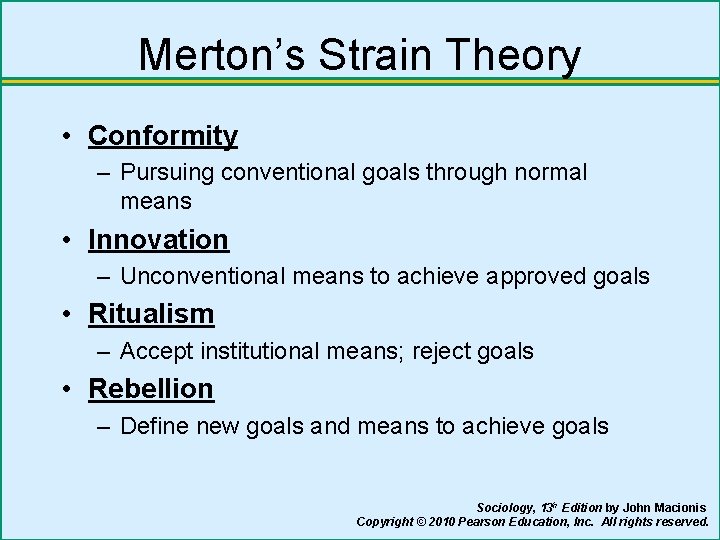
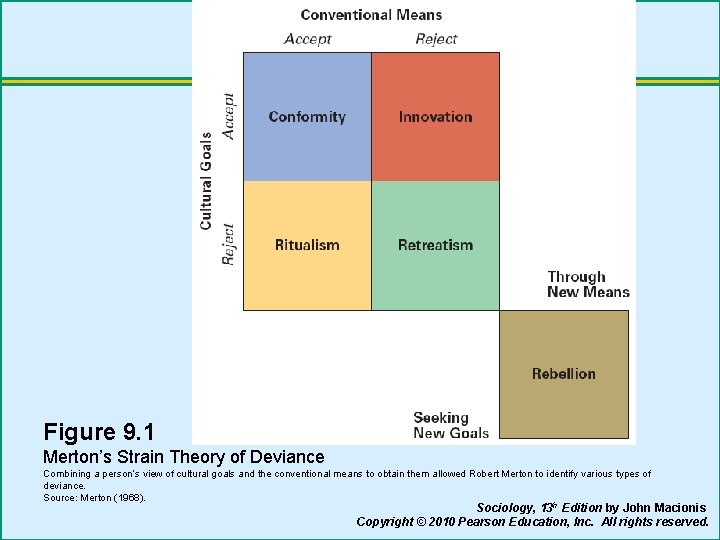
Merton’s Strain Theory • Conformity – Pursuing conventional goals through normal means • Innovation – Unconventional means to achieve approved goals • Ritualism – Accept institutional means; reject goals • Rebellion – Define new goals and means to achieve goals Sociology, 13 h Edition by John Macionis Copyright © 2010 Pearson Education, Inc. All rights reserved.
Figure 9. 1 Merton’s Strain Theory of Deviance Combining a person’s view of cultural goals and the conventional means to obtain them allowed Robert Merton to identify various types of deviance. Source: Merton (1968). Sociology, 13 h Edition by John Macionis Copyright © 2010 Pearson Education, Inc. All rights reserved.
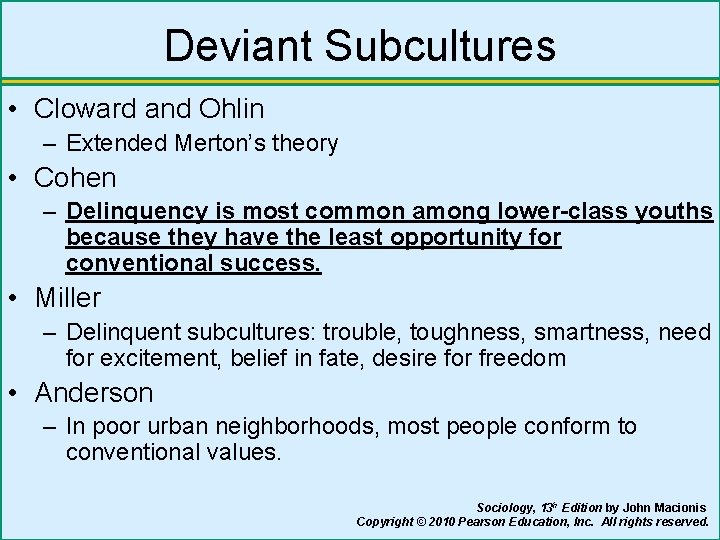
Deviant Subcultures • Cloward and Ohlin – Extended Merton’s theory • Cohen – Delinquency is most common among lower-class youths because they have the least opportunity for conventional success. • Miller – Delinquent subcultures: trouble, toughness, smartness, need for excitement, belief in fate, desire for freedom • Anderson – In poor urban neighborhoods, most people conform to conventional values. Sociology, 13 h Edition by John Macionis Copyright © 2010 Pearson Education, Inc. All rights reserved.
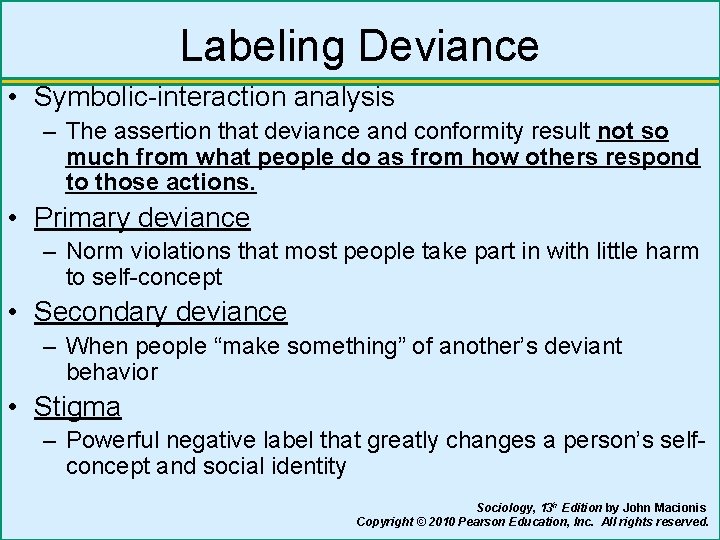
Labeling Deviance • Symbolic-interaction analysis – The assertion that deviance and conformity result not so much from what people do as from how others respond to those actions. • Primary deviance – Norm violations that most people take part in with little harm to self-concept • Secondary deviance – When people “make something” of another’s deviant behavior • Stigma – Powerful negative label that greatly changes a person’s selfconcept and social identity Sociology, 13 h Edition by John Macionis Copyright © 2010 Pearson Education, Inc. All rights reserved.
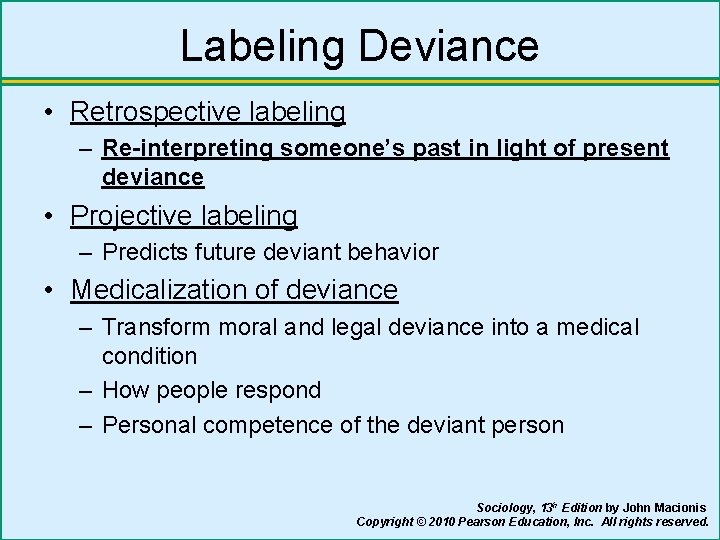
Labeling Deviance • Retrospective labeling – Re-interpreting someone’s past in light of present deviance • Projective labeling – Predicts future deviant behavior • Medicalization of deviance – Transform moral and legal deviance into a medical condition – How people respond – Personal competence of the deviant person Sociology, 13 h Edition by John Macionis Copyright © 2010 Pearson Education, Inc. All rights reserved.
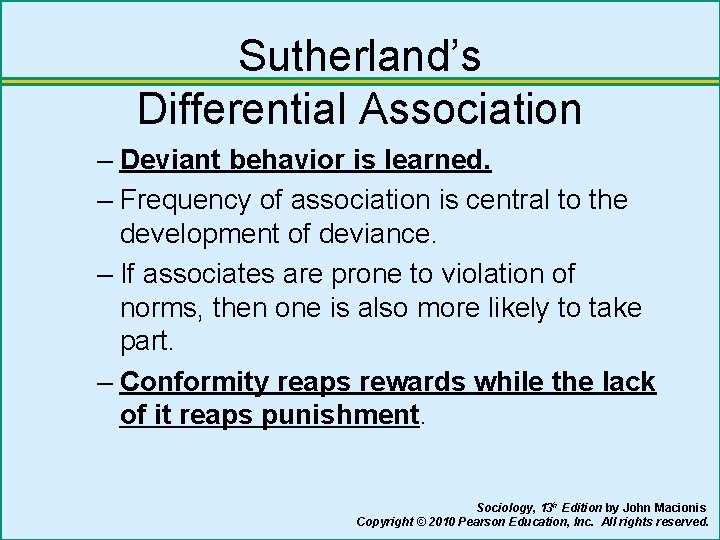
Sutherland’s Differential Association – Deviant behavior is learned. – Frequency of association is central to the development of deviance. – If associates are prone to violation of norms, then one is also more likely to take part. – Conformity reaps rewards while the lack of it reaps punishment. Sociology, 13 h Edition by John Macionis Copyright © 2010 Pearson Education, Inc. All rights reserved.
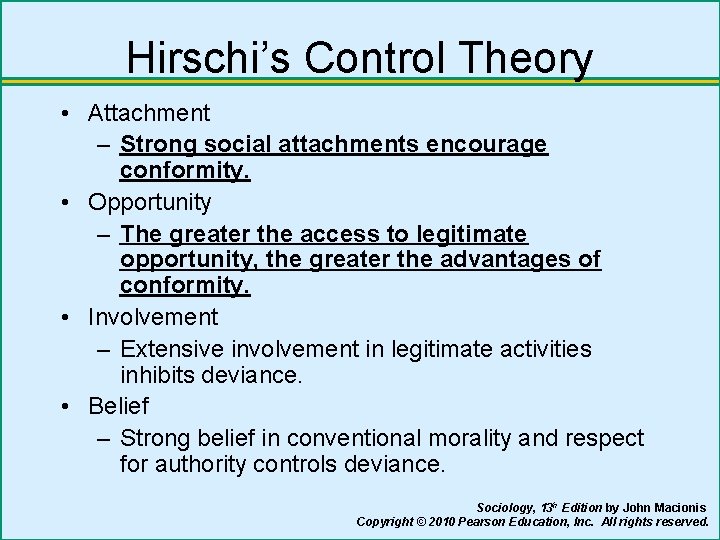
Hirschi’s Control Theory • Attachment – Strong social attachments encourage conformity. • Opportunity – The greater the access to legitimate opportunity, the greater the advantages of conformity. • Involvement – Extensive involvement in legitimate activities inhibits deviance. • Belief – Strong belief in conventional morality and respect for authority controls deviance. Sociology, 13 h Edition by John Macionis Copyright © 2010 Pearson Education, Inc. All rights reserved.
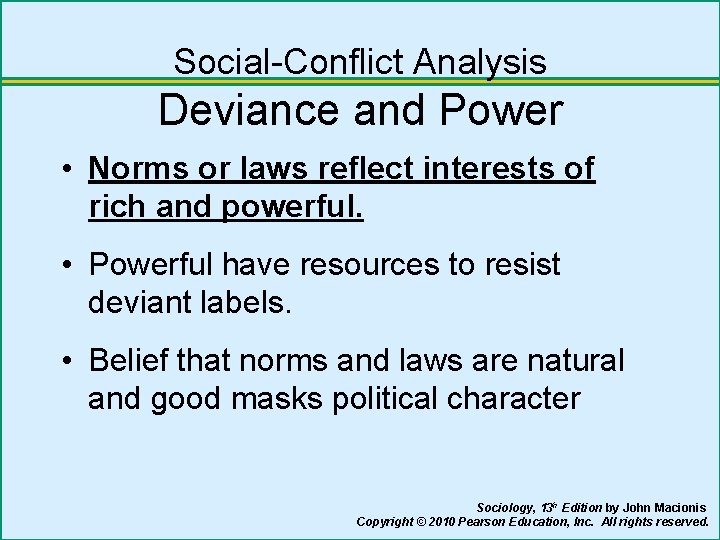
Social-Conflict Analysis Deviance and Power • Norms or laws reflect interests of rich and powerful. • Powerful have resources to resist deviant labels. • Belief that norms and laws are natural and good masks political character Sociology, 13 h Edition by John Macionis Copyright © 2010 Pearson Education, Inc. All rights reserved.
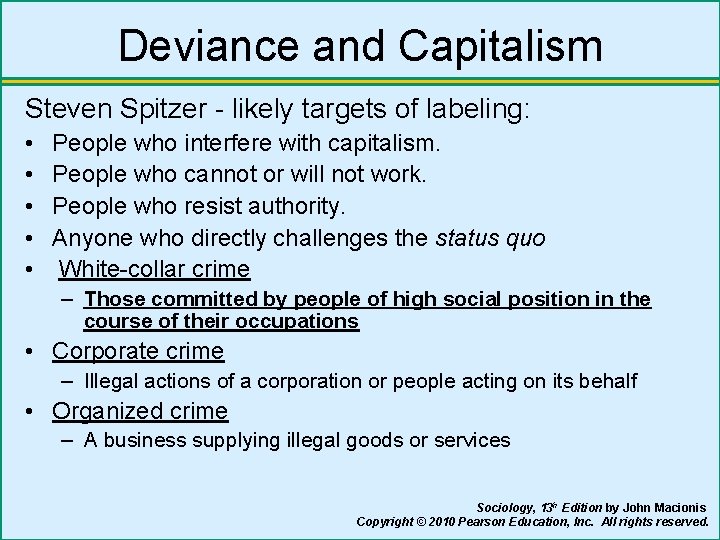
Deviance and Capitalism Steven Spitzer - likely targets of labeling: • • • People who interfere with capitalism. People who cannot or will not work. People who resist authority. Anyone who directly challenges the status quo White-collar crime – Those committed by people of high social position in the course of their occupations • Corporate crime – Illegal actions of a corporation or people acting on its behalf • Organized crime – A business supplying illegal goods or services Sociology, 13 h Edition by John Macionis Copyright © 2010 Pearson Education, Inc. All rights reserved.
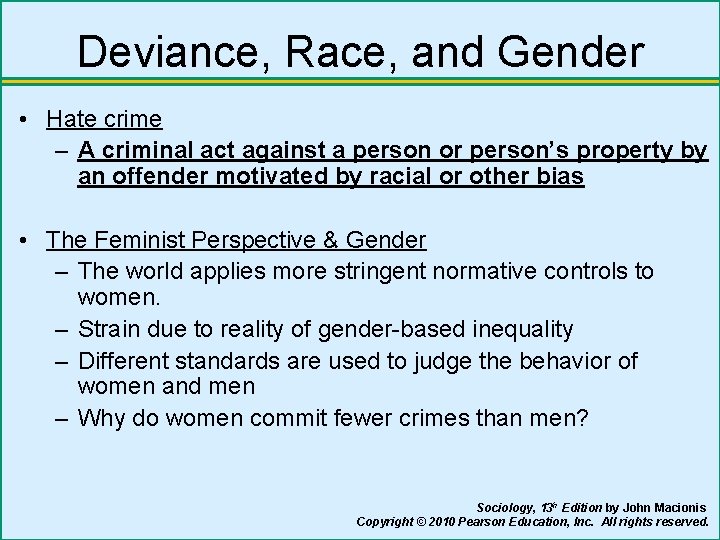
Deviance, Race, and Gender • Hate crime – A criminal act against a person or person’s property by an offender motivated by racial or other bias • The Feminist Perspective & Gender – The world applies more stringent normative controls to women. – Strain due to reality of gender-based inequality – Different standards are used to judge the behavior of women and men – Why do women commit fewer crimes than men? Sociology, 13 h Edition by John Macionis Copyright © 2010 Pearson Education, Inc. All rights reserved.
Applying Theory Deviance Sociology, 13 h Edition by John Macionis Copyright © 2010 Pearson Education, Inc. All rights reserved.
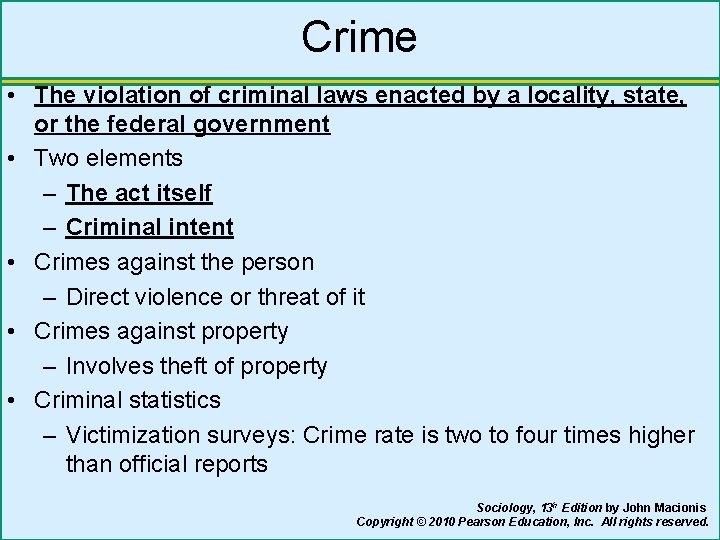
Crime • The violation of criminal laws enacted by a locality, state, or the federal government • Two elements – The act itself – Criminal intent • Crimes against the person – Direct violence or threat of it • Crimes against property – Involves theft of property • Criminal statistics – Victimization surveys: Crime rate is two to four times higher than official reports Sociology, 13 h Edition by John Macionis Copyright © 2010 Pearson Education, Inc. All rights reserved.
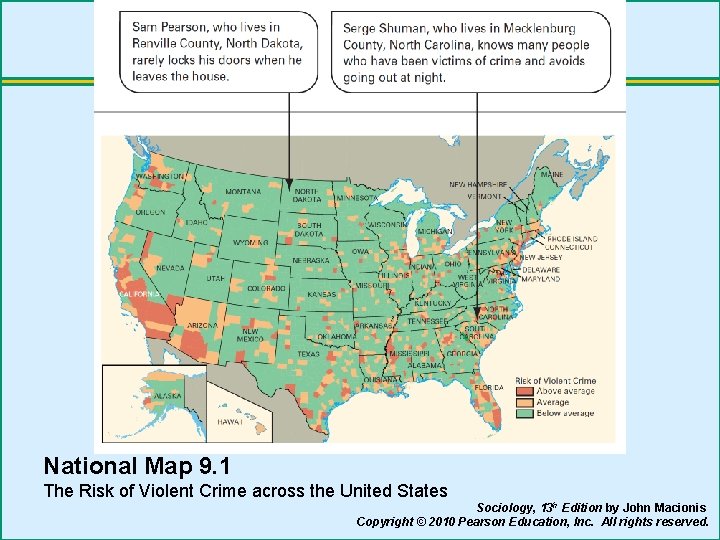
National Map 9. 1 The Risk of Violent Crime across the United States Sociology, 13 h Edition by John Macionis Copyright © 2010 Pearson Education, Inc. All rights reserved.
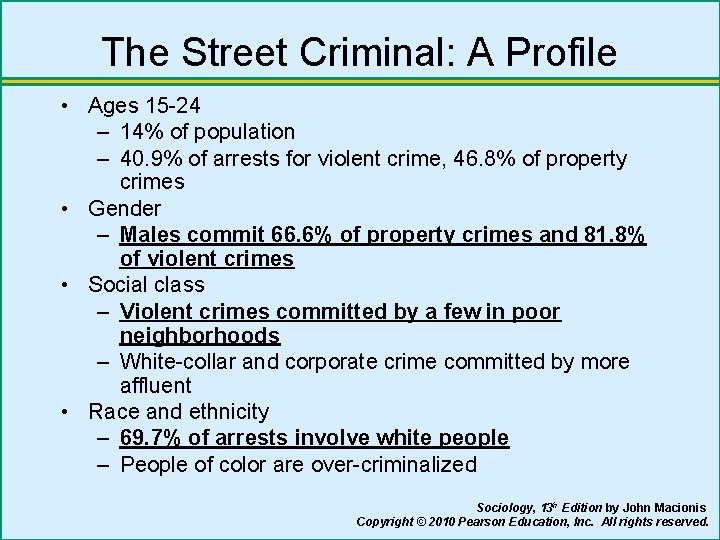
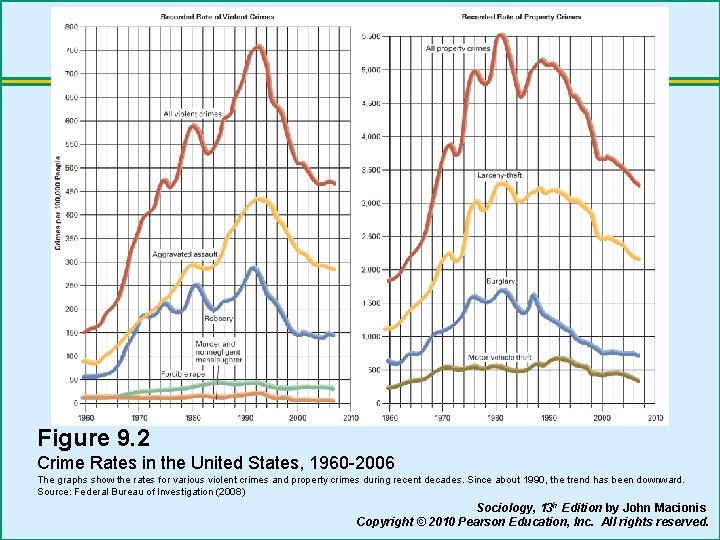
The Street Criminal: A Profile • Ages 15 -24 – 14% of population – 40. 9% of arrests for violent crime, 46. 8% of property crimes • Gender – Males commit 66. 6% of property crimes and 81. 8% of violent crimes • Social class – Violent crimes committed by a few in poor neighborhoods – White-collar and corporate crime committed by more affluent • Race and ethnicity – 69. 7% of arrests involve white people – People of color are over-criminalized Sociology, 13 h Edition by John Macionis Copyright © 2010 Pearson Education, Inc. All rights reserved.
Figure 9. 2 Crime Rates in the United States, 1960 -2006 The graphs show the rates for various violent crimes and property crimes during recent decades. Since about 1990, the trend has been downward. Source: Federal Bureau of Investigation (2008) Sociology, 13 h Edition by John Macionis Copyright © 2010 Pearson Education, Inc. All rights reserved.
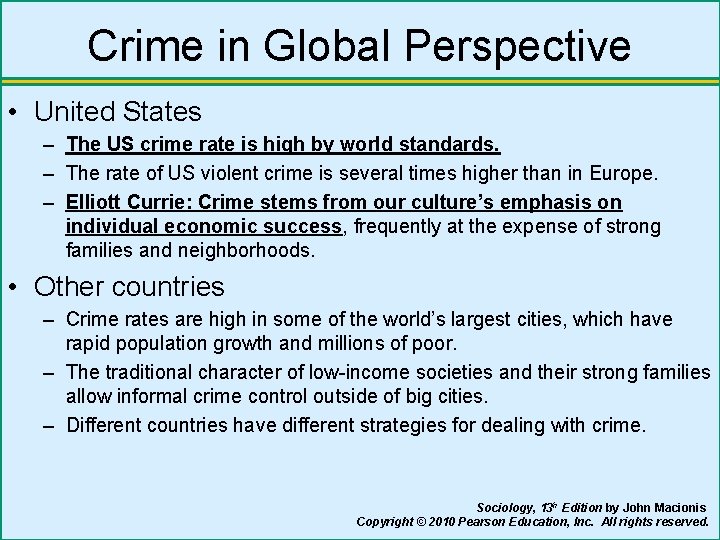
Crime in Global Perspective • United States – The US crime rate is high by world standards. – The rate of US violent crime is several times higher than in Europe. – Elliott Currie: Crime stems from our culture’s emphasis on individual economic success, frequently at the expense of strong families and neighborhoods. • Other countries – Crime rates are high in some of the world’s largest cities, which have rapid population growth and millions of poor. – The traditional character of low-income societies and their strong families allow informal crime control outside of big cities. – Different countries have different strategies for dealing with crime. Sociology, 13 h Edition by John Macionis Copyright © 2010 Pearson Education, Inc. All rights reserved.
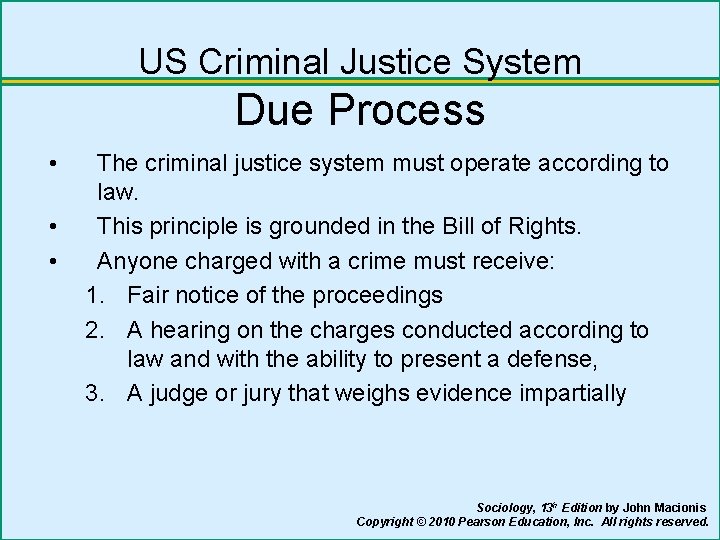
US Criminal Justice System Due Process • • • The criminal justice system must operate according to law. This principle is grounded in the Bill of Rights. Anyone charged with a crime must receive: 1. Fair notice of the proceedings 2. A hearing on the charges conducted according to law and with the ability to present a defense, 3. A judge or jury that weighs evidence impartially Sociology, 13 h Edition by John Macionis Copyright © 2010 Pearson Education, Inc. All rights reserved.
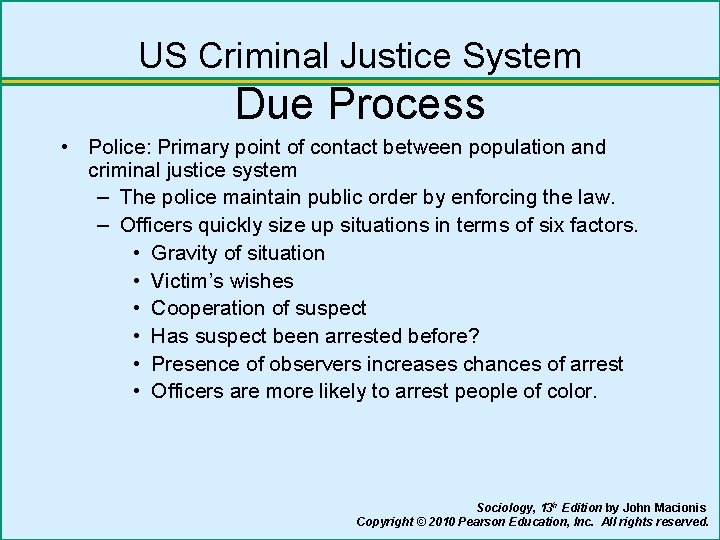
US Criminal Justice System Due Process • Police: Primary point of contact between population and criminal justice system – The police maintain public order by enforcing the law. – Officers quickly size up situations in terms of six factors. • Gravity of situation • Victim’s wishes • Cooperation of suspect • Has suspect been arrested before? • Presence of observers increases chances of arrest • Officers are more likely to arrest people of color. Sociology, 13 h Edition by John Macionis Copyright © 2010 Pearson Education, Inc. All rights reserved.
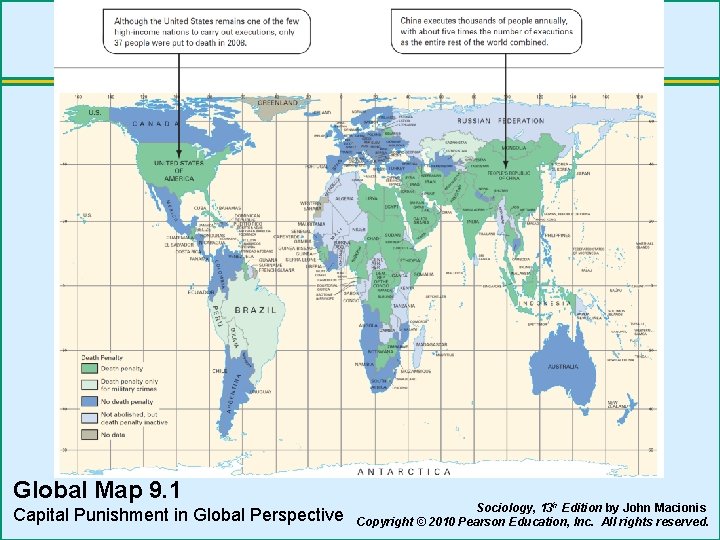
Global Map 9. 1 Capital Punishment in Global Perspective Sociology, 13 h Edition by John Macionis Copyright © 2010 Pearson Education, Inc. All rights reserved.
US Criminal Justice System Courts • Plea bargaining: A legal negotiation in which a prosecutor reduces a charge in exchange for a defendant’s guilty plea. • Widespread because it spares the system the time and expense of trials. • Pressures defendants to plead guilty. • Undercuts both the adversarial process and the rights of defendants Sociology, 13 h Edition by John Macionis Copyright © 2010 Pearson Education, Inc. All rights reserved.
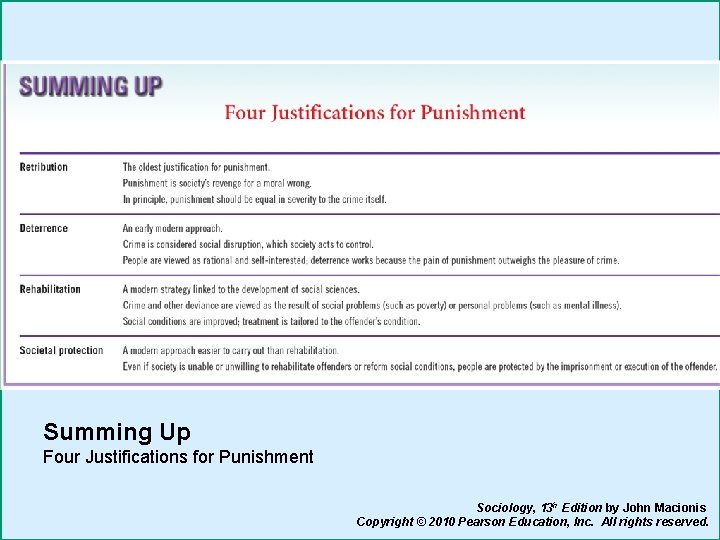
Justifications for Punishment • Retribution – An act of moral vengeance by which society makes the offender suffer as much as the suffering caused by the crime • Deterrence – The attempt to discourage criminality through the use of punishment • Rehabilitation – A program for reforming the offender to prevent later offenses • Societal protection – Rendering an offender incapable of further offenses temporarily through imprisonment or permanently by execution. Sociology, 13 h Edition by John Macionis Copyright © 2010 Pearson Education, Inc. All rights reserved.
Summing Up Four Justifications for Punishment Sociology, 13 h Edition by John Macionis Copyright © 2010 Pearson Education, Inc. All rights reserved.
The Death Penalty • Majority of the population supports the death penalty • Death penalty sentences have declined: 1. Decline in crime rates has resulted in a decreased fear of crime. 2. Fear of wrongful convictions. 3. Increased use of life sentences without parole. 4. High cost of prosecuting capital cases. Sociology, 13 h Edition by John Macionis Copyright © 2010 Pearson Education, Inc. All rights reserved.
Community-Based Corrections Correctional programs operating within society at large rather than behind prison walls. • Probation – A policy permitting a convicted offender to remain in the community under conditions imposed by a court • Shock probation – When a judge orders a convicted offender to prison for a short time, then suspends the remainder of the sentence. • Parole – Releasing inmates from prison to serve the remainder of their sentences in the community. Sociology, 13 h Edition by John Macionis Copyright © 2010 Pearson Education, Inc. All rights reserved.
Violent Crime Is Down • • • Reduction in youth population Changes in policing More prisons Better economy Declining drug trade Sociology, 13 h Edition by John Macionis Copyright © 2010 Pearson Education, Inc. All rights reserved.