
DEVELOPMENTAL SURVEILLANCE AND SCREENING The Help Me Grow



- Slides: 19
DEVELOPMENTAL SURVEILLANCE AND SCREENING The Help Me Grow National Center Standpoint Paul H. Dworkin, MD Executive Vice President for Community Child Health Founding Director, Help Me Grow National Center Connecticut Children’s Medical Center Professor of Pediatrics University of Connecticut School of Medicine Hartford, Connecticut November, 2018 Part of Connecticut Children’s Office for Community Child Health www. helpmegrownational. org
EDUCATIONAL GOALS 1. Define the processes of developmental surveillance and screening and derive implications for early recognition of developmental problems. 2. Describe the context for the use of such specific strategies as parent-completed questionnaires to facilitate early detection 3. Explain the clinical utility of different types of information available from parents. 4. Place the process of early detection within a comprehensive, integrated approach to developmental promotion, early detection, referral and linkage.
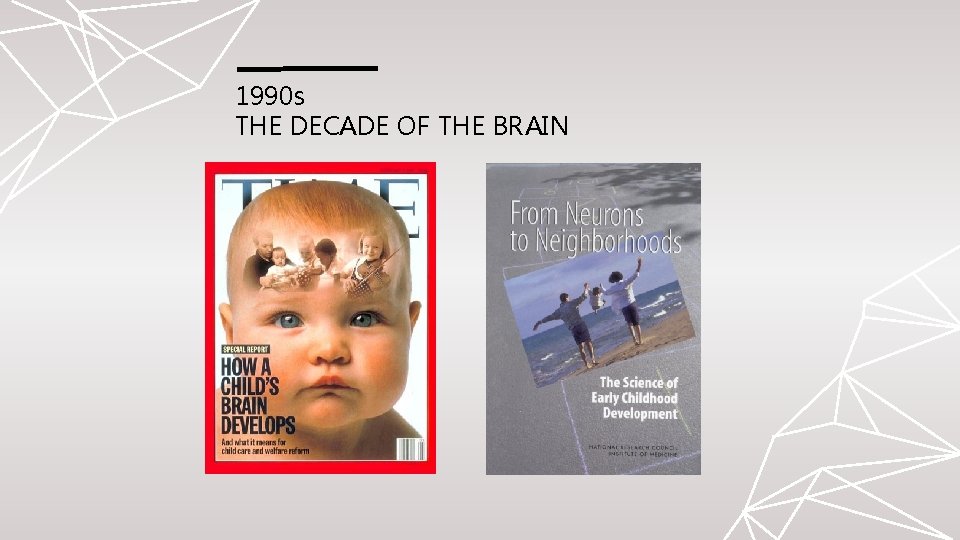
1990 s THE DECADE OF THE BRAIN
DEVELOPMENTAL PROBLEMS RATIONALE FOR EARLY DETECTION • Critical influence of early childhood years • Less-differentiated brain of younger child amenable to intervention • Neural plasticity • Sensitive periods • Sequential development of brain structures • Activity-dependent neural differentiation • Role of experience in brain development • Biology of adversity/toxic stress • ACE Study • “Biological embedding of environmental events”
Criteria for judging conditions appropriate for the screening process • Must have significant morbidity or mortality and be sufficiently prevalent • Screening program must include entire population • Diagnostic tests must distinguish affected from non-affected persons • Condition must treatable or controllable • Detection and treatment during asymptomatic stage much improve prognosis • Adequate resources must be available for definitive diagnosis and treatment • Cost of screening must be outweighed by savings in suffering and alternative expenditures British and American recommendations for developmental monitoring: The role of surveillance. Pediatrics 1989; 84: 1000 -1010.
Criteria by which specific tests are judged appropriate for use in screening programs • Simple, convenient, acceptable • Reliable, valid (sensitive and specific) • Economical • Lend themselves to easy interpretation British and American recommendations for developmental monitoring: The role of surveillance. Pediatrics 1989; 84: 1000 -1010.
DEVELOPMENTAL SURVEILLANCE ELICIT PARENTS’ OPINIONS AND CONCERNS Information available from parents Appraisals (opinions of children’s development) • Concerns • Estimations • Predictions Descriptions • Recall • Report
DEVELOPMENTAL SURVEILLANCE PARENTS’ APPRIASALS CONCERNS Accurate indicators of true problems • Speech and language • Fine motor • General functioning (“he’s just slow”) Self-help skills, behavior less sensitive “Please tell me any concerns about the way your child is behaving, learning, and developing” • “Any concerns about how she…”
DEVELOPMENTAL SURVEILLANCE PARENTS’ APPRAISALS ESTIMATIONS • “Compared with other children, how old would you say your child now acts? ” • Correlate well with developmental quotients • Cognitive, motor, self-help, academic skills • Less accurate for language abilities PREDICTIONS • Likely to overestimate future function • If delayed, predict average functioning • If average, “presidential syndrome”
DEVELOPMENTAL SURVEILLANCE PARENTS’ DESCRIPTIONS RECALL OF DEVELOPMENTAL MILESTONES • Notoriously unreliable • Reflect prior conceptions of children’s development • Accuracy improved by records, diaries • Even if accurate, age of achievement of limited predictive value
DEVELOPMENTAL SURVEILLANCE PARENTS’ DESCRIPTIONS REPORT • Accurate contemporaneous descriptions of current skills and achievements • Importance of format of questions • Recognition: words…” • Identification: • “Does your child use any of the following “What words does your child say? ” Produces higher estimates than assessment • • Child within a familiar environment Skills inconsistently demonstrated
EARLY DETECTION DEVELOPMENTAL SURVEILLANCE AND SCREENING DEFINITION OF SURVEILLANCE � Flexible, longitudinal, continuous process � Knowledgeable practitioners perform skilled observations during child health encounters COMPONENTS OF SURVEILLANCE: � Eliciting/attending to parents’ concerns � Obtaining a relevant developmental history � Making accurate observations of children � Identifying risk and resiliency factors � Maintaining record of process and findings � [Sharing opinions with other professionals] View child within context of overall well-being AAP Policy Statement, July 2006
EARLY DETECTION DEVELOPMENTAL SURVEILLANCE AND SCREENING USE OF SCREENING TOOLS AT PERIODIC INTERVALS TO STRENGTHEN SURVEILLANCE TYPES • Parent-completed questionnaires • Professionally-administered “tests” FREQUENCY • 9, 18, 24 -30 months • When concerns arise • (“second-stage”) AAP Policy Statement, July 2006
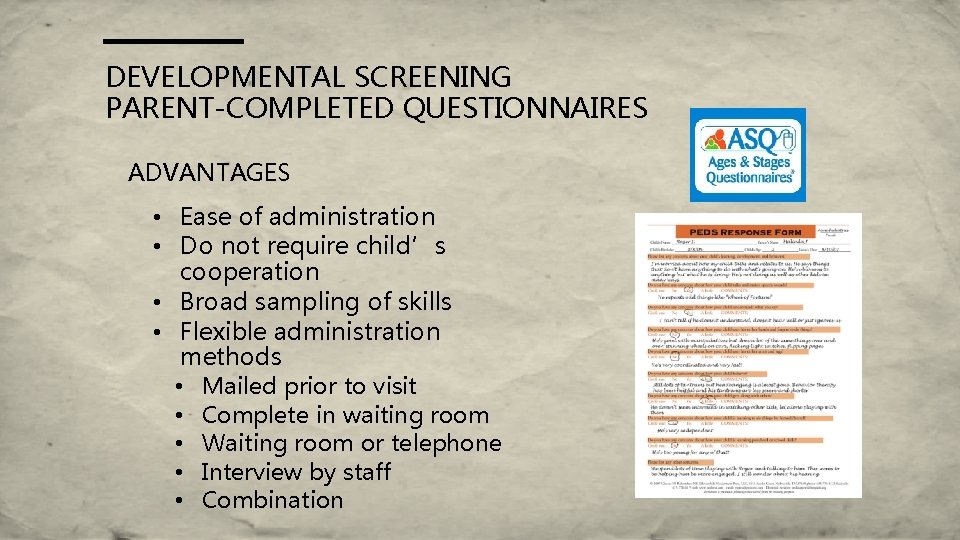
DEVELOPMENTAL SCREENING PARENT-COMPLETED QUESTIONNAIRES ADVANTAGES • Ease of administration • Do not require child’s cooperation • Broad sampling of skills • Flexible administration methods • Mailed prior to visit • Complete in waiting room • Waiting room or telephone • Interview by staff • Combination
DEVELOPMENTAL SURVEILLANCE AND SCREENING CONCLUSIONS • Expert opinion and research evidence support developmental surveillance as “optimal” clinical practice for monitoring children’s development • Effectiveness is enhanced by incorporating valid measures of parents’ appraisals and descriptions (i. e. , parent questionnaires) and/or objective measures of children’s development (i. e. , professionally-administered tools) o Surveillance and screening o Screening at 9 -, 18 -, and 24 -30 month visits Arch Pediatr Adolesc Med 2001; 155: 1311 -1322
DEVELOPMENTAL SURVEILLANCE AND SCREENING CONCLUSIONS CAVEAT Detection without referral/intervention is ineffective and may be judged unethical Perrin E. Ethical questions about screening. J Dev Behav Pediatr 1998; 19: 350 -352
SHARED ASSUMPTIONS Children with developmental/behavioral problems are eluding early detection Many initiatives exist to provide services to young children, their families A gap exists between child health and child development/early childhood education programs Children and their families would benefit from a coordinated, region-wide system of early detection, intervention for children at developmental risk
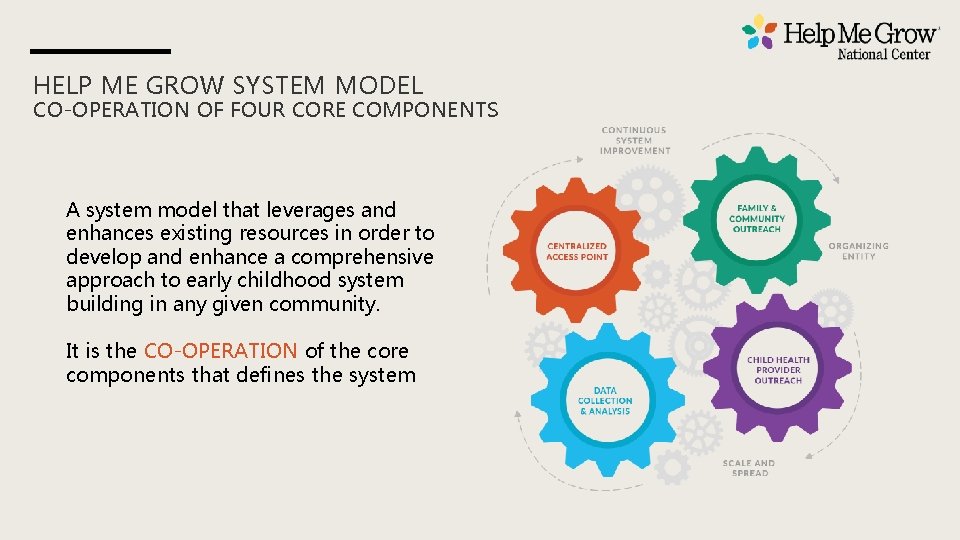
HELP ME GROW SYSTEM MODEL CO-OPERATION OF FOUR CORE COMPONENTS A system model that leverages and enhances existing resources in order to develop and enhance a comprehensive approach to early childhood system building in any given community. It is the CO-OPERATION of the core components that defines the system
Thank You