
Developmental Psychology The Nature of Adolescence G Stanley




- Slides: 47
Developmental Psychology
The Nature of Adolescence ► G. Stanley Hall (1904): adolescence is a time of “storm and stress” § More recent research has found that this is not necessarily true § Most adolescents successfully negotiate their path from childhood to adulthood § Negative stereotypes of adolescence are common but are not always accurate
Understanding Adolescence ► Transition from childhood to adulthood § 10 -12 to around 18 -21 years of age ►E. g. , ► Balance teenagers positive and negative aspects ► Marked by the search for identity ► Roughly 75% are happy, enjoy life, believe they can cope effectively with stress, and value school and work
Adolescence ► Adolescence is a transitional period with continuity and discontinuity with childhood § It is not just a time of rebellion, crisis, pathology, and deviance § More accurately, it is a time of evaluation, decision-making, commitment, finding a place in the world ► Genetic, biological, environmental, and social factors interact in adolescence § Relationships with parents take a different form
Today’s Adolescent ► Adolescents are exposed to complex options through the media § Face temptations of drug use and sexual activity § Too many adolescents are not provided with adequate opportunities and support to become competent adults ► Ethnic, cultural, gender, socioeconomic, age, and lifestyle differences influence the actual life trajectory of every adolescent
Puberty ► Puberty is not the same thing as adolescence § It is the most important marker of the beginning of adolescence § Puberty ends before adolescence does ► Puberty: Period of rapid physical maturation involving hormonal and bodily changes § Puberty is not a single, sudden event § The most noticeable changes are signs of sexual maturation and increases in height/weight
Puberty ► Puberty: Period of rapid physical maturation involving hormonal and bodily changes § Menarche is a girl’s first menstruation § Pubic hair growth § Facial and chest hair growth in males § Voice changes in both males and females § Breast growth in females, hips widening § Sexual maturity § Marked weight and height gains
Puberty ► Order of Male Changes § Increase in penis and testicle size § Appearance of pubic hair § Minor voice change § First ejaculation § Onset of maximum growth in height/weight § Hair in armpits § More detectable voice changes § Growth of facial hair ► Order of Female Change § § § § Breasts enlarge Pubic hair appears Hair appears in armpits Height increases and hips become wider Menarche Voice changes (not comparable to males) By end, breasts become more fully rounded
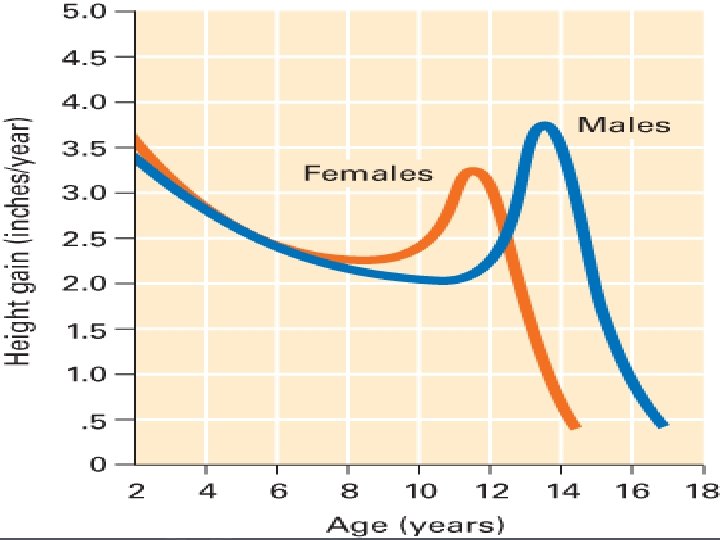
Puberty ► Weight, Height and the Growth Spurt § Girls tend to outweigh boys early in adolescence § At beginning of adolescence, girls tend to be as tall as, or taller than boys of their age § Mean age at the beginning of the growth spurt is 9 for girls, and 11 for boys ►Girls grow ~3. 5 inches/year ►Boys grow ~4. 0 inches/year
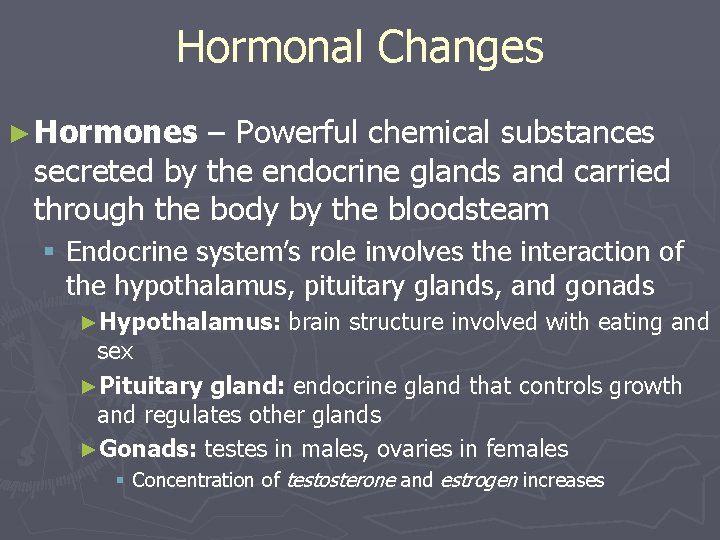
Hormonal Changes ► Hormones – Powerful chemical substances secreted by the endocrine glands and carried through the body by the bloodsteam § Endocrine system’s role involves the interaction of the hypothalamus, pituitary glands, and gonads ►Hypothalamus: brain structure involved with eating and sex ►Pituitary gland: endocrine gland that controls growth and regulates other glands ►Gonads: testes in males, ovaries in females § Concentration of testosterone and estrogen increases
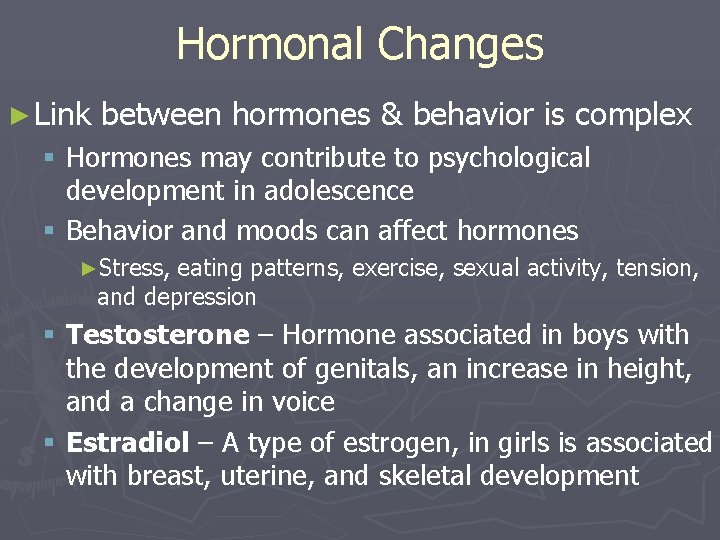
Hormonal Changes ► Link between hormones & behavior is complex § Hormones may contribute to psychological development in adolescence § Behavior and moods can affect hormones ►Stress, eating patterns, exercise, sexual activity, tension, and depression § Testosterone – Hormone associated in boys with the development of genitals, an increase in height, and a change in voice § Estradiol – A type of estrogen, in girls is associated with breast, uterine, and skeletal development
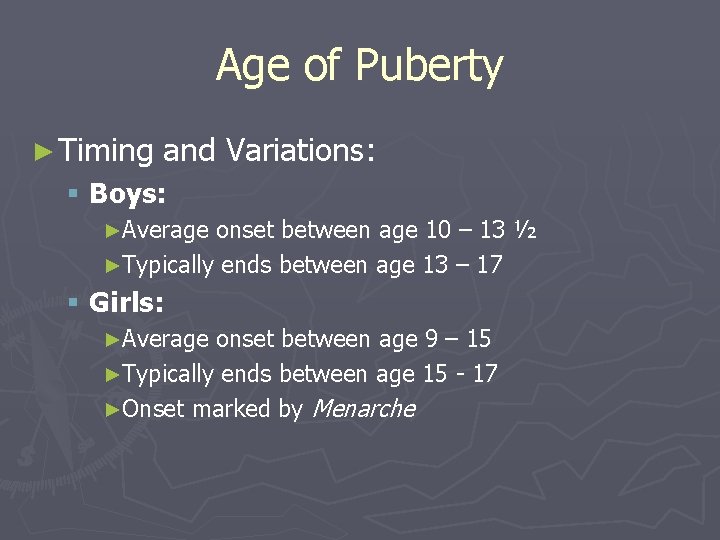
Age of Puberty ► Timing and Variations: § Boys: ►Average onset between age 10 – 13 ½ ►Typically ends between age 13 – 17 § Girls: ►Average onset between age 9 – 15 ►Typically ends between age 15 - 17 ►Onset marked by Menarche
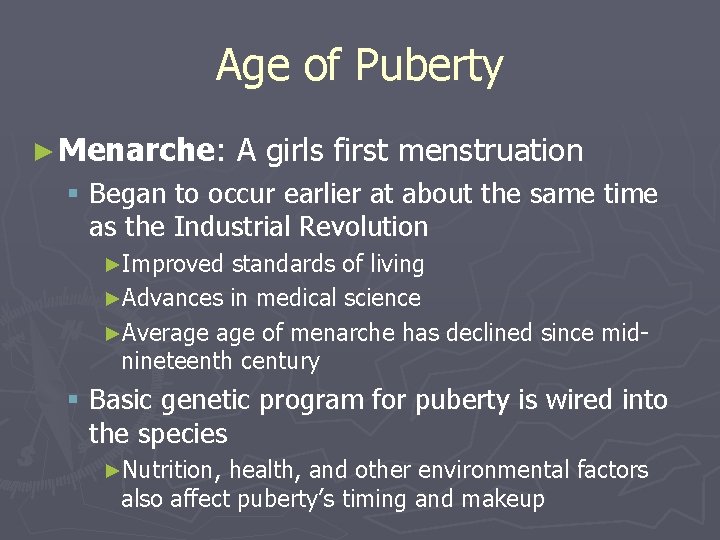
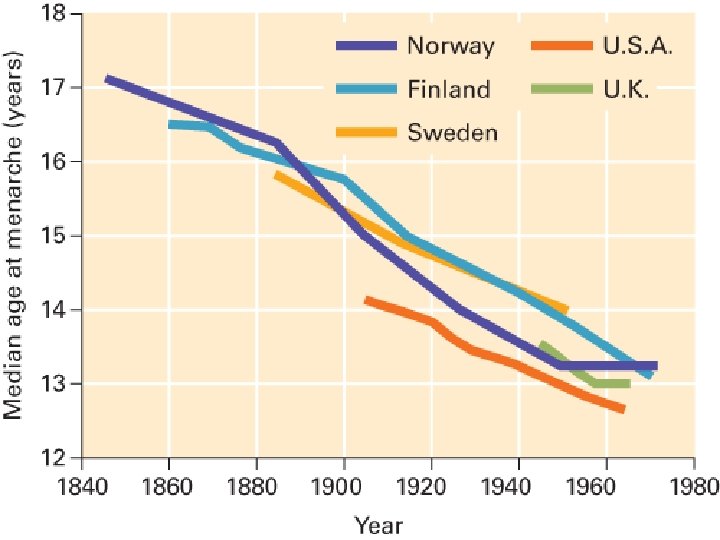
Age of Puberty ► Menarche: A girls first menstruation § Began to occur earlier at about the same time as the Industrial Revolution ►Improved standards of living ►Advances in medical science ►Average of menarche has declined since midnineteenth century § Basic genetic program for puberty is wired into the species ►Nutrition, health, and other environmental factors also affect puberty’s timing and makeup
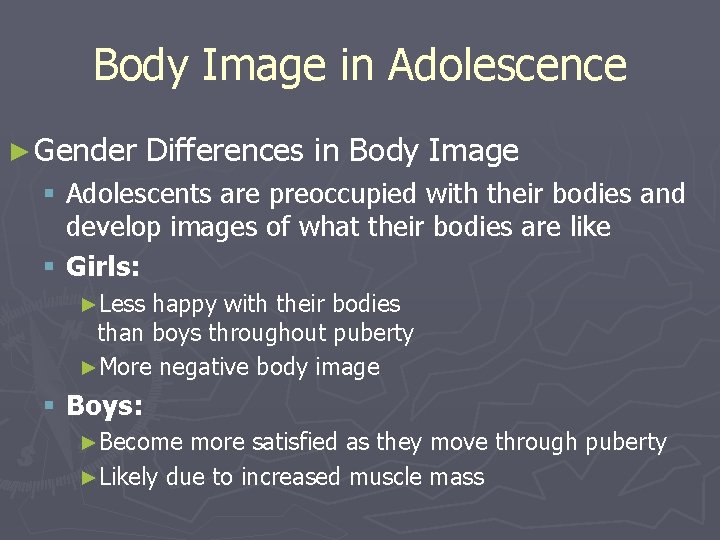
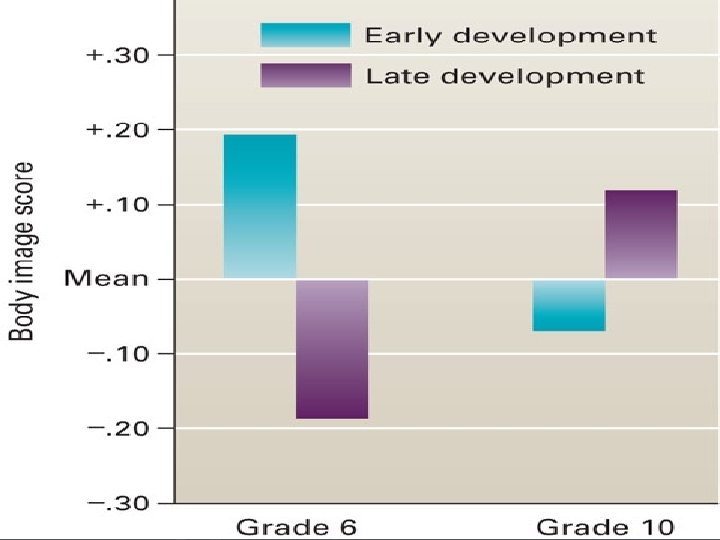
Body Image in Adolescence ► Gender Differences in Body Image § Adolescents are preoccupied with their bodies and develop images of what their bodies are like § Girls: ►Less happy with their bodies than boys throughout puberty ►More negative body image § Boys: ►Become more satisfied as they move through puberty ►Likely due to increased muscle mass
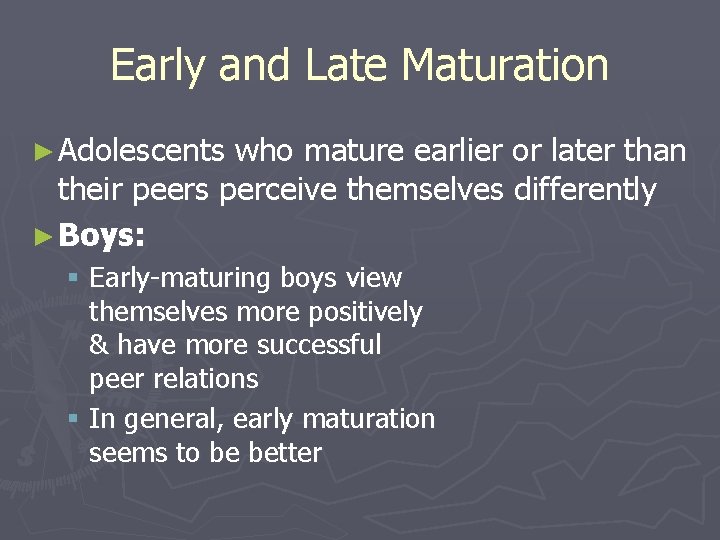
Early and Late Maturation ► Adolescents who mature earlier or later than their peers perceive themselves differently ► Boys: § Early-maturing boys view themselves more positively & have more successful peer relations § In general, early maturation seems to be better
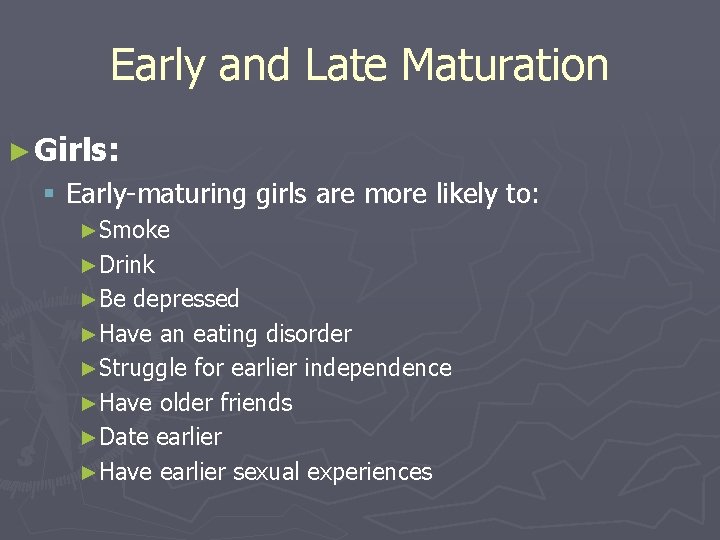
Early and Late Maturation ► Girls: § Early-maturing girls are more likely to: ►Smoke ►Drink ►Be depressed ►Have an eating disorder ►Struggle for earlier independence ►Have older friends ►Date earlier ►Have earlier sexual experiences
Puberty Girls
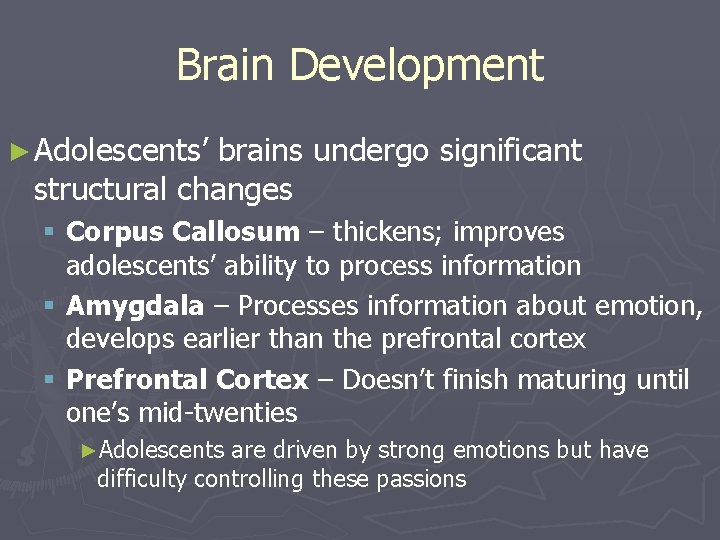
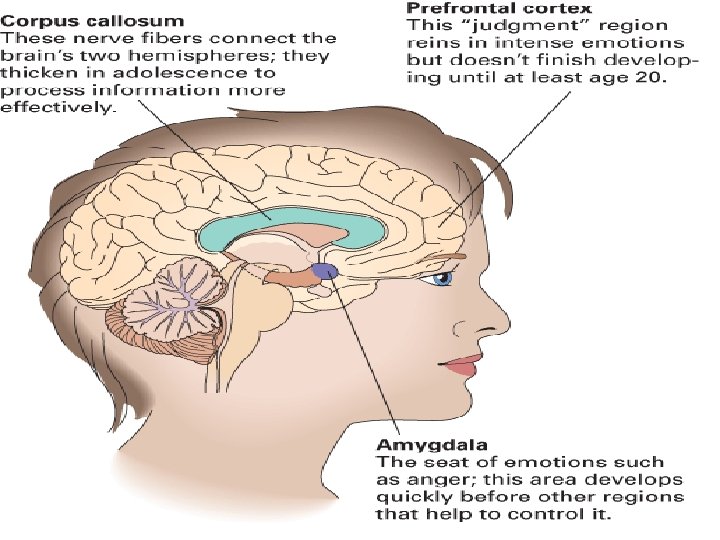
Brain Development ► Adolescents’ brains undergo significant structural changes § Corpus Callosum – thickens; improves adolescents’ ability to process information § Amygdala – Processes information about emotion, develops earlier than the prefrontal cortex § Prefrontal Cortex – Doesn’t finish maturing until one’s mid-twenties ►Adolescents are driven by strong emotions but have difficulty controlling these passions
Adolescent Sexuality ► Adolescent sexuality is a time of exploration, experimentation, sexual fantasies, and incorporating sexuality into one’s identity ► Every society gives some attention to adolescent sexuality § In some societies, adults clamp down and protect adolescent females from males § Other societies promote very early marriage while others allow some sexual experimentation
Adolescent Sexuality ► North American attitudes are restrictive § Media contradicts family messages ►Abstinence Programs ►Highly sexualized images § More liberal over past 40 years ►Most say premarital sex is ok for committed partners
Sexually Transmitted Infections ► Sexually Transmitted Infections (STI’s) § Infections contacted primarily through sexual contact, including oral-genital and anal-genital contact ►Annually more than 3 million American adolescents will contract an STI ►About ¼ of those who are sexually active will contract an STI
Sexually Transmitted Infections ► Adolescents highest rate of STIs § Among sexually active teens, 1 in 6 will contract an STI § Higher rates in United States ► Education improving § 60% of middle school, 90% of high school understand basics of AIDS ►Unsure of how to protect themselves § Misunderstanding of oral sex
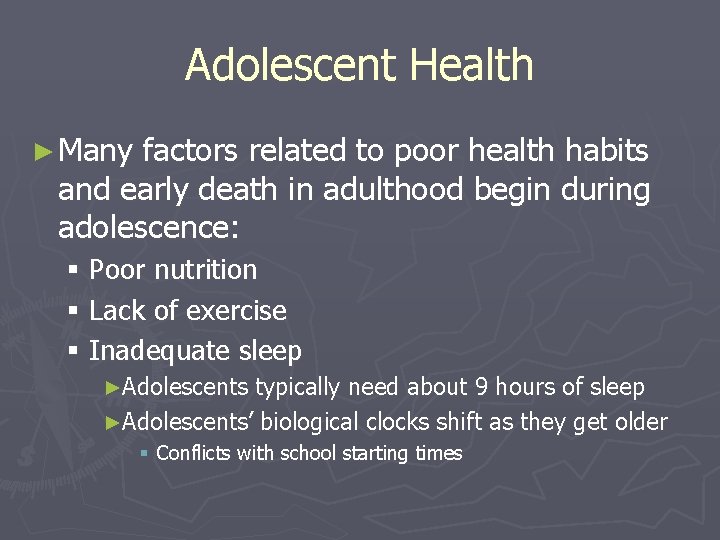
Adolescent Health ► Many factors related to poor health habits and early death in adulthood begin during adolescence: § Poor nutrition § Lack of exercise § Inadequate sleep ►Adolescents typically need about 9 hours of sleep ►Adolescents’ biological clocks shift as they get older § Conflicts with school starting times
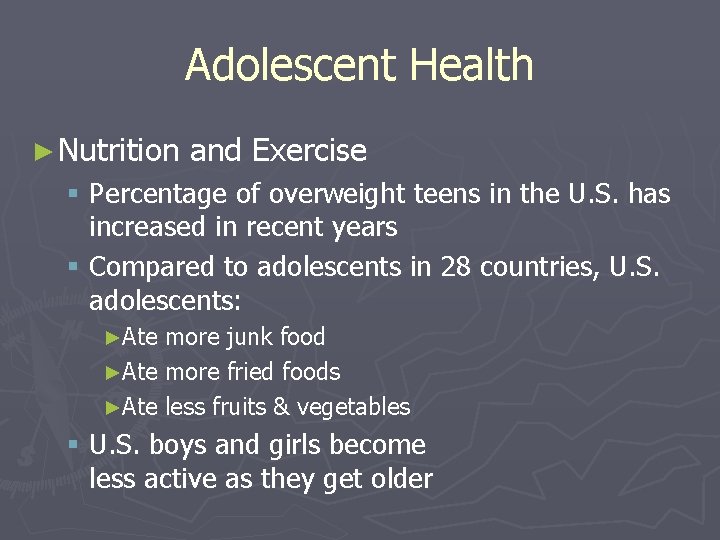
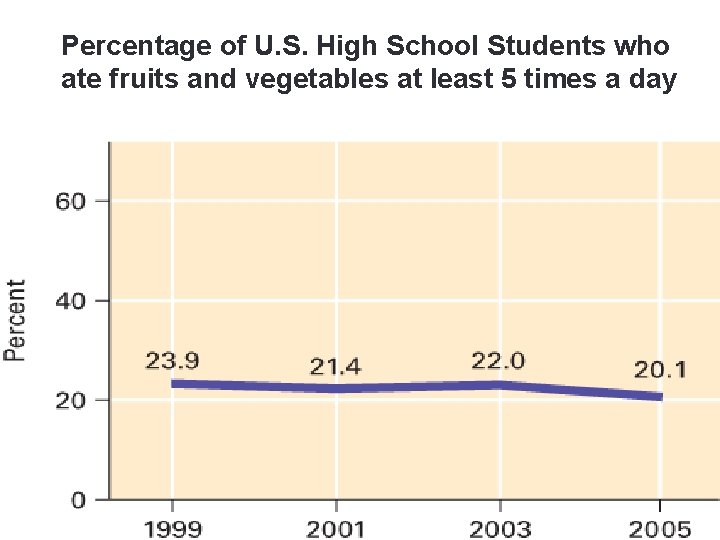
Adolescent Health ► Nutrition and Exercise § Percentage of overweight teens in the U. S. has increased in recent years § Compared to adolescents in 28 countries, U. S. adolescents: ►Ate more junk food ►Ate more fried foods ►Ate less fruits & vegetables § U. S. boys and girls become less active as they get older
Percentage of U. S. High School Students who ate fruits and vegetables at least 5 times a day
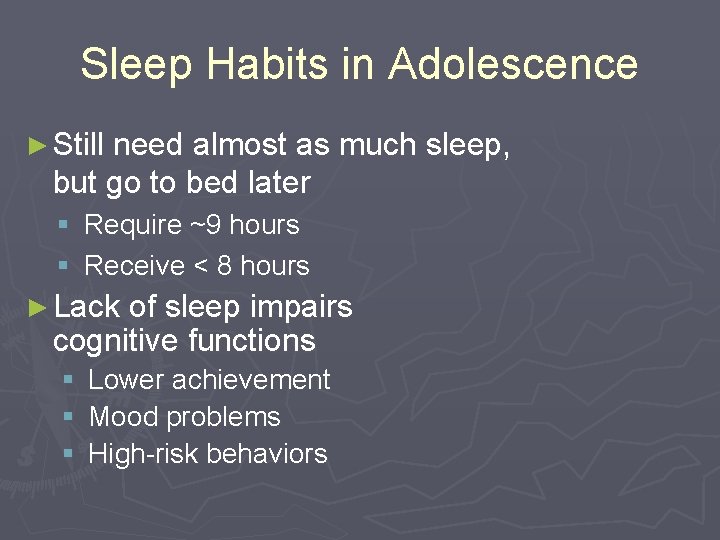
Sleep Habits in Adolescence ► Still need almost as much sleep, but go to bed later § Require ~9 hours § Receive < 8 hours ► Lack of sleep impairs cognitive functions § § § Lower achievement Mood problems High-risk behaviors
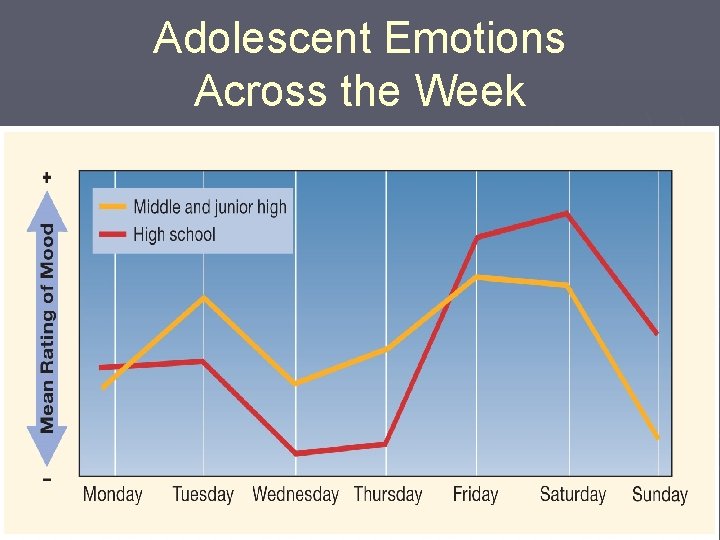
Adolescent Emotions Across the Week
Death in Adolescence ► Leading causes of death in adolescence: § Accidents ►More than half of all deaths for ages 10 to 19 are due to accidents § Most involve motor vehicles § Homicide § Suicide ►Adolescent suicide rate has tripled since the 1950’s
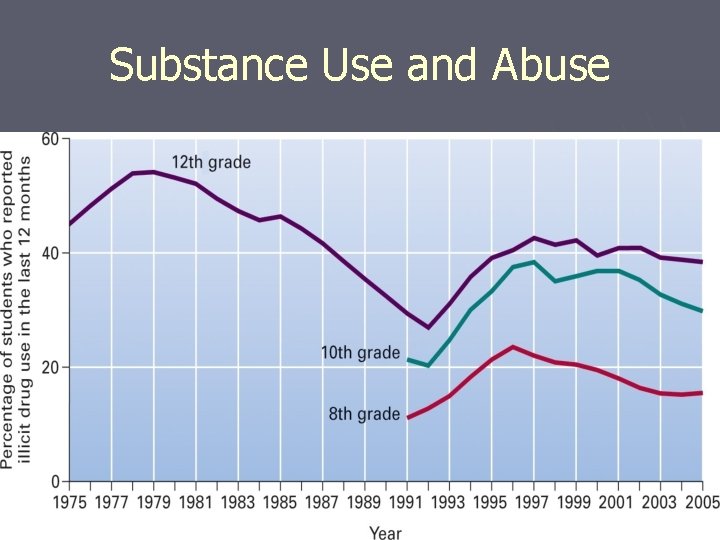
Substance Use and Abuse ► Proportions of U. S. students who used any illicit drug declined in the late 1990 s and first years of the 21 st century ► Sizeable declines in alcohol use have occurred in recent years § Binge drinking – having 5 or more drinks in a row in the last 2 weeks
Substance Use and Abuse ► United States has one of the highest rates of adolescent drug use of any industrialized nation § Alcohol and cigarette consumption has declined in recent years § Use of painkillers (Vicodin, Oxycontin) is increasing § Parents, peers, and social support can play important roles in preventing adolescent drug abuse
Substance Use and Abuse
Eating Problems and Disorders ► Research findings about eating disorders center around these variables: § Body Image § Parenting § Sexual Activity § Role Models and the Media ►Commercials with idealized thin female images increased adolescent girls’ dissatisfaction with their own bodies
Anorexia Nervosa ► Anorexia Nervosa – Eating disorder that involves the relentless pursuit of thinness § Three main characteristics of anorexia are: ►(1) Weighing less than 85% of what is considered normal for a person’s age/height ►(2) Having an intense fear of gaining weight ►(3) Having a distorted image of one’s body shape
Bulimia Nervosa ► Bulimia Nervosa – Eating disorder in which the individual consistently follows a binge-and -purge pattern § Typically, bulimics go on an eating binge and then purge by self-inducing vomiting, laxatives, or other methods § Bulimics are preoccupied with food § Have a strong fear of becoming overweight § Often depressed or anxious
Anorexia vs. Bulimia ► Two critical features distinguish these disorders § (1) Body Image ►Those with Anorexia have a very distorted perception of their body size ►People with Bulimia have an accurate body perception, but still worry about gaining weight § (2) Amount of Weight Lost ►People with Anorexia weigh significantly less than normal for height/build (85% or less) ►People with Bulimia have weight that is either average or above-average
Cognitive Development ► Piaget’s Formal Operational Thought (11+) § Fourth and final stage begins in adolescence § Formal operational thought is more abstract § Increased verbal problem-solving ability § Increased tendency to think about thought itself § Full of idealism and possibilities § Develop systematic, scientific thinking § More logical thought
Formal Operational Thought ► Hypothetical-Deductive Reasoning: § Creating a hypothesis and deducing its implications § Pendulum problem ► Propositional Thought: § Evaluating the logic of verbal propositions ►True, False or Uncertain ►“Either the chip in my hand is green or it is not green” ►“The chip in my hand is green and it is not green”
Formal Operational Thought ► Follow-up research on formal operations: § Children show aspects of abstract thinking ►Basic hypothetical-deductive reasoning ►Problems with propositional thinking § Formal operations may not be universal ►Training, context contribute to development ►Often fall back on easier thinking ►Schooling an essential factor
Information Processing ► Executive Functioning § Involves higher-order cognitive activities such as reasoning, decision-making, thinking critically, monitoring ones cognitive progress § Improvements in executive functioning permit: ►More effective learning ►Making decisions ►Engaging in critical thinking
Information-Processing Improvements in Adolescence ü ü ü ü Attention Inhibition Memory strategies Knowledge Metacognition Cognitive self-regulation Processing capacity Speed of thinking
Adolescent Egocentrism ► Adolescent Egocentrism – heightened self-consciousness of adolescents § Imaginary Audience: Adolescent’s belief that others are as interested in them as they themselves are § Personal Fable: Involves a sense of uniqueness and invincibility ►“No one understands me, particularly my parents. They have no idea of what I am feeling. ”
Adolescent Egocentrism ► Adolescents often show a sense of invincibility or invulnerability § This can lead to risky behaviors such as: ►Smoking cigarettes ►Drinking alcohol ►Drag racing ►Unprotected sex ►“Are you kidding? I won’t get pregnant!” ►“I’m a good driver, I won’t get into an accident!”
School Issues ► Top-Dog Phenomenon – § Moving from being the oldest, biggest, and most powerful… § …to being the youngest, smallest, and least powerful students ►Consequence ► U. S. of moving from middle to high school High school dropout rates have declined
School Transitions in Adolescence ► Grades decline with each transition § Higher standards § Less supportive teaching– learning environment ► Lower self-esteem § More with 6 – 3 organization than 8 – 4 § Girls more than boys