
Developmental Psychology Studies the way a childs behaviour
Developmental Psychology Studies the way a child’s behaviour changes as the child develops or grows into adulthood.
Developmental psychology has two major goals: To describe the behaviour of children at each stage of their development. 1. • • • Examples: Age the baby first starts to talk How a child of about 4 years old determines right from wrong How a fetus develops in the womb To identify the causes and processes that produce changes in behaviour from one stage to the next. 2. • • Examples: Studying the effects that the environment has on a child’s ability to learn Studying genetics and the effect they have on intelligence
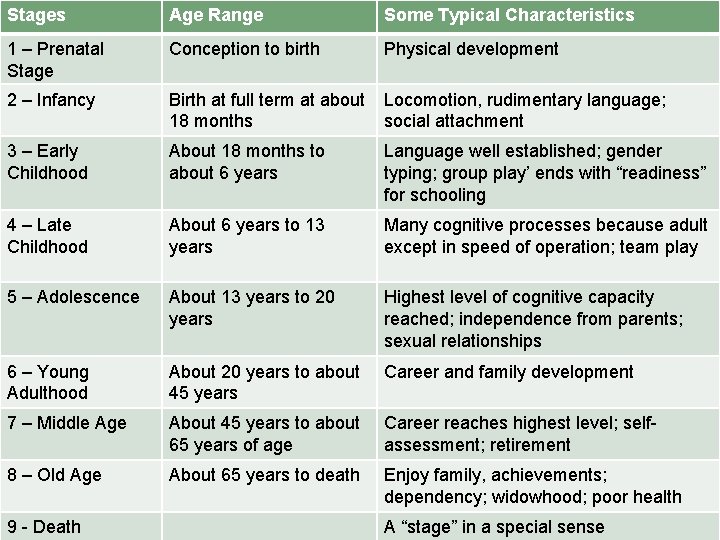
Stages in Life �On the following chart you will see the nine different stages of life �We will focus on the first 5 because humans tend to go through their most extensive changes during these stages. �Development during childhood is important because at certain critical periods of time, certain skills must be acquired or they will never appear – this appears in humans as well as animals
Stages Age Range Some Typical Characteristics 1 – Prenatal Stage Conception to birth Physical development 2 – Infancy Birth at full term at about 18 months Locomotion, rudimentary language; social attachment 3 – Early Childhood About 18 months to about 6 years Language well established; gender typing; group play’ ends with “readiness” for schooling 4 – Late Childhood About 6 years to 13 years Many cognitive processes because adult except in speed of operation; team play 5 – Adolescence About 13 years to 20 years Highest level of cognitive capacity reached; independence from parents; sexual relationships 6 – Young Adulthood About 20 years to about 45 years Career and family development 7 – Middle Age About 45 years to about 65 years of age Career reaches highest level; selfassessment; retirement 8 – Old Age About 65 years to death Enjoy family, achievements; dependency; widowhood; poor health 9 - Death A “stage” in a special sense
Extreme Cases �In extreme cases of child abuse where children were isolated and confined in small spaces during certain critical periods were never able to fully develop motor skills like walking or language skills like talking in complete sentences �The Wild Child Genie and Victor of the Jungle
Types of Developmental Research 1. 2. 3. Descriptive Research – monitoring a child’s development and recording observations Correlational Research - discovering relationships that exist between two variables (example: a baby wakes crying in the middle of the night is correlated to needed his diaper changed) Scientific Research – is based on the scientific method
Different Design Studies � Normative Studies – designed to determine averages or norms, creating timelines for when children tend to develop certain behaviours like walk or talk � Historical Studies – studies the differences between different generations, must rely on previously collected data � Longitudinal Studies – studies the same people at different ages (example: change of behaviour over time) Problem with this?
� Cross-sectional Studies – used to test subjects from different age groups simultaneously � Twin Studies – used to determine the effects the environment has on behaviour. Identical twins who were separated at birth (adoption) are later tested for behaviour differences, twin studies are excellent for studying the genetic factors that influence abnormal behaviours
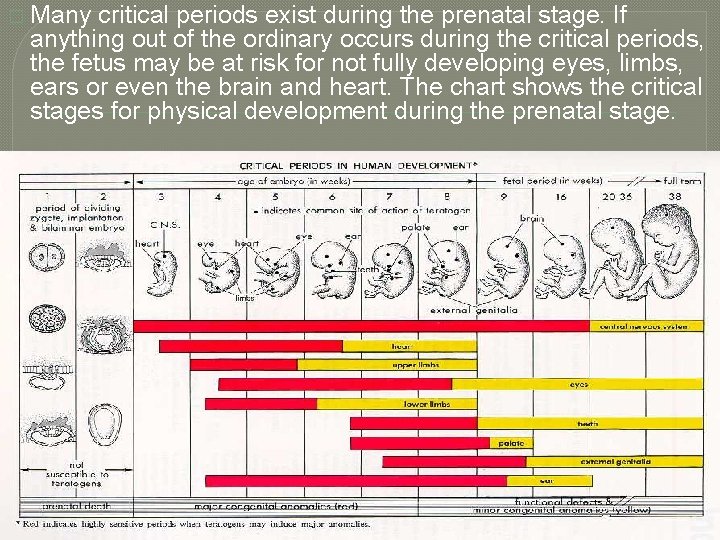
� Many critical periods exist during the prenatal stage. If anything out of the ordinary occurs during the critical periods, the fetus may be at risk for not fully developing eyes, limbs, ears or even the brain and heart. The chart shows the critical stages for physical development during the prenatal stage.
Teratogens � Anything that may harm a fetus when exposed to the mother, illegal and legal drugs, the mother’s health and age, and harmful chemicals in the environment � Examples: aspirin – in large quantities, abortion, bleeding, newborn respiratory problems, cocaine and crack – growth retardation, premature birth, irritableness in newborns, withdrawal symptoms, alcohol use – brain and hearing damage, growth retardation, mental retardation, fetal alcohol syndrome, herpes – mental retardation, eye damage, deafness, heart defects, radiation – leukemia, abnormal brain and body growth, cancer, genetic alterations, miscarriage, stillbirth
Senses of Newborns � Newborns are sensitive to pain and touch but these senses are not fully developed. Sensitivity to pain and touch increases rapidly just days after birth. Babies to not tend to recognize a familiar object by touch alone until approximately one year of age. This improves with age and experience. The senses of smell and taste also improve within a few days after birth. Babies are able to distinguish familiar smells a week after birth. Within two hours after birth, babies are able to distinguish between sweet, sour, bitter and salty tastes. Fetuses tend to respond to sound by 28 weeks, but newborns do not have fully developed hearing, this develops until the age of 10 when it peaks. After the age of 10 hearing slowly worsens. Vision also improves with age and is quite poor at birth. The baby can see, but everything is very blurry. Vision slowly improves and equals that of adults by the age of one year.
Newborn Testing �Apgar Exam – method of assessing a newborn’s overall health in five difference categories: heart rate; breathing; muscle tone and response to painful stimuli. These are rated on a scale from zero to two. Zero is the least optimal score and two represents the most optimal score. An extremely healthy baby would get a rating of 10.
� Prechtl Test – measures some of the same factors as the Apgar, but it also assesses a baby’s facial expressions (it is up to the doctor to determine the relevance of certain facial expressions), alertness, reflexes, muscle tone, spontaneous movement and reaction to being placed in various positions � Brazelton Scale – is the most comprehensive of the three tests, is assesses babies in four categories: attention and social responsiveness; muscle tone and physical movement; control of alertness; and physiological response to stress • Assesses baby’s ability to remain alert and become accustomed to repeated stimulation. This is good for babies that may be at risk for developmental delays later in life.
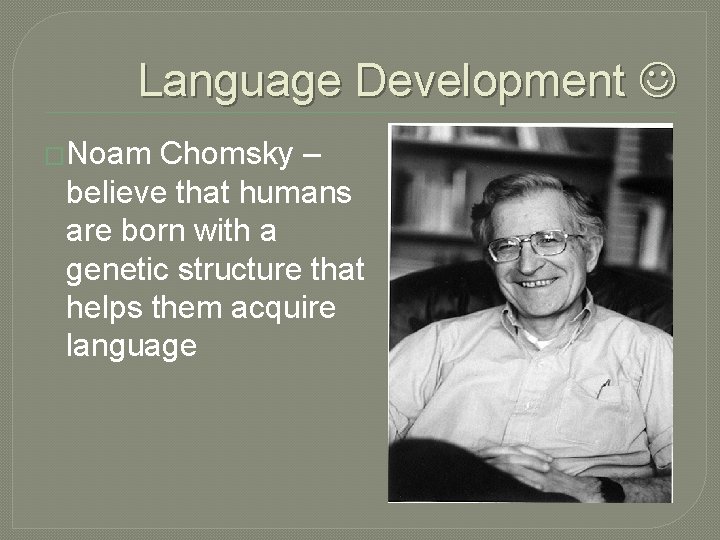
Language Development �Noam Chomsky – believe that humans are born with a genetic structure that helps them acquire language
Cognitive Language Model �A theory that states children learn language by grouping new words into categories that reflect what they know about the world (Example: categorizing mom, dad, baby, dog)
Heuristics �Are general rules people follow in social situations �Examples: stopping at a red light, shaking someone's hand when they offer it, saying thank you when given something
Feedback �The information a person is given regarding his/her behaviour, understanding the rules �Supports learning theory of language acquisition where a child acquires the proper use of language by being praised for appropriate use and being corrected for misuse.
Stereotypes � Are schemas that narrowly and negatively attempt to define a group of people (Example: being blonde) � We seem most willing to believe a stereotype that is about a group of people that are seemingly different from themselves � Negative effects – appearance of being uninformed, preventing themselves from really getting to know someone, unfair prejudice, selffulfilling prophecies (when someone believes a stereotype about him/herself and behaves in a manner to fulfill that stereotype)
- Slides: 18