
Developmental Milestones Birth to 8 years SOURCE The
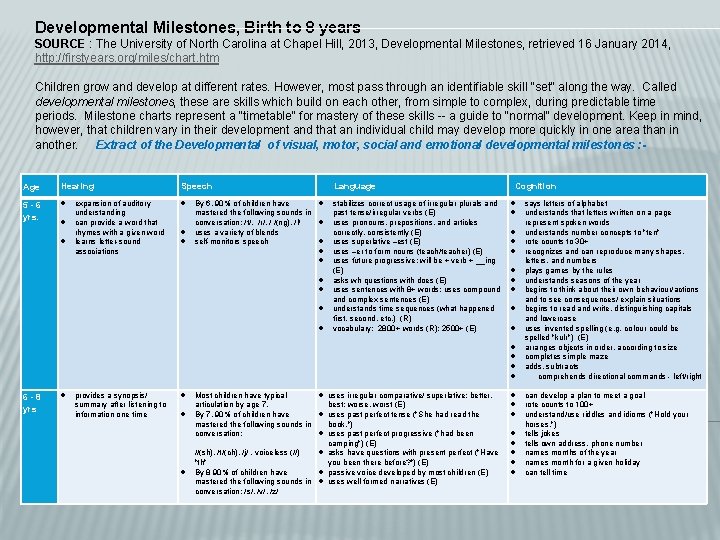
Developmental Milestones, Birth to 8 years SOURCE : The University of North Carolina at Chapel Hill, 2013, Developmental Milestones, retrieved 16 January 2014, http: //firstyears. org/miles/chart. htm Children grow and develop at different rates. However, most pass through an identifiable skill "set" along the way. Called developmental milestones, these are skills which build on each other, from simple to complex, during predictable time periods. Milestone charts represent a "timetable" for mastery of these skills -- a guide to "normal" development. Keep in mind, however, that children vary in their development and that an individual child may develop more quickly in one area than in another. Extract of the Developmental of visual, motor, social and emotional developmental milestones : - Age Hearing Speech 5 -6 yrs. expansion of auditory understanding can provide a word that rhymes with a given word learns letter-sound associations By 6, 90% of children have mastered the following sounds in conversation: /t/, /r/, / /(ng), /l/ uses a variety of blends self-monitors speech Language stabilizes correct usage of irregular plurals and past tense/irregular verbs (E) uses pronouns, prepositions, and articles correctly, consistently (E) uses superlative –est (E) uses –er to form nouns (teach/teacher) (E) uses future progressive: will be + verb + __ing (E) asks wh questions with does (E) uses sentences with 8+ words; uses compound and complex sentences (E) understands time sequences (what happened first, second, etc. ) (R) vocabulary: 2800+ words (R); 2500+ (E) Cognition 6 -8 yrs. provides a synopsis/ summary after listening to information one time Most children have typical articulation by age 7. By 7, 90% of children have mastered the following sounds in conversation: //(sh), /t/(ch), /j/ , voiceless (//) "th" By 8 90% of children have mastered the following sounds in conversation: /s/, /v/, /z/ uses irregular comparative/ superlative: better, best: worse, worst (E) uses past perfect tense ("She had read the book. ") uses past perfect progressive ("had been camping") (E) asks have questions with present perfect ("Have you been there before? ") (E) passive voice developed by most children (E) uses well formed narratives (E) says letters of alphabet understands that letters written on a page represent spoken words understands number concepts to "ten" rote counts to 30+ recognizes and can reproduce many shapes, letters, and numbers plays games by the rules understands seasons of the year begins to think about their own behaviour/actions and to see consequences/ explain situations begins to read and write, distinguishing capitals and lowercase uses invented spelling (e. g. colour could be spelled "kulr") (E) arranges objects in order, according to size completes simple maze adds, subtracts comprehends directional commands - left/right can develop a plan to meet a goal rote counts to 100+ understand/use riddles and idioms ("Hold your horses. ") tells jokes tells own address, phone number names months of the year names month for a given holiday can tell time
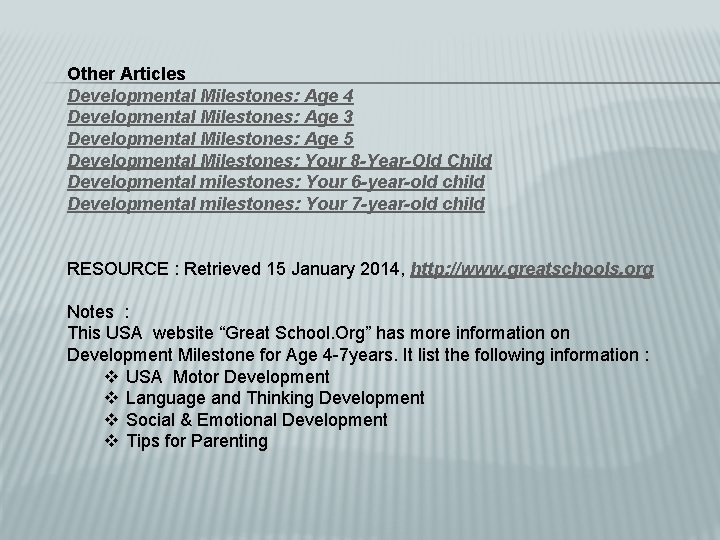
Other Articles Developmental Milestones: Age 4 Developmental Milestones: Age 3 Developmental Milestones: Age 5 Developmental Milestones: Your 8 -Year-Old Child Developmental milestones: Your 6 -year-old child Developmental milestones: Your 7 -year-old child RESOURCE : Retrieved 15 January 2014, http: //www. greatschools. org Notes : This USA website “Great School. Org” has more information on Development Milestone for Age 4 -7 years. It list the following information : v USA Motor Development v Language and Thinking Development v Social & Emotional Development v Tips for Parenting
- Slides: 2