
DEVELOPMENTAL DISABILITIES LIFE SUPPORT Introduction The EMS providers
DEVELOPMENTAL DISABILITIES LIFE SUPPORT
Introduction The EMS providers Understanding of Developmental Disabilities
Objectives… 1. Identify Common Developmental Disabilities 2. Develop an understanding of characteristics specific to each developmental disability. 3. Identify True and False statements specific to each developmental disability. 4. Recognize perception differences. 5. Identify approach and assessment of the developmentally disabled individual. 6. Never disregard what the patient tells you. 7. Identify assistive devises 8. Recognize needs of caregiver as well as patient
The Typical EMS Response… • A hypoglycemic who is acting out because of decreased sugar to the brain. • A young person who dove into a quarry and cannot move their legs. • A woman who has had difficulty becoming pregnant and is now in her third trimester bleeding heavily. • An elderly man with chest pain. • A child with a small laceration on his toe. • The frequent flyer who always has chest pain and is “cured” with a cup of fresh coffee in the ER.
The Typical EMS Patient… • • • Most are easy to approach They recognize the uniform They know why you are there Can accept some level of comfort Generally they can respond to your questions They have some information about past medical history.
A Different Kind of Call… What’s going through your mind? Your are called to the scene of a school bus accident with injuries. As you are getting into your gear, you are mentally preparing for a bus load of frightened kids, some injured, some hysterical. Any trauma call involving children is difficult but you know what to do and feel confident in your abilities.
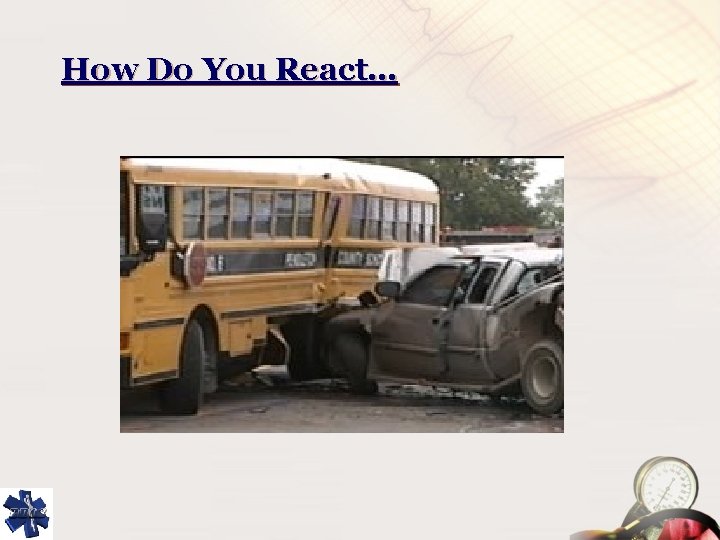
How Do You React…
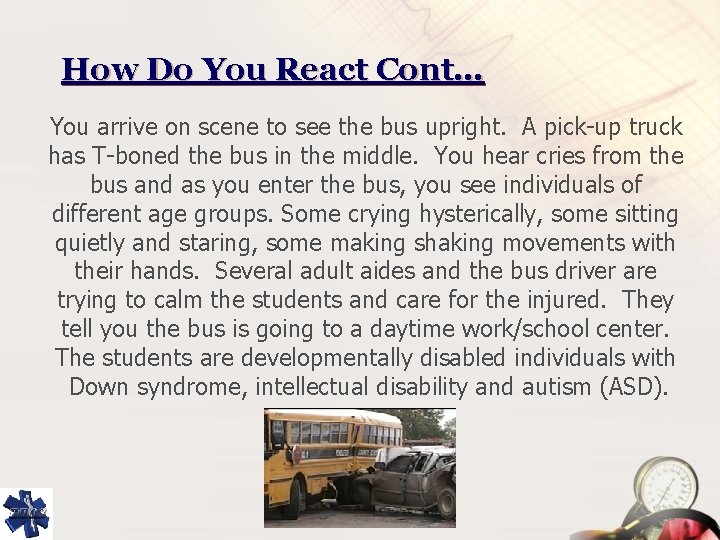
How Do You React Cont… You arrive on scene to see the bus upright. A pick-up truck has T-boned the bus in the middle. You hear cries from the bus and as you enter the bus, you see individuals of different age groups. Some crying hysterically, some sitting quietly and staring, some making shaking movements with their hands. Several adult aides and the bus driver are trying to calm the students and care for the injured. They tell you the bus is going to a daytime work/school center. The students are developmentally disabled individuals with Down syndrome, intellectual disability and autism (ASD).
– Since you’ve dealt with chaos before, you begin by going to the first patient and implementing a triage system. The response is withdrawal, hands batting at you, and no answers to your question; " Do you hurt anywhere? ”. – Two firefighters enter the bus in turnout gear and there is an obvious fright reaction by some students. – You have managed to triage several students, but upon attempting to assist them from the wreckage they begin frantically fighting to stay on the bus.
– Eventually the injured are cared for, the bus is empty, transport of the injured to the hospital is complete and your team are back at the station. Questions abound. – What was wrong with those people? – Wasn’t that the hardest call we’ve ever had? – Did you see how a couple of the patients didn’t want to get off the bus? What was that all about?
EMS Considerations… • Have you ever taken care of a developmentally disabled person? • What were your thoughts? • Did you adjust your approach to the patient? • Were there family members or other caregivers involved? • How was your interaction with them?
Developmental Disability. A severe, chronic disability of an individual 5 years of age or older that: 1. Is attributable to a mental or physical impairment or combination of mental and physical impairments; 2. Is manifested before the individual attains age 22; 3. Is likely to continue indefinitely; 4. Results in substantial functional limitations in three or more of the following areas of major life activity; (i) (iii) (iv) (vi) (vii) Self-care Receptive and expressive language Learning Mobility Self-direction Capacity for independent living Economic self-sufficiency 5. Reflects the individual's need for a combination and sequence of special, interdisciplinary, or generic services, supports, or other assistance that is of lifelong or extended duration and is individually planned and coordinated, except that such term, when applied to infants and young children means individuals from birth to age 5, inclusive, who have substantial developmental delay or specific congenital or acquired conditions with a high probability of resulting in developmental disabilities if services are not provided. "

Three Common Developmental Disabilities… • Intellectual Disability • Autism/Autism Spectrum Disorder (ASD) • Down Syndrome
Relevance to the Pre-Hospital Care Provider… • Most individuals with a diagnosis of Down Syndrome, Intellectual Disability or Autism live with their families, however, prior to the late 1970’s and early 80’s many patients were institutionalized. They lived with psychiatric patients and there was no specific treatment for their problems. • These hospitals treated individuals on site in most cases. EMS treatment and transport was extremely rare.

Relevance to the Pre-Hospital Care Provider… • Many now attend sheltered workshops. EMS interaction and transport from group homes, sheltered workshops, and family homes is very common. • EMS providers may find difficulty in caring for the patients without knowledge of the underlying condition.
Intellectual Disability
Intellectual Disability • Developmental disability • Originates prior to the age of 18 • Limited intellect, problems understanding • Problems adapting to everyday life • Not a disease process in itself – Result of a pathogenic process
MYTH or TRUTH 1) Intellectual disability is hereditary. 2) Bad deeds in the previous life of parents intellectual disability. 3) Intellectual disability is infectious. 4) Children with intellectual disability become completely normal as they grow and become adults. cause
MYTH or TRUTH 5) Adults who are intellectually disabled have poor sexual control and pose a danger to others. 6) Intellectually disabled children are incapable of learning anything and consequently everything has to be done for them. 7) Intellectually disabled children should not be disciplined in any fashion or challenged to conform to rules.
Diagnostic and Statistical Manual of Mental Disorders Definition of Intellectual Disability • Significantly sub-average intellectual functioning. Intelligence quotient (IQ) of approximately 70 or below. • Concurrent deficits or impairments in adaptive functioning in at least 2 of the following areas: communications, self care, home living, social/interpersonal skills, use of community resources, self direction, functional academic skills, work, leisure, health and safety. • Onset before age 18.
Five Major Groups of Possible Causes… 1. Embryonic development problems-such as those caused by drugs, toxins or chromosome abnormalities. 2. Environmental deprivation and other mental disorders including autism. 3. Fetal hypoxia, infection, trauma, malnutrition, prematurity 4. Central nervous system infection (meningitis), trauma or lead poisoning during infancy or childhood. 5. Heredity abnormalities - chromosomal or metabolism errors.
Genetic Disorders that may Contribute to Intellectual Disability… • Down Syndrome • Cri-du-chat syndrome: one less chromosome • Tuberous sclerosis: gene mutation that effects the embryo. • Phenylketonuria (PKU): mutated gene causing abnormal enzyme activity that affects digestion. Tested for at birth. If positive, controlled by dietary changes
Pre and Perinatal Causes of Intellectual Disability… • • Maternal rubella infection during pregnancy. Fetal alcohol syndrome. Maternal drug abuse. Toxemia of pregnancy. Prematurity. Maternal hemorrhage. Supine hypotensive syndrome. Secondary to encephalitis in neonate from Herpes Simplex 2 virus contracted at birth.
Post Natal Causes of Intellectual Disability… • Childhood infections. • Exposure to toxic substances such as lead. • Childhood malignancies. • Children raised by mothers suffering from severe mental illness: developmentally delayed, possibility of cognitive defects.
Classifications of Intellectual Disability… • Mild • Moderate to severe • Profound Sometimes disability is defined in a mix of terms.
Mild Intellectual Disability • Most mild to moderate developmental delays • Most reach 3 rd to 6 th grade education level by completion of high school • Most are able to obtain employment • Some marry and have children.
Moderate to Severe Intellectual Disability • Diagnosed in early childhood • Many have recognizable co-morbidity such as Down Syndrome • Most attend regular school, special adaptive living skills classes are common • Some are mainstreamed into regular classes. • Total independence is unlikely, live with family or in group homes • Some are employed in sheltered workshops but many receive supports and are gainfully employed in the community
Profound Intellectual Disability • Require care throughout life • Multiple disabilities: mobility and communication • Usually require wheelchair • Classrooms designed for moderate to severe sometimes have profound students • Adults live in natural homes with care givers, group homes, or nursing homes
Approaching the Patient… • Always identify yourself and use your first name • Tell patient why you are there • Tell the patient it’s important for you to be there to take care of them. • Be calm and patient to prevent or reduce fears. Patients will take clues from your demeanor. Model the behavior you desire from your patient.
Approaching the Patient Cont… • Use short sentences, simple words, and basic terminology. • Be honest. • Tell patient what you are going to do before you do it and ask them if it is OK to touch them.
Obtaining History… • Wide range of disability: information gathering can be routine, difficult, or nearly impossible • Profoundly disabled are not able to give history • Caregivers have pertinent past medical history • Caregivers with patient note changes in behavior that can indicate illness • Listen to caregivers! Don’t get burned! • Some intellectually disabled patients are not able to protect themselves. Require constant observation
Obtaining History Continued… • Moderate to Severe patients may be able to give you a chief complaint, some history related to the complaint, and some past medical history. • Caregiver can fill in gaps and explain items you cannot understand. • Mildly disabled persons are usually able to give current and past medical information.
Associated Co-Morbidities… • Cerebral palsy: spastic or dystonic muscle movement possible. • Tardive dyskinesia: peri-oral muscle movements, lip smacking, gait abnormalities, unusual head, trunk and limb movements. Associated with psychotropic meds. • Some develop tardive dyskinesia without meds.
Associated Co-Morbidities Continued… • Bruxism: grinding teeth during sleep. • In profound intellectual disability, bruxism during waking hours. • ADHD • Tics • OCD • Down Syndrome • Seizures • Autism
MYTH or TRUTH Answers 1. Intellectual disability is a hereditary problem. ANSWER: Only a few causes of intellectual disability are hereditary. It is often caused by external influences, some of which can be prevented. 2. Bad deeds in the previous life of parents cause intellectual disability. ANSWER: Such beliefs add to the stress of the families who are already burdened with caring for their children. Some communities perpetuate the myth.
MYTH or TRUTH Answers 3. Intellectual disability is infectious. ANSWER: Intellectual disability cannot be spread by touching the person. 4. Children with intellectual disability become completely normal as they grow and become adults. ANSWER: Children can make substantial progress as they grow up. However, it is unlikely that they will become completely independent.
MYTH or TRUTH Answers 5. Intellectually disabled adults have poor sexual control and pose a danger to others. ANSWER: Adults with intellectual disability are sexually more inhibited than that of their counterparts. Many are victims of sexual abuse.
MYTH or TRUTH Answers 6. Intellectually disabled children are incapable of learning anything and so everything has to be done for them. ANSWER: These children are capable of learning, although how much they learn and at what speed they learn may vary. The harder we work with them, the more they will learn and more independent they can become. 7. Intellectually disabled children should not be disciplined in any fashion or challenged to conform to rules. ANSWER: All children need to develop self-discipline and learn right from wrong.
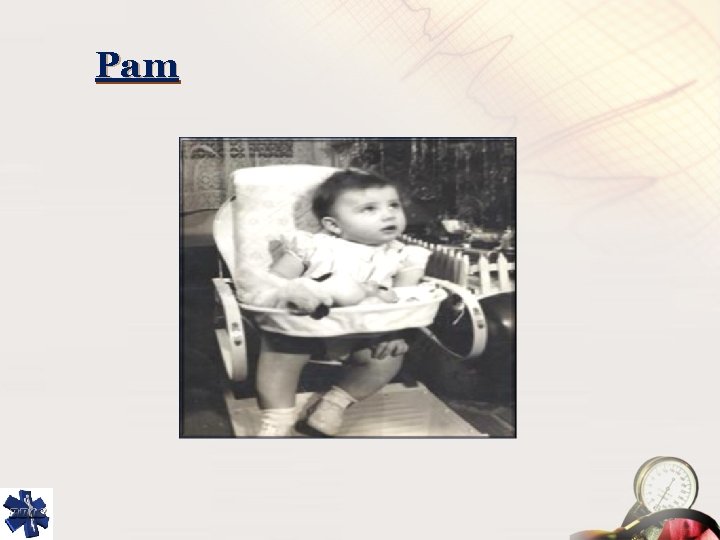
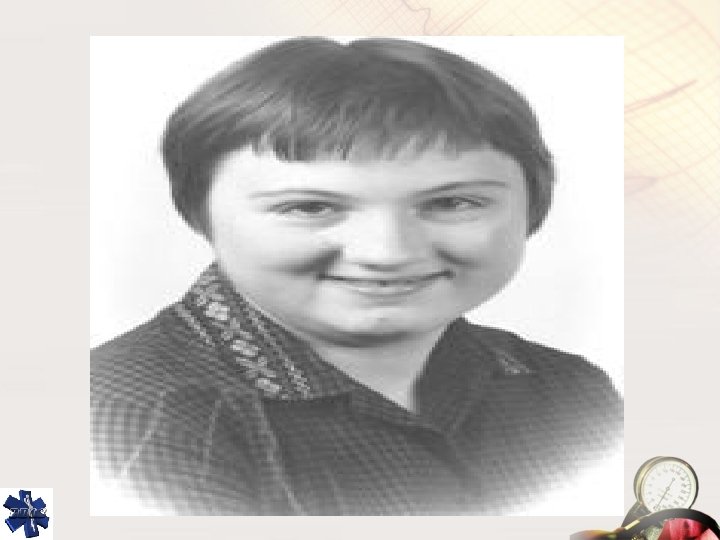
Pam
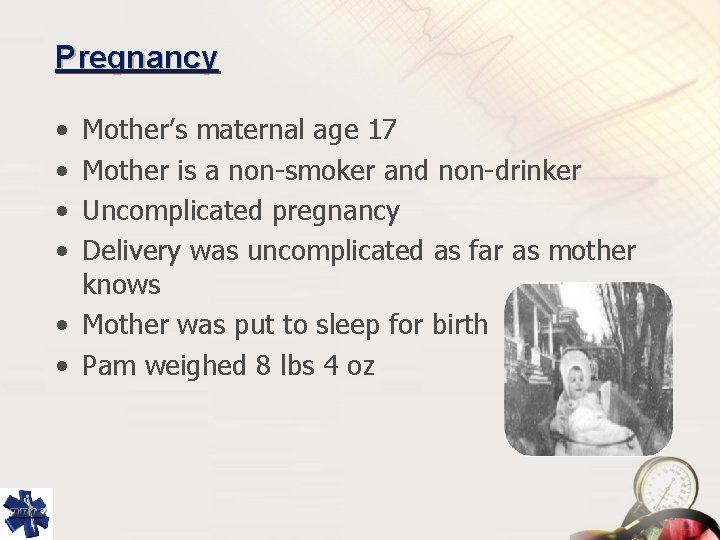
Pregnancy • • Mother’s maternal age 17 Mother is a non-smoker and non-drinker Uncomplicated pregnancy Delivery was uncomplicated as far as mother knows • Mother was put to sleep for birth • Pam weighed 8 lbs 4 oz
Early Childhood • Normal time for teething and sitting up • Began walking at 1 year old • At 1 ½ years of age showed some signs of altered coordination: Dr. noticed that left leg went laterally away from body when walking • Developed petit mal seizures at age 1 which continued until age 10 • Diagnosed with mild to moderate mental retardation, now known as intellectual disability
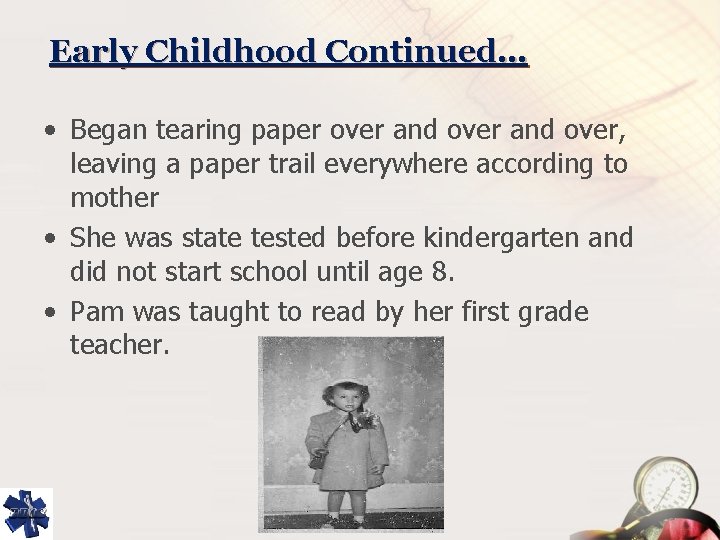
Early Childhood Continued… • Began tearing paper over and over, leaving a paper trail everywhere according to mother • She was state tested before kindergarten and did not start school until age 8. • Pam was taught to read by her first grade teacher.
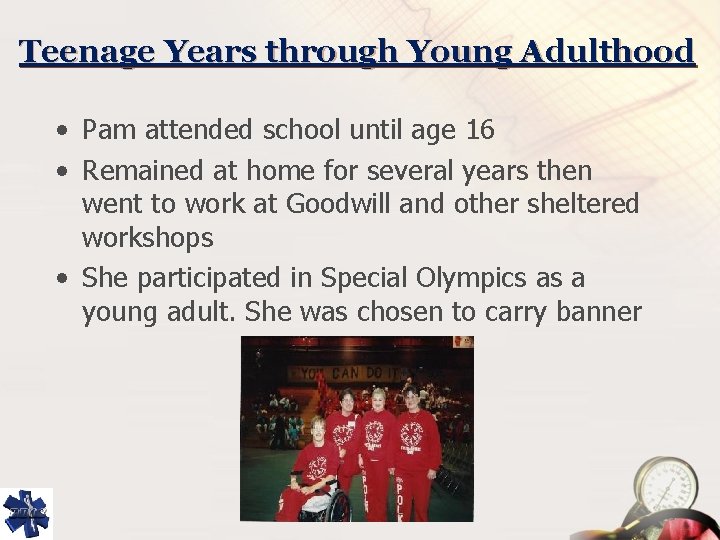
Teenage Years through Young Adulthood • Pam attended school until age 16 • Remained at home for several years then went to work at Goodwill and other sheltered workshops • She participated in Special Olympics as a young adult. She was chosen to carry banner
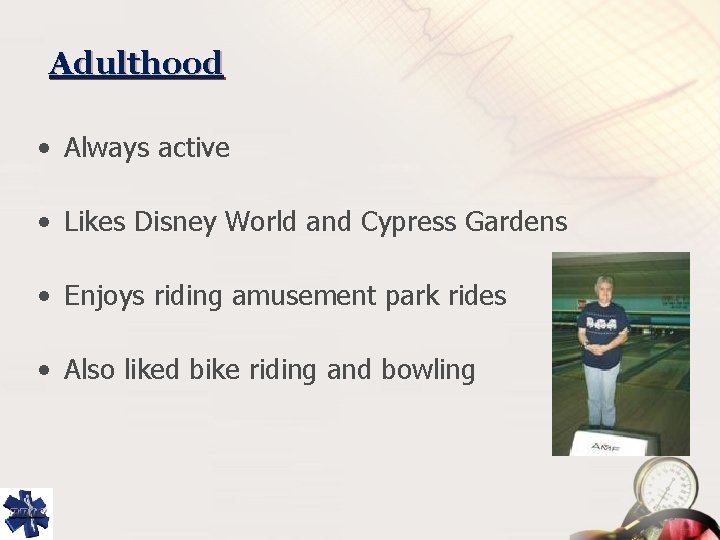
Adulthood • Always active • Likes Disney World and Cypress Gardens • Enjoys riding amusement park rides • Also liked bike riding and bowling
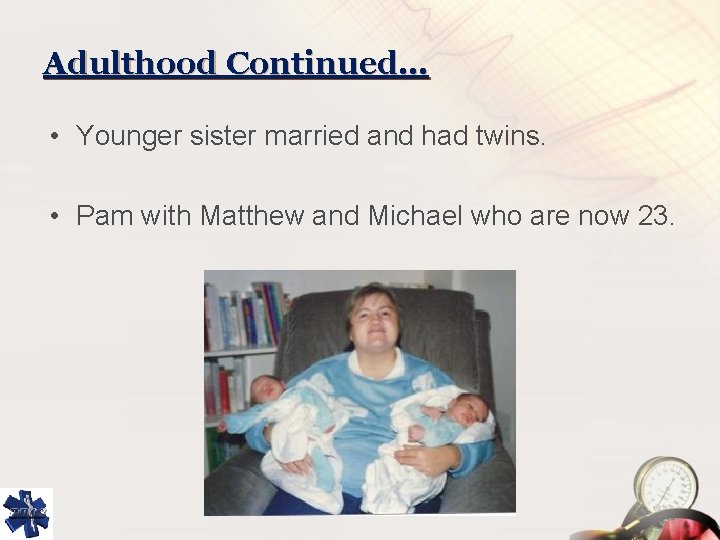
Adulthood Continued… • Younger sister married and had twins. • Pam with Matthew and Michael who are now 23.
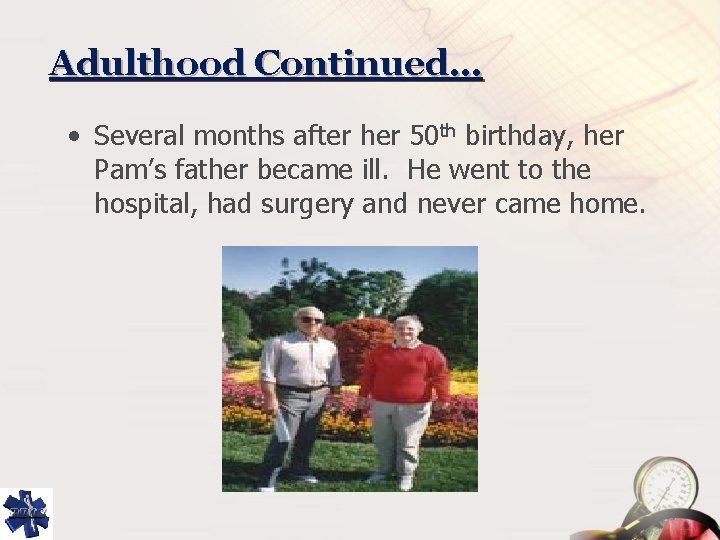
Adulthood Continued… • Several months after her 50 th birthday, her Pam’s father became ill. He went to the hospital, had surgery and never came home.
Pam’s Mother goes to the Hospital • A few years ago, Pam’s mother became ill at church. She was taken to the hospital by ambulance and a church member took Pam was crying and asking “Is my Mom going to die? My Dad went to the hospital and he died. ” • Could be a challenge for pre-hospital care providers?
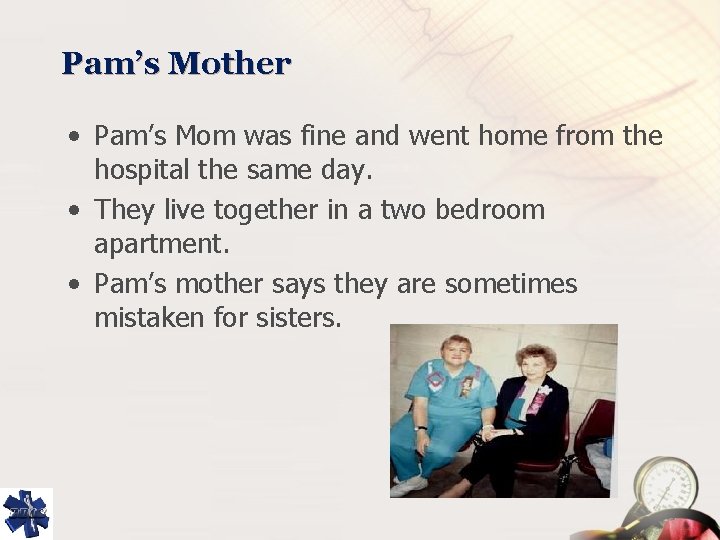
Pam’s Mother • Pam’s Mom was fine and went home from the hospital the same day. • They live together in a two bedroom apartment. • Pam’s mother says they are sometimes mistaken for sisters.
Education • Pam works at a sheltered workshop but reviews 12 spelling words five times daily at home. She is tested at the end of the week. • She also reads daily. • She uses a phonics workbook daily.
Health • Pam is treated for anxiety, depression, high cholesterol and seasonal allergies. • Medications: Zoloft, Klonopin, Zocor, Loratidine. • She has recently been released from care of a sacral pressure ulcer for which she wore a wound vac for 14 weeks.
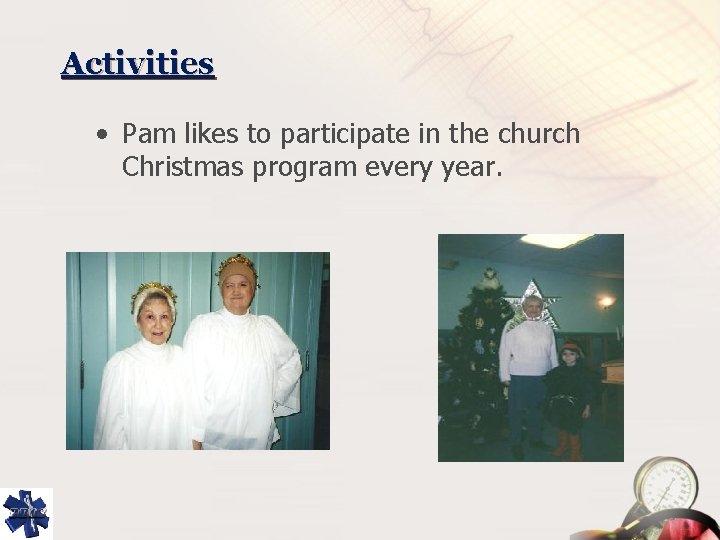
Activities • Pam likes to participate in the church Christmas program every year.
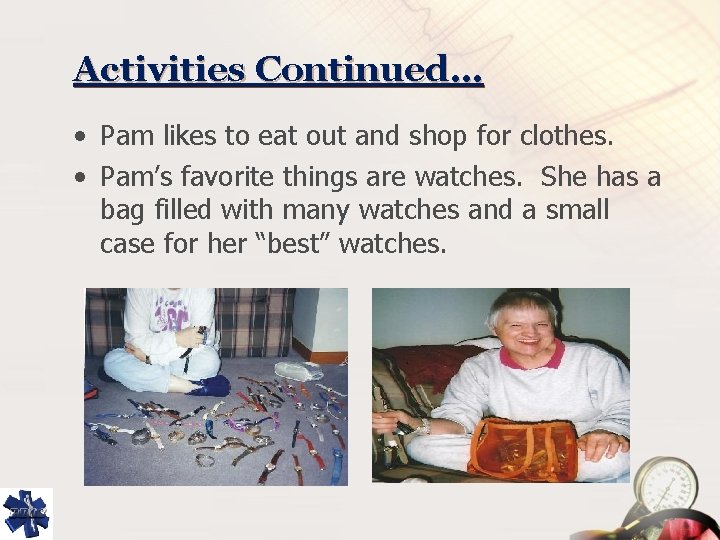
Activities Continued… • Pam likes to eat out and shop for clothes. • Pam’s favorite things are watches. She has a bag filled with many watches and a small case for her “best” watches.
PAM A Closer Look…
PAM A Closer Look…

Break Time

Autism
RAINMAN • Before Rainman, no one knew about Autism • Now broadly recognized • Neurologically based developmental disability although there is no known cause or cure • Some signs of autism may present by 18 months, Asperger’s may present later. But there’s more…
ASD • ASD: Autism spectrum disorder – Autism – Asperger syndrome – Pervasive developmental disorder-Not otherwise specified (PDD-NOS)
Autism Characteristics • • Markedly impaired social interaction Difficulty with expressive and receptive language Unusual sensory perception Restrictive interests and activities May not respond to name until one year old Often suspicion of deafness Speech – some may be unable to speak while others may have an extensive vocabulary
Autism Characteristics Continued… • Will not look when someone is pointing at something • Will not play pretend games • Will not make eye contact • May enjoy spinning • Delayed speech and language skills • Repeat words or phrases over and over • Have obsessive interests
MYTH or TRUTH 1. Children and adults with autism spectrum disorders prefer to self-isolate. 2. Autism spectrum disorders are caused by poor parenting or parental behavior. 3. ASD is a behavioral/emotional/mental health disorder. 4. People with autism spectrum disorders cannot have successful lives and be contributing members of society.
MYTH or TRUTH 5. All people with an autism spectrum disorder have “savant skills”, like Dustin Hoffman’s character in Rain Man. 6. It is better to “wait and see” if a child does better rather than refer the child for a diagnostic assessment. 7. Children and adults with ASD do not interact very much. They do not have good eye contact. They do not speak well. They are not very intelligent.
Asperger Syndrome • Milder symptoms than autism • Awkward social behavior and possibly unusual interests • Typically no problem with language or intellectual disability
AMY A Better Understanding…
AMY A Better Understanding…
PDD-NOS Pervasive Developmental Disorder - Not Otherwise Specified • Meet some of the criteria for autism and asperger syndrome • Symptoms may only be social and communication problems • Many have heightened sensitivities to certain stimuli
Occurrences • All racial, ethnic and socioeconomic groups • Four times more likely to occur in males • CDC estimates 1 in 110 children have ASD • Occurs in individuals of all levels of intelligence • More information about ASD to public-awareness leads to more accurate numbers
ASD Causes • • Brain disorder Genetic causes present but not defined Research continues Certain genes may make the body more accessible to environmental toxins • Maternal ingestion of certain prescription drugs such as Depakote during pregnancy • Old studies concluded that vaccines were responsible. Since proven not true
A Better Understanding… • Temple Grandin – Thinking in Pictures – Brain is computer full of files – Recognize something: dog – Other person refers to dog, autistic person can only picture the dog that is stored in the “brain file”. – Would get frustrated when others did not “see” what she saw
More Temple Grandin… • Had desire for a hug, but not from another human • Built herself a “squeeze machine” that she could lie in, pull a cord and the sides would come in and squeeze her • Advises families not to stop working with autistic child as they grow. Changes occur that can be built upon if discovered.
Approach and History • • Keep calm Tell patient your name Ask questions and allow time to answer Stimuli-attention span problems will affect interview. Decrease as much stimuli as possible • Speech problems, hearing deficit problem • Talk to caregiver if available but DO NOT IGNORE what patient is trying to tell you
Assessment • History from family or caregiver • Chief complaint may come from patient • Provider should move slowly through assessment and avoid unwanted sensory stimulation • Assess patient's method of communication, don’t use slang terms • Immediate or delayed echolalia: repetition or echoing verbal utterances by another person
Assessment Continued… • Pain assessment: difficult to read facial expressions. Hypo or hyper sensitivity to pain or temperature. Trauma assessment must be thorough • Sexual assault – May not understand what happened – Unaware a crime was committed • Poor toleration of bandages, arm boards, splints, blood pressure cuffs, etc.
Medical Conditions Associated with ASD • Seizures (up to 40%) • Hypotonia- may not be able to support airway • Asthma (common)
MYTH or TRUTH Answers 1. Children and adults with autism spectrum disorders prefer to self-isolate. ANSWER: Children and adults with ASD often want to socially interact but lack the ability to spontaneously develop effective social interaction skills. 2. ASD are caused by poor parenting or parental behavior. ANSWER: Parents do not and cannot cause ASD.
MYTH or TRUTH Answers 3. ASD is a behavioral/emotional/mental health disorder. ANSWER: Autism related disorders are developmental disabilities and neuro-biological disorders. 4. People with autism spectrum disorders cannot have successful lives and be contributing members of society. ANSWER: Many people with autism spectrum disorders are being successful living and working and are contributing to the well being of other in their communities.
MYTH or TRUTH Answers 5. All people with an autism spectrum disorder have “savant skills” like Dustin Hoffman’s character in Rain Man. ANSWER: Most people with autism spectrum disorders do not have any special savant skills. Some have “splinter skills”, areas of high performance that are not consistent with other skill levels.
MYTH or TRUTH Answers 6. It is better to “wait and see” if a child does better rather than refer the child for a diagnostic assessment. ANSWER: The earlier autism spectrum disorders are diagnosed and treated, the better. Outcomes for children’s lives are significantly improved with early diagnosis and treatment.
MYTH or TRUTH Answers 7. Children and adults with ASD do not interact very much. They do not have good eye contact. They do not speak well. They are not very intelligent. ANSWER: Children and adults with ASD may speak and/or interact with others. They may have good eye contact. They may be verbal or non-verbal. They may be very intelligent, of average intelligence or have cognitive deficits.
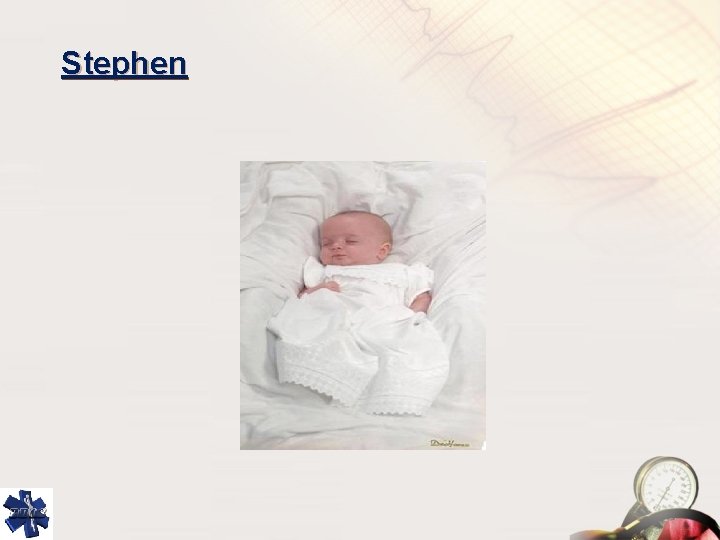
Stephen
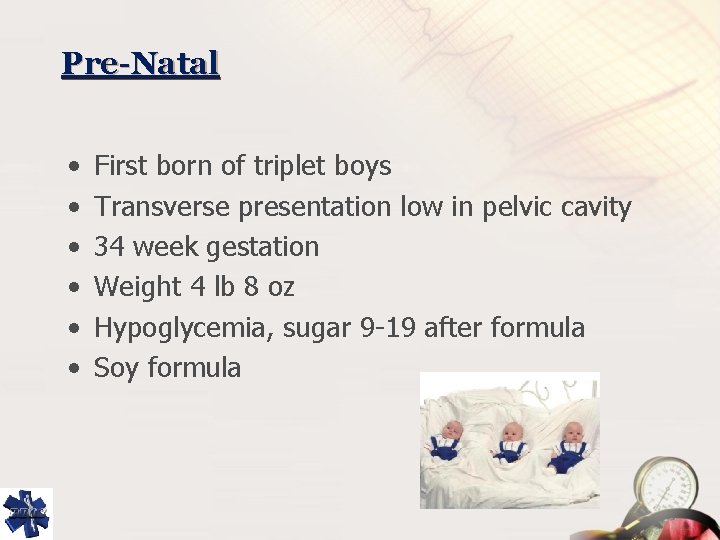
Pre-Natal • • • First born of triplet boys Transverse presentation low in pelvic cavity 34 week gestation Weight 4 lb 8 oz Hypoglycemia, sugar 9 -19 after formula Soy formula
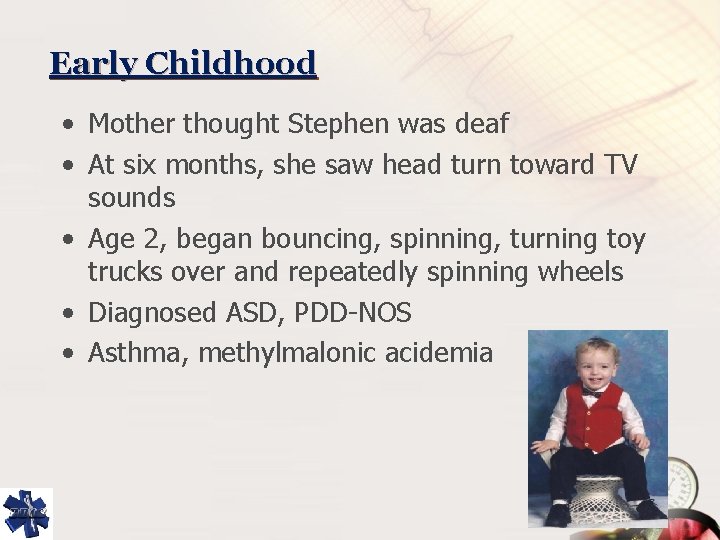
Early Childhood • Mother thought Stephen was deaf • At six months, she saw head turn toward TV sounds • Age 2, began bouncing, spinning, turning toy trucks over and repeatedly spinning wheels • Diagnosed ASD, PDD-NOS • Asthma, methylmalonic acidemia
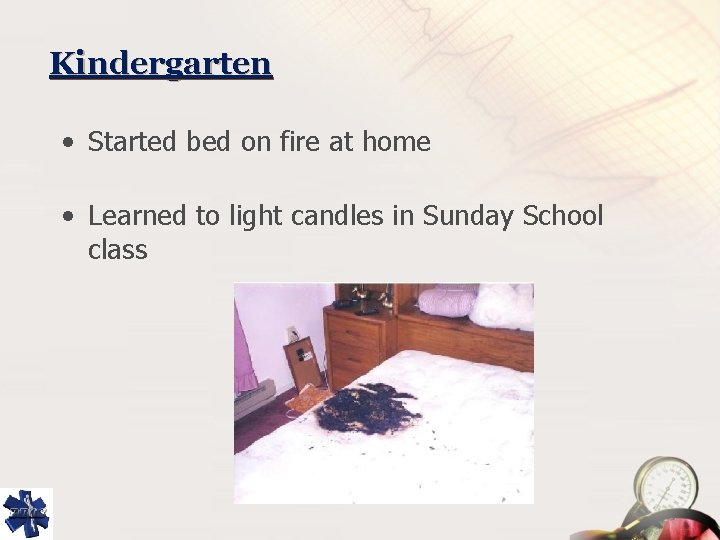
Kindergarten • Started bed on fire at home • Learned to light candles in Sunday School class
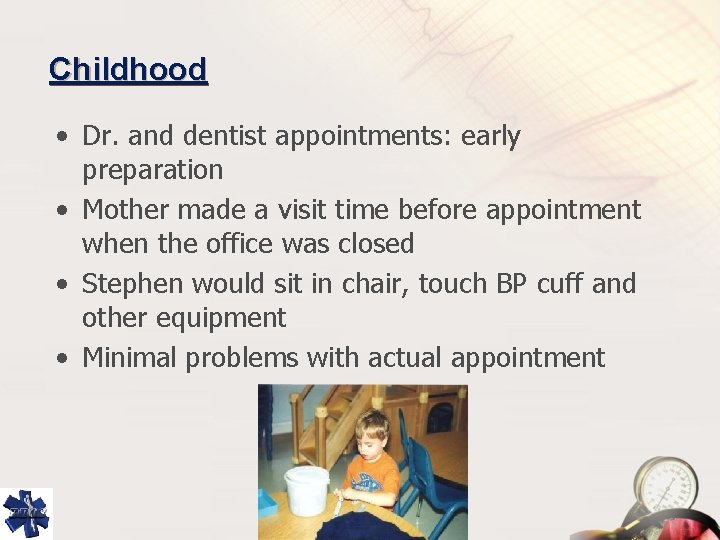
Childhood • Dr. and dentist appointments: early preparation • Mother made a visit time before appointment when the office was closed • Stephen would sit in chair, touch BP cuff and other equipment • Minimal problems with actual appointment
Childhood Continued… • Started to talk age 6 • Was able to point to presidents when asked name in first grade • Likes watching trains. Sunday activities consisted of mother and brothers going to church, Mc. Donalds, and to the train station.
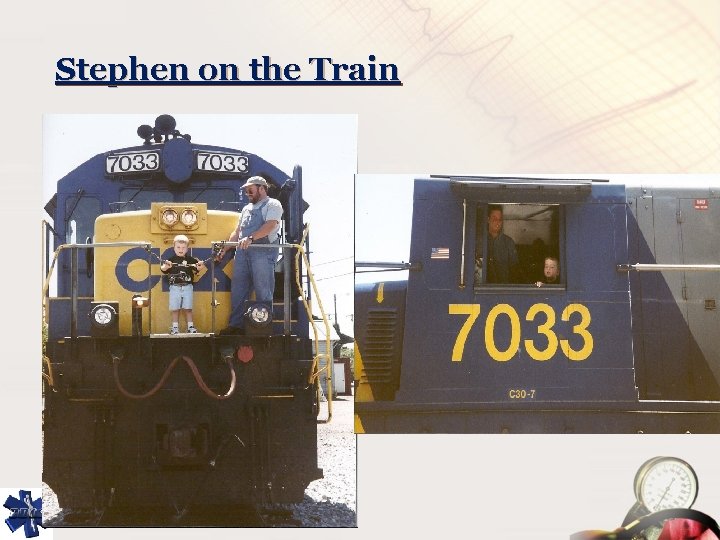
Stephen on the Train
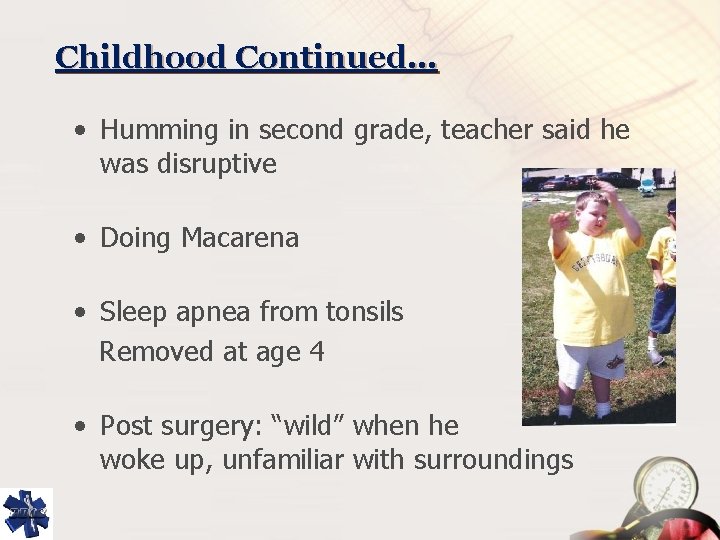
Childhood Continued… • Humming in second grade, teacher said he was disruptive • Doing Macarena • Sleep apnea from tonsils Removed at age 4 • Post surgery: “wild” when he woke up, unfamiliar with surroundings
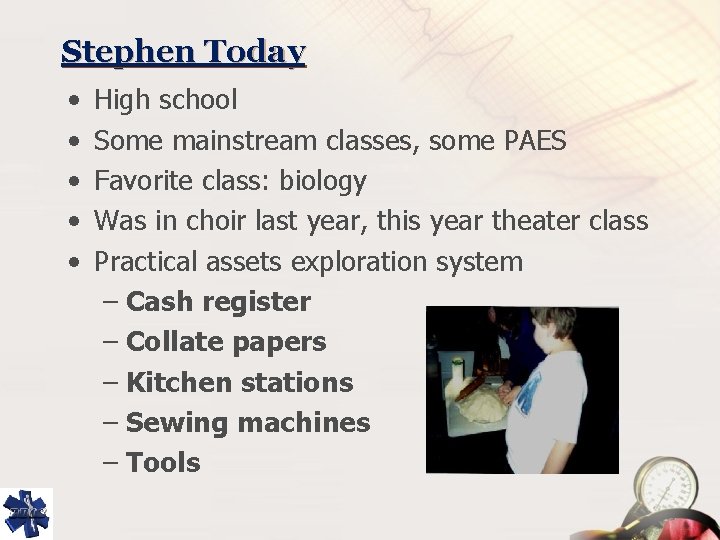
Stephen Today • • • High school Some mainstream classes, some PAES Favorite class: biology Was in choir last year, this year theater class Practical assets exploration system – Cash register – Collate papers – Kitchen stations – Sewing machines – Tools
Stephen Today Continued… • Follows Japanese sports on the computer. He is able to discuss even though it’s a foreign language • Doesn’t like to hear a baby’s cry • Sits away from group at parties • Doesn’t answer if he doesn’t want to • Takes books to environments where he may become upset • Doesn’t like emergency lights or sirens • Likes all sports and can recite statistics for many sports
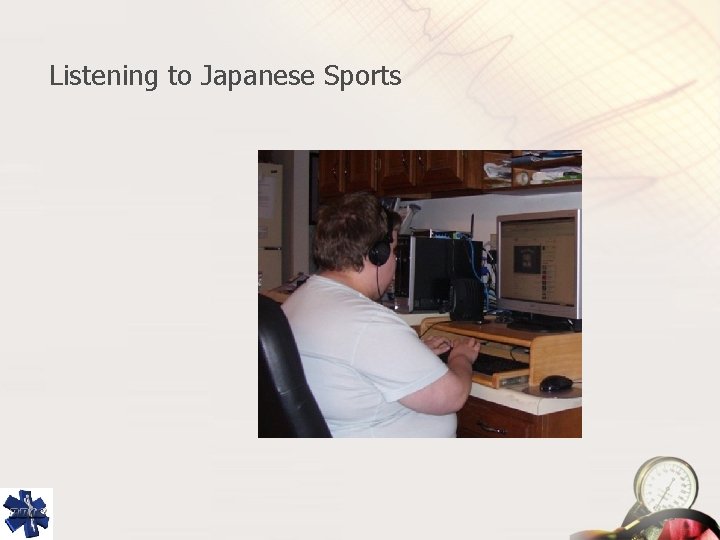
Listening to Japanese Sports
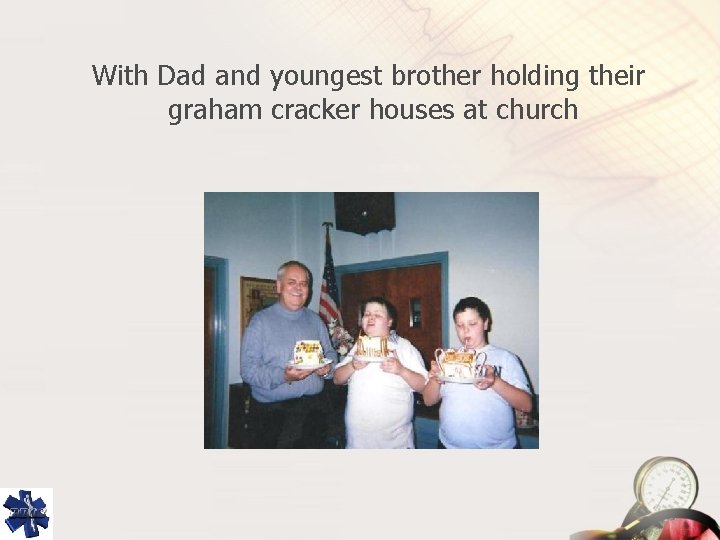
With Dad and youngest brother holding their graham cracker houses at church

Stephen A Closer Look…
Stephen A Closer Look…

Break Time
Down Syndrome
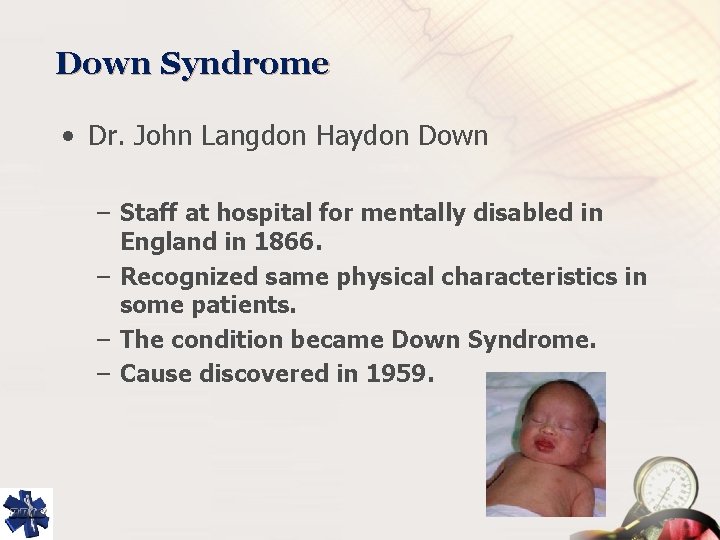
Down Syndrome • Dr. John Langdon Haydon Down – Staff at hospital for mentally disabled in England in 1866. – Recognized same physical characteristics in some patients. – The condition became Down Syndrome. – Cause discovered in 1959.
MYTH or TRUTH 1. Down syndrome is a rare genetic disorder. 2. People with Down syndrome have a short life span. 3. Most children with Down syndrome are born to older parents. 4. People with Down syndrome are severely “retarded”. 5. Most people with Down syndrome are institutionalized.
MYTH or TRUTH 6. Children with Down syndrome must be placed in segregated special education programs. 7. Adults with Down syndrome are unemployable. 8. People with Down syndrome are always happy 9. Adults with Down syndrome are unable to form close personal relationships leading to marriage.
Genetic Illness • • • Genes determine everything about people. Genes join together, become chromosomes. Normal: 23 pairs chromosomes, total 46. Down Syndrome: extra chromosome, total 47. Extra chromosome: embryo and fetal development, physical characteristics
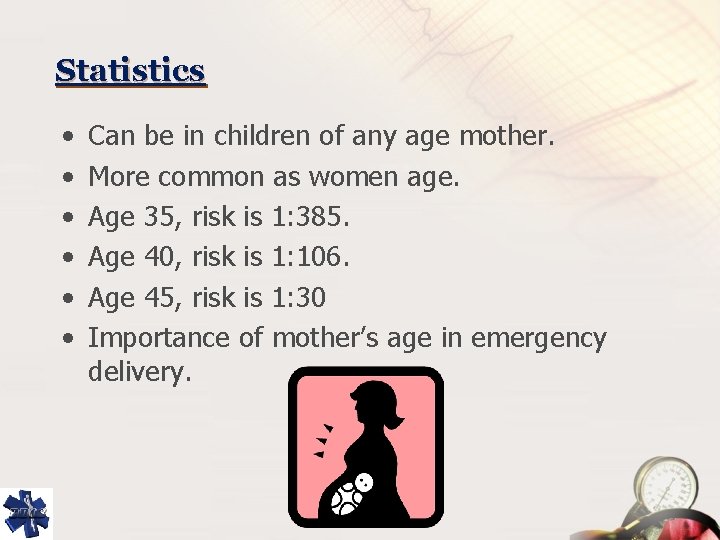
Statistics • • • Can be in children of any age mother. More common as women age. Age 35, risk is 1: 385. Age 40, risk is 1: 106. Age 45, risk is 1: 30 Importance of mother’s age in emergency delivery.
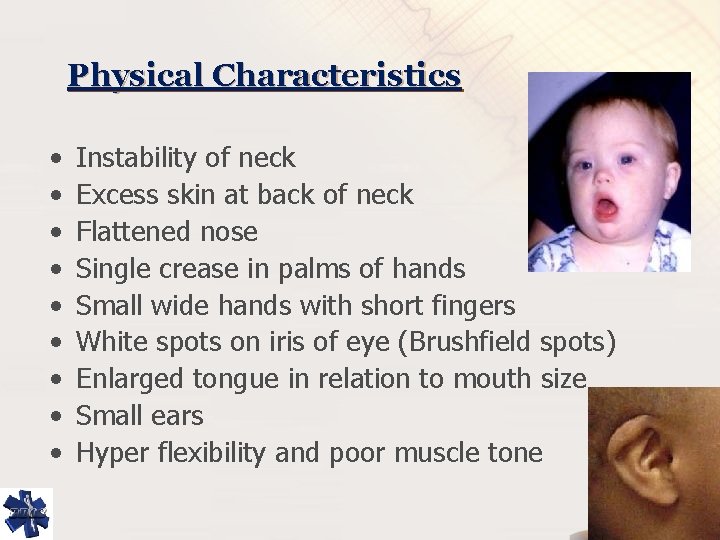
Physical Characteristics • • • Instability of neck Excess skin at back of neck Flattened nose Single crease in palms of hands Small wide hands with short fingers White spots on iris of eye (Brushfield spots) Enlarged tongue in relation to mouth size Small ears Hyper flexibility and poor muscle tone
Associated Physical Diagnosis • 50% risk of congenital heart defects – Atrial septal defect, patent ductus arteriosus, ventricular septal defect • 12% risk of gastrointestinal problems – Tracheoesophageal fistula, duodenal atresia, pyloric stenosis. • Eye abnormalities – Cataracts, nystagmus, glaucoma, refractive errors
Associated Physical Diagnosis Cont… • Hypothyroidism • Deafness • Seizures • Dry skin • Early Alzheimer’s disease • Obesity • ADHD
Growth and Development Problems • Newborn problems with feeding • Short stature • Obesity begins during adolescence • Sleep apnea: large tongue, small mouth, obesity
Growth and Development Problems • Seizures: spasms in younger patients, tonicclonic in older patients • Premature aging: decreased skin tone, graying or loss of hair • Increased periodontal destruction • Hearing loss beginning in childhood
Growth and Development Continued… • Leukemia is common in children • Blood abnormality: enlarged spleen and liver, low blood cell count (all), immature white blood cells • Decreased risk of solid tumors
Growth and Development Continued… • Increased risk of Hepatitis B if institutionalized at any time • Increased risk of infectious disease, especially pneumonia • Baldness, skin abscesses and recurrent infections
Reproduction • Affected persons rarely reproduce • Males: hypogonadism • 15 -30% females fertile -50% chance of having affected child
Psychiatric / Emotional • Generally Down Syndrome patients are spontaneous, warm, cheerful, tolerant, gentle • Some exhibit anxiety/stubbornness • Possible ADHD, OCD, ASD (Autism Spectrum Disorder), Depressive disorder • Impaired stimuli-attention span
Approach and History • • Keep calm Tell patient your name Ask questions and allow time to answer Stimuli-attention span problems will affect interview. Decrease stimuli as much as possible. • Speech problems, hearing deficit problems • Talk to caregiver if available but DO NOT IGNORE what patient is trying to tell you
Assessment • Head to toe assessment explaining each step • Airway and breathing: problems due to smaller mouth, larger tongue • Respiratory signs and symptoms in infants: may be from congenital heart and NOT respiratory cause • Endocarditis suspicion with sub-sternal chest pain and signs of infection • Be mindful that aging is premature, including dementia
Trauma • Pre-existing atlantoaxial or atlanto-occipital instability with signs and symptoms – Neck pain, limited neck mobility, loss of motor skills, sensory deficits, spasticity, loss of upper body strength, change in bowel or bladder function, changes in sensation in hands and feet – Compare with signs and symptoms of acute spinal trauma – Dislike being strapped down-tact and patience
Treatment • Treat problem based on assessment • Remember physical differences and other diagnoses • Don’t forget basics: A, B, C; SAMPLE, DCAPBTLS • Keep voice calm, confident and quiet • Every touch needs to be explained – Assessment – Treatment
Transport • Remember comfort • Avoid siren if possible – Reduce Stimuli-attention span – More comfortable ride for patient – Easier on-going assessment for provider
MYTH or TRUTH Answers 1. Down syndrome is a rare genetic disorder. ANSWER: Down syndrome is the most commonly occurring genetic condition. One in every 733 live births is a child with Down syndrome. 2. People with Down syndrome have a short life span. ANSWER: Life expectancy for individuals with Down syndrome has increased dramatically in recent years, with the average life expectancy approaching that of peers without Down syndrome.
MYTH or TRUTH Answers 3. Most children with Down syndrome are born to older parents. ANSWER: Most children with Down syndrome are born to women younger than 35 years old simply because younger women have more children. However, the incidence of births of children with Down syndrome increases with age of the mother.
MYTH or TRUTH Answers 4. People with Down syndrome are severely “retarded”. ANSWER: Most people with Down syndrome have IQ’s that fall in the mild to moderate range of intellectual disability. People with Down syndrome fully participate in public and private educational programs.
MYTH or TRUTH Answers 5. Most people with Down syndrome are institutionalized. ANSWER: Today people with Down syndrome live at home with their families and are active participants in the educational, vocational, social, and recreational activities of the community.
MYTH or TRUTH Answers 6. Children with Down syndrome must be placed in segregated special education programs. ANSWER: Children with Down syndrome have been included in regular academic classrooms in schools across the country. In some instances, they are integrated into specific courses, while they may attend mainstream classes for other courses.
MYTH or TRUTH Answers 7. Adults with Down syndrome are unemployable. ANSWER: People with Down syndrome are employed by banks, corporations, nursing homes, hotels and restaurants. Many also work in the music and entertainment industry. 8. People with Down syndrome are always happy. ANSWER: People with Down syndrome have feelings just like everyone else in the population. They experience a full range of emotions.
MYTH or TRUTH Answers 9. Adults with Down syndrome are unable to form close interpersonal relationships leading to marriage. ANSWER: People with Down syndrome date, socialize, form ongoing relationships and sometimes marry.
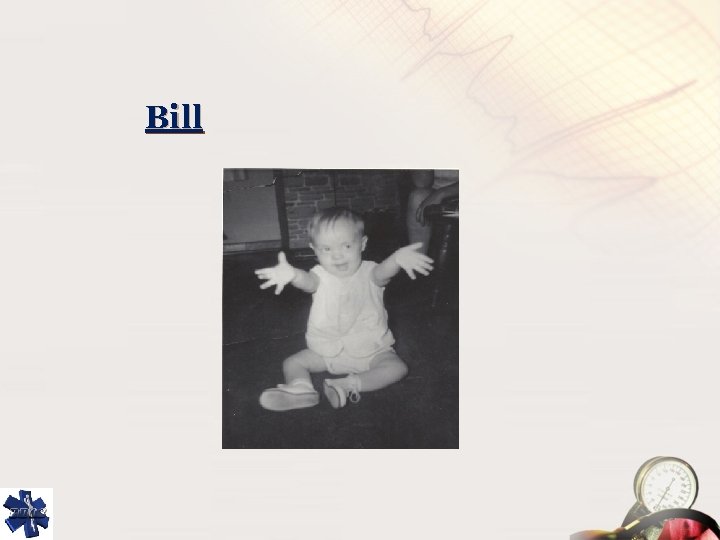
Bill
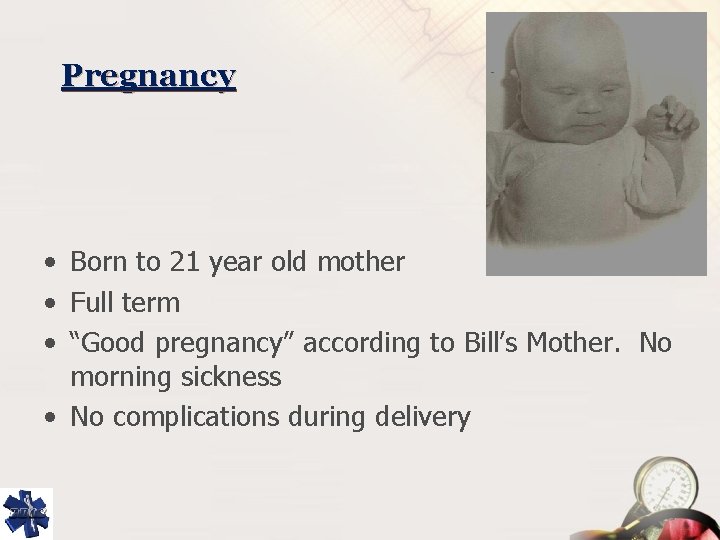
Pregnancy • Born to 21 year old mother • Full term • “Good pregnancy” according to Bill’s Mother. No morning sickness • No complications during delivery
Pregnancy Continued… • Dr. was out of town and Bill delivered by covering physician • Five days later, Dr. returned. Walked into room and said “Your baby is a Mongoloid. He’ll never develop properly. He won’t walk, won’t talk. You will want to put him in a home. ” • Mom says she held Bill, touched his toes and fingers and decided he would stay with the family • Bill was only child
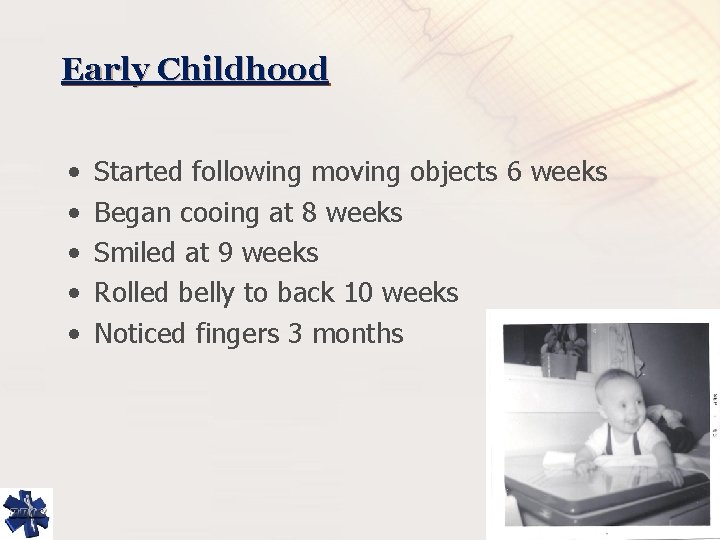
Early Childhood • • • Started following moving objects 6 weeks Began cooing at 8 weeks Smiled at 9 weeks Rolled belly to back 10 weeks Noticed fingers 3 months
Early Childhood • Pulled himself to standing position at 9 months but would not walk until 26 months • Bill was talking before he walked • Age 6: was potty trained and started school at Pikeside Special Education Center
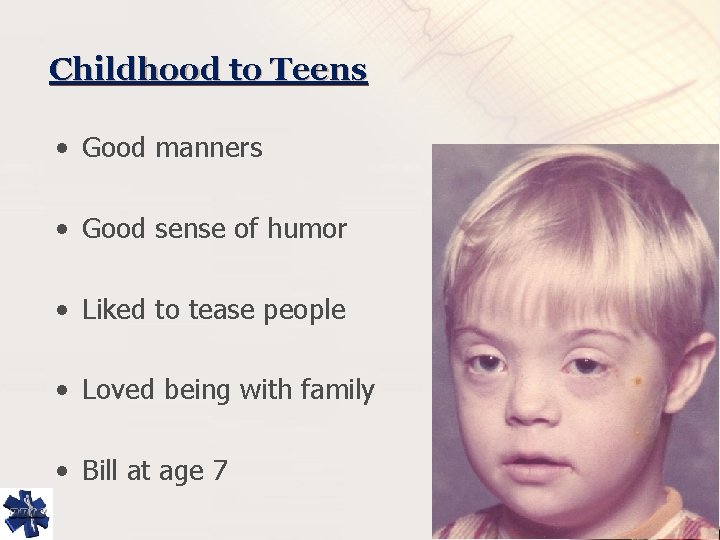
Childhood to Teens • Good manners • Good sense of humor • Liked to tease people • Loved being with family • Bill at age 7
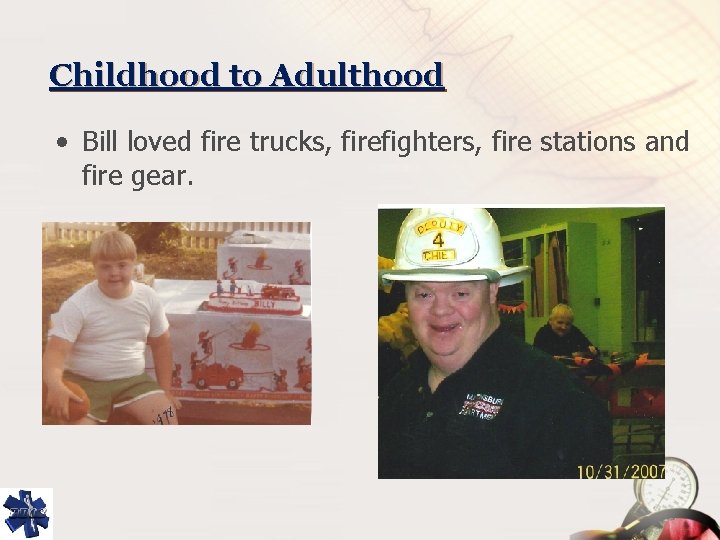
Childhood to Adulthood • Bill loved fire trucks, firefighters, fire stations and fire gear.
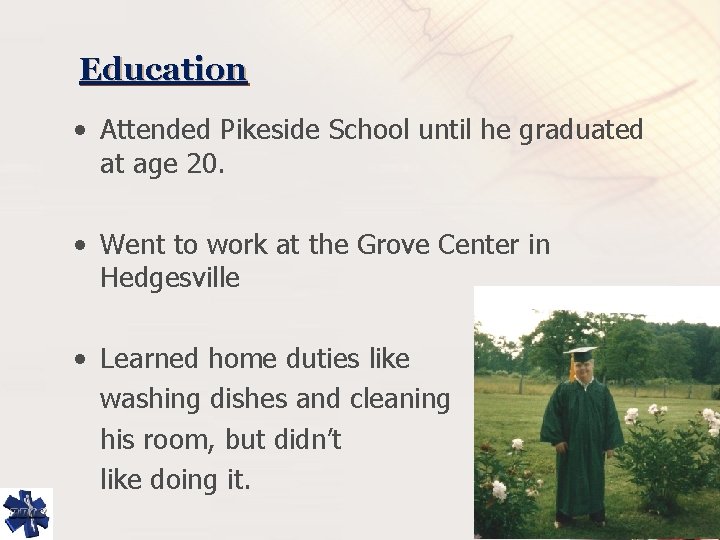
Education • Attended Pikeside School until he graduated at age 20. • Went to work at the Grove Center in Hedgesville • Learned home duties like washing dishes and cleaning his room, but didn’t like doing it.
Favorite Pastimes • Liked action figures only if they were “bendable” • Was able to draw perfect brick walls on etch-asketch. And boats with wooden hull. • Liked country music, especially the Oak Ridge Boys – Attended at least 30 Oak Ridge Boys concerts with his Mother
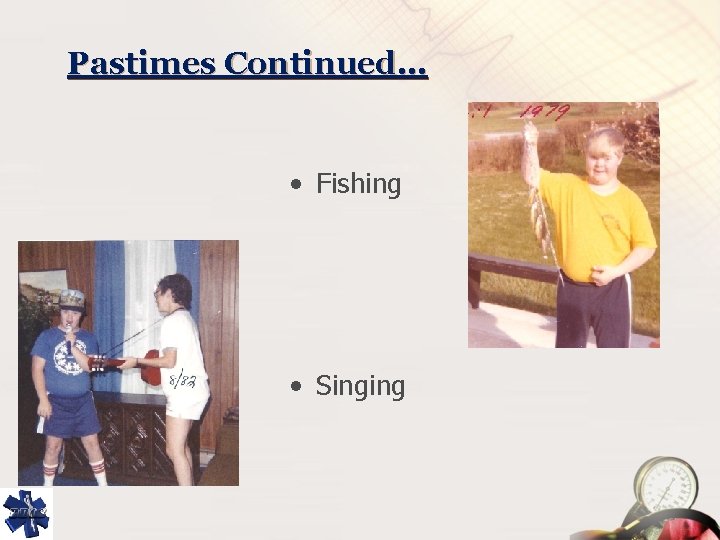
Pastimes Continued… • Fishing • Singing
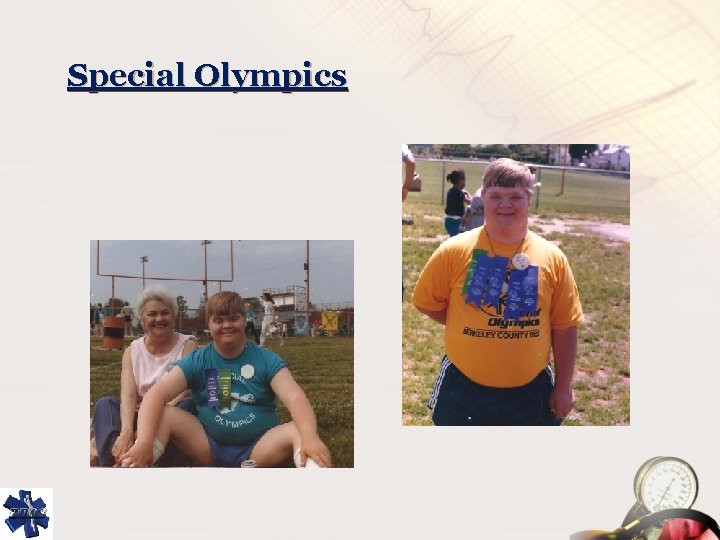
Special Olympics • Competed in the first Special Olympics held in Martinsburg, WV • Participated in 100 meter run, softball throw and shot put • As an adult, Bill told his Mother he would do the 100 meter walk because he was not supposed to run when he got older
Special Olympics
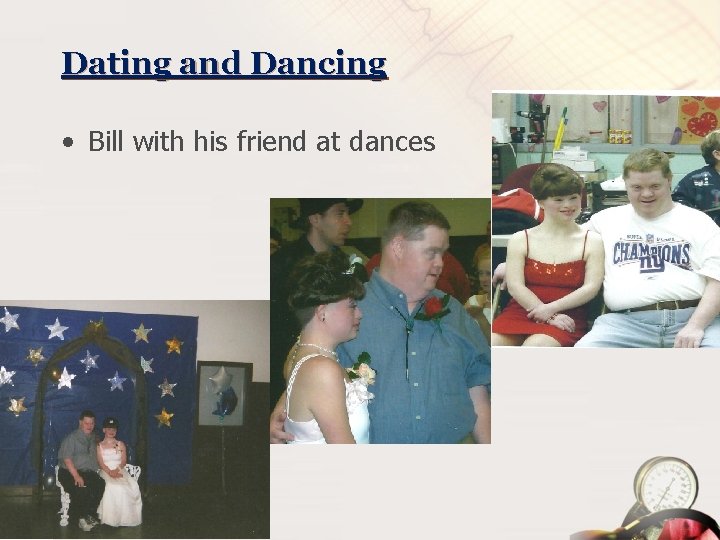
Dating and Dancing • Bill with his friend at dances
Health Problems • December 2008 began having episodes of Alzheimer like symptoms • Had a seizure followed by CAT Scan that showed brain tissue shrinking • Father passed away September 2009 • Bill mourned for his Dad • By December 2009, Bill was hardly able to walk to table to eat
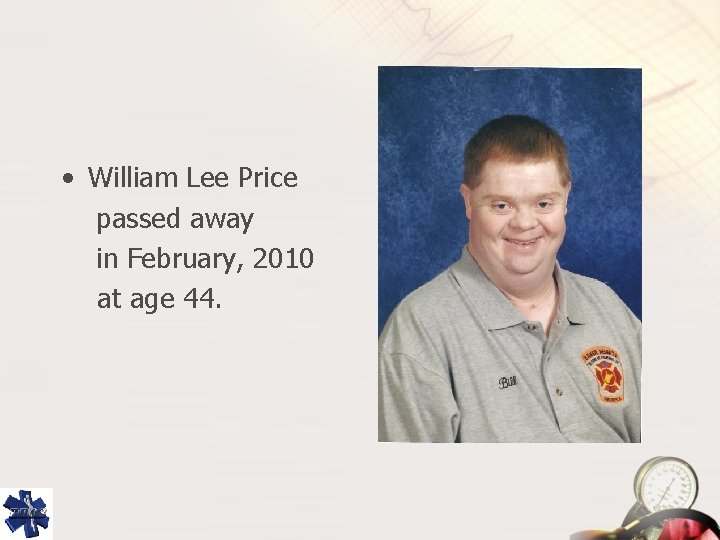
• William Lee Price passed away in February, 2010 at age 44.
Bill A Better Understanding…
Bill A Better Understanding…

Break Time
Care and Communication
Communication Emergency response personnel may find challenges in communicating with some individuals who are developmentally disabled… • Identify basic communication methods – Pay attention to pointing, gestures, nods, sounds, eye gaze, eye blinks • Speak slowly
Communication Cont… • Listen carefully and allow extra time for a response • Ask Yes or No questions • Once communication methods have been identified, ask basic questions one at a time
Communication • Use simple language • Eliminate distractions and redirect the individuals attention if appropriate • Allow the individual to touch equipment and become familiar with surroundings
Communication • Model calming body language – keep hands low and breath slowly • Model the behavior you want the person to display • Give encouragement • Hearing impairment considerations
Communication Methods • Some developmentally disabled people use sign language • Individuals with developmental disabilities may utilize special devices to communicate – Communication Board – Communication Book – Speech Generating Devices
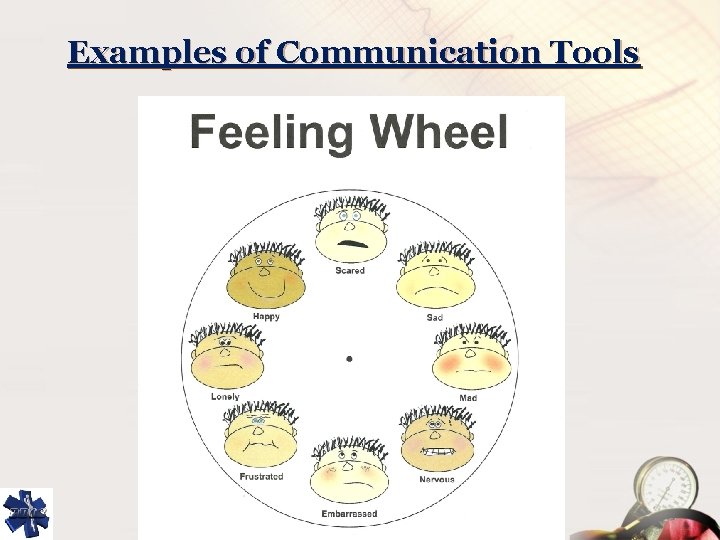
Examples of Communication Tools
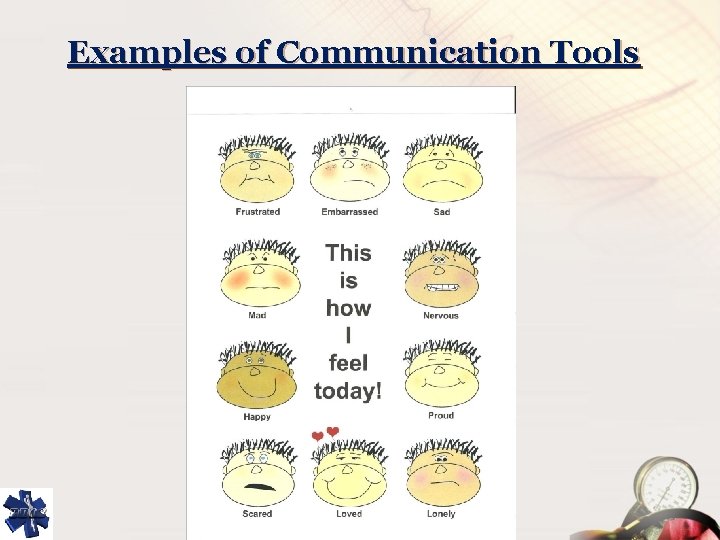
Examples of Communication Tools
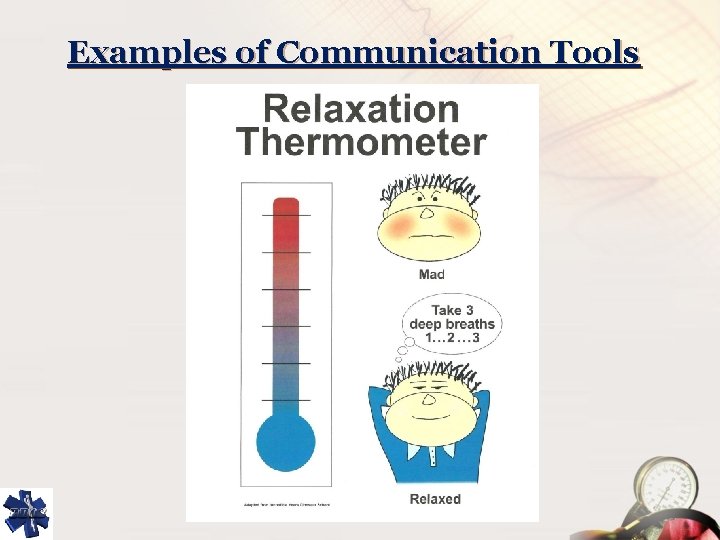
Examples of Communication Tools
Lets Meet Ryan
Lets Meet Ryan
Assessment of Individuals with Developmental Disabilities • Sirens and emergency lights may over stimulate • Noise, activity, and other types of lights may also over stimulate • Individuals may not want to lie flat or want to be strapped down. If patient does not require immobilization, allow the patient to lie on their side • Avoid touching patient; especially shoulders and face unless absolutely necessary
Assessment Continued… • Thoroughly assess trauma patients: Some may have high pain tolerance that masks potential injury • Evaluate for history of seizures and avoid use of computers and penlights • If no history of seizures, may use computer, clipboard with paper and pen, pictures to help answer questions • If immobilization is necessary, approach from the side. Autistic individuals tend to throw their heads back and possibly fall backward
Assessment Continued… • Be sure not to misinterpret a patients behavior – Unsteady gate – Flailing arms – Difficulty with speech • Ask the individual prior to touching them • Talk with the caregiver about medical history, communication, and special needs. Care giver can give information that distinguishes normal behavior from an illness
Assessment Continued… • People with disabilities may have a poor toleration of bandages, arm boards, splints, blood pressure cuffs, etc. • NEVER ignore what the patient is trying to tell you • Treat patients with respect and dignity, beforeduring-after the call
Assessment Continued… • REEVES Sleeve, immobilization devices and other EMS equipment require introduction and familiarity prior to use • Treat problem based on assessment • Remember physical differences and other diagnoses • Don’t forget the basics: – A, B, C’s, SAMPLE, DCAP-BTLS
Special Considerations… • Care Giver – Pre-hospital providers should consider the physical and mental state of the care giver as well as the patient – Caregivers may have needs as well, especially if they are the parent or relative or have been with the patient for long period of time
Special Considerations… • Care Giver – Isolation: normal, related to reduction in free time available to socialize – Anger: feeling angry at disabled person for “putting them into this situation” and at doctors / EMS for not supplying needed assistance
Special Considerations Continued… • Developmentally disabled individual These individuals may require assistive technology. Assistive Technology is any item, piece of equipment, or product system, whether acquired commercially, off-the-shelf, modified or customized, that is used to increase, maintain, or improve functional capabilities of individuals with disabilities.
Assistive Technology – Speech and communication aids – Mobility devices – Hearing / seeing aids – Education devices – Transportation – Adaptive clothing
Final Words… People who have developmental disabilities are present in every aspect of society. Disability is not the defining characteristic of an individual, but merely one aspect of the whole person.
- Slides: 161