
Developmental Disabilities Causes Classifications text chapter 5 Sensory
Developmental Disabilities: Causes & Classifications (text: chapter 5) & Sensory Impairments: Hearing & Vision (text: chapter 6)
Learning Objectives: List possible parental reactions to a diagnosis List ways in which teachers/professionals to help families through difficult times List and describe possible causes of developmental disabilities List the 12 categories used to allocate federal funding for educational services, approved by the federal government List possible warning signs of a hearing and/or vision problem List and describe alternate methods of comunication
Education ABC’s…Week 5: ER=Evaluation Report ELL=English Language Learners ESL=English as a Second Language MA=Medical Assistance NOREP=Notice of Recommended Educational Placement OCDEL=Office of Child Development and Early Learning VI=Visual Impairment

Poem: Welcome to Holland by Emily Perl Kingsley http: //www. our-kids. org/Archives/Holland. html
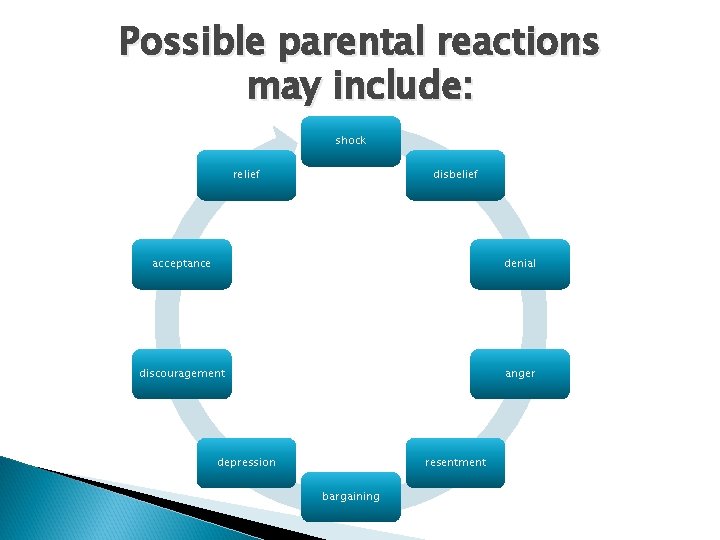
Possible parental reactions may include: shock relief disbelief acceptance denial discouragement anger depression resentment bargaining
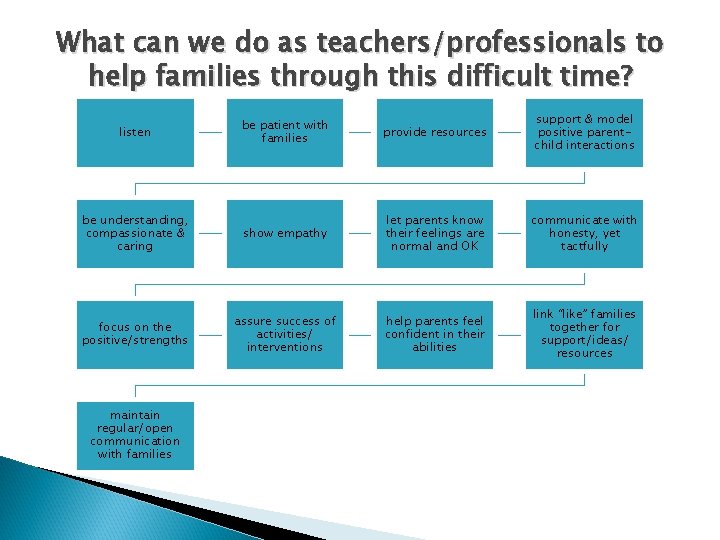
What can we do as teachers/professionals to help families through this difficult time? be patient with families provide resources support & model positive parentchild interactions be understanding, compassionate & caring show empathy let parents know their feelings are normal and OK communicate with honesty, yet tactfully focus on the positive/strengths assure success of activities/ interventions help parents feel confident in their abilities link “like” families together for support/ideas/ resources listen maintain regular/open communication with families
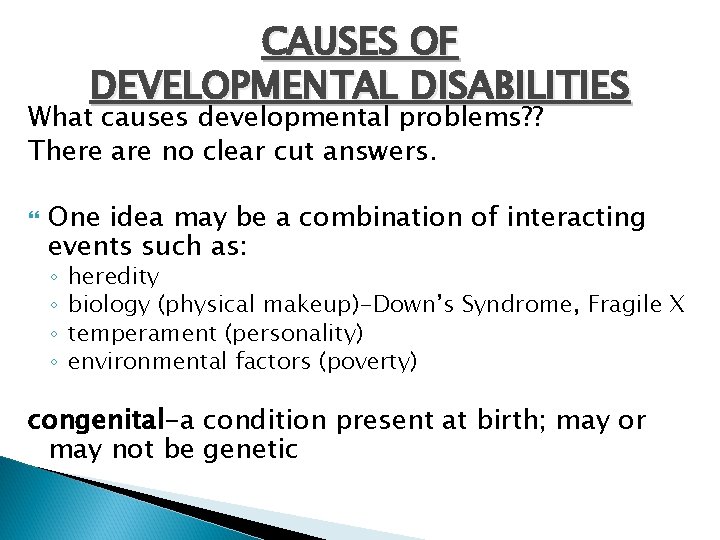
CAUSES OF DEVELOPMENTAL DISABILITIES What causes developmental problems? ? There are no clear cut answers. One idea may be a combination of interacting events such as: ◦ ◦ heredity biology (physical makeup)-Down’s Syndrome, Fragile X temperament (personality) environmental factors (poverty) congenital-a condition present at birth; may or may not be genetic
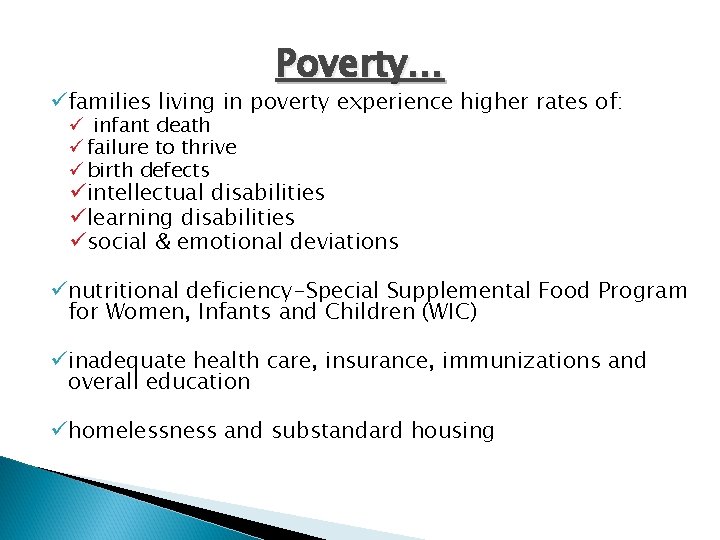
Poverty… üfamilies living in poverty experience higher rates of: ü infant death ü failure to thrive ü birth defects üintellectual disabilities ülearning disabilities üsocial & emotional deviations ünutritional deficiency-Special Supplemental Food Program for Women, Infants and Children (WIC) üinadequate health care, insurance, immunizations and overall education ühomelessness and substandard housing
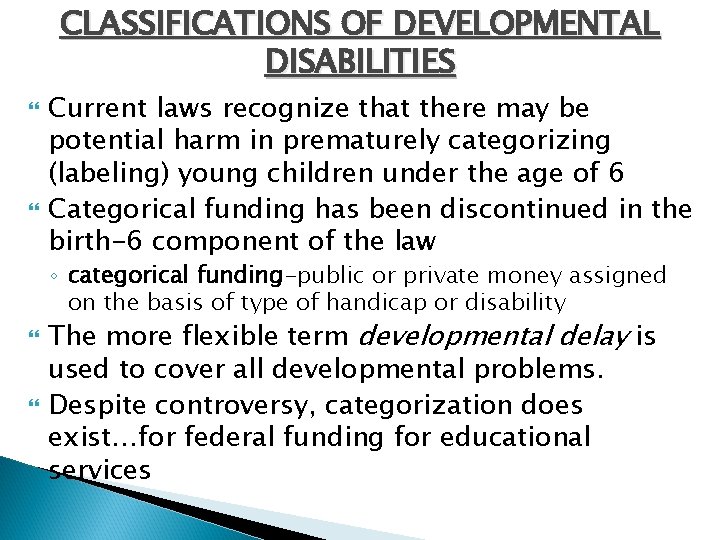
CLASSIFICATIONS OF DEVELOPMENTAL DISABILITIES Current laws recognize that there may be potential harm in prematurely categorizing (labeling) young children under the age of 6 Categorical funding has been discontinued in the birth-6 component of the law ◦ categorical funding-public or private money assigned on the basis of type of handicap or disability The more flexible term developmental delay is used to cover all developmental problems. Despite controversy, categorization does exist…for federal funding for educational services
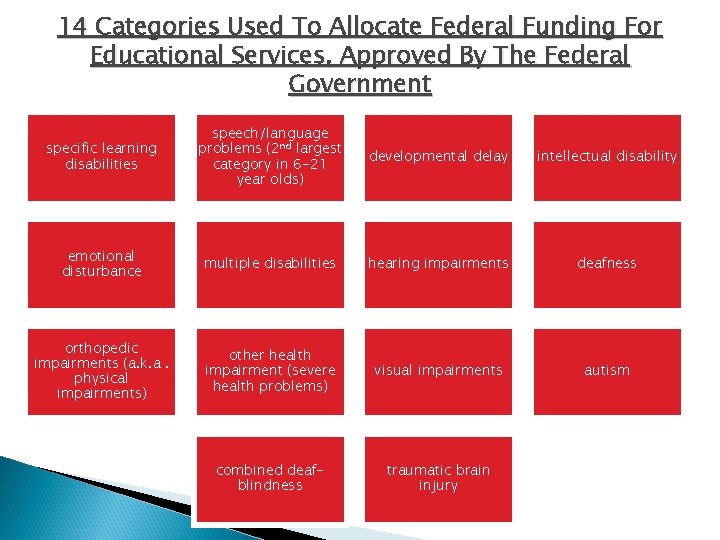
14 Categories Used To Allocate Federal Funding For Educational Services, Approved By The Federal Government specific learning disabilities speech/language problems (2 nd largest category in 6 -21 year olds) developmental delay intellectual disability emotional disturbance multiple disabilities hearing impairments deafness orthopedic impairments (a. k. a. physical impairments) other health impairment (severe health problems) visual impairments autism combined deafblindness traumatic brain injury

Sensory Impairments: Hearing & Vision
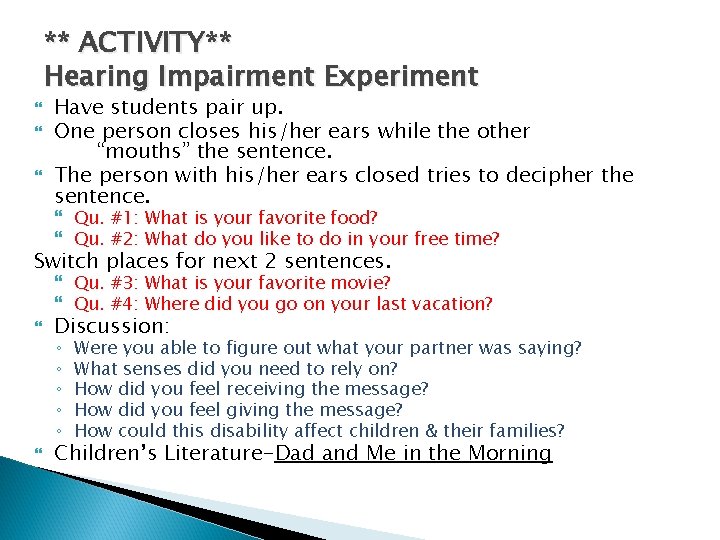
** ACTIVITY** Hearing Impairment Experiment Have students pair up. One person closes his/her ears while the other “mouths” the sentence. The person with his/her ears closed tries to decipher the sentence. Qu. #1: What is your favorite food? Qu. #2: What do you like to do in your free time? Switch places for next 2 sentences. Qu. #3: What is your favorite movie? Qu. #4: Where did you go on your last vacation? Discussion: Children’s Literature-Dad and Me in the Morning ◦ ◦ ◦ Were you able to figure out what your partner was saying? What senses did you need to rely on? How did you feel receiving the message? How did you feel giving the message? How could this disability affect children & their families?
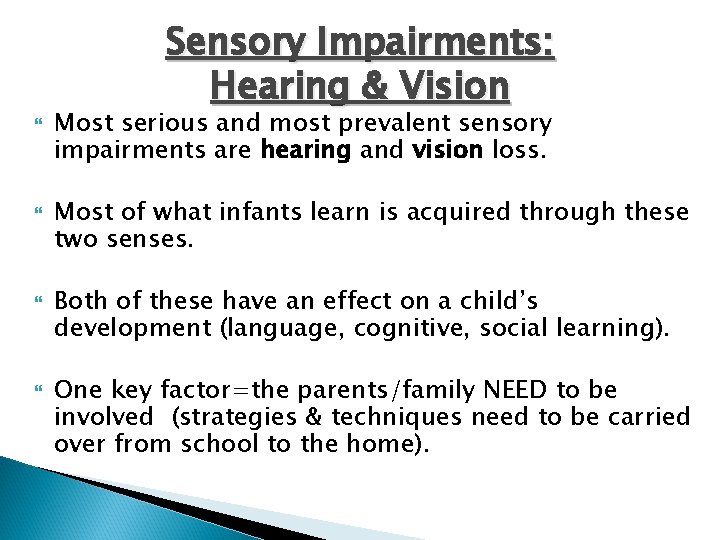
Sensory Impairments: Hearing & Vision Most serious and most prevalent sensory impairments are hearing and vision loss. Most of what infants learn is acquired through these two senses. Both of these have an effect on a child’s development (language, cognitive, social learning). One key factor=the parents/family NEED to be involved (strategies & techniques need to be carried over from school to the home).
What are some warning signs that parents & teachers should be aware of to signify that hearing may be a problem?
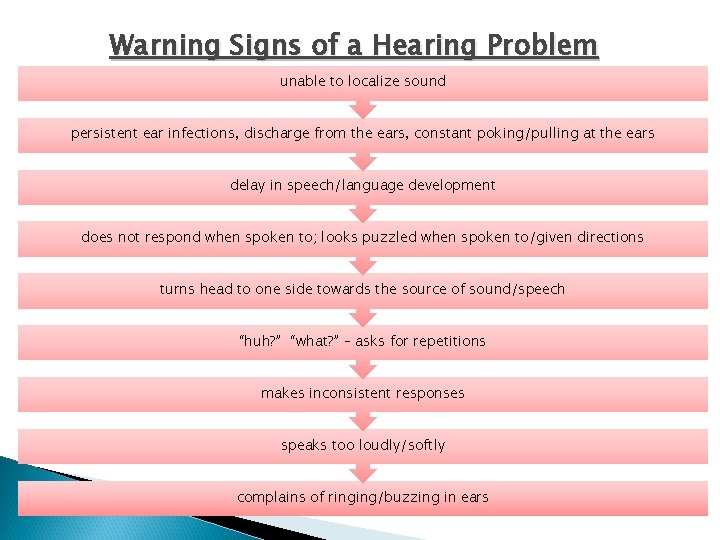
Warning Signs of a Hearing Problem unable to localize sound persistent ear infections, discharge from the ears, constant poking/pulling at the ears delay in speech/language development does not respond when spoken to; looks puzzled when spoken to/given directions turns head to one side towards the source of sound/speech “huh? ” “what? ” – asks for repetitions makes inconsistent responses speaks too loudly/softly complains of ringing/buzzing in ears
Family Life The greater the hearing loss, the more effect it has on family life. The child & his/her family are exposed to increased frustration, especially in the early stages of communication attempts. It is often difficult/challenging for the family to carry out (spend time & effort) the required recommended intervention procedures that will help the child function in a hearing environment (i. e. sign language). The family requires a lot of support in adapting to their child’s hearing disability.
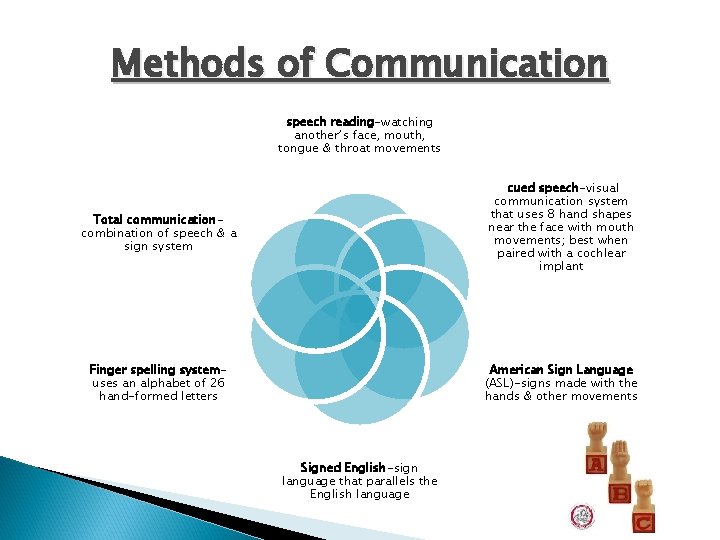
Methods of Communication speech reading-watching another’s face, mouth, tongue & throat movements Total communicationcombination of speech & a sign system cued speech-visual communication system that uses 8 hand shapes near the face with mouth movements; best when paired with a cochlear implant Finger spelling systemuses an alphabet of 26 hand-formed letters American Sign Language (ASL)-signs made with the hands & other movements Signed English-sign language that parallels the English language
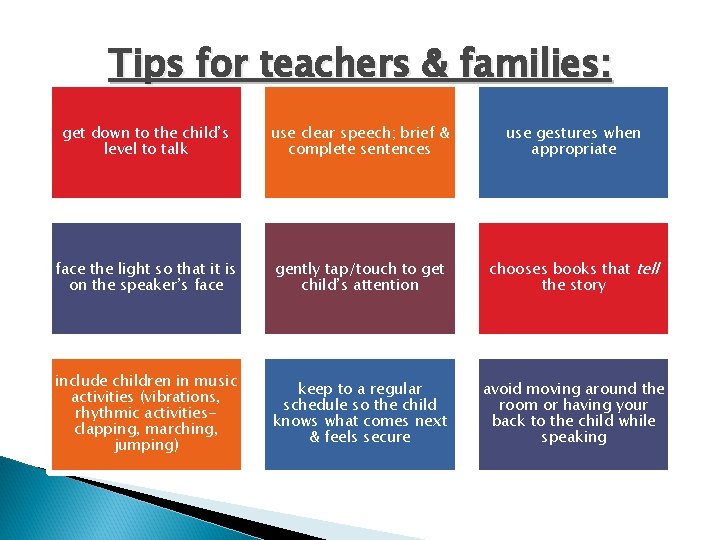
Tips for teachers & families: get down to the child’s level to talk use clear speech; brief & complete sentences use gestures when appropriate face the light so that it is on the speaker’s face gently tap/touch to get child’s attention chooses books that tell the story include children in music activities (vibrations, rhythmic activitiesclapping, marching, jumping) keep to a regular schedule so the child knows what comes next & feels secure avoid moving around the room or having your back to the child while speaking
Moving to vision impairments…. Introduction Video. What Would You Do? TV Show “Stealing From the Blind” http: //www. youtube. com/watch? v=myyyq. H 4 j 6 34 (9 minutes)
What are some warning signs that parents & teachers should be aware of to signify that vision may be a problem?
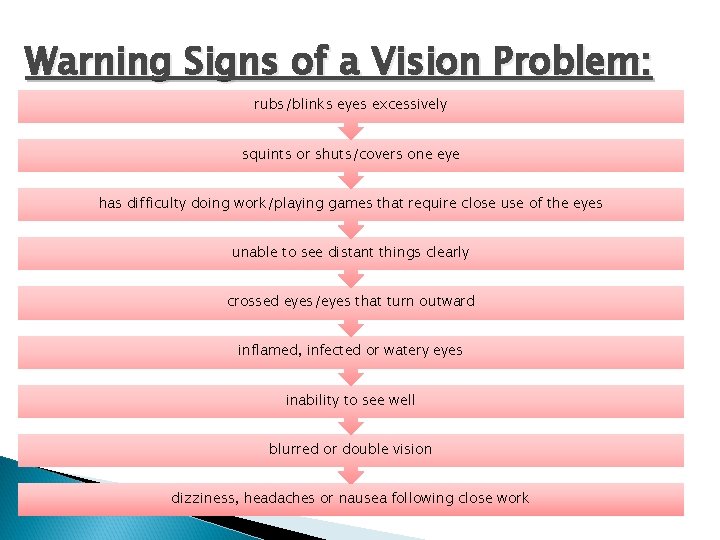
Warning Signs of a Vision Problem: rubs/blinks eyes excessively squints or shuts/covers one eye has difficulty doing work/playing games that require close use of the eyes unable to see distant things clearly crossed eyes/eyes that turn outward inflamed, infected or watery eyes inability to see well blurred or double vision dizziness, headaches or nausea following close work
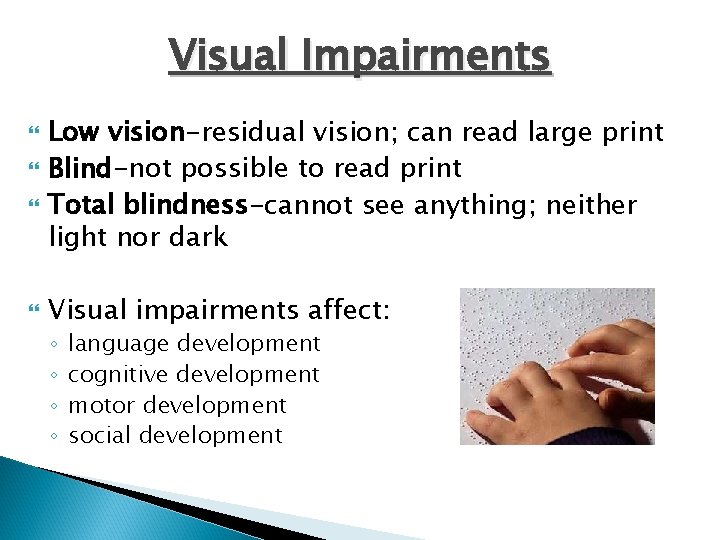
Visual Impairments Low vision-residual vision; can read large print Blind-not possible to read print Total blindness-cannot see anything; neither light nor dark Visual impairments affect: ◦ ◦ language development cognitive development motor development social development
Teaching & Programming focus on the parent as the teacher a specially-trained teacher provides parents with information regarding development and vision problems and coaches them in special techniques for interacting (i. e. orientation and mobility trainer)
Tips for teachers & families… familiarize the child with the classroom layoutrefrain from too many “furniture” changes; when they do occur, orientate the child with the new layout put identifying materials or noisemakers on the floor, doors, dividers, etc (i. e. wind chime near the door to the outside, rough matting by doors to the outside) use specific words to tell the child what to do (i. e. “put your shoes in the cubby”) talk to the child about everything in the immediate environment (label, label!)
Tips for teachers & families…(cont’d) provide action words (i. e. “you are drinking juice” or “you were running in the grass”) play auditory guessing games provide opportunities to learn through the other senses provide physical prompts (i. e. hand over hand) with gradual reduction provide left to right training (in preparation for reading & writing)
** ACTIVITIES** ü Hearing ü “Dear Abby” letter ü Shape Sorter Race & Vision Impairment Word Search (complete for homework)
CONNECT Module 1 Week 5: (~60 minutes) A. Step 3: Evidence (Definition) 1. 2. 3. 4. 5. 6. 7. 8. 9. 10. 11. 12. 13. 14. 15. 16. 17. 18. 19. 20. 21. 22. 23. Video Clip 1. 3 -Routine at home – playing peek-a-boo (1: 21 min) Video Clip 1. 4 -Routine at home – talking on the phone (: 51 sec) Video Clip 1. 5 -Routine in a program – enjoying mealtime (1: 42 min) Video Clip 1. 6 -Routine in a program – taking turns (1: 23 min) Video Clip 1. 7 -Routine in a program – building with blocks (1: 08 min) Video Clip 1. 8 -Routine in the community – going to the store (1: 07 min) Video Clip 1. 9 -Routine in a program – block play (1: 49 min) Handout 1. 1 -Examples of environmental modifications Activity Sheet 1. 3 a-Describe environmental modifications Video Clip 1. 10 -Routine in a program – water play (1: 13 min) Video Clip 1. 11 -Routine in a program – singing a song (1: 21 min) Video Clip 1. 12 -Routine in a program – rolling with friends (3: 25 min) Video 1. 13 -Routine in the community – playing at a park (1: 19 min) Handout 1. 2 -Examples of peer support Activity Sheet 1. 4 a-Describe peer support Video Clip 1. 14 -Routine in a program – expanded block play (3: 08 min) Video Clip 1. 15 -Routine at home – playing Mr. Potato Head (3: 31 min) Activity Sheet 1. 5 a-Identify embedded interventions during facilitated free play time Video Clip 1. 16 -Routine in a program – reading at circle time (1: 24 min) Activity Sheet 1. 6 a-Identify embedded interventions during a small group activity Video Clip 1. 17 -Routine in a program – playing red light green light (1: 36 min) Activity Sheet 1. 7 a-Identify embedded interventions during a large group activity Activity Sheet 1. 8 a-Identify embedded interventions in real life settings
Kassandra Case Study: Watch video and take own observation notes based on assigned discipline; share with “like” group. Hand out Transdisciplinary Play-Based Observation worksheets (or HELP Developmental Checklists) to review for next week.
** ACTIVITY** Vision Impairment Experiment #1: Label the Sounds Close your eyes and/or put your head down. Listen to the 5 different sounds and write down what you think you hear after each one. Share & discuss answers. What senses did you need to rely on to figure out the answers? How did it make you feel to not see the item? How could this disability affect children & their families? Children’s Literature-Lucy’s Picture
- Slides: 29